A 26-year-old man, Solomon Bernard, has been accused of killing his grandmother over the issue bothering on inheritance.
Bernard, who has been charged to an Edo Magistrates’ Court in Benin was said to have committed the offence on November 20, at 13, Igunbo Street, Benin City.
The prosecutor, Sunday Lucky, said that the offence contravened Section 319 (a) of the Criminal Code, and if found guilty is liable to death sentence.
Lucky told the court that the accused admitted killing killed his maternal grandmother, Janet Ogbeifun, with a cutlass over storey building inheritance.
The plea of the accused person was however not taken.
The Magistrate, Taiye Omoruyi, said the court lacked jurisdiction to entertain the case and ordered that the accused be remanded in prison custody.
Omoruyi also ordered that the case file should be duplicated and sent to the Department of Public Prosecution for legal advice.
She adjourned the case to February 8, 2016. [myad]
The Kaduna State Governor, Malam Nasir Ahmad El-Rufai has posed a question to media men and women in Nigeria, asking: would you join President Muhammadu Buhari in his present battle with corrupt people or join the corrupt ones who would always fight back?
The governor made it clear that if the press people decided to join the President to battle the corrupt one, Nigeria would subsequently get out of the socio-economic morass into which such corrupt people have thrown it.
El-Rufai, who declared open today, a three-day retreat in Kaduna, for State House Press Corps (SPHC), made up of senior journalists, editors and online publishers stressed that one of the consequences of media joining the corrupt people to fight the government back would be the mortgaging of the future of the country.
“It is really up to you to make the change succeed. You are the tool to fight back corruption and you have to chosen to either support or resist the fight against corruption.”
The governor who described the recent revelations and the ongoing investigations as more of stranger than fiction, expressed confidence that Nigerian media people who have been in the forefront towards the coming of Change would not now abandon the content of such change.
Governor El-Rufai lamented the rot and decay that had characterized previous regimes, adding: “the responsibilities that have been thrusted in the hands of President Buhari is immense. Our party and our president will do their best to pick up the pieces and restore the economy and make life better for Nigerians.”
He congratulated members of the State House Press Corps for choosing the theme: Journalism And The Change Mantra State House In Focus,” saying that the theme demonstrated the readiness of the State House Press Corp to be on the part of change being demonstrated by President Buhari.
The Chairman of the Press Corps, Mr. Kehinde Amodu thanked both governor El.Rufai and Garba Shehu for encouraging journalists covering the Presidency to go out and improve their perception of the workings of the Presidency and their impact on Nigeria.
He promised that the knowledge so acquired would be put to use for the benefit of the development of country. [myad]
President Muhammadu Buhari has expressed pain over the way a few Nigerian leaders amassed wealth which their generation and future generations of their families cannot spend in their lifetime, even as millions wallow in abject poverty.
The President, who spoke today at the Osigwe Anyiam-Osigwe Foundation Lecture in Abuja said that the nation’s commonwealth had at one time or the other been entrusted to leaders and at different levels of governance, and that instead of using the God given resources to better the lot of the citizens, they diverted them to private use.
“They then amass wealth in billions and trillions of naira, and other major currencies of the world, ill gotten wealth which they cannot finish spending in several lifetimes over. This is abuse of trust, pure and simple. When you hold public office, you do it in trust for the people. When you, therefore, use it to serve self, you have betrayed the people who entrusted that office to you.”
Here is the full text of President Buhari’s lecture:
Distinguished ladies and gentlemen, I want to begin by appreciating the Osigwe Anyiam-Osigwe Foundation for its impact on the development of ideas through its annual lecture series. The fact that the themes of the lecture series have focused on critical puzzles bordering on human development lends credence and justification for the sustenance of the lecture series.
It is no doubt that an event like this demands a lot of sacrifice financially and otherwise. Apart from the contribution of the lecture series to human development, it has also unveiled the genius personality of Emmanuel Onyechere Osigwe Anyiam-Osigwe, whose philosophical insight is gradually finding place in the psyche of academics globally, particularly at a time when Africans are determined to rewrite their own history.
The topic of discourse at this session, which is corruption, significantly ties into my vision for our great country, Nigeria, that we must kill corruption before corruption will kill us. My being here to deliver the keynote address at today’s session is instructive on the resolve of this government to interface with initiatives that are fundamentally patriotic and assisting in our path to socio-economic and political recovery.
In the last general elections, in the midst of a number of issues upon which we campaigned as a party, the one that gained higher currency in the psyche of our people was that Nigerians needed leadership that could be relied upon to tackle the orgy of corruption in the country.
While our programme of action identified corruption as a very dangerous challenge that must be curtailed if our country could ever generate a future of hope, the issues of collapsing educational system, diversification of our economy, fostering a welfare based agenda for the disadvantaged, infrastructural development, among others, were also very prominent in our campaign focus.
The primary attention that tackling corruption earned in the course of our campaign and in determining the final outcome of the election underpins how seriously Nigerians see corruption as a fundamental factor crippling the progress and development of the country. Nigerians are, indeed, convinced that except we curtail corruption, the country will remain in perennial regression.
It is upon this conviction of our people that corruption poses great danger and should be curtailed that we anchor our hope. It underpins our assurance that the efforts of this government in checking corruption will yield significant successes in the final outcome.
In other words, we note that sheer heroism cannot achieve the elimination of corruption from our social space. What is most required is the conviction of the populace that corruption is an antithesis to social cohesion and development, and must be eliminated. We must get to a point where every Nigerian begins to hate corruption with a passion, and collectively determine to root it out of our body polity.
Any effort to try to deal with corruption without a convinced populace will end as spasmodic, ephemeral exercise, lacking the appropriate social impact. When we are talking about corruption conventionally, it is a manifestation of the human mindset. It is the human beings that manifest corruption.
To win the war on corruption, therefore, begins with the people accepting that there is an error to be corrected in their lives, that there is a need to refocus and re-orientate the values that we cherish and hold dear. It requires change of mindset, change of attitude, and change of conduct.
The decision of the Osigwe Anyiam-Osigwe Foundation to choose corruption as the topic of discourse at this session is, therefore, encouraging to this government, pursuant to our vision that winning the war against corruption requires our synergy, a collectivisation of our resolve that corruption must be eliminated in the social psyche of the Nigerian nation.
Even in my earlier years in service to our country, I had personally identified the destructive impact of corruption. Taken from the narrow perspective of the embezzlement of public funds, its social consequence of gross economic inequality alters the basis for social peace and security.
When given the opportunity to play a leading role in our national history in 1984, we acknowledged that corruption is not just about the embezzlement of public funds but that the perversion of our consciousness and mindset was the point at stake. This was the basis of our WAR AGAINST INDISCIPLINE (WAI) – Indiscipline in any way and manner is a form of corruption of the human essence. That was why we waged campaigns against indiscipline, and its many manifestations in the 1980’s during my tenure as Head of State of our great Nation.
Sadly in this season, we find ourselves in a Nigeria where indiscipline has been taken to an unprecedented level. The rule of law is grossly perverted, and corruption has been elevated to a way of life at all strata of the society. In striving to reorder our country and put it on the path of recovery, we have thus identified the need to tackle corruption head-on. In this regard, we have taken steps towards recovering a reasonable amount of the money that was looted or misappropriated from public coffers. Investigations are ongoing on public officers who served, or are still serving, and those whose conduct are questionable will be compelled to accept the path of honour and surrender their loots.
As I stated recently, a good number of people who abused their positions are voluntarily returning the illicit funds. I have heard it said that we should disclose the names of the people, and the amount returned. Yes, in due course, the Central Bank of Nigeria will make information available to the public on the surrendered funds, but I must remark that it is yet early days, and any disclosure now may jeopardize the possibility of bigger recoveries. But we owe Nigerians adequate information, and it shall come in due course. It is part of the collective effort to change our land from the bastion of corruption it currently is, to a place of probity and transparency.
Quite frankly, the anti-corruption war is not strictly about me as a person, it is about building a country where our children, and the forthcoming generations, can live in peace and prosperity. When you see dilapidated infrastructure round the country, it is often the consequence of corruption. Poor healthcare, collapsed education, lack of public utilities, decayed social services, are all products of corruption, as those entrusted with public resources put them in their private pockets. That must stop, if we want a new Nigeria. And that was why I said at another forum that people need not fear me, but they must fear the consequences of their actions. Corrupt acts will always be punished, and there will be no friend, no foe. We will strive to do what is fair and just at all times, but people who refuse to embrace probity should have every cause to fear.
Look at the corruption problem in the country, and tell me how you feel as a Nigerian. Our commonwealth is entrusted to leaders at different levels of governance, and instead of using the God given resources to better the lot of the citizens, they divert them to private use. They then amass wealth in billions and trillions of naira, and other major currencies of the world, ill gotten wealth which they cannot finish spending in several lifetimes over. This is abuse of trust, pure and simple. When you hold public office, you do it in trust for the people. When you, therefore, use it to serve self, you have betrayed the people who entrusted that office to you.
Again, how do you feel year after year, when Transparency International (TI) releases its Corruption Perception Index, and Nigeria is cast in the role of a superstar on corruption? In 2011, out of 183 countries, Nigeria was 143 on the corruption ladder. In 2012, we were 139th out of 176. In 2013, we ranked 144 out of 177, and in 2014, we stood at 136th out of 174. Hardly a record to inspire anyone. In fact, it is sad, depressing and distressing. Our country can be known for better things other than corruption.
In the process of trying to recover stolen funds now, we are seeking the cooperation of the countries were these loots were taken. Time it was, when such nations may have overlooked our overtures for assistance to fight corruption. However, we now live in an era where corruption is anathema, looked upon as something that should be tackled head-on because the actions of the corrupt can have global impact.
It is to be noted that resolving the problem of corruption transcends merely arresting and trying people that have held public office. This is because, to curtail corruption, we have to reorder the mindset of all. Empirical facts have shown that even those who are critics today are most times not better than those they criticize. When they are availed the same or similar opportunities, they act likewise. In other words, those who didn’t have the opportunity criticise and blow whistle but when they get into office; they become victims of the same thing they criticize. Nigeria must grow beyond that point, and be populated by people with conviction, a new breed without greed, radically opposed to corruption.
This points to the fact that curtailing corruption might require a more broadened social engineering. It, indeed, requires conforming every mindset in the social order to the moral tenets in which propriety anchors as a way of life.
That was why in the earlier dispensation, we saw corruption beyond the embezzlement of public funds. We knew that a morally upright personality, a disciplined person, will not embezzle people’s money or betray the confidence reposed in him after being elected or appointed to manage any office.
We knew that due to the perversion of our mindsets, people would rather abandon pedestrian bridges and flyovers and run through the traffic in very busy highways. We understood the economic and social worth of every Nigerian and the need to preserve their lives; we tried to enforce compliance with commuters using the pedestrian bridges provided for their safety. We even went as far as enforcing the discipline of queuing to board buses and not the chaos of scrambling with its attendant dangers. The people saw where we were headed, and cooperated with us.
That effort of the past was under a military regime, a dictatorship as it is classified. Now we are under a democracy. The democratic system has its benefit in the rule of law and the fact that a man cannot be assumed guilty until it is so determined by the court of law.
With the rule of law and its advantages, the same could however pose as serious limitations to curtailing corruption when the legal system is not adequately reinforced. The onus, therefore, is on those who run our legal process to ensure that the corrupt does not go free through exploiting the weakness and lacuna in the system.
I agree with Anyiam-Osigwe that corruption is an attitude and it is about the wrong attitude. The problem with tackling corruption is that when people have become used to a particular way of doing things, even if it is not the proper way, they find it difficult to change.
We all know that to lie is not good. But we have a sense of justification each time we tell lies. This sense of justification encourages us always to do the wrong thing. It is in this context that the mindset becomes an issue. There is the need to bring back our minds to the pure state of the human identity.
While changing the mindset of the people is integral to dealing with the manifestation of corruption socially, it is also important to heal the wounds inflicted by the corruptive indulgence of specific people who have been entrusted with public positions or funds.
Thus, it is the responsibility of government to investigate reported cases of corruption. In the process, suspected culprits could be arrested, detained or questioned. All these efforts would eventually end up with prosecuting the case in court. A government that closes its eyes to brazen corruption loses its essence, the very reason of its existence. Such a government is sheer flippancy, a waste of time, moral and sociological absurdity.
In Nigeria, it needs be said that two problems stare us in the face. First is that our laws need to be strengthened if we must realistically contend with the miasma of corruption. The second is that we must correct the gaps in our legal system that are exploited to frustrate the process of justice. A number of anti-corruption cases have been rendered inconclusive due to legal limitations.
Dealing with corruption, requires the collective will of every Nigerian. Without our collective will to resist corrupt acts as a people, it will be difficult to win the war. We in the leadership will provide the right example. We will not pay mere lip service to corruption. We will eschew it in every aspect of our lives. However, we are but few, in a country of more than 170 million people. We need the mass army of Nigerians to rise as one man, and stand for probity in both public and private lives. It is only then that we can be sure of dealing a mortal blow on corruption, which will engender a better country.
Nigeria has been brought almost to her knees by decades of corruption and mismanagement of the public treasury. We must come to a point when we all collectively say Enough! That is collective will, and that is what will bring us to a new state and status. If this country will realize her potentials, and take her rightful place in the comity of nations, we must collectively repudiate corruption, and fight it to a standstill. It remains eternally true: if we don’t kill corruption, corruption will kill Nigeria.
Over 100 Senior Journalists, editors and publishers covering the Presidency, under the aegis of State House Press Corps (SHPC), today, began a three-day retreat in Kaduna with change mantra as focus.
The retreat, which is being sponsored and hosted by the Kaduna state governor, Malam Nasir Ahmad El-Rufai, is being held at Sir Ahmadu Bello Memorial Foundation, on race course road, Kaduna.
The occasion was declared opened by the governor, even as the Senior Special Assistant to President Muhammadu Buhari on media and publicity, Malam Garba Shehu, who is the Chief Convener of the retreat spoke on the essence of the retreat.
Garba Shehu admitted that members of the State House Press Corps were the best in Africa in terms of knowledge of what they are supposed to do, but that such was not an excuse not to continue to improve.
The Presidential spokesman, who commended the Press Corps, also cautioned them against the hysteria that is now pervading media industry, where each media is sacrificing accuracy of it reports for haste.
“Accuracy in journalism is essencial. Accuracy must come ahead of speed. If you are not sure, hold fire. Myself and Femi Adesina, the Special Adviser to the President on media and publicity, have made ourselves available to the press, I dare say, more than many people who previously occupied similar positions in the past. You have our phone numbers, our email addresses; you are free to stop us whenever you see us outside…and so any information can be easily verified by first contacting us.”
Garba Shehu expressed President Muhammadu Buhari’s appreciation of the role they played in igniting the Change agenda that has swept into Nigeria in March 2015, but that the President has begun the Change agenda with the recent happenings.
“This government still requires the assistance of the media to continue that process of Change. The President needs the press to remain impartial and eschew spurious incentives when reporting and carrying out your responsibilities.”
Editor of the Guardian newspaper, Mr. Martins Oloja is expected to deliver a lecture on ‘Balancing State House Reporting with National Interest.”
A senior editor in the AIT, Mr. Rotimi Amaechi and the United State of America’s Counselor for Public Affairs in Nigeria, Victoria Sloan would also deliver lectures on various topics against the background of the theme: ‘Journalism And The Change Mantra, State House In Focus.’ [myad]
The drop in the global benchmark Brent crude to $39 per barrel yesterday is threatening the yet-to-be presented N6 Trillion Nigeria Federal Budget for 2016. The Federal Executive Council (FECT) approved the budgetary amount at its meeting on Monday, with a proposal for $38 per barrel as the oil benchmark price, down from $53 this year, 2015.
The Excess Crude Account, into which the country saves the difference between the market price of oil and the budget benchmark to provide a cushion when oil prices fall or extra cash is needed for spending on infrastructure, has been depleted in recent times as oil revenues plunged.
The account, which stood at about $4.11billion in October 2014, dropped to $2.45 billion in December that year, down from about $3.11 billion in November. The balance in the ECA was put at $2.1 billion in July this year.
Senators on Wednesday, disagreed among themselves on the $38 per barrel proposed by the Federal Executive Council as the oil benchmark price for the 2016 budget, which was contained in the Medium Term Expenditure Framework and Fiscal Strategy Paper forwarded to the upper chamber by President Muhammadu Buhari.
While some of the lawmakers called for an increase in the benchmark price, others supported the decision of the Federal Government to peg the benchmark at $38 per barrel.
Brent, against which most of the world’s oil, including Nigeria’s is priced, has fallen by more than 60 per cent in the past 18 months, putting pressure on oil-exporting countries.
The global benchmark fell below the $40-per-barrel mark on Tuesday for the first time in almost seven years due to oversupply. It later headed back above $40, at which it traded on Wednesday.
Commenting on the proposed $38 per barrel benchmark for the 2016 budget, the Head of Energy Research, Ecobank Capital, Mr. Dolapo Oni, in an emailed response to questions from our correspondent, said, “I think it is a fair price. The oil market is pretty volatile and reacting to the OPEC news currently.”
He said oil price could even go lower to $38 per barrel, but added that it would recover above $40 and potentially $50.
“We have forecasted an average of $46.33 per barrel next year because we see the potential for prices above $50 as well as prices in the $20-30 range. In my opinion, therefore, I think the benchmark is satisfactory,” Oni said.
Nigeria, like other countries that rely on oil revenues, has seen its finances badly hit by the decline in oil prices, with crude trading below the country’s 2015 budget benchmark price in recent months.
The steep decline in oil prices had in March forced the National Assembly to settle for $53 per barrel as the benchmark price for the 2015 budget, down from $65 proposed by the Executive, which had to adjust it twice, from $78 to $73, and later to $65.
Goldman Sachs, one of the most influential banks in commodity markets, recently said that oil could fall to as low as $20 per barrel amid fears that the world is running out of storage capacity.
The Chief Executive Officer, Total, Patrick Pouyanne, had on Monday said he did not expect pressure on oil prices after OPEC’s decision last Friday not to impose a ceiling on crude output and keep production at high levels.
“OPEC’s decision was expected by the market. We don’t anticipate a recovery in 2016 (for oil prices), because in 2016, the growth in capacity will be larger than the growth in demand…I am not very optimistic for 2016,” he told reporters in Qatar.
OPEC failed to agree on a new output quota on Friday, allowing member countries to continue pumping more than 31 million barrels per day of oil, further swelling a glut that has lowered prices.
The OPEC decision sent Brent into heavy fall on Monday, when it fell to $41 per barrel, the lowest level since March 2009. [myad]
Human rights lawyer and former President, Nigerian Bar Association (NBA), Dr. Olisa Agbakoba, has seen the ideological shift to the left by the government of Muhammadu Buhari as a source of anger for the Nigeria’s elites, even as he warned the President to beware of such elites.
The lawyer, who spoke to newsmen in Lagos, on the state of the nation, said that since May 29, there has been an economic correction in the country, as well as an ideological shift to the left to serve the people’s interest.
According to him, the implementation of Treasury Single Account (TSA), quality of the ministers, the blocking of finance leakages, social regulations, benefits and stimulus strategy, like paying employment benefits, keeping the oil subsidy, at least in the short term, and the zero tolerance for corruption, are evidences that President Buhari fully understands the enormous challenges facing the country.
“I want to warn President Buhari about the conspiracy of the elite and its resolve to frustrate his reform agenda. This elite class, made up of people in high positions in the religious circles, traditional institutions, professions and businesses, represents a small percent of Nigerians but exert tremendous influence, with a view to state capture.
“This class is very dissatisfied about the ideological change of Buhari’s administration. They see the new agenda as a threat to their privileges. As set out below, they are the greatest roadblocks to President Buhari’s economic and political policy agenda.”
Agbakoba said however, that the reform is yet to be felt, and advised President Buhari to avoid communication lethargy in 2016 and that he must clearly carry the people along to inspire hope, followership, confidence and practice.
He advised Buhari to create an Office for Strategic Communication to link government with the people.
“There is no need to have two Press Secretaries. One may be assigned to head the Office of Strategic Communication, while the other should cover the President’s diaries,” he said. [myad]
Director General of the Debt Management Office (DMO), Abraham Nwankwo as said that the current Nigeria’s debt profile is $64 billion even as he assured that the debt would not affect the economy, contrary to claims by some financial experts. Nwankwo explained that the N1.2 trillion domestic borrowing and foreign loan of N635.88 billion proposed in the Medium Term Expenditure Framework (MTEF) for the 2016 fiscal year, was also okay for the country’s development. Nwankwo, who appeared before the Senate Committee on Foreign and Local Debts, said that 84 percent of the entire debt profile was owed locally while the remaining 16 percent was foreign. according to him, $25 billion was needed per annum continuously for the next 10 years to effectively tackle infrastructure deficit in the country. He, however, explained that debts owed local contractors were not part of the domestic debts listed because their details were under the purview of the Budget Office of the Federation and National Planning. He said they were operational debts. “Even before the collapse of oil prices, it has been estimated, more than five years ago that Nigeria needed a minimum of $25 billion per annum continuously for up to 10 years to enable it close its infrastructure deficit. “That has been established by all relevant experts, and institutions. In addition, the collapse of the oil prices by our own estimate shows that public revenue from oil had dropped by about $16 billion per annum. “In this type of situation, what a responsive government should do, and which is what our government is doing is to make sure that it counteracts a continuous decline in economic activities… “Borrowing is being done to achieve positive impact on the economy, it will lead to growth, creation of employment, and build solid capacity for the future, which will help us to diversify our economy. “What the government is planning to do now is to explore at least five out of the 34 solid minerals that we have. We will develop, and process them for export.” [myad]
A certain Mr. Bright (surname withheld) has been arrested by officers of Ejigbo police station for beating his wife, who allegedly referred to him as irresponsible man in a quarrel, to death. Mr. Bright and his late wife reside in Olusesi Street in Idimu road, Ejigbo Lagos.
It was gathered that the couple, who have been married for years, were known for their constant domestic violence and that this time around, the quarrel was on feeding expense.
The woman, it was gathered, called her husband ‘irresponsible man.’
It was learnt that the man, who was angered by the wife’s outburst, descended on her with countless punches till she collapsed and died on the spot.
“When the man noticed his wife was dead, he quickly removed the body and put inside his car boot,” the resident said.
However, luck ran out of the man after a neighbour spotted him and raised alarm, which attracted other tenants.
The prompt intervention of the security men saved the man from being lynched by some angry youths.
He was subsequently arrested and taken to the police station.
When our reporter visited the street on Thursday, residents of the areas were seen discussing the incident in groups.
A source said the remains of the deceased have been deposited at a mortuary in the area. [myad]
“Did they send you your own share of the bush meat?”
“Bush meat?”
“The lion in the zoo that became bush meat in Jos”
“What’s my own inside? I don’t know any zoo worker in Jos and how could a lion that was allowed out of its cage and got shot end up in my stomach. The kind of things you say sometimes.”
“That means you have not been following the story.”
“It is an animal tale”
“Created, concocted and delivered by animals in human skin, working in animal kingdom, telling us animal tales. What surprises me is the fact that there has been no public uproar, no outrage.”
“People are too busy thinking of how to survive as human beings, how to fight the current nationwide epidemic of empty pockets and stomachs, and survive the change in their lives.”
“But when a similar incident occurred at the Hwange National Park in Zimbabwe, there was serious outrage all over the world. Dr. Palmer, the American who killed the lion was the target of abuse and attacks. He even had to shut down his dental office. There were calls for his prosecution.”
“I know. In our case, the international community is indifferent. It is as if nothing has happened. A lion was killed in Zimbabwe; there was protest. A few days ago in Kenya, two Maasai herdsmen were charged for poisoning a lion. A lion is killed in Nigeria, not a whimper. “
“The truth is that the rest of the world is convinced that Nigeria itself is a zoo. Boko Haram is slaughtering thousands of human beings, girls are being abducted in hundreds, women are being raped, voters are getting killed in Kogi and Bayelsa. With such evils against humanity, why should anyone worry about a Nigerian lion being shot and ending up in the zoo of stomachs?”
“The zoo of stomachs”
“Look, I can swear that if you open some people’s stomachs in this country, what you will find is a zoo: lions, grasshoppers, horses, cats, rats, snakes, dogs, rabbits, antelopes, crocodiles, birds, elephants, extinct animals, disappearing species, anything that can serve the gut, and ginger the taste buds. That is why we can never successfully run a zoo, or a Games Reserve.”
“See, the situation in Zimbabwe with Cecil, the lion is no different. In Zimbabwe, the zoo guides deliberately released the lion and Dr. Palmer laid siege and gunned down the lion, and beheaded it. In Jos, their explanation is that the lion slipped out of its cage when it was being fed breakfast.”
“Lying liars. Fibbing fibbers.”
“They made it sound as if the lion was living in a room and parlour and he just moved from the room to the parlour, to the verandah and to the streets. It is a zoo, for Heaven’s sake and there are standards and best practices!.”
“How will they know what the best practice is, when they don’t even know the age of the lion? The manager of the zoo says the lion has been there since 1972. A 43-year old lion, and yet there is no established protocol for managing it.”
“There is no 43-year old lion anywhere in the world. That is a lie. They don’t have records. They don’t keep records.”
“The lion doesn’t even have a name. In Zimbabwe, and Kenya, they name their lions.”
“That is not a problem. We can give the lion a name, right now. What is the name of the state Governor?”
“Simon Lalong. What about him?”
“Good. Simon, the lion. How about that?”
“Ha. The man is still alive oh. And of what use is a name to a lion that is dead, skinned, cut into bits and pieces, taken home to the cooking pots, eaten, digested, and washed down with whatever the animals eating animal meat deemed fit.”
“The very reason the Governor should order a serious investigation. Who released the lion? And why? Who killed it, skinned it? And who took part in the Feast of the Lion? For all you know, the zoo-keeper deliberately released the lion. He may have been commissioned to do so, by herbalists, who I hear value the body parts of a lion. In that kind of world, the teeth of a lion, the paws, the skin, the ears, all of this can be used by ritualists to give a human being, lion-like powers.”
“Blood of Jesus!”
“Did you not see how the killers posed with the lion for photograph, drooling from the mouth, salivating, looking hungry?
“They made it seem as if the lion was a jailbird who escaped, and resisting arrest, they shot it, instead of tranquilizing it. And they turned the zoo into an abattoir!”
“All the characters involved should be investigated and sacked. Otherwise, tomorrow, they will release a rabbit and gun it down, next tomorrow, an antelope will also break jail, and it will be shot, to be followed by a snake, all getting shot and ending up in people’s pots as bush meat.”
“That is why we can’t run a proper zoo, games reserve or a tourism programme. We talk about climate change and the environment but we don’t know that animals are important to the ecosystem. Sad.”
“Have you not heard of the lion that the Saraki Senate has also let loose?”
“A zoo in the Senate? I don’t get it.”
“They have just released one lion called Social Media Bill.”
“You mean the Frivolous Petitions Prohibition Bill”
“The law seeks to gag the social media. It says you can’t even complain on your what’s app, email, twitter, BB or blog and if you say something that is frivolous, you can go to jail or pay a fine.”
“That is an assault on the fundamental right to free speech; a dangerous lion that should be tranquilized!”
“They don’t have tranquilizer in Jos zoo or any other zoo in Nigeria, is it in the Senate that they will have it? Look, some activists have decided to organize their own public hearings and shoot down this particular lion.”
“Let’s go there then. Let the shooting shooters, the gunning gunners, the writing writers, the protesting protesters, the marching marchers, the shouting shouters, the fighting fighters, the petitioning petitioners, the blogging bloggers and the tweeting children of anger have their own public hearing. That’s democracy.”
“You left out the Wailing Wailers”
“They too. I think this is the type of lion that Nigerians should kill, not Simon.” “I like your passion. But there was a protest in Abuja on Tuesday. I didn’t see you joining them?”
“Hen. Hen. You want them to mistake me for a lion that escaped and shoot me, abi? You don’t know that to be an activist, you must also be wise, and protect your stomach from bullets.”
“I thought you were bullet-proof. And you need not be afraid, anyway. The Senate has made it clear that it is acting in the public interest and that its members are not opposed to free speech. Just a simple matter.”
“Please! My fear is that they are all shooting already and because they are yet to hit target, there are stray bullets flying all around, respecting nobody. You go and ask Dino.”
“Which of the Dinos? Dino 1, Dino 2, Dino 3 or Dino $1,000?”
“I don’t know. But the people in Aso Rock have been smart enough to duck. They are now talking about free speech. Free speech. Free speech! Thank God oh, for free speech!”
“Not in Bayelsa at this time, though. Or in Kogi, where people are suspicious of tomorrow.”
“Why not in Bayelsa? I saw the people insisting that they should be allowed to choose their Governor. Too much violence in that election.”
“I hear Countriman has declared that he’s not going to die and that the election will be concluded.”
“Who is so-called?”
“Dickson”
“Ha, Dickson na Ijebu Ode boy oh. Him no ready to die. Bobo no go die, afi to ba di Governor. Bobo!”
“But INEC says the Bayelsa election is inconclusive.”
“This new INEC should just be renamed Inconclusive National Electoral Commission (INEC). If they take weeks to conduct elections in eight local governments, with less than one million voters, if they have to run a nationwide election, then the entire country will be declared inconclusive. Where is Jega by the way? They need him as a Consultant.”
“Why? Let him enjoy his retirement, I beg.”
“Why not?”
“It is called change, my brother.”
“But not in Kogi where I hear the Deputy-Governor elect is swearing that if he is not allowed to inherit the Audu-Faleke undeclared victory, he will not show up to be sworn in as a Deputy Governor on January 27, 2016.”
“He doesn’t want to be Deputy Governor again?”
“He says he cannot betray former Governor Abubakar Audu.”
“Ha. Inconclusive matter! I think we should declare 2015 our year of inconclusiveness. 2015: Nigeria’s Inconclusive Year. How about that?
“Nigeria’s Year of Inconclusivity.”
“Two weeks to Christmas, see how people are looking sad. Some people this year will just pretend that there is no Christmas, Christmas having been declared inconclusive! Even prostitutes have reduced their charging rates; everybody is looking for survival, and anything is fair game, be it a live lion, or the people’s rights or what is that famous blogger’s favourite word again? Yes, eggplant. As Douglas Adams said: to summarize the summary of a summary, people are a problem.”
“Tell me more about these prostitutes and their current rate cards.”
“No be me and you. You go and find out. You see, you are part of the problem.”
“That includes you too, I beg. You always talk about change; now you have it, and you don’t want to talk about it. My friend, don’t complain. Go and sit down.”
“Change?”
“Change is the necessity of history”
“You know the truth?”
“What?”
“Things do not change, we do.” Henry David Thoreau.”
“I don’t know him. You know what? Stop quoting dead people.” [myad]
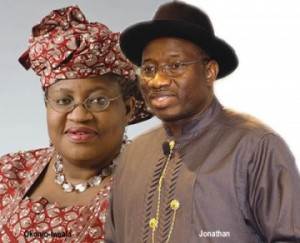
Nigeria’s former Minister of Finance and Coordinating Minister of the Economy, Dr. Ngozi Okonjo-Iweala has revealed how she, former President Goodluck Jonathan and former Minister of Justice had a meeting and resolved to divert the sum of $322 which was the late General Sani Abacha’s loot that was returned to Nigeria, to the former National Security Adviser (NSA), Colonel Sambo Dasuki (rtd.) to prosecute the war against Boko Haram.
The fresh revelation which came in the form of statement by her media adviser, Paul Nwabuikwu, was a reaction to allegations that she illegally authorized the diversion of recently recovered Abacha loot during the administration of former president, Goodluck Jonathan, describing it as “part of a campaign of falsehood” to “tarnish her image.”
The former minister noted that the contents of a memo dated January 20, 2015 in which she responded to a request by the former NSA, Col. Dasuki for funds to prosecute the war against Boko Haram, was “distorted.”
Okonjo-Iweala who explained that the central responsibility of her ministry was to find sources of funding for the financing of approved national priorities such as security, job creation and infrastructure, recalled that throughout 2014, there were public complaints by the military hierarchy to President Jonathan about the inadequacy of funds to fight the anti-terror war in the North East, resulting in Boko Haram making gains and even taking territories.
She said that a lot of the criticism was directed at her and that she was accused of not doing enough to find funds for the operations.
“In fact, the Ministry, on several occasions, had to call press conferences to provide details of budgetary spending on the military, to show, against the background of limited resources and other urgent national priorities, that it was doing its best on funding security.
“It was about this time that some new Abacha funds of about $322m were returned with another $700m still expected to be returned. ormer President Jonathan set up a Committee comprising of the former Minister of Justice, former NSA and the former Minister of Finance to determine how best to use both the returned and expected funds for development.
“The NSA made a case for using the returned funds for urgent security operations since, he noted, there cannot be any development without peace and security. Based on this, a decision was taken to deploy about $322m for the military operations, while the expected $700m would be applied for development programmes as originally conceived.
“Following the discussions and based on the urgency of the NSA’s memo, Dr Okonjo-Iweala requested the President to approve the transfer of the requested amount to the NSA’s Office for the specified purposes.”
Okonjo-Iweala said that she insisted on three conditions: “a. only a part, not the entire Abacha funds would be spent on the arms; the rest would be invested in developmental projects as originally conceived b. the money was to be treated as borrowed funds which would be paid back as soon as possible c. the NSA’s office was to account for the spending to the President who was the Commander in Chief, given the fact that the Minister of Finance is not part of the security architecture and does not participate in the Security Council.”
She insisted that the attempt to link her name to any misuse of these funds for any purpose other than security as far as she understood it is totally false and cannot stand.
It was alleged that Okonjo-Iweala had illegally approved the transfer of at least N61.4 billion ($300 million and £5.5 million) from funds recovered from late Sani Abacha, to the Office of the National Security Adviser, Sambo Dasuki, for “urgent security needs.” [myad]
We use cookies on our website to give you the most relevant experience by remembering your preferences and repeat visits. By clicking “Accept”, you consent to the use of ALL the cookies.
This website uses cookies to improve your experience while you navigate through the website. Out of these, the cookies that are categorized as necessary are stored on your browser as they are essential for the working of basic functionalities of the website. We also use third-party cookies that help us analyze and understand how you use this website. These cookies will be stored in your browser only with your consent. You also have the option to opt-out of these cookies. But opting out of some of these cookies may affect your browsing experience.
Necessary cookies are absolutely essential for the website to function properly. This category only includes cookies that ensures basic functionalities and security features of the website. These cookies do not store any personal information.
Any cookies that may not be particularly necessary for the website to function and is used specifically to collect user personal data via analytics, ads, other embedded contents are termed as non-necessary cookies. It is mandatory to procure user consent prior to running these cookies on your website.


 A 26-year-old man, Solomon Bernard, has been accused of killing his grandmother over the issue bothering on inheritance.





Who Released, Killed And Ate Our Lion? By Reuben Abati
“Bush meat?”
“The lion in the zoo that became bush meat in Jos”
“What’s my own inside? I don’t know any zoo worker in Jos and how could a lion that was allowed out of its cage and got shot end up in my stomach. The kind of things you say sometimes.”
“That means you have not been following the story.”
“It is an animal tale”
“Created, concocted and delivered by animals in human skin, working in animal kingdom, telling us animal tales. What surprises me is the fact that there has been no public uproar, no outrage.”
“People are too busy thinking of how to survive as human beings, how to fight the current nationwide epidemic of empty pockets and stomachs, and survive the change in their lives.”
“But when a similar incident occurred at the Hwange National Park in Zimbabwe, there was serious outrage all over the world. Dr. Palmer, the American who killed the lion was the target of abuse and attacks. He even had to shut down his dental office. There were calls for his prosecution.”
“I know. In our case, the international community is indifferent. It is as if nothing has happened. A lion was killed in Zimbabwe; there was protest. A few days ago in Kenya, two Maasai herdsmen were charged for poisoning a lion. A lion is killed in Nigeria, not a whimper. “
“The truth is that the rest of the world is convinced that Nigeria itself is a zoo. Boko Haram is slaughtering thousands of human beings, girls are being abducted in hundreds, women are being raped, voters are getting killed in Kogi and Bayelsa. With such evils against humanity, why should anyone worry about a Nigerian lion being shot and ending up in the zoo of stomachs?”
“The zoo of stomachs”
“Look, I can swear that if you open some people’s stomachs in this country, what you will find is a zoo: lions, grasshoppers, horses, cats, rats, snakes, dogs, rabbits, antelopes, crocodiles, birds, elephants, extinct animals, disappearing species, anything that can serve the gut, and ginger the taste buds. That is why we can never successfully run a zoo, or a Games Reserve.”
“See, the situation in Zimbabwe with Cecil, the lion is no different. In Zimbabwe, the zoo guides deliberately released the lion and Dr. Palmer laid siege and gunned down the lion, and beheaded it. In Jos, their explanation is that the lion slipped out of its cage when it was being fed breakfast.”
“Lying liars. Fibbing fibbers.”
“They made it sound as if the lion was living in a room and parlour and he just moved from the room to the parlour, to the verandah and to the streets. It is a zoo, for Heaven’s sake and there are standards and best practices!.”
“How will they know what the best practice is, when they don’t even know the age of the lion? The manager of the zoo says the lion has been there since 1972. A 43-year old lion, and yet there is no established protocol for managing it.”
“There is no 43-year old lion anywhere in the world. That is a lie. They don’t have records. They don’t keep records.”
“The lion doesn’t even have a name. In Zimbabwe, and Kenya, they name their lions.”
“That is not a problem. We can give the lion a name, right now. What is the name of the state Governor?”
“Simon Lalong. What about him?”
“Good. Simon, the lion. How about that?”
“Ha. The man is still alive oh. And of what use is a name to a lion that is dead, skinned, cut into bits and pieces, taken home to the cooking pots, eaten, digested, and washed down with whatever the animals eating animal meat deemed fit.”
“The very reason the Governor should order a serious investigation. Who released the lion? And why? Who killed it, skinned it? And who took part in the Feast of the Lion? For all you know, the zoo-keeper deliberately released the lion. He may have been commissioned to do so, by herbalists, who I hear value the body parts of a lion. In that kind of world, the teeth of a lion, the paws, the skin, the ears, all of this can be used by ritualists to give a human being, lion-like powers.”
“Blood of Jesus!”
“Did you not see how the killers posed with the lion for photograph, drooling from the mouth, salivating, looking hungry?
“They made it seem as if the lion was a jailbird who escaped, and resisting arrest, they shot it, instead of tranquilizing it. And they turned the zoo into an abattoir!”
“All the characters involved should be investigated and sacked. Otherwise, tomorrow, they will release a rabbit and gun it down, next tomorrow, an antelope will also break jail, and it will be shot, to be followed by a snake, all getting shot and ending up in people’s pots as bush meat.”
“That is why we can’t run a proper zoo, games reserve or a tourism programme. We talk about climate change and the environment but we don’t know that animals are important to the ecosystem. Sad.”
“Have you not heard of the lion that the Saraki Senate has also let loose?”
“A zoo in the Senate? I don’t get it.”
“They have just released one lion called Social Media Bill.”
“You mean the Frivolous Petitions Prohibition Bill”
“The law seeks to gag the social media. It says you can’t even complain on your what’s app, email, twitter, BB or blog and if you say something that is frivolous, you can go to jail or pay a fine.”
“That is an assault on the fundamental right to free speech; a dangerous lion that should be tranquilized!”
“They don’t have tranquilizer in Jos zoo or any other zoo in Nigeria, is it in the Senate that they will have it? Look, some activists have decided to organize their own public hearings and shoot down this particular lion.”
“Let’s go there then. Let the shooting shooters, the gunning gunners, the writing writers, the protesting protesters, the marching marchers, the shouting shouters, the fighting fighters, the petitioning petitioners, the blogging bloggers and the tweeting children of anger have their own public hearing. That’s democracy.”
“You left out the Wailing Wailers”
“They too. I think this is the type of lion that Nigerians should kill, not Simon.”
“I like your passion. But there was a protest in Abuja on Tuesday. I didn’t see you joining them?”
“Hen. Hen. You want them to mistake me for a lion that escaped and shoot me, abi? You don’t know that to be an activist, you must also be wise, and protect your stomach from bullets.”
“I thought you were bullet-proof. And you need not be afraid, anyway. The Senate has made it clear that it is acting in the public interest and that its members are not opposed to free speech. Just a simple matter.”
“Please! My fear is that they are all shooting already and because they are yet to hit target, there are stray bullets flying all around, respecting nobody. You go and ask Dino.”
“Which of the Dinos? Dino 1, Dino 2, Dino 3 or Dino $1,000?”
“I don’t know. But the people in Aso Rock have been smart enough to duck. They are now talking about free speech. Free speech. Free speech! Thank God oh, for free speech!”
“Not in Bayelsa at this time, though. Or in Kogi, where people are suspicious of tomorrow.”
“Why not in Bayelsa? I saw the people insisting that they should be allowed to choose their Governor. Too much violence in that election.”
“I hear Countriman has declared that he’s not going to die and that the election will be concluded.”
“Who is so-called?”
“Dickson”
“Ha, Dickson na Ijebu Ode boy oh. Him no ready to die. Bobo no go die, afi to ba di Governor. Bobo!”
“But INEC says the Bayelsa election is inconclusive.”
“This new INEC should just be renamed Inconclusive National Electoral Commission (INEC). If they take weeks to conduct elections in eight local governments, with less than one million voters, if they have to run a nationwide election, then the entire country will be declared inconclusive. Where is Jega by the way? They need him as a Consultant.”
“Why? Let him enjoy his retirement, I beg.”
“Why not?”
“It is called change, my brother.”
“But not in Kogi where I hear the Deputy-Governor elect is swearing that if he is not allowed to inherit the Audu-Faleke undeclared victory, he will not show up to be sworn in as a Deputy Governor on January 27, 2016.”
“He doesn’t want to be Deputy Governor again?”
“He says he cannot betray former Governor Abubakar Audu.”
“Ha. Inconclusive matter! I think we should declare 2015 our year of inconclusiveness. 2015: Nigeria’s Inconclusive Year. How about that?
“Nigeria’s Year of Inconclusivity.”
“Two weeks to Christmas, see how people are looking sad. Some people this year will just pretend that there is no Christmas, Christmas having been declared inconclusive! Even prostitutes have reduced their charging rates; everybody is looking for survival, and anything is fair game, be it a live lion, or the people’s rights or what is that famous blogger’s favourite word again? Yes, eggplant. As Douglas Adams said: to summarize the summary of a summary, people are a problem.”
“Tell me more about these prostitutes and their current rate cards.”
“No be me and you. You go and find out. You see, you are part of the problem.”
“That includes you too, I beg. You always talk about change; now you have it, and you don’t want to talk about it. My friend, don’t complain. Go and sit down.”
“Change?”
“Change is the necessity of history”
“You know the truth?”
“What?”
“Things do not change, we do.” Henry David Thoreau.”
“I don’t know him. You know what? Stop quoting dead people.” [myad]