A tanker which attempted to off-load fuel, today, threw a filling station along Okpanam road by Macdon fast food, Asaba, Delta State capital, into full conflagration.
The inferno, according to eye witness accounts, caused chaos as people who trooped into Macdon fast food centre to celebrate the Christmas began running helter-skelter for safety.
One of the eye witnesses who simply identified himself as Mr. Ifeanyi said: “I suspect that somebody stored fuel or chemical. Otherwise, the fire would not have had such an impact.”
Sympathizers who thronged the scene of the incident to assist in putting off the fire described the disaster as a tragedy for the victims who had planned to celebrate the festive period with their families.
Although no live was lost in the fire, property worth millions of naira was destroyed before the arrival of officers of the state fire service.
One of the victims, Mr. Vincent, lamented his loss, saying: “as I talk to you, no single thing, not even a plank was spared. The things burnt are not less than N3 million. I am so surprised; I don’t really know the cause of the fire.”
The Asaba fire occurred today, a day after an explosion at a gas plant in Nnewi, Anambra State killed 100 people. The Christmas Eve explosion resulted in a fire, which razed several buildings, 60 cars and 50 motorcycles, leaving more than 20 other people with injuries. [myad]
Pope Francis has expressed worry about human dignity of far too many people around the world which he said is being trampled on, including that of refugees and migrants. He said: “Even today, great numbers of men and women are deprived of their human dignity, and like the child Jesus, suffer cold, poverty and rejection. “May our closeness today be felt by those who are most vulnerable, especially child soldiers, women who suffer violence, and the victims of human trafficking and the drug trade.” Pope Francis who is the 266th Pope spoke today while delivering his Christmas message on at the St. Peter’s Basilica in Vatican City.
He called on the world to unite to end atrocities being committed against humanity, especially by Islamist militants. The Pope, who marked the third Christmas since his election in 2013, said that the unity of the world against the insurgents has become imperative in view of the immense suffering they have been inflicting on many countries. He particularly referred to the civil wars in Syria and Libya, adding: “May the attention of the international community be unanimously directed to ending the atrocities which in those countries, as well as in Iraq, Libya, Yemen and sub-Saharan Africa, even now reap numerous victims, cause immense suffering and do not even spare the historical and cultural patrimony of entire peoples.” He was clearly referring to Islamic State militants, who have carried out numerous attacks in those countries and destroyed many cultural heritage sites. In October, Islamic State militants blew up the Arch of Triumph, a jewel in the exquisite collection of ruins in the Syrian oasis city of Palmyra. The pontiff condemned recent “brutal acts of terrorism,” including the November 13 attacks by Islamist militants that killed 130 people in Paris and the downing of a Russian plane over Egypt’s Sinai peninsula that killed 224 people on October 31. Both were claimed by Islamic State. Pope Francis said: “Only God’s mercy can free humanity from the many forms of evil, at times monstrous evil, which selfishness spawns in our midst. “The grace of God can convert hearts and offer mankind a way out of humanly insoluble situations.” He called for peace between Israelis and Palestinians in the area where Jesus was born. He said: “Where peace is born, there is no longer room for hatred and for war. “Yet precisely where the incarnate Son of God came into the world, tensions and violence persist and peace remains a gift to be implored and built.” Pope Francis asked God to bring consolation and strength to Christians who are being persecuted around the world and called for peace in the Democratic Republic of Congo, Burundi, South Sudan and Ukraine.[myad]
Christmas looks so different these days from what it was when I was growing up. It is so different it is almost unrecognizable. In this same country, in the 70s, Christmas was a season of celebration, but also of spiritual upliftment, joy abundant, hope, reaffirmation of faith in the certainty of Salvation, and the ritual of that which begins, and that which ends, as a New Year beckoned. We were brought up on a steady diet of Sunday School lessons, and so Christmas and Easter were very much a part of our growing up. We always looked forward to Christmas with excitement. It was that time of the year when we all wanted to act one role or the other in the re-enactment of the drama of Nativity. The preparation for this drama, which was usually staged during Christmas service, to the sound of melodious songs and priestly excitement, was the high point on Christmas Day of the celebration of Christ The Lord. Weeks earlier, the church organized Christmas Carols. If you made the special choir, you felt as if you had won a lottery. Everyone was a songster of sorts, belting out Christmas Carols in both English and the local language. Parents singing. Children singing. Everyone dancing. The feel-good mood was so intense. You could run into people on the streets and the standard greeting, be they Muslims or Christians, was “Merry Christmas!” The official church Carol team went from one church member’s home to another to deliver the good tidings of the season and to announce the coming birth of the Saviour. Christmas strengthened our sense of community, and our Christianity and faith as well. It was also that time of the year for the reinforcement of family values. People whom you had not seen for the whole year travelled home from their stations to be part of Christmas. You got the chance to meet cousins, make new friends, and sing till you almost went hoarse. I wasn’t much of a singer or drummer- my friends used to laugh each time I missed a note or a beat and we would spend weeks afterwards mimicking each other. In short, Christmas was real fun. But it was relatively a simple, inexpensive celebration, year after year. Our parents did not have to borrow, or go bankrupt, or agonize, for Christmas to be meaningful. We got one or two new clothes and shoes: those were the usual Christmas gifts. On Christmas day, after church, lunch didn’t have to be anything extra-ordinary: it was no more than rice and chicken. In those days, chicken was a special delicacy, reserved for Sundays, or special occasions like birthdays or Christmas, very much unlike now that every child acquires the taste for tasty chicken from the womb! On Boxing Day, we either visited friends or stayed home, and played with firecrackers and bangers on the streets. Those children who could not afford bangers were not left out. They improvised with local devices made by blacksmiths. That contraption produced even better effect. Our Muslim friends usually joined us, but they always teased us. In those days, Muslims and Christians celebrated religious festivals together, without any hang-ups about the difference in faith. Virtually every family had Muslim and Christian branches. Give it to Muslims, however, their own seasons were usually more elaborately and colourfully celebrated. They slaughtered rams during the Eid el-Kabir and were generous, handing out gifts of fried meat to family friends and acquaintances. During that festival also known as Ileya, the major Muslim festival, you could acquire a whole bucket-load of meat to sustain the family soup pot for weeks, without being a Muslim and without buying a ram. Christians were not known to be that generous. Every Christian family was governed by rules of restraint. And so, Christmas restricted themselves to the killing of chicken or turkey; some families did not even bother to slaughter anything at all, and they did not violate any religious code, and in any case, Christians didn’t feel obliged to share meat with neighbours. The effect was that Muslim relations and friends had this funny song, which was a friendly way of accusing Christians of being stingy. “Ko s’ina dida nbe; Ko s’ina dida nbe, K’olorun ko so wa d’amodun o, ko s’ina dida nbe”. The truth is that nobody took offence, nobody considered the songs derisory, instead the teasing by Muslims attracted shared laughter. Even if there was no meat to share among the entire neighbourhood, there was more than enough fun to go round as many Muslim children joined us to shoot the bangers and make lots of noise. Many of them in fact knew the Christmas songs; they also joined us to stage in our own neighbourhood then, what was called the Christmas masque, or in Yoruba: “Mebo”. The Mebo was a simple enactment, a blend of the secular, the profane and the religious, drawing its elements from a syncretic base. The Masque or Mebo was dressed like a Masquerade: his face was not supposed to be seen. He was the main attraction, backed by drummers and singers: we used pots and pans and maybe our mouths as drums. The masque danced and led the songs: “Iya Kaa’le o Wa dagba wa darugbo Baba Ka’ale o Wa dagba wa darugbo Mebo yo robo E ba mi wa so mi soro Mebo O yo robo o E ba mi wa so mi soro. There is nothing Christianly about this type of song, but for us, growing up, we celebrated Christmas in the neighbourhood, mixing elements of all the religions and all the available modes. Even children of Egungun worshippers joined the Christmas celebration. And so we could start with Mebo yo robo, and shift to “We wish you a Merry Xmas…Good tidings we bring… Hark! The Herald Angels Sing… E lu agogo E lu agogo, E lu agogo o Olugbala de o, e lu agogo…Keresimesi, Keresimesi, …” followed by other songs in Yoruba, which connected well with the community and did not attract any objections. We went from one house to the other and some people would give the Mebo money, which we shared thereafter and used to buy more bangers and firecrackers. We went round night after night until Christmas Eve. Our parents did not discourage us, knowing that it was all in the spirit of the season. They also did not have to worry about anyone getting kidnapped, or getting into any form of danger. It was a different Nigeria in those days. Those were the days of innocence when children were brought up to shun any form of ostentation and conspicuous consumption. It was the season of joy and contentment. Just as we celebrated Christmas in the town, there was also as much excitement in the villages. The prospect of a New Year, a week after, always made the season special. But Christmas today is different. It has become a commercial enterprise for many families and investors, with little or no emphasis on the spiritual dimension. I don’t hear too many children going from house to house even in the same old town where I grew up, singing Christmas Carols. This new generation does not know Mebo. But they know Santa in Naija on their phones and similar animations. In our time, we talked about Father Christmas; today’s children refer to him as Santa Claus. There is no sense of community anymore, only a sense of rising expenses and religious isolationism. Many churches cannot even organize house-to-house Carols. Parents are reluctant to let their children go out to any stranger’s house, be they Christians or whoever. They don’t want their children kidnapped; they don’t want their daughters to be raped. Some of the churches have no buses, or they cannot even afford to buy fuel at N130 per litre. If anybody shows up at anybody’s door, singing Christmas Carols, these days, the door is likely to remain shut. The times are truly different. You can never know who the visitors are: they could be a band of armed robbers, dancing their way to your doorstep, to gain entrance and inflict harm. I don’t see the excitement of old anymore. Many average families cannot even afford to travel home for Christmas. The cost is too high. The city of Lagos used to look deserted close to Christmas, because virtually all the non-Lagosians would have returned to their villages to celebrate Christmas and New Year with their kith and kin. This year, Lagos traffic is still as busy as ever. People are staying back. Even the more privileged families also don’t want to go to the village. They are afraid of being mobbed by all kinds of relatives looking for help. It is easier to tell people you did not see their text messages, or the account numbers they sent, even when you have not announced that you have surplus money to give away, but to go to the village and see them face-to-face, could be quite an ordeal. I have listened to various tales of harassment, reported by persons who have had to tolerate that cousin who has just taken a third wife, who wants to be supported to maintain the woman, or that in-law who wants to buy a motorcycle and his body language is like if he doesn’t get the support he wants, he’d be tempted to recall his daughter! I really haven’t heard those peals of laughter that used to be the main feature of Christmas anymore. What I see is the sheer anxiety on people’s faces. Christmas has become so expensive. Many parents are practically panicking! The children of today are not interested in Christmas rice and chicken: that stopped being a special delicacy a long time ago. They want expensive gifts. And there are many capitalists cashing in on the taste of today’s children, to provide a variety of services and items that dig holes in a parent’s pockets. One parent remarked that he really does not know what to do. His salary has not been paid. His children would like to experience Christmas. His wife wants a special gift. His children look like they don’t want their Christmas to be “inconclusive.” But in January, he will also have to pay their school fees for the new term. On top of it all, our society today is more divided than it was even after the civil war. Our laughter is shorter; our hopes are slimmer. We will celebrate Christmas all the same because we are a people of faith and hope..…Well, “don’t worry, be happy!” Merry Christmas .[myad]
Hon. Essien Ayi, a member of the Peoples Democratic Party (PDP), representing Calabar South in Cross River state, was caught on camera sleeping during the Budget presentation by President Muhammadu Buhari at the National Assembly joint session on December 22. [myad]
The Nigerian Army has warned a lecturer at the Ahmadu Bello University, Zaria, Dr Abdullahi Danladi and members of the Islamic Movement of Nigeria to desist from making misleading comments that are capable of breaching public peace and order. In a statement today, the Army spokesman, Colonel Sani Usman said that it is aware of clandestine campaign of calumny and misinformation on the incident of December 12, 2015 in Zaria. Colonel said that a group of high ranking members of Islamic Movement of Nigeria, “led by one Dr Abdullahi Danladi, a lecturer at Ahmadu Bello University Zaria” had misrepresented facts about the incident. The spokesman of the Army said that the lecturer was at the university on Wednesday soliciting for support and telling lies about the circumstances surrounding the incident and the incident itself. “He also went further to make false and unfounded allegations of casualty figures and desecration of burial grounds. “Dr. Abdullahi Danladi and likeminded individuals should be warned to desist from telling lies and misrepresentation of facts capable of misleading the general public.” Colonel Usman said that the actions of Danladi was preposterous and showed lack of concern and respect for peace and tranquility. It said that the Army would not sit back and allow some mischievous elements in the society to further create unnecessary tension and disaffection in the society. It called on the public to disregard the misleading campaign by the sect. The statement added: “This attitude will not be tolerated where people abuse their privileged position to mislead the public, create disaffection. “Nigerians and indeed all well meaning people are please enjoined to be patient and await the outcome of the various enquiries instituted by various government and non-governmental agencies.” [myad]
Ebonyi state government has announced that it would borrow about N17 billion from the capital market and financial houses to augment the income of the state. This was made known today by the state governor, David Umahi when he signed into law, the 2016 appropriation bill of N101.1 billion. Governor Umahi lamented the financial resources coming to the state have been dwindling over the year and therefore impeding the rapid development of the state. “Unfortunately,from the time we proposed this budget to today, the expected inflow from federation account,which stands about N36 billion,at N3 billion per month has gone down by about 33%” He said that the budget would therefore focus on agriculture and internally generated revenue to make the state buoyant and self-sustaining. “The chunk of the budget or 20% of it is expected to come from agriculture: N20 billion. We also expect about sixty something billion to come from Internally Generated Revenue.” Umahi said that the budget assist Ebonyi indigenes hawking on the streets of major cities in the country by engaging in more dignified ventures. He said that the government would also assist indigent widows, pursue its urban renewal drive, ensure efficient health care services, boost agriculture and address the plight of Ebonyi people. The governor commended the State House of Assembly for the timely passage of the bill and called for stronger collaboration in the implementation of the budget. Earlier, the speaker of the House of Assembly, Hon. Francis Nwifuru, said that the budget went through normal process before its passage. The 2016 budget proposal was submitted to the Assembly on 10th of December, 2015 by Governor Umahi. [myad]
Burundi appear to be edging closer toward a civil war as a new rebel group has sprang up, threatening to oust President Pierre Nkurunziza.
A former senior officer in Burundi’s army, Lt. Col. Edouard Nshimirimana said today that he and other army officers have formed a rebel movement known as the Republican Forces of Burundi to remove Nkurunziza from power.
According to Lt. Col. Nshimirimana, who was in charge of military transmissions and communications before he defected in September, the new rebel group’s main objective is to protect Burundians who are being killed because they are protesting the violation of the country’s constitution.
Nshimirimana said that the other objective of the rebellion is to protect the Arusha Agreement that limits Burundian presidents to two terms in office, adding that all forces against Nkurunziza are united under the Republican Forces of Burundi..
“We have no choice and the world is not helping Burundians who are being killed. We are calling on all Burundians who believe in the rule of law to join us,” Nshimirimana said, adding that many soldiers of various ranks who are suspected of opposing Nkurunziza’s third term in office, have been harassed, arrested and in some cases killed by members of security services.
The Arusha Agreement ended Burundi’s 13-year civil war 10 years ago and integrated former Hutu rebels into the Tutsi-dominated army to create a more ethnically balanced force.
“The Arusha Agreement was the solution to Burundi’s political problems. Now that it has collapsed, the war is inevitable,” Nshimirimana told AP.
The Arusha Agreement introduced power-sharing quotas in the government institutions and military forces, with the objective of protecting the minority Tutsis by giving them a disproportionately large share of power in government. Tutsis make up about 14 percent of Burundi’s 10 million people, while the Hutu make up about 85 percent.
Burundi has been rocked by turmoil since April when it was announced that Nkurunziza would run for a third term in office. Nkurunziza won elections in July but the violence has since escalated.
The rebel force was behind the recent attacks on three military camps, where they captured enough weapons to fight Burundi’s army, said Nshimirimana, who trained at ISCAM, a military school in Burundi, and was commander of the 17 Battalion.
At least 87 people were killed in Bujumbura in December when rebels attacked two military barracks in Bujumbura and one in Mujejuru in the Bujumbura Rural province.
More than 400 people have been killed in Burundi and some 220,000 have fled to neighboring countries since April .Violent street protests in opposition to Nkurunziza staying in power boiled over into a failed military coup in May. The leader of the coup, Godefroid Niyombare, is at large but a former defense minister is among 28 officials facing trial for the failed overthrow.
Although Burundi’s current unrest has been based on political divisions, there is growing international concern that the country threatens to descend into ethnic violence, such as neighboring Rwanda’s 1994 genocide by majority Hutus against the minority Tutsi.
Burundi’s army, spokesman Col. Gaspard Baratuza, had earlier said after Nshimirimana’s defection that Burundi had a force of 30,000 army capable of defending the country. [myad]
Some vigilantes, who are civilian security agents, today in Maiduguri, Borno state, intercepted five food flasks filled with bombs, outside a popular Maiduguri mosque.
Information reaching us indicated that the Mosque was filled with worshipers for the Maulud celebration for which today was declared public holiday by the federal government.
It was learnt that no fewer than five suspected Boko Haram members, accompanying the consignment in a hand-pushed cart and headed for Medinatu Mosques in the heart of Maiduguri, Borno state, were arrested. They were said to have been arrested before they could make their way to the Mosque where members of the Tijjaniya Islamic sect were marking the MauludNabiyi.
The arrested bombers, according to witnesses, earlier claimed that the giant food flasks contained hot rice cooked to be delivered to the celebrating Muslims as gifts.
Maiduguri has always been a home to thousands of Muslims from different parts of the country and from other Islamic countries, for the Maulud observance at the popular Sheikh Abdulfathi mosque, located in Medinatu neighbourhood of old Maiduguri. During the celebration, individuals usually make charity donations in form of foods and other consumables to help make visitors comfortable.
One of the civilian security agents who participated in intercepting the dangerous food flasks, Aminu Abdullahi said: “when we saw them coming with hand-push-cart filled with food flasks. We thought they were normal people that usually come here.
“We almost passed them on when one of our members instinctively asked what the content of the large food flasks were, and they said ‘hot rice to be delivered to the Sheik’s guests.’
“All of us were almost deceived but when we insisted on seeing the flasks opened for proper inspection, the conveyors became jittery, and by the time we forced them to open the flasks, we were shocked to find coupled bombs in all the flasks.” [myad]
The government of Somalia has issued a ban on Christmas and New Year’s celebrations, saying that the festivities “have nothing to do with Islam.”
The director of Somalia’s ministry of religion, Sheikh Mohamed Kheyrow, speaking on state radio today said: “we warn against celebration of Christmas, which is only for Christians. This is a matter of faith. The Christmas holiday and its drum beatings have nothing to do with Islam.”
He said that the ministry has sent letters to the police, national security intelligence and officials in the capital Mogadishu instructing them to “prevent Christmas celebrations.”
The announcement had echoes of Islamist militants al Shabaab, which controlled the capital Mogadishu until 2011. Among their edicts was to ban Christmas celebrations.
It was not immediately clear what prompted the government announcement. Somalia is almost entirely Muslim, but it hosts thousands of African Union (AU) peacekeepers, including from the majority-Christian countries Burundi, Uganda and Kenya.
The country, which is struggling to emerge from two decades of fighting and chaos, has also seen a growing number of Somalis returning from Europe and North America, sometimes bringing foreign traditions and attitudes with them.
Officials also said that Christmas celebrations may attract attacks from the Islamist militants al Shabaab.
Spokesman for Mogadishu mayor, Abdifatah Halane, told Reuters: “Christmas will not be celebrated in Somalia for two reasons; all Somalis are Muslims and there is no Christian community here. Christmas is for Christians. Not for Muslims.”
He said that the other reason is for security, saying that on December 25 last year al Shabaab claimed responsibility for an attack on the main AU base in Mogadishu, which lasted several hours and left three peacekeepers and a civilian contractor dead. [myad]
An 18-year-old Akwa-Ibom state indigene, one Endurance Akpan has been arrested for allegedly killing his mother. Akpan, who hails from Idio Nung Iba village, in Etim Ekpo Local Government Area of the state, is said to be the last child of the family of eight children.
The state Police Public Relations Officer (PPRO),, Ms. Cordelia Nwawe who spoke to news men today in the state capital as she paraded three suspects, said that Akpan had tricked his mother out of her room into his room with a promise of surprising her with a gift from Port Harcourt and that instead of presenting a gift to the woman, he allegedly strangulated her to death.
Akpan was said to have killed his mother, Mrs. Lovina Akpan, after he arrived the village from Port Harcourt, Rivers State, where he used to live with his father.
The PPRO said that after killing his mother, Akpan pulled her out of the room and took her close to a pit toilet within the compound and dumped her there in the morning of November 25. Thereafter, he left for Port Harcourt, where he was arrested.
On why he killed his mother, Akpan confessed: “I killed her because she tried to poison me so I would not understand myself any more.”
The Police spokeswoman hinted that another suspect, one Anietie Obong who was said to have killed his 16-year-old housemaid on allegation of witchcraft are presently in the cell at the state command headquarters, Uyo..
Nwawe also paraded one Pastor Gideon Idio for allegedly killing his female church member.
Pastor Gideon Idio, is of God’s Power City, from Nkwa in Ibiono Local Government Area, and is residing at 14 Fine Face Street, Off Enen Afaha Street, Uyo. He was said to have called the deceased, his church member, one Joanna Okon, to come over to his office.
On arrival, both of them engaged in a scuffle, the cause of which still remained unknown to the police. However, the PPRO said the issue degenerated to a point that the suspect attacked the deceased and she collapsed and died in his office.
“The so-called pastor locked the deceased inside his office and used the deceased’s phone to call her close relation claiming to be a tricycle operator who picked up the girl from Udotung Ubo Street enroute Itam and she slumped inside the tricycle and that he was taking her to an undisclosed hospital.
“As if that was not enough, the suspect later informed the relations of the girl that he saw her corpse at IBB Road, Uyo and removed the corpse to his office, after which the suspect and relations of the deceased conveyed the corpse to a mortuary at Ibiono Ibom.”
The third murder suspect, Anietie Obong, was said to have taken custody of the deceased, Happiness Isaiah, with a promise of sponsoring her secondary education, but early this month, the suspect’s wife lost her three months pregnancy and the suspect was unhappy about the incident. He blamed Happiness for his wife’s ordeal, accusing her of witchcraft.
Nwawe saidd that when the deceased had served dinner to the suspect and his wife, Obong summoned the deceased to his sitting room, poured hot water on the deceased’s thoracic cavity and the back.
“These injuries led to the death of the 16-year-old-victim,” the PPRO stated.
The PPRO said that the trio would be charged to court soon. [myad]
We use cookies on our website to give you the most relevant experience by remembering your preferences and repeat visits. By clicking “Accept”, you consent to the use of ALL the cookies.
This website uses cookies to improve your experience while you navigate through the website. Out of these, the cookies that are categorized as necessary are stored on your browser as they are essential for the working of basic functionalities of the website. We also use third-party cookies that help us analyze and understand how you use this website. These cookies will be stored in your browser only with your consent. You also have the option to opt-out of these cookies. But opting out of some of these cookies may affect your browsing experience.
Necessary cookies are absolutely essential for the website to function properly. This category only includes cookies that ensures basic functionalities and security features of the website. These cookies do not store any personal information.
Any cookies that may not be particularly necessary for the website to function and is used specifically to collect user personal data via analytics, ads, other embedded contents are termed as non-necessary cookies. It is mandatory to procure user consent prior to running these cookies on your website.



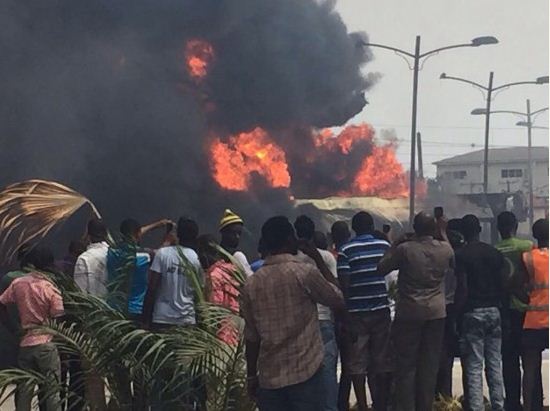 A tanker which attempted to off-load fuel, today, threw a filling station along Okpanam road by Macdon fast food, Asaba, Delta State capital, into full conflagration.






Remembering Christmas, By Reuben Abati
The preparation for this drama, which was usually staged during Christmas service, to the sound of melodious songs and priestly excitement, was the high point on Christmas Day of the celebration of Christ The Lord. Weeks earlier, the church organized Christmas Carols. If you made the special choir, you felt as if you had won a lottery. Everyone was a songster of sorts, belting out Christmas Carols in both English and the local language. Parents singing. Children singing. Everyone dancing. The feel-good mood was so intense. You could run into people on the streets and the standard greeting, be they Muslims or Christians, was “Merry Christmas!” The official church Carol team went from one church member’s home to another to deliver the good tidings of the season and to announce the coming birth of the Saviour. Christmas strengthened our sense of community, and our Christianity and faith as well.
It was also that time of the year for the reinforcement of family values. People whom you had not seen for the whole year travelled home from their stations to be part of Christmas. You got the chance to meet cousins, make new friends, and sing till you almost went hoarse. I wasn’t much of a singer or drummer- my friends used to laugh each time I missed a note or a beat and we would spend weeks afterwards mimicking each other. In short, Christmas was real fun. But it was relatively a simple, inexpensive celebration, year after year. Our parents did not have to borrow, or go bankrupt, or agonize, for Christmas to be meaningful.
We got one or two new clothes and shoes: those were the usual Christmas gifts. On Christmas day, after church, lunch didn’t have to be anything extra-ordinary: it was no more than rice and chicken. In those days, chicken was a special delicacy, reserved for Sundays, or special occasions like birthdays or Christmas, very much unlike now that every child acquires the taste for tasty chicken from the womb! On Boxing Day, we either visited friends or stayed home, and played with firecrackers and bangers on the streets. Those children who could not afford bangers were not left out. They improvised with local devices made by blacksmiths. That contraption produced even better effect.
Our Muslim friends usually joined us, but they always teased us. In those days, Muslims and Christians celebrated religious festivals together, without any hang-ups about the difference in faith. Virtually every family had Muslim and Christian branches. Give it to Muslims, however, their own seasons were usually more elaborately and colourfully celebrated. They slaughtered rams during the Eid el-Kabir and were generous, handing out gifts of fried meat to family friends and acquaintances. During that festival also known as Ileya, the major Muslim festival, you could acquire a whole bucket-load of meat to sustain the family soup pot for weeks, without being a Muslim and without buying a ram.
Christians were not known to be that generous. Every Christian family was governed by rules of restraint. And so, Christmas restricted themselves to the killing of chicken or turkey; some families did not even bother to slaughter anything at all, and they did not violate any religious code, and in any case, Christians didn’t feel obliged to share meat with neighbours. The effect was that Muslim relations and friends had this funny song, which was a friendly way of accusing Christians of being stingy. “Ko s’ina dida nbe; Ko s’ina dida nbe, K’olorun ko so wa d’amodun o, ko s’ina dida nbe”. The truth is that nobody took offence, nobody considered the songs derisory, instead the teasing by Muslims attracted shared laughter. Even if there was no meat to share among the entire neighbourhood, there was more than enough fun to go round as many Muslim children joined us to shoot the bangers and make lots of noise. Many of them in fact knew the Christmas songs; they also joined us to stage in our own neighbourhood then, what was called the Christmas masque, or in Yoruba: “Mebo”.
The Mebo was a simple enactment, a blend of the secular, the profane and the religious, drawing its elements from a syncretic base. The Masque or Mebo was dressed like a Masquerade: his face was not supposed to be seen. He was the main attraction, backed by drummers and singers: we used pots and pans and maybe our mouths as drums. The masque danced and led the songs:
“Iya Kaa’le o
Wa dagba wa darugbo
Baba Ka’ale o
Wa dagba wa darugbo
Mebo yo robo
E ba mi wa so mi soro
Mebo O yo robo o
E ba mi wa so mi soro.
There is nothing Christianly about this type of song, but for us, growing up, we celebrated Christmas in the neighbourhood, mixing elements of all the religions and all the available modes. Even children of Egungun worshippers joined the Christmas celebration. And so we could start with Mebo yo robo, and shift to “We wish you a Merry Xmas…Good tidings we bring… Hark! The Herald Angels Sing… E lu agogo E lu agogo, E lu agogo o Olugbala de o, e lu agogo…Keresimesi, Keresimesi, …” followed by other songs in Yoruba, which connected well with the community and did not attract any objections. We went from one house to the other and some people would give the Mebo money, which we shared thereafter and used to buy more bangers and firecrackers. We went round night after night until Christmas Eve.
Our parents did not discourage us, knowing that it was all in the spirit of the season. They also did not have to worry about anyone getting kidnapped, or getting into any form of danger. It was a different Nigeria in those days. Those were the days of innocence when children were brought up to shun any form of ostentation and conspicuous consumption. It was the season of joy and contentment. Just as we celebrated Christmas in the town, there was also as much excitement in the villages. The prospect of a New Year, a week after, always made the season special.
But Christmas today is different. It has become a commercial enterprise for many families and investors, with little or no emphasis on the spiritual dimension. I don’t hear too many children going from house to house even in the same old town where I grew up, singing Christmas Carols. This new generation does not know Mebo. But they know Santa in Naija on their phones and similar animations. In our time, we talked about Father Christmas; today’s children refer to him as Santa Claus. There is no sense of community anymore, only a sense of rising expenses and religious isolationism. Many churches cannot even organize house-to-house Carols. Parents are reluctant to let their children go out to any stranger’s house, be they Christians or whoever. They don’t want their children kidnapped; they don’t want their daughters to be raped. Some of the churches have no buses, or they cannot even afford to buy fuel at N130 per litre. If anybody shows up at anybody’s door, singing Christmas Carols, these days, the door is likely to remain shut. The times are truly different. You can never know who the visitors are: they could be a band of armed robbers, dancing their way to your doorstep, to gain entrance and inflict harm.
I don’t see the excitement of old anymore. Many average families cannot even afford to travel home for Christmas. The cost is too high. The city of Lagos used to look deserted close to Christmas, because virtually all the non-Lagosians would have returned to their villages to celebrate Christmas and New Year with their kith and kin. This year, Lagos traffic is still as busy as ever. People are staying back. Even the more privileged families also don’t want to go to the village. They are afraid of being mobbed by all kinds of relatives looking for help. It is easier to tell people you did not see their text messages, or the account numbers they sent, even when you have not announced that you have surplus money to give away, but to go to the village and see them face-to-face, could be quite an ordeal. I have listened to various tales of harassment, reported by persons who have had to tolerate that cousin who has just taken a third wife, who wants to be supported to maintain the woman, or that in-law who wants to buy a motorcycle and his body language is like if he doesn’t get the support he wants, he’d be tempted to recall his daughter!
I really haven’t heard those peals of laughter that used to be the main feature of Christmas anymore. What I see is the sheer anxiety on people’s faces. Christmas has become so expensive. Many parents are practically panicking! The children of today are not interested in Christmas rice and chicken: that stopped being a special delicacy a long time ago. They want expensive gifts. And there are many capitalists cashing in on the taste of today’s children, to provide a variety of services and items that dig holes in a parent’s pockets. One parent remarked that he really does not know what to do. His salary has not been paid. His children would like to experience Christmas. His wife wants a special gift. His children look like they don’t want their Christmas to be “inconclusive.” But in January, he will also have to pay their school fees for the new term.
On top of it all, our society today is more divided than it was even after the civil war. Our laughter is shorter; our hopes are slimmer. We will celebrate Christmas all the same because we are a people of faith and hope..…Well, “don’t worry, be happy!” Merry Christmas .[myad]