Jesus was born on the Feast of Tabernacles. He was not born on “Christmas Day.”
Jesus was not born on December 25. That is the date of a pagan festival of the sun god Tammuz merged with Christianity under Constantine. However, the evidence is overwhelming that Jesus was born during the Feast of Tabernacles.
Coming of Elijah
Zachariah, John the Baptist’s father, was ministering in the Temple when an angel told him he would have a son. He belonged to “the priestly group of Abijah.” (Luke 1:5). Abijah was eighth in line according to the Jewish time-table for priests ministering in the Temple: “The first lot fell to Jehoiarib, the second to Jedaiah, the third to Harim, the fourth to Seorim, the fifth to Malchijah, the sixth to Mijamin, the seventh to Hakkoz, the eighth to Abijah.” (1 Chronicles 24:7-10).
That means Zechariah would have been ministering in the Temple in June, when it was officially the turn of Abijah. If his wife therefore conceived in June, John the Baptist would have been born around March the next year during the Passover. It is the Jewish tradition to reserve a special glass of wine for Elijah during the Passover meal, in expectation of his attendance. So it makes sense for John the Baptist to be born during the Passover.
The angel told Zachariah John the Baptist would come “in the spirit and power of Elijah.” (Luke 1:17). Indeed, Jesus confirms that John the Baptist is the expected Elijah. He told the disciples: “‘Elijah has already come, and they did not recognize him, but did to him whatever they pleased. So also the Son of Man will certainly suffer at their hands.’ Then the disciples understood that he was speaking to them of John the Baptist.” (Matthew 17:11-13).
Birth of the Messiah
If John the Baptist was born during the Passover, then Jesus must have been born during the Feast of Tabernacles. There are six months between both feasts, and we are told Mary became pregnant six months after John’s mother, Elizabeth:
“(Zechariah’s) wife was expecting a baby, and for five months she did not leave the house. She said to herself, ‘What the Lord has done for me will keep people from looking down on me.’ One month later God sent the angel Gabriel to the town of Nazareth in Galilee with a message for a virgin named Mary.” (Luke 1:24-27). “Your relative Elizabeth is also going to have a son, even though she is old. No one thought she could ever have a baby, but in three months she will have a son.” (Luke 1:36).
Think about it. Does it not make perfect sense that “the light of the world” should be born during the “Festival of Lights;” when lamps illuminate the entire city of Jerusalem? That is the Feast of Tabernacles. It is also known as “the Season of our Joy;” so it makes sense for the angel to tell the shepherds he brings “good tidings of great joy” concerning Jesus’ birth during the joyful season of the Feast of Tabernacles:
The angel said: “Behold, I give to you good tidings of great joy, which shall be to all people. For to you is born today, in the city of David, a Savior, who is Christ the Lord.” (Luke 2:10-11).
International feast
Quite appropriately, the Feast of Tabernacles is the only Jewish festival which is for “all people,” both Jews and non-Jews. It is for all the families of the earth:
“It shall be, everyone who is left of all the nations which came up against Jerusalem shall go up from year to year to worship the King, Jehovah of Hosts, and to keep the Feast of Tabernacles. And it shall be, whoever will not come up from all the families of the earth to Jerusalem to worship the King, Jehovah of Hosts, even on them shall be no rain.” (Zechariah 14:16-19).
The Feast of Tabernacles is also known as “the Festival of the Nations;” showing it is not exclusively for the Jewish nation. All the men of Israel are required to come to Jerusalem to observe the Feast of Tabernacles: “Three times in a year shall all your males appear before Jehovah your God in the place which He shall choose: in the Feast of Unleavened Bread, and in the Feast of Weeks, and in the Feast of Tabernacles.” (Deuteronomy 16:16).
This means Jerusalem becomes filled up with visitors during the festival, and they spill over into the surrounding regions including Bethlehem, which is only about five miles away. As a result, there is likely to be a shortage of guest-houses in Bethlehem; accounting for the difficulty of Mary and Joseph in finding suitable accommodation.
Tabernacle of God
In writing about the incarnation of Jesus, John employs the terminology of tabernacles. He says the Word became flesh and “tabernacled” among us. (John 1:14). Indeed, one of Jesus’ spiritual names means “God with us:” “‘A virgin will have a baby boy, and he will be called Immanuel,’ which means ‘God is with us.’” (Matthew 1:22-23). It therefore makes sense that God would choose to come down to earth in the person of Jesus Christ to tabernacle with men during the Feast of Tabernacles.
It is also quite conceivable that the wise men from the east were Jewish rabbis, anticipating the coming of the Messiah according to Daniel’s prophecy. (Daniel 9:24). At the time of Jesus’ birth, the largest Jewish population was not in Palestine but in Babylon, where they had been carried into exile by Nebuchadnezzar. Babylon is east of Palestine; and a “magi” or wise man is another expression for a “rabbi.” Daniel for example, who was named Belteshazzar, was regarded as one of the magi of his time. (Daniel 4:9).
Star of Bethlehem
During the seven-days of the Feast of Tabernacles, Jewish families live in booths built with branches of trees. It is customary to leave a hole in the roof so as to be able to look at the stars at night. Therefore, the Feast of Tabernacles is the perfect time for Jewish magi east of Palestine to notice the appearance of the star of Bethlehem.
That is why it is important to note that the magi did not get to Bethlehem at the time of Jesus’ birth, as erroneously portrayed on Christmas cards. By the time they arrived, Jesus was already a young child: “When they had heard the king, they departed; and, lo, the star, which they saw in the east, went before them, till it came and stood over where the young child was.” (Matthew 2:9).
It must have taken them up to two years to get there, which is why, in the bid to kill Jesus, Herod killed all the children in Bethlehem from two years old and under: “When Herod found out that the wise men from the east had tricked him, he was very angry. He gave orders for his men to kill all the boys who lived in or near Bethlehem and were two years old and younger. This was based on what he had learned from the wise men.” (Matthew 2:16).
All this point to one thing. Jesus was born on the Feast of Tabernacles. He was not born on “Christmas Day.” [myad]
The Catholic Bishop of Sokoto Diocese, Father Matthew Hassan Kukah, has lamented the commercialization of churches with religious leaders making investment of billions of Naira into the running of the churches.
Father Kukah, in his Christmas message, said that Christian religion ought to be a profit-making venture as it has now been turned.
“The word of God and its living blessings are free. Isaiah said that much when he said ‘come all of you who are thirsty, come to the water and you who have no money, come and eat. Buy wine and milk without money and without cost (Isaiah: 55:1)’,” the clergyman said.
Father Kukah pointed out that there were times when the Catholic Church was guilty of “simony” – the practice of making profit out of sacred things.
“That was one of the reasons for Father Martin Luther’s revolt. But, so much has changed now. Prayer for our people is the duty of all ordained ministers, but today, it has become subject to abuse.”
The cleric called on Christians to return to the model of Jesus Christ as they celebrate Christmas, adding that considering the life that Christ lived, it was difficult to understand how Nigerians had come to equate success, prosperity and blessings of God with wealth. [myad]
As the war on corruption heightens, the political battle-line between the governing All Progressives Congress (APC) and the opposition Peoples Democratic Party (PDP) has sharply been drawn.
While leaders from both parties voice out their support for the clean-up of the country by ridding it of corruption, the National Working Committee of the PDP seems clearly to be working contrary to the anti-corruption rhetoric of their Board of Trustees. Their public communication organs have, in particular, become increasingly combative against the exercise. All that the President, leading the APC change orchestra is trying to do is to revamp a moribund nation with growth, jobs and recovered looted funds. Sadly, only a few, if any in Wadata House are treating the war against corruption as the extra-ordinary event which it is. Instead, when they speak up, they do so most ardently against it. In a clear demonstration of abstructist politics, they challenge the government in every move it makes, but fail to spell out alternative roadmaps to curbing the monstrous corruption that threatens to consume the country; they rush to condemn and dramatize even the smallest of measures which, given time and patience will manifest through positive outcomes.
Doing this gives the PDP the illusion of being an effective opposition party but taken in the context of national interest and the mood of the nation, it is doubtful it it is yielding anything beyond limited political returns. To most Nigerians, the cacophonous opposition is just a media spectacle to distract or mellow the President.
After an historic loss in an election to the opposition for the first time in the annals of this country’s political history, PDP has not looked inwards in any serious way to seek its revival. The first and major leap at reform ended disastrously when first, the party establishment rejected a well-timed apology tendered on its behalf for their past failures. Then, the leader of the reform movement got himself mired in allegations leading to court charges of the theft of billions of Naira voted for weapons purchase to fight terror in the North East. Chief Raymond Dokpesi’s trial (and Col. Dasuki’s) is no doubt a serious blow to any prospects of a turn-around in the PDP.
The party did not seek democratize their internal organization, a major reason for their implosion leading to the loss of the election or began thinking innovatively about the challenges of modern day Nigeria, nor have they got a “Plan B” that is inviting to the voters.
It is this failure to reckon with, or look at the real issues confronting the party and the nation that led to their call for an investigation of President Buhari for having been supplied two jeeps by the erstwhile Jonathan administration after the personal bullet-proof jeep he owned was bombed by yet unknown assailants.
As the Special Adviser to the President, Femi Adesina said, issuance of the cars, soon after this incident was merely a face-saving move, intended to cover the government’s failure to keep its duty to this particular former leader. The law, cited as the Remuneration of Former Presidents and Heads of State (and other Ancillary Matters), entitles former Nigerian Presidents including General Muhammadu Buhari to “three vehicles to be bought by the Federal Government and liable to be replaced every four years”.
Cars are just a few in a litany of entitlements written in that law although it is contestable to say that General Buhari had been given his due entitlements by successive administrations as provided hereunder. Regime after regime treated him as if he was not a former Head of State.
General Abacha came on the saddle and wanted to throw everything at Buhari who, knowing his very nature declined virtually but his military pension. The military in particular treated him so badly that its leaders kept silent when the PDP charged that he didn’t have WAEC papers. One shameless Army Records officer said that the former Head of State had no records at all under their system. General Buhari went without a full complement of armed guards from the army he served at the highest level until the dastardly bomb attack on his convoy in April 2014. It was at this time that the Chief of Army Staff at that time thought it necessary to reinstate the armed convoy to protect him. When they brought the two cars within a few days of his being bombed, the staff of the General were merely informed that this was from the Federal Government in fulfillment of its obligation to him. Since this was an entitlement long-overdue, not minding that it came short of what was expected, there was absolutely nothing wrong on the part of the General for accepting that which was due to him.
This hashtag “#Buharigate” was intended as a counterpoise to “Dasukigate,” the phenomenal corruption scheme by which money intended for weapons to fight terror was shared among PDP leaders. It was a fake intervention and a malicious propaganda against the president, obviously intended to detract from his enormously huge reputational capital, the basis on which the APC nation-wide victory was founded.
The #Buharigate failed to gain traction because was seen as an opposition overreach and a desperate attempt to tarnish his hard-earned name and nothing more. No serious blogger therefore paid a serious attention to it.
This baseless allegation that the President had benefitted from the diversion of money intended to fight insurgency under the former National Security Adviser equally underlines the cruel nature of today’s politics, that even the best personal examples cannot keep a leader from the tar brush of the opponent.
Apart from seeking to mellow the President, I suspect that the opposition had thought these attacks would revive the collapsed fortunes of the PDP while at the same time projecting their leaders as victims of persecution in the hands of the APC administration.
What however is encouraging in the country today is that Nigerians have thrown their full weight behind the war on corruption. This itself is an account the constructive nature of the government’s engagement against the vice and the determination with which it is being fought. Adding impetus and flavor is the frustration at the routionisation of corruption by the last administration and their inadequate and impotent efforts to curb and punish high-profile offenders.
My concluding augment is that President Buhari’s election and war against terrorism and corruption have become a template. In Niger, Chad and Ghana where there will be elections next year, opposition candidates are parading themselves as the “Buhari” of their own country.
President Buhari must have himself been embarrassed by calls, through newspaper articles, posters and banners in the course of his visits to these friendly countries, saying “we want Buhari type elections; we will wage Buhari-type anti-corruption war”. One Chadian political party published an advertorial asking their government to procure and issue permanent voters cards as well as the use of card readers in the coming election and if the funds were not available, “let us borrow from Nigeria” for the coming elections.
President Buhari was and is far, far away from, and remains untouched by the “Dasukigate”. “#Buharigate” is therefore a fraud and an unbecoming spectacle designed to tarnish the illustrious record of the President so as to mellow his anti-corruption drive. It failed because it was born out of desperation to gain sympathy by an opposition that can’t heal itself unless it comes to terms with the danger of corruption they thrived in, and the party’s internal structures are overhauled and remade to meet the minimum requirements of a democratic organization.
Garba Shehu is Senior Special Assistant to President Muhammadu Buhari on Media and Publicity. [myad]
Pope Francis has expressed worry about human dignity of far too many people around the world which he said is being trampled on, including that of refugees and migrants. He said: “Even today, great numbers of men and women are deprived of their human dignity, and like the child Jesus, suffer cold, poverty and rejection. “May our closeness today be felt by those who are most vulnerable, especially child soldiers, women who suffer violence, and the victims of human trafficking and the drug trade.” Pope Francis who is the 266th Pope spoke today while delivering his Christmas message on at the St. Peter’s Basilica in Vatican City.
He called on the world to unite to end atrocities being committed against humanity, especially by Islamist militants. The Pope, who marked the third Christmas since his election in 2013, said that the unity of the world against the insurgents has become imperative in view of the immense suffering they have been inflicting on many countries. He particularly referred to the civil wars in Syria and Libya, adding: “May the attention of the international community be unanimously directed to ending the atrocities which in those countries, as well as in Iraq, Libya, Yemen and sub-Saharan Africa, even now reap numerous victims, cause immense suffering and do not even spare the historical and cultural patrimony of entire peoples.” He was clearly referring to Islamic State militants, who have carried out numerous attacks in those countries and destroyed many cultural heritage sites. In October, Islamic State militants blew up the Arch of Triumph, a jewel in the exquisite collection of ruins in the Syrian oasis city of Palmyra. The pontiff condemned recent “brutal acts of terrorism,” including the November 13 attacks by Islamist militants that killed 130 people in Paris and the downing of a Russian plane over Egypt’s Sinai peninsula that killed 224 people on October 31. Both were claimed by Islamic State. Pope Francis said: “Only God’s mercy can free humanity from the many forms of evil, at times monstrous evil, which selfishness spawns in our midst. “The grace of God can convert hearts and offer mankind a way out of humanly insoluble situations.” He called for peace between Israelis and Palestinians in the area where Jesus was born. He said: “Where peace is born, there is no longer room for hatred and for war. “Yet precisely where the incarnate Son of God came into the world, tensions and violence persist and peace remains a gift to be implored and built.” Pope Francis asked God to bring consolation and strength to Christians who are being persecuted around the world and called for peace in the Democratic Republic of Congo, Burundi, South Sudan and Ukraine. [myad]
The Federal Government has announced that from January 1, 2016 the pump price of Premium Motor Spirit, popularly known as petrol, will be reduced from N87 per litre to N85. The Minister of State for Petroleum, Dr. Emmanuel Ibe Kachikwu, who spoke news men at the Port Harcourt Refinery Company in Port Harcourt, Rivers State, where he spent Christmas inspecting the plant said that he approved the new price for the agency yesterday, Thursday.
Kachikwu, who is also the Group Managing Director of the Nigerian National Petroleum Corporation (NNPC) said: “Like I said, we have done a modulation calculation and it is showing us below N87. I imagine that if PPPRA publishes it today, it will become effective immediately. “But the 1st of January, that is when we are looking at.” Kachikwu said that the new price is below the current N87 per litre and it would now convince Nigerians that the pricing modulation that the Federal Government promised to embark on a few days ago was not a trick. He said that the government carried out analysis and research and that it has been realized that the country can fluctuate the fuel market in accordance with the crude oil market fundamentals. He Justified government’s reasons for scrapping the Petroleum Support Fund, otherwise known as fuel subsidy, explaining that government can no longer afford to subsidize the product following the fraud that has attended its operation. He added that it has become clear that government earnings are dipping on daily basis. “It is out. I signed off on it yesterday (Thursday). I imagine that in the next couple of days, the marketers would get advice on that. “The nice thing about the PPPRA, where I signed up on it yesterday, is that the price will be far below N87. So for the first time, people will understand that the pricing modulation I was talking about is not a gimmick. It is for real. “We have gone to find out how we will be able fluctuate this market to reflect what the reality of crude market is. The objective is that one, we cannot afford to continue to subsidize “We can’t even understand where those subsidies were going to. There is a lot of fraud elements in it, so we need to cut that off. The second is the earning capacity of the Federal Government is deteriorating by the day with lower prices of crude and come out more.” Kachikwu said that from the application market realities for the pricing modulation, government has discovered that petrol would sell for either N85 or N86 per litre. The minister recalled that it was from this axiom that President Muhammadu Buhari announced that the price of petrol remains N87 at the moment. “But in applying that where we landed when we did the analysis for the very first time was about N85 or N86. So it is below N87. And maybe the first price that will come will reflect it. “That was why Mr. President said that price will be N87 for now. And that is what we have in mind.” On the security of the pipelines, Kachikwu said government had tried to stop the menace with military intervention to no avail before it engaged some private contractors who had worked with the majors for the crude pipeline management. According to him, the private contractors have taken over Atlas Cove, Mosimi and they would be extending the surveillance to Ilorin, Kwara State. They will also look at the Port Harcourt and Aba axis, he stressed. The minister said that government is now beginning to have a clue of how to tackle pipeline insecurity, adding that it is far more expensive to convey petroleum and products through pipelines than trucking them by road. Kachikwu said from the briefing he got from the inspection of the refineries, they are close to re-opening. “In the next one week, we are ready to see products out of here.” Kachikwu said that a lot of the rehabilitation of the refinery was being done with intensive manual labour of the staff since paucity of fund affected the holistic change that is required in the factory. He said the refinery is now ageing so one fault comes up after the other even after repair, but that would stop when government repairs the plant holistically early next year. According to him, about 5.5 million litres daily of PMS is expected from the refinery in the next few days. Other products to come from the plants, said Kachikwu “are AGO, kero and others. “Where we love to be is to have half of the consumption of this country at the refineries at the minimum, which is about 20 million litres. “But where we are with the sleepless night I have had in the last few weeks, any molecule is significant. “Kaduna will still be doing 2.3 million. Let’s start from there. And that is doing 60 per cent performance. This is still an assumption. I will like to see them getting closer to 80 or 90. “By the time they do that, we will be getting 11 to 12 million litres out of this place.” [myad]
The Minister of Defence, Brigadier General Muhammad Dan-Ali (rtd), has reminded soldiers fighting Boko Haram in the North Eastern part of Nigeria that their actions and inaction on the battle field would be accounted for at the end of the day.
“I want you all to note that your actions and inaction will be accounted for. You must therefore respect the rights of people in your host communities.” Dan-Ali spoke today in Damaturu, Yobe State at a Christmas lunch organized for troops fighting insurgency in the North East.
The minister, who acknowledged some of the challenges facing the operations, assured the soldiers that government is committed to providing the needed logistics to expeditiously end insurgency in the country. He advised the soldiers to remain committed to the war against insurgency, adding: “while your welfare needs is being addressed, I urge you to continue to adhere to all the rules of engagement in your operations.” Also, the Chief of Defence Staff, General Gabriel Olonisakin, commended the sacrifices of troops fighting on different fronts across the country, adding that their contributions in the defeat of terrorism would not be forgotten in a hurry. Olonisakin, however, urged the troops not to relent in their efforts to effectively end the insurgency. We are gradually moving into 2016. Therefore, we must not rest on our oars to win the war. “As we move into 2016, I want to enjoin you to be more determined to reclaim all lost territories. “That is the charge and demand on all of you as we enter the New Year. On our part, we will do our best to ensure that all logistics and welfare required to prosecute the war to a logical conclusion are provided.” Lieutenant General Tukur Buratai, the Chief of Army Staff, said the visit of Dan-Ali would boost the morale of troops in the ongoing operation. Buratai noted that the situation in the troubled region has improved tremendously and attributed the feat to the sacrifices of the troops. He said: “The security situation has greatly improved and I want to congratulate the troops for a job well done. “We are entering the New Year and I believe that we will start winding down to conclude the operation.” The Deputy Governor of Yobe State, Abubakar Aliyu, confirmed that the security situation has improved in the state, saying that unlike the previous festivities since the insurgency started, residents were able to celebrate the yuletide without fear of any attack from the insurgents. [myad]
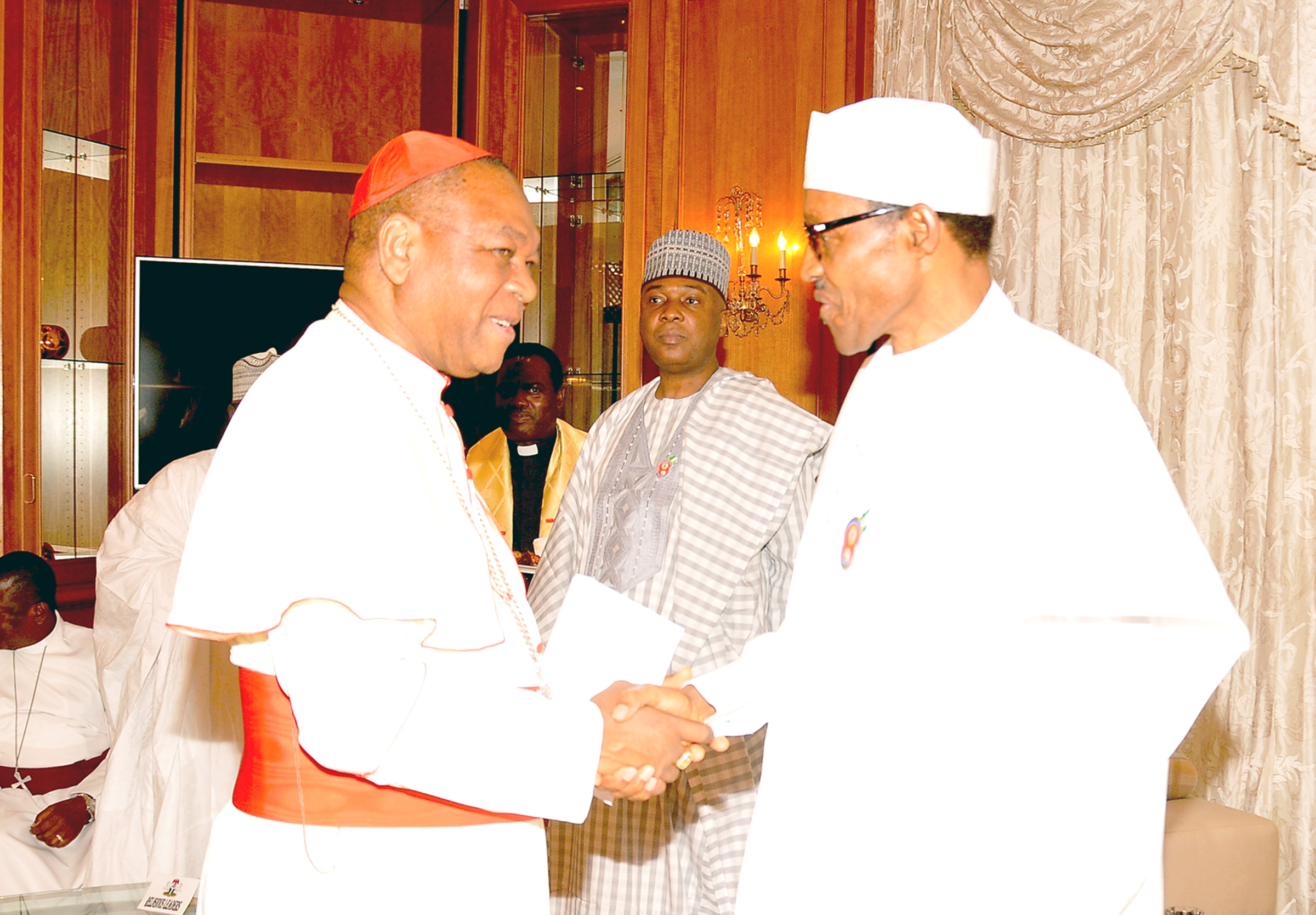
From Left: Senate President Bukola Saraki, President Muhammadu Buhari, FCT Minister Mohammed Bello, and Permanent Secretary(FCT), Dr Tope Ajakaiye during the Christmas homage to the President by FCT residents led by the Minister at the Presidential Villa.
From Left: Senate President Bukola Saraki, President Muhammadu Buhari, FCT Minister Mohammed Bello, and Permanent Secretary(FCT), Dr Tope Ajakaiye during the Christmas homage to the President by FCT residents led by the Minister at the Presidential Villa. President Muhammadu Buhari welcoming Cardinal John Onaiyekan during the Christmas homage to the President by FCT residents at the Presidential Villa.
Satguru Maharaji ji, the founder of the One Love Family Sect, has asked agitators for the Republic of Biafra to stop it as it threatens the unity of Nigeria as a nation.
Maharaji ji who spoke today in Ibadan at a press conference marking his 68th birthday anniversary, said that Nigerians must learn from the current insurgency in the North East Zone which had resulted in loss of lives and property.
The sect leader said the current security challenges facing the country required the support of all Nigerians, irrespective of ethnic or religious affiliations, saying that the Biafra issue had died since 1968 even as he asked all Nigerians to pray for the country and its leaders.
“The issue of bad roads and infrastructural decay in the country were responsible for this agitation and it needs urgent attention to avoid another Boko Haram insurgency in the country.
.“Igbo traditional rulers should be invited in finding a solution to this issue of Biafra.
“The country is right now fully in control of its security situation and the issue of Biafra should urgently be attended to before it escalates to what we do not expect.”
Mahaji ji rejected the Social Media Bill, saying the new media platforms offer ordinary citizens avenues to question their leaders even as he expressed support for the anti-corruption campaign of President Muhammed Buhari’s administration.
He, however, called for accelerated hearings in corruption cases to serve as a deterrent to others. [myad]
Association of Senior Civil Servants of Nigeria (ASCSN) has asked President Muhammadu Buhari to make sure that his government fully implements the contents of the 2016 federal budget when it is passed by the National Assembly.
The Association is particularly excited by the aspect of the N6.08 Trillion budget where the President spoke about recruiting 500,000 unemployed graduates and holders of National Certificate of Education (NCE) as teachers to curb the escalating rate of unemployment in the country.
In a statement issued in Lagos today, the ASCSN President, Bobboi Bala Kaigama, and the Secretary-General, Alade Bashir Lawal said: “we also commend Mr. President for his decision to ensure that all the Federal Ministries, Departments, and Agencies (MDAs) are captured and brought under the Integrated Personnel Payroll Information System (IPPIS) because this will not only reduce the burden of manual preparation of payrolls but also curb cases of sharp practices in the system.”
The Association commended the President for resolving to implement the government’s cash transfer programme, even as it stressed the need for the policy to be transparent and inclusive without discrimination.
“We must equally express joy in the decision of Government to make good its promise to provide a meal per day for primary school pupils.”
ASCSN, however, frowned at the decision of the government that fuel subsidy would not be removed “for now,” saying that the impression had been created that it might be removed later, especially as there is no provision was made for fuel subsidy in the budget estimate.
It called for the meeting of all stakeholders, including labour, to discuss the subsidy issue. It argued that the price of crude oil in the international market had reduced drastically, and that the template being used to arrive at the price of fuel should be reviewed downward commensurably.
“If that is done, it is doubtful if the price of petrol will be up to ₦70 per litre,” the union stated.
The Union observed the level of deficit financing in the budget put at ₦2.22 trillion and posited that it was on the high side and advised the Government to work very hard in the area of looted funds recovery as that would go a long way to shore up government revenue and thereby mitigate the negative impact which the quantum of deficit would have on the entire economy.
“On the whole, the union expressed happiness that instead of talking about austerity measures, the government has decided to put more money in the economy, a scenario that has the potential of bringing more resources to the poorest of Nigerians which would also impact positively on major economic variables.” [myad]
President Muhammadu Buhari has called all those in leadership positions across the strata of the Nigerian society to come together and pull the country out of its current challenges. The President who made the call today when he received a cross section of residents of the Federal Capital Territory (FCT), led by its Minister, Malam Muhammad Musa Bello, who paid him Christmas homage at the Presidential Villa, Abuja said that Nigeria’s main problem is how to get the right leadership in place for the general good of the society. “For the leaderships at various stages, both civil and spiritual, we need to be patient in managing the society. We need to come together and pull the country out of these problems that we find ourselves. “Everybody in the world believes that Nigeria is a lucky country because of its natural resources. “Our problem is how to organize ourselves and how to get the right leadership in place.” On security challenges, Buhari said that no society can develop in an atmosphere of insecurity and social discontent even as he said that his administration is determined to persuade the Boko Haram militants, if they could be persuaded, to allow peace to reign in the country. The President expressed concern over the pathetic conditions of the Internally Displaced Persons (IDPs) in some parts of the country and asked Nigerians to partner with government to uplift the quality of life of the IDPs. He commended the security agencies, the Victims Support Fund led by retired General T. Y. Danjuma and the G-7 for their support and assistances to the IDPs. “We appreciate that the security agencies are doing their best and their best is showing and we have to continue praying for them. There can be no development without security. We have to continue to pray. “If we have two million people as IDPs and 70 per cent are women and children and 30 per cent of them are children, some them are orphans, they will grew up not knowing their parents, tradition or culture, then, as leaders we have a weighty responsibility to ensure that infrastructure for the orphans are taken care of. “As leaders, we must realize that the most important thing for those children is that they must not be denied education. Schools must be rebuilt. “We also thank (Victims Support Fund) Danjuma and the G-7 led by the US. They have been doing their best to help Nigeria to train our military and provide support to the IDPs and areas affected by the insurgency.” Earlier, Muhammad Bello and the leader of the Christian community in Abuja, Rev. Israel Akanji, had commended the President for his vision and leadership qualities. Akanji advised Nigerians, irrespective of socio-political backgrounds, to support and show more understanding to the various policies and programmes of the government meant to pull the country out of its challenges. Highlight of the event were the presentation of giant Christmas cards to President Buhari by various groups in the FCT. [myad]
We use cookies on our website to give you the most relevant experience by remembering your preferences and repeat visits. By clicking “Accept”, you consent to the use of ALL the cookies.
This website uses cookies to improve your experience while you navigate through the website. Out of these, the cookies that are categorized as necessary are stored on your browser as they are essential for the working of basic functionalities of the website. We also use third-party cookies that help us analyze and understand how you use this website. These cookies will be stored in your browser only with your consent. You also have the option to opt-out of these cookies. But opting out of some of these cookies may affect your browsing experience.
Necessary cookies are absolutely essential for the website to function properly. This category only includes cookies that ensures basic functionalities and security features of the website. These cookies do not store any personal information.
Any cookies that may not be particularly necessary for the website to function and is used specifically to collect user personal data via analytics, ads, other embedded contents are termed as non-necessary cookies. It is mandatory to procure user consent prior to running these cookies on your website.



 The Catholic Bishop of Sokoto Diocese, Father Matthew Hassan Kukah, has lamented the commercialization of churches with religious leaders making investment of billions of Naira into the running of the churches.






Jesus Was Not Born On December 25, By Femi Aribisala
Jesus was not born on December 25. That is the date of a pagan festival of the sun god Tammuz merged with Christianity under Constantine. However, the evidence is overwhelming that Jesus was born during the Feast of Tabernacles.
Coming of Elijah
Zachariah, John the Baptist’s father, was ministering in the Temple when an angel told him he would have a son. He belonged to “the priestly group of Abijah.” (Luke 1:5). Abijah was eighth in line according to the Jewish time-table for priests ministering in the Temple: “The first lot fell to Jehoiarib, the second to Jedaiah, the third to Harim, the fourth to Seorim, the fifth to Malchijah, the sixth to Mijamin, the seventh to Hakkoz, the eighth to Abijah.” (1 Chronicles 24:7-10).
That means Zechariah would have been ministering in the Temple in June, when it was officially the turn of Abijah. If his wife therefore conceived in June, John the Baptist would have been born around March the next year during the Passover. It is the Jewish tradition to reserve a special glass of wine for Elijah during the Passover meal, in expectation of his attendance. So it makes sense for John the Baptist to be born during the Passover.
The angel told Zachariah John the Baptist would come “in the spirit and power of Elijah.” (Luke 1:17). Indeed, Jesus confirms that John the Baptist is the expected Elijah. He told the disciples: “‘Elijah has already come, and they did not recognize him, but did to him whatever they pleased. So also the Son of Man will certainly suffer at their hands.’ Then the disciples understood that he was speaking to them of John the Baptist.” (Matthew 17:11-13).
Birth of the Messiah
If John the Baptist was born during the Passover, then Jesus must have been born during the Feast of Tabernacles. There are six months between both feasts, and we are told Mary became pregnant six months after John’s mother, Elizabeth:
“(Zechariah’s) wife was expecting a baby, and for five months she did not leave the house. She said to herself, ‘What the Lord has done for me will keep people from looking down on me.’ One month later God sent the angel Gabriel to the town of Nazareth in Galilee with a message for a virgin named Mary.” (Luke 1:24-27). “Your relative Elizabeth is also going to have a son, even though she is old. No one thought she could ever have a baby, but in three months she will have a son.” (Luke 1:36).
Think about it. Does it not make perfect sense that “the light of the world” should be born during the “Festival of Lights;” when lamps illuminate the entire city of Jerusalem? That is the Feast of Tabernacles. It is also known as “the Season of our Joy;” so it makes sense for the angel to tell the shepherds he brings “good tidings of great joy” concerning Jesus’ birth during the joyful season of the Feast of Tabernacles:
The angel said: “Behold, I give to you good tidings of great joy, which shall be to all people. For to you is born today, in the city of David, a Savior, who is Christ the Lord.” (Luke 2:10-11).
International feast
Quite appropriately, the Feast of Tabernacles is the only Jewish festival which is for “all people,” both Jews and non-Jews. It is for all the families of the earth:
“It shall be, everyone who is left of all the nations which came up against Jerusalem shall go up from year to year to worship the King, Jehovah of Hosts, and to keep the Feast of Tabernacles. And it shall be, whoever will not come up from all the families of the earth to Jerusalem to worship the King, Jehovah of Hosts, even on them shall be no rain.” (Zechariah 14:16-19).
The Feast of Tabernacles is also known as “the Festival of the Nations;” showing it is not exclusively for the Jewish nation. All the men of Israel are required to come to Jerusalem to observe the Feast of Tabernacles: “Three times in a year shall all your males appear before Jehovah your God in the place which He shall choose: in the Feast of Unleavened Bread, and in the Feast of Weeks, and in the Feast of Tabernacles.” (Deuteronomy 16:16).
This means Jerusalem becomes filled up with visitors during the festival, and they spill over into the surrounding regions including Bethlehem, which is only about five miles away. As a result, there is likely to be a shortage of guest-houses in Bethlehem; accounting for the difficulty of Mary and Joseph in finding suitable accommodation.
Tabernacle of God
In writing about the incarnation of Jesus, John employs the terminology of tabernacles. He says the Word became flesh and “tabernacled” among us. (John 1:14). Indeed, one of Jesus’ spiritual names means “God with us:” “‘A virgin will have a baby boy, and he will be called Immanuel,’ which means ‘God is with us.’” (Matthew 1:22-23). It therefore makes sense that God would choose to come down to earth in the person of Jesus Christ to tabernacle with men during the Feast of Tabernacles.
It is also quite conceivable that the wise men from the east were Jewish rabbis, anticipating the coming of the Messiah according to Daniel’s prophecy. (Daniel 9:24). At the time of Jesus’ birth, the largest Jewish population was not in Palestine but in Babylon, where they had been carried into exile by Nebuchadnezzar. Babylon is east of Palestine; and a “magi” or wise man is another expression for a “rabbi.” Daniel for example, who was named Belteshazzar, was regarded as one of the magi of his time. (Daniel 4:9).
Star of Bethlehem
During the seven-days of the Feast of Tabernacles, Jewish families live in booths built with branches of trees. It is customary to leave a hole in the roof so as to be able to look at the stars at night. Therefore, the Feast of Tabernacles is the perfect time for Jewish magi east of Palestine to notice the appearance of the star of Bethlehem.
That is why it is important to note that the magi did not get to Bethlehem at the time of Jesus’ birth, as erroneously portrayed on Christmas cards. By the time they arrived, Jesus was already a young child: “When they had heard the king, they departed; and, lo, the star, which they saw in the east, went before them, till it came and stood over where the young child was.” (Matthew 2:9).
It must have taken them up to two years to get there, which is why, in the bid to kill Jesus, Herod killed all the children in Bethlehem from two years old and under: “When Herod found out that the wise men from the east had tricked him, he was very angry. He gave orders for his men to kill all the boys who lived in or near Bethlehem and were two years old and younger. This was based on what he had learned from the wise men.” (Matthew 2:16).
All this point to one thing. Jesus was born on the Feast of Tabernacles. He was not born on “Christmas Day.” [myad]