The Kogi state governor, Captain Idris Wada has given an undertaken to ensure that the next governor of the state after him comes from one of the minority areas of the state.
Wada said that the Peoples Democratic Party (PDP), under which he is contesting the November 21 governorship election, will break another ground by being the first to actualize the aspiration of the people for power rotation. Addressing a crowd of party supporters who thronged the rally ground in Okene for the PDP Governorship Campaign Flag-off in Kogi state, the governor asked the people of the state to re- elect him for a second term.
He said that his administration has fulfilled most of the promises made to them and is in the process of consolidating on the gains.
At the campaign rally, which saw most of the PDP chieftains canvassing support for Wada, the Deputy Senate President Ike Ekerenmadu, Ondo state governor Olusegun Mimiko and former Chairman of the party, Dr. Ahmadu Ali extolled the virtues of the incumbent governor and urged the people to vote him rather than the APC candidate whom they said cannot be trusted with power. [myad]
Angry staff members of the Lagos State University (LASU) are celebrating the exit of the embattled Vice Chancellor of the institution, Professor John Obafunwa.
The tenure of the Vice Chancellor, who was appointed the 7th Vice Chancellor of LASU by the immediate past governor, Babatunde Fashola on November 1, 2011 bowed out as his tenure ended.
Four staff unions have begun a week-long activities to celebrate his exit which include prayer and fasting and would end on Monday, November 1. Within a year, Professor Obafunwa experienced violent students protest in January 2013 and was rescued and smuggled out in disguise by the police to escape the wrath of the angry students over the closure of the registration portal. His administration settled down after the protest and Obafunwa was able to hold two convocations uninterrupted, but the third one was marred by a violent protest by the four staff unions over unmet demands and arrest of their members. On November 2014, in what appeared to kick start his second term ambition, the VC rolled out the drum to celebrate 3rd year of his administration. But the Academic Staff Union of Universities (ASUU) and the Senior Staff Association of Nigerian Universities (SSANU) faulted the achievements and credited some of it to the former VC, Professor Lateef Hussien. According to the VC, on assumption of office, his administration set out and has continued to pursue without distraction, a strong mission on the LASU project, meant to reposition the university for excellence and re-package its academic programmes for the purpose of fulfilling the contemporary academic needs and challenges of the 21st Century and producing graduates that are employable and also as employers of labour. In the 48-page document titled “1095 days in office,” the VC said his administration worked tirelessly at ensuring prompt response to students matters, scholarships and bursary, regular matriculation exercise for newly admitted students, staff and students identification cards, review of students handbook, LASUSU e-voting system, management interactive session with students while on accreditation, he disclosed that relevant bodies accredited its professional courses. On establishment, resuscitation and repackaging of academic programmes, he said some rested courses were repacked which include, LASU External System, LASU Foundation, open and distance learning institute, pre-degree science programme, internal part-time programme. Other achievements are staff promotion, prompt payment of salaries, production of 56 doctorate degrees, provision of loan to staff, payment of 17 months arrears of salary increment, resuscitation of TETFUND, renovation of staff quarters, robust welfare package, promotion of sports and recreational activities, improved internet services, beautification of LASU, hosting of Governor Fashola’s 2,200 days in office. On March 16, 2015 Prof Obafunwa was chased out of the campus by the workers, he has not used his office till date. He has been operating from his personal office at the Lagos State University College of Medicine. The two large banners were placed at the Main gate along the Badagry Expressway and the Iba Expressway of the university and every day the date is changed by an unknown person to reflect the number of days remaining for Professor Obafunwa’s tenure to end. At a briefing as part of activities to mark his exit, the four staff unions appealed to the governing council to appoint an acting VC to replace Obafunwa whose tenure ended today, October 31 to avert a vacuum in the administration of LASU. [myad]
President Muhammadu Buhari and Asiwaju Bola Ahmed Tinubu have spoken glowingly about the Emir of Borgu, Alhaji Haliru Dantoro, Kitoro III who died yesterday, Friday, in Germany after a brief illness at the age of 77.
In a statement by his Special Adviser on Media and Publicity, Femi Adesina, the President sympathized with the late Emir’s family and the people of Borgu Emirate over whom he said the deceased ruled for many years with “commendable wisdom, benevolence and an uncommon dedication to duty.”
The President also sympathized with the government and people of Niger State on the death of the traditional ruler, saying he would be long remembered and honoured for his notable contributions to the development of his community, state and country,
The statement reads in part, “The President joins them in mourning Alhaji Haliru, a friend and associate of many years, with whom he shared the vision of a peaceful, politically stable, united, progressive and prosperous Nigeria to which every citizen will be proud to belong.
“President Buhari will forever treasure his memories of the late Emir as a great patriot, indefatigable unifier and bridge-builder who did his utmost best as a political leader and traditional ruler to strengthen the bonds that bind all Nigerians together in the interest of national peace, harmony and progress.
In a statement issued by Tinubu’s media unit, the former Lagos governor said that it was unfortunate that the Emir passed away less than 48 hours after he visited him and witnessed how he was gradually recovering.
Tiubu lamented that the Emir’s death is ”most painful coming at such a critical time when Nigeria was in dire need of his forthrightness and wisdom.”
Below is full statement:
I received with shock, disbelief and great sadness the death of the Emir of Borgu in Niger State, Alhaji Haliru Dantoro Kitoro III [Mai Borgu]. It is a upsetting that the Emir passed away less than 48 hours after I visited him and witnessed how close he was to full recovery. He was full of life, jovial and eager to return to Nigeria this weekend . I feel a profound sense of personal loss on the sudden passing away of my royal father, a friend, brother and above all a confidant and supporter.
His death is most painful coming at such a critical time when Nigeria was in dire need of his forthrightness and wisdom. He was a man who loved Nigeria truly. His patriotism was never in question. His loyalty was never in doubt. Nigeria for him was a nation of promise with diverse people bound together in one fate. He did not just dream of a totally united nation in word and deed; he worked tirelessly,day and night to seek to build bridges where there were none and to unite friends and foes. He was a people’s person and everywhere in Nigeria for him was home. He was highly progressive in his orientation and practice.
Whenever the history of this epoch is written, he will be reserved several pages for his sacrifice for Nigeria, his love for country and its people and his unmatchable contribution to building a better and just society. Through his career as a public servant , a Senator and later a prominent royal father, Alhaji Haliru Dantoro, Kittoro III made sacrifices and contributed immensely to nation building. He will not be forgotten because his likes are rare.
I came to know him very personally before he turbaned me the Jagaban of Borgu Kingdom. But thereafter, we became brothers, just like family. He never left me alone and I never left him alone either. We shared a common bond. A common patriotic desire to see Nigeria rise up to her full potentials. We were fired up in our belief that though the journey to nation hood may be long and tortuous , Nigeria had what it takes to attain greatness. We both shared the responsibility of contributing our time, resources and intellect to these onerous task.
He was a major team player in the struggle for the new political dispensation we now enjoy in Nigeria today. He died a fulfilled man even though he went away early. I condole with the President Muhammadu Buhari, who has also lost a friend and brother and the people of Nigeria and also my condolences to his fellow Emirs and Obas.
Above all, I condole with his family and relatives and also with his friends across the length and breath of this country. May Allah grant his soul eternal peace.” [myad]
The Nigeria Immigration Service in Kogi has reminded foreigners that they have no voting right in the November 21 governorship election in the state.
The Controller of the Service in the state, Baba Zakari, who addressed representatives of Ghanaian and Nigeriene nationals resident in Kogi advised them to steer clear of the polling centres and units on the Election Day, saying that immigrants had no right to vote in any government-organized elections in the country.
The Controller said that though nationals of ECOWAS countries who have genuine travel documents could reside in any part of the country to carry out their legitimate businesses, but that they have no voting rights.
“You have no right to take part in any elections in this country. If any of you has registered, it is illegal and you should not take part in the election because Immigration officials will be at all the polls.”
He made it clear that violators would be promptly apprehended and arraigned accordingly.
He said that all the registered political parties in the state had, at a meeting with the Police Command, pledged to promote free and fair election.
“The parties were told not to mobilize non-nationals to vote for them.” [myad]
In raising this point of observation, there are one or more questions that need to be answered. We may also need to do some kind of calculations to enable for reasonable conclusion to be drawn without any bias, for the objective minds. First of all, what period of time does the current corrupt charges against Senator Bukola Saraki at the Code of Conduct Tribunal cover? What did the then General and now, President Muhammadu Buhari say about the period from where his war against corruption would commence if he won the Presidential election? Let’s attempt answers: In clear term, Saraki was governor of Kwara state between May 29, 2003 and May 29, 2011, four clear years before Buhari formally assumed the position as President of the Federal Republic of Nigeria. The Code of Conduct Bureau’s 13-count-charge of corruption and false declaration of assets covered only that period (2003 – 2011). Part of the charges in the charge sheet, number ABT/01/15, dated September 11, 2015, and filed before the Code of Conduct Tribunal, included offences ranging from anticipatory declaration of assets to making false declaration of assets in forms he filed before the Code of Conduct Bureau while he was governor of Kwara state (up to 2011, over four years ago).
According to the charges, the Senate President is also accused of failing to declare some assets he acquired while in office as governor, also within the same period. He is also accused of allegedly acquiring assets beyond his legitimate earnings and operating foreign accounts while being a public officer – governor and senator. The offences, the charge said, violated sections of the Fifth Schedule of the Constitution of the Federal Republic of Nigeria 1999, as amended. He is also said to have breached Section 2 of the Code of Conduct Bureau and Tribunal Act and punishable under paragraph 9 of the said Fifth Schedule of the Constitution. What was the position of Buhari and All Progressives Congress (APC) before the election? On March 12 this year, shortly before the election, Buhari said in Kaduna that he would not probe leaders who had been overseeing Nigeria’s affairs from 1999 till date.
Buhari who took his campaign to Kaduna, for the zonal rally held at the International Trade Fair said in Hausa language: “On the issue of past corrupt leaders facing trials in various courts across the country, I would allow the courts to decide on those cases, but whoever that is indicted of corruption between 1999 to the time of searing-in, would be pardoned. I am going to draw a line. Anybody who involved himself in corruption after I assume office, will face the music.” Also the All Progressives Congress (APC), through its National chairman, Chief John Oyegun said that Buhari will not immediately launch into probes of past leaders, politicians and officials who have stolen from the country when elected president, insofar as they repent. Oyegun, who spoke in Benin said that Buhari will concentrate primarily on solving Nigeria’s many problems left behind by past leaders, adding: “his message will be clear: whatever you did before that was detrimental to the people of this country, please stop it, change has come.” Oyegun stressed that while Buhari would be willing to give officials who stole in the past a chance to mend their ways, he will come down hard on those bent on continuing with corruption.
APC National Chairman, Chief John Odigie-Oyegun
Now the question: is it true that the Code of Conduct Bureau carried out verification of the assets and ascertained the claims made by Saraki when he was governor? Why should the Bureau wait till 12 years later to be pointing out an alleged inconsistencies in a document submitted to it in 2003? Is it true that Saraki submitted asset declaration form to the Bureau in 2007, 2011 and 2015? If Buhari and APC promised, before elections that a line would be drawn between the past and the future in the battle against corruption, why would the agency of the government now look backward to corruption allegedly committed before May 29, 2015? Where was Code of Conduct Bureau between 2003 and 2011 when the then Governor Saraki was said to have made false declaration of his assets? Why would the Bureau not take him to task in all that period? Why did the Bureau never write to Dr. Saraki to complain of any inconsistency in his asset declaration forms in all these years? Even more appropriately, why did Bureau not frame the same charges against him all through the period he was campaigning in his Kwara constituency for the senate between 2014 and 2015, even up to the time he won the senate seat? Why now that he is the Senate President? [myad]
“Of course, Nigeria is broke,” was the answer which President Muhammadu Buhari gave when he spoke with the Nigerian Television Authority (NTA) and Channels Television in New Delhi, India, where he attended the 3rd India-Africa Summit. The President asked: “Where is the money? “This country was materially vandalized and morally so and you are in a position to know even more than myself unless you are testing my knowledge whether I know it or not.” Buhari, who defended his administration’s slow pace in the development of infrastructure, insisted that there is no money to embark on projects and that the government could not even afford to pay salaries, a situation which he said, degenerated to a level that the Federal Government had to help 27 of the 36 states to pay salaries. “You must have known that the Federal Government had to help 27 of the 36 states to pay salaries. Nigeria cannot pay salaries. “The Federal Government itself had to summon the governor of the Central Bank to see how it would pay salaries not to talk of the agreements we signed with foreign countries, counterpart funding and so on.
Also a news conference after the Summit in India, Buhari stressed that would like to be remembered as a Nigerian president who fought corruption to a standstill and has therefore asked Nigerians who are not involved in corruptly enriching themselves with public funds not to be afraid. President Buhari said he would not lose sleep over criticism that he was being selective in the fight against corruption even as he called on the elites to encourage him to get whoever had compromised his position and the trust given to him. He assured that he would remain resolute in the fight against corruption and would want to be remembered for that when it is all said and done. He listed his administration’s three main focus to include security, economy and the fight against corruption. On the economy, critics of his administration said he was too slow in addressing economic and infrastructure challenges in a country yearning for development, a criticism he has responded to, saying: “They call me baba go slow, but I will go slow and steady.” [myad]
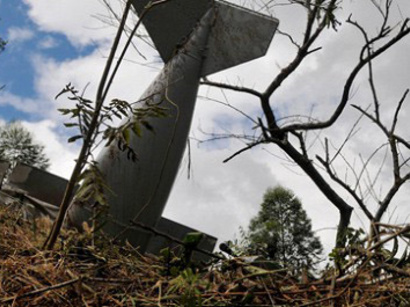
A Russian passenger plane carrying 224 people has just be reported crashed in Egypt’s restive Sinai Peninsula.
According to an AFP report quoting Egyptian officials in the office of Prime Minister, Sharif Ismail, a “Russian civilian plane… crashed in the central Sinai.”
A senior aviation official said the plane was a charter flight operated by a Russian company carrying 217 passengers and seven crew members. He added that communication with the aircraft was lost.
Sergei Lzvolsky, an official with the Russian aviation agency Rosaviatsia told Interfax news agency that the plane had departed Egypt’s Red Sea resort town of Sharm el-Sheikh at 5:51 am local time (03:51 GMT) today.
He said the aircraft did not make contact as expected with air traffic controllers in Cyprus, and “since then the plane has not made contact and has not appeared on radars.”
“Prime Minister (Ismail) is expected to meet the concerned ministries and competent authorities to follow up on the accident of the Russian civilian plane that fell in central Sinai,” Egyptian premier’s office said. [myad]
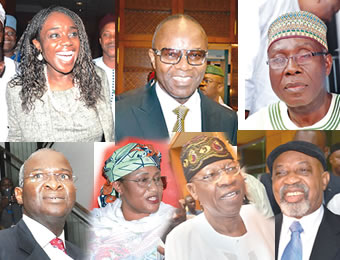
Just as the newly confirmed ministers by the Senate are waiting to get their respective portfolios in the Federal Cabinet, another spanner has been put in their works. President Muhammadu Buhari sent a shock wave across to them by saying that not all the confirmed ministers would be assigned offices. The President made it clear that some of the screened and confirmed ministers will only end up sitting on the Federal Executive Council (FEC) as a way of fulfilling the constitutional requirement of having at least one minister from each state of the federation. The President made this position known Friday in an interview he granted the Nigerian Television Authority (NTA) and Channels TV, shortly before he left for New Delhi, India to attend the third summit of the India-Africa Forum. “There was no reduction (of ministers) to 36. What the constitution says, and we cannot work outside the constitution, is that there must be a cabinet representative from each state. “Yes, there used to be 42 ministers. I think we will be lucky if we can have half of that now because we cannot afford it. “Others may not be substantive ministers, but they will sit in the cabinet because that is what the constitution says and we cannot operate outside the constitution.” President Buhari insisted that he would reduce the number of federal ministries and by extension number of ministers. In answer to a question on whether he will reduce the number of ministers, he said: “Of course. “Unless you can volunteer to be paying them (ministers).” [myad]
What do you do during a flight that lasts nine hours and six minutes? You read. You sleep. You wake, and sleep again. You eat. You pray (if you are the praying type). You discuss with your co-passengers. And of course, you ruminate about your destination. What you’ve heard, or read about the place, particularly if you were visiting for the first time.
But first, due credit for this headline. ‘A Passage to India’ is the title of a literature text I read in the university some 32 years ago. It was a 1924 novel by the English writer, E.M Forster. The book was on the struggle for Indian independence from British colonial rule, and the book is today regarded as one of the 100 Great Works of the 20th Century by the Modern Library, while Time Magazine also includes it in its ‘All Time 100 Novels’ list.
A Passage to India. That was what I embarked on, alongside my principal, President Muhammadu Buhari, who was billed to attend the 3rd India-Africa Forum Summit, scheduled for New Delhi, the Indian capital, between October 27 and 30,2015.
What had I heard about India? You probably heard those childhood tales, too. India, the land of potent talisman. India does not take part in world soccer competitions, because the world football ruling body, FIFA, had banned it for life. What was the offence? Well, France had met with a country that nobody knows, in a game of soccer. But instead of depending on natural skills, India deployed its famed talisman. The opponents kept kicking the air, because the Indians had made the ball invisible. While the opponents did all the gyrations, however, the Indians did all the scoring. When the game ended at the end of 90 minutes, India had scored 90 goals.
Blue murder, FIFA screamed! This is unnatural, and would bring the beautiful game into disrepute. So it banned India for life. Well, that was the story we heard as young boys. Believe it, and you’d believe anything.
And what of athletics. The International Athletics Federation had to ban India for life, too. What happened? It was an Olympics Games (nobody seemed to know what year, and who the host country was). India was competing, and ended up winning gold medals in all the races. You would see all the athletes at the starting blocks, and the moment the whistle is blown for the race to begin, Indian athletes would already be breasting the tape at the other end. Talisman at work!
This is unfair competition, the rest of the world screamed. So the athletics federation banned India again. And that was how the country was left to play cricket, hockey and other such games. But the question we did not ask ourselves was; if talisman worked with soccer and athletics, why doesn’t it work with cricket and hockey? At least, India gets defeated in those games. Some imaginations are simply fertile.
Well, we were passing to India, and it was for serious business. India and Africa had found common grounds, and were cooperating for development in what Narendra Modi, Indian Prime Minister calls “partnership beyond strategic and economic benefits.”
We landed in the land of film stars, beautiful damsels (hope my wife is not reading this) and, of course, medical tourism, at nighttime. Straight to Lalit Hotel, where our President and his entourage were to stay. Lalit. You need to hear a bit about the story of the hotel. It was part of the Lalit Hospitality Group, established in 1988 by Mr Lalit Suri, a very successful businessman and politician, who represented his people in the Indian parliament.
Lalit Suri had the Midas touch. The hotel chain was very successful, and can be found today in most major Indian cities. He had great plans for expansion, and was growing steadily towards the goal. But in 2006, while on a trip to London, Lalit suffered a massive heart attack, and died. He was only 59. But his wife, Dr Jyotsna Suri, took up the gauntlet, and is today keeping her husband’s dreams alive, along with their four adult children.
A day before we travelled, a massive earthquake had occurred in Afghanistan, and the tremor was felt both in Pakistan, and New Delhi. But the organizers of the summit said ‘no shaking,’ that delegates had nothing to fear. There were presidents and top government officials from more than 41 countries, and it was, indeed, a great outing for India and Africa.
Wednesday began with a bilateral meeting between President Buhari and Prime Minister Modi. Discussions focussed mainly on three areas: strengthening relations between the two countries, oil business, and helping Nigeria and Africa to develop their potentials.
India would be quite willing to cooperate with Nigeria on the military front, the PM said. She had helped set up the Nigerian Defence Academy in the early 1960s, provided instructors, and also took in Nigerian officers in its military academy. In fact, President Buhari was at the Defense Services College, Wellington, between July 22 and November 24,1975.
India wants Nigeria’s oil on government to government transactions, and President Buhari said the request would be considered in the context of ongoing reforms in the industry.
Back to Wellington. The alumni of the academy paid the Nigerian president a courtesy visit at the Lalit Hotel. Led by Gen V.K Singh, it was time to go down memory lane. The then Lt Col Buhari had been described thus in a confidential report by H.W Kulkam, the Chief Instructor of the College:”Tall, slim, and well-turned out, Buhari is a quiet, unassuming and honest individual.”
Major General S.P Malhotra, Commandant of the College, on his part, had written: “Sober and balanced. Straightforward, simple and mature.” Memories are made of such.
In almost all the countries he has visited, President Buhari always spared the time to interact with Nigerians in the Diaspora, at the grounds of the Nigerian Embassy or High Commission. It was not different in New Delhi.
Ambassador ‘Sola Enikanolaiye, the acting High Commissioner of Nigeria to India had put together an impressive assemblage of professionals, post-graduate students, businessmen, indeed, Nigerians from all walks of life. He reeled out the many ways in which the High Commission supports Nigerians in India, and from the way he was repeatedly hailed, he seems quite popular with the people.
Nigerians asked many questions. The President answered them all. And he gave them his usual charge: be law abiding. Don’t lord it over your hosts. Obey the rules. Be good ambassadors of Nigeria.
From the High Commission, it was time to meet with the CEOs of Indian companies, particularly those who do, or are aspiring to do business in Nigeria. All the big names in pharmaceuticals, telecommunications, construction, manufacturing, power, oil and gas, agriculture, and many other sectors, were there. They spoke earnestly. The President responded frankly. New vistas were opened, promises were made. A very rewarding session, if you ask me.
That parley did not end without President Buhari warning the Indian businessmen not to connive with unscrupulous people to send sub-standard food and pharmaceutical products to Nigeria. To show how dear this was to the heart of the Nigerian president, it formed part of his paper at the plenary session of the summit the next day.
Thursday was the main day, in which 41 heads of government gathered at the Indira Gandhi Stadium for the high point of the summit.
After a colorful opening session of cultural display, Prime Minister Modi took the floor. He underscored the raison detre of the summit:
“The dreams of one-third of humanity have come together under one roof. Today, the heartbeat of 1.25 billion Indians and 1.25 billion Africans are in rhythm.”
He said further: “India is honoured to be a development partner for Africa. It is a partnership beyond strategic and economic benefits. It is formed from the emotional bonds we share, and the solidarity we feel for each other.”
Modi backed his position with statistics. In the past few years, trade between Africa and India has more than doubled to over $70 billion. India is now a major source of business investment in Africa, and 34 African countries enjoy duty free access to the Indian market. The country has equally committed $7.4 billion in concessional credit and $1.2 billion in grants since the first summit held in 2008.
In the immediate future, according to Modi, concessional credit of $10 billion would be given to Africa within five years, while grant assistance will total $600 million.
The presidents spoke one after the other. Trust Robert Mugabe, who spoke in his capacities as Zimbabwean president and chairman of African Union, he used the opportunity to fire darts at the West.
According to him, one-third of the world’s population must be respected, therefore, the United Nations must become the United Equal Nations, with its Charter amended.
Chairperson of the AU Commission, Dr Nkosazana Dlamini Zuma, submitted that Africa and India could no longer be rationally excluded from the permanent seat of the UN Security Council, a position supported by almost all the presidents.
One thread ran through the presentation of nearly all the African leaders. This was a good time to promote cooperation between Africa and India. South-south cooperation must not just be political slogan, but an opportunity for the countries to to meet their growing challenges.
“Africa needs mutual partnerships leading to development, rather than aids,” submitted King Mohammed VI of Morocco.
Idris Deby Itno of Chad said India and Africa had had mutual exchanges since time immemorial, stressing that partnership will help achieve the Sustainable Development Goals (SDGs).
President Muhammadu Buhari said India and most African countries have similar historical experiences, and the summit was an opportunity to review what had been achieved since 2008, stressing:”India and Africa must develop new spirit of solidarity to confront challenges.”
He equally brought the message home, saying:”as a government, we have demonstrated our strong determination to change the direction and content of governance, including the management of our resources through accountability, transparency, and result-orientation in governance. We are confident that India, as a tested friend and dependable partner, will always stand shoulder to shoulder with us in the discharge of the mandate entrusted to us by our people.”
With the summit over, and planning to return home, I sent text messages to my friends in Nigeria, saying since I was in the land of talisman, they should indicate the type they wanted. The responses were rib-cracking, but you can’t beat this one from Steve Nwosu, Deputy Managing Director/Deputy Editor-in-Chief of The Sun Newspapers. He wrote:
“Get me a money doubling ring. They call it evergreen pocket. Every money you spend finds its way back to your pocket. Hahahaha.”
No doubt, India and Africa are onto a strong partnership that may be enduring, mutually beneficial, with strong implications for development. That is the true talisman.Ever potent, ever sure.
Femi Adesina is Special Adviser, Media and Publicity, to President Buhari. [myad]
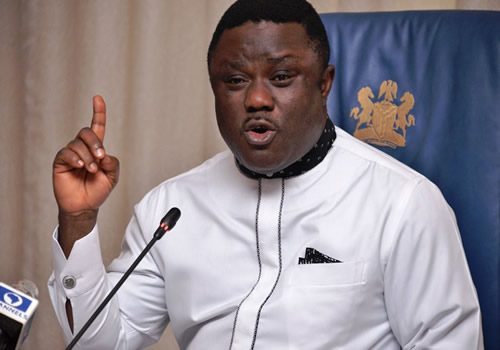
The Permanent Secretary in the Cross River ministry of education, Anne Odey has angered the state Governor, Ben Ayade. The punishment for what the state government called “flouting of civil service rules” is an indefinite suspension. According to the State Security Adviser to the governor, itJude Ngaji, in a chat with news men in Calabar, the state capital, the suspended permanent secretary single handedly ordered the stoppage of prayers in schools’ assemblies by students. Odey had, in a statement directed all private and public primary and secondary schools in the state to stop morning and afternoon devotion forthwith. According to Odey, the directives came from the Commissioner of Police, Henry Fadairo, in view of the security challenges facing the nation. But the Security Adviser said that governor Ayade was not aware of such directive and neither did the permanent secretary pass on such information through the governor or through his office for approval. “The governor feels pained that the permanent secretary got such sensitive information without seeking for his advice and went ahead to issue directive suspending morning devotions in schools. “The governor has directed that the permanent secretary be suspended indefinitely while the ban on suspension of devotion has been lifted immediately. “It is true that police got intelligence information that Boko Haram is planning to bomb schools during morning devotion and therefore directed authorities in the ministry of education to act fast. “But the permanent secretary did not bother to refer to the governor or call for stakeholders’ meeting to that effect.” According to the SSA, it would be contradictory to say that the governor who not only believes in God, but a strong catholic, would turn around to do otherwise. Ngaji appealed to religious leaders to discountenance such instructions as the state government is committed to inculcating good moral lessons into the pupils and students in schools. Reacting, John Eluu, the state Police Public Relations Officer, said Fadairo had approved a 10 minute time duration for morning and afternoon devotions. “The Commissioner of Police told us during our briefing today that he has approved 10 minutes each for morning and afternoon devotion in both public and private schools in the state.” The state Chairman of the Christian Association of Nigeria (CAN), Archbishop Joseph Ukpo, had reacted to the directive stopping devotion in schools by asking the state government to immediately withdraw such directive. The CAN leader said that such directive negated freedom of worship. “This directive to suspend morning devotion will negatively affect the moral upbringing of our children who are the future leaders of this country.” [myad]
We use cookies on our website to give you the most relevant experience by remembering your preferences and repeat visits. By clicking “Accept”, you consent to the use of ALL the cookies.
This website uses cookies to improve your experience while you navigate through the website. Out of these, the cookies that are categorized as necessary are stored on your browser as they are essential for the working of basic functionalities of the website. We also use third-party cookies that help us analyze and understand how you use this website. These cookies will be stored in your browser only with your consent. You also have the option to opt-out of these cookies. But opting out of some of these cookies may affect your browsing experience.
Necessary cookies are absolutely essential for the website to function properly. This category only includes cookies that ensures basic functionalities and security features of the website. These cookies do not store any personal information.
Any cookies that may not be particularly necessary for the website to function and is used specifically to collect user personal data via analytics, ads, other embedded contents are termed as non-necessary cookies. It is mandatory to procure user consent prior to running these cookies on your website.







A Voyage To India, By Femi Adesina
What do you do during a flight that lasts nine hours and six minutes? You read. You sleep. You wake, and sleep again. You eat. You pray (if you are the praying type). You discuss with your co-passengers. And of course, you ruminate about your destination. What you’ve heard, or read about the place, particularly if you were visiting for the first time.
But first, due credit for this headline. ‘A Passage to India’ is the title of a literature text I read in the university some 32 years ago. It was a 1924 novel by the English writer, E.M Forster. The book was on the struggle for Indian independence from British colonial rule, and the book is today regarded as one of the 100 Great Works of the 20th Century by the Modern Library, while Time Magazine also includes it in its ‘All Time 100 Novels’ list.
A Passage to India. That was what I embarked on, alongside my principal, President Muhammadu Buhari, who was billed to attend the 3rd India-Africa Forum Summit, scheduled for New Delhi, the Indian capital, between October 27 and 30,2015.
What had I heard about India? You probably heard those childhood tales, too. India, the land of potent talisman. India does not take part in world soccer competitions, because the world football ruling body, FIFA, had banned it for life. What was the offence? Well, France had met with a country that nobody knows, in a game of soccer. But instead of depending on natural skills, India deployed its famed talisman. The opponents kept kicking the air, because the Indians had made the ball invisible. While the opponents did all the gyrations, however, the Indians did all the scoring. When the game ended at the end of 90 minutes, India had scored 90 goals.
Blue murder, FIFA screamed! This is unnatural, and would bring the beautiful game into disrepute. So it banned India for life. Well, that was the story we heard as young boys. Believe it, and you’d believe anything.
And what of athletics. The International Athletics Federation had to ban India for life, too. What happened? It was an Olympics Games (nobody seemed to know what year, and who the host country was). India was competing, and ended up winning gold medals in all the races. You would see all the athletes at the starting blocks, and the moment the whistle is blown for the race to begin, Indian athletes would already be breasting the tape at the other end. Talisman at work!
This is unfair competition, the rest of the world screamed. So the athletics federation banned India again. And that was how the country was left to play cricket, hockey and other such games. But the question we did not ask ourselves was; if talisman worked with soccer and athletics, why doesn’t it work with cricket and hockey? At least, India gets defeated in those games. Some imaginations are simply fertile.
Well, we were passing to India, and it was for serious business. India and Africa had found common grounds, and were cooperating for development in what Narendra Modi, Indian Prime Minister calls “partnership beyond strategic and economic benefits.”
We landed in the land of film stars, beautiful damsels (hope my wife is not reading this) and, of course, medical tourism, at nighttime. Straight to Lalit Hotel, where our President and his entourage were to stay. Lalit. You need to hear a bit about the story of the hotel. It was part of the Lalit Hospitality Group, established in 1988 by Mr Lalit Suri, a very successful businessman and politician, who represented his people in the Indian parliament.
Lalit Suri had the Midas touch. The hotel chain was very successful, and can be found today in most major Indian cities. He had great plans for expansion, and was growing steadily towards the goal. But in 2006, while on a trip to London, Lalit suffered a massive heart attack, and died. He was only 59. But his wife, Dr Jyotsna Suri, took up the gauntlet, and is today keeping her husband’s dreams alive, along with their four adult children.
A day before we travelled, a massive earthquake had occurred in Afghanistan, and the tremor was felt both in Pakistan, and New Delhi. But the organizers of the summit said ‘no shaking,’ that delegates had nothing to fear. There were presidents and top government officials from more than 41 countries, and it was, indeed, a great outing for India and Africa.
Wednesday began with a bilateral meeting between President Buhari and Prime Minister Modi. Discussions focussed mainly on three areas: strengthening relations between the two countries, oil business, and helping Nigeria and Africa to develop their potentials.
India would be quite willing to cooperate with Nigeria on the military front, the PM said. She had helped set up the Nigerian Defence Academy in the early 1960s, provided instructors, and also took in Nigerian officers in its military academy. In fact, President Buhari was at the Defense Services College, Wellington, between July 22 and November 24,1975.
India wants Nigeria’s oil on government to government transactions, and President Buhari said the request would be considered in the context of ongoing reforms in the industry.
Back to Wellington. The alumni of the academy paid the Nigerian president a courtesy visit at the Lalit Hotel. Led by Gen V.K Singh, it was time to go down memory lane. The then Lt Col Buhari had been described thus in a confidential report by H.W Kulkam, the Chief Instructor of the College:”Tall, slim, and well-turned out, Buhari is a quiet, unassuming and honest individual.”
Major General S.P Malhotra, Commandant of the College, on his part, had written: “Sober and balanced. Straightforward, simple and mature.” Memories are made of such.
In almost all the countries he has visited, President Buhari always spared the time to interact with Nigerians in the Diaspora, at the grounds of the Nigerian Embassy or High Commission. It was not different in New Delhi.
Ambassador ‘Sola Enikanolaiye, the acting High Commissioner of Nigeria to India had put together an impressive assemblage of professionals, post-graduate students, businessmen, indeed, Nigerians from all walks of life. He reeled out the many ways in which the High Commission supports Nigerians in India, and from the way he was repeatedly hailed, he seems quite popular with the people.
Nigerians asked many questions. The President answered them all. And he gave them his usual charge: be law abiding. Don’t lord it over your hosts. Obey the rules. Be good ambassadors of Nigeria.
From the High Commission, it was time to meet with the CEOs of Indian companies, particularly those who do, or are aspiring to do business in Nigeria. All the big names in pharmaceuticals, telecommunications, construction, manufacturing, power, oil and gas, agriculture, and many other sectors, were there. They spoke earnestly. The President responded frankly. New vistas were opened, promises were made. A very rewarding session, if you ask me.
That parley did not end without President Buhari warning the Indian businessmen not to connive with unscrupulous people to send sub-standard food and pharmaceutical products to Nigeria. To show how dear this was to the heart of the Nigerian president, it formed part of his paper at the plenary session of the summit the next day.
Thursday was the main day, in which 41 heads of government gathered at the Indira Gandhi Stadium for the high point of the summit.
After a colorful opening session of cultural display, Prime Minister Modi took the floor. He underscored the raison detre of the summit:
“The dreams of one-third of humanity have come together under one roof. Today, the heartbeat of 1.25 billion Indians and 1.25 billion Africans are in rhythm.”
He said further: “India is honoured to be a development partner for Africa. It is a partnership beyond strategic and economic benefits. It is formed from the emotional bonds we share, and the solidarity we feel for each other.”
Modi backed his position with statistics. In the past few years, trade between Africa and India has more than doubled to over $70 billion. India is now a major source of business investment in Africa, and 34 African countries enjoy duty free access to the Indian market. The country has equally committed $7.4 billion in concessional credit and $1.2 billion in grants since the first summit held in 2008.
In the immediate future, according to Modi, concessional credit of $10 billion would be given to Africa within five years, while grant assistance will total $600 million.
The presidents spoke one after the other. Trust Robert Mugabe, who spoke in his capacities as Zimbabwean president and chairman of African Union, he used the opportunity to fire darts at the West.
According to him, one-third of the world’s population must be respected, therefore, the United Nations must become the United Equal Nations, with its Charter amended.
Chairperson of the AU Commission, Dr Nkosazana Dlamini Zuma, submitted that Africa and India could no longer be rationally excluded from the permanent seat of the UN Security Council, a position supported by almost all the presidents.
One thread ran through the presentation of nearly all the African leaders. This was a good time to promote cooperation between Africa and India. South-south cooperation must not just be political slogan, but an opportunity for the countries to to meet their growing challenges.
“Africa needs mutual partnerships leading to development, rather than aids,” submitted King Mohammed VI of Morocco.
Idris Deby Itno of Chad said India and Africa had had mutual exchanges since time immemorial, stressing that partnership will help achieve the Sustainable Development Goals (SDGs).
President Muhammadu Buhari said India and most African countries have similar historical experiences, and the summit was an opportunity to review what had been achieved since 2008, stressing:”India and Africa must develop new spirit of solidarity to confront challenges.”
He equally brought the message home, saying:”as a government, we have demonstrated our strong determination to change the direction and content of governance, including the management of our resources through accountability, transparency, and result-orientation in governance. We are confident that India, as a tested friend and dependable partner, will always stand shoulder to shoulder with us in the discharge of the mandate entrusted to us by our people.”
With the summit over, and planning to return home, I sent text messages to my friends in Nigeria, saying since I was in the land of talisman, they should indicate the type they wanted. The responses were rib-cracking, but you can’t beat this one from Steve Nwosu, Deputy Managing Director/Deputy Editor-in-Chief of The Sun Newspapers. He wrote:
“Get me a money doubling ring. They call it evergreen pocket. Every money you spend finds its way back to your pocket. Hahahaha.”
No doubt, India and Africa are onto a strong partnership that may be enduring, mutually beneficial, with strong implications for development. That is the true talisman.Ever potent, ever sure.
Femi Adesina is Special Adviser, Media and Publicity, to President Buhari. [myad]