The National and State Assembly Election Petitions Tribunal sitting in Jalingo has set aside the election of the Speaker, Taraba State House of Assembly, Hon. Abel Peter Diah. He is of the Peoples Democratic Party (PDP).
In a judgment delivered today in the petition filed by the All Progressive Congress (APC ) candidate for Mbamga state constituency, Mr Emmanuel Bongo, the tribunal ordered the Independent National Electoral Commission ( INEC ) to withdraw the certificate of return issued to the Speaker pending the conclusion of elections in eight polling units in the constituency.
The APC candidate had filed a petition before the tribunal challenging the victory of Hon Diah on the grounds that elections in 9 polling units of the constituency did not conform substantially with the provisions of the Electoral Act.
In the ruling, which was read by Justice A.M Ali on behalf of the three man panel of justices, the tribunal held that elections in 8 polling units out of the total 48 polling units did not conform substantially with the provisions of the Electoral Act 2010 as amended and therefore ordered INEC to conduct fresh election in the 8 polling units within 90 days.
The tribunal further held that the petitioner failed to proof his case in regard to the 9th polling unit in contention due to his failure to call oral witnesses as he did in regards to the other 8 polling units that were cancelled. [myad]
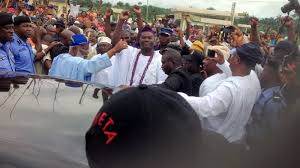
The new Ooni of Ife, Prince Adeyeye Ogunwusi, today entered Ile Ife with pump and pageantry as the residents trooped onto the streets to welcome him. He arrived in Ile Ife at exactly 2.15pm today
Shortly after his arrival, former President Olusegun Obasanjo paid him a visit quietly.
The new Ooni was received at the Ile Ife end of Ibaden-Ife Expressway by Ife chiefs, led by the Lowa Adimula, Oba Joseph Ijaodola.
The new monarch was conveyed to the end of the toll gate in a black car together with the Chairman of the Screening Committee of the Giesi Ruling House, Prof. Adekanye Aderibigbe.
Ogunwusi was first received by his father, who introduced him to the chiefs, led by Ijaodola.
He consulted with the chiefs for about three minutes before he boarded the car that conveyed him to the old toll gate.
He acknowledged cheers from thousands of Ife residents and well wishers who trooped out to witness his arrival.
Ogunwusi’s arrival caused heavy traffic jam on the roads in Ile Ife as youths and elders lined both sides of the road, singing songs of welcome as the new monarch entered into the heart of the town.
Pupils of various schools in Ile Ife were also part of the welcome party for the new Ooni. [myad]
President Muhammadu Buhari has made it clear to Indian business people wanting to do business in Nigeria that it is no longer going to be business as usual. He specifically asked the Indian Chief Executive Officers (CEOs), to accept the changes in policy being introduced by his administration and observe all extant Nigerian laws in running their business in Nigeria. The President, who spoke today in New Delhi at an interactive session with Chief Executives of Indian companies with interests in Nigeria, warned, particularly, that his administration will not tolerate the importation of sub-standard goods, especially foods and medicines, into Nigeria. Buhari said that despite the fall in oil prices, his Administration remains fully committed to maintaining macro-economic stability and improving investor confidence in Nigeria even as he expressed the belief that with its abundance of human and material resources, the Nigerian economy does not have to suffer unduly from low oil prices, despite its severe impact on government revenues. “What is required of us, to which we are strongly committed, is the implementation of tight expenditure controls, effective fiscal and monetary policies, including the husbandry of scarce resources which our introduction of the Single Treasury Account has began to address. “We are aware some of these measures may hurt operations of some businesses in the short term, but we believe they are right for a sustainable economy.” The President noted that India has been a dependable ally and friend of Nigeria and called on the Chief Executives to expand their companies’ investments in Nigeria “so that we can, together, turn our engagements into a win-win situation for our two countries. “We can increase and diversify the current volume of our bilateral trade beyond US$16.36 billion, and diversify to other critical sectors such as agriculture; green technologies in power generation; infrastructure; information and communications technologies; the services sector; education; industry, especially textiles and solid minerals among others.” [myad]
“In the meantime, we will continue to prosecute those who have been indicted for corrupt practices and ensure that stolen funds are recovered, to serve as deterrence to others who nurse the ambition of seeking public office solely for illegal personal gain.” President Muhammadu Buhari made this vow today in New Delhi when he addressed members of the Nigerian community in India. He reaffirmed his Administration’s resolute commitment to curbing corruption, plugging all loopholes in public sector accounting and deploying available resources for the good of all Nigerians. President Buhari stressed that the recovery of stolen funds and prosecution of persons who have been indicted for corrupt practices will also continue to be vigorously pursued. The President said that he expected the ongoing recoveries and prosecutions to serve as a deterrent to others who nurse the ambition of seeking public office solely for illegal personal gain. President Buhari assured Nigerians that his administration fully recognized the devastating consequences of the illegal diversion of public resources meant for national development into private bank accounts, and is doing all within its powers to stop such diversions. “The anti-corruption campaign will be on-going for many years. We are committed to the enthronement of good governance that plugs the loopholes in public sector accounting, and the use of scarce resources for public good. “We are determined to demonstrate exemplary leadership that will make our citizens to change their ways in a manner that lays a solid foundation for reconstruction and development. “I am confident that our approach to fighting corruption through value re-orientation, improved internal processes and systems and the rule of law, as well as enhancing the capacity of the various anti-corruption agencies and institutions will prove more enduring in addressing this evil.” The President told the Nigerian community that he is fully aware of the expectations of Nigerians who elected him on the platform of change, integrity, probity and accountability, and is therefore doing his utmost best to meet those expectations. “I wish to assure you that we shall do our best to fix the economy, create jobs for the teeming population of our youths and make the home environment safe, secure and more attractive to Nigerians outside the country like your good selves. “On the economy, our aim is to address the challenge of infrastructure in all its ramifications, especially power and transportation. We are seeking to create jobs through agriculture, mining, industrial value-addition and the promotion of small scale enterprises. “We are also taking steps to address criminality across the country. We are tackling the menace of terrorism posed by Boko Haram head on and I am pleased to note that though sporadic attacks on soft targets have not stopped, the over-all capacity of Boko Haram to hold territory and determine the course of the conflict has been severely degraded. “If the current positive trends are maintained, we are confident that by the end of this year, we would have succeeded in permanently turning the tide against the Boko Haram insurgents in Nigeria.” [myad]
The Itsekiri ethnic nationality of Warri, Delta State, has expressed surprised that some Igbo interest groups in the South-East that have been agitating for the Biafra Republic out of Nigeria have gone ahead to include the whole of the Niger Delta in the said Republic,dissociating itself completely from such move.
The Itsekiri Leaders of Thought (ILT), in a statement by its Chairman, Pa Johnson Ayomike and Secretary, Edward Ekpoko said that never again will the Itsekiri tolerate invasion of their territory by Igbos as they did in 1967, adding that the Itsekiri nation is committed to the unity of Nigeria and will do all it can to promote and protect it as one indivisible country.
“As Major General Philip Effiong said on January 14, 1970, the Republic of Biafra ceased to exist. We, the Itsekiri, wish it to be eternally so for the peace and development of our great nation.” [myad]
Governor Nyesom Wike has raised an alarm over what he called judicial gang up to wrestle power from him at all costs.
Reacting to the nullification of his election by the Election Petition Tribunal and confirmation of same by the Supreme Court yesterday, Wike said this is a gang up against him and the people of the state.
According to him, the judiciary is setting a dangerous precedent in the country with the way it had gone about elections in Rivers state.
In a statement in Port Harcourt, his special adviser on media and publicity, Opunabo Nko-Tariah alleged that there had been effort to wrestle power from Wike through the back door and that legal steps will be taken to defend the mandate of the people displayed in the April 11 general election.
“What is going on right now can best be described as judicial gang-up against Governor Wike, nay, the people of Rivers State. It is an affront on democracy and a blight disregard for the will of the people as evinced in the April 11 general elections.
“The courts are setting pernicious precedents by hinging their verdicts on inane points. Rivers people overwhelmingly gave their mandate to Governor Wike but a microscopic few want to wrest that mandate from him through the back door.” [myad]
A 200 level student of Economics in the Kogi State University, Anyamgba, Odo Sylvester has confessed that he actually demanded the sum of N2 Million from The Sun newspapers Deputy Managing Director, Mr. Steve Nwosu to assist him retrieve his kidnapped wife, Mrs. Toyin, claiming that he is not a kidnapper and doesn’t know what kidnapper looks like.
Sylvester, who was arrested on the premises of the university in Anyamgba yesterday by police detectives, said that he only posed as one of the kidnappers in order to extort money from Mr. Nwosu, to buy some handouts and furnish his apartment.
He told a crowd at the Lagos State Police Command where he was paraded alongside 44 other suspected criminals that he demanded N2 million as ransom from Mr. Nwosu.
“I am not a kidnapper. I do not know what a kidnapper looks like. Greed led me into this. When I read about the kidnap of The Sun DMD’s wife abduction, I decided to hijack the opportunity to play a fast one on her husband in order to raise money to buy some handouts and also furnish my apartment.
“Immediately, I bought a copy of The Sun newspaper and got the number of the DMD from the back page. I dialed the number and demanded for N100,000 from him, saying I would assist him secure the release of his wife. He told me he had N2.5 million on ground as ransom. When I heard that, I became cold because I have never counted a million in my life, let alone N2.5 million.
“He told me to send my account details but I told him I would get back to him. When I called again, I demanded for N2 million.
“Again, I called next day to negotiate on how to get the N2 million, only for him to inform me that some people had called him, claiming they were the abductors. That ended my call to him. This thing started in a day and also ended in one day.
“But to my shock, some plain clothes policemen stormed my school while I was in class and whisked me away. I am not a kidnapper. I never collected any money from them. My intention was just to collect the N100,000 and refund anything more than that.”
Meanwhile, the Lagos State Commissioner of Police, Fatai Owoseni has given assurance that investigation was still ongoing to apprehend others involved in the abduction of Mrs. Nwosu. [myad]
I have a story to tell the world and most importantly the people of Ile-Ife. About 40 years ago, I was born into the Giesi Ruling House, Ojaja Royal Compound in the ancient city of Ile-Ife. From birth, my life has been a journey; one that I embarked on, saddled with great conscientiousness when I became a responsible father at the age of 19, which shaped and groomed me for greater challenges ahead. To cater for my family as a young father, I became very enterprising with the knack of building something out of nothing. This certainly increased my temperament for being successful in all my endeavours, as well as towing the right path as a responsible father. Thus, in the following years, I was able to build a consortia of companies with a team of well-versed, highly skilled and unskilled professionals from scratch and with hard work and God’s providence. This has made me a huge employer of labour and a captain of industries. The story of Ile-Ife begins as the cradle of civilization and has spread its tentacles beyond Black Africa. The Ooni stool is highly revered and exalted and as the world looks on; our strength and emphasis need to be injected into the development of Ile-Ife as a beacon of hope and enviable city.
Spiritual home of all Yoruba Suffices to say that Ile-Ife is the ancestral and spiritual home of all Yorubas, bona fide, in Nigeria and the Diaspora, and the World Headquarters of the House of Oduduwa, which comprises people resident in nearly all the continents of the world. Thus, the Ooni, as the head of the vast Oduduwa family, must be no less versatile and resourceful. Available evidences from the curatorial community and archaeological discoveries have put the origin of Ile-Ife around 2000 years BC. Around this time, the people of Ile-Ife have distinguished themselves in technology and cultural advancement. A notable fact in this direction is Ori-Olokun: though purportedly ‘discovered’ by the famous German archaeologist Leo Frobenius in 1910, but had been in existence for thousands of years. Discovery: The pure-copper sculpture took the entire arts world by storm at the time of its discovery that experts from the West argued that the artefact was a mystery that was too sophisticated to have been created by African hands. However, after careful examinations of other works, profusely located in and around the city and bearing striking resemblance, the world accepted the truth that the advanced people of Ile-Ife had, not only wielded the technology to turn iron to alloy but also of moulding abstract artworks out of the product. Consequently, it is now accepted by the curatorial community that the advanced artistic techniques used to create the sculpture were more advanced than those of Renaissance Italy, and comparable to those of [the artist] Donatello. Yet, Ile-Ife has not taken its rightful position as the ‘source’ of civilization despite her wealth of history, culture and tradition. Having found ourselves in such state of affairs where the potential of the land remains untapped and its people lacking economic and social emancipation, we should all take it upon ourselves to redress this situation.
Redressing the situation The Ile-Ife of ‘my dream’ will be strategically positioned to empower its people socially, economically and culturally to bring about the desired developments. Now, with our resolve to transform Ile-Ife we are ‘SET’ to leave no stone unturned, in the drive to put Ile-Ife on the map of the world. Our ultimate goal is to reposition the House of Oduduwa as a worthy example of successful inward-looking community. At this juncture, I consider it pertinent to share with everyone the account of how Nigeria as a nation came to be. The Royal Niger Company was a mercantile company charter by the British government in the nineteenth century. It was formed in 1879 as the United African Company and became the Royal Niger Company in 1886. By 1900 it went through several name changes and in 1914 a merger occurred between the Southern Nigeria Protectorate and the Northern Nigeria Protectorate to become the independent Federal Republic of Nigeria in 1960. It suffices to say our beloved nation developed through a corporation of technocrats and quality mind input. Arguably, this is one of the several ways cities and communities are built; through large corporations. The ethos of this account goes to prove that any geographic setting can undergo boundless growth through clusters of companies which invariably can lead to the creation of settlements and human capital development. Consequently, there is a huge possibility for Ile-Ife to experience tremendous growth through industrialization and developmental projects like a company managed by dedicated sons and daughters of Ife and all Ife enthusiasts. I have no doubt, Ife will be great again due to its economic dexterity. Ife has one of the largest land mass in the South-west beaming with natural resources including three out of the four factors of production; ‘land’, ‘labour’ and ‘entrepreneurship’ and with our great resolve we shall work towards ‘capital’ creation. I am very passionate about my roots with the determination of bringing Ile-Ife to the forefront of economic and social affairs. In my private life, I have for a while been involved in many philanthropic gestures in Ile-Ife and its environs. The progressiveness of the youths of Ile-Ife is at the core of my philosophy and I have been instilling hope to thousands of youths through the various ongoing reciprocity Programmes I established a while ago. It is within the dictates of our culture that the young shall provide for the old and for this reason our youths need to be nurtured and engaged positively hence they can attain financial independence and in return provide for their parents, families and dependants. This is not to say that the old and elderly will be left out. There will be various empowerment Programmes for the elderly and the widowed to learn new trades and acquire new skills that will help stamp out redundancy and at the same time be financially rewarding to them. Many might argue that the tasks before me are incredibly monumental and impossible. However, I do not get easily swayed by the idea of impossibilities. In every challenging situation what I see is a speck of possibility which I build on till the task at hand is completed. I have done this time over time and I have defied the rules of men to follow my gut instincts. I have excelled where, people had predicted failure and I derived the most joy where others have said emphatically “it is not possible.” A recent classic example of turning impossibilities to possibilities took place at ‘Parakin’ in Ile-Ife where I converted a sizeable piece of thick forest land into a beautiful castle within a month. The land hitherto, was a garbage dump and an escape route for men of the underworld in the vicinity which constituted a social menace to the inhabitants of ‘Parakin’. In recent history one cannot mention Ile-Ife without acknowledging the Ife and Modakeke conflict. It’s unfortunate that lives were lost during the war between Ife and Modakeke; a war that had no economic value and displaced many lives. I paid a courtesy visit to the youths affected by the war and implored them to be proactive. Furthermore I urged them to be on the straight and narrow path and propagated the tenets of hard work as the only way to make it in life.
Touching experiences In the course of my life I have had many touching experiences. However, my most compelling experience till date involves two young boys namely Demola Adewole and Taye Fayemi. Demola and thousands of others energetic youths visit work sites on a daily basis to solicit for money. I took it upon myself to get to know these young boys and found that all they wanted was to earn a decent living. We got acquainted with Demola and found out he was a welder. Without hesitation, we helped to re-orientate him and got him involved in construction work in ‘Parakin’. Demola Adewole has turned out to be one of the best welders I have been privileged to work with till date. Another set of energetic youths on one of the days I visited Ife chased after my car, many of them climbed onto the fast moving car and during the tussle to stay latched on to the car, one of them got injured. I got out of the car and addressed all of them and asked why they would want to hurt themselves and with no care in the world, Taye replied “death means nothing to me”; I shed tears, there is no hope for the youths and no one to rebuild their dashed hopes or future. Taye Fayemi was simply desperate to make a living for himself and today, to the glory of God I personally supervise Taye’s rehabilitation, his personal development and wellbeing. Destinies: Similar to the story of Demola and Taye, are thousands of youths with different expertise that need our help to find their feet, many whose destinies would have been cut short like the others lost the war. I cannot but emphasize that the development and well being of our youths is paramount to our future and one that is very close to my heart. This area needs to be properly addressed to ensure our youths are well engaged in various professional and vocational pursuits. Today, and to the glory of God, I have been energized to rehabilitate and take off the streets several thousands of youths by providing them with gainful employment. Furthermore, we shall set up a foundation that will support post war effects and the rebuilding of war torn Ife and Modakeke. Thereafter there shall NEVER be war again. I stand firmly for peace and unity between Ife and Modakeke and I guarantee that this peace and unity will transcend into economic and social benefits for everyone. Similarly, we shall use this stool to unify the entire Yoruba race; there shall be no division, no supremacy or animosity amongst us, we are all from the one and the same source-God Almighty. Coming to the throne is a clarion call to heed my selfless desire to serve the people of Ile-Ife, the Yoruba race and all of humanity. We will use the stool to provide a lot of opportunities to invest in the youths through mentor-ship and empowerment programs that will further take thousands off the streets on a gradual basis. Youths all over the country will be eligible for the mentor-ship programme and Ife will be the pilot model. We will use the stool to transpose Ile-Ife into the twenty-first century and with the use and influence of social media we are ‘set’ for his transformation. Sons and daughters of Ife and Ife enthusiasts around the world will have an input in the building of the New Ife City, ‘NIC’ through constructive feedback. ‘Socially’, we are ‘set’ to revive and promote Ile-Ife as a tourist destination. ‘Economically’ we are ‘set’ to increase our industrial footprints to give Ife the much desired facelift and ‘Traditionally’ we are ‘set’ to redefine the kingship system by blending modernity into our cultural values and practices and our tradition of thousands of years will stand. Plans are well under-way to revitalize Ife in the areas of Sports, Mining, Agriculture, Real Estate, Tourism and rapid industrialization. To achieve this transformation, a brand new platform named ‘House Of Oduduwa Resources Limited’ has been established to stimulate the entire economy of Ile-Ife with a positive impact on the entire Yoruba race and our nation as a whole. ‘House Of Oduduwa Resources Limited’ will be tasked with rebuilding Ife into the ‘New Ife city’, NIC. However, this is a herculean task which can only be achieved with the support of all well-meaning technocrats, sons and daughters of Ile-Ife in Nigeria and in the Diaspora and all lovers of Ife. My fervent desire is to grow ‘House Of Oduduwa Resources Limited’ into one of the biggest corporations out of Africa, likewise uniting all lovers of Ife with the people of Ife. Earlier this year, I acquainted the youths of Ile-Ife of my plans to replicate the truly Nigerian project, Inagbe Grand Resorts Lagos, Nigeria (almost hundred percent of raw materials used are locally sourced) in Ile-Ife. Inagbe Grand Resorts is the first of its kind and will soon be the most sought after resort destination in all of West Africa. I have developed an incredible master plan for the proposed ‘Ife Grand Resorts’ which will be an off shoot of ‘Inagbe Grand Resorts Lagos’. The ‘Ife Grand Resort’ project and the ‘NIC’ initiative was conceived to attract young men and women, businesses, corporate organization, investors, holiday makers, lovers of Ife and Ife in Diaspora to a comfortable ambience to stay when they are away from home. This will continually put Ile-Ife, the cradle of black civilization on the map likewise showcasing many artefacts about the Yoruba race, hence creating a steady influx of people into Ile-Ife. The time has come for us to embrace our true heritage as the progeny of Oduduwa and the task of modernizing Ile-Ife is yours and mine. I am highly honoured to have been chosen to fill the stool that great men once occupied; history and I will forever remember this day. I use this opportunity to pay tribute to Oba Adesoji Aderemi and Oba Okunade Sijuwade; these monarchs were colossus that redefined the monarchy with touch of diligence, elegance and gravitas that traversed so many cultural boundaries. They were great fathers to me and I will forever miss and honour them. I am not coming to the throne to pass judgment on those that have maliciously wronged me. But then, I should think that a bid to be enthroned as the foremost Oba in Yoruba race should be healthy and ordained of God. There is also the Ifa divination that also synthesizes the process, just in case human beings are partial. Rather, some people resorted to dangerous attacks, wicked lies, malicious insinuations and vigorous campaign of calumny. Why would I fail to forgive them when all came to nought and the good people and governments of Ife and State of Osun saw through these unfair games and chose me as the prestigious Ooni of Ife. Therefore, I am coming to set a good example and show the world that I am truly called by God to lead Ile-Ife into a state of tranquillity, conscientiousness and prosperity. It is my fervent prayer that the Lord will continue to guide us all and bestow us with great wisdom to carry out our incumbent tasks. I use this opportunity to call on all the sons of Ile-Ife that were alongside me in the race for the stool to heed to my call and let’s work harmoniously to align our goals for the sake of posterity and Ile-Ife. Together we shall not lose sight of the values and tradition that have made us the greatest nation of black people on earth. I come before you all today as a man pledging his unwavering commitment to his Kingdom and his people that I cannot do this alone; without you all there is no me “I will serve you all with everything I have”. Long live Ile-Ife; long live the Yoruba race, long live the House of Oduduwa, and God Bless the Federal Republic of Nigeria. . Prince Ogunwusi is the Ooni-elect. The process of his coronation begins on Wednesday (today). . Culled from Vanguard newspaper. [myad]
Last week in this column, entitled “Jonathan’s fair-weather friends,” I said Dr. Reuben Abati, former spokesman of President Goodluck Jonathan, was wrong to subscribe to the popular belief that a section of this country, specifically the North – for which read the so-called Hausa/Fulani – believed it is, to use the hackneyed expression, “born to rule.” Abati did not use exactly those words in his well-publicised sharp reprimand of Chief Edwin Clark over the godfather’s recent denunciation of his erstwhile godson, Jonathan. But the difference between the words he used and the hackneyed phrase was more or less like that between half a dozen of one and six of the other. The only difference this time was that Abati stretched the presumed Northern superiority complex to include others outside the region.
The betrayal of Jonathan’s confidence by the likes of Clark, Abati said in his putdown of the old man, was one reason “why the existent power blocs that consider themselves most fit to rule, continue to believe that those whose ancestors never ran empires can never be trusted with power.”
Abati’s reference to “those whose ancestors never ran empires” obviously would include at least the Jukuns who once ran the mighty Kwararafa Empire, the Yoruba who ran the Oyo Empire and the Edo who ran the Benin Empire. Abati, I am sure, knows very well that none of these three nationalities, or for that matter any other nationality, would agree that it suffers from any superiority complex, along with the Hausa/Fulani. But then even the Hausa/Fulani themselves would deny they suffer from this complex and even go further to accuse others of the same complex.
The fact is that every nationality in the world, no matter how small, thinks it is superior to others – hence its faith in preserving its language and culture – but paradoxically also accuses others of the same complex. This clearly makes the notion of ethnic superiority, and by the same token, ethnic inferiority complex, more subjective than objective.
Take, for example, Nigeria’s political-economy which has rested on a tripod of its three biggest ethnic groups, the Hausa/Fulani in the North, the Yoruba in the West and the Igbo in the East. In his 1987 autobiography, the late Alhaji Babatunde Jose, post Independent Nigeria’s greatest newspaperman, provided what I believe is probably the greatest insight into the country’s tripod-based politics.
This was in Chapter 7 where he shed some light in what led to the infamous Kano Riots of May 18, 1953 which started from Sabon Gari, the mainly Igbo settlement on the city’s outskirts. Jose was at that time on tour of the North as a senior reporter of Daily Times. He had, he said, arrived Zaria from Kano by train when he heard that a riot had broken out in Kano following a campaign rally addressed by Chief Ladoke Akintola, then Deputy Leader of Action Group, in which he disparaged the Northern leadership “in fluent Hausa” for opposing the independence motion that had been moved in parliament in Lagos by his party.
As a resourceful reporter, Jose persuaded a senior railway officer to allow him to double-back to Kano on a goods train that night. He then filed an eye-witness account of the riot in which he reported that it was one between the Hausa and the Yoruba. “Somehow,” Jose said, “it appeared in the Daily Times as a riot between Hausa and Ibos, a very different matter, and potentially a very dangerous error.” So dangerous that Percy Roberts, the expatriate boss of the newspaper, was summoned by the Chief Secretary of the Government (today’s equivalent of Secretary of the Government of the Federation) and persuaded to withdraw the entire edition and reprint it with the correct story.
“We,” Jose said, “never found out how the mistake occurred. Was it an accident or was it a deliberate attempt to foment trouble?”
Whatever it was, the incident provided an insight into how politics in this country has revolved around the three biggest ethnic groups in the country. As Jose pointed out in that chapter, “The Yorubas had literally ruled Nigeria since the British came to the exclusion of the Hausa and the Ibos. While the Yorubas had produced the second generation of graduates in law, medicine and engineering, the Ibos were just starting with the first generation. But the Hausas had not started at all… Lagos was Nigeria and there was resistance to the backward provincials coming to share power in Lagos.”
So Nigeria’s predicament has been one in which democracy, as essentially a game of numbers, has pitted the elites of one big ethnic group who think they have the numbers to dictate the shots against the elites of the other two big groups who believe they have the Western education to be the rightful heirs to the departing colonialists. And until Jonathan, an Ijaw, came along in 2011, the other smaller ethnic groups were supposed to be little more than bit players in the country’s political drama.
Numbers may have trumped Western education in the politics of this country since Independence, but neither the West (Yoruba) nor the East (Igbo) have the moral right to accuse the North (Hausa/Fulani) of thinking it is “born to rule.” If nothing else, the victory of Chief M. K. O. Abiola, a Yoruba, against Alhaji Bashir Tofa, a “Hausa” in the now famous June 12, 1993 presidential election even in the North, and the support his victory got from leading Northern elites like late Major-General Hassan Usman Katsina, Malam Adamu Ciroma and Alhaji Balarabe Musa, has since debunked the notion that Northerners alone believe they are born to rule.
Of course, a Northerner, military president, General Ibrahim Babangida, annulled the election and another Northerner, General Sani Abacha, buried the struggle for its realization as military head of state. But none of them had any one’s mandate to do so. And they only succeeded with the active support of elites from all over the country.
The fact is that few of our elites, whatever their ethnicity, believe in democracy as a means to power through the popular will. Fewer still are prepared to work long and hard to cultivate any reasonable level of popular support across ethnic, regional and religious lines. Instead they’ll sooner use all three, and others more, to divide us in order to rule us.
Anyone inclined to accuse only the North of a “born to rule complex” should remember how, in an interview in Sunday Vanguard of July 21, 2002, Mr Femi Fani-Kayode, then a spokesman of President Olusegun Obasanjo, declared that whether anyone liked it or not the South would rule Nigeria for “close to 50 years.” He even argued that the North would “actually be better-off being ruled by people from the South” because the benefits of good governance, which, presumably, was a Southern preserve, would “flow down.”
It should also be remembered that three years after Fani-Kayode’s declaration, the Southern Leaders Forum met in Enugu and demanded that power remained in the South beyond the 2007 elections and threatened otherwise to boycott the elections.
So if the so-called Hausa/Fulani, and by extension, the North, appear more guilty of a “born to rule” syndrome than the other big ethnic groups – and remember as we have seen in several multi-ethnic states like Benue, Kogi, Delta and Bayelsa, one man’s minority group is another’s majority – it is not because it is the veritable truth. It is simply because as Arthur Schlesinger, Jr. the American historian once said, “Karl Marx held that history is shaped by those who control the means of production. In our times history is shaped by those who control the means of communication.”
In Nigeria’s information and communication order, the North has clearly been grossly disadvantaged historically and has remained so even today. For this, however, the region can have only itself to blame because it has had more than 50 years to catch up or at least narrow the gap significantly but has failed to do so. [myad]
Vice President Yemi Osinbajo has admitted that the task of rebuilding, restoring and rehabilitating the towns and villages, including fixing brick and mortar as well as mending hearts and minds “damaged by senseless murderous violence” is many and profound. He stressed also that it would cost money and time but that neither money nor time can fix the trauma of loss of family, relations and friends, the shame and pain of the raped, the scars and fears of the parents of the abducted and kidnapped as well as the loss of homes and possessions and livelihoods, the hundreds of thousands of orphaned children. Vice President Osinbajo spoke today at the opening of the North-East Humanitarian Multi-stakeholders Engagement meeting at the Government House, Maiduguri, Borno State. He said: “we are called not just to mend hearts and minds of victims but also of their traducers, and killers. The young men and women who have been brainwashed to kill, maim and destroy in the warped believe that by doing so they please God.” Osinbajo said that the North-East humanitarian stakeholders meeting was important not just for what it plans to achieve, including the presentation and endorsement of collaborative efforts to the North East but also for the fact that the meeting was taking place in Maiduguri which probably suffered the most loss of lives and property in the six years of Boko Haram scourge. The Vice President empathized that the North-East region has suffered tremendously in the areas of the destruction of infrastructure, farmlands, businesses and trades, the destruction of schools and the loss of school years. The Vice President who commended the civil society groups, funding partners, regional and international partners, told the stakeholders that though much have been done but that much more still needs to be done According to Professor Osinbajo, the meeting was the “expression of our collective determination to, find the most effective and creative ways to intervene in restoring the dignity, family lives and livelihood of hundreds of thousands of IDPs in the North- East. “One of the goals of this initiatives is to strengthen the capacities of existing Civil Society Organisations (CSOs), especially in the region, and to aide the development of others where noticeable and important gaps exist. He announced that the Presidential Initiative for the North-East will unveil a plan to help develop the capacities of NGOs in the region and grow new ones where needed. Earlier, the governor of Borno State, Alhaji Kashim Shttima commended the federal government, President Buhari and Vice President Osinbajo for commitment to restore peace and development of the region. He said that due to the unflinching support of the Vice President, the military and civil society Organisations as well as the United Nations, peace and commercial activities have returned to Borno State and IDPs have also returned to the state. [myad]
We use cookies on our website to give you the most relevant experience by remembering your preferences and repeat visits. By clicking “Accept”, you consent to the use of ALL the cookies.
This website uses cookies to improve your experience while you navigate through the website. Out of these, the cookies that are categorized as necessary are stored on your browser as they are essential for the working of basic functionalities of the website. We also use third-party cookies that help us analyze and understand how you use this website. These cookies will be stored in your browser only with your consent. You also have the option to opt-out of these cookies. But opting out of some of these cookies may affect your browsing experience.
Necessary cookies are absolutely essential for the website to function properly. This category only includes cookies that ensures basic functionalities and security features of the website. These cookies do not store any personal information.
Any cookies that may not be particularly necessary for the website to function and is used specifically to collect user personal data via analytics, ads, other embedded contents are termed as non-necessary cookies. It is mandatory to procure user consent prior to running these cookies on your website.










The “Born To Rule” Syndrome And The Nigerian Elite, By Mohammed Haruna
Last week in this column, entitled “Jonathan’s fair-weather friends,” I said Dr. Reuben Abati, former spokesman of President Goodluck Jonathan, was wrong to subscribe to the popular belief that a section of this country, specifically the North – for which read the so-called Hausa/Fulani – believed it is, to use the hackneyed expression, “born to rule.” Abati did not use exactly those words in his well-publicised sharp reprimand of Chief Edwin Clark over the godfather’s recent denunciation of his erstwhile godson, Jonathan. But the difference between the words he used and the hackneyed phrase was more or less like that between half a dozen of one and six of the other. The only difference this time was that Abati stretched the presumed Northern superiority complex to include others outside the region.
The betrayal of Jonathan’s confidence by the likes of Clark, Abati said in his putdown of the old man, was one reason “why the existent power blocs that consider themselves most fit to rule, continue to believe that those whose ancestors never ran empires can never be trusted with power.”
Abati’s reference to “those whose ancestors never ran empires” obviously would include at least the Jukuns who once ran the mighty Kwararafa Empire, the Yoruba who ran the Oyo Empire and the Edo who ran the Benin Empire. Abati, I am sure, knows very well that none of these three nationalities, or for that matter any other nationality, would agree that it suffers from any superiority complex, along with the Hausa/Fulani. But then even the Hausa/Fulani themselves would deny they suffer from this complex and even go further to accuse others of the same complex.
The fact is that every nationality in the world, no matter how small, thinks it is superior to others – hence its faith in preserving its language and culture – but paradoxically also accuses others of the same complex. This clearly makes the notion of ethnic superiority, and by the same token, ethnic inferiority complex, more subjective than objective.
Take, for example, Nigeria’s political-economy which has rested on a tripod of its three biggest ethnic groups, the Hausa/Fulani in the North, the Yoruba in the West and the Igbo in the East. In his 1987 autobiography, the late Alhaji Babatunde Jose, post Independent Nigeria’s greatest newspaperman, provided what I believe is probably the greatest insight into the country’s tripod-based politics.
This was in Chapter 7 where he shed some light in what led to the infamous Kano Riots of May 18, 1953 which started from Sabon Gari, the mainly Igbo settlement on the city’s outskirts. Jose was at that time on tour of the North as a senior reporter of Daily Times. He had, he said, arrived Zaria from Kano by train when he heard that a riot had broken out in Kano following a campaign rally addressed by Chief Ladoke Akintola, then Deputy Leader of Action Group, in which he disparaged the Northern leadership “in fluent Hausa” for opposing the independence motion that had been moved in parliament in Lagos by his party.
As a resourceful reporter, Jose persuaded a senior railway officer to allow him to double-back to Kano on a goods train that night. He then filed an eye-witness account of the riot in which he reported that it was one between the Hausa and the Yoruba. “Somehow,” Jose said, “it appeared in the Daily Times as a riot between Hausa and Ibos, a very different matter, and potentially a very dangerous error.” So dangerous that Percy Roberts, the expatriate boss of the newspaper, was summoned by the Chief Secretary of the Government (today’s equivalent of Secretary of the Government of the Federation) and persuaded to withdraw the entire edition and reprint it with the correct story.
“We,” Jose said, “never found out how the mistake occurred. Was it an accident or was it a deliberate attempt to foment trouble?”
Whatever it was, the incident provided an insight into how politics in this country has revolved around the three biggest ethnic groups in the country. As Jose pointed out in that chapter, “The Yorubas had literally ruled Nigeria since the British came to the exclusion of the Hausa and the Ibos. While the Yorubas had produced the second generation of graduates in law, medicine and engineering, the Ibos were just starting with the first generation. But the Hausas had not started at all… Lagos was Nigeria and there was resistance to the backward provincials coming to share power in Lagos.”
So Nigeria’s predicament has been one in which democracy, as essentially a game of numbers, has pitted the elites of one big ethnic group who think they have the numbers to dictate the shots against the elites of the other two big groups who believe they have the Western education to be the rightful heirs to the departing colonialists. And until Jonathan, an Ijaw, came along in 2011, the other smaller ethnic groups were supposed to be little more than bit players in the country’s political drama.
Numbers may have trumped Western education in the politics of this country since Independence, but neither the West (Yoruba) nor the East (Igbo) have the moral right to accuse the North (Hausa/Fulani) of thinking it is “born to rule.” If nothing else, the victory of Chief M. K. O. Abiola, a Yoruba, against Alhaji Bashir Tofa, a “Hausa” in the now famous June 12, 1993 presidential election even in the North, and the support his victory got from leading Northern elites like late Major-General Hassan Usman Katsina, Malam Adamu Ciroma and Alhaji Balarabe Musa, has since debunked the notion that Northerners alone believe they are born to rule.
Of course, a Northerner, military president, General Ibrahim Babangida, annulled the election and another Northerner, General Sani Abacha, buried the struggle for its realization as military head of state. But none of them had any one’s mandate to do so. And they only succeeded with the active support of elites from all over the country.
The fact is that few of our elites, whatever their ethnicity, believe in democracy as a means to power through the popular will. Fewer still are prepared to work long and hard to cultivate any reasonable level of popular support across ethnic, regional and religious lines. Instead they’ll sooner use all three, and others more, to divide us in order to rule us.
Anyone inclined to accuse only the North of a “born to rule complex” should remember how, in an interview in Sunday Vanguard of July 21, 2002, Mr Femi Fani-Kayode, then a spokesman of President Olusegun Obasanjo, declared that whether anyone liked it or not the South would rule Nigeria for “close to 50 years.” He even argued that the North would “actually be better-off being ruled by people from the South” because the benefits of good governance, which, presumably, was a Southern preserve, would “flow down.”
It should also be remembered that three years after Fani-Kayode’s declaration, the Southern Leaders Forum met in Enugu and demanded that power remained in the South beyond the 2007 elections and threatened otherwise to boycott the elections.
So if the so-called Hausa/Fulani, and by extension, the North, appear more guilty of a “born to rule” syndrome than the other big ethnic groups – and remember as we have seen in several multi-ethnic states like Benue, Kogi, Delta and Bayelsa, one man’s minority group is another’s majority – it is not because it is the veritable truth. It is simply because as Arthur Schlesinger, Jr. the American historian once said, “Karl Marx held that history is shaped by those who control the means of production. In our times history is shaped by those who control the means of communication.”
In Nigeria’s information and communication order, the North has clearly been grossly disadvantaged historically and has remained so even today. For this, however, the region can have only itself to blame because it has had more than 50 years to catch up or at least narrow the gap significantly but has failed to do so. [myad]