


Ex CBN Governor, Sanusi, Insists The Only Way To Stem Economic Collapse Is To Remove Fuel Subsidy
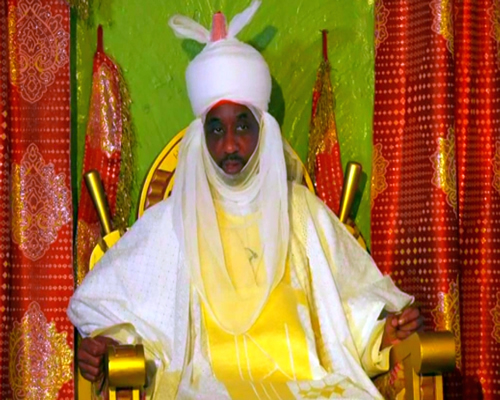 Former governor of the Central Bank of Nigeria (CBN) and currently the Emir of Kano, Alhaji Muhammadu Sanusi 11 has made it clear that the only way President Muhammadu Buhari can stem the nation’s economic collapse is for him to remove the subsidy on fuel.
The former CBN governor, who sounded this warning at the All Africa Business Leaders Award, West Africa, held in Lagos yesterday, stressed that Nigeria could no longer afford the many leakages that had ravaged and eaten deep into the economic system for ages.
The monarch, who quoted, CBN figures, said: “in the first two quarters of this year, this country spent over N500 billion on debt servicing. At the end of this year, it will be over N1trillion which is more than the amount of money budgeted for health, education and defence combined.
“There is no room in the government’s balance sheet for borrowing and spending. We have no option but to block leakages and to stop non-priority expenditures.
“It is for this reason that we cannot afford to spend all our time talking about the past. It is time to look at what we are doing now and ask ourselves if the fiscal stance and monetary stance are the appropriate stances for the situation we are in.
“Does it make sense at this time for the government to continue paying petroleum subsidy? It does not, and we must say it.
“When you need fiscal consolidation, when you cannot borrow, when you are not earning because oil prices are down, you have to shut down, especially those expense lines that have been known historically to be the sights of those seeking rent.This fuel subsidy has to go.”
He also called for the expansion of the tax base and an increase in Value-Added-Tax (VAT0, adding: “our tax base has to expand. VAT has to go up. We can’t continue having an economy where we collect tax from oil companies, collect tax, maybe, from the telecoms companies, and then 60, 70 per cent of the GDP does not pay taxes. This is something that has to be looked at.”
Sanusi also frowned at the anomalies in the economy, saying: “we are Africa’s biggest oil producer but the biggest export from the United Kingdom to Nigeria is petroleum products. We don’t refine our own crude. We don’t have a petro-chemical industry. We burn our gas and we don’t have enough electricity.
“We produce cotton and import textiles from China. We have a large tomato belt and we import tomato paste. Everywhere you turn…we produce cassava, we don’t produce starch. And what we don’t have we export. It is so bad that we had a military government that conducted free democratic elections in Liberia. We exported democracy when we had a military government.”
The Emir recalled his days as the apex bank boss, Sanusi and said that the biggest challenge he had as Governor of Central Bank was convincing politicians that there would be a day when we will regret not saving the money when oil price was high.
“That the leakages in the oil sector could not continue; that oil was a commodity whose price goes up and goes down and when it comes down, if you don’t have the buffers, you are going to suffer.
“It is one of these moments where if you were not a Nigerian, you would say well, I told you so. But you can’t, because it is a very sad story. It is very obvious and it has happened over and over again. You have high oil prices, high oil revenues and you blow the money away, and when oil prices crash, you don’t know how to face the situation.
“In 2009, we had a huge crisis. Oil prices crashed from 140 dollars to less than 40 dollars. That was the time I was coming to the Central Bank. But at that time, the government had a number of advantages. The previous administration had saved a lot. There were physical buffers. The Central Bank and the Ministry of Finance could pursue countless fiscal and monetary policies, even though we had devaluation, even though we had some inflations, even though we dealt with the biggest banking crisis in our history, the economy continued to grow and people continued to be employed.
“The situation today is different. We spent years deceiving ourselves, calling ourselves the 21st biggest economy in the world based on something called rebasing. We said our debt to GDP ratio was 11 per cent and that the ratio looked very good. Yes we had a debt to GDP ratio of 11 per cent, but we were spending 33 per cent of government revenue servicing debts.” [myad]





Nigeria’s Notorious Baby Factories, By Philip Obaji Jr.
Eze, as we’ll call him, is an agent involved in Nigeria’s notorious baby trafficking ring. In a local restaurant in Nigeria’s southeastern city of Enugu, where dozens of people gather every evening to eat the city’s popular goat-meat pepper soup, and where all kinds of gossip can be heard, I overheard him talking to a middle-aged woman about the possibility of getting her a newborn child of any sex she requires.
I walked up to him after the woman had left, and sought to find out if he truly sells babies.
“Do you want a baby fresh from the womb?” he asked me.
He thought I wanted to buy a baby, but in fact I was on a fact-finding mission.
Eze claimed to be able to get me babies in less than 24 hours. He said that a baby, due to be born in a couple of days, was meant to go to a couple in Sweden but could be mine if I paid the cash in full immediately.
“We’ll get another baby for this couple. They won’t even notice we’ve given them something else,” he said.
I then told Eze I wanted to be taken to the factory, to be sure if the business was genuine before saying anything.
“It wouldn’t work that way,” he said to me. “For security reasons, the women are kept in a hidden place. We don’t want any encounter with the police.”
When I insisted I needed to see the babies before believing him, Eze said he could only take me to the woman who runs the factory, but with a condition that I paid him 10,000 naira (about $50).
I was eager to find out how this trade was carried out, so I paid the money, and off we went—driving for about 20 minutes in a cab through slum neighborhoods late at night.
Eze may be the agent for the business, but he isn’t very familiar with the area where his employer lives. On the two occasions he’s been there, it was under the cover of darkness, he said. He told me his boss deliberately took him to her home at night so he would not recognize the location of the place. That suggests some of the secrecy that shrouds this business.
On the last part of the trip we were guided by a young boy who knew the woman we were looking for. He soon pointed at a gate, saying, simply, “It’s here.”
We met Eze’s “Madam,” a middle-aged woman who introduces herself as “Madam Sarah” and asks us to follow her to the sitting room. She bid us have a seat and then turned to me. “Welcome, my son,” she said.
“I have about six girls in my custody, and they are all heavily pregnant and expecting soon,” she said. “They are not here. I keep them in a secret location.”
As we were talking, a young man walked in and whispered to her. After he had left, Madam Sarah turned to me and said: “That man is the biological father to many of the children we sell,” apparently to convince me that the babies she sells are not stolen.
“His job is to get the girls pregnant, and he knows how to get the job done,” she said with a big smile.
She went on to tell me that she charges 400,000 naira ($2,000) for a girl and 500,000 naira ($2,500) for a boy.
She talked about the cost of caring for the mothers, justifying the price of the babies. “It’s expensive catering for these girls,” she said. “I give them food and shelter and pay the guys who sleep with them, but I let them go after they have given birth.”
She claims she can arrange court orders and is able to get children of all ages, genders and complexions, and at any time. The police, she said, are not a problem for her.
“What sex do you want?” she asked me. “A boy or a girl?”
“He just came to find out if what I told him about this business was true,” Eze told her. She then turned to me and said: “Now you know it’s real. Come back when you’re ready.”
I stood up and left, winding my way back to the waiting taxi, having glimpsed up close how the child trade mafia operates in Africa’s most populous country.
Every year, the Nigerian security operatives discover several new baby factories. Young girls are held captive to give birth to babies who are then sold illegally either to adoptive parents, into slavery, or, it is said, for traditional rituals. There are rumors and fears that newborns are being sold to witch doctors for rituals in a country where there is a widespread belief in traditional communities that a powder made of infants brings luck. But, such sensational claims notwithstanding, the vast majority of buyers almost certainly are married couples struggling to conceive.
A huge amount of the trade is carried out locally in Nigeria, but authorities suspect that babies also have been sold to people from Europe and the United States, and despite the controversy surrounding adoptions in Nigeria, many foreigners continue to seek infants here.
There are several reasons given for the high patronage of baby factories.
Security agencies say most places where the illegal baby trade occurs masquerade as non-governmental organizations or charitable homes for marginalized women. Operators of these places present themselves as humanitarians who take care of the pregnant teenagers in need.
Human trafficking, including selling children, is prohibited under Nigerian law (PDF), but almost 10 years ago a UNESCO report (PDF) on human trafficking in Nigeria identified the business as the country’s third-most common crime behind financial fraud and drug trafficking, and the situation certainly has not improved. At least 10 children are reportedly sold every day across the country.
The scourge has intensified in the southeast, which is populated mainly by the Igbo ethnic group. Security officials have several ongoing undercover operations targeting suspected baby trafficking rings in Enugu State, underscoring the severity of the problem in this region.
One measure taken by the government to check the proliferation of baby factories in the state has been to set up a committee on child adoption, and its research has suggested that the incidence of child trafficking and illegal adoptions has been on the rise because some security agencies and unscrupulous state officials aided the baby-sellers.
“They are now being sold like commodities and, as a responsible government, we cannot allow this to continue to exist in Enugu State,” Ifeanyi Ugwuanyi, governor of Enugu, said while inaugurating the committee last month.
“While we acknowledge the right and the necessity for the childless or benevolent couples to adopt motherless children and orphans,” the governor declared, “we believe that there is need for strict compliance with due process and the provisions of relevant laws to guarantee the security and well being of the affected children.”
Eze and Madam Sarah, of course, have other ideas.
Philip Obaji Jr. is the founder of 1 GAME, an advocacy and campaigning organization that fights for the right to education for disadvantaged children in Nigeria, especially in northeastern Nigeria, where Boko Haram forbids western education. Follow him @PhilipObaji
Photo illustration by Celina Fang for The Daily Beast
Culled from The Daily Beast [myad]