President Barack Obama has made a vigorous case for his nuclear deal with Iran, warning lawmakers that rejecting diplomacy would lead to war and destroy US credibility.
Casting the debate over the agreement with Tehran as “the most consequential foreign policy debate” in a decade, Obama said today that Congress must not waver under pressure from critics whom he said history had already proven wrong.
“Many of the same people who argued for the war in Iraq are now making the case against the Iran nuclear deal,” he said, urging lawmakers to instead choose an American tradition of strong diplomacy.
“Congressional rejection of this deal leaves any US administration that is absolutely committed to preventing Iran from getting a nuclear weapon with one option: another war in the Middle East.
“If Congress kills this deal, we will lose more than just constraints on Iran’s nuclear program or the sanctions we have painstakingly built,” he warned.
“We will have lost something more precious. America’s credibility as a leader of diplomacy. America’s credibility as the anchor of the international system.”
Positing the now unpopular Iraq war as a cautionary tale, Obama recalled president John F. Kennedy’s diplomatic efforts to engage a nuclear Soviet Union as a more worthy example to follow.
Obama’s remarks came at the American University, in Washington, where in 1963 Kennedy used a commencement address to argue vehemently for peace with the Soviet Union in the face of panic over a nuclear conflagration.
Speaking a year after the Cuban missile crisis, Kennedy cautioned against brandishing US power to bring about the “peace of the grave or the security of the slave.”
Instead, he announced diplomatic efforts to check “one of the greatest hazards which man faces in 1963, the further spread of nuclear arms.”
“The young president offered a different vision,” Obama said. “Strength, in his view, included powerful armed forces and a willingness to stand up for our values around the world.”
Obama’s diplomatic deal would give Iran sanctions relief in exchange for curbs on its nuclear program, which Washington long believed was cover for building a bomb. [myad]
America is heading for war with Russia. Some call the current situation “an increase of hostility” or “Cold War II.” There are two sides to this story. I believe that American journalists from all political persuasions are not offering critical analysis. Understanding the Russian side and taking their arguments seriously can help prevent serious consequences.
Americans believe that Russians are fed propaganda by the state-controlled media. If Russians only could hear the truth, the thinking goes, they would welcome the US position. This is not so. There are more than 300 TV stations available in Moscow. Only 6 are state-controlled. The truth is that Russians prefer hearing the news from the state rather than the Internet or other sources. This is different from almost any other country. It is not North Korea where the news is censored. Each night during the Crimea crisis, anyone could watch CNN or the BBC bash Russia.
With regard to Ukraine, Russia has drawn a red line: It will never allow Ukraine to be part of NATO. Russia sees the US as the aggressor, surrounding Russia with military bases in Eastern Europe at every opportunity since the collapse of the Soviet Union. The US sees Russia as the aggressor against its neighbors. A small misstep could lead to war. This time the war will not be “over there.” The Russian bombers flying off the California coast on July 4th clearly demonstrate this point. Russians understand that the US has not fought a war on its soil since the civil war. If new hostilities start, Russia will not let the war be a proxy war where the US supplies weapons and advisors and lets others do the “boots on the ground” combat. Russia will take the war to the US. How did we reach this critical point in such a short time?
Russia sees the US as the aggressor, surrounding Russia with military bases in Eastern Europe at every opportunity since the collapse of the Soviet Union. The US sees Russia as the aggressor against its neighbors.
First, some background. I moved to Moscow two and a half years ago. I went to Russia to build a non-government funded news channel with editorial views consistent with the Russian Orthodox Church. I have completed that task and returned to the west. I see both sides of this escalating conflict and unless there is a change in thinking, the result will be catastrophic. When I first arrived, the relationship between the US and Russia seemed normal. As an American, my ideas were welcomed, even sought after. At the time, Mr. Obama planned to attack Assad’s army in Syria for crossing the “red line” for a chemical weapon attack. Russia intervened and persuaded Syria to destroy its chemical weapons. Mr. Putin had helped Mr. Obama save face and not make a major blunder in Syria. Shortly after, Mr. Putin wrote an editorial published in the New York Times, which was generally well-received. Relations appeared to be on the right course. There was cooperation in the Middle East and Russia phobia was easing.
Then Russia passed a law that prevented sexual propaganda to minors. This was the start of tensions. The LGBT lobby in the West saw this law as anti-gay. I did not. The law was a direct copy of English law and was intended to prevent pedophilia, not consenting relationships between adults. Gay relations in Russia are not illegal (although not accepted by the majority of the public). Regarding gay protests, they were restricted from view of children. I saw this in the same way that we in America restrict children from seeing “R” rated films. The punishment for breaking this law is a fine of less than $100. Double-parking a car in Moscow carries a heavier fine of $150. Nonetheless the reaction was overwhelming against Russia.
The boycott of the Sochi Olympics was the West’s way of discrediting Russia. Russia saw this boycott as an aggressive act by the West to interfere with its internal politics and to embarrass Russia. Sochi was for Russians a great source of national pride and had nothing to do with politics. For the West, this was the first step in creating the narrative that Russia was the old repressive Soviet Union and Russia must be stopped.
Then came the color revolution in the Ukraine. When the president of Ukraine was overthrown, from a Russian viewpoint this was a Western organized coup. The overthrow of a democratically elected president signaled that the West was interested in an expansion of power, not democratic values. The leaked recorded conversations of Assistant Secretary of State Victoria Nuland and US Ambassador Geoffrey Pyatt suggested that the US was actively involved in regime change in the Ukraine. For Russia, the Ukrainians are their brothers, much more than any other group. The languages are similar; they are linked culturally and religiously. Kiev played a central role in the Christianization of Russia. Many Russians have family members in Ukraine. For Russians, this special relationship was destroyed by outside forces. Imagine if Canada suddenly aligned itself with Russia or China. The US would surely see that as a threat on its border and act decisively.
When the Soviet Union collapsed, from an American viewpoint, the borders of Eastern Europe were frozen. However in the late 1990s, the borders of Yugoslavia changed, breaking that country apart. Russians had accepted Kiev’s rule of Crimea since 1954 as a trusted brother might watch a family property. But when that brother no longer is a part of the family, Russia wanted Crimea back. Crimea also wanted Russia back. Crimeans speak Russian and are closely tied to their 300-year Russian heritage. From the Russian point of view, this was a family matter and of no concern to the West, The sanctions imposed were seen as aggression by the West to keep Russia in its place.
Sanctions are driving Russia away from the West and toward China. Chinese tourism in Russia is at record levels. More transactions are now settled directly between Rubles and Yuan, with the US dollar’s role as middleman being limited. Although the dollar remains strong now, this is deceptive. China has created the AIIB bank to directly compete against the IMF for world banking power and the US is having trouble preventing its allies from joining. This is the first crack in US financial domination as a direct result of sanctions.
We are moving closer and closer to a real war. Republicans and Democrats talk tough on foreign policy towards Russia. When all politicians are in agreement, there is no discussion of alternative approaches. Any alternative to complete isolation of Russia and a NATO build up on Russia’s borders is a sign of weakness. Any alternative to this military build up is criticized as “appeasement,” likened to the failed foreign policy of British Prime Minister Neville Chamberlain toward Nazi Germany between 1937 and 1939.
Liberal Democrats historically are anti-war, but not this time. In the Czech Republic, there was the start of an anti-war movement when NATO paraded its military along its borders. “Tanks but no thanks” became a rallying cry. Czechs became uncomfortable with a muscle flexing approach to the standoff. Only a lone libertarian, Ron Paul raises a critique of the wisdom of this military build up.
The mistake that will cost America dearly is the assumption that Russia has the same ambitions as the Soviet Union. The cold war strategy used against the Soviet Union cannot be repeated with the same result. The Soviet Union was communist and atheistic. Modern Russia has returned to its Christian roots. There is a revival in Russian Orthodoxy with over 25,000 new churches built in Russia after the fall of Communism. On any Sunday, the churches are packed. Over 70% of the population identifies themselves as Orthodox Christians. Combine this religious revival with renewed Nationalism and Russia is growing in self-confidence.
A war with Russia cannot be won economically. Russia has oil and an abundance of natural resources. It occupies the largest landmass in the world.
The Marxist ideology followed by the Soviet Union was evangelistic. Only when the whole world became communist will Marxist principles be realized. When collective farms missed their goals, it was because the whole world wasn’t communist yet, not because the ideology destroyed individual initiative. For this reason, the Soviet Union needed to dominate the whole world. For modern Russia, world domination is not its goal. Russia wants to keep its Russian identity and not lose it to outside forces.
Russian history is filled with invaders trying to conquer Russia. Napoléon and Hitler are only the latest examples. Russia has always prevailed. Driving in from the airport, you can see exactly how close Hitler came to Moscow. You are also reminded that it was here that he was stopped. Russia is sure that they will repel the newest invader NATO.
A war with Russia cannot be won economically. Russia has oil and an abundance of natural resources. It occupies the largest landmass in the world. It is growing in its ability to replace goods restricted from the west. A proxy war using the Ukrainian army will not solve the problem.
There is still time to make a deal. More sanctions, and more isolation from the West are not the way to resolve differences. The US flexing its military muscle will not solve the problems. War is not the answer but too often in history becomes the only solution when two sides refuse to see the other’s point of view. [myad]
A man who saw his new wife for the first time without make up after he married her has taken her to court demanding cash compensation for the trauma she put him through during months of courtship.
The unnamed couple had just got married in Algeria and after spending the night together, the husband woke up to find his wife’s ugly faced in contrast to the beautiful one he was used to during their courtship.
It was reported that instead of his usual admiration for what he thought was her natural beauty, the man was taken aback and could not believe that the woman was his wife. He was said to have called her “a thief.”
Finally realising that this was in fact the woman he loved, the man is now allegedly suing her for fraud and “psychological suffering”.
A source said: “He said he was deceived by her as she used to fill up her face with make up before their marriage.
“He said she looked very beautiful and attractive before marriage, but when he woke up in the morning and found that she had washed the make-up off her face, he was frightened as he thought she was a thief.”
The price of the husband’s “suffering” is put at £13,000 (about N3.6 Million). [myad]
L- R. Eloghosa Iyamu, a student of the University of Benin, former Adviser to the President on Petroleum, Dr. Emmanuel Egbogah, inspecting a car built by students of the institution for the Shell Eco-marathon competition at the 2015 conference and exhibition of the Society of Engineers in Lagos. [myad]
Former Petroleum Minister, Diezani Allison-Madueke
An international governance watchdog, the Natural Resource Governance Institute (NRGI), has accused the Nigeria National Petroleum Corporation (NNPC) of failing to remit $12.3 billion, about N2.46 trillion into the Federation Account, being proceeds of sales of one of Nigeria’s crude oil grade over the last ten years.
The NRGI, in a report titled: “Inside NNPC Oil Sales: A Case for Reform in Nigeria’, said its research found no evidence that NNPC forwarded to the treasury any revenues from sales of Okono crude between 2005 and 2014, volumes which totaled over 100 million barrels with an estimated value of $12.3 billion.
“In other words, the corporation has provided no public accounting of how it used a decade’s worth of revenues from an entire stream of the country’s oil production.”
The report further disclosed that the NNPC’s approach to oil sales suffers from high corruption risks, adding that company had failed to maximize returns for the nation.
According to the report over the last 38 years, the NNPC has neither developed its own commercial or operational capacities, nor facilitated the growth of the sector through external investment, noting that instead, it has spun a legacy of inefficiency and mismanagement.
The report lamented that in spite of the failings of the NNPC, especially in its debilitating consumption of public revenues, successive governments have made no effort to undertake a reform of the corporation.
“We find that management of NNPC’s oil sales has worsened in recent years—and particularly since 2010. The largest problems stem from the rising number of ad hoc, makeshift practices the corporation has introduced to work around its deeper structural problems.
“For instance, NNPC entered into poorly designed oil-for-product swap deals when it could no longer meet the country’s fuel needs. Similarly, it began unilaterally spending billions of dollars in crude oil revenues each year, rather than transferring them to the treasury, because NNPC’s actual budget process fails to cover operating expenses.
“Some of these makeshift practices began with credible goals. But over time, their operation became overly discretionary and complex, as political and patronage agendas surpassed the importance of maximizing returns.
“These poor practices come with high costs. Average prices for the country’s light sweet crude topped $110 per barrel during the boom of 2011 to 2014. Yet during that same period, treasury receipts from oil sales fell significantly.
“While volumes lost to oil theft explain some of the decline, NNPC’s massive revenue withholdings and an increase in suboptimal sales arrangements are also to blame. “Mismanagement of NNPC oil sales also raises commercial, reputational and legal risk for actors worldwide: the sales involve some of the world’s largest commodity trading houses, are financed by top banks, and result in the delivery of crude to countries across the globe.”
To this end, the report called for an urgent deeper structural reform of the NNPC, especially in its management of oil sales, warning that if a reform is not undertaken, the country risks a new round of coping mechanism.
The report said: “NNPC oil sales are Nigeria’s largest revenue stream and face severe problems. Fixing them should come first in the reform queue, before revisiting upstream contracts with international oil companies.
“Repairing oil sale governance does not require omnibus legislation like the Petroleum Industry Bill (PIB). Rather, a bold and targeted agenda with a one-to-two-year timeline better suits Nigeria’s political timetables.
“When overhauling oil sales, the government should prioritize simplicity throughout. Current governance problems thrive on byzantine arrangements which only a handful of people understand.
“The bad practices that undermine NNPC oil sale performance all have political interference at their root. Only sustained leadership from the very top will shift incentives towards performance and away from patronage.” [myad]
Long before the emergence of Boko Haram, the Nigerian Muslim population-especially those in the northern part-has always craved for a unifying leader; a leader that would lead base on the Sharia system. The amalgamation of the southern and northern protectorates in 1914 saw to the end of the last vestiges of the Uthman Dan Fodio Caliphate. Ever since, abjuration of this Caliphate legacy has proved difficult for the Muslims to come to terms with. They have strived to find a replacement to it.
The Amalgamation gave rise to series of constitutional amendments, and eventually Independence in 1960. The twin impacts of the amalgamation and independence reduced the former Caliphate to a mere fragmented states within nations (Niger, Cameroun and Nigeria). To the Muslims in the north of Nigeria, it was a re-ordering on a scale never envisaged. Hence, the notion that human rights and democracy are a western manifestation that must be debunked, and resisted. Senegal, unlike Nigeria, had that unifying leader before and after Independence in person of Sheikh Ibrahim Niass in the early and late 20th century. Even after his death in 1975, he is still being held as a source of inspiration and guidance to not only the Sengalese, but also to a large number of Muslims in West Africa. By this sheer fate, Senegal would build the most enduring democracy in the region with little or no sectarian strife. Or without any flirtation with the ever divisive and unstable Arab world. Essentially, they aren’t torn between the Sunni-Shia conflict that has come to define Islam. The Tijjaniyya Islam which Sheikh Ibrahim Niass propagated has so far proved to be the safety valve, and most importantly as a hedge against radical Islam in Senegal.
Nigeria, on the other hand, has been searching in the wilderness for such a leader as Senegal had. This saw the Muslims in Nigeria to journey far afield in search of this. In the 1970s when Muammar Ghaddafi declared Libya a Jamhuriyya ( a republic), it was common place to see male children named after him. Fast forward to the 1990s, the Gulf War to be precise. Male children were named after Saddam Hussein. The one personality with the most devastating impact was Osama bin Laden, who exploited one of the major ideological issues uniting the Muslim world: the statehood and sovereignty of Israel. This ideological sentiment that the leader of Al Qaeda used to coalesce an army of followers around the globe found ready enthusiasts in Nigeria. These factors further radicalized the Muslim population, and to some certain degree steeled them to great feats of endurance with the ultimate aim of re-establishing a pax Islamica. The clerical parvenu that was created, politically speaking, by above factors and personalities mentioned, considers the re-establishment of the Sharia system as an elemental necessity-a precondition for justice and fair play. And the radical characters in this clerical assemblage conceived themselves as a divine will. This movement is at cross purposes with the Westphalian style of governance or international order where citizens are expected to obey a sovereign power other than God in return for security and protection.
A 21st century Nigeria finally bowed to terror. But something is missing in this gradual radicalization of Muslims in Nigeria in the 21st century. In as much as a more extreme form of Islamic terror has replaced Al Qaeda that is ISIS. We are yet to see parents naming their male children as Abu Bakr Al Baghdadi or even Abubakar Shekau-the leader of Boko Haram. So, what has changed? Truth is, ISIS and Boko Haram have the same ideology, which is the total annihilation of any form of a secular society or government. The positive here is that, Nigerians have come to understand, first hand, what religious extremism is. The same way the Afghans and Pakistanis have come to the realization that this cannot be the proper way to pursue a cause. This shift is what I prefer to call the positive, and governments around the world must seize it. Yes. They must make Islam and democracy as compatible opposites. Not even the case of Charlie Hebdo could reverse this positive trend in Nigeria. There were no rioting. Instead adherents of the Islamic faith took to the media-electronic and print-to register their grouse with the Charlie Hebdo magazine. We must understand that terror groups latch on such rifts and divisions to loom large. Another salient positive is the issue of conventional banking that deals in interest. Muslims around the globe have always desired to have a banking system that incorporates ethical products. This feat was achieved not by war but by a simple democratic legislation in Nigeria. These positives have increasingly made the prospect of having an extreme individual or group as the fidei defensor diminished in the future.
However, the smooth elections of March and April 2015, and the now seamless transition process have denied these elements of terror what would have been their own opposite version of “The Miracle House of the Brandenburg”, if we have had a chaotic election.
In a nutshell, the war on terror cannot be about bullets alone, but above all, enlightenment on how far the world has become very much interdependent. Hence, the notion of universality of any one system must be aligned to work in tandem with an interdependent world shaped by what is unanimously agreed upon as a legit partnership.
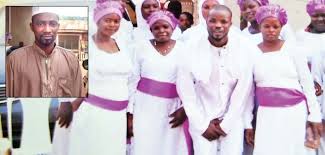
The founder and leader of Apata Adura Cherubim and Seraphim Church, Ekute, Ado-Ekiti in Ekiti State, former Pastor Adekunle Afolabi has converted to Islam.
Afolabi accepted the teachings of Prophet Muhammadu (SAW) after practicing Christianity for over 25 years where he even rose to become the General Overseer of his church.
Explaining the reason behind his conversion, the 45-year-old man now addressed as Alfa Abubakar Afolabi, said he had a divine encounter with a stranger in his dreams.
He said the man showed him certain flaws in Christianity and convinced him that indeed Islam is the only religion that leads to heaven.
He made it clear that he had no regrets swapping to the other religion, adding: “I was preparing for the anniversary when I started having dreams that eventually led to my conversion. At first in the dreams, I noticed my members were sitting on the floor in the church and some of them were covering their heads. I also saw that people were washing their hands and feet before entering the church just like it is done in Islam.”
Asked if he still engaged in some spiritual activities like he did while in Christianity, Afolabi said: “rendering spiritual help is given to all men by God for their own use, so the wisdom of it is given to me by God, he didn’t take it away from me because that is different from religion. It is a way of livelihood; so, if any one falls sick, wants to give birth, is having stillbirth, stagnation at work, that is all what we use that for. He showed me places in the Bible where many prayed to God in Islamic way. By this praying, I mean to kneel down and bow down your head and face down.”
On how his church members reacted when he decided to dump Christianity, he said: “they all left me the day I invited an Imam to come and preach in my church, the day of our anniversary. I have also been stripped of my position as president of our association. The only thing the pastors do once in a while is to call to ask me if indeed I still want to continue in the new faith and I usually confirm it. As for friends, some have stayed, while others have left.” [myad]
The World Bank has released the first tranche of funding totaling N1.4 billion to facilitate the take off of 10 African Centres of Excellence in Nigerian universities.
The Executive Secretary of the National Universities Commission, Julius Okojie, who disclosed this at a news briefing today in Abuja, said the money was released to 10 out of the 19 centres.
He said the centres are expected to embark on various research works to help solve problems confronting the African continent.
He explained that the centres would focus their research on various fields, namely agriculture, health, science and technology, engineering and mathematics.
Okojie, a professor, cautioned the benefiting institutions against compromising the objectives of the scheme.
He said the success of the ACE projects holds the prospect of favourable global ranking for Nigerian universities and that the country could not afford to toy with the opportunity.
The NUC secretary noted that the feat of a Nigerian university which assisted in checking the spread and scourge of the Ebola Virus Disease when it broke out in the country last year could have ordinarily earned Nigeria a top place among world universities.
According to him, investigations had commenced to identify universities offering online degrees with a view to checking their illicit operations.
He said the Nigerian Research and Education Network is solving the problem of Internet connectivity in Nigerian universities and assured that it would improve global presence of Nigerian universities.
He argued that a system where some foreign universities award degrees to unsuspecting Nigerians without physical contact with their students leaves much to be desired.
On the recent low ranking of Nigerian Universities, Mr. Okojie said the standard of country’s universities was high in spite of their categorisation.
He stressed that that the problem with Nigerian universities was low Internet presence. [myad]
President Muhammadu Buhari has frowned at the way the nation’s mining business is being run, describing it as most demoralizing.
The President who spoke today at the Presidential Villa after receiving a briefing from top officials of the Ministry of Mines and Steel Development led by the Permanent Secretary, Baba Umar Farouk, said: “this is one of the most demoralizing briefs I have received.”
According to him, the biggest threat to this country besides the Boko Haram is unemployment and the mining sector is key to employment creation.
President Buhari who made it clear that his government would not tolerate illegal mining and other improper activities that have inhibited the growth of Nigeria’s solid minerals sector, noted that the mines and steel sector is very important for the diversification of the economy.
He expressed displeasure at Farouk’s report that the sector had been overrun by illegal miners, adding: “we cannot be held back on such a strategic industry that can give us much needed jobs and promote economic growth.
“There must be more seriousness in running this country and we are determined to instill that seriousness”
The Permanent Secretary had told the President that Nigeria’s mining sector has been infiltrated by “illegal aliens” who carry out unlawful mining activities in the country.
Also Tuesday in Abuja, President Buhari directed the Ministry of Environment to undertake a rigorous study of Lake Chad, with a view to bringing up proposals on how best to reverse the shrinking of the lake, which currently serves as a major source of livelihood for many.
Speaking after receiving a briefing on the challenges facing the Ministry of Environment, President Buhari noted that the security and economic challenges faced by member countries of the Lake Chad Basin Commission could be substantially ameliorated with an improvement in the economic value of the lake.
The President also urged the Ministry of Environment to take up the challenge of researching cheaper ways of sourcing energy for cooking apart from firewood.
The Permanent Secretary, Nana Fatima Mede told President Buhari that Lake Chad has shrunk considerably from the 1960s, when it covered an area of more than 26,000 square kilometers, to less than one-tenth of that size at present. [myad]
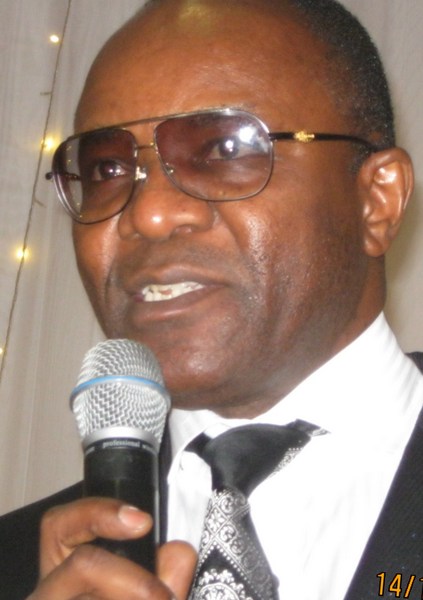
President Muhammadu Buhari has appointed Dr. Emmanuel Ibe Kachikwu as the Group Managing Director of the Nigerian National Petroleum Corporation (NNPC).
Dr. Kachikwu, who was the Executive Vice Chairman and General Counsel of Exxon-Mobil (Africa), is to take over from Dr. Joseph Thlama Dawha.
A statement from the Presidency said that Dr. Kachikwu hails from Onicha-Ugbo in Delta State and is a First Class Graduate of Law from the University of Nigeria, Nsukka and the Nigerian Law School.
The new NNPC Chief Executive also has Masters and Doctorate Degrees in Law from the Harvard Law School.
He started his working career with the Nigerian/American Merchant Bank before moving on to Texaco Nigeria Limited where he remained for about eight years before joining ExxonMobil.
The statement announced that President Buhari also approved the appointment of Professor Umaru Garba Danbatta as the new Executive Vice Chairman and Chief Executive of the Nigerian Communications Commission (NCC).
Prof. Danbatta, who holds a Doctorate Degree in Electronic Engineering, takes over from Dr. Eugene Juwah whose tenure expired on July 29, 2015.
The new NCC Chief Executive’s other academic qualifications include a Bachelors Degree in Electronic Engineering and Telecommunications as well as a Masters Degree in the same field.
He is a Fellow of the Nigerian Society of Engineers and has had a meritorious career in which he rose to become Professor of Electrical Engineering and Electronics at Bayero University, Kano, specializing in Telecommunications Engineering and Information and Communications Technology.
Before his new appointment, Prof. Danbatta held top management and leadership positions at different times including Head of Department, Dean Of Faculty, Director, Centre for Information Technology, Chairman of the Nigerian Society of Engineers (Kano Branch), Deputy Vice Chancellor and Acting Vice Chancellor.
His appointment as Executive Vice Chairman of the NCC is for five years in the first instance. [myad]
We use cookies on our website to give you the most relevant experience by remembering your preferences and repeat visits. By clicking “Accept”, you consent to the use of ALL the cookies.
This website uses cookies to improve your experience while you navigate through the website. Out of these, the cookies that are categorized as necessary are stored on your browser as they are essential for the working of basic functionalities of the website. We also use third-party cookies that help us analyze and understand how you use this website. These cookies will be stored in your browser only with your consent. You also have the option to opt-out of these cookies. But opting out of some of these cookies may affect your browsing experience.
Necessary cookies are absolutely essential for the website to function properly. This category only includes cookies that ensures basic functionalities and security features of the website. These cookies do not store any personal information.
Any cookies that may not be particularly necessary for the website to function and is used specifically to collect user personal data via analytics, ads, other embedded contents are termed as non-necessary cookies. It is mandatory to procure user consent prior to running these cookies on your website.









Nigeria Has Always Been Within The Grasp Of Terror, By Nuhu Othman
Long before the emergence of Boko Haram, the Nigerian Muslim population-especially those in the northern part-has always craved for a unifying leader; a leader that would lead base on the Sharia system. The amalgamation of the southern and northern protectorates in 1914 saw to the end of the last vestiges of the Uthman Dan Fodio Caliphate. Ever since, abjuration of this Caliphate legacy has proved difficult for the Muslims to come to terms with. They have strived to find a replacement to it.
The Amalgamation gave rise to series of constitutional amendments, and eventually Independence in 1960. The twin impacts of the amalgamation and independence reduced the former Caliphate to a mere fragmented states within nations (Niger, Cameroun and Nigeria). To the Muslims in the north of Nigeria, it was a re-ordering on a scale never envisaged. Hence, the notion that human rights and democracy are a western manifestation that must be debunked, and resisted. Senegal, unlike Nigeria, had that unifying leader before and after Independence in person of Sheikh Ibrahim Niass in the early and late 20th century. Even after his death in 1975, he is still being held as a source of inspiration and guidance to not only the Sengalese, but also to a large number of Muslims in West Africa. By this sheer fate, Senegal would build the most enduring democracy in the region with little or no sectarian strife. Or without any flirtation with the ever divisive and unstable Arab world. Essentially, they aren’t torn between the Sunni-Shia conflict that has come to define Islam. The Tijjaniyya Islam which Sheikh Ibrahim Niass propagated has so far proved to be the safety valve, and most importantly as a hedge against radical Islam in Senegal.
Nigeria, on the other hand, has been searching in the wilderness for such a leader as Senegal had. This saw the Muslims in Nigeria to journey far afield in search of this. In the 1970s when Muammar Ghaddafi declared Libya a Jamhuriyya ( a republic), it was common place to see male children named after him. Fast forward to the 1990s, the Gulf War to be precise. Male children were named after Saddam Hussein. The one personality with the most devastating impact was Osama bin Laden, who exploited one of the major ideological issues uniting the Muslim world: the statehood and sovereignty of Israel. This ideological sentiment that the leader of Al Qaeda used to coalesce an army of followers around the globe found ready enthusiasts in Nigeria. These factors further radicalized the Muslim population, and to some certain degree steeled them to great feats of endurance with the ultimate aim of re-establishing a pax Islamica. The clerical parvenu that was created, politically speaking, by above factors and personalities mentioned, considers the re-establishment of the Sharia system as an elemental necessity-a precondition for justice and fair play. And the radical characters in this clerical assemblage conceived themselves as a divine will. This movement is at cross purposes with the Westphalian style of governance or international order where citizens are expected to obey a sovereign power other than God in return for security and protection.
A 21st century Nigeria finally bowed to terror. But something is missing in this gradual radicalization of Muslims in Nigeria in the 21st century. In as much as a more extreme form of Islamic terror has replaced Al Qaeda that is ISIS. We are yet to see parents naming their male children as Abu Bakr Al Baghdadi or even Abubakar Shekau-the leader of Boko Haram. So, what has changed? Truth is, ISIS and Boko Haram have the same ideology, which is the total annihilation of any form of a secular society or government. The positive here is that, Nigerians have come to understand, first hand, what religious extremism is. The same way the Afghans and Pakistanis have come to the realization that this cannot be the proper way to pursue a cause. This shift is what I prefer to call the positive, and governments around the world must seize it. Yes. They must make Islam and democracy as compatible opposites. Not even the case of Charlie Hebdo could reverse this positive trend in Nigeria. There were no rioting. Instead adherents of the Islamic faith took to the media-electronic and print-to register their grouse with the Charlie Hebdo magazine. We must understand that terror groups latch on such rifts and divisions to loom large. Another salient positive is the issue of conventional banking that deals in interest. Muslims around the globe have always desired to have a banking system that incorporates ethical products. This feat was achieved not by war but by a simple democratic legislation in Nigeria. These positives have increasingly made the prospect of having an extreme individual or group as the fidei defensor diminished in the future.
However, the smooth elections of March and April 2015, and the now seamless transition process have denied these elements of terror what would have been their own opposite version of “The Miracle House of the Brandenburg”, if we have had a chaotic election.
In a nutshell, the war on terror cannot be about bullets alone, but above all, enlightenment on how far the world has become very much interdependent. Hence, the notion of universality of any one system must be aligned to work in tandem with an interdependent world shaped by what is unanimously agreed upon as a legit partnership.
The writer can be reached at nuhuothman@gmail.com. [myad]