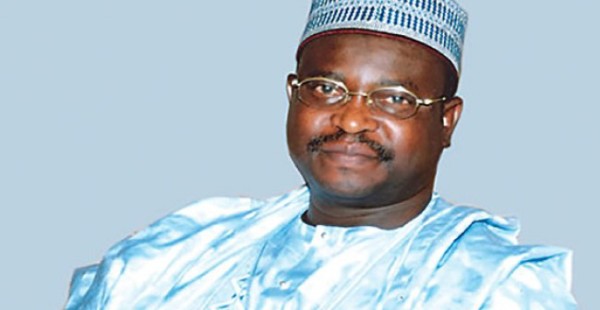
Former Speaker of the House of Representatives and foundation member of the ruling Peoples Democratic Party (PDP), Alhaji Ghali Na’Abba has tendered his resignation from the party, effective from today, March 15, 2015.
In his resignation letter dated March 15, Na’Abba, who led the legislative chamber during the Olusegun Obasanjo presidency, accused President Goodluck Jonathan of reducing governance to a ridiculous level and splitting the country along ethnic and religious lines.
The ex-lawmaker’s letter was sent to the chairman of the PDP Sharada Ward in Kano Municipal Local Government Area and titled “Notification of Resignation from PDP, each organs and committees.”
The letter was also copied to the PDP chairman in Kano, North West Zone National Vice Chairman, National Chairman, and Chairman of the party’s Board of Trustees.
Na’Abba blamed President Jonathan and other previous leaders of the PDP, which has ruled Nigeria since 1999, of putting the country in a bad situation.
“In the sixteen years the Party has been ruling at the center, the Party’s leadership has failed to lead by example,” he said.
He, however, had the harshest criticism for the current president, saying, “No administration has used religion and ethnicity to divide Nigerians more than the current administration under the leadership of Mr. Goodluck Jonathan.”
The former lawmaker did not state if he was joining any other party but told PREMIUM TIMES on phone that he was being lobbied by other parties to join them. His supporters in Kano, whose governor, Rabiu Kwankwaso, also dumped the PDP for the All Progressices Congress, APC, however expect the ex-lawmaker to also join the main oppostion party.
Read excerpts of his resignation letter below.
“You are no doubt aware of the abysmal level to which the leadership of our great Country under President Goodluck Jonathan and the Peoples Democratic Party have reduced governance to, as a result of which our great Party has been losing its sons and daughters including so many of its founding fathers and members by the day,” the Kano-born lawmaker stated.
“All efforts of critical members and fathers of the Party to offer advice remain always unheeded. It pains most of us that majority of the founding fathers that had died like Chief S. M. Afolabi, Alhaji Muhammad Abubakar Rimi, Chief Solomon Lar, Professor Osammor, Chief S. B. Awoniyi etc all died as a result of their frustration by and with the Party.
“Those living like Dr. Alex Ekwueme, Malam Adamu Chiroma, Dr Shettima Mustapha, Alhaji Asheikh Jarma Dr. Victor Odili, Mr. Isaac Shaahu and many others are equally living with such frustration. While others like Alhaji Atiku Abubakar, Alhaji Isyaku Ibrahim, Alhaji Musa Gwadabe, two former National Chairmen, Chief Audu Ogbe and Chief Barnabas Gemade etc had since left the Party.
“The Party and the administration clearly possess neither compassion nor empathy.
“The Country’s and the Party’s leadership have become cabalised to the extent that while Nigerians are aware that they have a President in the person of Dr. Goodluck Jonathan, they are at the same time at a loss as to who governs their Country. Both Nigeria and the PDP are left to drift. In the sixteen years the Party has been ruling at the center, the Party’s leadership has failed to lead by example.
“Instead, it has left us with the conventional wisdom that people cannot succeed in life unless they are ruthless and unprincipled. The Party has become characterized by corruption and impunity in the way and manner candidates for elective positions are being selected to the extent that in almost twenty states, crisis has engulfed the Party over the Gubernatorial primaries and the manner other candidates for other elective positions emerged.
“In short, the Party and the Country’s leadership have failed to consolidate democratic gains for sister African Countries and other transition Countries to follow. Instead, under the current leadership, Nigeria is suffering from loss of esteem, as we are now most often consigned to the back seat of international relations. Most worrisome is the current anxiety of most Nigerians as the regime wobbles and tumbles toward the oncoming election.
“It has today become incontrovertible that cartels and shady characters are becoming visible, important and indispensable factors in Nigeria’s governance. It appears those at the helm of affairs are more comfortable with such characters of easy virtue than with patriotic and altruistic Nigerians. No doubt, in our Country today, the quality of governance is going down by the day.
“Critical National Institutions that unify and wield Nigerians together have been dragged into politics, contrary to wise counsel and political correctness. No administration has used religion and ethnicity to divide Nigerians more than the current administration under the leadership of President Goodluck Jonathan. The ultimate test of any leader is looking at what has remained after he is gone.
“You will agree with me that such pervasive political behavior should under no circumstances be tolerated by all who subscribe to decent and conscionable political practice. I have relentlessly pushed for reform of the internal policies of the PDP individually and collectively, without success. In fact it is common knowledge that all critical members of the Party have been made irrelevant by the Party.
“Members who are pliant and who lack principle and who stand for nothing are always more trusted by the leadership to carry out Party assignments. Such members are said to be “loyal”. Such loyalty is nothing but a euphemism for people who stand for nothing. Because no one is trusted by the leadership both at governmental and party levels, only a handful of party men and women are always entrusted with such party tasks as National Conventions, fund raising. Such men and women are now fully re circled.
“Their faces are today so familiar to the eyes of Nigerians. As a politician with political science background, it is obvious to me that PDP is both self-destruct and irredeemable. Coupled with the regimes divisive and unpatriotic disposition, Nigeria has become a bye-word for “touch and go”, if examples of contemporary nations are anything to go by. The challenge before Nigerians today, in order to secure a new lease of life therefore, is how to get out this inept leadership that has neither allure nor inspiration.
“In its place, Nigerians deserve not just a good President, good governors, and other political office holders, but true and exemplary leaders. And within this context, leadership that is more truly both transactional and transformative and which have more competence and capacity to govern. Nigeria needs leaders with a clear vision for the future. Leaders that will lead not from the back, side or front but from within. Leaders that will provide courageous and moral leadership the dearth of which has led to the weakening of political and economic institutions throughout Nigeria.
“For the above and many reasons, effective today 15th March 2015, I hereby tender my resignation from the Peoples Democratic Party, it’s organs including the Board of Trustees and all other committees to which I belong at National and State levels.
“I pray that your mind and those of other Patriots would also be illuminated with truth so that you may also act wisely and accordingly. This comes with the renewed assurances of my highest consideration and personal respect.” [myad]



 A group known as Kano State PDP Frontiers has said that the former speaker of the Federal House of Representatives, Ghali Umar Na’aba, who recently resigned from the ruling Peoples Democratic Party (PDP) after about 16 years of membership has never been of any use to the party.





Understanding MultiChoice’s New Price Regime, By Caroline Oghuma
Without doubt, I have a dog in this fight.
As the spokesperson for DStv, there should be no garlands for guessing the dog I am backing. Like everybody else, I have followed the public response to the new price regime announced by MultiChoice with keen interest. That is expected.
What I have been able to take away from the debate, a very robust one, is that our subscribers is that they are unhappy with the fact that they will have to pay more for our services.
As a user of other services, including those unrelated to pay-TV, I cannot claim to have combusted with joy each time prices go up. Nobody I know of does that.
Here at MultiChoice Nigeria, the announcement of a new price regime was made with a great deal of reluctance. We are not happy to see subscribers angry because they are the ones whose goodwill has kept us going.
As such, anything that has the potential of depleting our deposit of goodwill among subscribers is something we have done and we will continue to do our best to avoid.
Sometimes, though, the best of our efforts are not good enough. I will explain. It is a fact that MultiChoice Nigeria has had the same price regime for two years. What I am saying is that our subscription rates have not increased in two years. That is not the case in other countries on the continent, where price increase have been an annual occurrence.
During this period, prices of countless goods and services have gone up by as much as 50 per cent. While I am in no position to explain the peculiarities of each of increases in the prices of other goods and services, I am fairly certain that market conditions and a few other factors have a hand in compelling such.
It is the same with us at MultiChoice, where we have been left with no choice than to do what we have done to keep serving you better. To keep doing that requires us to remain a going concern.
That we are unlikely to remain, without a new price regime that reflects the present economic situation and operating environment. MultiChoice, I make bold to say, is a social institution. If it suffers ill-health, its partners are not likely to fare better.
Think of local content creators, suppliers of various items, installers, retailers, agents and those directly employed by the company. The government also loses in tax revenues. Can we, as a country, afford this?
I understand the public anger, but I seek an understanding of the situation in which we operate as an organisation.
Much of the anger is founded on the incorrect belief that we do as we please because we are a monopoly. We are certainly not one. We are in a field where competition exists and has always existed.
StarSat, one of our competitors, recently won the rights to broadcast matches of the German Bundesliga.
I am also certain that Nigerians know that Consat, ACTV, MyTV and Montage TV among others are not MultiChoice subsidiaries.
Before now, we had FSTV, CTL and HiTv, all defunct.
HiTv, in actuality, won widespread applause when it wrested the rights to some premium sporting content from MultiChoice. That success turned out to be a fleeting one because those rights had been obtained at stratospheric costs and was fatally undermined by an unsustainable, albeit lower price regime.
We know that MultiChoice got on the scene before everybody else. We are also happy that we got a rich bouquet of the content that has made you happy over the years.
This has nothing to do with the absence of competition, as evidenced by HiTv, but with a desire to have you better served on our platform.
To make our services more accessible, we also designed bouquets suitable for various income brackets. That is hardly the trait of a dyed-in-the-wool monopolist.
When prices go up, there is a need to reflect and understand what might have provoked such. Prices of commodities like toothpaste, bread, beer and phones as well as of professional services have risen in the last two years, most probably, because providers of such-especially those in low-margin businesses- have been left with no other option. There are limits to financial hoop-jumping.
And very crucially, the content we buy and bring to your homes, including those AfricaMagic movies and series, are paid for in dollars. It may surprise you to learn that local television content is paid for in dollars, but that is the truth. Our content purchase is done centrally-by our parent company in South Africa.
As we all know, the naira, our local, currency, is currently not enjoying the best of spells in its value to the dollar. The implication of this is that MultiChoice has to look for naira in far greater amount than it used to if it wants to continue buying and delivering to-tier television content to you. The same thing happening to the naira is happening to South Africa’s Rand and other currencies on the continent.
Closely related to this is a surge in the cost of acquiring television content. This, on a regular basis, is the product of the feisty competition among television companies involved in the bidding for rights. It was this type of competition that caused a 70 per cent hike in the cost of the broadcast rights to England’s Barclays Premier League.
The two outfits involved, Sky and BT, wanted the rights so badly and had to pay top dollar. The deal, which runs from next year to 2019, cost over 5billion pounds, with Sky paying 4.176billion pounds.
Already, it has hinted that its subscribers will have to pay more to view matches on its platform. It also means any overseas broadcaster seeking to include the Barclays Premier League in its offering will have to pay more to do so.
Premium content, as I hinted earlier, is not sold on the cheap anywhere in the world. It why it carries the tag “premium”.
What we have done has been done has been forced on us by pay-television economics, not an abuse of our pre-eminent position, as has been suggested. In the world of television economics, a fraction of the fee paid as subscription by the subscriber goes to the providers of content or channel owners as what is called “affiliate fees.” Affiliate fees represent a compensation to content providers and they are the oil that keeps the wheel of content development rolling. Thus, the subscription paid by a subscriber is for programming (the watched channels) and the distribution (infrastructure and profits for cable companies) and is shared with the content owner or distributor. Content is usually sold on a per subscriber basis, with channels broadcasting the most watched content attracting greater cost of acquisition of such.
As much as we would have loved to keep our subscription at the same level, the prevailing economic situation makes that impossible.
Oghuma is the Public Relations Manager of DStv. [myad]