Home Blog Page 2282

Jonathan Recieves Forensic Report On NNPC

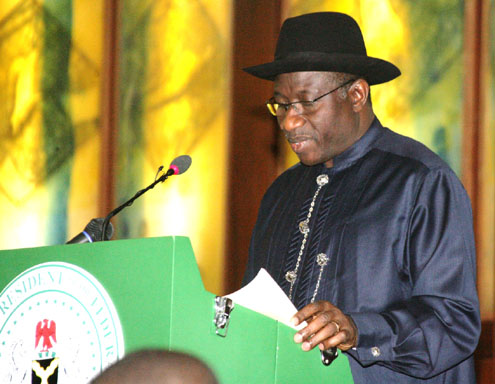
Jonathan recieves report on NNPC


From left: Risk and Quality leader (Africa), Pricewaterhousecoopers (PWC), Mr. Gabriel Ukpeh; Country Senior Partner of  PWC, Mr. Uyi Akpata; President Goodluck Jonathan and the Nigeria’s Auditor-General, Mr. Ukura Samuel at the submission of the Forensic Audit Report of the finances of the Nigeria National Petroleum Corporation (NNPC) BY THE Prcewaterhousecoopers at the Presidential Villa today, Monday. [myad]

APC Asks Jonathan To Tell Nigerians What Has Happened to Victims Of Phony Immigration Jobs

 Nigeria Minister of Interior, Abba Moro
Nigeria Minister of Interior, Abba Moro

The All Progressives Congress (APC) Presidential Campaign Organization has asked President Goodluck Jonathan to tell Nigerians what his government has done to the victims of some hapless job applicants who were assembled at the National Stadium for enlistment into non existing jobs at the Nigeria Immigration Service which led to a stampede and deaths, six months after the incidence.
APC expressed regret that six months after, the Jonathan-led federal government is yet to bring the culprits to book or provide succour to the victims of the job scam.
A statement signed by the APC Director of Media and Publicity, Mallam Garba Shehu today said that it is even more confounding that the Minister of Interior under whose watch thousands of Nigerian youths were compelled to pay N1000 for the job application, and which proceeds run into hundreds of millions of Naira, is busy campaigning for PDP and President Jonathan’s re-election, whereas the applicants who lost their lives have been forgotten, and their parents and relations left to bemoan their fate.
Garba Shehu said that it is even more shocking that despite the uproar which the scandal generated across the country and beyond, “neither the Nigeria Immigration Service, Ministry of Interior or the Federal Government has given any satisfactory answer to the posers as to why thousands of Nigerian youths were assembled in major cities for few job vacancies which have already been allocated to children of powerful people in government.”
The APC Campaign said that despite the tragedy of this unfortunate incident, the Jonathan administration did not deem it fit to set up a commission of inquiry to investigate the immediate and remote causes of the stampede, and neither was any official held to account for the loss of lives of the innocent Nigerians who for no fault of theirs fell victim to the ignominious official scam.
“It is more disturbing that the Minister of Finance. Dr. Mrs. Ngozi Okonjo-Iweala keeps bandying unverified figures of jobs created by this administration, but the reality on ground does not in any way support the statistics. Recently, she released a figure of 1.4 million jobs that have been created as a result of the policies the Jonathan Administration executed, yet the suffering and pain young Nigerian graduates undergo daily in search of non-existent jobs  has become scandalous to say the least.”
Garba Shehu then called on President Jonathan and the PDP to render account to Nigerians of what led to the stampede at the Nigeria Immigration Service job recruitment exercise, adding that failure to do so will amount to insensitivity to the bereaved families of the dead applicants as well as the scam that led to thousands of job applicants losing their money to a certain consultant of the Nigeria Immigration Service. [myad]

Jonathan, Atiku Grieve Over Death Of Molade Okoya-Thomas

Molade Okoya Thomas 

President Goodluck Jonathan and former Vice President Atiku Abubakar have expressed shock over the death, today in Lagos, a Nigeria’s leading entrepreneur, Chief Molade Okoya-Thomas.
Okoya-Thomas, who holds the traditional titles of the Asoju Oba of Lagos, Babasuwa of Ijebu-Remo and Odofin of Ife, died at the age of 79. He was until his death, the Chancellor of the Lagos State University and Chairman of CFAO Nigeria Limited.
In a statement issued today by Dr. Reuben Abati, special adviser to President Jonathan on media and publicity, President Jonathan described the deceased as a very successful businessman who lived a very worthy and fulfilled life, and left a legacy of great entrepreneurial achievements for his successors to build on.
The President believed that Chief Okoya-Thomas will also be long remembered and honoured as a very generous philanthropist and sports enthusiast who established the popular Asoju-Oba Table Tennis Championships.
He extended his condolences to members of Chief Okoya-Thomas’ family as well as his friends, associates, business partners within and outside Nigeria, and the people of Lagos where he held the traditional title of Asoju-Oba.
The President said that he shared in their pain and sorrow as they mourn the late Chief Okoya-Thomas who was also honoured in his lifetime with the traditional titles of Odofin of Ile- Ife and Bobasuwa of Ijebu-Remo.
Atiku Abubakar, in a press statement by his media office in Abuja described the death of Okoya-Thomas as a huge blow to the community of Nigeria’s businessmen, saying that he was a visionary and astute businessman whose contribution to Nigeria’s private sector economy will remain indelible.
“Although the late Molade Okoya-Thomas left the stage at a prime age of 79, his death nonetheless is a huge blow to the community of businessmen in Nigeria.
“He was a pioneer and a visionary. Okoya-Thomas belonged to a generation of private sector investors who saw opportunities in making investments in the economy when it was risky to do so.
“His legacies will remain indelible in corporate Nigeria and I pray God will grant his family and loved ones the fortitude to bear the loss.” [myad]

Buhari, Osinbajo Begin Person-To-Person Town-Hall Meetings, Ignore Television Debates

APC Presidential candidate, Muhammadu Buhari and his running mate, Yemi Osibajo,

Presidential candidate of All Progressives Congress (APC) General Muhammadu Buhari and his running mate, Professor Yemi Osinbajo have opted for town hall meetings, as a deliberate strategy of the campaign to interact with and explain directly to citizens the policy thrust of their envisaged administration and how the set objectives will be achieved. This is coming on the heels of the party’s decision that its candidates will not participate in the presidential television debates which are being organised by, among others, Africa Independent Television (AIT), owned by a chieftain of the ruling Peoples Democratic Party (PDP) Chief Ray Dokpesi.
A statement, signed by the Director of Media and Publicity of the APC Presidential Campaign Organisation in Abuja today said that the town hall meetings kicked off in Lagos today, with a robust interaction between Buhari/Osibanjo and the Organised Private Sector.
Garba Shehu said that the party is compelled to chart this course because of the compelling need to have a person-to-person interactive sessions during which pertinent questions will be posed to the candidates and responses provided.
“Our campaign decided to chart this path because we cannot afford to shy away from the more pressing urgency to have one-on-one interactions with Nigerians through town hall meetings.”
Here is the full text of the statement “The All Progressives Congress Presidential Campaign Organisation wishes to announce the commencement of town hall meetings ahead of the February 14 presidential election.
“Due to the more pressing urgency to have an open interaction with Nigerians, the campaign will be organising town hall meetings in different parts of the country.
“The town hall meetings kicked off today (Monday) in Lagos with a public interaction between the presidential candidate, General Muhammadu Buhari, his running mate Professor Yemi Osinbajo and representatives of Organised Private Sector.
“On Tuesday, the town hall meeting will hold in Kano with traders and market associations. Thereafter, the meeting will hold in Benin with labour and civil society leaders.
“The focus of the town hall meeting will then shift to Ibadan where students and youth groups will be engaging General Buhari and Professor Osinbajo, while Enugu and Port Harcourt will follow suit.
“The direction the that the campaign will be moving in the countdown to the election day is to have as many as possible person-to-person interactive sessions for Nigerians to hear directly from the presidential candidate and his running mate.” [myad]

Fani-Kayode Condemns General Buhari For His Alleged Contempt For Debates

Femi Fani Kayode 

The Director of media and publicity of the Peoples Democratic Party (PDP) Presidential Campaign Organization, Chief Femi Fani-Kayode has condemned the All Progressives Congress (APC) Presidential candidate, General Muhammadu Buhari’s alleged contempt for Nigerians by his refusal to participate in live television debates with President Goodluck Jonathan.
In a statement in Abuja today, Fani-Kayode said that the decision by General Buhari to shun another debate organized by the Newspaper Proprietors Association of Nigeria (NPAN) and Channels Television was despicable and even as he called on Nigerians to ensure the rejection of Buhari at the poll as a just recompense for his action.
“We have been informed that General Buhari and the APC have decided not to participate in the NPAN-CHANNELS Television-organized debate after they had earlier agreed to take part in it.
“We had thought that having withdrawn from participating in the debate organized by Broadcasting Organization of Nigeria (BON), they would have availed themselves this second platform.
“Now that they have also turned their back on this, it is now very clear that General Buhari is incapable of engaging in  rigorous live television debates on the issues of governance.  It speaks about his intellectual laziness and his loss of touch with contemporary issues of development and statecraft.
“We would like to reiterate that the APC has something to shield about General Buhari.  He has campaigned in some states of the federation attacking President Jonathan’s handling of insurgency, corruption and economy.  Now there is a platform on which both candidates can engage each other on these issues and he (Buhari) is running away.
“It is a disgrace to the APC and their candidate that they would treat everybody with contempt.  The organizers of the debates are interested in promoting a robust culture of debates so that people can listen to the candidates and make informed choices on the basis of their arguments.
“We call on Nigerians to express their displeasure with General Buhari and the APC by rejecting them at the poll.  This will be a just recompense for treating the Nigerian people and electorate with disdain.” [myad]

2015 Polls: Nigeria Cannot Afford To Fail, Says Governor Uduaghan

Delta rulers
Delta State Governor, Dr. Emmanuel Uduaghan has said that peaceful elections in Nigeria cannot be compromised as the nation cannot afford to fail because of its implications for the unity of the country.
Speaking at a Voters Education meeting with traditional rulers in Asaba, the state capital today, Governor Uduaghan wanted all hands to be on deck to ensure that the nation gets it right.
The governor, who said that the consequences of failure in the conduct of the election would be too disastrous for the country asked the Government, the Independent National Electoral Commission (INEC), security agencies and stakeholders to work together to ensure that the elections are free and fair, devoid of any form of violence.
“As much as possible we want to totally remove violence during elections and one way of achieving this is through proper voter education. You know ignorance can lead to violence and there are so many people out there that are not well informed about issues surrounding the temporary voters’ card, permanent voters’ card, the voting process etc.”
The Governor said everything would be done to ensure that there is no violence during and after the elections, adding: “we are determined to have peaceful elections in Nigeria and Delta State in particular. It is important and very critical that we have peaceful elections.”
According to him there are still about 600,000 permanent voters’ cards that are yet to be collected and urged traditional rulers to inform their subjects to endeavour to collect their voters’ cards before the deadline.
Governor Uduaghan said that Delta State has recorded peaceful electioneering campaigns and informed the traditional rulers that President Goodluck Jonathan would lead the campaign train of the Peoples Democratic Party (PDP) to Asaba tomorrow (Wednesday) for a campaign rally and urged all Deltans to remain peaceful throughout the period.
“We are expecting the visit of the Mr. President to be very peaceful even as the All Progressive Congress (APC) Presidential candidate, Mohammedu Buhari had a peaceful campaign in the state.”
He said that security agencies are collaborating to ensure a hitch-free visit by the President and his team, even as he observed that the State has so far recorded a peaceful electioneering period.
“The beauty of our primaries was that they were all peaceful, candidates emerged, nothing unusual happened as it concerns security issues. We thank God for that because we had some other States in the country where there was violence after their primaries.”
He enjoined security agencies to be more vigilant after the Presidential elections, saying that the state elections are more competitive in Delta State.
The resident electoral commissioner (REC) in Delta State, Elder Aniedi Ikoiwak said that INEC is ready for peaceful, free, fair and credible elections. He said that logistics have been put in place for accreditation of voters to commence at exactly 8.00 am on the day of elections.
He emphasized that voting can only be done with the permanent voter’s cards and by the owners of such cards as electronic card readers have been procured to ensure that voting cannot be done by proxy.
Traditional rulers who spoke at the occasion promised to enlighten their subjects on the need to collect their PVCs while heads of security agencies assured Deltans that no stone would be left unturned to ensure peaceful and successful elections.
They warned trouble makers to desist from entering the election venues as they were prepared to prosecute anybody caught engaging in actions that are detrimental to the electioneering process. [myad]

I Won’t Probe Military, But Will Deal With All Kinds Of Impunity- General Buhari

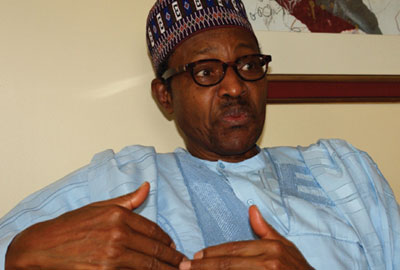
Gen. Muhammadu Buhari (Rtd)


The Presidential Candidate of the All Progressives Congress (APC), General Muhammadu Buhari has made it clear that he has no intention of subjecting the Nigeria military and other arms of government to probes if elected president in the February 14 election.

General Buhari, through a statement today, signed by the Directorate of Media and Publicity of the APC Presidential Campaign Organisation, Garba Shehu said that his administration would decisively deal with all cases of impunity and corruption, no matter who is involved.

The statement further reiterated Buhari’s stance that “when elected into office in February, the era of impunity will be over for the rogues. But there is no time for engaging in probes or witch hunts.”

It also quoted Buhari as saying that he was passionately concerned about the conditions of the armed forces at the moment.

General Buhari lamented that despite huge budgetary allocations, the government of the Peoples Democratic Party (PDP) has failed to effectively deal with security threats, including the Boko Haram terrorism.

The statement reads in part: “What he (Buhari) said at every given opportunity is that he is keenly interested in knowing what has gone wrong, if any, with the army that he knew. When he has access to them as Commander-in-Chief, he will like to hear from his commanders what are the problems they are dealing with so that they can be solved.”

“In a democracy such as ours, all institutions of government, including the armed forces, are accountable. No country can achieve results in its counter-terrorism efforts when there is no transparency in the management of huge resources for the purpose.

“He (General Buhari) will reinvigorate the armed forces and restore their rapidly evaporating morale.” [myad]

Ngozi Okonjo-Iweala And The Missing Trillions, By Chukwuma Charles Soludo


Soludo and Okonjo

Here, I will focus on Dr. Ngozi Okonjo-Iweala’s response (as Minister of Finance and Coordinating Minister of the Economy—CME and hence on behalf of the Federal Government).

Charles Soludu vs Ngozi Okonjo-Iweala I read some of the responses to my article, “Buhari vs Jonathan: Beyond the Election”, and I want to thank everyone who has contributed to the debate. I am glad that the debate has finally taken off. I have decided, for the record, to re-enter the debate if only to set some records straight and hopefully elevate the debate further.  Whom do I respond to? First, let me thank Gov Kayode Fayemi for his very mature and professional response on behalf of the APC. It forms a great basis for deepening the conversation. Pat Utomi, Oby Ezekwesili, Iyabo Obasanjo, and thousands of other patriotic Nigerians have raised the content of the debate. Femi Fani-Kayode made me laugh, as usual. The Gov. Jang faction of the Governors’ Forum played the usual politics, although I know what most of them think privately. Who else? Oh, Peter Obi. Well, since he can’t write and designated Valentine as usual to write for him (who never disputed the NBS statistics that Obi broke world record in the pauperization of Anambra people but instead focused on lies and abuses) I won’t dignify him with a response here. His third class performance in Anambra will be the subject of a comprehensive article later.

Here, I will focus on Dr. Ngozi Okonjo-Iweala’s response (as Minister of Finance and Coordinating Minister of the Economy—CME and hence on behalf of the Federal Government). Since I have known her, out of deep respect, I have never called her by her name: I call her Madam. I must state that I have great pains seeing myself on the opposite side of the table with Madam, in this way. I respect you, Madam, and will always do.  If you read my article of September 2010 (before you became Minister), the tone and elucidation were as strong as the current one. It is my honest effort to ensure that our choice of leaders is based on rigorous scrutiny of what is on offer.  Part of my frustration is that five years after, everything I warned about has come to happen and we are conducting our campaigns as if we are not in crisis. As a concerned Nigerian, I have a duty to speak out again. Regrettably, you have taken it very personal.

I am not bothered about the personal abuses: I actually expected worse. What name has the government not called President Obasanjo or any person who has dared to disagree with it of late? Anyone who disagrees with the government must either be ‘insane’ or have a ‘character’ deficiency or must be ‘looking for a job’ or ‘without honour’, or a ‘charlatan’. Yesterday, Sanusi alleged that $20 billion was missing and he was accused of gross financial mismanagement, recklessness and poor governance to the point of being the first governor of central bank to be suspended from office. Today, he is the good one; and for daring to award an “F” grade for our economic performance, Soludo has become the ‘worst’ and ‘without character’ or perhaps ‘looking for position’ (Lol!). Some days ago, a former president was called ‘a motor park tout’ and ‘un-statesmanly’ just for disagreeing.  This “how dare you criticise us” mind-set of the government is dangerous for our democracy.

In this Part One of my planned three part series, I will restrict it to the main issues you raised. I will not bother about the malicious attacks on my person. For me, it is nothing personal. In early 2011, I had a similar heated exchange with then Finance Minister Segun Aganga. But when the Nigerian economy was at stake and he invited me to a stakeholders meeting in his office (as Minister of Trade and Investment) to discuss Nigeria’s response to the ruinous EU- Economic Partnership for Africa (EPA), I flew into Nigeria for that (at my expense)— the first and only time I have been to any government office to discuss policy since I left office. It is about Nigeria. I will, as expected, remind people like you of the salient aspects of my record of public service in response to your charge; challenge your claim to debt relief, and your reason for not saving; highlight your forgery of economic statistics and the lies in your response; but most importantly re-focus our attention to the historic mismanagement of our economy which you carefully avoided. I will show that while you are introducing austerity measures and soon to immiserate the citizens, our public finance is haemorrhaging to the point that estimated over N30 trillion is missing or stolen or unaccounted for, or simply mismanaged— under your watch! We can’t go on like this, and I am convinced that an alternative future is possible. Can we have a public debate on this alternative future? The issues at stake are too grave to be trivialized through name calling. As I write, the naira exchange rate to the dollar is at N215 (from N158 a few months ago) and unless oil price recovers, this is just the beginning.  For the sake of Nigeria, I won’t keep quiet anymore!

Let me start with Madam’s rather comical, wild judgment on my tenure of office which I believe to be totally false and baseless. I apologise upfront that in the process of making a ‘personal defence’, it is difficult to avoid a rather uncomfortable emphasis on “I”. I did not want that but since Madam has dragged us this low, I have little choice but to do so in the next few paragraphs—just to keep the record straight!

In my view, there are three criteria for evaluating a public officer’s stewardship: the evaluation by his employer; the satisfaction of the public he served; and the hard facts of performance. As I will show on these three counts, I am convinced that I left a world record of public service, and a thousand Okonjo-Iwealas cannot re-write that history. I served Nigeria under two presidents (Obasanjo and Yar’Adua) and as my immediate bosses, below are their written testimonials of my record.

Said President Obasanjo (December 2004):

“Charles Soludo is a true Nigerian. He is the sort of Nigerian that we all know we can rely on. Among his numerous virtues is COURAGE. I have found in him a man who can take tough and realistic decisions, stand his ground, educate others on the salience of his decision, and work very hard to ensure that the decision is efficiently and effectively implemented. His dedication to duty is first rate. His leadership qualities are admirable and his willingness to listen and learn is simply infectious. Professor Soludo has within a short time emerged as one of the leading lights of our nation. Not because he has a godfather but by sheer hard work, loyalty, dedication to duty, commitment to the nation, creativity, and undiluted association with the reform agenda….”

President Yar’Adua (May 2009) had the following to say about the Central Bank of Nigeria under my leadership:

“… the CBN has performed creditably well in delivering on its core mandates. This is especially even more so in the last five years. Most people would agree that without the successful banking consolidation and effective management of our foreign reserves, the current global crisis would have shaken the financial system and our national economy to their foundations with calamitous consequences”.

In the President’s special letter of commendation after the completion of my tenure of office, President Yar’Adua (June 2009) had the following to say to me:

“As your tenure as Governor of the Central Bank of Nigeria comes to a glorious end, I write on behalf of the Government and people of Nigeria to place on record our debt of gratitude to you for your dedicated service and uncommon sense of duty over the past five years. I am confident that your worthy antecedents in the CBN and in prior appointments in the service of our nation remain sources of inspiration to an entire generation. As I wish you even more astounding successes in the years ahead, it is my fervent hope that you will readily avail us of your distinguished service when the need arises in the future”.

To the best of my knowledge, President Obasanjo has not changed those views even after ten years. The views of my two bosses, not the emotional outburst of an angry person desperate to get even, are what count.

How did Nigerians evaluate my public service? Unfortunately, we do not have scientific opinion polls on job approval ratings for individual public officers. But if the public opinions of individuals and organized groups (labour, employers, depositors, borrowers, stakeholders of the financial institutions, newspaper editorials, investors, etc) as expressed in thousands of newspaper/magazine clips during and after my tenure are anything to go by, then 82% of the public largely agree with the sentiments expressed by my two bosses. Your views belong to the other 18% which is okay, after all, no one is perfect. Five Nigerian newspapers and magazines simultaneously named us “man of the year” in one year— unprecedented in Nigeria’s history. I do not talk about hundreds of awards and recognitions by various segments of our society (during and even after service) for “excellent public service”. I was particularly touched by the historic award by the staff union of the Central Bank and the tears in the eyes of many as thousands of the staff gave me a standing ovation as I walked the aisle after my brief farewell speech.

Certainly, the international community (investors, bankers, scholars, donors, media, etc) took serious notice of the revolution in Nigeria’s monetary and financial system. I am recipient of five international awards as global and African central bank governor of the year, not to mention dozens of other recognitions (even after leaving office). The London Financial Times described us as “a great reformer”. Even as the global economic and financial crisis raged in 2008, the United Nations General Assembly appointed me to serve on the Commission of Experts to reform the international monetary and financial system. You don’t appoint someone who has ‘mismanaged’ his national financial system to reform the global system. For 8 years until 2012, I served on the chief economist advisory council (CEAC) of the World Bank, and together with two Nobel Prize winners in economics and other experts we met periodically and advised two presidents and two chief economists of the World Bank, and in 2011, I served on the External Advisory Group of the IMF.  Again, these are not positions for ‘mis-managers’. Since I left office, I have been advising countries and central banks; and there is hardly any two months I don’t consult/advise on banking/financial and monetary policy. I have given these illustrations to make the point that for every one Okonjo-Iweala’s attempt to rewrite history, there are thousands who disagree.

Now, to some skeletal facts of our stewardship! I will be brief as I have a whole book to tell my story. As chief economic adviser, I had advised that our banking system could not support the private sector-led economy envisioned under NEEDS. When I assumed office at CBN, I inherited 89 rickety, mostly family banks (all of which put together were not up to the size of number four bank in South Africa). Many were insolvent, with depositors’ money trapped, and 20 more about to collapse. To get a credit of $300 million probably required all the banks to syndicate it. For me, there was a national emergency. I drafted a 13-point reform agenda, discussed and agreed all the specifics with the President, and his VP; as well as my management team at the CBN, and we swung into action. President Obasanjo promised 100% support and actually delivered 1000%— which was decisive. I apologize to you Madam because I did not brief or inform you about it. We just wanted to keep it confidential given the sensitivity of the announcement. It is on record that you never supported it.

It was both a revolution and a war and most people thought it was “impossible”, but thank God we succeeded. For the first time in Nigeria’s history a policy of that magnitude was announced and deadline kept with precision.  We were courageous to revoke the licenses of 14 banks, including those of my friends, in one day. The FT-Banker concluded that the scale, precision, and cost of the transformation were unprecedented in the world. Before then, Malaysia had the least cost of banking consolidation at 5% of Malaysian GDP. It did not cost Nigerian taxpayers one penny. Twenty-five new, stronger banks emerged but the powerful idea behind consolidation ignited something even more powerful—‘the race to the top’. Banks raised more capital, and even banks like First Bank, Zenith, GTB, etc that did not merge with others went on capital raising several times. The consequence was higher levels of capitalization and within two years, 14 Nigerian banks were in the top 1000 banks in the world and two in the top 300 (no Nigerian bank was in the top 1000 before I came). Even after I left office, still 9 banks were in the top 1000. Our vision was to have a Nigerian bank in the top 100 banks within 10 years. As I see the new Access bank; Zenith, GTB, Fidelity, Diamond, UBA, FBN, FCMB, Skye, Stanbic IBTC, Union, Ecobank, etc, I cannot but feel that we have taken giant steps forward.

Deposits and credit soared (from barely N1.2 trillion to over N7 trillion); new technologies (ATM and e-banking) boomed, and banks had 57,000 new jobs; mega businesses emerged (ask any major operator in the Nigerian economy their experience with banking and credit before and after Soludo —the Dangotes, Arik, MM2, oil and gas operators; etc); capital market boomed and dominated by the banking sector. It was a new dawn for Nigerian private sector. I have heard Dangote twice say that he would not be near as big as he is today without the banking consolidation. Many other stakeholders still say it today. FDI and portfolio inflows flooded into Nigeria. The world celebrated, and one single transformative idea has changed the face of the private sector and economy forever.  Banks became Nigeria’s first transnational corporations with about 37 branches outside of Nigeria.

Nigeria survived the global crisis because of this, and it is the banking sector that has largely been powering the economic growth you claim (compare banks trillions of naira credit for investments in the productive sector with your government’s miserable expenditure on critical infrastructure and investment; much of your borrowing – bonds – is from the banks). Your privatization of power sector, several PPP projects on infrastructure, etc, are now possible because of the mega banks. Today, Nigerian banks syndicate multi-billion dollar loans— unthinkable before. Madam, if the consolidation was ‘mismanaged’, there would not have been any bank to start with in the aftermath of the global crisis— as President Yar’adua correctly pointed out. Even you, during a recent presentation at the Banquet Hall in Abuja advertised consolidation as a historic achievement. How can you recognize a ‘mis-managed’ project as an outstanding achievement? As we say in Igbo, you can’t cover the moon with your palms.

Let me be clear: the quantum size of the new banks following consolidation presented challenges of risk management and supervision. We deployed all we had and overworked the CBN staff. The carry-over of bad loans from the consolidated banks was quickly cleaned up. To the best of my knowledge, we instituted stringent regulatory and supervisory regime (consistent with best practices at the time). We even had resident examiners in the banks and required bank MDs to personally sign their reports to CBN. I recall that the former MD of GTB complained of “regulatory intrusiveness”. To our credit, non-performing loans (NPL) came down from 22% in 2003 and 2004 to 6% as at 2008. Anywhere in the world, a central bank that brought NPL from 22% to 6% over a four year period does not look like one with a loose supervisory regime. Name other developing countries that performed better, Madam. So, on point of fact, Madam lied. Yours was a reckless assertion without basis by a Finance Minister.

The banks in Nigeria were supervised by the CBN and NDIC, but other institutions— international firms which audited them, international rating agencies which also examined their books, capital market operators since most were listed companies — all had oversight. I put on record that there was never any information/report of infractions by any bank which was brought to my attention and which we did not act upon decisively during my tenure. I heard the comment that some of the bank MDs were my friends. Well, my response is that perhaps as CME you should kill all your friends operating in the economy or become their enemies. For the record, my successor audited all the banks and none of my so-called friends was indicted. It speaks volumes. Indeed, it is also a fact that the alleged personal criminal infractions (including lapses in corporate governance Madam alluded to) by some bank CEOs were found out, only AFTER they had been removed from office. My successor told me that the comprehensive audit of the banks did not reveal such infractions. Of course, you must be God or have a special tip-off from inside to get to such information while the MDs are in office. Unfortunately, all over the world, no financial system has succeeded in routing out all criminal behaviours by the operators. So, Madam, I challenge you to provide one shred of evidence that ‘there was no separation between regulators and regulated’ or be honourable enough to retract your reckless statement.

What happened? The unanticipated and unprecedented crisis of 2008/09 hit the world. More than 40 US and European banks either collapsed or were shaken badly (remember the Lehman Brothers, Fannie Mae and Freddie Mac, Wachovia, HSBC, Lloyds TSB, Citibank, Goldman Sachs, even UBS, etc) and hundreds of billions of dollars were spent to bail them out. The contagion effects spread like a wild fire, destroying national stock markets and banks. The nascent (big) banks in Nigeria faced sudden multiple shocks— liquidity, exchange rate, oil price, capital market, etc. As oil prices collapsed, loans to oil and gas became non-performing overnight; loans to the capital market became non-performing overnight; etc.  Our first priority was to save the entire banking system and the economy from systemic collapse. I assured Nigerians that no bank would be allowed to fail, and not many people know what it took to achieve it. Once we had navigated through the unexpected /unprecedented turbulence, we laid out a comprehensive plan to clean up the debris which we presented to stakeholders in Lagos (March 2009). I had pleaded with the Senate to pass the AMCON bill which we sent to them in 2004. But I had a comprehensive plan to finish the clean-up with or without AMCON by the end of 2009, including second round consolidation and a N500 billion fund (my book will detail all these). I left behind an 11-volume document of the Financial System Strategy 2020 (FSS2020) which has remained the policy roadmap for the CBN/financial sector since I left office.

I have two analogies for our experience. Ours was really like an airplane that was cruising and suddenly meets an unexpected and unprecedented turbulence. After the pilots and the crew succeed in navigating through the potential crash and probably land the airplane, people look in and start blaming the crew for the broken tea cups, chairs, and drinks that fell during the turbulence as evidence that the crew never kept the airplane clean or serviced it. My second analogy is that of a sudden earthquake in a region it was never expected and some houses collapsed. All of a sudden, the housing authority is to blame for not requiring earthquake-proof foundations for the houses. Well, my legal experts call it force majeure, an act of nature!

To be fair, after every crisis, there are lessons (and my book will detail what, with benefit of that experience, we should have done differently). Risk management— which has always been there— now took a new centre stage all over the world following the crisis. But for anyone to suggest that CBN under me, for one minute, took its eyes off the ball is, to say the least, ludicrous. The US financial system literally crippled the world costing America hundreds of billions of dollars but no one has suggested that Alan Greenspan is no longer the great maestro!

AMCON is a big topic (which I will address at a later date) but her claims show either ignorance or mischief. She claims that N5.7 trillion of AMCON funds was used to rescue banks and the ‘bond issued’ as ‘cost to taxpayers’. Really? I will deal with the AMCON I envisaged and the AMCON under you later but let me state that even if 100% of the banks’ NPL was offloaded on AMCON, it would not be up to N5.7 trillion. Enough said for now. The fact is that the Federal Government has not put a penny in the AMCON fund: the banking system is financing itself, and together with the sinking fund by banks, AMCON surely can’t default (thanks to consolidation that the banks are now big enough to cough out such funds to solve the system’s problem). Did you intend to deceive the readers by refusing to tell them that much of the AMCON fund is ‘investment’ and not ‘expense’. Am sure you heard the IMF’s alarm about moral hazard? If you want, we can have a focused debate on AMCON.

Next, let me briefly respond to a few outlandish claims. She brags about ‘single-digit’ inflation rate ‘now’ and alleges that when I left office, inflation was above 13%. I just laughed at this one. In Nigeria’s history, no governor of the Central Bank has delivered 24 consecutive months of single digit inflation as I did until the advent of the unprecedented global crisis in 2008. It was not for nothing that the world cheered us as monetary policy czar, Madam! Perhaps you are also not aware that we broke a world record by having a depreciated real effective exchange rate during a time of export boom and this was at the heart of our reserve accumulation and the portfolio/FDI inflows. I resisted the IMF advice to deplete reserves for liquidity management, and Nigeria had enough self-insurance to survive the global crisis.  The opposite has happened under you Madam, and the Nigerian economy is in trouble. Naira exchange rate appreciated under me from N133 to N117 before the global crisis; and reserves grew to all time high of $62 billion. For the first time since 1986, the official, interbank and parallel market exchange rates converged under me. You can’t match these records!

I hereby challenge your attempt to blame others for not saving for the rainy day. It is not a virtue when you are quick to appropriate all the credit when things are going well, but shift the blame when they go wrong. You blame the state governors— who, according to you, have taken the Federal Government to the Supreme Court—not that a Supreme Court judgment forced your hands. For your information, the governors have never agreed to savings and always threatened court action even under Obasanjo. Why did we save under Obasanjo but not under Jonathan? Two keywords explain it: leadership and integrity.  Governor Amaechi said the governors insisted on sharing the funds because they found out that you were illegally fiddling with the savings.  So, as Nigerians still wonder, if billions of dollars are now ‘missing’ under your nose, why should governors trust you to keep their money?  Do the states that have taken the federal government to the Supreme Court and refused to save also include the PDP governors—who are in the majority? If so, then it is fatal: even governors of your own party, PDP, do not trust you to keep their money! Furthermore, did the governors also stop the Federal Government from saving part of its share? If you ran a surplus budget at the Federal level, you would have had credibility to blame others or to say they did not listen to your advice. The key point is that since you were running huge deficits yourself, it was also in your own interest to share the ECA. You did not show leadership or credibility, full stop!

Next, Madam, I was really embarrassed for you to read that one of the reasons for declining forex reserves is ‘oil theft’. Under you as Minister of Finance and coordinator of the economy, the basket of our national treasury is leaking profusely from all sides. Just a few illustrations! First, you admit that ‘oil theft’ has reduced oil output from the average 2.3 – 2.4 million barrels per day (mpd) to 1.95mpd (meaning that at least 350,000 to 450,000 barrels per day are being ‘stolen’. On the average of 400,000 per day and the oil prices over the past four years, it comes to about $60 billion ‘stolen’ in just four years. In today’s exchange rate, that is about N12.6 trillion. This is at a time of cessation of crisis in the Niger Delta and amnesty programme. Can you tell Nigerians how much the amnesty programme costs, and also the annual cost for ‘protecting’ the pipelines and security of oil wells? And the ‘thieves’ are spirits? Come on, Madam!

Second, my earlier article stated that the minimum forex reserves should have been at least $90 billion by now and you did not challenge it. Rather it is about $30 billion, meaning that gross mismanagement has denied the country some $60 billion or another N12.6 trillion.

Now add the ‘missing’ $20 billion from the NNPC. You promised a forensic audit report ‘soon’, and more than a year later the Report itself is still ‘missing’. This is over N4 trillion, and we don’t know how much more has ‘missed’ since Sanusi cried out. How many trillions of naira were paid for oil subsidy (unappropriated?).  How many trillions (in actual fact) have been ‘lost’ through customs duty waivers over the last four years? As coordinator of the economy, can you tell Nigerians why the price of automotive gas oil (AGO), popularly called diesel,  has still not come down despite the crash in global crude oil prices, and how much is being appropriated by friends in the process?  Be honest: do you really know (as coordinator and minister of finance) how many trillions of Naira, self- financing government agencies earn and spend? I have a long list but let me wait for now. I do not want to talk about other ‘black pots’ that impinge on national security.  My estimate, Madam, is that probably more than N30 trillion has either been stolen or lost or unaccounted for or simply mismanaged under your watchful eyes in the past four years. Since you claim to be in charge, Nigerians are right to ask you to account. Think about what this amount could mean for the 112 million poor Nigerians or for our schools, hospitals, roads, etc. Soon, you will start asking the citizens to pay this or that tax, while some faceless “thieves” were pocketing over $40 million per day from oil alone.

You alluded to debt relief in your response and tried to take credit. Well, your CV is honest enough to admit that your two achievements in office as Finance minister under Obasanjo were that “you led the Nigerian team that struck a deal with the Paris Club” and that you “introduced the practice of publishing each state’s monthly financial allocation in the newspapers”. You are right about the two achievements. Let me put on record that Nigeria would have secured debt relief under anyone as Minister of Finance. President Obasanjo secured debt relief for Nigeria. Much of his first term was used to get Nigeria back into the international community and to campaign for debt relief. Before you were sworn in as Minister of Finance, President Bush visited Nigeria and both of us accompanied President Obasanjo during the meeting. There, Mr. Bush promised to support Nigeria with debt relief and asked our president to ensure that he met the conditions of the Paris Club. Obasanjo mobilized the global political support and coordinated all of us to ensure that the government met the check-list of ‘conditionalities’ as required.  I spent five weeks in the hotel with my team (as coordinator/chairman for drafting the National Economic Empowerment and Development Strategy, NEEDS).

Some of the reform targets in NEEDS became the ‘conditionalities’ Nigeria was required to fulfil to merit debt relief. You and I signed the various MoU with the IMF on behalf of Nigeria (the policy support instrument). We had a great team at work and each member of the economic team had specific aspects of the conditionalities to deliver: Bode Agusto was in-charge of the budget; Oby Ezekwesili held sway at Bureau of Public Procurement and later Minister of Solid Mineral, and Education (but specifically tasked with delivering on EITI and procurement reforms); Nuhu Ribadu was at the EFCC fighting corruption; I was at the Central Bank delivering on monetary policy and banking reforms; Steve Oronsaye worked hard to delist Nigeria from the FATF; Nenadi Usman was in-charge of the parastatals; El-Rufai held forth at FCT and in charge of public sector reforms; privatization programme went on, etc. Did you know that the IMF wrote President Obasanjo threatening that there would be no debt relief if the CBN did not meet some monetary targets, and do you know the magic we performed to meet them? Can you tell Nigerians which of the ‘conditionalities’ that you personally implemented? With the groundswell of political support and Nigeria meeting all the ‘conditionalities’, debt relief was assured.

Your major role as stated in your CV was to lead the team to negotiate the specific terms of the relief, having fulfilled the conditions. I still believe that Nigeria should have gotten far better terms than you negotiated. Of course, with your eyes on returning to the World Bank after office, I did not expect you to boldly stand up to the donor community in defence of Nigeria. Was there a conflict of interest on your part?

By the way, can you tell Nigerians why you were eased out as Finance Minister and you cried like a baby begging OBJ to still allow you remain in the Economic Management team—- barely few weeks after the debt relief? Why were you eventually also removed from the economic management team if you were so important?  Ironically, President Jonathan has recycled you, with a bigger title and greater responsibilities. But the difference is that the team that did the actual work is no longer there, and the world has seen that the king is naked.

You are brilliant Madam, but you need serious help. Having spent all your life in the World Bank bureaucracy largely in administration/operations, no one will blame you if your economics has become a bit rusty. There are firebrand Nigerians all over the world to draft to service. It is certainly embarrassing to Nigeria for you to be bothering World Bank economists to help you with most basic economic analysis.

Your response on the poverty issue is deeply troubling. You accuse me of using “2011 statistics on poverty by the NBS to support his argument, while ignoring more recent figures”. At least you did not refute the NBS figure as valid. In the next sentence, Madam went ahead to note that “as stated in the Nigeria Economic Report 2014 by the World Bank, poverty in Nigeria has dropped from 35.2 percent of population in 2010/2011 to 33.1 percent in 2012/2013”. Did you notice that you have quoted two figures for poverty for the same year as being equally correct? So, for 2011, was poverty 71% (according to NBS) or 35% according to the World Bank? To the best of my knowledge, the last published household survey by NBS was in 2011. The World Bank does not conduct household surveys in member states to determine poverty incidence. So, when and by whom was the survey that gave the World Bank figures?

What worries me is that this government is the first in our history to attempt to manipulate our national statistics under Okonjo-Iweala. When NBS published the poverty figures in 2011, she felt indicted and incensed. She called upon the World Bank to come and examine the ‘methodology’ and get NBS to ‘review’ its numbers. Oby Ezekwesili (as VP Africa Region rejected the call to try to tamper with a country’s statistics). Once Oby left, the ‘World Bank’ started talking about ‘new figures’, without conducting any new surveys.  I was told about it by a World Bank economist, and I cautioned that it was a dangerous gamble that would damage the credibility of the NBS. If you want to ‘review methodology’, you conduct another survey but you can’t change ‘methodology’ because you don’t like the published figures. No government in our history has tried it: even Sani Abacha allowed a poverty survey that put poverty at 67% under his regime. At this rate, who will believe statistics coming from the Nigerian government again? Is it now the World Bank that sits in Washington and allocates poverty numbers to Nigeria? Something smells here!

Madam alleges that the NBS—as a parastatal under the National Planning Commission (under me) departed from the ‘international standard method of poverty measurement’. How and when, Madam? I was in office at National Planning for 11 months from July 2003 to May 2004. A poverty survey was conducted in 2004 and the results computed and published in 2005/2006— more than a year after I had gone to the Central Bank. Or perhaps, it was a clever way to divert attention from your manipulation of published economic statistics. The NBS published its poverty data in 2006 when you were Minister of Finance, and you did not question the ‘methodology’ because the figures looked good. In 2011, the poverty numbers (using the same methodology as in 2005/2006) indicted the government and suddenly, the ‘methodology’ is wrong. Interesting times!

Now that you decide which economic statistics published by NBS to accept and which ones to ‘change the methodology’ to give favourable figures, you can keep feeding your manipulated figures to your international media circus for the vain glorious awards to sustain an empty hype, while Nigerians groan under hardship. We can actually ask Nigerians whether they are getting better off now contrary to your bogus figures.

Many of Madam’s responses were comical, but this one is classic. According to her, the chief economic adviser and NBS “worked hard to determine how many jobs we need to create in a year”, and went on to ask, “why didn’t Soludo do this when he was CEA?” (Lol!). Madam, any good economist needs less than 10 minutes to compute this figure, not the (months? of) ‘hard work’ by your team. My calculation is that the number of jobs Nigeria needs to create each year to significantly reduce unemployment rate to sustainable levels in the next few years is at least 3 million, and not the 1.8 million by your team. We are talking about the Nigerian economy, please.

Your magic wand for mass housing is the Mortgage Refinance Corporation with 23,000 mortgage offers—for a country with 17 million housing deficit! Then, there is the pedestrian proposal of a new development bank— financed with loans from the World Bank, etc? A World Bank loan to set up another ‘development bank’ where we already have Bank of Industry, Bank of Agriculture, NEXIM, Federal Mortgage Bank, etc? People have totally run out of ideas and can’t see anything for Nigeria without through the prism of the World Bank. I will offer you free consultancy on how to set up a development bank without a World Bank loan but we don’t need another one now. I actually gave President Yar’adua a two page note for a N3 trillion development fund then, and if we plug your leaking pipes, it could actually be a N10 trillion Fund. I envisioned and set up the Africa Finance Corporation (AFC)—Africa’s premier infrastructure bank!

Frankly, I don’t understand why you seem highly troubled that the Soludo you thought had “disappeared from the political space” seems to be still around. Well, let me assure you that I will only ‘disappear’ in God’s own time. I gave credit to two past presidents who laid the foundation of the market economy we operate today. You did not contest or contradict any of my points. Rather, what you see is that Soludo must be ‘looking for a position’. Pity! If I am looking for a position, I would be running around one of the candidates now just as you are busy dancing Atilogwu dance at TAN and PDP rallies, struggling to keep your job. How Yar’adua drafted me to contest for governor in Anambra and APGA leadership as well and how I was “stopped” on both occasions are in the public domain. But I am not deterred for one minute. Chinua Achebe said that on leadership, Nigeria is a country that goes for a football match with its 10th Eleven. I am proud and happy to have offered to serve my people, and for the service of Nigeria, I will do it again and again. How many times did Abraham Lincoln, Obama, Reagan, etc contest before they got there? I actually encourage everyone who believes he/she has something to offer to get involved or stop complaining. I am happy seeing the increasing critical mass of professionals (like you) now getting involved. It is good for Nigeria!

What is at stake is the survival and prosperity of Nigeria. Next elections are critical, and for me the key is the ECONOMY. We must offer Nigerians clarity on the choices before them. Can I propose a three-way debate with you (representing PDP/Federal Government), nominee of APC (Utomi or Fayemi? or any other), and myself (as independent citizen— I don’t belong to any of the two). Let us have two bouts of debate between now and 12th February, 2015 focusing on: CBN/AMCON and the financial system (if you want); our economy and its outlook, and agenda/alternative paths to sustainable prosperity post elections. Choose the dates and times, and for the sake of Nigeria, I will fly in. You can invite any of your international media friends as moderators. I feel the pain of the 180 million Nigerians whose tomorrow you have carelessly rendered bleak, and when I think of what the missing trillions could do for them, it becomes extremely urgent that we all must deepen the debate. Eagerly waiting for your response, please!

Chukwuma Charles Soludo is a former Governor of the Central Bank of Nigeria. [myad]

Obasanjo To INEC: There’ll Be No Room For Excuses

obasanjo

Former Nigerian President, Chief Olusegun Obasanjo has said that Nigeria and international communities are fully confident that it would conduct one the best elections in the February general elections in Nigeria, making it clear that there would be no excuses.

“We must not make mistake of allowing the international community to make jest of us, as such, those we want to beg are the Independent National Electoral Commission, who had just told us here on how the process would go, to assure us that it shall be well.

“You must be fully prepared. You must be up and doing. No excuses. You know all this terrain very well. There should be no delay and late arrival of voting materials.

“A situation where somebody at Egua will be phoning at 11am that they are still expecting materials will be unacceptable. A situation where the Police will be telling us no fuel to move will be unacceptable.”

Obasanjo spoke today at a public enlightenment programme on electoral process, organized by the Organization of Tadhamunul Muslimeen and The Muslim Congress, Ogun State chapter, held at the Olusegun Obasanjo Presidential Library, Abeokuta.

The former President who was represented at the occasion by Chief Idowu Akanle warned that Nigeria cannot afford to bungle the elections, adding that the international community is watching the country.

He said that there is the need for Nigerians to protect the integrity of the country with their votes, fearing that the failure of the elections would bring the nation to ridicule in the face of the international community.

“The elections are crucial and the international community is watching us. We should not disappoint them by ensuring that the elections are free and fair.

“This election is for progress and development of this great country and should be devoid of sentiments, like religion, ethnicity and nepotism. This election should be a unity election for all of us.” [myad]

Corruption Has Turned Nigeria Into Abnormal Country, APC Vice Presidential Candidate Laments

Yemi Osinbajo
The Vice Presidential candidate of All Progressives Congress (APC), Professor Yemi Osinbajo has described Nigeria as an abnormal country as a result of corruption that has held it down for a long time.
“We have to deal with corruption very seriously. This is an abnormal country. It is only in an abnormal country that the Central Bank will, by own admission, accept that USD 10 billion is missing and 400,000 barrels of crude oil is stolen and nothing has been done about that.”
At a parley with health care professionals under the auspices of the Health Care Federation of Nigeria today in Lagos, the APC Vice Presidential hopeful made it clear that until corruption is tackled frontally, Nigeria would not be able to move forward.
Professor Osinbajo said that the APC to be led by General Muhammadu Buhari, would spare nothing in bringing what he called “systemic corruption” to an end, emphasizing that the country’s problems would be solved only after dealing with corruption, which he said, is now the order of the day.
He announced that APC would run free education that would, in addition to being available at primary and secondary school levels, also be extended to tertiary levels but limited to science, technology, Engineering, Mathematics and Education.
Professor said that the party had made adequate plans to make sure that the National Economic Council which comes under the Vice Presidency is a vibrant body in line with the the constitution.
The Director of Media and publicity of the APC Presidential Campaign organization, Garba Shehu, quoted Professor Osinbajo as saying that the incoming APC government will partner with the private sector in the Healthcare sector and in other sectors of the economy.
He said that APC government will ensure the lowering of the cost of funds to provide easy access to capital and will address the crisis in the power sector amongst others. [myad]

Advertisement ADVERTORIAL
WP2Social Auto Publish Powered By : XYZScripts.com