Home Blog Page 2286

A Former Dictator Is A Better Choice Than A Failed President, By Economist magazine’s Editorial

buhari-jonathanSometimes there are no good options. Nigeria goes to the polls on February 14th to elect the next president, who will face problems so large—from rampant corruption to a jihadist insurgency—that they could break the country apart, with dire consequences for Nigerians and the world.
And yet, as Africa’s biggest economy stages its most important election since the restoration of civilian rule in 1999, and perhaps since the civil war four decades ago, Nigerians must pick between the incumbent, Goodluck Jonathan, who has proved an utter failure, and the opposition leader, Muhammadu Buhari, a former military dictator with blood on his hands (see article). The candidates stand as symbols of a broken political system that makes all Nigeria’s problems even more intractable.

In this section

Start with Mr. Jonathan, whose People’s Democratic Party (PDP) has run the country since 1999 and who stumbled into the presidency on the death of his predecessor in 2010. The PDP’s reign has been a sorry one. Mr. Jonathan has shown little willingness to tackle endemic corruption. When the governor of the central bank reported that $20 billion had been stolen, his reward was to be sacked.
Worse, on Mr. Jonathan’s watch much of the north of the country has been in flames. About 18,000 people have died in political violence in recent years, thousands of them in January in several brutal attacks by Boko Haram, a jihadist group that claims to have established its “caliphate” in territory as large as Belgium. Another 1.5m people have fled their homes. The insurgency is far from Mr Jonathan’s southern political heartland and afflicts people more likely to vote for the opposition. He has shown little enthusiasm for tackling it, and even less competence. Quick to offer condolences to France after the attack on Charlie Hedbo, Mr Jonathan waited almost two weeks before speaking up about a Boko Haram attack that killed hundreds, perhaps thousands, of his compatriots.
The single bright spot of his rule has been Nigeria’s economy, one of the world’s fastest-growing. Yet that is largely despite the government rather than because of it, and falling oil prices will temper the boom. The prosperity has not been broadly shared: under Mr Jonathan poverty has increased. Nigerians typically die eight years younger than their poorer neighbours in nearby Ghana.

Goodbye Jonathan

Voters have ample cause to send Mr. Jonathan packing. In a country where power has often changed through the barrel of a gun, the opposition All Progressives Congress has a real chance of winning through the ballot box. Yet its candidate, Mr. Buhari, is an ex-general who, three decades ago, came to power in a coup. His rule was nasty, brutish and mercifully short. Declaring a “war against indiscipline”, he ordered whip-wielding soldiers to ensure that Nigerians formed orderly queues. His economics, known as Buharism, was destructive. Instead of letting the currency depreciate in the face of a trade deficit, he tried to fix prices and ban “unnecessary” imports. He expelled 700,000 migrants in the delusion that this would create jobs for Nigerians. He banned political meetings and free speech. He detained thousands, used secret tribunals and executed people for crimes that were not capital offences.
Should a former dictator with such a record be offered another chance? Surprisingly, many Nigerians think he should. One reason is that, in a country where ministers routinely wear wristwatches worth many times their annual salary, Mr Buhari is a sandal-wearing ascetic with a record of fighting corruption. Few nowadays question his commitment to democracy or expect him to turn autocratic: he has repeatedly stood for election and accepted the outcome when he lost. He would probably do a better job of running the country, and in particular of tackling Boko Haram. As a northerner and Muslim, he will have greater legitimacy among villagers whose help he will need to isolate the insurgents. As a military man, he is more likely to win the respect of a demoralised army.
We are relieved not to have a vote in this election. But were we offered one we would—with a heavy heart—choose Mr Buhari. Mr Jonathan risks presiding over Nigeria’s bloody fragmentation. If Mr Buhari can save Nigeria, history might even be kind to him.

[myad]

What Happened To $1.5 Billion US Exim Bank Credit For Nigeria’s Power Sector, APC Asks: Says Jonathan Has Failed On Power

Minister of Power Prof Chinedu Nebo

All Progressives Congress (APC) Presidential Campaign Organisation has asked Peoples Democratic Party (PDP) government to tell Nigerians what happened to $1.5 Billion (about N300 Billion) which the US Exim Bank provided for investors in the power sector even as it dismissed President Jonathan promise, four years ago, of improving electricity, as a ruse.
APC Presidential Campaign Organisation, in a statement by its Director of Media and Publicity, Garba Shehu, said that as at today, the government has not come out to tell the nation about the status of the credit line by US Exim Bank, lamenting: “no one can show exactly where all that money has gone.”
Garba Shehu recalled that while campaigning for the 2011 presidential elections, President Jonathan made a number of promises to Nigerians, including the rehabilitation of all existing power generation, distribution and transmission assets to give a minimum of 6,000mw of electricity; the harnessing of alternative sources of energy such as coal, wind and solar to generate an initial 13,000mw, and the unbundling of PHCN into 18 successor companies.
The APC’s Director regretted that four years after he made those promises, President Jonathan is still making more promises to Nigerians, when he clearly has no intention of fulfilling them the same way he has not fulfilled those regarding power.
He said that, in initial moves craftily aimed at convincing the nation that he was true to his word, the PDP candidate went on to create the Nigeria Bank Bulk Electricity Trading Plc. and undertook an MoU with General Electric mostly to add up to 15 percent in power projects to achieve 10,000mw addition by 2020.
“However, till date, unacceptable lapses are still seen in the power sector,” Shehu said.  “All over Nigeria, from Yola to Port Harcourt to Ibadan, Nigerians are complaining about the poor supply of electricity to their offices and homes.”
Garba Shehu said that Nigeria’s current capacity is still under 4400MW, despite the PDP government’s promise to complete all National Integrated Power Projects (NIPP) to deliver at least 4,000 MW by 2012.
“As of 2015, NIPP has not met 50 percent of what it said it would achieve by 2012,” Shehu said.  “NIPP’s involvement in the power sector requires more transparency and disclosure.”

[myad]

PriceWaterHouse Finds About N300 Billion Missing, Wants NNPC To Refund It

Nigeria's Minister of Petroleum Diezani Allison-Madueke speaks at a media briefing on a new gas price regime in the capital of AbujaPriceWaterHouse Coopers, hired by Goodluck Jonathan government to audit the account of the Nigerian National Petroleum Corporation (NNPC) has come up with a damning report that more than $1.48 Billion (about N300 Billion) was actually missing.
The accounting Firm, which submitted its report to President Jonathan on Tuesday asked both the NNPC and the Nigerian Petroleum Development Company (NPDC) to refund to the federation account a minimum of $1.48 Billion.
The international audit Firm was last year hired to carry out the exercise following an allegation by the former Governor of the Central Bank of Nigeria, Lamido Sanusi, that $20bn was not remitted to the Federation Account by the NNPC.
The highlights of the report was released by the Auditor General for the Federation, Mr. Samuel Ukura, in Abuja. President Jonathan, whille receiving the report on Tuesday, ordered the Auditor General to tidy up the report for white paper to be issued on it.
Lamido Sanusi, who is now the Emir of Kano, had written a letter to President Jonathan that $49 Billion was not remitted to the Federation Account by the NNPC, leading to his clash with the President and eventual suspension from office.

[myad]

APC Asks Jonathan Government To Stop The Lies About Railway Rehabilitation

Minister of transport, Senator Idris Umar

All Progressives Congress (APC) Presidential Campaign Organisation has described claims by President Goodluck Jonathan and his Peoples Democratic Party (PDP) that they have resuscitated Nigerian’s railways which they say has been moribund for over 20 years as a hoax and asked the government to stop the lies.
President Jonathan, said the Director of media and publicity of the APC Presidential Campaign Organisation, Garba Shehu in a statement, has repeatedly stated while campaigning for re-election that he resuscitated the country’s railways which he says had been moribund for over 20 years, but that this has been proved to be one of the many lies of the Jonathan government.
“The Director General of his (Jonathan’s) campaign, Senator Ahmadu Ali, even stretches this moribund hyperbole to 35 years,” Garba Shehu said, adding: “the railway lies just seem to keep tumbling out.”
He noted that among the claims which are parts of the Jonathan government’s lies are the President’s statement during his campaign rallies that his government has rehabilitated and built about 3,500 km of railways.
“They have done no such thing as only about 2,000 kilometres have so far been rehabilitated and less than 250 kilometres of new track has been built.”
Garba Shehu said that the quality of work done on these rehabilitations even left a lot to be desired, “because the government had shown a preference towards issuing contracts to their cronies, regardless of whether they had the essential skills or experience.
“A railway expert advises that the real test of the integrity of the more recently rehabilitated track infrastructure is when the rainy season arrives.”
The APC Presidential campaign spokesman said that the huge railway contracts awarded by the PDP-led Jonathan government do not include most of the railway sidings and passing loops, adding that this has effectively limited the capacity of the lines in terms of the number of trains that can run on them at any time, thus making an unviable rail service even more unviable.
“They also do not say why the railway track rehabilitations which were supposed to take 10 months have taken 4 years and counting.”
Garba Shehu referred to the Jonathan government’s claim that it had commenced work on the Lagos-Calabar coastal railway line as “another big fat lie, and asked: “how can they commence work on a project that has no appropriation? How can they commence construction on a project without a signed contract? Or is a memorandum of understanding now a contract?
“In any case, why is the scope of work being described as Lagos to Calabar, when the Lagos-Ibadan part of the route is in another contract (i.e. the Obasanjo Lagos-Kano contract)? Will he pay twice for Lagos-Ibadan? With the addition of Benin-Onitsha to the coastal line, what is the new cost and how is he going to pay for it all? With more loans while the nation bleeds financially?”
The said that all these lies were simply evidence of an overactive imagination.
“One railway project the President and his media personnel have been silent about is the Abuja Rail Mass Transit.  “What Mr. President will not tell the people is how many Nigerians truly benefit from the hundreds of billions purportedly spent on the rehabilitation of rail lines and whether value for money has been achieved. What he will not tell Nigerians, is that it costs about N10, 000 per passenger to produce that Lagos-Kano service, which his railway corporation sells at N1,930 per passenger.
“What he will not tell Nigerians is the number of derailments that have taken place on the Lagos-Kano line as a result of poor quality track work.

[myad]

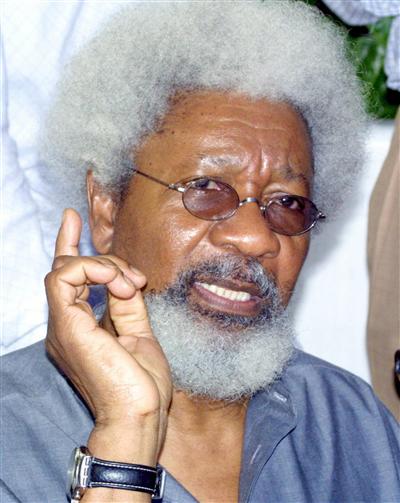
2015: I Have 60 Reasons Why I Will Not Vote For President Jonathan – Wole Soyinka

Professor Wole Soyinka

Nobel laureate, Professor Wole Soyinka has announced that he has sixty reasons why he will not vote for the continuation of President Goodluck Jonathan’s government, emphasising that whoever have any thought that he would vote for Jonathan “must be living in Sambisa forest.”
Professor Soyinka who spoke today at Lagos Black Festival 2015 said: “I will not vote and I will not encourage ‎anyone to vote for the continuation of this government, simply because your colleagues (students) numbering over two hundred, were kidnapped.”
Soyinka told students at the 2015 edition of Vision of the Child (VOTC), a yearly programme inaugurated in 2012 that Chibok girls, kidnapped on 14 April of last year were sent on a mission to acquire an education but ended up being kidnapped.
“And the government of this nation failed to show leadership.‎ So anyone who says after that event that I will vote or cast my vote or encourage anyone to vote for this regime must be living in Sambisa forest,” Soyinka said, referring to a forest in Borno State where the Chibok girls are believed to be held by Boko Haram.
“There has been a failure of leadership. Our children whom you represent today have been betrayed‎.”.
Professor Soyinka regretted that it even took the Jonathan government ten days to even accept that the Chibok girls were missing, adding: “after that dereliction of duty, after that failure of leadership, after that betrayal for our future, for anyone to think or to put words in my mouth suggesting that I will vote or encourage anyone to vote for this regime is a travesty of intelligence.”
Professor Soyinka laughed off those who had claimed on the social media that he ‎was dead, telling journalists at the event that they should not misquote him. If they do, he added, he will rise from the dead to correct them.
The 2015 edition of Vision of the Child has for theme “The Road to Sambisa.”
This year, a total of 250 student participants from 60 primary and secondary schools within Lagos attended the interview. The age bracket for the participants was 9 to 12 years.
Their entries were assessed by a panel of eminent judges comprising teachers, artists, child carers and social workers.
The finalists will be invited on the 7 March to the National Conversation Foundation Park. Lekki, and provided with brush, paint and easel, and will be required to illustrate their literary presentation in the complementary medium painting.
This year, 60 finalists were drawn from 35 schools within Lagos State, said Foluke George‎, Festival Secretary and Programme Manager for the Vision of the Child.

[myad]

Buhari, Tambuwal, APC Governors Attending Council Of State Meeting In Villa

Buhari and Oshiomhole

Presidential flag bearer of Nigeria’s leading opposition All Progressives Congress (APC), General Muhammadu Buhari, speaker of the House of Representatives, Hon. Aminu Waziri Tambuwal and all the governors of APC made a surprise appearance today at the Presidential Aso Villa, Abuja to attend the Council of State meeting.

Genera Buhari, who is attending the meeting after a long time absence from such meeting, is there in his capacity as former Nigerian Head of State. He was said to have been ushered in to see President Goodluck Jonathan shortly on his arrival at the State Hosuse by the Secretary to the Government of the Federation, Anyim Pius Anyim.

Also in attendance at the meeting, which is still ongoing, are all the PDP Governors and other past leaders of the country.

Details later. [myad]

Jega Threatens To Resign If He’s Pushed Too Much

INEC Boss, Prof. Atahiru Jega

Chairman of the Independent National Electoral Commission (INEC) Professor Attahiru Jega has threatened not to stay in office a day longer the moment he is being pushed to do things that is not from his conscience.

Professor Jega who spoke at an interactive session in Chatham House, London yesterday, made it clear that for now he is not under pressure from any quarters on what INEC should do or not do on the 2015 general elections.

“No one can make me do what is against my conscience. I will walk away the day I feel I can’t do the job according to the dictates of my conscience”, he declared.

He added that whatever INEC does are in accordance with provisions of the law, logistics and the exigencies of the issues at hand, explaining that the recently released election timetable was premised on the commission’s capacity and resources.

Professor Jega said due to the enormity of the tasks and challenges involved, INEC is not yet ready to conduct all elections in one day, stressing that the commission would however go a step better in 2015 by staggering the elections over two days instead of the three days as was the case in 2011.

He said that it was logical to conduct national elections – presidential and National Assembly elections in one day and local elections – gubernatorial and state houses of assembly elections – on another day, but lamented that whatever the sequence INEC chose to conduct the elections, people would still complain as it is difficult to satisfy everyone.

Professor Jega assured that the 2015 elections would be “much better than 2011” but expressed concern over the “must-win” and “do-or-die” attitude of some politicians whose mindset is to win at all costs.

He also criticized media practitioners in Nigeria for pandering to the propaganda of politicians instead of sticking to the dictates of their profession.

He called on all to support INEC in its onerous task to conduct free and fair elections, stressing that the task of ensuring credible elections in the country is not on the commission alone, but all stakeholders. [myad]

State House Press Corps Declares 3-Day Mourning For Late Dan Idonor

Daniel Idor
State House Press Corps (SHPC), made up of Journalists and special editors covering the Nigeria Presidency for their media organizations, has declared a three-day mourning for the former Chairman of the Corps, Mr. Daniel Ovwigho Idonor who died last week Monday, February 2nd, in Abuja.
A statement signed by the current chairman of the SHPC, Mr. Kehinde Amodu today said that the three-day mourning period would be observed by members with prayers.
“During the period, which is from Thursday 5th to Saturday 7th February,  2015, members are enjoined to pray for the repose of his soul as well as ask God to grant his family and friends the fortitude to bear the huge loss,” the statement explained.
It also enjoined members of the Corps to visit the immediate family of late Idonor at their Abuja residence even as it commiserated with the management and staff of Frontier Newspapers which the deceased co-established and served as Executive Editor until he died. The SHPC also condoled with Champion and Vanguard Newspapers where he previously worked respectively before venturing into online publication.
“Mr. Daniel Idonor, popularly referred to in the Villa as “Chair” will be remembered for his purposeful and bold leadership during the two terms he served as Chairman of the State House Press Corps.
“The Corps prays God Almighty to grant his soul eternal rest.” [myad]

Pirates Hijack Oil Tanker Off Nigerian Coast, Kill One, Take 3 Hostages

Pirates kill police

Pirates are reported to have hijacked a 15-year-old crude oil tanker, Malta-flagged Kalamos, off the Nigerian coast, taking three hostages and killing the vessel’s Greek deputy commander.

The Greek coastguard confirmed that Malta-flagged Kalamos was anchored and awaiting fresh cargo from Qua Iboe, an oil terminal in Nigeria’s southeastern region operated by ExxonMobil, when it was boarded on Tuesday.

Report says that two of the three hostages are Greek, and that Greeks make up 10 out of the total 23 crew.

A spokeswoman for the coastguard said that the hijacking of the tanker took place in the Gulf of Guinea, which experts have said is the new epicentre of piracy in Africa.

It would be recalled that between January and September last year, the area recorded 33 incidents of piracy and armed robbery.

According to the International Maritime Bureau, the pirates operating off the coast of Nigeria, Togo and Benin are heavily armed and violent, and often hold crews hostage for several days. [myad]


Don’t Leave North In Panic, Governor Okorocha Advises Igbo

RochasOkorocha

Governor Rochas Okorocha of Imo State has advised Igbo People living in the northern part of the country not to leave the North out of panic over the February general elections, assuring that there will be no crisis during and after the elections.

This was even as he blamed the ruling Peoples Democratic Party (PDP) of intruding politics of religion and ethnicity in Nigeria.

Governor Okorocha, who spoke in Abuja after a meeting between leaders of All Progressives Congress (APC) and its National Assembly candidates nationwide, dismissed insinuations that the party’s presidential candidate, General Mohammdu Buhari would pursue an Islamic agenda if elected.

According to him, the idea of Islamizing the country was propagated by PDP, which he accused of dividing Nigerians along ethnic and religious lines.

“it is uncalled for to return home. There is no need for it. The elections, as far as we are concerned, will be peaceful. Nigeria and Nigerians are only passing through a challenging period in their political history.

“That does not mean it will bring about crisis. I do not think so. Unless for Igbo who have registered at home. They should come home to vote. But those who registered in the north should stay there.

“Again, this is one of the things we have been complaining about. Since the advent of PDP, this nation has been polarized between Muslims and Christians.

“That is the most dangerous point PDP has introduced in the Nigerian politics. Before now, you do not even know where you come from or who is who. We were all one.

“But when PDP decided to go to churches and other religious houses, they polarized the polity. That is why the only thing they have to say about Buhari is that he will make the whole Christians become Muslims overnight.

“The General was once the Head of State with Idiagbon; very powerful then. With decree in their hands, they could not Islamize anybody. Is it now we have National Assembly and state Houses of Assembly they will do that? It is not possible.

“This is cheap politics by PDP and that is what is creating the tension. Nigerians love themselves and this campaign of hate introduced by PDP is also very worrisome.

“But what is before us now is more than the sentiments of tribe and religion.” [myad]


Advertisement ADVERTORIAL
WP2Social Auto Publish Powered By : XYZScripts.com