President Goodluck Jonathan has made it clear once again that he will not, under any circumstance, permit any threat to peace and security in whatever form in any part of Nigeria. The President who commissioned the new governor’s Office in the Sir Kashim Ibrahim House, Kaduna today said that his government is committed to working with Kaduna state government to ensuring the protection of the lives and property of the entire people of the State, “and indeed all Nigerians.” President Jonathan was delighted with what he called ‘the prevailing peace and security’ in the State, adding: “we can achieve much more if we continue to sustain the peace and work in unity in the interest of our people. “The sustenance of the prevailing peace is necessary to accelerate economic growth and prosperity. Let me again appreciate the Government and good people of Kaduna State for working hard to make this happen.” He reminded the people that the prime purpose of politics is to engender sustained growth and development even as he commend Governor Yero for his dedication and commitment to improving the lives and livelihood of the people of Kaduna State. “By completing this and many similar projects, he has sufficiently demonstrated his belief in continuity, which is imperative for sustainable growth and development. “This historic edifice stands as a befitting tribute to the historic place of Kaduna as the traditional Capital of the old Northern Region of Nigeria. This is a major legacy project which successive administrations in the decades ahead will appreciate.” Jonathan counted the number of progress that has been made by his government in the provision of critical infrastructure which he said is the centerpiece of his Transformation Agenda. “For this reason, we have initiated and executed various developmental projects across the length and breadth of our nation; Kaduna State is a major beneficiary in this regard. “As you may be aware, our administration is on the verge of completing the Abuja-Kaduna standard-gauge fast rail line – the first of its kind in the country. Our ultimate goal is to make it easier to traverse Nigeria and increase the integration of our people and our ability to do business with each other. “In the last three and half years, we have also completed several road projects in this great State including the reconstruction of the Vom-Manchok Road, the rehabilitation of the Access Road to Kaduna Refinery and the rehabilitation of the Mararaba-Pambeguwa-Saminaka Road to mention just a few. “Kaduna State has also benefitted immensely from the national reforms and attendant overhaul in the power sector. The construction of a 215 megawatts thermal power plant at Kudenda and distribution projects like the 330kv Kaduna-Zaria-Kano line, and the 132kv Jos-Kafanchan-Funtua-Malumfashi-Katsina Transmission lines among others. “We are largely agrarian people and our focus in the Agriculture and Water Resources sector, has seen us completing the Galma Dam at Kuzuntu, as well as the Gurara Dam. It is pertinent to note that these major multipurpose dams have dual capacity for power generation, as well as irrigation for our farmers.” The President said that agriculture has received high priority under his administration because it recognizes the sector as its new frontier for growth. “Our Agricultural Transformation Agenda, which I launched in 2011, has the primary objective of unlocking the huge potentials of the agricultural sector and making it the main driver of our national economy – the way it was before we discovered oil. “As we witness, for instance, high yields in rice, corn, sorghum, pepper, tomatoes and other crops, we can confidently attribute this to the elimination of corruption in fertilizer distribution as ordinary farmers in our country now have a direct access to fertilizers and input through the e-wallet system. I am glad that the Kaduna State Government has keyed in to the Agricultural Transformation Agenda.” myad]
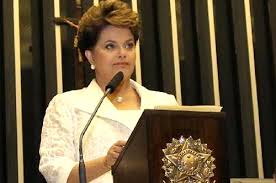
President Goodluck Jonathan has said that he received with great delight, the news of the re-election for another term, of President Dilma Rousseff of Brazil. In a congratulatory message today, President Jonathan savoured what he called ‘excellent relations and strategic partnership’ that has been forged between Nigeria and Brazil during the first term in office of the re-elected President. The Nigerian leader wrote: “on behalf of the Federal Government and the people of Nigeria, I congratulate President Dilma Rousseff of Brazil on her victory in yesterday’s final round of her country’s presidential elections.” Jonathan said that as President Rousseff prepares to begin a new term of office on January 1, 2015, he looks forward to working with her government to expand and further enhance existing relation with Brazil, especially in the area of trade and economic relations, for the mutual benefit of the people of both countries. President Jonathan also applauded President Rousseff’s expressed commitment to working for greater peace, national unity and more reforms in Brazil during her second term. He congratulated the people of Brazil for their unwavering commitment to democracy and its processes which have produced a peaceful and acceptable outcome in the very keenly contested elections. [myad]
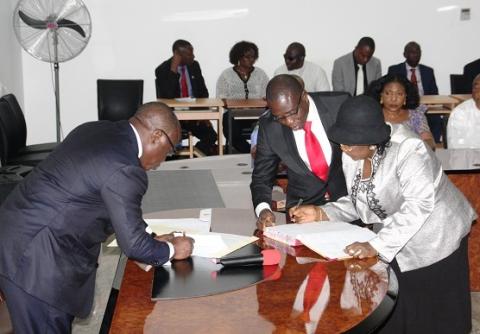
Delta State government has began an investigation into the Ibabu/Iselegu communal crisis. The state governor, Dr. Emmanuel Uduaghan inaugurated a three-man Judicial Commission of Inquiry on the crisis. Inaugurating the commission in Asaba today, the governor charged communities in the state to always explore avenues of dialogue in resolving issues rather than engaging in warfare. “I appeal to communities to explore all available means of dialogue to settle their differences because communal crisis is inimical to orderly development and also create image problem for the state.” According to him communal crisis contribute to frustration and disenchantment experienced by members of the society, adding: “economically, it can scare potential investors and relocation of existing industries in our communities to other states thereby creating avoidable problem.” Governor Uduaghan listed the terms of reference of the commission as:“determine the remote and immediate cause or causes of the civil disturbances between the Iselegu and Ibabu communities in Ndokwa East and West Local Government Areas respectively, sometime in June, 2014. “Determine those persons or institutions responsible for the disturbance in Iselegu and Ibabu communities, identify those who suffered injury to their persons and the nature of injury, those who lost their lives; and the extent of destruction of properties and those whose properties were destroyed during the disturbances.” Other terms of reference of the commission are to: Investigate any other matter incidental or relevant to the terms of reference, which in the Commission’s view should be investigated to ascertain the true facts, make appropriate recommendations, including immediate measures to be taken by government and or the communities for the sustenance of peaceful co-existence in the communities and to prevent future crisis or disturbance in the area.” Dr. Uduaghan said that the commission has one month within which to submit an interim report, even as he described the members as “distinguished Deltans with proven integrity and it is my expectation and that of our people that they will handle this responsibility with due diligence, impartiality, transparency and fairness to all sides.” The commission has Hon. Justice Barbara Molokwu as chairman with Mr. Enie Otrofanowei and Surveyor Dickson Akpoghene as members while Mr. Anthony Abuah will serve as Secretary. Responding on behalf of members of the Commission, Hon. Justice Molokwu (rtd.) assured Deltans that they would dutifully, diligently, treat with dispatch this matter that has re-occurred despite efforts to arrest it, adding: “peace is very important to the development of the society.” [myad]
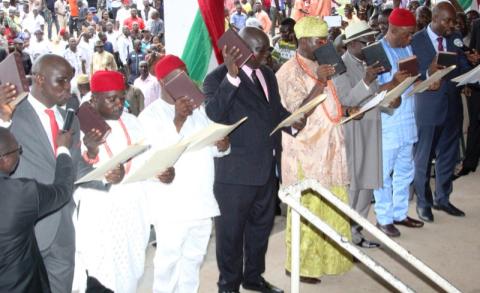
Delta state governor, Dr. Emmanuel Uduaghan has charged the newly elected local government council chairmen to live among their people so as to know their needs. Administering oath of office today on 23 newly elected local government chairmen that won the Saturday council polls conducted by the Delta State Independent Electoral Commission (DSIEC) the governor advised them to let their elections be a blessing to the people “and make sure you reside in your local government headquarters so that you can be accessible to the people. “As local government chairmen, please, don’t discriminate between those that worked for you or worked against you during the elections because, you were elected to serve everybody.” He further advised them to join hand with his administration in promoting ‘Delta Beyond Oil Economic Development Model’ through judicious application of resources. Governor Uduaghan advised the chairmen to be abreast with local government laws even as he charged them to complete all on-going projects in their locality. “Government is a continuum, consolidate on the achievements of your predecessors and complete all the ongoing projects.” He asked them to ensure that peace and security reign in their councils at all times. Dr. Uduaghan used the occasion to condemn the conduct of some voters at the Saturday’s poll whose action of thronging DSIEC offices and police stations disturbed the distribution of materials. According to the governor it was wrong for the electorates to besiege places where sensitive election materials were kept. “At the future elections, let us not go to the Police or DSIEC offices to wait for materials, we should wait for materials at the different polling units.” The Governor commended DSIEC for conducting a generally acceptable elections and also thanked the security agencies, religious leaders and traditional rulers for their various roles in the successful conduct of the polls. Dr. Uduaghan said that the council polls in the state were delayed due to legal issues that surrounded the government’s attempt to reconstitute the commission. Responding on behalf of the chairmen, Hon. Constantine Ikpokpo, Chairman, Isoko South Local Government Council said they would execute people-oriented projects and would be responsible to the electorates. [myad]
South Africa football captain, Senzo Meyiwa has been reportedly shot dead by intruders as he tried to protect his girlfriend during a robbery at her home near Johannesburg.
Officials said today that the 27-year-old Orlando Pirates goalkeeper died yesterday, Sunday after suffering a single shot through the chest at the home of girlfriend Kelly Khumalo, a local actress and singer, in the township of Vosloorus.
“Two guys entered the house and demanded cellphones, money and other valuables,” provincial Community Safety official Sizakele Nkosi-Malubane told reporters at the scene.
“Senzo tried to protect Kelly because one of the men had a gun pointed towards her.”
Police said two men entered Khumalo’s house where Meyiwa was in a party of seven in the house. A third assailant waited outside the house and all three fled immediately after the shooting.
Meyiwa was declared dead on arrival at hospital, the police added.
South Africa coach Ephraim Mashaba comforted several of Meyiwa’s teammates who had arrived at the hospital not long after the shooting.
“We can assure all South Africans that we will do all we can to bring Meyiwa’s killers [to] book,” the South African Police Services said on its Twitter account, offering a reward of 150,000 South African rand (Dh50,347).
National Police Commissioner Riah Phiyega announced a special task force team had been formed to investigate the murder.
“We mourn the death of this young footballer and team leader whose life has been taken away at the prime of his career,” said a statement from South African president Jacob Zuma on Monday.
“The law enforcement authorities must leave no stone unturned in finding his killers and bring them to justice. Words cannot express the nation’s shock at this loss.”
Police cordoned off the street leading to Khumalo’s house on Monday morning as a forensic team conducted its investigation, keeping locals and reporters away from the scene.
Meyiwa captained South Africa in their last four matches in the African Nations Cup qualifiers without conceding a goal and played on Saturday when his club advanced to the semi-finals of the South African League Cup.
“This is a sad loss whichever way you look at it – to Senzo’s family, his extended family, Orlando Pirates and to the nation,” Pirates chairman Irvin Khoza said in a statement.
Meyiwa’s death has further highlighted South Africa’s rampant gun violence less than a week after Paralympic runner Oscar Pistorius was given a five-year jail sentence for culpable homicide after shooting dead his girlfriend Reeva Steenkamp.
More than 17,000 people were murdered in South Africa between April 2013 and March 2014, an increase of about 800 over the previous year, according to police figures.
South Africa teammates Dean Furman and Andile Jali were among the first to react to the Meyiwa tragedy on Twitter.
“Beyond devastated at the loss of our captain and friend Senzo Meyiwa. Thoughts and prayers are with his family and friends at this terrible time,” tweeted England-based Furman, who plays for Doncaster Rovers in the third-tier in the English league.
“Just got a call and I was sleeping, but now I cannot sleep because of what I just heard,” tweeted Jali, who moved from Pirates to Belgiuan club Ostend this year.
The Guild of Corporate Online Publishers has called on members to adhere strictly to the principles of fairness and adequate consideration for national security as they set to cover the political campaigns and elections in the 2015 general elections.
The Guild, in a communiqué issued today, arising from its meeting in Abuja recently, called on journalists to step up the quality of their coverage of political activities as the 2015 elections draw nearer.
The communiqué which was signed by the Guild’s President, Mr. Malachy Agbo and the General Secretary, Mr. Dotun Oladipo, asked journalists not to forget the basic principles guiding journalism, especially in this electioneering campaign era.
The Guild, however decried the harassment of journalists in recent times by security agents, even as it called on the security agents to respect the rights of journalists as well as the constitutional guarantee for the unfettered discharge of their duties.
The Guild expressed the need to work in concert with the Nigerian Copyright Commission to properly articulate steps to take in protecting the intellectual property of writers.
“This stems from the flagrant abuse of the properties of writers, especially journalists. The Guild thus called for professionalism among journalists, top of which should be giving credit to source (s) of information.
“The Guild commiserates with the nation, the executive committee and members of the Nigerian Guild of Editors, co-workers and family members of former presidential spokeswoman and for Managing Director of the News Agency of Nigeria, Dame Remi Oyo; the Vice Chairman of Sun Publishing Limited, Pastor Dimgba Igwe; and the Editor-in-Chief of Real News magazine, Mike Akpan, all of who died recently. While it wished the departed souls eternal and blissful rest. It also prayed to God to grant all those affected by their departure the fortitude to bear the loss.
Over 20 members of Guild attended the Abuja meeting. [myad]
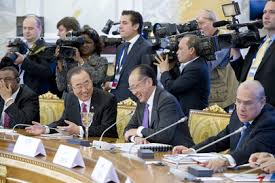
Leaders of global and regional institutions today begin an historic trip to the Horn of Africa to pledge political support and major new financial assistance for countries in the region, totaling more than $8 billion over the coming years.
UN Secretary-General Ban Ki-moon, the World Bank Group (WBG) President, Jim Yong Kim, as well as the President of the Islamic Development Bank Group and high level representatives of the African Union Commission, the European Union, the African Development Bank, and Intergovernmental Agency for Development (IGAD) are combining forces to promote stability and development in the Horn of Africa.
On the first day of the joint trip, the World Bank Group announced a major new financial pledge of $1.8 billion for cross-border activities in a Horn of Africa Initiative that will boost economic growth and opportunity, reduce poverty, and spur business activity.
The initiative covers the eight countries in the Horn of Africa — Djibouti, Eritrea, Ethiopia, Kenya, Somalia, South Sudan, Sudan, and Uganda.
“This new financing represents a major new opportunity for the people of the Horn of Africa to make sure they get access to clean water, nutritious food, health care, education, and jobs,” said World Bank Group President Jim Yong Kim.
“There is greater opportunity now for the Horn of Africa to break free from its cycles of drought, food insecurity, water insecurity, and conflict by building up reg
Leading the trip to the Horn of Africa, the United Nations Secretary-General, Ban Ki-moon said: “The countries of the Horn of Africa are making important yet unheralded progress in economic growth and political stability. Now is a crucial moment to support those efforts, end the cycles of conflict and poverty, and move from fragility to sustainability. The United Nations is joining with other global and regional leaders to ensure a coherent and coordinated approach towards peace, security and development in the Horn of Africa.” The European Union also announced that it would support the countries in the region with a total of around $3.7 billion until 2020, of which about 10 percent would be for cross-border activities; the African Development Bank announced a pledge of $1.8 billion over the next three years for countries of the Horn of Africa region; while the Islamic Development Bank committed to deploy up to $1 billion in new financing in its four member countries in the Horn of Africa (Djibouti, Somalia, Sudan and Uganda).
The Horn is diverse, with some of the fastest growing economies and huge untapped natural resources. However, it also has many extraordinarily poor people and populations that are now doubling every 23 years. Unemployment is widespread among growing numbers of young people. Women, in particular, face huge obstacles because of their gender, including limited land rights, limited education, and social customs that often thwart their ability to pursue economic opportunity, and improve living conditions for their families and communities.
Countries in the region are also vulnerable to corruption, piracy, arms and drug trafficking. Terrorism, and related money flows are significant and interconnected threats in the Horn of Africa. People-trafficking is also a growing problem in the region. However, there are commendable efforts being made through regional cooperation in parts of the Horn to tackle the root causes of these problems.
The new financing announcement will support those efforts and comes on the first day of the trip led by UN Secretary-General Ban Ki-moon, to discuss peace, security, and resilience. In addition to the UN Secretary-General, other leaders making the trip are World Bank Group President Jim Yong Kim; Islamic Development Bank Group President Ahmad Mohamed Ali; African Union Commission Deputy Chairperson Erastus Mwencha; Intergovernmental Agency for Development (IGAD) Executive Secretary, Ambassador Mahboub Maalim; African Development Bank Group Special Advisor to the President, Youssouf Ouedraogo; Deputy Director General for Development and Cooperation, European Commission, Marcus Cornaro and European Union Special Representative for the Horn of Africa, Alexander Rondos.
The World Bank Group said its new $1.8 billion packaging, which is in addition to its existing development programs for the eight countries, would create more economic opportunity throughout the region for some of the most vulnerable peoples, including refugees and internally displaced populations and their host communities. Wars and instability have generated more than 2.7 million refugees along with over 6 million internally displaced people. The Bank Group will also help the region build up its communicable disease surveillance, diagnosis, and treatment capacity.
Many of these diseases are associated with or exacerbated by poverty, displacement, malnutrition, illiteracy, and poor sanitation and housing. Increased cross-border trade and economic activity in the Horn of Africa will necessitate simultaneous investments in strengthening disease control efforts and outbreak preparedness.
The Bank Group will also support greater regional links between countries with regional transport routes, stronger ICT and broadband connectivity, more competitive private sector markets, increased cross-border trade, regional development of oil and gas through pipeline development, and the expansion of university and other tertiary education.
The Bank Group’s pledge includes $600 million from the IFC, its private sector arm, which will support economic development in the countries of the Horn. IFC investments under the new Horn Initiative will include a regional pipeline linking Uganda and Kenya; greater investment in agribusiness expansion in storage, processing, and seeds; possible public-private partnerships in pharmaceuticals, renewable energy and transport; and financial advice and support to government and companies to improve business confidence and investment, access to markets, and access to private finance. Another $200 million is for guarantees against political risks from the Multilateral Investment Guarantee Agency.
A new World Bank Group paper forecasts that the Horn will undergo dramatic and lasting change when oil production starts in Kenya, Uganda, and possibly Somalia and Ethiopia.
For its part, the European Union’s Horn of Africa approach is based on a strategic framework adopted in 2011. Support programs for 2014-2020 will be guided by the same analysis that underpins the World Bank’s Horn of Africa Initiative and will focus on the development challenges that must be tackled to unlock the region’s considerable potential. EU support will mostly target the three pillars of the Horn of Africa Initiative: boosting growth, reducing poverty by promoting resilience, and creating economic opportunities.
“The EU stands ready to further deepen its long-standing partnership with the Horn of Africa – helping to build robust and accountable political structures, enhancing trade and economic cooperation, financing peace keeping activities and providing humanitarian assistance and development cooperation,” said European Development Commissioner Andris Piebalgs prior to the trip.
Other leaders on the trip said that the Horn of Africa region needs new development assistance in order to secure peace and opportunity to thrive and prevent future conflicts.
The Islamic Development Bank Group said its new financing for Djibouti, Somalia, Sudan and Uganda over 2015-2017 would focus on critical infrastructure development, food security, human development, and trade. A further $2 billion could be provided by the Arab Coordination Group over the same period.
Commenting on this announcement, Islamic Development Bank Group President, Ahmad Mohamed Ali said: “The Horn of Africa is an important gateway to Africa and a bridge to Western Asia. Bringing stability and sustainable development to the Horn of Africa will undoubtedly significantly contribute to stability across the entire African continent. The Islamic Development Bank Group salutes this renewed focus on the Horn of Africa and stands ready to work with all partners, including the Arab Coordination Group, to support regional cooperation and the economic revival of the Horn of Africa, especially in its four member countries.”
“Given the complexity of the environment prevailing in the region, we must convince ourselves that it is not the financial means that will win in the Horn of Africa region, but our commitment and determination to act under the leadership of the countries in a united and coordinated manner,” said African Development Bank Group Representative, Youssouf Ouedraogo, Special Advisor to the President.
African Union Commission Deputy Chairperson, Erastus Mwencha, added, “Our efforts to create peace and stability must be reinforced by investments in the peoples and countries of the Horn.”
A new WBG regional study on the Horn of Africa released today at the start of the trip found reasons for hope for the region: “Despite the challenges the Horn of Africa faces, there are encouraging signs of political momentum for enhanced regional economic interdependence. Increasingly, Horn of Africa countries are members of the East African Community, IGADin Eastern Africa, and the Common Market for East and Southern Africa. Some countries are showing strong political will to solve both security and development issues through increased cooperation—for example, many have sent troops to participate in peace-keeping efforts and have participated in diplomatic initiatives.”
“This mission is the apex of an ambitious partnership approach that will provide the necessary instruments to strengthen the resilience agenda in the IGAD region,” said IGAD Executive Secretary, Ambassador Mahboub Maalim.
For the UN’s Ban and World Bank’s Kim, this is their third trip in 18 months together to Africa. In 2013, the two travelled to the Great Lakes and Sahel regions, drawing attention to the need to promote both peace and development. During the two previous trips, Kim pledged $2.7 billion for regional projects for programs to improve health, education, nutrition, access to energy, and job training. [myad]
Nigeria’s Presidency went wild with uncomplimentary words today against Governor Rotimi Amaechi of Rivers state, whom it said has taken “his obnoxious willingness to denigrate the highest office in the land in a reckless bid to advance his selfish political interests to a new level of irresponsible and rascally behaviour yesterday in Port Harcourt with his totally false and baseless vituperations against President Jonathan, the First Lady and the Federal Government.” The Presidency added: “it appears from the Governor’s completely unfounded and off-the-mark allegations that he had totally lost all sense of propriety, decorum and responsible political behaviour and resorted to unacceptable demagoguery, libel, blackmail and incitement of public disorder.” In a statement by special adviser to President Goodluck Jonathan on media and publicity, Dr. Reuben Abati, the Presidency imagined that governor Amaechi’s “unbridled ambition and desire for self- promotion have completely befuddled his mental faculties and caused him to totally lose touch with reality.” If not so, the statement stressed, the offending governor should have known that his claims and allegations are untrue. “We can only assume therefore that he is deliberately spewing malicious falsehood in a desperate effort to incite the people of Rivers State and Nigeria against his assumed political foes. “We warn him that there are legal, constitutional and moral limits to political rascality beyond which he will not be allowed to go without repercussions. “The immunity which he currently enjoys notwithstanding, Governor Amaechi should be under no illusions: A day of reckoning will surely come when he will answer for all his actions and false allegations against President Jonathan, the First Lady and the Federal Government. “He should also know that Nigerians are aware of the truth and will never be fooled or swayed by his arrant opportunism and anti-Jonathan rantings. “Nigerians know that while Mr. Amaechi falsely accuses others of corruption, he cannot show or explain to the people of Rivers State what he has done with the billions of Naira that has accrued to the state under his tenure. “They also know that while Amaechi continues to falsely accuse the Jonathan Administration of having done nothing for Rivers State, he has recklessly squandered huge state resources on dubious, vain-glorious projects or self aggrandizement. “Nigerians will know too that while he falsely alleges that Rivers and other states have not received funds due to them from the Federation account, the only outstanding allocation was for September, which was released to all states well over a week ago. “The Governor should stop trying to make President Jonathan the scapegoat for his woeful performance in Rivers State and look to his own very apparent failings and incompetencies. “He should also stop blackmailing the First Lady who has demanded nothing from him other than good governance, justice, equity, fairness, real development and progress in Rivers State.”
Six policemen who were kidnapped over the weekend by dare-devil pirates operating along the creeks and waterways of the Niger Delta have been killed. The policemen, who were among the 12 persons kidnapped in separate operations in Nembe area of Bayelsa, were stripped naked with their rifles and uniforms taken away along with their gunboat.
The bodies of the slain policemen, who were not immediately identified, have been recovered and deposited at the morgue of the Federal Medical Centre, Yenagoa, it was also learnt.
It was gathered that the pirates had made away with a gunboat belonging to the police, in an attack which occurred in broad daylight, at about 1.30pm on Friday. The gunboat was said to have been escorting a barge owned by Nigerian Agip Oil Company (NAOC) when it came under attack.
It was gathered that the hoodlums, who operated on a speedboat, laid ambush for the gunboat and opened fire on the policemen. They were said to have overpowered the policemen and later took control of the gunboat along Santa Barbara and Nembe waterways caused panic among travelers.
The incident also caused a delay in the movement of persons travelling to Okpoama, Brass Local Government Area, for the funeral of former Governor Timipre Sylva’s uncle. Most of the guests for the burial were said to have waited at Ogbia jetty till the gunmen had finished their operation.
A security source who pleaded anonymity said the hoodlums were not interested in the Agip barge and its occupants.
“Policemen escorting Agip barge were attacked on Friday. The gunboat and the policemen were all taken away. The policemen were three including the driver of the boat making them four. “The barge and its occupants escaped because the gunboat was the target of the pirates. This incident happened along Santa Barbara and Nembe route at about 1.30pm. The pirates were after the gunboat and the police arms.”
In a separate incident, the source confirmed that six persons working for a company identified as Icon Xearex were abducted at Oluasiri in Nembe. He said the pirates attacked a boat owned by the company in the early hours of Friday and took the workers away. According to him, the company is suspected to be an oil-servicing firm.
“There was another incident at Oluasiri. As a matter of fact six persons were kidnapped. They were in a boat called Icon Xeareax. Six persons were abducted from the boat belonging to that company. The company is suspected to be an oil-servicing company”, he said.
All efforts to confirm the incident from the police proved abortive as the Police Public Relations Officer, Mr. Alex Akhigbe, said he was in Abuja for a programme. Also, the state Commissioner of Police, Mr. Valentine Ntomchukwu, sent a message, claiming to be in a meeting. [myad]
Bishop of Catholic Church of Sokoto, Matthew Hassan Kukah has classified Nigerian politicians into one single group: “they have a language of their own; they have a culture of their own and have a universe of their own that they live in.”
The Bishop, in an interview in Port Harcourt said: “Those of us who are not politicians should wake up to the reality that politicians have a language of their own; they have a culture of their own and have a universe of their own that they live in.
“Those of us who are so stupid as to surrender our lives for nothing, would appreciate the fact that with the politicians of Nigeria, they are in PDP today, they are in APC tomorrow, the next day they are in CPC and the next day are in another party.
“You have to understand the fact that the politicians live in a different universe. If you are going to make a choice, make a choice wisely, but that choice must not include wasting your own life, because, only the living can play politics. So, the choice is chiefly ours.”
Bishop Kukah advised politicians to be mindful of the repercussion of trading with the fortune of Nigerians, even as he advised them to live one day at a time and remember that they do not own their lives.
He cautioned the Federal Government against politicizing the release of the abducted Chibok girls after six months of their incarceration, saying that there are dangerous consequences of jungle justice in a democratic setting.
“This should not be a matter of politics, as somebody had said. We are prayerfully hoping that things would change. “This is not something that is within the power of one person. The issues are much more complicated than that.
“And I think we must trust the sense of judgement of the government, trust the sense of judgement of the security agencies and trust the goodwill of ordinary Nigerians and share in the agony of the parents of these children and just prayerfully hope that they come back to us alive.” [myad]
We use cookies on our website to give you the most relevant experience by remembering your preferences and repeat visits. By clicking “Accept”, you consent to the use of ALL the cookies.
This website uses cookies to improve your experience while you navigate through the website. Out of these, the cookies that are categorized as necessary are stored on your browser as they are essential for the working of basic functionalities of the website. We also use third-party cookies that help us analyze and understand how you use this website. These cookies will be stored in your browser only with your consent. You also have the option to opt-out of these cookies. But opting out of some of these cookies may affect your browsing experience.
Necessary cookies are absolutely essential for the website to function properly. This category only includes cookies that ensures basic functionalities and security features of the website. These cookies do not store any personal information.
Any cookies that may not be particularly necessary for the website to function and is used specifically to collect user personal data via analytics, ads, other embedded contents are termed as non-necessary cookies. It is mandatory to procure user consent prior to running these cookies on your website.





 Nigeria’s Presidency went wild with uncomplimentary words today against Governor Rotimi Amaechi of Rivers state, whom it said has taken “his obnoxious willingness to denigrate the highest office in the land in a reckless bid to advance his selfish political interests to a new level of irresponsible and rascally behaviour yesterday in Port Harcourt with his totally false and baseless vituperations against President Jonathan, the First Lady and the Federal Government.”