Home Blog Page 2464

Borno Governor Has Been Offering N1 Million To Family Of Soldier Killed In Boko Haram Operation

Borno-State-GovernorFacts have emerged to show that Borno State Governor, Alhaji Kashim Shettima has been providing the sum of one million naira to the family of any soldier killed in the battle with Boko Haram.
According to the governor’s spokesman, Isa Gusau said in a statement today said that through a strong network of communities involvement Governor Shettima has been working hard in generating and providing information the security forces process for their intelligence.
“The State provides N1m to families of every soldier killed in combat as palliative to familes and to motivate others on battle field. Security chiefs have unfettered access to the Governor as they see him at the shortest time with or without prior appointment, day or night.
“The Governor acts on his daily reports appropriately even as he inspires youth volunteers, trained and equipped them with patrol vehicles and pays them salaries to do community policing to complement troops.”
Gusau, was obviously reacting, on behalf of the governor, to the damning report of Amnesty International today that indicted security forces over the abducted female students of the Government Girls Secondary School, Chibok in Borno state
He said that Amnesty International clearly directed its report at the Federal Government, saying that Governor Shettima will not comment on the report. “But the Governor deeply appreciates the efforts and sacrifices of security agencies in Borno State who have been engaged in counter-insurgency operations in the last three years with some of them laying their lives for the State. The Governor also respects the Amnesty International as a credible institution and will not doubt it’s findings. The Governor is very much committed to supporting ongoing search and rescue efforts to free Borno’s precious daughters. “More than any other person in position of authority, Governor Shettima is deeply pained by that unfortunate abduction and is committed to providing all necessary support security agencies and community volunteers towards freeing his daughters. Just for the record, Governor Kashim Shettima has since assuming power, accorded nothing short of outstanding support for all security agencies in the State and this has been well acknowledged by different heads of security agencies at various times.
“Borno State under his tenure, has provided over 300 brand new hilux patrol vehicles to them. The state fuels these vehicles daily and provides maintenance. “The State provides other material logistics to security agencies.”

Chibok Abduction: Amnesty International Indicts Nigeria Security Forces

Amnesty internationalAmnesty International has indicted Nigerian security forces which it said failed to act on advance warnings about Boko Haram’s armed raid on the state-run boarding school in Chibok which led to the abduction of more than 240 schoolgirls on April 14.
After independently verifying information based on multiple interviews with credible sources, the organization today exclusively revealed that the Nigerian security forces had more than four hours of advance warning about the attack but did not do enough to stop it.
The Amnesty’s Africa Director, Netsanet Belay who spoke in Abuja today, said:
“The fact that Nigerian security forces knew about Boko Haram’s impending raid, but failed to take the immediate action needed to stop it, will only amplify the national and international outcry at this horrific crime.
“It amounts to a gross dereliction of Nigeria’s duty to protect civilians, who remain sitting ducks for such attacks. The Nigerian leadership must now use all lawful means at their disposal to secure the girls’ safe release and ensure nothing like this can happen again.
“The abduction and continued detention of these school girls are war crimes, and those responsible must be brought to justice. Attacks on schools also violate the right to education and must be halted immediately.”
Amnesty confirmed through various sources that Nigeria’s military headquarters in Maiduguri was aware of the impending attack soon after 7pm on 14 April, close to four hours before Boko Haram began their assault on the town.
But an inability to muster troops – due to poor resources and a reported fear of engaging with the often better-equipped armed groups – meant that reinforcements were not deployed to Chibok that night.
It went on: “the small contingent of security forces based in the town–17 army personnel as well as local police–attempted to repel the Boko Haram assault but were overpowered and forced to retreat. One soldier reportedly died.
“More than three weeks later, the majority of the girls remain in captivity in an unknown location. A climate of confusion and suspicion has so far scuppered efforts to secure their release.”
The Amnesty reiterated its call on Boko Haram to immediately and unconditionally release the hostages into safety and stop all attacks on civilians.
“Warnings ignored
Between 7pm on 14 April and 2am on 15 April, the military commands in Damboa, 36.5 km away from Chibok, and Maiduguri, 130 km away from Chibok, were repeatedly alerted to the threat by both security and local officials.”
According to sources interviewed by Amnesty, local civilian patrols (known as “vigilantes”, set up by the military and local authorities) in Gagilam, a neighbouring village, were among the first to raise the alarm on the evening of 14 April after a large group of unidentified armed men entered their village on motorbikes and said they were headed to Chibok. This set off a rapid chain of phone calls to alert officials, including the Borno State Governor and senior military commanders based in Maiduguri.
One local official who was contacted by Gagilam residents told Amnesty:
“At around 10:00 PM on 14 April, I called [several] security officers to inform them about earlier information I had received from the vigilantes in Gagilam village. They had told us that strange people had arrived in their village that evening on motorbikes and they said they were heading to Chibok. I made several other calls, including to Maiduguri. I was promised by the security people that reinforcement were on their way.”
Another local official was contacted by herdsmen who said that armed men had asked where the Government Girls Secondary School was located in Chibok.
At around 11:45 PM, a convoy reportedly numbering up to 200 armed Boko Haram fighters – on motorbikes and in trucks – arrived in Chibok town and engaged in a gunfight with a small number of police and soldiers based there. Outnumbered and outgunned, the security forces eventually fled in the small hours of 15 April. Some of the Boko Haram fighters proceeded to the Government Girls Secondary School and abducted more than 240 schoolgirls.
Two senior officers in Nigeria’s armed forces confirmed that the military was aware of the planned attack even prior to the calls received from local officials. One officer said the commander was unable to mobilize reinforcements. He described to Amnesty the difficulties faced by frontline soldiers in north-eastern Nigeria:
“There’s a lot of frustration, exhaustion and fatigue among officers and [troops] based in the hotspots…many soldiers are afraid to go to the battle fronts.”
Amnesty’s requests for a reaction from the military headquarters in Abuja have gone unanswered.
Since the 14 April raid, a climate of confusion and suspicion appears to have slowed down the Nigerian authorities’ efforts to locate and free the abducted schoolgirls. On 16 April, a senior Defence Ministry spokesperson said that almost all of the abducted girls had been rescued and only eight were still missing. The next day he had to retract that statement.
Netsanet Belay added:
“The climate of suspicion and lack of transparency about the rescue effort has been unhelpful – all authorities must work together to ensure the girls are brought home safely and more must be done to protect civilians in future.”
Amnesty is calling on the Nigerian government to provide adequate information to families of abducted girls on the authorities’ current efforts to ensure their safe release. The families – and the abducted girls, once they are freed – must be provided with adequate medical and psychological support.
Background
The information on the advance warnings of the impending Boko Haram attack in Chibok came from multiple sources, including local officials and two senior military officers, interviewed by Amnesty. The sources independently verified a list of Nigerian officials who were alerted on 14-15 April, before and during the raid on the Government Girls Secondary School. They have been kept anonymous for their safety.
The abduction of the schoolgirls in Chibok comes amid months of worsening violence and serious human rights violations and abuses being committed by armed Islamist groups and Nigerian government forces alike in the conflict in north-eastern Nigeria.
Amnesty’s research indicates that at least 2,000 people have been killed in the conflict in Nigeria this year alone.
In a separate incident on 5 May, at least eight girls were abducted by gunmen in the Warabe and Wala communities in north-eastern Nigeria. There have been similar abductions on a smaller scale, mainly of women and girls, in the last two years.
Also on 5 May, more than 200 people were killed in Gamboru, Ngala, Borno state, when an armed group traveling in two armoured cars opened fire on a market in broad daylight. The attack began around 1:30pm and lasted several hours, and the armed group torched market stalls, vehicles and nearby homes and shops.
Despite such ongoing attacks, the Nigerian authorities have failed to adequately investigate the killings and abductions, bring suspected perpetrators to justice, or prevent further attacks.
At the same time, the government continues to unlawfully detain hundreds of people suspected of links with Boko Haram in military detention and is denying them access to lawyers. The majority of those detained around the country are held without criminal charges, and many have been extrajudicially executed by security forces before facing trial

You Are Too Slow In Responding To Abduction, Mrs. Clinton Tells Jonathan

Former U.S Secretary of State, Hillary Clinton

Less than six hours after she declared the mass kidnapping of Nigerian schoolgirls an “abominable” act of terror, Mrs. Hillary Clinton has rated President Goodluck Jonathan’s response to the news on the abducted female students of the Government Girls Secondary School, Chibok, Borno state as being slow’
She said that the civilian leader in Abuja was too slow in the response to the abduction, even as she demanded “a lot more action” in the fight to bring the children home.
The domestic and international efforts — or lack thereof — to rescue the girls from their Boko Haram captors took center stage as Clinton stepped to the podium at an International Crisis Group award dinner in New York City’s lush Waldorf Astoria hotel.
“Everyone needs to see this for what it is,” she told a dinner crowd that mixed high-powered philanthropists with young staffers.
“It is a gross human rights abuse but it is also part of a continuing struggle within Nigeria and within North Africa.”
Clinton took repeated shots at Nigerian President Goodluck Jonathan, charging that his ”security forces…have, at times, perpetrated their own human rights abuses,” and, “the Nigerian government has failed to confront the threat or address the underlying challenges of poverty, lawlessness and despair.
“All of this,” Clinton said, “demands a strong response from the people and government of Nigeria, from the region and from the international community.”
As for whose troops should lead the way, the former secretary of state was less assured.
“I greatly appreciated President Obama’s decision to send a team to assist the Nigerians,” she said, noting that while “the United Kingdom and other European partners have offered support,” and, “every asset and expertise should be brought to bear,” it is Nigeria and “Nigeria’s neighbors” who should align and launch a “coordinated effort to rescue the girls and bring their kidnappers to justice.”
Earlier, in Washington, D.C., Rep. Sheila Jackson Lee, D-Texas, came out of a meeting at the Nigerian Embassy and, in the same vein, demanded Jonathan step up and take a lead role in pressuring Boko Haram leaders.

Journalists Fight On TV Talk Show In Jordan

Journalists Fight On TV

There was a physical assault launched today between Jordanian journalists Mohammad al-Jayousi and Shaker al-Johari during a talk show over a disagreement on the Syrian crisis.
The fight was shown on-air by Seven Stars Television
The two journalists were having a televised debate about the civil war in neighboring Syria but literally turned – and overturned – the table on each other during an on-air brawl.
The program aired yesterday on the “Seven Stars” satellite television channel.

It featured journalists Shaker al-Johari and Mohammad al-Jayousi talking about the 3-year-old war pitting rebels against President Bashar Assad’s government, a conflict that activists say has killed more than 150,000 people.
However, the debate fell apart as al-Jayousi accused al-Johari of supporting the Syrian rebels. Al-Johari then accused al-Jayousi of taking money for supporting Assad.
The two men, obviously carried away by the debate, stood up and grabbed the edge of the studio table they had been seated at, and tried to fight each other.
In the scuffle, the top of the table broke off and the rest of it toppled as the moderator and studio workers tried to stop the fight and finally separated the two journalists.

Chibok Abduction: United Nations, ECOWAS, Others Sympathize With Nigeria, As Jonathan Meets US Ambassador

United Nation Secretary-General, Ban-Ki-moon

The Secretary-General of the United Nations (UN), Mr. Ban Ki Moon, President of the ECOWAS Commission, Mr. Kadré Désiré Ouédraogo, President of Ghana, Mr. John Mahama and other leaders across the world have expressed their sympathy to Nigeria and disgust at the abduction of female students of the Government Girls Secondary School at Chibok in Borno state about three weeks ago. Mr. Ban Ki Moon assured President Jonathan that the United Nations is ready to help Nigeria in every possible way to rescue the abducted girls and achieve greater security of lives and property in all parts of the country
The leaders who spoke with President Jonathan on the phone today, conveyed the sympathy and solidarity of the global community with the government and people of Nigeria.
The Ghanaian leader said that a meeting of Heads of Intelligence Services of ECOWAS member-countries will hold in Accra next week to work out a new framework for intelligence sharing in support of the effort to eradicate the threat of terrorism in Nigeria and the entire West African Sub-Region.
President Mahama informed President Jonathan that to support Nigeria’s efforts to rescue the abducted girls and defeat terrorism, ECOWAS leaders have decided to invoke the community’s protocols on counter-terrorism.
President Jonathan also had private meetings with the Founder of the World Economic Forum, Professor Klaus Schwab, who said that Nigeria deserved the maximum solidarity of the world at this trying moment.
Jonathan also met with President Jakaya Kikwete of Tanzania, former President Lula Da Silva of Brazil and the Prime Minister of Mali, Mr. Moussa Mara all of who conveyed the solidarity of their governments and people.
The President held a meeting with the United States Ambassador to Nigeria, Mr. James Entwistle to discuss modalities for the actualization of the offer made by President Barrack Obama to assist Nigeria in rescuing the girls abducted from Chibok, Borno State.
The meeting on the sidelines of the ongoing World Economic Forum on Africa was a follow-up to talks held yesterday between Mr. Entwistle and Nigerian security officials on the United States offer of assistance.
At the talks with the Ambassador, President Jonathan reiterated Nigeria’s appreciation of the United States offer to deploy U.S. security personnel and assets to work with their Nigerian counterparts in the search and rescue operation, which was conveyed to him on Tuesday by the U.S. Secretary of State, Mr. John Kerry.
The President told Mr. Entwistle and other delegations which met separately with him at the venue of the World Economic Forum that the much greater support which Nigeria is receiving from the United States and other members of the international community in the aftermath of the Chibok abductions, will certainly help the country to rapidly overcome the Boko Haram insurgency.

Governor Uduaghan Insists On State Police

Governor Emmanuel Uduaghan
Delta State Governor, Emmanuel Uduaghan

Delta State Governor, Dr. Emmanuel has again stressed the need for state Police to effectively combat crimes at local levels before such crimes escalate to national level.

The governor who spoke today on Channels Television’s breakfast programme, Sunrise Daily live from Abuja said that the involvement of state police and the “locals” will reduce certain attacks.
He aid that his government has set up a committee, headed by the Commissioner of Police of the state and other security agencies to seek solution to the herdsmen and farmers clashes in the state.
On the abducted female students of the Government Girls Secondary School, Chibok in Borno state, Uduaghan said that it has now becomes a challenge for both Nigeria and international communities.   
Governor Uduaghan said that before the abduction of the Chibok girls, there had been various ethnic and religious crises affecting the nation but “the Chibok abduction became the high point of concern.”
He called on Nigerians to stand solidly behind President Goodluck Jonathan to give him all the support that he needs in dealing with the issues of terrorism, even as he expressed delight on the supports from international countries such as the US, France, UK, amongst others in the fight against terrorism and finding the abducted Chibok girls.
He said that his government has mobilized the traditional rulers to meet with their communities in order to stop the clashes between herdsmen and farmers in the state, adding that there is the need for communities and village heads to hold regular meetings and look into issues affecting the communities.

New York Times Scores Jonathan Government Low On Fight Against Corruption

The NYT Head Office
The NYT Head Office

The United States- based New York Times has delivered a verdict of low level of President Goodluck Jonathan’s government in the area of fighting corruption, even as it said that President Jonathan is leading a corrupt government.

Saying that the government has little credibility, the newspaper, in its editorial published on its website on May 6, condemned Jonathan’s “inept and slow” attitude towards locating and rescuing the schoolgirls abducted from Government Secondary School, Chibok, Borno State, on April 14.
It also condemned the reaction of the President’s wife, Patience, to the incident, describing it as “stunningly callous.”
It expressed worry that it took the Jonathan administration more than two weeks after the kidnappings, to call a meeting of government officials to discuss the incident.
The editorial stated: “Mr. Jonathan, who leads a corrupt government that has little credibility, initially played down the group’s threat and claimed security forces were in control.
 “It wasn’t until Sunday, more than two weeks after the kidnappings, that he called a meeting of government officials, including the leader of the girls’ school, to discuss the incident.
 “There is no doubt the intelligence and investigation help President Obama offered on Monday is needed.”
The violent Islamic sect, Boko Haram, had claimed responsibility for the kidnappings with its leader, Abubakar Shekau, saying in a video clip released on Monday that “I abducted your girls. I will sell them in the market, by Allah.”
 The newspaper said the President’s inept and slow approach to the incident was shocking.
 The editorial read in part: “Three weeks after their horrifying abduction in Nigeria, 276 of the more than 300 girls who were taken from a school by armed militants are still missing, possibly sold into slavery or married off.
 “Nigerian security forces apparently do not know where the girls are and the country’s president, Goodluck Jonathan, has been shockingly slow and inept at addressing this monstrous crime.”
 On the reaction of Patience to the incident hurling abuses at demonstrators who were demanding government’s action to rescue the girls, the newspaper said, “The reaction of Mr. Jonathan’s wife, Patience, was stunningly callous; according to state news media, she told one of the protest leaders, ‘You are playing games. Don’t use schoolchildren and women for demonstrations again’.”
 It pointed out that the 6,000 troops deployed in Abuja for the World Economic Forum on Africa, could only keep delegates safe “but Nigeria’s deeply troubled government cannot protect its people, attract investment and lead the country to its full potential if it cannot contain a virulent insurgency.”

Boko Haram’s Days Are Numbered, Jonathan Boasts, Says Chibok Abduction Will Be Its Last

President Jonathan Addressing WEF Deligates in Abuja

President Goodluck Jonathan has boasted that the days of Boko Haram in Nigeria are numbered with optimism that the abduction of more than 200 schoolgirls in Chibok, Borno State, would be the last act of terrorism in the country.

The President spoke today at the opening plenary of the World Economic Forum on Africa holding in Abuja, saying that Nigeria is proud to host the event for the first time it is coming to West Africa.
President Jonathan thanked China, the US, United Kingdom and France for volunteering to assist Nigeria in the rescue efforts of the girls and in fighting the terrorists
“Let me specially thank all of you for accepting to come, especially this time that as a nation, we are facing attacks from terrorists. Let me appreciate you individually and collectively for your support and your sentiment.
“In fact by your presence here in Nigeria at this time, you have already supported us to win the war. If you have refused to come because of fear, the terrorists would have jubilated and even have committed more havoc.
“Your coming here to support us morally is a major blow on the terrorists and by God’s grace we will conquer the terrorists.
“Let me use this opportunity to thank the other countries who have volunteered to help us in terms of rescuing the abducted girls. The government of China has promised to assist us and I believe that assistance will come almost immediately.
“US, UK and France have also spoken to me and expressed their commitment to assist us. I believe that the kidnapping of these girls will be the beginning of end to terror in Nigeria.”

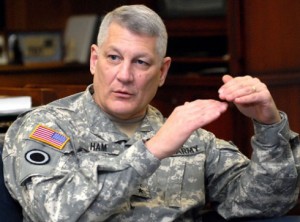
I Will Get Kidnapped Female Students From Boko Haram, Retired US General Says

General Carter Ham
General Carter Ham

Retired General, Carter Ham, who until last year led the U.S. African Command, has said that there is still a chance to help to free over 200 abducted girls in Chibok, Borno state, and return them to their families.

General Ham’s former command will be part of the U.S. effort to search for the missing schoolgirls, who were kidnapped three weeks ago by Boko Haram. The group’s leader said this week that he plans to sell them.
General Ham said today that he suspected that some of the girls may have already been sent to other countries, saying: “that’ll be a difficult challenge,”
“But we have surveillance platforms, signals intelligence and other capabilities that would be helpful.”

Nigeria’s Gbenga Sesan, 6 Others, Win 2014 Africa Social Entrepreneurs Of The Year

Gbenga SesanSeven Social Entrepreneurs, including Nigeria’s Gbenga Sesan of the Paradigm Initiative, have been named Africa Social Entrepreneurs of the Year at the World Economic Forum on Africa currently taking place in Abuja, Nigeria. The awards were conferred today by Philipp Rösler, Managing Director, World Economic Forum.


The Head of the Schwab Foundation for Social Entrepreneurship, David Aikman said at the ceremony that social entrepreneurs are an integral community of the World Economic Forum and an increasingly sought-after one.
“A growing number of corporations see income inequality and environmental problems like climate change as fundamental threats to their long-term growth. Many governments are starting to rethink the way they deliver goods and services that improve social outcomes. I am confident this trend will only continue to grow in the future, and the Forum is proud to be at the forefront of catalysing partnerships among these stakeholder groups for social and environmental change.”
Those named for the 2014 Africa Social Entrepreneurs of the Year are:
Gbenga Sesan, Paradigm Initiative Nigeria, Nigeria
Paradigm Initiative Nigeria’s (PIN) vision is to connect underserved young Nigerians with ICT-enabled opportunities to improve their livelihoods. Solving these twin problems – unemployment and cyber-crime – is at the heart of PIN’s strategy. Its model involves a two-pronged approach of capacity-building/ICT empowerment and ICT policy interventions. PIN offers income-generating ICT training and social media consultancy to private or non-profit organizations that need them, working with PIN’s graduates as implementing partners. Current partners include the Peery Foundation, Internews, Microsoft and Google.
Patrick Awuah, Ashesi University, Ghana
Ashesi was founded to address Africa’s biggest roadblocks to progress: the need for ethical leadership and innovative thinking. Ashesi University College is a secular, private, non-profit liberal arts college located in Ghana, West Africa. Ashesi aims to make a significant contribution to transform Africa by educating a new generation of ethical, entrepreneurial leaders. Ashesi’s unique curriculum combines a rigorous liberal arts core with practical, high-impact majors in business, computer science and MIS, and a four-year focus on leadership development and community service. To date, 100% of Ashesi’s graduates have found quality placement within a few months of graduating and over 95% have stayed to work for progress in Africa.
Ashifi Gogo, Sproxil, Ghana, Nigeria and India
Sproxil has developed and trademarked a Mobile Product Authentication (MPA) solution that enables consumers to verify that the pharmaceutical product they are buying is genuine. Consumers use a scratch card, similar to those used to replenish cellular talk-time, to reveal a one-time-use code on pharmaceutical products. Sproxil has set up Africa’s first national, mobile-based anti-counterfeit service in Nigeria and has already sold more than 250 million anti-counterfeit labels.
Martin Kariongi Ole Sanago, Institute for Orkonerei Pastoralists Advancement (IOPA), Tanzania
IOPA facilitates transformation and diversification of the economic system of the Maasai through social business, social entrepreneurship and innovation. Using radio programmes, roundtable discussions and festivals, the Institute prepares a fertile ground for self-examination and collective action. The Institute also teaches the Maasai veterinary services and techniques and sensitizes them to the use of both modern and traditional veterinary medicine; and carries out vaccination campaigns that have enabled pastoralists to use modern treatments and methods of livestock management, allowing animals to live healthier, longer, more productive lives.
Jay Kimmelman and Shannon May, Bridge International Academies, Kenya
Bridge International Academies is a chain of nursery and private schools in Africa delivering high-quality education for just $5 a month on average. The model of Bridge International Academies – centred on the academy-in-a-box solution, delivered through data-enabled tablets – enables thousands of teachers to deliver world-class lessons to children who had struggled simply to have a teacher show up at their previous schools. It has been just over four years since its first academy opened. As of January 2014, Bridge operates 259 academies in Kenya, employing over 3,000 people and educating approximately 80,000 pupils. By 2025, Bridge plans to be educating 10,000,000 pupils in over a dozen countries.
Allen Wilcox, Village Reach, Mozambique
VillageReach is a nonprofit social enterprise with a mission to save lives and improve health by increasing access to quality healthcare for the most underserved communities. VillageReach develops, evaluates and proves system innovations that improve health system performance. Through collaboration with governments, non-governmental organizations and communities, VillageReach seeks to extend the reach of health systems in scalable and sustainable ways by strengthening health service delivery, enhancing information and communication technology systems, and engaging the private sector.
Advertisement ADVERTORIAL
WP2Social Auto Publish Powered By : XYZScripts.com