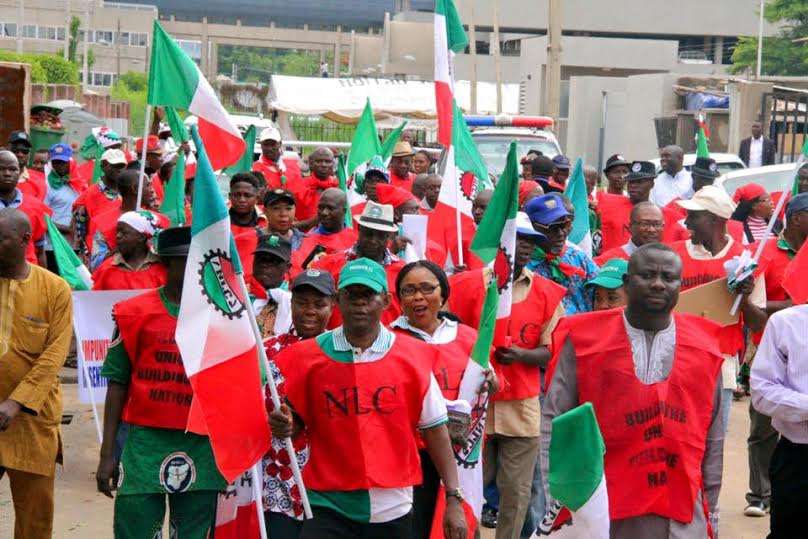
The Nigeria Labour Congress (NLC) and the Trade Union Congress (TUC) have declared a nationwide strike over the failure of the Federal Government to meet their demands. The Labour unions announced said that the strike action would commence on October 3, 2023. Both Unions took the stand on Tuesday, shortly after their National Executive Council meetings in Abuja. NLC President, Joe Ajaero, who spoke first, during a joint press briefing in Abuja said an indefinite strike became inevitable owing to the government’s lackadaisical stance in meeting demands raised by both unions. To this end, Ajaero said the executive councils of both unions, having taken into consideration the stance of the government in the wake of the subsidy removal policy, left them with no option but to call for an indefinite strike. On his part, President of the Trade Union Congress, Festus Osifo said they resolved that beginning from October 3rd all workers are expected to withdraw their services.
President Bola Ahmed Tinub ha warned that the African continent would remain in chains till it breaks free from the shackles of the criminal enterprises of drug barons and syndicates of illicit drugs. Tinubu sounded the warning in Abuja yesterday, September 26, when he declared open, the 31st meeting of the Heads of National Drug Law Enforcement Agencies, Africa (HONLAF) in Abuja. “If we don’t dismantle the criminal enterprises that threaten our future and build a brighter tomorrow for all Africans, we will remain in chains in a diseased and amoral world, as will our children and their children.” The keynote address titled: ‘Rising Above the Drug Threat’, delivered by Vice President Kashim Shettima, the President said that Africa is at the mercy of a threat that knows neither race nor geography, neither gender nor social class. He enjoined the heads of drug law enforcement agencies to consider the conference in Abuja as a ray of hope and a catalyst for positive change across the continent. President Tinubu thanked them for their sacrifices in ensuring a world that is free of illicit drugs. “This threat has crossed borders and destroyed societies and dreams. Without the moral commitment of the men and women in this room, this threat would have left cities, countries, and even civilizations erased. So, I must commend you for your sacrifices in the bids to keep our world drug-free, sane and safe. “This conference emphasizes your investment across borders to protect us from the devastations of drugs, a threat that only submits to the enforcement of the law. “Therefore, we are grateful to HONLAF and its partners, notably the United Nations Office on Drugs and Crime, for creating this avenue, for offering intelligence and drug law enforcement officials a grand opportunity to compare notes, collaborate, and build networks that would be several steps ahead of the criminal network of drug transnational organizations.” Tinubu said that in the last couple of decades, criminal organisations had made frantic efforts to breach the security measures in African countries, all in a bid to pollute the minds of their citizens, adding that the anti-narcotics agencies have proven to be a thorn in their flesh. The President who doubles as the chairman of the Authority of Heads of State and Government of the Economic Community of West African States (ECOWAS) said: “But while it’s a compliment that drug-law enforcement organizations are a threat to their criminal empires, their desperation must never be taken for granted. “Without you as gatekeepers of healthy nations, humanity as we know it would have long been perverted. So, on behalf of the world, I say: thank you, thank you to all of you who have kept us from being polluted and destroyed. “For us, the commitment to the fight against drug trafficking and substance abuse is not just a matter of policy; it is a moral imperative. We recognize that a population at war with drugs is not a dividend but a liability. We believe that the future of our youth, the strength of our institutions, and the well-being of our communities depend on our ability to eradicate this threat.” President Tinubu stressed the need for the the anti-narcotics agencies to consolidate established contacts, strengthen operational existing partnerships and cooperation among them at the sub-regional and regional levels. H said that this would make trafficking of illicit drugs and movement of drug syndicates difficult in the African continent. “So, I must appeal to you to see this gathering as an avenue for the exchange of novel ideas and the development of practical strategies. We must consolidate established contacts, operational partnerships, and cooperation to ensure that the outcomes of this four-day deliberation advance public safety and the emergence of drug-free African communities. “Our strength has always been our proactive actions to prevent any individual or group from turning our countries into a minefield of drug trafficking. So, we must prioritize prevention, education, and rehabilitation to empower our youth with knowledge and opportunities. We must steer them away from the treacherous path of drug abuse and trafficking and protect our economy from the consequences of their actions. “This administration will continue to provide the necessary support, motivation, and tools for the NDLEA to fulfill its mandate. We understand the connection between the success of the fight against substance abuse and illicit drug trafficking and the attainment of a number of goals on our socioeconomic and security agenda. “Ladies and gentlemen, I know you don’t need to be reminded of the sacred task before us. I know you are fully aware of the number of people and dreams that depend on your decisions and actions to reach their destination. But, more importantly, I know that you are up to the task.” On the choice of Nigeria for the conference, President Tinubu said it is a profound recognition of the campaign and fight against illicit drugs in the country by the National Drug Law Enforcement Agency (NDLEA). “We are hosting the 31st HONLAF meeting here to reassure you of our promise to participate in building a world not threatened by the infiltration of illicit drugs.” Welcoming the guests earlier, Chairman of the National Drug Law Enforcement Agency (NDLEA), retired Brigadier General Buba Marwa, restated the stakeholders’ commitment to addressing the world’s drug problem and that Nigeria will continue to uphold the objectives of multilateral organizations dedicated to combating drug trafficking and related crimes. He emphasized the need for global partnerships in addressing drug trafficking and other vices, saying that world’s drug problem cannot be effectively tackled by individual entities.
The minister of the Federal Capital Territory (FCT), Nyesom Wike has asked the judiciary to support him as he carries out reforms in the FCT Administration. Speaking at the ceremonies marking the commencement of the 2023/2024 Legal Year of the Court of Appeal in Abuja yesterday, September 25, the minister said: “here in the FCT, we are fully committed to implementing certain reforms that will not only restore the glory of the Federal Capital Territory but also make it a source of pride for every Nigerian. “And as we diligently work towards realizing this vision of rejuvenating the FCT, we implore the judiciary to also stand beside us in this quest.” Wike stressed the importance of a strong and independent judiciary as it affects the preservation of justice, protection of citizens’ rights and the overall wellbeing of the society and assured that his Administration will continue to provide the necessary support to promote the efficient functioning of the court. The Minister expressed the resolve of the Administration to address some of the accommodation challenges confronting Appeal Court Justices in the capital city. “We recognize that a strong and independent judiciary is pivotal to the preservation of justice, the protection of citizens’ rights, and the overall wellbeing of our society. Therefore, we are resolute in our determination to provide the necessary support to ensure the efficient functioning of the Court. “We are not unaware of some of the challenges confronting the justices of this Honourable Court in the FCT, especially the problems associated with their accommodation. “We will look closely at this matter and see how it can best be mitigated.” He said that the Appeal Court has a huge task ahead as the final Court for appeals arising from the National and State Houses of Assembly Election Tribunals, adding a lot of industry is required while hearing and determining these appeals. Wike charged the court of appeal to live up to the trust and tremendous faith in the decisions of the court by members of the public. “By virtue of Section 246(3) of the 1999 Constitution of the Federal Republic of Nigeria (as amended), this court is the final Court for appeals arising from the National and State Houses of Assembly Election Tribunals. “This implies that a lot of industry is required while hearing and determining these appeals. The public has tremendous faith in the decisions of this Court and the Court has a responsibility to live up to that trust.” On the need for peace and stability in the country as President Bola Ahmed Tinubu drives the renewed hope agenda, the Minister said that the judiciary, as a bastion of justice and an arbiter of disputes, has a role to play in maintaining stability, peace, and progress throughout the country. In her remarks, the President of the Court of Appeal, Justice Monica Bolna’an Dongban-Mensem, said that the special court session is designed to not only reflect on the achievements and challenges of the past year, but to set sights on the path ahead and recommit to the ideals of fairness, equity and the delivery of justice. Justice Dongban-Mensem who described the legal profession as the bedrock of the nation’s social, economic and political coherence, said that the Court of Appeal will harness the potential of technology, fortify the capacities of staff and deepen its tireless devotion in the discharge of its constitutional mandate in the new legal year. She charged the Bar to uphold the role of legal custodians and refrain from dubious tactics that could hinder progress and sabotage national interest. Speaking at the event, the Attorney General of the Federation and Minister of Justice, Prince Lateef Fagbemi, stressed the need for quick dispensation of Justice so as to decongest the court of pending cases. He expressed concern over the plight of judiciary workers in terms of poor remuneration, saying that the issue is being addressed with the aim of finding a lasting solution soon.
Diphtheria, a disease that causes difficulty in breathing or rapid breathing, nasal discharge, fever and chills and tiredness among others, has reportedly killed no fewer than 453 people across Nigeria. Reports reaching us at Greenbarge Reporters online newspaper showed that 7,202 cases have been recorded out of the 11,587 suspected cases across 105 local government areas in 18 states, including the Federal Capital Territory (FCT). The Federal Ministry of Health and Social Welfare, which Confirmed the spread of the disease, in a joint press statement signed by the ministry, the National Primary Health Care Development Agency, the Nigeria Centre for Disease Control and Prevention, and other development partners, said that Kano State has the highest figure of 6,185 confirmed cases and prevalence. Other states with cases are Yobe (640), Katsina (213), Borno (95), Kaduna (16), Jigawa (14), Bauchi (eight), Lagos (eight), FCT (five), Gombe (five), Osun (three), Sokoto (three), Niger (two), Cross River (one), Enugu (one), IMO (one), Nasarawa (one) and Zamfara (one). It was gathered that 5,299 of the confirmed cases occurred among children of ages one to 14 years with those from five to 14 years bearing the brunt of the disease. So far, a total of 453 deaths have occurred in confirmed cases, giving a case fatality rate of 6.3 per cent, the statement added. The government, however, said it has been coordinating surveillance and response activities across the country since the outbreak of the disease in December 2022. “Given the escalation of the outbreak and findings that 80 per cent of confirmed cases in the ongoing outbreak are unvaccinated, the Honourable Coordinating Minister of the FMOH&SW, Professor Ali Pate, set up a national emergency task team co-chaired by the Executive Director of the NPHCDA, the Director General of the NCDC for higher level coordination of outbreak response efforts. “This includes ensuring optimal collaboration of all relevant health stakeholders in this fight. “Other prominent members of the task force include the director of Public Health-FMOH, representatives from the Federal Ministry of Information, the World Health Organisation, the United Nations Children’s Fund, USCDC, USAID, Gavi the Vaccine Alliance, other non-governmental organisations and development partners. “For the first time for any diphtheria outbreak, the FMOH&SW through NCDC and with WHO support, procured diphtheria antitoxin and more recently intravenous erythromycin and distributed them to the affected states. “With support from partners and in collaboration with the State Ministry of Health, Diphtheria Treatment Centres/Wards have been established in affected states. “Intensified routine diphtheria immunisation and reactivated vaccination campaigns in 33 LGAs in Bauchi, Katsina, Yobe, Kano, and Kaduna by the NPHCDA. Mobilised procurement of vaccines and essential logistics for three large-scale outbreak response campaigns in 56 LGAs across seven priority states – Bauchi, Borno, Jigawa, Kaduna, Kano, Katsina and Yobe,” it said. To reduce the risk of diphtheria, the government advised parents to ensure that their children are fully vaccinated against it with the three doses of diphtheria antitoxin-containing pentavalent vaccine, given as part of Nigeria’s childhood immunisation schedule. “Healthcare workers should maintain a high index of suspicion for diphtheria and practice standard infection prevention and control precautions while handling all patients in their care. “All healthcare workers (doctors, nurses, laboratory scientists, support staff etc.) with a high level of exposure to cases of diphtheria should be vaccinated against diphtheria. “Individuals with signs and symptoms suggestive of diphtheria should promptly present to a health care facility or designated diphtheria treatment centres and where possible they and/or healthcare workers should notify their LGA, State Disease Surveillance Officer, their State Ministry of Health helpline, or the NCDC through our toll-free line on 6232.” Diphtheria, caused by a toxin produced by the bacteria Corynebacterium diphtheriae, is a vaccine-preventable disease covered by one of the vaccines provided routinely through Nigeria’s childhood immunisation schedule. Some of the symptoms are thick, gray membrane covering the throat and tonsils, sore throat and hoarseness, swollen glands (enlarged lymph nodes) in the neck, difficulty in breathing or rapid breathing, nasal discharge, fever and chills and tiredness.
The Nigerian Content Development and Monitoring Board (NCDMB) has signed a Memorandum of Understanding (MoU) cum Service Level Agreement (SLA) with the Nigerian National Petroleum Company Ltd (NNPC Ltd) and five international oil-producing companies.
The MoU is aimed at
quickly ramping up Nigeria’s flagging crude oil production, ensuring compliance with the provisions of the Nigerian Content Act, and timely approvals of documents,
The SLA was conceptualised by the NCDMB and is intended to optimize the contracting cycle in the oil and gas industry and spur the speedy development of new oil and gas projects, contributing to increased oil production and improved national economy.
The agreement was signed by the Executive Secretary of NCDMB, Engineer Simbi Kesiye Wabote, while the new Executive Vice President Upstream of the NNPC Ltd, Oritsemeyiwa A. Eyesan signed on behalf of the national oil company.
Other top industry officials who signed the agreement included the Managing Director of Shell Petroleum Development Company (SPDC) and Country Chair, of Shell Companies in Nigeria (SCiN) Mr. Osagie Okunbor, and the Chairman and Managing Director of ExxonMobil’s affiliates in Nigeria, Mr. Shane Harris. Others included the Director of Joint Ventures for Chevron Nigeria, Mr. Iwueze Cosmas; the Managing Director, Nigerian Agip Oil Company Ltd, Mr. Fabrizio Bloomfied, and the Executive Director, Joint Ventures, Total Exploration and Production Nigeria, Mr. Obi Imemba.
The Executive Secretary stated that the overall goal is to conclude the oil and gas industry’s tendering to contract award processes within six months, affirming his conviction that the target is realistic with all key parties now on board with the execution of the SLA. He expressed delight that NNPC Limited signed up to the MoU, being the senior partner of the joint ventures and concessionaire of the production sharing contracts (PSC) arrangements that govern the operations of the industry.
Wabote recalled that NCDMB first introduced the 15-day Rule to the industry in 2017, when it promised that it would respond within 15 working days to any formal request for approvals in relation to projects execution. He noted that the rule was later formalized with an SLA in May 2017 with Nigeria LNG Ltd pioneering the process and breaking approval records in respect of the NLNG Train7 project.
“The industry found the outcome impressive leading to the Independent Petroleum Producers Group (IPPG) signing the SLA in 2018 and Oil Producers Trade Section (OPTS) thereafter.”
Wabote said that NCDMB is a business-enabling regulator, adding: “this is attested to by our being recognised and awarded as the most efficient amongst the MDAs in 2022 by the Presidential Enabling Business Environment Council (PEBEC).
”We are also rated PLATINUM by the Bureau for Public Service Reforms in recognition of the self-imposed reforms of our processes.”
The NCDMB boss assured the industry that the SLA would not be an exception, adding that the Board would deliver its own part of the deal.
The SLA signed with the Nigeria LNG in 2017 was the first of its kind to be entered between a regulator and another entity in the oil and gas industry. The template was adopted for managing documentation, contracting and expatriate quota applications between the Board and international and local operating companies.
The agreement obligated NLNG to submit to the NCDMB documents like the Quarterly Job Forecast, Nigerian Content Plan, Bidders List, Nigerian Content Evaluation Criteria, Nigerian Content Technical Bid among others, while the Board had to respond on specific timelines. Should the Board fail to respond in accordance with the provisions of the SLA, the company could proceed with its tendering process after informing the Board in writing or email.
The Independent National Electoral Commission (INEC) is set to conduct mock Voter’s Accreditation in the three States: Kogi, Bayelsa and Imo States that it will conduct governorship election on November 11. The mock Voter’s Accreditation will be conducted on October 14.
The decision to embark on mock Voter’s Accreditation came after a meeting today, September 25, of the stakeholders of the Commission.
A statement by the National Commissioner and Chairman of the
Information and Voter Education Committee, Sam Olumekun mni, said that mock Voter’s Accreditation is a recent innovation in the off-cycle Governorship elections.
“The Commission will conduct a mock accreditation using the Bimodal Voter Accreditation System (BVAS) and upload of polling units results to the INEC Result Viewing Portal (IReV).
“The test run will take place simultaneously in the three States on Saturday 14th October 2023 from 8.30am to 2.30pm.
“A maximum of three polling units in each Senatorial District have been identified across each of the three States, covering a total of nine Senatorial District and 27 polling units.
“Lessons learnt from the exercise will be taken into consideration in ensuring a seamless process on Election Day.
“Full details of the polling units, including their locations by Local Government Area (LGA), Registration Area (RA)/Ward, Delimitation Code and number of registered voters have been uploaded to our website and social media platforms.”
The Commission appealed to registered voters in the selected polling units to turn up with their Permanent Voters’ Cards (PVCs) for the exercise.
The Commission made it clear that “this is strictly a test accreditation exercise and not the actual election.”
The first Nigerian professor of Capital Market, Professor Uchenna Joseph Uwaleke, has been scheduled to speak on Nigeria’s Roadmap for Socio-Economic Recovery and Sustainability at the 2023 annual conference of the Guild of Corporate Online Publishers (GOCOP) in Abuja, the nation’s federal capital city. The chairman of the Conference Planning Committee and Deputy President of GOCOP, Danlami Nmodu, mni, said in a statement today, September 25 that Prof Uwaleke who is currently the Special Adviser to the Senate Committee Chairman on Capital Market, will be giving the keynote address on Thursday, October 5, 2023 at Abuja Continental Hotel (Old Sheraton Hotel) Abuja. The statement from GOCOP Publicity Secretary, Remmy Nweke, quoted Danlami as saying that the theme of the conference will be: “Nigeria: Roadmap for Socio-Economic Recovery and Sustainability” and will be chaired by the Registrar and Chief Executive Officer of the Joint Admissions and Matriculations Board (JAMB), Professor Ishaq Oloyede. Danlami said that the choice of the topic is informed by the current socio-political and economic realities facing Nigeria, where a new set of leaders at national and state levels has emerged after the 2023 general elections. Professor Uwaleke is a professor of Finance and Capital market at Nasarawa State University Keffi and until recently, was the Finance Commissioner in Imo State under the governorship of Chief Emeka Ihedioha.
African Union Heads of State and Government, global health leaders and development partners have warned about the looming deadly malaria and issued a joint call for urgent action to address the looming emergency. They warned that failure to act now will put at risk both the African Union’s target of eliminating malaria in Africa by 2030, and the UN target of ending malaria epidemics by 2030. At a press briefing in New York, leaders warned that the world is facing the biggest malaria emergency of the last two decades, due to a perfect storm of climate change, growing resistance impacting the efficacy of insecticides, antimalarials and rapid diagnostic tests as well as inadequate funding linked to the global financial crisis. President Umaro Sissoco Embaló of the Republic of Guinea-Bissau and Chair of the African Leaders Malaria Alliance painted an alarming picture: “We are at a critical juncture. There are currently insufficient resources to even maintain existing lifesaving malaria programmes, posing the most serious threat to malaria elimination in the last 20 years. If we don’t act swiftly to address the immediate gap of $1.5 billion and mobilise the necessary resources, we will undoubtedly see malaria upsurges and epidemics.” Examples were shared of how the ongoing global financial crisis has led to significant increases in the cost of delivering essential malaria interventions. Countries are now facing increasing levels of insecticide and drug resistance requiring newer, more expensive tools and approaches to be effectively addressed. Leaders also shared how the impacts of climate change, including a rise in extreme weather events such as temperature increases, flooding and cyclones, and the resulting humanitarian emergencies, are expanding the areas impacted by malaria and the costs of delivering programmes. These higher costs are leading to the reversal of previously hard-won gains against malaria. “Defeating Malaria across the continent is a priority. Without defeating this age-old disease, we will miss the targets that we have set for ourselves for healthy citizens and socio-economic transformation. We must meet the ambitious targets set out in the Catalytic Framework to End AIDS, TB and Eliminate Malaria in Africa by 2030, Africa Health Strategy and Africa’s Agenda 2063, the Africa that we want. We need to ensure that we sustain our political commitment and continue to translate these commitments into concrete action. With most AU Member States off-track to achieve the goal of eliminating malaria by 2030, much still needs to be done” said Professor Julio Rakotonirina, Director Health, and Humanitarian Affairs at the African Union Commission. During the press briefing, leaders addressed accelerating the launch of multisectoral high level National End Malaria and Neglected Tropical Disease councils and funds to maintain malaria high on the national development and resource mobilization agenda as well as to increase public and private sector domestic funding. Examples were shared of increasing public sector budget allocation to health and malaria. They addressed prioritization of health and malaria financing in the country allocations of World Bank International Development Association (IDA) funding; and the use of debt swaps. The World Bank was urged to commit to a new Malaria Booster Programme to facilitate the additional financing needed to close immediate gaps, with additional commitments from regional development banks. Increased international financing from traditional donors and new donor markets remains critical. The CEO of the RBM Partnership to End Malaria, Dr Michael Charles said: “The malaria situation is extremely precarious. While we saw good progress against the disease in the early 2000s thanks to the immense support received for malaria programmes, in recent years we have seen funding overall plateau due to other health pressures like the COVID pandemic and the global economic downturn. As a result, we are now facing the biggest malaria emergency in decades. Already, this disease claims around 600,000 lives annually and kills a child every minute. If we do not take more action urgently, we will see this worsen and a regression of the gains we have made. We face a multitude of challenges, from climate change to insecticide resistance, but we also have an opportunity to get this right, and even use our response to malaria as an entry point to strengthen health systems more broadly. To do this, we need to integrate, innovate, accelerate and get the needed finances to take us over the line of elimination and eradication.” President Embaló called on fellow Heads of State, Government and partners to act: “Now is the time to fully finance the malaria fight to ensure that we eliminate the disease once and for all. This can be achieved through integrated approaches, with malaria as an essential pathfinder when strengthening health systems for UHC and pandemic preparedness; as well as for mitigating and adapting to the impact of climate change”. The fight against malaria is at a crossroads. It is up to countries, regions and the global community to protect the gains made over the past two decades, and to achieve the 2030 target of putting an end to malaria epidemics and delivering an Africa free of malaria.
Having hit the ground running at home, with a series of very bold and unprecedented reform decisions, President Bola Ahmed Tinubu has gone ahead to seize the opportunity offered by the month of September 2023, to make a grand entry onto the global stage. In what has been his busiest month on the global stage since he assumed office, President Tinubu traveled to India for the G20 Summit on the special invitation of Prime Minister Modi, made a stopover on his way back home for a crucial meeting with the leadership of the United Arab Emirates (UAE), on lingering issues of concern between UAE and Nigeria, and then traveled to New York to make his debut at the most important annual gathering of Heads of State, the United Nations General Assembly (UNGA). At the UN—in a delivery reminiscent of the powerful and iconic ‘Africa Has Come Of Age’ speech by the late Head of State, General Murtala Muhammed, almost five decades ago—President Tinubu caught the attention of a listening world with his emphasis on an equal and mutually beneficial relationship between Africa and the world, instead of one defined by condescension, pity and greed. The President spoke boldly for the entire African continent, tracing the history of the post-World War 2 global system, starting with a Marshall Plan that helped redeem Europe. Asking for a 21st century equivalent for that Plan, President Tinubu added, “We realize that underlying conditions and causes of the economic challenges facing today’s Africa are significantly different from those of post war Europe. We are not asking for identical programs and actions. What we seek is an equally firm commitment to partnership. We seek enhanced international cooperation with African nations to achieve the 2030 agenda and Sustainable Development Goals.” At every engagement, he has taken the time to remind the world of just how significant his first four months in office have been, in terms of laying the foundation for unlocking levels of economic growth and prosperity that we have always been capable of, but have sadly remained a pipe dream. He ended a costly and wasteful fuel subsidy regime that has, over the decades, deprived the country of tens of billions of dollars in potential infrastructure and human capital investments. He also commenced an overhaul of the Central Bank of Nigeria, shaking up the leadership of the bank and supporting it to abolish an inefficient system of multiple exchange rates, which, like the petrol subsidy, has seen a lot of abuse, and stifled domestic and international confidence in the economy. President Tinubu has also assembled a cabinet with an impressive representation of young people and women, while also creating new Ministries and ministerial portfolios to reflect the pressing realities of the 21st century, as well as the priorities of our administration. For example, we now have a Federal Ministry of Marine and Blue Economy, recognizing the unlimited potential of that sector to produce national prosperity. We also now have a dedicated Ministry for the Creative Economy. In addition, the Ministry of Agriculture has been expanded to include Food Security, underpinning the President’s declaration of a national emergency on Food Security early on in his administration. On the regional level, President Tinubu has, in his role as recently-elected Chairman of ECOWAS, shown great commitment to stemming the condemnable wave of military takeovers that have rocked the sub-region, and I expect his diplomatic efforts to yield enduring fruit in the months ahead. The President is being supported in his many onerous assignments by a very energetic and committed Cabinet. In the last few days, I joined some of my colleagues for events at the UN General Assembly, and can testify to the remarkable levels of determination within the cabinet, to solve Nigeria’s problems with the support and cooperation of the global community. I can boldly assert that we stand on the threshold of a Nigeria that is a true global giant, a country that is able to fully exploit its immense potential energy of demographics, culture, and entrepreneurial dynamism. I have no doubt that my colleagues and I, under the leadership of the President, will step boldly forward, not backwards, from this historic threshold. We have a very busy last quarter of the year ahead of us. The administration will finalize and unveil its inaugural budget, which will set the tone for investors and other potential partners, about our priorities. Nigeria will take part in the annual global gathering for Climate Change, COP28, in Dubai. We will push forward with work on the various reforms that the President has kickstarted, from tax policy reform to a Compressed Natural Gas (CNG) transition for petrol- and diesel-powered vehicles, to the full implementation of a comprehensive relief package to cushion the effects of the fuel subsidy. As the President has repeatedly said, most recently last week in New York: “I am mindful of the transient hardship that reform can cause. However, it is necessary to go through this phase in order to establish a foundation for durable growth and investment to build the economy our people deserve.” He understands how important it is to engage with the world to achieve this. During this month of diplomatic shuttling, he has met with Presidents and Head of States from the United States, India, Germany, South Korea, South Africa, Angola, Jordan, among others. From the global business executives he has held meetings with this month—Exxon Mobil, Bharti Enterprises, Oracle, Hinduja Group, Indorama, Skipper Seil, and others—he has received pledges amounting to several billions of dollars in new investments. This cannot be overemphasized: at the end of the day, one of our administration’s overriding goals is to attract new investment that will create jobs and wealth for the people of Nigeria. We will continue to finetune and amplify our narrative in this regard—a message that the President reiterated at every opportunity in New Delhi and New York—that Nigeria is open and ready for business, with partners who are equally open and ready for business with us, and who are not looking to exploit us or treat us like junior partners. And we will follow up the talk with action. My Ministry, the Federal Ministry of Information and National Orientation will be very critical to the success of our national messaging, and we will give it everything required for our narratives to succeed. We have a vision that includes redesigning how the Federal Government of Nigeria engages with the Nigerian people at home and abroad, and with the world. As part of this, we will scale up our engagements with stakeholders, modernize our tools and platforms of information and communication, and work to craft credible and believable narratives that Nigerians will be proud of and delighted to share with the world. In a few days, our dear country will celebrate its 63rd Independence Anniversary. It will offer an opportunity to further reflect on our nationhood journey, and the expectations of our citizens, and for us as leaders to rededicate ourselves to delivering on the bold and dynamic leadership that will enable Nigeria to fully assume its rightful place on the global stage. I have absolute confidence that success in this regard will be a defining legacy of this momentous era of President Bola Ahmed Tinubu. Mohammed Idris, current Minister of Information and National Orientation, wrote in from Abuja.
A section of the Supreme Court building in the Federal Capital Territory (FCT), has been gutted by fire this morning, September 25. Report, monitored on Arise TV, showed that offices of three Justices have been completely burnt down. The Supreme Court is located in what is termed “the Three Arms Zone” comprising the Presidential Villa, the National Assembly and the Supreme Court. As at the time of this publication, no official statement has been issued on the fire incident.
We use cookies on our website to give you the most relevant experience by remembering your preferences and repeat visits. By clicking “Accept”, you consent to the use of ALL the cookies.
This website uses cookies to improve your experience while you navigate through the website. Out of these, the cookies that are categorized as necessary are stored on your browser as they are essential for the working of basic functionalities of the website. We also use third-party cookies that help us analyze and understand how you use this website. These cookies will be stored in your browser only with your consent. You also have the option to opt-out of these cookies. But opting out of some of these cookies may affect your browsing experience.
Necessary cookies are absolutely essential for the website to function properly. This category only includes cookies that ensures basic functionalities and security features of the website. These cookies do not store any personal information.
Any cookies that may not be particularly necessary for the website to function and is used specifically to collect user personal data via analytics, ads, other embedded contents are termed as non-necessary cookies. It is mandatory to procure user consent prior to running these cookies on your website.







Home And Away, Tinubu Is Taking Nigeria To Its Rightful Place, By Mohammed Idris
Having hit the ground running at home, with a series of very bold and unprecedented reform decisions, President Bola Ahmed Tinubu has gone ahead to seize the opportunity offered by the month of September 2023, to make a grand entry onto the global stage.
In what has been his busiest month on the global stage since he assumed office, President Tinubu traveled to India for the G20 Summit on the special invitation of Prime Minister Modi, made a stopover on his way back home for a crucial meeting with the leadership of the United Arab Emirates (UAE), on lingering issues of concern between UAE and Nigeria, and then traveled to New York to make his debut at the most important annual gathering of Heads of State, the United Nations General Assembly (UNGA).
At the UN—in a delivery reminiscent of the powerful and iconic ‘Africa Has Come Of Age’ speech by the late Head of State, General Murtala Muhammed, almost five decades ago—President Tinubu caught the attention of a listening world with his emphasis on an equal and mutually beneficial relationship between Africa and the world, instead of one defined by condescension, pity and greed.
The President spoke boldly for the entire African continent, tracing the history of the post-World War 2 global system, starting with a Marshall Plan that helped redeem Europe. Asking for a 21st century equivalent for that Plan, President Tinubu added, “We realize that underlying conditions and causes of the economic challenges facing today’s Africa are significantly different from those of post war Europe. We are not asking for identical programs and actions. What we seek is an equally firm commitment to partnership. We seek enhanced international cooperation with African nations to achieve the 2030 agenda and Sustainable Development Goals.”
At every engagement, he has taken the time to remind the world of just how significant his first four months in office have been, in terms of laying the foundation for unlocking levels of economic growth and prosperity that we have always been capable of, but have sadly remained a pipe dream.
He ended a costly and wasteful fuel subsidy regime that has, over the decades, deprived the country of tens of billions of dollars in potential infrastructure and human capital investments. He also commenced an overhaul of the Central Bank of Nigeria, shaking up the leadership of the bank and supporting it to abolish an inefficient system of multiple exchange rates, which, like the petrol subsidy, has seen a lot of abuse, and stifled domestic and international confidence in the economy.
President Tinubu has also assembled a cabinet with an impressive representation of young people and women, while also creating new Ministries and ministerial portfolios to reflect the pressing realities of the 21st century, as well as the priorities of our administration.
For example, we now have a Federal Ministry of Marine and Blue Economy, recognizing the unlimited potential of that sector to produce national prosperity. We also now have a dedicated Ministry for the Creative Economy. In addition, the Ministry of Agriculture has been expanded to include Food Security, underpinning the President’s declaration of a national emergency on Food Security early on in his administration.
On the regional level, President Tinubu has, in his role as recently-elected Chairman of ECOWAS, shown great commitment to stemming the condemnable wave of military takeovers that have rocked the sub-region, and I expect his diplomatic efforts to yield enduring fruit in the months ahead.
The President is being supported in his many onerous assignments by a very energetic and committed Cabinet. In the last few days, I joined some of my colleagues for events at the UN General Assembly, and can testify to the remarkable levels of determination within the cabinet, to solve Nigeria’s problems with the support and cooperation of the global community.
I can boldly assert that we stand on the threshold of a Nigeria that is a true global giant, a country that is able to fully exploit its immense potential energy of demographics, culture, and entrepreneurial dynamism. I have no doubt that my colleagues and I, under the leadership of the President, will step boldly forward, not backwards, from this historic threshold.
We have a very busy last quarter of the year ahead of us. The administration will finalize and unveil its inaugural budget, which will set the tone for investors and other potential partners, about our priorities. Nigeria will take part in the annual global gathering for Climate Change, COP28, in Dubai. We will push forward with work on the various reforms that the President has kickstarted, from tax policy reform to a Compressed Natural Gas (CNG) transition for petrol- and diesel-powered vehicles, to the full implementation of a comprehensive relief package to cushion the effects of the fuel subsidy.
As the President has repeatedly said, most recently last week in New York: “I am mindful of the transient hardship that reform can cause. However, it is necessary to go through this phase in order to establish a foundation for durable growth and investment to build the economy our people deserve.”
He understands how important it is to engage with the world to achieve this. During this month of diplomatic shuttling, he has met with Presidents and Head of States from the United States, India, Germany, South Korea, South Africa, Angola, Jordan, among others.
From the global business executives he has held meetings with this month—Exxon Mobil, Bharti Enterprises, Oracle, Hinduja Group, Indorama, Skipper Seil, and others—he has received pledges amounting to several billions of dollars in new investments. This cannot be overemphasized: at the end of the day, one of our administration’s overriding goals is to attract new investment that will create jobs and wealth for the people of Nigeria.
We will continue to finetune and amplify our narrative in this regard—a message that the President reiterated at every opportunity in New Delhi and New York—that Nigeria is open and ready for business, with partners who are equally open and ready for business with us, and who are not looking to exploit us or treat us like junior partners. And we will follow up the talk with action.
My Ministry, the Federal Ministry of Information and National Orientation will be very critical to the success of our national messaging, and we will give it everything required for our narratives to succeed. We have a vision that includes redesigning how the Federal Government of Nigeria engages with the Nigerian people at home and abroad, and with the world.
As part of this, we will scale up our engagements with stakeholders, modernize our tools and platforms of information and communication, and work to craft credible and believable narratives that Nigerians will be proud of and delighted to share with the world.
In a few days, our dear country will celebrate its 63rd Independence Anniversary. It will offer an opportunity to further reflect on our nationhood journey, and the expectations of our citizens, and for us as leaders to rededicate ourselves to delivering on the bold and dynamic leadership that will enable Nigeria to fully assume its rightful place on the global stage. I have absolute confidence that success in this regard will be a defining legacy of this momentous era of President Bola Ahmed Tinubu.
Mohammed Idris, current Minister of Information and National Orientation, wrote in from Abuja.