Chairman of the Independent National Electoral Commission (INEC), Professor Mahmud Yakubu has given reasons why the Commission has remained silence in the face of all the noises about its performance in the just concluded general election across the country.
Addressing the Resident Electoral Commissioners (REC) today, July 4, at a meeting in Abuja, Professor Yakubu said that after the conclusion of the election, “the time has come for introspection, stocktaking, review and evaluation.
“Since the conclusion of the election, diverse opinions have been expressed by political parties, candidates, observers, analysts And the general public on aspects of the elections that took place in February and March. “Such diverse opinions should normally be expected, and the Commission welcomes all of them insofar as their purpose is to improve the future conduct of elections and to consolidate our democracy.
“The Commission has consciously not joined in these commentaries in the immediate aftermath of the election for several reasons.
“First, our preference is to listen more and draw lessons rather than join in the heated and often emotive public discussion on the election.
“Second, since we plan to conduct our own review of the election, we see no need to pre-empt the process.
“Third, the Commission would not want to be seen as defensive or justificatory in joining the ongoing discussions. “Finally, and perhaps most importantly, several issues around the election are sub-judice and it is not the intention of the Commission to either undermine or promote the chances of litigants in the various election petition courts beyond what is required of us by the legal process.”
The INEC boss noted that anything coming from the Commission could be cited by litigants as either justifying best claims or an indication of bias against them.
He said that despite those fears, the Commission needs to make a few broad remarks about the 2023 General Election “as we commence our review of the election.
“In doing this, it is necessary to look at the entire process before, during and after the election to make an informed assessment. Granted that events on Election Day are probably the most important in terms of the optics of elections.
Professor Yakubu said that it is also very essential to look at the totality of the process, adding that this is necessary to enable the Commission learn the full lessons of the election going forward.
Parts of the speech of the INEC chairman go thus:
Compared to some previous elections, we believe that the 2023 General Election was one of the most meticulously prepared for in recent times. Learning from previous experiences, we started preparations immediately after the 2019 General Election, carefully ticking the necessary boxes over a four-year period. It is the need to learn from both the positives and the shortcomings that makes the stocktaking that we are embarking on today essential.
Among the positive stories is that the security challenge which threatened to derail the elections did not materialise. Concerns that the polls will be disrupted by the perennial insecurity across the country fizzled out on Election Day as the elections were largely peaceful. Despite currency and fuel challenges and widespread attacks on our personnel and facilities nationwide, the Commission proceeded with the election as scheduled. The first set of elections, the Presidential and National Assembly, held as planned for the first time in the last four General Elections conducted in the country. Accreditation of voters using the Bimodal Voter Accreditation System (BVAS) has generally been scored very high by voters. Our records show that the success rate for BVAS accreditation stands at 98% compared to the Smart Card Reader’s 29.2% during the 2019 General Election.
Above all, despite the divergent opinions about the outcome of the election, the overall outlook suggests that it is a fair reflection of a complex multi-party democracy. We wish to remind Nigerians that elections were held for a total of 1,491 constituencies made up of one Presidential, 28 Governorship, 109 Senatorial, 360 Federal Constituencies and 993 State Assembly seats. Our record shows that these elections have produced the most diverse outcomes ever recorded since 1999. Today, five political parties produced State Governors, seven parties won Senatorial seats, eight are represented in the House of Representatives and nine in State Houses of Assembly. Clearly, the 10th National Assembly is certainly the most diverse in party representation since 1999. In some States around the country, different political parties controlled the legislative and executive arms of Government. What is clear from these records also is that the days of single party dominance of our national politics are probably gone. Furthermore, many prominent candidates lost in the constituencies they contested, and political parties lost in some of their presumed strongholds.
Still, we must acknowledge that there were also some challenges, which were structural, infrastructural and human in nature. Indeed, it is in furtherance of our determination to address the challenges as we prepare for future elections that the Commission is commencing its post-election review engagements today.
We are presently looking at all the evidence of infractions during the election, including the prosecution of offenders. We are looking at the activities of all actors involved in the election, including some of our high-ranking officials. I can confirm that the Nigeria Police concluded its investigation of the conduct of our Resident Electoral Commissioner in Adamawa State and submitted the case file to us. Appropriate action will be taken in a matter of days and Nigerians will be fully informed.
I can also confirm that we have received 215 case files from the Nigeria Police following their arrest and the conclusion of investigation into electoral offences arising from the 2023 General Election. We are working with the Nigerian Bar Association (NBA) to prosecute the alleged offenders. Already, the NBA has submitted a list of 427 lawyers across the country who have volunteered to render pro bono services to the Commission. They are not charging legal fees but by mutual agreement the Commission will provide a token amount to cover for filing fees/expenses. We are most grateful to NBA and its President, Yakubu Maikyau SAN, for this historic collaboration. Similarly, we are working with the Economic and Financial Crimes Commission (EFCC) and the Independent Corrupt Practices Commission (ICPC) on the prosecution of cases relating to vote buying and associated violations.
In the next few weeks, several internal debriefing meetings will be held, culminating in engagements with stakeholders. I implore the Resident Electoral Commissioners, as senior officials of the Commission, to lead the discussion on all aspects of the election from preparations, conduct and aftermath frankly and constructively. Among other issues, I expect you to cover such specific areas as:
Operational processes for the Continuous Voter Registration (CVR) and general elections, including planning, organisation, coordination and evaluation of activities, focusing particularly on such specific issues as the issuance of voters’ cards, logistics, delivery of materials, deployment of personnel, etc.;
Legal framework for the conduct of elections with a view to addressing any key legal challenges that may have arisen prior to the 2023 General Election which were not envisaged before the election;
Technologies deployed in the electoral process, including the INEC Voter Enrolment Device (IVED); INEC Result Viewing Portal (IReV); Bimodal Voter Accreditation System (BVAS); party nomination portal; observer, media and polling/collation agents’ accreditation portals etc., focusing particularly on their performance;
Effectiveness of overall administrative procedures and channels within the Commission in the coordination and execution of pre-election, election and post-election activities;
Political party registration, party primaries and nomination of candidates for the 2023 General Election, as well as monitoring of the processes;
Process of recruitment, training, deployment and performance of all categories of ad-hoc staff during CVR and the General Election; and
Strengthening the Commission’s cooperation and relations with other bodies such as MDAs, NGOs etc. and any other issues in the electoral process that are likely to impact the work of the Commission in future.
In line with our policy, at the end of the internal review and engagement with stakeholders, a comprehensive report will be published by the Commission.
Furthermore, the Commission has so far received reports from 54 accredited national and international observers. We will give equal prominence to all the reports and review them in a holistic manner to ensure that necessary lessons are learnt from their conclusions and recommendations. As a Commission, we hope to continue to count on the support of stakeholders to improve the electoral process in Nigeria.
Our work in INEC is enormous. As Resident Electoral Commissioners, you are no doubt aware, that there is no election season in Nigeria any longer. Numerous off-cycle and bye-elections are held throughout the period between one general election and another. Even as we commence our review of the conduct of the 2023 General Election and barely a few weeks after the inauguration of the National and State Houses of Assembly, we are already confronted with four bye-elections as a result of resignation in the case of Surulere 1 Federal Constituency of Lagos State and death in respect of Jalingo/Yorro/Zing Federal Constituency of Taraba State, Chibok State Constituency of Borno State and Chikun State Constituency of Kaduna State. Furthermore, the Commission is preparing for three off-cycle Governorship elections in Bayelsa, Imo and Kogi States, which are scheduled for 11th November 2023. We have already published the final list of candidates for the elections and campaign in public officially commenced on 14th June 2023. The Commission will soon commence the regular stakeholder engagements ahead of the elections.
Let me at this point specifically reiterate to the Resident Electoral Commissioners that we are commencing these debriefings with you because you are central to the conduct of elections. Many of you performed very well during the general election under extremely challenging circumstances. I commend you for that. However, a few of you did not properly manage the tasks lawfully bestowed upon you for which the Commission has taken some administrative action. I urge you to remain loyal to your oath of office.
Once again, I welcome you all to this meeting. I look forward to a frank discussion.






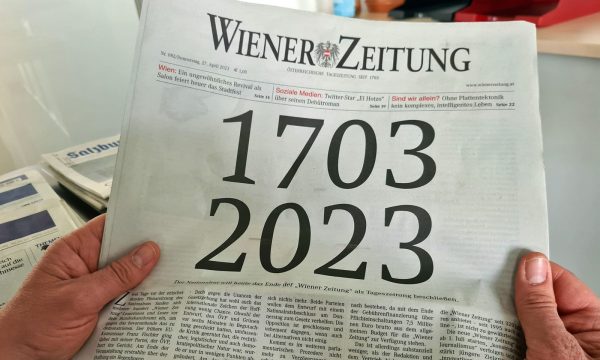 The world oldest newspaper, Wiener Zeitung, printed in Vienna, has stopped hardcopy production and has gone fully online.
 An Assistant Inspector General of Police, Mbu Joseph Mbu, has been awarded the sum of N40 million as general damages, against the Police Service Commission (PSC) which retired him him in 2016.
 The United Kingdom has pledged to support the Multinational Joint Task Force (MNJTF) in achieving its mandate of regional security.