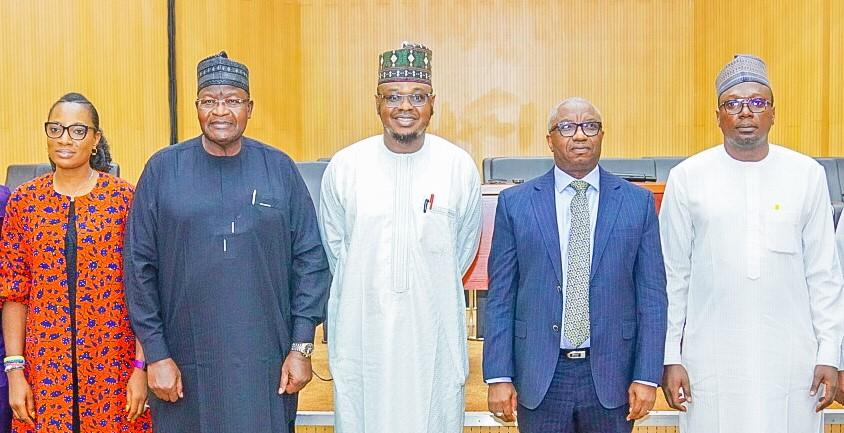
The Minister of Communications and Digital Economy, Professor Isa Ali Ibrahim Pantami, Executive Vice Chairman/Chief Executive Officer, Nigerian Communications Commission (NCC), Professor Umar Danbatta, along with other telecommunication expert: Senior Administrative Manager, Mafab Communications Ltd. Jacqueline Olowolayemo; National Commissioner/Chief Executive Officer, Nigeria Data Protection Bureau, Dr. Vincent Olatunji and Senior Manager, Public Affairs, MTN Nigeria, Anas Galadima, spoke to news men today, March 21, under the canopy of the Presidential Review Committee on Excise Duty in the Digital Economy Sector.
The Nigeria’s President-elect, Asiwaju Bola Ahmed Tinubu has extended a hand of friendship to the opposition political parties and their Presidential candidates that contested with him in the February 25 election to join him in healing the wounds caused through campaigns ahead of the elections. In a statement today, March 21, personal signed by him, the President-elect said: “my appeal is for us to rise above our differences, which, in reality, are fewer than the valued strings that bind us together as a people irrespective of the circumstances of our births.” He advised that the winners and losers of the elections must take urgent steps to unite “those who voted for us and those who did not. We must champion the healing process by embracing the opponents and their supporters.” Asiwaju Tinubu insisted that as the time for politicking is gone, politicians should make this time as the time for nation building, “a task beyond one individual or a section of the society.
“We need every hand from wherever it may come to be on deck. “I am ready to work with you all as your President. I will be a worthy partner you can trust and rely on as we all bond together, in unity of purpose and renewed hope for, the betterment of our blessed country and beloved people.” Read the full text of the statement by the President-elect: With the conclusion of the Governorship and State Houses of Assembly elections, I congratulate all the elected governors and assembly members for earning the mandate of the people. The March 18 governorship election held across 28 states and the state legislative poll across the 36 states of the federation have brought the 2023 election circle to a fitting close. I must praise President Muhammadu Buhari, the Independent National Electoral Commission, security agencies, Observer Groups, Civil Society Organisations, development partners and the electorate for the success of the elections. The election is pivotal to the growth and sustenance of democracy and democratic governance at the state level. Consolidating democratic governance at the sub-national level will bring more development and improved quality of life to the masses. The more we entrench and consolidate the gains of our democratic venture across the length and breadth of our country, the more our people benefit in terms of dividends of democracy and good governance. However, I’m saddened by the reported isolated infractions during the elections and its aftermath in some states. I strongly condemn it. Also, the report of arson after the announcement of governorship results in one state did not represent who we truly are: peace-loving people. The physical and verbal assaults committed are unacceptable and antithetical to democratic ethos. Elections should be a celebration of our maturing democracy and freedom of choice and ought not to be moments of grief. I am particularly pained by cases of ethnic slurs, which are capable of creating needless mis-characterisation reported in some locations. My appeal is for us to rise above our differences, which, in reality, are fewer than the valued strings that bind us together as a people irrespective of the circumstances of our births. As former governor of Lagos State, I can attest to the strength in our diversity and togetherness. As your President-elect, it is that spirit of inclusiveness we engendered in Lagos that I intend to bring into national governance so that together we can attain our full potentials. I will give priority to expanding the civic space and safeguarding citizens’ freedom to exercise their rights within the bounds of the law. Indeed, the elections are over. The people have voted to elect their governors and state legislators that will serve them for the next four years. The time for leadership and governance is now upon us. In a democracy, majority would have their way but that majority must not suppress the minority from having their say. As democrats, we have to safeguard free expression. Winners must be magnanimous and those who did not win should have a large heart for tolerance and respect for the greater interest of the nation. As the elected, the only way to justify the trust and confidence of the people and the mandate entrusted in us is to commit ourselves to the service of the people. We must all work diligently and sincerely to make life better for the masses. As elected officers, we have no other assignment than to be burden-bearers for the masses and ensure they have better life that we promised during the campaigns. We must take urgent steps to unite the people; those who voted for us and those who did not. We must champion the healing process by embracing the opponents and their supporters. As I have stated previously, the time for politicking is gone. This is time for nation building, a task beyond one individual or a section of the society. We need every hand from wherever it may come to be on deck. I am ready to work with you all as your President. I will be a worthy partner you can trust and rely on as we all bond together, in unity of purpose and renewed hope for, the betterment of our blessed country and beloved people. Asiwaju Bola Tinubu, President-elect, Federal Republic of Nigeria March 21, 2023
The 2023 general elections in Nigeria have come and gone: it started on February 25 with the Presidential and National Assembly elections and was concluded on March 18, with the election of State Governors and members of the State Houses of Assembly.
The elections, to say the least, were far different from the previous ones. As a matter of fact, there was never a time in the history of this country as we journey through democratic governance, that elections were so coloured dirty with ethno-religous rivalry, than the 2023 general elections, with particular reference to the Presidential election, held on February 25.
The Presidential election was contested basically along the line of the two major religions – Islam and Christianity – in the country. The ethno-religious factor was unmistakably and unashamedly displayed between Peter Obi, a Christian, behind whom about 95 percent Nigerian Christians queued, and three other major contestants: Asiwaju Bola Ahmed Tinubu of the All Progressives Congress (APC), Atiku Abubakar of the Peoples Democratic Party (PDP) and Rabiu Musa Kwankwaso who are all Muslims.
The intensity of the religious factor was ignited, willy-nilly, by the APC and its Presidential candidate, through the introduction of Muslim-Muslim ticket. That was the fact which Tinubu, a Muslim from the Southwest, in picking Alhaji Shettima, a Muslim from the Northeast as running mate, downplayed.
Majority of the Christians from across the country kicked against the same faith combination, but APC/Tinubu would not listen, for whatever reason, justified or not.
While the APC was on that suicidal move, another major party, PDP, floated a Muslim Fulani from the North, Atiku Abubakar as its Presidential candidate, against the cry of people from the Southern part of the country that Northerner should not go for the Presidency after another Northerner, President Muhammadu Buhari, would have served two terms of eight years.
Amidst such scenario, Peter Obi surfaced from an obscure corner in a weak political platform, the Labour Party. The aggrieved Christians from the Southern part of the country and the minority Northern Christians saw Peter Obi not only as a saviour from what they considered as “marginalization, but an alternative to their quest to have one of them as President.
Peter Obi did not hide the fact that he had emerged as purely a candidate for the Christians, and Igbo speaking population across the country in general and the Southeast in particular.
So much he boxed himself into the ethnic religious corner that he lost the sense of reaching out, even covertly, to Muslims anywhere in the country. He was obviously comfortable visiting churches and appealing to the emotions of Christians, who also felt aggrieved by the same faith system, adopted by the APC/Tinubu. The Obi’s sympathizers ignored the saying that two wrongs cannot make a right.
Christians and Igbo in Southeast as well as those in other parts of the country embarked on mobilizing themselves for Peter Obi, in ways they had never done on any collective national project before. Churches across the country and in villages and settlements turned themselves into potent political structure for Peter Obi, who was dismissed by political pundits as a candidate without political structure.
As it was posited earlier, the APC/Tinubu triggered off the ethno-religious political system, when it was obvious that Nigeria’s democracy has not matured to make people look beyond such issue.
As the saying goes, if you point a finger at a person, the remaining four are pointing back at you, asking “what if it’s you?” In other words, if Christians today, decide to go into same faith Presidential contest, would Muslims welcome it? This is where Christians got the sympathy of rational thinkers. And it is in this context that the rise by Christians to go into protest vote against not just the APC but other parties that showed a semblance of domination or traits of marginalization is located.
To cleanse the country of the putrid ethno-religious Augean stables as the elections came to an end, Peter Obi should understand that he owes Christians in the country a lot of gratitude. That he should thank them for their massive votes that elevated his political status and profile far beyond even his own imagination.
In fact, if it were not the circumstances that forced Christians to vote for him en-mass, he would have ended up, at best, being confined to his tribal enclave in the Southeast. And above all, Peter Obi should start now to build bridge across the ethnic and religious divides, if he still have the ambition to contest election in future and win to be President of this country.
He needs to start creating beneficial and friendly interaction with Muslims in the North, leaders of Yoruba dominated Southwest and other relevant political blocks in the six geopolitical zones of the country.
Mutual respect should be allowed to flourish once more between Igbos wherever they live and doing legitimate businesses and the natives of the places, believing that businesses can thrive only where peace, love and friendliness permeate the environment.
The leadership of the PDP, being the major opposition in the country, needs to come together to resolve issues that led to the disintegration ahead of the just concluded elections. Atiku Abubakar and his team should be experienced enough to know that elections cannot be won by ignoring “the little things.”
And above all, the President-elect, Asiwaju Tinubu needs to make the mending of the broken political fence one of the top priorities of his government, and urgently so.
He can involve the people from contending forces in running the government. He really needs to set strong machinery in motion to cleanse the country of the putrid ethno-religious Augean stables.
Of course, Tinubu may not find it difficult to mend the fence in the polity, knowing that his wife is not only a devout Christian but a strong church leader, even as most of his right hand men and women are Christians.
In all, Muslims and Christians and other actors that shaped the 2023 general elections should understand the reality that every election in Nigeria and elsewhere always bring some unique feature to play, and that the feature in the just concluded elections was within that context.
With the elections over, the citizenry, irrespective of ethnic and religious group, should return to the reality of the hardness of life and living today, and contribute to the unity and progress of the country to make the pursuit of things that would make life better for us all, easier.
As part of the series of events to mark the 2023 International Consumers Rights Day, the Nigerian Communications Commission (NCC) has unveiled a Telecom Consumer Assistance, Resolution and Enquires (TELCARE) Centre at the Terminal C of the Nnamdi Azikwe International Airport, Abuja.
The Chairman, Board of Commissioners of NCC, Professor Adeolu Akande, who unveiled the initiative, said the launch of the TELCARE, is the beginning of the helpdesk project expected to adorn some airports and other similar public locations across the country. He said it is one of NCC’s strategies for expanding the channels of engagement with telecom consumers.
Akande said the project is a deliberate effort by the Commission to amplify its commitment to promoting the interest of consumers using various engagement strategies and initiatives to protect, inform, and educate telecom consumers.
While expressing gratitude to the Management of the Federal Airport Authority Nigeria (FAAN) for its support in ensuring the successful establishment of a TELCARE Desk at the airport, Akande reiterated that the platform would serve as an additional channel for consumers to make enquiries on consumer issues, allowing the Commission to provide advocacy on consumer concerns as well as create awareness regarding Commission’s activities.
The Commission, under the leadership of its Executive Vice Chairman, Prof. Umar Danbatta, has continued to re-engineer its strategies and structures to make them more effective to engage critical stakeholders to address unfair practices including but not limited to matters relating to tariffs.
In his goodwill message, the Regional General Manager, FAAN, Kabir Mohammed, said that the Management of FAAN was delighted to partner with the NCC on the initiative, as the passengers and airport users will have the opportunity to resolve issues bothering them while in transit.
Mohammed also noted that the first-hand interface with consumers would not only expedite the feedback mechanism in addressing telecom consumer issues but also curb unfair practices within the system and further bridge any communication gap between the consumers and its regulators.
NCC’s Head, Consumer Affairs Bureau, Ayanbanji Ojo, speaking through the Head, Consumer Protection and Advocacy at NCC, Clem Omife, expressed optimism about the expected success of the initiative.
Ojo noted that many consumers transiting at the airport are already taking advantage of the Desk even before the launch of the TELCARE Desk, to make enquiries or lodge complaints.
“This is a pilot project, and the Commission will ensure that the TELCARE Desk is established in more strategic locations around the nation. We believe that through adequate education, information sharing, and the provision of layers of channels for complaints and redress, we can safeguard the interest of telecom consumers and innovatively promote the prospect of more excellent consumer experience,” Ojo said.
When and if he is eventually sworn in as the next president of Nigeria, Mr. Bola Ahmed Tinubu, the candidate of the ruling All Progressives Congress (APC) who has been declared winner by the Independent National Electoral Commission (INEC), will have his work cut out for him. This much is clear particularly in relation to the revamping of the Nigerian economy. The new President would need to focus on a number of critical issues if the economy would receive a boost during his tenure. It is now common knowledge that under the Muhammadu Buhari administration, the state of the economy became worse than what it was in 2015 when he assumed office.
This cuts across virtually all the economic indicators namely, poverty incidence, exchange rate, level of inflation, growth rate of the Gross Domestic Product (GDP), debt burden, fiscal sustainability and indeed the overall living standards of the average Nigerian. As a matter of fact, the economic scorecard of the Buhari administration was very woeful. The new President must avoid the path taken by the outgoing administration. It must put in place programmes and structures to turn the corner and guarantee a future for the bulging youth population who appear hopeless in the current scheme of things
First, the new President must put together a crack economic team akin to those of the Obasanjo and Goodluck Jonathan administrations where well-tested technocrats such as Ngozi Okonjo-Iweala, Akinwunmi Adesina and others with sound pedigree as well as global credibility were engaged to manage the Nigerian economy. Irrespective of any contrary view, it is on record that the Nigerian economy recorded tremendous growth over those periods. Credible members of professional bodies such as the Nigerian Economic Society among others should be brought on board to help chart the way forward for the Nigerian economy. The economic team will assist to ensure that there is harmonisation of fiscal and monetary policies and that the economy is made productive in the pursuit of sustainable growth. Currently the economy is largely based on consumption and rent-seeking.
Second, the incoming administration should frontally address the fiscal sustainability challenge the Nigerian economy is going through. This is at the heart of the current economic problem. The Buhari administration inherited an average annual budget size of about N4.5 trillion in 2015 but has successively increased this to over N20 trillion in 2023. Not much has been seen in the growth of the Nigerian economy to justify this increase. What has become very obvious has been the increase in the level of the country’s public debt burden from about N12.5 trillion in 2015 to over N48 trillion given the latest figures of the country’s Debt Management Office (DMO). This is not accounting for the deficits of the 2022 budget as well as the over N20 trillion Ways and Means advance from the Central Bank of Nigeria (CBN).
The new President must frontally address the public debt issue. It is so devastating that the debt service payment is even in excess of the revenue receipts thus prompting the country to continually borrowing more. This may require the need to seek for a rescheduling of the entire debt portfolio and the need to adopt a more pragmatic debt management strategy where borrowing is strictly tied to projects that can repay the loan on its own. The expenditure side has to be addressed also and this is an area where the new President would have to engage the other arms of government in ensuring that there is a drastic reduction in the cost of governance. This is very critical. Revenue management is also important. Serious leakages such as the seemingly perennial oil theft have to be addressed. It is sad and shameful that Nigeria has not been able to meet up with its OPEC quota and has thus not benefited maximally from the Russia /Ukraine war which has boosted the revenue inflow of many oil exporting countries through the reasonably high price of crude oil on the international oil market. Tax revenue would need to be boosted through the inclusion of the informal sector into the tax net, as much as is possible. Multiple taxes would however need to be avoided, as much as possible.
Third, the issue of fuel subsidy should be confronted headlong. This will have a serious impact in the enhancement of the country’s fiscal sustainability as well as flow in line with the dictates of the Petroleum Industry Act which allows for a deregulation of activities in the oil and gas industry. Despite the public outcry that may follow with this move, government should not relent but instead proceed accordingly although necessary palliatives would need to be provided to cushion the likely inflationary effects of the policy. This issue needs to be addressed.
Next, the need to address the poverty problem in Nigeria is very important. Many Nigerians have lost hope in the ability of the Nigerian economy to guarantee their sustenance and means of survival. That is why many persons particularly the youth are leaving the country in droves. Virtually everyone is getting poorer in Nigeria since the inception of the Buhari administration in 2015. Inflation has increased drastically from single digit in 2015 to about 22 % in 2023. Real wages have fallen. The exchange rate has depreciated from about N197 to a US dollar in 2015 to N750 presently. All these have fuelled inflation. The cost push factors of poor infrastructure, insecurity and low level of public energy supply have hindered production and thus fuelled inflation also. All these have to be addressed in order to make life worth living for the average Nigerian.
Finally, the new government should pursue a balanced development strategy, in making effort to open up the country and enhance decentralisation of economic activities away from the already congested parts of the country. Lagos for example, is getting increasingly populated following regular influx of Nigerians from other regions. The ensuing pressure, against limited infrastructure, is making living difficult; there is the great need to open up other economic centres across the country. One of the ways of doing this is to expand the operations of the Warri and Port Harcourt ports and consequently divert cargo to them to help decongest Lagos and enhance development in the hinterland. That does not deter Lagos from being the country’s economic capital but will stem the tide of the continual influx of people to Lagos in search of economic opportunities. That should be addressed if the new government plans to enhance economic inclusion across the geopolitical zones. The adoption of a balanced development approach would also involve the development of sustainable infrastructure in these regions.
The Presidential election has come and gone and what is required now is governance; indeed good governance. Though the task is herculean, the new President must hit the ground running. By and large, what the people are looking for is good governance. Many will largely forget any grievances they may have concerning the outcome of the elections or any bias they nursed against the APC or the president-elect, if they can experience improved living standards and better national cohesion under the new administration.
The Independent National Electoral Commission (INEC), has declared Governor Babajide Sanwo-Olu of the ruling All Progressives Congress (APC) the winner of the governorship election in Lagos State. He is going for a second term of another four years.
He polled a total of 762,134 to defeat first runner-up, Labour Party’s Gbadebo Rhodes-Vivour, who secured 312,329 votes, even as Abdulazeez Adeniran of the Peoples Democratic Party (PDP), got 62,449 votes.
The results were announced by the Returning Officer, Prof Adenike Temifayo-Oladiji, Vice Chancellor, Federal University of Technology Akure (FUTA).
In Kano State, the governorship candidate of the New Nigerian Peoples Party (NNPP), Abbas Kabiru Yusuf was declared the winner. He defeated the candidate of the ruling All Progressives Congress (APC) Nasiru Yusuf Gawuna.
Declaring Yusuf winner, the returning officer of the governorship poll Professor Ahmed Doko Ibrahim said that Yusuf got 1,019,602 votes while Gawuna secured 890,705 votes.
Following the governorship and State Houses of Assembly election held on Saturday, March 18 in the country, results of the winners are trickling in.
In Ogun State Governor Dapo Abiodun, on the platform of the All Progressives Congress (APC), was declared the winner. He polled 276,298 votes to defeat his closest challenger, Ladi Adebutu of the Peoples Democratic Party (PDP), who scored 262,383 votes.
He was declared the winner by the INEC Returning Officer, Professor Kayode Adebowale.
In Akwa Ibom State, INEC declared Umo Eno of the Peoples Democratic Party (PDP), as the winner. The Returning Officer, Professor Emmanuel Adigio, Vice Chancellor, Nigerian Maritime University, Delta, announced the result, saying that Eno won in 29 out of 31 Local Government Areas of the state to defeat Sen. Bassey Akpan of the Young Progressive Party (YPP).
He said that the PDP candidate scored 354,348 votes, beating closet rival, of Young Progressive Party (YPP), who got 136,262 votes.
He said that the All Progressives Congress (APC) scored 129,602 votes while the New Nigeria Peoples Party (NNPP) got 12,509 votes while Labour Party (LP) scored 4,746 votes
In Jigawa State the incumbent Deputy Governor and APC candidate, Umar Namadi, was declared the winner by INEC’s Returning Officer, Umar Zaiyan of Federal University Birnin Kebbi, announced the result on Sunday in Dutse.
Zaiyan said Namadi scored 618,449 votes to beat his closest rival, Mustapha Sule Lamido, who polled 368,726 votes.
And in Kwara State, the incumbent governor on the platform of the APC, Abdulrahman Abdulrazaq was the winner.
The Returning Officer and Vice Chancellor, University of Markurdi, Isaac Itodo, said that Abdulrazaq won in all the 16 local government areas of the state. The governor polled the highest votes of 273,242, while his closet rival, Shuaib Yaman of the PDP scored 155,490, while Akeem Lawal of the Social Democratic Party (SD) came third with 18,922
In Gombe State, the incumbent governor, Inuwa Yahaya of the APC also returned, having been declared winner by the INEC returning officer, Professor Maimuna Waziri, the Vice Chancellor of Federal University, Gashua.
Professor Waziri said that Governor Yahaya scored 342, 821 votes to defeat his closest rival, Jibrin Barde of the PDP, who polled 233,131 votes.
Also in Yobe State, the incumbent governor, Mai Mala Buni of the APC was declared the winner. Announcing the result, the State Returning Officer, Professor Umar Pate said that Mai Mala Buni scored 317,113 to defeating, Sheriff Abdullahi of the PDP, who scored 104,259.
In Katsina State, Dikko Umar Radda of the APC emerged winner. He polled 859,892 votes to beat Garba Yakubu Lado of PDP, who scored 486,620 votes.
Professor Ma’azu Abubakar Gusau, Returning Officer for Katsina governorship poll, announced the result.
Bishop Matthew Hassan Kukah | Credit: The Kukah Centre
The Bishop of the Catholic Diocese of Sokoto, Matthew Hassan-Kukah, has said that for the first time, Nigeria is going to have a President, Asiwaju Bola Ahmed Tinubu that is prepared.
According to him, President Muhammadu Buhari , former presidents Goodluck Jonathan and Olusegun Obasanjo, among others that led Nigeria, became presidents unprepared.
“No President or Head of State in the history of Nigeria ever came prepared for the job of the number one citizen of the country except the President Elect, Senator Bola Ahmed Tinubu who has been nursing and preparing for the task decades ago.”
Speaking in an interview with Channels Television today, March 19, Bishop Kukah said: “You can go all the way down in Nigeria, you’re not going to find one single person who has been President or Head of State in Nigeria that came prepared for the job.”
According to Kukah, Asiwaju Tinubu is prepared because he has been preparing himself way back since 1990 for this act of service as a President.
“So he knew what to do in making this country to be peaceful, prosperous and industrialized.
“Awolowo was also to perform very well as premier of Western Region then because he was prepared for the job.
“Awolowo started preparing for this job when he was studying in UK and at same time studying how UK government was running perfectly well then so he could have a better understanding of how to run a government like that in his own country.
“Atiku, Obi weren’t prepared for this job and that’s why I said we should not make the same mistakes in rushing to just get someone anyhow who is not prepared to be the president of Nigeria again.
“That’s why I opted for Asiwaju Tinubu that’s prepared for the task of the job of a president of Nigeria.”
He used the analogy of a “bad marriage” to explain the relationship between Nigeria and its political leaders, saying: “I always say to people, as a priest, that the solution to a bad marriage is not a new marriage.
“It’s often an attempt to look at what has gone wrong. And if you jump into a new marriage very quickly, after some time, you become nostalgic about the first marriage.”
He said that one could say the same thing about Nigeria, adding: “a lot of these changes that we have seen in Nigeria are largely unprogrammed.”
Speaking about the military era, the cleric said: “Military coups by themselves that stretched over 20 years were just glorified banditry and armed robbery because you pull the gun and became a Head of State.”
The Independent National Electoral Commission (INEC) has declared the Oyo State Governor and candidate of the Peoples Democratic Party (PDP (, Seyi Makinde, as winner of Saturday, March 18 governorship election in the state. The State INEC Resident Electoral Commissioner, Tella Adeniran, declared Makinde the winner of the poll today, March 19. While Makinde polled 563,756 votes, his closest rival and candidate of the All Progressives Congress (APC), Senator Teslim Folarin, scored 256,685 votes. Makinde also won in 31 out of the state’s 33 local government areas.
I have been overwhelmed by concern over the heightened tension foisted on the nation partly by the declarations, imprudence, and miscues of two sides of the mob. There are always two sides to bigotry. Particularly concerning is the tension among Nigerians who have lived together in harmony for decades in Lagos state. First, it is bad politics for anyone, particularly a non-native to make ‘’taking over Lagos’’ a refrain. ‘’We’ll take over Lagos’’ – is bad sloganeering. It is revolting, and naturally will provoke resistance. I believe the same resistance will be compelled if non-natives of Anambra, for instance, say they want to change the political order in the state. The duelling mobs have been dutiful with divisive propaganda, which now appears to be pitting Nigerians against one another. Tired and enraging motifs like ‘’No man’s land’’ have been reintroduced into the public discourse. But Lagos, clearly, has aboriginal owners. It is the territorial heritage of the Yoruba. This is distressing rhetoric, really. Lagos is a melting pot of cultures and people. It has been welcoming and accommodating of everyone. It is depressing that this lodestar among states is the subject of vicious barbs and back talks. The real wealth of Lagos is its diversity. It is essential that Nigerians cognise this fact and protect the peace and sanity of the state. Second, it is important that Nigerians understand that the factotums of the brawling mobs do not represent any group. These are half-witted individuals who lack knowledge of history, direction, and constipated by anger. Let it be clear that they do not represent any ethnic group. Third, it is dangerous and unacceptable to profile any Nigerian citizen for whatever reason. We are all Nigerians with mutually guaranteed rights under the constitution. We must make a departure from the old ways of reasoning and interrogating issues. There is a need for us to discard prejudices and put Nigeria’s unity and Nigerians first in whatever we say and do. I was among the very few writers who spoke against the profiling of the Fulani when speaking out earned you excoriation and cancellation, and if you come from my part of the country, a death sentence. In fact, the detained leader of IPOB did a broadcast calling for my beheading. The bottom line is, we must be sensitive to Nigeria’s unity, peace, and harmony. “One Nigeria” is not vacant of meaning. It must mean something to us. We must imbibe it, and it should reflect in our thinking, in what we say and do. Is what we are saying promoting peace, unity, and facilitating the healing of all Nigerians or is it deepening strife and tension? We must understand the intricacies of governance and diversity and should not in any way become vectors of the social media contagion or soundboard for the noise, hate and prejudices of that ungoverned space. Nigeria is in our hands. The healing we all seek and the unity we all seek begin with every word we say. Fourth, Nigerians must be mindful of the sort of rhetoric they promote. We cannot build a country on mutual hostilities. Hate and prejudice are the thoroughfare to Rwanda. It is troubling that the injudiciousness of the sparring mobs has dissolved into ethnic recriminations. What some of those battering one another on the amphitheatres of ethnicity may not know is that the Yoruba and the Igbo are of the same ethnic phylum. Renowned scholars and historians like Adiele Afigbo and Samuel Johnson established this kinship which colonial politics of divide and conquer submerged. As I wrote in ‘’Do the Igbo and Yoruba know they are sons of Oduduwa’’, the two groups have had established trade-links dating to the period before contact with the first Europeans. And they are known to share passion for industry; are convivial, accommodating and peace loving. Also, there is no documented history of war between the Igbo and the Yoruba despite occupying the same “southern hemisphere”. In the precolonial times, wars among kingdoms and natives were common, but there is no recorded incident of battle between the clans and kingdoms of the two groups. In language, they are both of the Kwa-group Niger-Congo origin. The similarities between the Yoruba and the Igbo language are remarkable, if not uncanny, which point to an identical fount. We are too connected to be divided. I condemn the violence, voter intimidation and harassment across the 31 states in the governorship elections. And I plead with all Nigerians to submit to peace and unity to build our nation and a brighter future for everyone.
We use cookies on our website to give you the most relevant experience by remembering your preferences and repeat visits. By clicking “Accept”, you consent to the use of ALL the cookies.
This website uses cookies to improve your experience while you navigate through the website. Out of these, the cookies that are categorized as necessary are stored on your browser as they are essential for the working of basic functionalities of the website. We also use third-party cookies that help us analyze and understand how you use this website. These cookies will be stored in your browser only with your consent. You also have the option to opt-out of these cookies. But opting out of some of these cookies may affect your browsing experience.
Necessary cookies are absolutely essential for the website to function properly. This category only includes cookies that ensures basic functionalities and security features of the website. These cookies do not store any personal information.
Any cookies that may not be particularly necessary for the website to function and is used specifically to collect user personal data via analytics, ads, other embedded contents are termed as non-necessary cookies. It is mandatory to procure user consent prior to running these cookies on your website.




 As part of the series of events to mark the 2023 International Consumers Rights Day, the Nigerian Communications Commission (NCC) has unveiled a Telecom Consumer Assistance, Resolution and Enquires (TELCARE) Centre at the Terminal C of the Nnamdi Azikwe International Airport, Abuja.




“We’ll Take Over Lagos” And Anger In The Land, By Fredrick Nwabufo
I have been overwhelmed by concern over the heightened tension foisted on the nation partly by the declarations, imprudence, and miscues of two sides of the mob. There are always two sides to bigotry. Particularly concerning is the tension among Nigerians who have lived together in harmony for decades in Lagos state.
First, it is bad politics for anyone, particularly a non-native to make ‘’taking over Lagos’’ a refrain. ‘’We’ll take over Lagos’’ – is bad sloganeering. It is revolting, and naturally will provoke resistance. I believe the same resistance will be compelled if non-natives of Anambra, for instance, say they want to change the political order in the state.
The duelling mobs have been dutiful with divisive propaganda, which now appears to be pitting Nigerians against one another. Tired and enraging motifs like ‘’No man’s land’’ have been reintroduced into the public discourse. But Lagos, clearly, has aboriginal owners. It is the territorial heritage of the Yoruba.
This is distressing rhetoric, really. Lagos is a melting pot of cultures and people. It has been welcoming and accommodating of everyone. It is depressing that this lodestar among states is the subject of vicious barbs and back talks. The real wealth of Lagos is its diversity. It is essential that Nigerians cognise this fact and protect the peace and sanity of the state.
Second, it is important that Nigerians understand that the factotums of the brawling mobs do not represent any group. These are half-witted individuals who lack knowledge of history, direction, and constipated by anger. Let it be clear that they do not represent any ethnic group.
Third, it is dangerous and unacceptable to profile any Nigerian citizen for whatever reason. We are all Nigerians with mutually guaranteed rights under the constitution. We must make a departure from the old ways of reasoning and interrogating issues. There is a need for us to discard prejudices and put Nigeria’s unity and Nigerians first in whatever we say and do.
I was among the very few writers who spoke against the profiling of the Fulani when speaking out earned you excoriation and cancellation, and if you come from my part of the country, a death sentence. In fact, the detained leader of IPOB did a broadcast calling for my beheading.
The bottom line is, we must be sensitive to Nigeria’s unity, peace, and harmony. “One Nigeria” is not vacant of meaning. It must mean something to us. We must imbibe it, and it should reflect in our thinking, in what we say and do. Is what we are saying promoting peace, unity, and facilitating the healing of all Nigerians or is it deepening strife and tension?
We must understand the intricacies of governance and diversity and should not in any way become vectors of the social media contagion or soundboard for the noise, hate and prejudices of that ungoverned space. Nigeria is in our hands. The healing we all seek and the unity we all seek begin with every word we say.
Fourth, Nigerians must be mindful of the sort of rhetoric they promote. We cannot build a country on mutual hostilities. Hate and prejudice are the thoroughfare to Rwanda. It is troubling that the injudiciousness of the sparring mobs has dissolved into ethnic recriminations.
What some of those battering one another on the amphitheatres of ethnicity may not know is that the Yoruba and the Igbo are of the same ethnic phylum. Renowned scholars and historians like Adiele Afigbo and Samuel Johnson established this kinship which colonial politics of divide and conquer submerged.
As I wrote in ‘’Do the Igbo and Yoruba know they are sons of Oduduwa’’, the two groups have had established trade-links dating to the period before contact with the first Europeans. And they are known to share passion for industry; are convivial, accommodating and peace loving.
Also, there is no documented history of war between the Igbo and the Yoruba despite occupying the same “southern hemisphere”. In the precolonial times, wars among kingdoms and natives were common, but there is no recorded incident of battle between the clans and kingdoms of the two groups.
In language, they are both of the Kwa-group Niger-Congo origin. The similarities between the Yoruba and the Igbo language are remarkable, if not uncanny, which point to an identical fount. We are too connected to be divided.
I condemn the violence, voter intimidation and harassment across the 31 states in the governorship elections. And I plead with all Nigerians to submit to peace and unity to build our nation and a brighter future for everyone.
Nwabufo aka Mr. OneNigeria is a media executive.