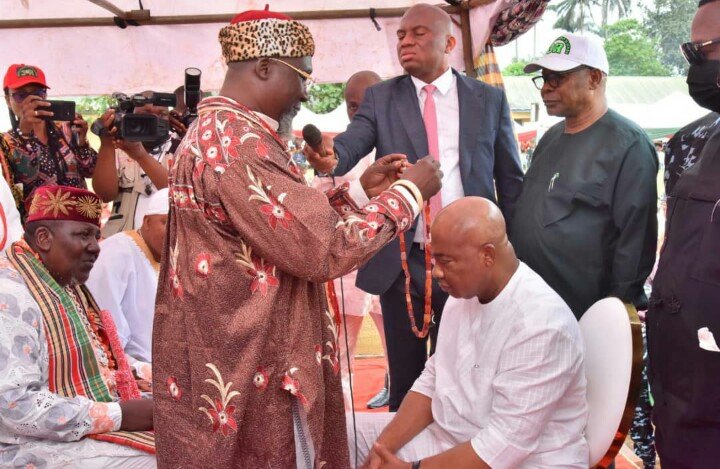
Amumara Mbaise traditional ruler, Eze Ositadinma Nwokocha, Umara ll conferred a Chieftaincy title of Enyioma Mbaise on Governor Hope Uzodimma of Imo State during the 2022 Iriji-Mbaise festival which held at Itu Ezinihitte Central School.
The new chairman of the Revenue Mobilization Allocation and Fiscal Commission (RMAFC), Muhammad Shehu has disclosed that Nigeria has not reviewed its revenue formula in the past 29 years.
Speaking to news men yesterday, August 17, at the Presidential villa, Abuja, the chairman said that this was despite that the Constitution makes it mandatory that the formula should be reviewed after a period of five years.
“Revenue allocation formula had not been touched for about 29 years. The Constitution says after a period of five years it can be reviewed, looking at the circumstances of the country, you know, more states have been created.”
The chairman admitted that there has been agitation for the review of the formula, recalling that the Commission had successfully done the review “sometimes I think, in February this year, and we have submitted our report to Mr. President.
“What he stated at that time was that he was waiting to see what the National Assembly will do in terms of looking at concurrent list and exclusive list and constitutional amendment.
“If he’s satisfied with what the National Assembly does, he will forward a recommendation and make it an Act so that it becomes a law.
Muhammad Shehu said that it is the responsibility of the Commission to take care of the salaries of political office holders, and judicial officers, as enshrined in the Constitution “that had not been reviewed since 2008.”
“And also, our other responsibility, like monitoring of CBN, monitoring of Ministry of Finance, customs, NNPC; those are huge task for the Commission. And of course, don’t forget that revenue mobilization is also a statutory member in the joint tax board, local government joint account and others.
“So my task is to get our members respond to the task that Mr. president gave them in 2019, when he swore in the new board that thye should try as much as possible to get more revenue and strengthen the monitoring mechanism. That is what we are going to do with all the stakeholders FIRS and NNPC, Federal Ministry of Finance and every revenue generating agency. We have to collaborate to be able to assist Mr. President get more revenue before he leaves office. This is a task that should be done by every meaningful member of the Commission.”
Governors of the 36 States of Nigeria have collectively pledged to commit themselves towards strengthening primary health care system in the country, having being inducted into the Seattle Declaration in November 2019.
Speaking on behalf of the governors, at the launch of the Primary Healthcare Leadership Challenge Initiative yesterday, August 17, in Abuja, the chairman of the Nigeria Governors’ Forum (NGF), Dr. Kayode Fayemi said: “on behalf of all of us, the 36 state governors, and members of the Nigerian Governor forum, this is our statement of commitment to strengthening primary health care system in Nigeria.”
He emphasized: “the Nigerian Governors Forum, representing the 36 states of the Federation, hereby affirm our commitment to strengthen the primary health care system in the country. We therefore adopt and confirm our commitment in line with the Seattle Declaration as outlined below.
“1. improving the governance of the primary healthcare system as a sub national level by fully implementing the primary health care under one roof policy, and providing active leadership for primary health care through regular engagement with relevant Primary Health Care stakeholders, and quarterly Primary Health Care performance review at the State Executive Council meetings
“2. to promote progressive increase in primary health care funding by ensuring efficient budgeting that is aligned to annual operational plans, promptly releasing approved budget to the state primary health care board, and primary health care facilities and ensuring that there is a mechanism in place for basic health care provision, fund implementation and oversight at the state and facility levels.
“3. recruit requisite health workforce to ensure that all primary health care facilities have the minimum staffing requirements appropriate for their level in line with the state’s minimum service package.
“4. institute a culture of use of evidence for decision making, by ensuring that the data quality across all primary health care facilities is progressively improved.
“5. develop a state led and state on local government area levels, Primary Health Care leadership challenge for local government area chairmen, for sustainability and strengthening the commitment of the local government area chairmen to primary health.”
The Country Director of Bill and Belinda Gates Foundation, Jeremie Zoungrana, recalled that in November 2019 and following the Seattle’s visit, all the 36 Governors endorsed the Seattle Declaration with key commitments towards improving primary health care and agreed to include PHC as a standing agenda item in your monthly NGF meetings.
She said that in order to support these commitments, the PHC Leadership Challenge Fund was initiated to fill critical leadership gaps in primary health care systems development in Nigeria, adding that the gaps have resulted in inefficiencies, underfunding, lack of prioritization and resulting in poor outcomes for women and children and communities.
“The PHC Challenge Fund represents a unique opportunity to motivate and publicly recognize ownership and leadership at the sub-national level. The PHC health indicators will be tracked to support the NGF build Governor-level accountability, improve performance management, and enhance investments in critical areas of PHC. The Challenge Fund will also leverage other BMGF investments that focus on improving state level data ownership, analysis, quality, and use.
“Under the Challenge, all 36 states are eligible for monetary grants awarded to one best performing and one most improved state within each of the country’s six geopolitical zones demonstrating the most progress against all indicators as per the agreed performance results framework as well as one state nationally displaying the most improved performance (total of 13 awards).
“The Bill and Melinda Gates Foundation is fully aligned with the Government of Nigeria’s determination to reform and revitalize PHC through the current effort by the Ministry of Health and the National Primary health Care Development Agenda. We are encouraged by recent reports showing improvement in routine immunization, Skilled birth attendants, Nutrition, Malaria coverage indicators and declining cases of CVDPV2. This is encouraging and you all should be proud of this achievement.
“As the team continues to engage key stakeholders and the independent verification team to collect and verify the data that will be used for the awards, I would like to draw your attention to the MICS 2021 result released yesterday. These results while encouraging as they show improvement in key indicators, should also spur us to further action.”
The Minister of Finance, Budget and National Planning, Dr. Zainab Shamsunna Ahmed has thumbed up for most State governments in Nigeria for what she called “very strong performance” in all the key Results Areas of Fiscal Transparency, Accountability and Sustainability Programme.
She paid special tributes to President Muhammadu Buhari, for introducing laudable and enduring reforms in the Public Finance Management among which is the World Bank-Assisted States Fiscal Transparency Accountability and Sustainability (SFTAS) Programme for Results.
The minister, who spoke yesterday, August 17, at the launch of the States Charter to sustain Fiscal Financial Transparency, Accountability and Sustainability Reforms, commended the State Governments for the demonstrable high level of ownership, active peer learning and peer competition.
According to Zainab Ahmed, the commendable performance of such State Governments has resulted into increasing fiscal transparency and accountability; strengthening domestic revenue mobilization; increasing efficiency in public expenditure and strengthening debt transparency and sustainability.
“Indeed, the very high level of political visibility and implementation structures created across the 36 States contributed largely to the successful implementation of the Programme over the period 2018 to 2022.
“As we gather this afternoon for the launch of the Charter, we are pleased to note that the Programme has achieved its objectives and made the following impactful deliverables: instilled a common set of fiscal behaviour and standards and facilitated the widespread adoption of good practices in fiscal and public financial management across the States while respecting their fiscal autonomy through preparation of Citizen -based Budgets, timely preparation and publication of Annual Budget and Audited Financial Statement as well as adoption of National Charts of Account.
“To date, twenty-eight (28) States have passed their Audit Law in line with internationally acceptable standards and all the thirty-six (36) States have passed their 2020 Audited Financial Statements before 31 July, 2021.”
Parts of the minister’s speech is reproduced here:
Also, 32 States prepared and published Local Governments’ Audited Financial Statements (AFSS) for FY2018, FY2019 and FY2020 including all allocations and actual receipts of State-Local Government Joint Account Allocation Committee (SLJAAC) transfers for each LG.
It has strengthened fiscal transparency by improving overall budget transparency and accountability to help build trust in government, enhance the monitoring of fiscal risks and improve accountability in public resource management. All the 36 States prepared Year 2022 budget in line with the National Charts of Account.
Improved accountability through the deployment of measures such as BVN in the Payroll Systems and implementation of Treasury Single Accounts to minimize leakages in the system and promote efficiency in resource management. To date, 31 States have linked BVN to payroll while thirteen (13) have adopted the Treasury Single Account. Also, 30 States had conducted biometric registration of at least 90% of their civil servants and pensioners on the payroll and addressed identified payroll fraud.
Also, many States have been able to increase their IGR significantly by reducing IGR leakages through the implementation of State-level Treasury Single Account (TSA), and intensifying efforts in IGR collection. Twenty-seven (27) States passed their Consolidated State Revenue Code (CSRC) by 2020 and 18 States were able to record a nominal IGR collection in 2020 that was equal to or higher than their 2019 nominal IGR collection. In addition, twenty (20) States have shown very strong commitment in establishing institutional arrangements focussed on laying foundation for State Property taxation which is a significant potential revenue source.
To date, twenty-nine (29) States have passed Public Procurement Laws and all 36 went ‘live’ on an e-procurement platform by 31 December 2021. This will improve procurement practices to enhance value for money and reduce opportunities for corruption and misuse of public resources, thereby increasing efficiency of public expenditure.
vil. It has strengthened fiscal sustainability through increased efficiency in spending, and debt sustainability to prevent further fiscal crises and enhance the fiscal space for productive spending aimed at supporting growth and public service delivery. Currently, thirty-three (33) States have passed State Debt Laws.
viii. The implementation of COVID-19 responsive indicators freed resources for effective response to COVID-19 at the peak of the Pandemic. All the 36 States had passed credible, fiscally responsible, COVID-19 responsive Amended 2020 State Budgets which significantly revised revenues in line with realistic projections, reduce non-essential overhead and capital expenditures with a view to protecting social expenditures. This significantly strengthened national response to COVID-19 and aligned efforts at both federal and State levels.
It successfully encouraged peer learning and competition amongst States and further enhanced delivery of good governance.
I am pleased to state that a total sum of N471.9 bn has so far been disbursed by the Federal government as grant to States under the $1.5bn World Bank-Assisted States Fiscal Transparency Accountability and Sustainability (SFTAS) Programme for the results achieved following various annual assessments carried out by the Independent Verification Agents. It is gratifying to note that beyond benefitting from the grants, all the 36 States in the Federation have fully domesticated the fiscal reforms in their public financial management system through the adoption of appropriate processes and practices as well as legal and regulatory frameworks which are already yielding positive outcomes.
At this juncture, permit me to specially recognize the Chairman, Governors’ Forum, the Ekiti State Governor, His Excellency, Dr. Kayode Fayemi, his able Deputy, the Sokoto State Governor, Rt. Hon. Aminu Tambuwal and their Edo State Counterpart, Governor Godwin Obaseki who chairs the Nigeria Governors’ Forum SFTAS Committee. The trio have indeed played major roles in institutionalizing SFTAS Programme not only in their States where they recorded outstanding achievements but in all the States of the Federation. The speedy adoption of this Charter bears great testimony to their unrelenting efforts in entrenching SFTAS ideals in government processes at the State level.
In the same vein, let me also commend all critical Stakeholders involved in the implementation of SFTAS for their untiring efforts towards the successful implementation of the programme thus far. In particular, officials of the Federal Ministry of Finance, Budget and National Planning and the Consultants in the Programme Coordinating Unit, the World Bank Task Team for their Technical Support; the Office of the Auditor General for the Federation who serves as the independent Verification Agent, the Governors’ Forum Secretariat, the Debt Management Office of Nigeria, the Public Service Institute of Nigeria, and the Open Government Partnership Secretariat for their various roles and contribution towards the successful implementation of the Programme.
Ladies and Gentlemen, as we launch the Charter today, its my hope and prayer that current administrations in the States and those that will come after would continue to sustain the ideals of SFTAS as enshrined in the Charter and build on the successes already recorded. Let me also express the commitment of the Federal Ministry of Finance, Budget and National Planning to support the States in the implementation of the Charter as we work together to further deepen on-going reforms in Public Finance Management. I wish to also use this opportunity to implore our friends in the media and the Civil Society as partners in development to join hands with the States to ensure the sustainability of SFTAS ideals.
The Minister of Information and Culture, Lai Mohammed, has assured Nigerians that the federal government is taking fiscal and monetary measures to tackle the rising inflation rate in the country, considered to be the highest in 17 years.
Nigeria’s inflation rate has surged from the previous month’s 18.60 per cent to 19.64 percent in July 2022, according to the latest data by the National Bureau of Statistics (NBS). The data showed that the increase inflation rate was driven by increases in the food and core indexes.
The last time Nigeria’s inflation was above 19.64 percent was in September 2005 when it rose to 24.32 precent.
According to the NBS, the rise in food inflation was caused by increases in prices of bread and cereals, food products, potatoes, meat, fish, oil, and fat.
Breakdown of the report shows that the urban inflation rate rose by 2.08 percent to 20.09 percent in July 2022 from 18.01 percent recorded in July 2021, while the rural inflation rate hit 19.22 percent from 16.75 percent recorded in the corresponding period of 2021.
“On a month-on-month basis, the food inflation rate in July was 2.04%, this was a 0.01% insignificant decline compared to the rate recorded in June 2022 (2.05%).
“This decline is attributed to a reduction in the prices of some food items like Tubers, Maize, Garri, and Vegetables.
Answering reporters’ questions today, August 17 after the meeting of the Federal Executive Council (FEC), in the Presidential villa, Abuja, Lai Mohammed said: “I wish my colleague the Honourable Minister of Budget, Finance and National Planning, was here and she will probably tell you both the fiscal and monetary measures government is taking, especially in the area of the medium term fiscal measures.
“But what I can tell you is that inflation is a global issue. And I think it reflects, you know, a lot of things going on, globally. But what government does to stem inflation varies from government to government.
“Sometimes it is the way you adjust your interest rate or the way you introduce certain fiscal measures that would allow you to bring down the inflation. But like I said, I wish the Minister of Finance was here she will be in a better position to tell me exactly what measures we have been taking to ensure that inflation does not continue to soar.”
This was even as the Minister of Niger Delta Affairs, Umana Umana, said that government will soon constitute the board of the NDDC support the smooth working of the ministry.
Umana said that the board would have to wait until the forensic report about the audit of the commission is out.
“Government is at the stage of concluding on that and I can very conveniently say that the constitution of the board will follow immediately thereafter. Nobody is trying to stall the constitution of the board.
“I want the board in place because it will make my work run smoothly. But we must also follow the due process, conclude on this report and the white paper is issued. So that is the position.”
Umana said that FEC has approved additional costs of carrying out the forensic audit.
“You will recall that for this exercise a lead consultant was appointed who had to work with 16 other field auditors and the initial contract zone which covered the lead consultants and the field forensic auditors was N1.786 billion.
“These auditors have since concluded their work but in the cost of carrying out this work, it was discovered that they had to deal with many more projects than were initially envisaged and the exercise also took an additional seven months.
“The total number of additional projects considered by the auditors was 3,773. So for reasons of the additional number of projects and the additional time taken, Council today approved a revised additional sum of N765,974,975.50 to cover the additional works done by the forensic auditors.”
Umana took over the Niger Delta Affairs ministry from Senator Godswill Akpabio who resigned in June to run in the presidential primary of the ruling All Progresives Congress (APC).
Minister of Power, Abubakar Aliyu, has lamented that shortage of gas shortage has been frustrating government’s effort in the power sector.
He explained that the inability to accomplish the 5,000 megawatts he promised the nation by July 1 this year is a function of gas supply and contract.
The minister, who briefed news men yesterday, August 17, shortly after the weekly meeting of the Federal Executive Council (FEC) at the Presidential villa, Abuja, said that in spite of federal government’s contract with the Nigerian Bulk Electricity Trading (NBET) Plc for gas to power supply, power generation had remained at about 4,000 megawatts.
“Regarding the drop of electricity, yes the supply has so many players, gas, the cost that drop, issues of gas to some power plants. They cannot switch on their plant and if they do you will experience some drop once they switch on.
“There may be drop due to fault of generator and it is mostly generation. I have been watching since yesterday (Tuesday) evening, we had a generation of around 4600 megawatts.
“We told you since 1st July that we will be able to raise it up to 5,000 megawatts when we activated the contract and we have not been able to do so due to some issues around gas contracts and gas to power which we are trying to take care of.
“We have gone very far with that and I believe, it is for that reason that we are able to reach up to 4600 as of yesterday.
“This morning (Wednesday), it dropped to 4100. So, this is what is happening, you will be experiencing this fluctuation due to all these issues around gas to power because gas is not something that we control directly.
“They will not give you gas until you pay. So, we are looking at ways to solve that issue. We are working around the clock to ensure that we raise the capacity to the required level.’’
On the 700 megawatts Zungaro Hydro electric power project, the minister said that FEC approved N2.740 billion as revised estimates for the building of structure at the facility, compensation and resettlement of the communities affected by the project.
An elite group, De Noble Club 10, Kogi Central, has risen to mobilize stakeholders to change the negative narrative about Egbira land being a breeding ground for terrorists and criminals. Members of the group, who are mainly concentrated in Abuja, the nation’s capital, at an emergency meeting at the weekend, expressed shock at the security report on the Owo Church attack that brought out names of some Egbira youths as the masterminds, and also being part of the terrorist in the Kuje, FCT prison escapees. De Noble Club 10 resolved to embark on rallying stakeholders, including traditional institutions, Non-Governmental Organization and sponsorship of radio programme to reverse the negative narratives which the few incidences have brought on the tribe. It argued that Egbira people, spread across the country, have been peaceful, hardworking, loyal and friendly, adding that the bad ones, as they are found in other ethnic groups, should not be used to judge the entire people that make up the entity.
Nigerian government has taken steps to stop farmers from selling agric commodities to foreigners directly. The Federal Executive Council (FEC), headed by President Muhammadu Buhari, had approved the measure at its meeting recently.
The Minister of Industry Trade and Investment, Adeniyi Adebayo, moved to implement the FEC approval by inaugurating an inter-ministerial standing committee in Abuja today, August 16.
According to the minister, the document has been jointly presented by the Ministry of Industry, Trade and Investment and the Federal Ministry of Agriculture and Rural Development on March 9, 2022 for approval by the Federal Executive Council.
Adebayo said that the move was part of government’s efforts to provide the enabling environment for the commodity subsector to thrive.
The minister said that the memo is “aimed at addressing the challenges impeding the development of the agricultural commodity subsector of the economy, curtailing unfair trade malpractices and exploitation of Nigerian farmers by foreigners and promoting competitive premium pricing as impetus for increased productivity in the commodity subsector amongst others.”
He decried the exploitation of farmers by foreigners who come to Nigeria to mop up agricultural commodities at the farm gates and in turn offer farmers prices below market value.
“This situation has indeed led to the failure of many contractual agreements between farmers and indigenous off-takers. It has also affected the production capacity of our local factories due to the fact that foreigners buy off supplies and deprive the factories of required stocks.
“The current practice of direct purchases of agricultural commodities at unfair prices by foreigners at our farm-gates poses serious dangers which include: reduction in farmers’ income, declining productivity in the agricultural sector, unemployment and insecurity.”
The Minister said that a number of activities have been outlined for implementation, adding that the committee is expected to ensure that they are properly articulated and implemented for the growth and development of our economy.
He charged the committee to come up with appropriate implementation mechanism and guidelines for implementing the approved FEC memo as well as liaise with States, Local Governments and other relevant stakeholders nation-wide to enforce the ban and compliance.
Other terms of reference for the committee include facilitating the establishment of enforcement organs in the States and Local Governments; to facilitate signing of Executive Order by the President, specifying penalties and fines for violators.
The Committee is also expected to liaise with the State Governments for establishment of commodity aggregation centres for export in some strategic locations nation-wide and carry out periodic assessment (quarterly) on the implementation.
Also speaking, the Permanent Secretary in the Ministry, Dr. Evelyn Ngige, represented by the Director, Human Resource Management in the Ministry, Yisau Adepoju, said the committee is saddled with the responsibility of ensuring 100 per cent implementation of the approved memo.
Ngige noted that part of the mandate of the ministry is to formulate and implement policies and programmes to attract investment, boost industrialization, increase trade and export, and develop enterprises with a view to promoting economic growth, create jobs and generate wealth.
“As you are aware, the Ministry is passionate about the promotion and development of the non-oil sector having realized the enormous potentials of the sector and its contributions to the national economy.
“There is no gainsaying the fact that wealth from crude oil is not sustainable given the fact that the oil wells will certainly dry up someday. Nigeria is naturally endowed with vast and fertile arable lands suitable for production of many commodities.
“The production, processing and marketing of these commodities not only provide food security but also jobs, income and foreign exchange, amongst others,” she said.
Responding, the Chairman of the Committee, Suleman Audu, expressed the readiness and willingness of the committee to provide the required leadership and coordination to ensure efficient implementation of its mandate.
Audu, who appreciated the government for the confidence reposed in them, pledged on behalf of the committee members not to disappoint the government on the important assignment.
The founder and President of Dangote Group, Alhaji Aliko Dangote, has been picked by President Muhammadu Buhari to head a 16-member End Malaria Council (NEMC).
Other members of the Council are Permanent Secretary, Office of the Vice President on Political and Economic Affairs, Shehu Ibrahim; Governor Kayode Fayemi of Ekiti State and Chairman of the Nigeria Governors’ Forum (NGF), Chairman of the Senate Committee on Health, Sen. Yahaya Oloriegbe; Chairman of the House of Reps Committee on AIDS, TB and Malaria, Hon. Abubakar Dahiru; Federal Minister of Health, Dr. Ehanire; Hon. Ekumankama, Mahmuda Mamman, Permanent Secretary.
Others include Chairman, Board of Directors of UBA, Tony Elumelu; CEO, Rose of Sharon Group, Folurunsho Alakija; CEO, Access Bank, Herbert Wigwe; CEO Forte Oil, Femi Otedola; President, National Council of Women Societies, Hajiya Lami Lau; Emertius Archbishop of Abuja Catholic Archdiocese, John Cardinal Onaiyekan; National Amira, Federation of Muslim Women Nigeria (FOWAN), Alhaja Rafiyat Sanni, and NEMC Secretariat/National Coordinator, National Malaria Elimination Programme (NMEP), Dr. Perpetua Uhomoibhi,
Inaugurating the Council today, August 16 at the Presidential Villa, Abuja, President Buhari projected that the successful implementation of the Council’s agenda and savings from the estimated economic burden of the disease would save Nigeria about N687 billion in 2022 and N2 trillion by 2030.
He said that beyond improving the quality of life, health and well-being of Nigerians, the concerted strategy to tackle malaria has both public health as well as socio-economic benefits for Nigeria.
“Our inauguration today will therefore ensure that malaria elimination remains a priority on our agenda, with strong political commitment from leaders at all levels.
“Additionally, the End Malaria Council will provide a platform to advocate for more funding to protect and sustain progress made so far by our country, and put us on a pathway to ending malaria for good.”
Buhari expressed concern that the age-long disease has remained a major public health challenge in Nigeria, even as he cited the World Health Organisation (WHO) report of 2021, which showed that Nigeria alone accounts for 27 per cent of all cases of malaria and 32 per cent of deaths globally.
“Malaria infection can cause severe disease and complication in pregnant women and lead to high rates of miscarriage.
“It is also responsible for a considerable proportion of deaths in infants and young children, with children under 5 years being the most vulnerable group affected. These are reasons we must not relent in fighting malaria.”
President Buhari said that he chose Dangote to chair the Council in recognition of the track record and passion of Africa’s richest man in supporting initiatives on various health issues such as polio and primary health care system strengthening.
He expressed confidence that Dangote would bring his outstanding achievements to help the country achieve its goal of malaria elimination, adding that a group of eminent personalities, who have also made their mark across all walks of life, have been selected to work in the Council.
He added that the membership of the Council reflects Government’s commitment to significantly reducing the malaria burden in Nigeria, to a level where it is no longer a public health issue.
“I have been informed that the End Malaria Council (EMC) has already been established in other African countries, in line with the African Union Assembly Declaration for Establishment of EMC’s in Africa.
“EMCs have provided leadership, new funding and innovation to enable these countries stay on track to meet malaria burden reduction targets, and I am optimistic that the setting up of the Nigeria End Malaria Council will do the same for Nigeria.
“I must add that with the additional advocacy and funding the Council will bring to the malaria control drive, we can anticipate a reduction in malaria burden that ensures that our children, pregnant women, indeed, all Nigerians are shielded from the disease.
“We must work together to reduce the unnecessary deaths attributable to malaria and ultimately improve the well-being of citizens. I implore the Council to ensure best practices and innovative strategies in achieving its mandate.”
President Buhari used the occasion to thank the Chairman of the African Leaders Malaria Alliance (ALMA), President Uhuru Kenyatta of Kenya, the Executive Secretary of ALMA, RBM Partnership in Nigeria for their continuous support to the Federal Ministry of Health and the malaria programme, in particular.
He also acknowledged the contributions of the Global Fund, the United States Agency for International Development, the President’s Malaria Initiative, Bill and Melinda Gates Foundation, WHO , UNICEF, UK Foreign and Commonwealth Development Office, other implementing partners, and the private sector.
In separate remarks, the Minister of Health, Osagie Ehanire, and the Minister of State for Health, Joseph Ekumankama Nkama, said that since 2010, Nigeria has been recording a continuous decline in malaria from 42 per cent in 2010, 27 per cent in 2015 to 23 per cent in 2018.
Quoting figures from the 2010 Nigeria Malaria Indicator Survey and the 2018 Nigeria Demographic and Health Survey, they attributed the decline to the thorough implementation of the National Malaria Strategic Plan (NMSP).
Both ministers, however, admitted that funding gap has impacted the implementation of the malaria programmes in Nigeria, adding that the country needs N1.89 trillion to reduce malaria prevalence and mortality by 2025. .
Ekumankama said: “The biggest challenge confronting us, which prevents the elimination of malaria, to ensure a malaria-free nation in the shortest possible time is inadequate finances to fund the NMSP.
“We are currently implementing NMSP of 2021 to 2025, with the intent to achieve a parasitic prevalence of less than 10 per cent and reduce mortality attributable to malaria to less than 50 deaths per 1000 live births by the year 2025. It will take about N1.89 trillion to implement this plan.
“However, in the first year of its implementation we had an estimated deficit of over N150 billion and in 2022, we already have a deficit of over N170 billion.”
In his acceptance speech, Dangote thanked the President and all members of the Council for entrusting him with the enormous responsibility, pledging to work hard to achieve the mandate.
“I must confess that this resonates with my current role as the Nigerian Ambassador for Malaria, my role on the Global End Malaria Council and with the work that my Foundation is doing to mobilise the private sector to support malaria control in Nigeria and Africa at large.”
We use cookies on our website to give you the most relevant experience by remembering your preferences and repeat visits. By clicking “Accept”, you consent to the use of ALL the cookies.
This website uses cookies to improve your experience while you navigate through the website. Out of these, the cookies that are categorized as necessary are stored on your browser as they are essential for the working of basic functionalities of the website. We also use third-party cookies that help us analyze and understand how you use this website. These cookies will be stored in your browser only with your consent. You also have the option to opt-out of these cookies. But opting out of some of these cookies may affect your browsing experience.
Necessary cookies are absolutely essential for the website to function properly. This category only includes cookies that ensures basic functionalities and security features of the website. These cookies do not store any personal information.
Any cookies that may not be particularly necessary for the website to function and is used specifically to collect user personal data via analytics, ads, other embedded contents are termed as non-necessary cookies. It is mandatory to procure user consent prior to running these cookies on your website.





 The Naira has continued to depreciate against the dollar at the Investors and Exporters window, exchanging at N430.67.
 Nigerian government has taken steps to stop farmers from selling agric commodities to foreigners directly. The Federal Executive Council (FEC), headed by President Muhammadu Buhari, had approved the measure at its meeting recently.