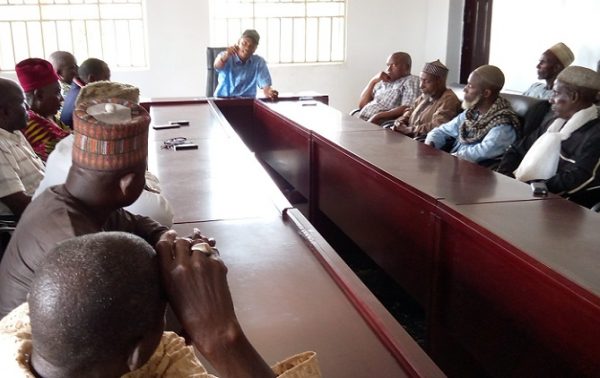
Nigerian Farmers’ Cooperative Societies (NANFACOS) has expressed concern over the practice whereby real farmers are often sidelined on the issue of agricultural funding and other related matters in Nigeria.
“It is a known fact that agricultural funding and materials from government most times do not get to the targeted farmers; it is been taken by portfolio farmers.”
Speaking to newsmen today, November 26 in Abuja, the President of the group, Nwogwugwu Uzoma
Uzoma, appealed to the Federal Government to support the group to gain access to credit facilities, land and vehicles.
He said that these would assist the government in stimulating the gains of agriculture in the country.
Uzoma asked the government to persuade the state governments to make at least 1,000 hectares of land available for agricultural activities in every state of the Federation.
The president said that NANFACOS would create a difference between cooperative farmers and ordinary farmers in Nigeria, as well as have good book-keeping programme to assist the farmers in business.
According to him, the cooperative is made up of 127, 000 registered farmers with a conglomerate of over 68 million individuals and practising cooperative farmers across the country.
Uzoma said that the cooperative has been able to visit funding agencies like ministries, parastatals, banks, and non-governmental organisations to negotiate for the funding of agribusiness.
”Those visited include Federal Ministry of Agriculture and Rural Development, Federal Ministries of Special Duties and Intergovernmental Affairs, and Central Bank of Nigeria.
“Others are Small and Medium Enterprises Development Agency of Nigeria, Nigeria Incentive-Based, Risk Sharing System for Agricultural Lending , and Bank of Agriculture.”
NANFACOS was given official recognition via its registration by the Federal Department of Cooperatives at the Federal Ministry of Agriculture and Rural Development in 2019, in accordance with the Nigeria Cooperative Societies Act.
The Benue State Governor, Samuel Ortom has accused the former Governor of the State, now Senator George Akume of misappropriating over N4.5 Billion when he was Governor.
The alleged financial fraud ranged from misappropriation of public funds, approvals above limit, abuse of office and public trust to sale of 33,440,818 units of shares at the Benue Investment and Property Company (BIPC).
In a petition to the antigraft agencies, Governor Ortom wanted Akume, who is now the Minister of Special Duties and Intergovernmental, to be investigated for financial impropriety amounting to N4,556,899,632.9.
The petitioner alleged that the shares, which were valued at billions of naira, were sold without recourse to due process.
A letter of complaint to the Economic and Financial Crimes Commission (EFCC); Independent Corrupt Practices Commission (ICPC) and the Inspector General of Police, was written and signed by counsel to the Benue State Government, Okeoga Darlington, Esq and made available to newsmen by the Attorney General and Commissioner for Justice, Barrister Michael Gusa.
The letter of complaint which was generated from an audit report, spanning 1999 – 2007 when Senator George Akume served as Governor, said he unilaterally approved the sum of N117 million which was above his approval limit without recourse to the State Executive Council meeting.
According to the letter, the reckless financial expenditures were for consultancy and feasibility study for Mbatiav Cement which turned out to be a white elephant.
The project, the petitioner claimed, never saw the light of the day.
The petitioner also alleged financial indiscipline, abuse of fiscal policies and misappropriation for various contracts amounting to N3,125,882,409.25 billion.
The former Governor was also accused of misappropriation of ecological funds amounting to N300,002,000 million, which was spent on projects different from ecological projects.
During the audit report, it was also discovered that on the watch of the former Governor, a loan of N150 million was taken from defunct Afri-Bank in December 2000 for purchase of shares in companies but the money was transferred to All Securities Limited for which no receipts were found for the transaction.
It was also discovered during the audit that the former Governor Akume claimed to have executed ‘many projects’ that were never located which the petition deemed to be an aberration of due process, abuse of fiscal policies and criminal violation of relevant laws.
“Regrettably, many of such projects, valued at N1,074,017,023.65 billion were not accounted for as there was no evidence of their execution anywhere.”
A visiting Professor at the National Universities Commission (NUC), Professor Hafiz Abubakar, has called for the adoption of what he described as agricultural-based economic diversification as a way of containing the insecurity in the country.
Professor Hafiz, who is also the former Deputy Governor of Kano State, insisted that the state of insecurity in the country can be managed with the aid of agriculture-based economic diversification.
Speaking today, November 26, at the 10th convocation lecture of Michael Okpara of Agriculture, Umudike (MOUAU), in Abia State, the Professor said that the development of the economic diversification plan requires clear guidelines and responsibilities of all stakeholders.
Professor Hafiz said that a strong political will is also required to develop and implement policies and strategies for the country’s economic diversification.
“To accommodate a growing number of young people entering the labour market, Nigeria will need to create at least five million new jobs each year over the next decade.
“Based on the experience of other countries, embracing more open trade and competition policies would help diversify the economy and reinvigorate growth, particularly as the African Continental Free Trade Area takes effect.”
According to Professor Hafiz, who is also the former Deputy Vice-Chancellor of Bayero University Kano, for Nigeria to move closer to unlocking its full agriculture potential, the value chain has to be identified, mapped, prioritised and digitised.
He advised MOUAU to lead research in the identification, mapping and deepening agricultural value chain and to explore the triple helix model (Academia-Industry-Government) partnership to build a model agricultural food value chain for self-sufficiency and national orientation.
This was even as chairman of the lecture, Senator Chris Adighije, described the topic of the lecture as apt because the role of security in nation-building could not be over-emphasised.
Adighije, who is the Pro-Chancellor and Chairman of Governing Council, Federal University, Lokoja, also described security as a pre-condition for everything and social development.
Earlier in his opening remarks, the Vice-Chancellor of MOUAU, Professor Maduebibisi Iwe, said the lecture was timely as the country was in dire need of economic advancement.
Professor Iwe, who was represented by his deputy (Academics), Prof. Udo Herbert, described the lecturer as a renowned academic, with vast knowledge in the agricultural sector.
Minister of the Federal Capital Territory (FCT), Malam Muhammad Musa Bello has commended the security agents for breaking the network of criminals in the territory and giving them thorough fight.
According to the Minister, from the number of arrests made over the past few weeks, a criminal network that operated across the FCT and neighboring states has been broken.
Muhammad Musa Bello, who spoke today, November 25, at the Security Committee meeting for the month of November, expressed appreciation to the heads of security agencies for the improvements in the security situation of the Territory over the last few weeks.
He said that a number of incidences, including kidnapping were averted with the cooperation of security operatives and the citizenry, adding that in a certain community, criminals had perfected plans to kidnap a Pastor alongside member of his family, but the plan was foiled and the criminals arrested.
The Minister expressed optimism that interventions by the FCT Administration will give the desired security results going into the New Year.
Muhammad Musa Bello seized the opportunity to call on the FCT wing of the Nigerian Union of Teachers (NUT) to call off its ongoing strike, which currently affects primary schools, being managed by the Local Education Authorities (LEA) in the Area Councils.
“The bedrock of our education is the primary school system and we should not allow students to suffer for issues that really are not their fault. The Chairmen of the Area Councils are engaging with the teachers and we have the assurances that they will reach an agreement.”
“My appeal to the teachers is this, no society can develop without education.”
He advised Administrators at the Area Council, religious and traditional leaders to dialogue with the teachers.
Also speaking, FCT ALGON Chairman, Adamu Mustapha Danze said that the Area Councils will continue to play complimentary roles in maintaining security in the territory and commended the Minister for efforts made in the fencing of schools across the Territory as well as the provision of other security measures to safeguard schools.
Adamu Mustapha also appealed to the striking teachers to call off the industrial action as it will have a negative consequences on the country.
The FCT Commissioner of Police, Babaji Sunday, advised residents to be security conscious, especially in this “ember months.”
He however assured them of adequate security during the end of year festivities.
Governor Willie Obiano of Anambra State has told the Economic and Financial Crimes Commission (EFCC) that he will relocate to the United States of America immediately after the completion of his tenure on March 17, 2022.
In a statement today, November 25, reacting to the EFCC’s threat, placing him on its watchlist, Governor Obiano promised however that he will give a scorecard of his two-term of eight year tenure before he run away.
The anti-graft agency had in a letter to the Comptroller-General of the Nigeria Immigration Service, dated November 15, 2021, requested the service to place the governor on watch list and inform it anytime he was travelling out of the country from any of the international airports and other points of entry and exit.
The governor’s statement on Thursday signed by the Anambra State Commissioner for Information and Public Enlightenment, Mr C Don Adinuba, the government said there was no doubt that the governor would leave the country after his tenure as he had always announced, but insisted that Governor Obiano was ready to account for his years in office.
The statement goes thus: “Governor Obiano is out of the country currently. And he travelled through one of the country’s international airports. He did not disguise himself, but rather left the country with his identity fully disclosed at the necessary immigration point.
“Chief Obiano has never left any persons in doubt that he will relocate to his base in the United States once he finishes his tenure. As early as Wednesday, March 4, 2020, he announced his decision to a meeting of the Anambra State Council of Elders.”
He said the action of the commission is being engineered by the same people who wanted to impose a state of emergency on Anambra, saying that the move was in retaliation of the defeat of their ambition to take Anambra at all cost.
He said: “Nigerians were dismayed that the EFCC went to a new low on Wednesday, November 24, 2021, when it sponsored media reports claiming that it had placed Governor Willie Obiano of Anambra State on its watch list.
“The EFCC provided no details of how Governor Obiano has been placed on its watch list, but made a reference to a letter it purportedly wrote on November 15, 2021, to the Comptroller General of the Nigeria Immigration Service (NIS) asking it to inform the anti-graft agency anytime the governor is travelling out of the country.
“Everything that can be wrong with politically motivated statements like this one is obviously wrong with this statement. The EFCC knows full well that it is acting inelegantly in this instance, and so has tried as much as possible not to make an official public statement on the alleged placing of Chief Obiano on the watch list. It furtively gave a section of the media the news report it wrote based on ostensibly its letter to NIS on November 15.”
Minister of State for the Federal Capital Territory (FCT), Dr. Ramatu Aliyu, has advised African women to rise to the challenge of rebuilding their countries’ economies, values and future.
The minister who spoke virtually at the on-going African Women Conference holding in Kigali, Rwanda, noted that women are mostly affected at the peak of the COVID-19 pandemic.
Dr. Ramatu Aliyu said that women are born managers of resources, and that they are bestowed with the core responsibility of ensuring the wellbeing of members of their homes and communities.
She however decried the continuous under-representation of women in the public space, in both elective and political appointments.
The minister stressed that the under-representation constituted the single most-important factor hampering the availability of economic opportunities.
“In this conference, we must work to ensure women are at the forefront of leading the economic growth that Africa desires, be part of policy making and implementation.
“Women should work towards the agenda of gender and social inclusion policy to protect women and female children in our various countries.
“The development and growth of a nation would only be achievable when women are equal partners in growth with men.
“The current reality is that in most African countries, women have relatively weak socioeconomic status and their successful empowerment must necessarily connect and feed their labour into the flow of economic development.
“Besides the negative impact on their economic status, women also have had to grapple with all forms of gender-based violence.
“For illustration, increased domestic abuse, sexual harassment, rape, amongst others, were reported during the lockdown.”
The minister argued that women had the population and innate potentials to contribute to the political and socio-economic development of any country.
Aliyu said it behoved the state to map out workable strategies that would ensure the effective empowerment of women at all levels.
She said that doing so would enable womenfolk to maximise their potentialities and further help to consolidate the gains that contemporary democratic opening provided, especially in the post-COVID-19 era.
This year’s conference has “Women’s participation in building an inclusive and sustainable post-COVID-19 economy’’ as its theme.
The Registrar of the Joint Admissions and Matriculation Board (JAMB), Professor Is’haq Oloyede has said that 706,189 students have been found to have been illegally admitted by Universities, Colleges of Education, Polytechnics and others.
Professor Oloyede, who made the disclosure at the Consultative Sensitization Meeting with Select Stakeholders in Abuja said that the illegal admissions have damaged the image of the country.
According to him, the illegality was perpetrated in all the six geopolitical zones by public and private higher institutions.
He said that while about 114 universities accounted for 67.795 of the illegal admissions, 137 polytechnics were responsible for 489,918, 80 Colleges of Education for 142, 818 and 37 other institutions involved in 5,678 cases.
The undisclosed admissions were perpetrated from 2017 to 2020 by the affected institutions.
He said that such admissions were unknown to JAMB as prescribed by law.
He said the institutions disregarded JAMB’s Central Admissions Processing System (CAPS which allows institutions to “only admit candidates that met the requirements.”
He said the affected institutions’ Vice Chancellors, Rectors and Provosts have admitted their mistakes by “sending a formal letter of confession and disclosure to the JAMB Registrar.”
In the list of the 114 universities given to stakeholders, some of the top indicted for illegal admissions include University of Jos (7,600); Benue State University (6,171); Olabisi Onabanjo University (5,669); Kwara State University (4, 281); Novena University (3,432); University of Nigeria, Nsukka (2,732); and Imo State University(2,330).
Others listed are University of Calabar (2,074); NTA Television College (1,934); Baze University (1,717); Oduduwa University (1,450); Kaduna State College of Education (1,417); Tai Solarin University of Education (1,101); Al-qalam University (1,062); Gombe State University (1,017).
“As a measure of mopping up the backlog of improperly admitted candidates, the Honourable Minister of Education, Malam Adamu Adamu, assented to the Board’s plea for a last chance for the violators.
“He also approved the caveat that the culprits should, first and foremost, declare the number of candidates admitted outside CAPS between 2017 and 2020 by sending a formal letter of confession and disclosure to the JAMB Registrar.
“Those minimally qualified would then be condoned to put an end to the period and finally put the matter to rest.
“The Board was then directed to launch massive campaigns to educate the public against accepting such illegal admissions henceforth.
“It is astonishing that so far, 706,189 candidates have been disclosed as illegally admitted between 2017 and 2020.”
Professor Oloyede said there will no longer be opportunities for illegal admissions by universities and other higher institutions.
He said that the illegality had hindered the future of many graduates and it was time to stop it.
“Meanwhile, the graduates of the illegitimate process need admission letters to pursue post-graduation endeavours like housemanship, scholarship, enrolment into the National Youth Service Corps (NYSC), among others, they are out of sync.”
Some candidates had been forced in the past to seek Direct Entry into other universities after graduation just because their degrees were not recognized as a result of lack of admission letters at critical stages. The physical, psychological and mental strain of such candidates is better imagined than experienced. This could have been avoided if everyone played the game according to the rules.
“The Board is then constrained to condone these illegitimate admissions through a process known as ‘condonement’ which was previously known as ‘Regularization’. This was done out of sympathy for the candidates and consideration of the enormous resources expended on the training of such candidates.
“Thus, the Board was condoning all these infractions in admissions conducted prior till 2017. It is noteworthy that the lawlessness is perpetrated in institutions across the six geopolitical zones of the country.”
Professor Oloyede also claimed that some university lecturers were recently arrested for engaging in massive fraud associated with ‘A Level’ examinations by the Joint Universities Preliminary Examinations Board (JUPEB) and Interim Joint Matriculation Board.
“As a moderator of the two ‘A-Level entrance examinations in Nigeria, Joint Universities Preliminary Examinations Board(JUPEB) and Interim Joint Matriculation Board Examination(IJMBE), the attention of the board was drawn to the massive fraud associated with the conduct of these examinations.
“It is quite disappointing that some of our colleagues were arrested while conniving with various examination syndicates to compromise the noble objectives of these two examinations. The Independent Corrupt Practices and Other Related Offences Commission (ICPC) in conjunction with the Federal Ministry of Education conducted a sting operation the result of which is monumentally embarrassing.
“Distinguished ladies and gentlemen, you must have been disturbed by the recent indicting release of the ICPC on the scandal in its campaign to put an end to such illegal, destructive and disruptive activities.
“The board has painstakingly taken some measures to forestall future recurrence. It has, for instance, initiated action to seek approval from the Honourable Minister of Education, Malam Adamu Adamu, to establish what it refers to as the “A Level Task Team/ A Level Qualification and Verification Databank” (ALQVD) as a repository for verified A/L qualifications in Nigeria.
“I am privileged to know that the Federal Ministry of Education is considering further necessary action on the matter. As soon as the appropriate approvals are secured, we would reach out to you for assistance.”
He said JAMB was already addressing some unethical and unacceptable practices by Computer-Based Testing (CBT) Centres.
“Fourthly, the review of our registration process has shown some unethical and unacceptable practices by Computer-Based Testing (CBT) Centres. “These centres are allowed to collect only Seven Hundred Naira (#700.00) as registration charges but they use the opportunity to engage in conduct unbecoming, including extortion, during the exercise.
“In order to put a stop to such extortion, we propose to make UTME registration henceforth cashless. In other words, JAMB will now be collecting the approved N700.00 registration fee on behalf of the CBT Centres along with its UTME registration fees and then remit what is due to each registration centre to its bank account on a weekly basis or any timeframe acceptable to the centre owners.
“This intervention will block all loopholes through which hapless candidates are extorted by unscrupulous service providers.”
The Minister of Finance and Economic Development, Zainab Ahmed has said that if Nigeria continues to pay subsidy on fuel, it may run into a situation where it will be paying N3 Trillion annually on the subsidy.
“If we don’t remove the subsidy that is what it will be costing us. This is the money that we can use to apply to health and to education.”
The Minister, who briefed newsmen yesterday, November 24 shortly after the meeting of the Federal Executive Council (FEC), at the Presidential villa, Abuja, recalled that even the Petroleum Industry Act (PIA) has a provision that all petroleum products must be deregulated.
“And in the 2020 budget, we made a provision to assume that at the maximum by the end of June, we must exit subsidy.
“In the last FAAC, the subsidy cost to the Federation was N243 billion. We look at a cost of about 250 billion per month, because it has been increasing consistently. So we are expecting something around N120 billion per month from NNPC.
“And now, we are getting to a point where NNPC will be remitting near zero. And if we don’t stop, we will get to a point where we will tell you pay me this for managing the fuel provision in the country.”
Zainab Ahmed said that between 20 and 40 million Nigerians will benefit from the intervention the government is planning to provide, adding that there is still a lot of work going on.
“We have a committee that is chaired by His Excellency, the Vice President, state governors and a few of us ministers as members.
“So we have to have a landing as to the exact number between 20 to 40 million. “We already agreed it will be N5,000 and we have also agreed that the remittances have to be done digitally.
“So the e-naria will help, but also so are the various payment platforms that are currently available. What we will not do is paying people in cash.
“The transfers that people will receive will be through one kind of electronic money or the other and it’s meant to be for a period of six, nine or 12 months.
“These are the things that we are still in negotiation because it’s still money that would have to come from the Federation account.
“Everybody that is a member of FAAC will have to agree on the numbers. The maximum will be 12 months, the minimum will be six months.
“We thought it was important to do this to give people a chance to adjust before the other support measures that the government is working on materialise and that is the provision of alternative to PSM which is CNG that is having mass transit vehicles converted to CNG.
“And also the printing on stream of petroleum refineries, including the Dangote refinery so that it reduces even the need to import the PMS in the first place.
“So that’s the logic behind targeting the middle of next year. This money is meant to provide relief to the very poor in the variable.
“On the experience we have had on the conditional cash transfer, it shows that that N5,000 that some people think is small actually makes a difference to families. It helps them to provide not only their basic needs, but we have seen women who are caregivers of those farmers actually start doing small trade, and they are able to maintain themselves thereafter.
“So in a way, it is not just consumption, it also helps to improve the productive activities of people that are at the bottom of the pyramid. And I remember during the COVID-19 pandemic, we had more people becoming vulnerable, especially in the urban area. So we are not covering only the rural areas but also the overburden, the urban poor.”
President Muhammadu Buhari has rolled out the drums to celebrate his Chief of Staff, Professor Ibrahim Agboola Gambari who clocked 77 today, November 24.
The President spoke after the Secretary to the Government of the Federation (SGF) announced, at the beginning of the meeting of the Federal Executive Council (FEC) at the Presidential villa, Abuja, that Professor Gambari’s birthday is today.
President Buhari congratulated Professor on the attainment of age 77, and added in a lighter mood: “you are still going strong. Congratulations!”
The ministers who were at the meeting chorused with laughter and birthday good wishes.
Professor Gambari joined the government as Chief of Staff twenty months ago following the demise of the former holder of the office, Abba Kyari.
Before this time, Professor Gambari had served as Minister of Foreign Affairs under the Military Government, led by the then Major General Muhammadu Buhari in the 1980s and went on to serve as Nigeria’s Permanent Representative to the United Nations.
He thereafter joined the United Nations system, rising to the position of Under-Secretary General and Special Adviser on Africa, serving as the joint African Union and UN Special Representative in some of the world’s troubled countries including Angola, Darfur, Iraq and Myanmar.
Described as an accomplished academic, Professor Gambari has taught at the City University of New York, the State University of New York at Albany and Ahmadu Bello University, Zaria, as well as served as a Visiting Professor at the John Hopkins School of Advanced International Studies in Baltimore, Maryland.
He is widely published in Nigerian and international scholarly journals and has written several books on Nigerian foreign policy.
Professor Gambari is the founder of the Savannah Centre for Diplomacy, Democracy and Development, a non-governmental “think-tank” established in Abuja.
Chairman of Igalamela-Odolu Local Government Council of Kogi State, Onoja James has fingered some traditional rulers and community leaders in the lingering clashes between herdsmen and farmers in their domains across the country.
Onoja James, who spoke today, November 23 at an Inclusive Forum for Accountable Society (IFAS) in Lokoja, the Kogi State capital, said that some traditional rulers are fund of collecting money from herders to allocate lands to them.
He added that the herders would subsequently lay claim to such land and assume absolute control of the area, thereby hindering farming and other productive activities.
This was even as the stakeholders appealed to the federal government to declare a State of Emergency on herders and farmers clashes to avert food crisis.
The stakeholders observed that the crisis had been allowed to linger for too long and affected almost every sector of the economy.
The meeting was organised by three development partners, ActionAid Nigeria, Participation Initiative for Behavioural Change in Development (PIBCID) and Global Community Engagement and Resilience Fund.
St the meeting, Ms. Halima Sadiq, Executive Director, PIBCID, said the declaration of a state of emergency is necessary because livelihoods of community members were at stake.
“We have been talking about zero-hunger in line with the Sustainable Development Goals and we are also talking about boosting agriculture by promoting women and youth participation.
“We know that 75 per cent to 85 per cent of rural dwellers are farmers while the remaining 15 per cent engage in passive farming.
“When you destroy farmers’ crops and take their lands from them, it affects their livelihoods.”
The Chairman of IFAS, Hamza Aliyu, called on Nigerians to stop denigrating ethnic nationalities over farmers-herders clashes as “not all herders are Fulani and not all Fulani are herders.’’
He said that disparaging an entire race over negative activities of a few was not a healthy approach to solving the problem.
“The security problem is not between Fulani and farmers but between herders and farmers.”
Aliyu expressed regret that herders-farmers clashes have assumed a national dimension.
“We are proposing a State of Emergency to government to bring in the needed resources to solve this problem at once.
“Not just the finances, but the needed human resources; the critical thinking facility of the government to bear on this problem so that we can solve it once and for all.
“State of Emergency is not to shut down the democratic system or the civic space.
“It simply means we should be able to deploy resources to help the communities to install structures that will address the issues squarely.”
We use cookies on our website to give you the most relevant experience by remembering your preferences and repeat visits. By clicking “Accept”, you consent to the use of ALL the cookies.
This website uses cookies to improve your experience while you navigate through the website. Out of these, the cookies that are categorized as necessary are stored on your browser as they are essential for the working of basic functionalities of the website. We also use third-party cookies that help us analyze and understand how you use this website. These cookies will be stored in your browser only with your consent. You also have the option to opt-out of these cookies. But opting out of some of these cookies may affect your browsing experience.
Necessary cookies are absolutely essential for the website to function properly. This category only includes cookies that ensures basic functionalities and security features of the website. These cookies do not store any personal information.
Any cookies that may not be particularly necessary for the website to function and is used specifically to collect user personal data via analytics, ads, other embedded contents are termed as non-necessary cookies. It is mandatory to procure user consent prior to running these cookies on your website.



 Nigerian Farmers’ Cooperative Societies (NANFACOS) has expressed concern over the practice whereby real farmers are often sidelined on the issue of agricultural funding and other related matters in Nigeria.
 A visiting Professor at the National Universities Commission (NUC), Professor Hafiz Abubakar, has called for the adoption of what he described as agricultural-based economic diversification as a way of containing the insecurity in the country.