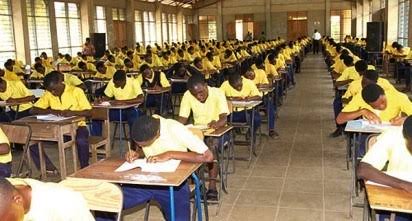
General Manager of the Lagos State Environmental Protection Agency (LASEPA), Dr Babatunde Ajayi has described young people as critical drivers of environmental change and effective advocacy. Speaking at the 2026 Inter-Tertiary Institutions Environmental Summit in Lagos, Dr. Babatunde Ajayi said: “I’m a very strong believer in efficient advocacy. The best way to make change happen is through young people who are still able to change their minds.” The Summit was held to engage students in discussions on environmental sustainability and transboundary pollution. It brought together students from the University of Lagos and Lagos State University for debates and discussions on environmental issues. LASEPA General Manager described universities as the bedrock for nurturing future environmental advocates and sustainability champions. He said that the summit focused on transboundary pollution and its impact on air, land and water resources across communities and countries. According to him, pollution generated in one location can spread beyond borders and affect neighbouring regions. “If you have intense air pollution in Lagos, acid rain can be experienced in Benin Republic, Togo, Ghana and even Burkina Faso.” Dr. Babatunde Ajay made reference to the recent Ojodu pollution incident, and said that discussions on such occurrences would help prevent a recurrence. “We feel that bringing this situation again to the limelight and making it the subject of discussion is one way to make sure it doesn’t happen again.” This was even as the Director of Partnerships, Grants Management and Innovation at LASEPA, Mrs. Shonibare Olabisi, said that more than 300 entries were received from public and private tertiary institutions across the state. She said that 212 essays qualified after screening by lecturers from the University of Lagos, while 10 students were shortlisted for the preliminary debate stage. Olabisi quoted former South African President Nelson Mandela as saying: “It always seems impossible until it is done.” She praised the students for emerging among the top entries within three weeks of submissions. According to her, the preliminary stage will produce six finalists for the grand finale scheduled for June 9 at the LASEPA Auditorium. An environmental expert, Olayinka Omotosho, argued that issues such as oil spills and water pollution required collaboration between states and the Federal Government. According to him, many environmental challenges cut across jurisdictions and cannot be addressed through isolated state actions. The debate was centred on the topic: “Combating Transboundary Pollution in Lagos State: A City-Level Intervention or National Effort?” The shortlisted students defended opposing positions before a panel of judges and environmental experts. One group argued that stronger state-level environmental regulations offered the most effective response to transboundary pollution, while the other maintained that national-level interventions would yield better results. Speaking during the session, Olabisi said that effective pollution control within states would prevent environmental problems from spreading beyond their borders. At the end of the contest, six students qualified for the grand finale scheduled for June 9.
A file photo of a burnt vehicle is seen following an attack by gunmen in Bokkos, north central Nigeria (AP photo)
Nigeria today stands at a dangerous crossroads. Across the country, communities are living in fear as kidnapping, banditry, terrorism, and mass killings continue to threaten lives and livelihoods. From the forests of the North-West to the villages of the Middle Belt and the highways of the South, insecurity has become one of the greatest challenges confronting our nation.
The recent kidnapping incidents involving school children in Oyo State once again exposed the vulnerability of innocent Nigerians. The trauma inflicted on young pupils, their parents, and their communities is immeasurable. Similar incidents have occurred in Kwara State, where kidnappers have repeatedly targeted travellers, students, and rural residents. In Kogi State, kidnappings along major roads and attacks on communities have become disturbingly frequent. Plateau State has witnessed recurring massacres of innocent villagers, with hundreds of lives lost in attacks that have left entire communities displaced and devastated.
These tragedies are not isolated events. They represent a national security crisis that demands urgent, coordinated, and sustained action.
Many Nigerians are increasingly concerned that political calculations surrounding the 2027 elections appear to be receiving more attention than the security emergency facing the country. Public discourse is increasingly dominated by defections, coalition-building, endorsements, and electoral strategies, while citizens continue to bury loved ones killed by criminals and violent extremists.
President Bola Ahmed Tinubu came into office with the promise of renewed hope. While some economic reforms have been initiated, many Nigerians believe that the government’s response to insecurity has not matched the scale and urgency of the threat. Citizens expect more than condemnations after attacks. They expect decisive action capable of preventing future tragedies.
The reality is that every successful kidnapping operation emboldens criminals. Every community attack that goes unanswered weakens public confidence in the state’s ability to protect its people. Every massacre that ends without accountability sends a dangerous message that human life has become cheap.
Security should never be treated as a secondary issue. It is the foundation upon which economic growth, education, healthcare, agriculture, and national development depend. Farmers cannot cultivate their lands when they fear abduction. Investors cannot commit resources where insecurity reigns. Children cannot learn effectively when schools become targets for kidnappers.
The question Nigerians are asking is simple: Where is the comprehensive strategy to end this nightmare?
The solution requires more than military deployments after attacks have already occurred. Nigeria needs a holistic security architecture that addresses both immediate threats and their root causes.
First, intelligence gathering must be strengthened. Security agencies need better coordination, modern surveillance technology, and real-time intelligence sharing. Criminal groups often operate successfully because they exploit gaps between agencies.
Second, community policing should be expanded and properly funded. Local communities often possess valuable intelligence about criminal activities, but there must be structured mechanisms for gathering and acting upon such information.
Third, the government must invest heavily in modern security technology, including drones, satellite surveillance, biometric databases, and advanced communication systems capable of monitoring vulnerable regions.
Fourth, the judicial process for kidnapping, terrorism, and mass murder cases must be accelerated. Criminals should face swift prosecution and punishment. Delayed justice weakens deterrence.
Fifth, economic opportunities must be expanded, particularly for unemployed youths who are often recruited by criminal networks. Security operations must be complemented by social and economic interventions.
Sixth, state governments should be granted greater operational roles in security management while maintaining national coordination. A nation as vast and diverse as Nigeria requires localized responses to localized threats.
Finally, political leaders at all levels must demonstrate that protecting lives is their foremost priority. Electoral ambitions should never overshadow the constitutional responsibility of safeguarding citizens. Governments are ultimately judged not by campaign promises but by their ability to secure lives and property.
Nigeria has the resources, manpower, and institutional capacity to overcome this crisis. What is needed is political will, strategic leadership, and unwavering commitment. The blood of innocent Nigerians should not become a recurring headline. The tears of grieving families should not become a normal feature of national life.
The time has come for leaders across board to place security above politics, governance above campaigns, and the protection of human life above every other consideration. The future of Nigeria depends on it.
Here are some of the unedited comments from my numerous readers in reaction to series of narrations I published, about my experiences in a Saudi Arabian hospital. The narration, in parts, was titled: My Return From The Gate Of the Other World. Please read on: Quite touching. This has moved me to tears. Alhamdulillah that you have survived. It is Allah’s way of doing His KUN FA YAKUN, and I believe you are back for a purpose, Baba. May Allah grant you more shifa, long life and strength as well. Hauwa A. Tijjani
Getting the chance to return from the other world’s gate is one of the rare things that usually happen to very few people, according to some scholars. Some said “it’s like being given a second chance or opportunity to live again” and change all that seemed wrong or not right. Be that as it may, this is another opportunity presented or handed to you to make amendments to what you perceived to be wrong in how you run your life in your little world. May this rare chance of “returning from what I will call the point of no return” straighten your activities toward your creator, parents, etc, etc. May this golden opportunity benefit you fid dunya wal alkhira. Hamid Magaji
Amazing experience, my brother, count yourself lucky to have been in Al Shifa hospital. What amazes me most is the fact that despite the gravity of your sickness, you were able to note the details of staff and what went around you. Even in sickness, you were still with that razor-sharp brain. Kois. Fatsuma Dada Mohammed
You are a very strong man, Mr Hassan. Shawkey Ibrahim (Nurse at Al Shifa Hospital, Makkah)
A good read filled with laughter…. Welcome back to the real world…. Survival is Evident…. Allah bless you for us… You are Honourable in the sight of Allah… Jazakhallahu Khair. Abu Aliyu
Allahu Akbar! Congratulations, Malam Hassan. Keep on doing the good work, Allah is with you. You are a strong man who always says the truth. I have known you as my brother for a long time. If you could remember when you started “The Informant”, then your office was located at Hamdala Plaza. I was then working with Hamdala Communication Business Centre. “Allah Ya baka lafiya”. And those who assist in saving your life, both in cash and kind, may Allah reward them. Mohammed Alkali Umar
Mashaa Allah! Alhamdulillah! This is indeed a story worth telling the world, as the lessons embedded in it cannot be overemphasised. Incidentally, and to buttress more facts, the comments made by the Pakistani doctor, Dr Imdad, saying “Allah brought you back because of the good things you are doing to your people, we see all the things”, further attest to the fact that your story is indeed one-of-a-kind, and therefore needs to be heard and re-echoed to the whole world. This is simply because people who stood for Truth, Justice, Equity and Fairness in their entire life don’t depart this world just like that. Their life to the people is as important as their life itself. I pray for Almighty Allah to continue to grant you good health, strong Iman (faith) and the strength to finish all your assignments before departing this world. Amin. Best regards, sir! Mohammed (Auwal) Gambo Yaro
Alhamdulillah. We were so concerned over here. Allah ya kara lafiya malam Sani Bello Hamza
This is very touching and reminds us again of the importance of being a good person at all times, for goodness will always come back to those who practice it. May Allah SWT continue to bless you with complete shifa. Farida Imam
“Welcome back OGA, good health and long life always.” Mohammed Ibrahim Jaji
Welcome back, and congratulations on picking up a new life despite the acute challenges. Hassan Usman
Allah ya ƙara lafiya Sir. This is a very powerful reminder of our frailty and mortality. Allah, in His infinite mercy, gives us many tests to strengthen our iman, and yours is certainly among the most difficult — to go to the very brink and return. Our prayers are with you for long life, good health, and the continuation of your great works. Allah kuma Ya karɓi ibadunmu da addu’o’inmu, Ameen. Welcome back, Sir. HF Dauda MoiSoro
A touching tale of a good person surrounded by love, affection, and help in his hour of great need. Congratulations. Now, as you yourself surmised, it would be good to use this second chance to re-examine yourself and redouble your effort to serve Almighty Allah (SWT) and his creatures as you have been doing. I also congratulate you on your experience of the other world. Now you know for sure what a part of the other world looks like. I wish you good health and a long life. Ezekiel Oloriegbe
Allah is greatest and the greatest indeed! All one needs to earn His favour(s) is absolute loyalty and faith. Thanks to Him, you have those and more, the spirit to fight, fight and fight. I pray for your complete healing and longevity to continue your good works, Amin Ya Rabbi. Aliyu Yahya
May God Almighty perfect His healing in your life permanently. Wishing you long life, sir. You’re indeed a man. A hearty congratulations to you, sir! Patience Caxton
I have gone through the two parts of your write-up The journey was a tough one to go through Thankfully, it happened in Saudi Arabia, where their health care is advanced. Thank God for your inner strength that saved you from the brink each time the doctors gave up. Thank God for your family, friends, associates, and government officials who showed you so much love. You are indeed, Gimba the fighter. Misan Udogie
Allahu Akbar! I just read the two editions about your travails in the hospital. It was quite sorrowful going through the narrative. Alhamdulillah that you have recovered. May it be the source of expiation and forgiveness from the Almighty Allah. May He continue to bless you with good health and strengthen your imani. Lawan Yakubu
Kai! I enjoyed this edition. You are a good narrator. Apart from the medical aspects, which are scary, I loved the Adamu Waziri, Mai Mala aspects, and then your classmates. Good people. Continue to thank Allah for His favours. Yes, Kois, I remember this word when I was doing my PhD in Sudan. They used it a lot. My brother, congratulations, yours was a rare but blessed experience. Kois. Fatsuma Dada Mohammed
Faith is tested by Allah. May Allah continue to heal and grant you shifa. You’re truly a fighter; Allah is your strength. Maryam Sani Salihu
May the almighty Allah grant you complete shifa and strengthen your Iman. Ameen Ya Allah Zainab Lawal
May Allah continue to strengthen you. May He grant you Shifa. Abba Muhammad Tawfiq
Allah sauwe garan zau. Musa Madu
Alhamdulillah! For the gift of life, health and everything. May Allah grant you more strength, wisdom and health to continue with the good work you are doing for humanity. As Dr Imdad always say to you in the hospital, “Allah brought you back because of the good things you are doing to your people.” Allah Ya sa jinyar da kayi ya zama kaffara gare ka. Bashir Musa
Allah is the ultimate disposer of affairs. May Allah continue to bless our lives, our families, and those who have been supporting us during the testing period like this. The medical team has really displayed professionalism and humanity. May Allah reward them. This is a real fight, and you fought to victory, with divine intervention from Allah Subhanahu Wata’alah. May Allah continue to increase us in good health. Mohammed Musa
Very powerful discussion of an experience in a hospital. It included everything the patient feels, or might feel, in the hospital. Thanks for sharing. Ezekiel Oloriegbe
I was deeply saddened to hear about the health challenges you are currently facing. Please know that you are in my thoughts and prayers during this difficult period. May Allah (SWT), the Lord of all healing, grant you complete shifa’, ease your pain, strengthen your heart, and replace every moment of hardship with comfort and peace. Ameen. Remember that every trial a believer goes through carries wisdom, mercy, and immense reward from Allah. The Prophet ﷺ taught us that no illness, pain, or suffering afflicts a believer except that Allah expiates sins through it and elevates their rank. May this challenge become a means of purification, forgiveness, and increased blessings for you. Please remain hopeful in the mercy of Allah and continue to hold firmly to patience and du’a. In sha Allah, brighter and healthier days lie ahead. May Allah surround you with His mercy, grant success to your treatment, and bless you with a quick and complete recovery. Ameen Ya Rabbal Alameen. Mohammed Bala Talba
Malam, you are really blessed with kind-hearted people around you who occupy the position of affluence. May Allah reward them abundantly for the rare show of solidarity and concern. Al-Shifa Health Centre is a place to visit for those in need of health services. Mohammed Musa
Masha Allah. Allah Ya kara maka lafiya da shekaru masu albarkha bijahi rasulullah, SAW. Abdullahi Musa
Hassan Gimba is the Publisher and CEO of Neptune Prime.
Concern Youth in Kogi Central Senatorial District have complained of the Marginalisation of Uka, the most populous clan in the area, even as they called on the state governor, Ahemd Usman Ododo, to invite relevant leaders of the clan for a dialogue. In a statement today, June 1, the concern Youth commended the governor for addressing many challenges facing the state and asked him to urgently attend to the issue of a meeting with relevant stakeholders in Uka clan over the obvious marginalisation. The statement said that Uka clan recognizes leaders and respected voices such as Architect Suleimen Obeito, Engineer Sadiq Abdulmumuni, Barrister Aliyu Saiki (SAN) and many other notable leaders whose voices and influence cannot be ignored in matters concerning the clan. The statement said that former Governor Yahaya Adoza Bello”s visit to Adozuka then, raised questions among many people, saying that Adozuka is known as a nurse and not a political figure, “and therefore he is not someone that can be regarded as the political representative or influential voice of the entire Uka clan.
“The reason for the then governor Yahaya Bello’s visit to Adozuka was difficult for many to understand, especially at the time when the people of Uka were deeply aggrieved over what they saw as clear marginalization.” The concern Youth stressed that being Adozuka does not make someone the spokesperson or father figure of the entire Ezi-Uka people, adding that to avoid another possible setback in future elections, the government of Ahmed Ododo should engage in dialogue with credible and widely accepted stakeholder within the Uka clan.
“Genuine dialogue with respected leaders remains the best path toward unity, understanding, and political progress. “Whatever is worth doing is worth doing well. Certain issues require sincerity, proper engagement and genuine dialogue. Attempting to resolve an already existing rift through backdoor approaches will only worsen the situation. “The Uka family is united. They are a people who believe in progress, fairness and who stand for the truth, regardless of whose interests are affected. Any attempt to divide and weaken this unity is bound to fail.” The statement said that the traditional leaders in Uka also represent all sons and daughters of the clan regardless of political affiliation, “as Uka people are spread across different political parties. “Unfortunately, some individuals are misinforming and misleading the government, thereby creating a wrong impression about the traditional institution and the people of Uka. If tomorrow the Uka clan decides to support any political party that recognizes and respects them, that decision should not be turned into unnecessary controversy or political drama.” The concern Youth advised the state government to invite the concerned individuals and stakeholders for a sincere, peaceful and productive dialogue. “However, if the matter continues to be handled through the wrong channels and with misinformation, the situation may eventually deteriorate and produce negative consequences for everyone involved. The concern Youth insisted that Uka, being the most popular and influential clan in Adavi LGA of the state would be neglected only at the expense of the leadership, especially the governor. “Over the years, there have been several online and offline protests calling on the government to recognize and address the concerns of the people, but unfortunately, little or nothing has changed. “The current political atmosphere in Adavi under the All Progressives Congress (APC) administration is far from encouraging. “If the Kogi government truly wants to seek meaningful dialogue and hope to secure an easy path to victory in 2027, especially in Adavi LGA, the proper channels of engagement must be followed.
A new report by the United Nations (UN) has warned that the world is heading into another period of dangerous heat. The report said that the global temperatures over the next five years will stay “at or near record levels” as climate change accelerates across land and sea. The report produced by the UK Metrological Office and released by the World Meteorological Organization (WMO) said that there is an 86 per cent chance that at least one year between 2026 and 2030 will surpass 2024 as the hottest year ever recorded. It said that there is a 91 per cent likelihood that average global temperatures will temporarily exceed 1.5 degrees Celsius above pre-industrial levels during at least one of the next five years. The 1.5°C mark is a key benchmark under the Paris Agreement on climate change, with scientists warning that exceeding it for prolonged periods would sharply increase the risks of extreme weather, ecosystem collapse, food insecurity and displacement. Such temporary breaches do not mean the Paris Agreement’s long-term climate goals are unattainable since the accord refers to warming sustained over decades rather than individual years. Still, the forecasts underscore the accelerating pace of global warming and the increasing frequency of extreme heat events. Annual global temperatures between 2026 and 2030 are expected to range between 1.3°C and 1.9°C above the 1850-1900 average. The report said that there is also a 75 per cent chance that the average warming across the entire five-year period will exceed 1.5°C. “There is an El Niño predicted for the end of 2026, which increases the chances of the following year, 2027, being the next record-breaking year,” said Leon Hermanson, the report’s lead author.
A none governmental organization (NGO), the Bridge That Gap Initiative (BTGI), has made moves to take environmental leadership skills to students of primary and secondary schools in Kaduna State. It said that it is part of the plan to raise a new generation of climate-conscious leaders through its Green Savers Club (GSC) initiative, designed to embed climate action among schoolchildren. The Executive Director of the organisation, Ms. Gloria Bulus, in an interview said that the initiative is designed to equip primary and secondary school children to also fosters early climate consciousness using hands-on activities like tree planting, waste management and eco-clubs within schools. She said that the GSC is a core component of BTG’s broader environmental and educational outreach across Northern Nigeria. “The GSC initiative focuses on closing the knowledge-to-action gap by teaching children about conservation, pollution control and climate resilience among others from an early age. “This will enable the young leaders to drive the needed change in their respective communities.” Ms. Gloria Bulus said that her NGO began establishing the clubs in one school in 2022 and has since grown into a community of young climate champions across Kaduna State. She said BTG is scaling up the GSC initiative in 2026, targeting 10 schools with the aim of “raising a new generation of climate-conscious leaders.” She said so far, four clubs have been established in schools across Kaduna North and Chikun Local Government Areas. Gloria Bulus identified the schools as YMCA Nursery and Primary School, Sabo Tasha; Government Girls Secondary School, Independence Way; Baptist Model School, Ungwan Boro and Ansar-Ud-Deen College, Abeokuta Street, Kano Road. According to her, the initiative is creating safe spaces for students to learn, engage and take action on climate and environmental issues. “The GSC is designed to bring climate education directly into classrooms, helping students connect global challenges to local realities. “By embedding climate action in schools, Bridge That Gap Initiative is ensuring that young people grow up with the knowledge, values, and leadership skills needed to protect their environment and communities.” The executive director said that the Nigerian Conservation Foundation (NCF) developed a Climate Change Children and Youth Action Manual to support the initiative. She explained that the manual provides age-appropriate resources for climate learning, beginning with starters, where children aged five to 10 years are introduced to climate basics in fun and engaging ways. She added that the advanced section, for ages 11 to 17, empowers youths with deeper knowledge, practical skills, and leadership opportunities to champion climate action. Gloria Bulus said that more than 250 students have already joined the movement through the first four clubs, adding that it aims to reach at least 1,000 students across 10 schools by the end of 2026. She said that it would build a strong network of climate-conscious leaders who will drive change in their communities. She said that the organisation intends to introduce its flagship Earth Lungs Project into the GSCs, focusing on planting, nurturing, and protecting trees in communities. “This is because trees are the lungs of our planet, essential for clean air, climate resilience, and biodiversity conservation. “As part of this integration, BTG will roll out the Tree Logbook, a practical tool developed to help schoolchildren track the growth of seedlings they plant. “The logbook allows students to monitor progress, record nurturing activities, and ensure sustainability of the trees over time. “This also ensures that every tree planted becomes part of a living legacy of climate action led by young people.” Gloria Bulus explained that the Earth Lungs Project was designed to plant hundreds of trees across communities, thereby expanding green spaces and restoring nature through consistent tree planting and nurturing. She added that the project also seeks to deepen community engagement by actively involving locals and students in tree planting and care, fostering shared responsibility and environmental stewardship. “The project will also boost biodiversity, support habitats for wildlife and promote ecological balance by restoring ecosystems. “It will equally promote cleaner air and a better future by improving air quality, strengthening climate resilience, and combating climate change for healthier communities.” She said that the future of climate action begins in our schools and that these young Green Savers are already leading the way. “Together, the Green Savers Clubs and the Earth Lungs Project will empower young people to plant hope, grow life, and restore our earth — one seedling, one school, and one community at a time.”
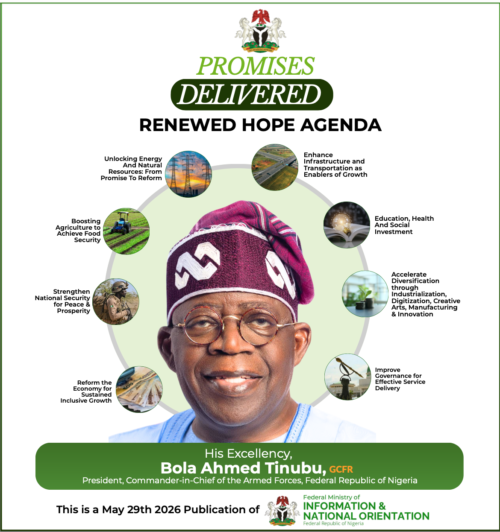
President Bola Tinubu has made it clear that when he assumed duty three years ago, his determination was to choose long term national (economic) recovery for Nigeria over short term comfort. He declared: “Together, we chose reform over ruin and decisiveness over hesitation. We chose long-term national recovery over short-term comfort.” In a statement today, May 29, to mark his third year in office, President Tinubu said that he understands the sacrifices many families have made in recent years even as he shares their hopes for a better Nigeria. He said that the economic situation he inherited demanded urgent and courageous action. ‘Difficult but necessary decisions had to be taken to stabilise the economy and prevent a deeper national crisis. “The easy choices would have been politically convenient. But leadership demands courage, especially when the right decisions are difficult.” Tinubu said that if he had failed to act, the nation would have drifted toward fiscal breakdown, worsening poverty and severe economic uncertainty. Please read the full text of the presidential third anniversary statement: STATEMENT BY PRESIDENT BOLA AHMED TINUBU (GCFR) ON THE THIRD ANNIVERSARY OF HIS ADMINISTRATION, MAY 29, 2026 My fellow compatriots, Three years ago, you entrusted me with the sacred responsibility of leading our beloved nation at a defining moment in our history. I accepted that responsibility, fully aware of the magnitude of the challenges before us, but also deeply confident in the resilience and potential of the Nigerian people. Today, on the occasion of the third anniversary of our administration, I speak to you not only as your President but also as a fellow citizen who understands the sacrifices many families have made in recent years and shares your hopes for a better Nigeria. When this administration assumed office, our nation faced profound economic and structural difficulties. Mounting fiscal pressures, unsustainable fuel subsidies, declining revenues, exchange-rate distortions, rising debt-servicing costs, insecurity in several parts of the country, energy supply constraints, and declining public confidence in institutions all threatened our progress. At the height of the subsidy regime, Nigeria was spending as much as ₦18.4 billion daily to sustain petrol subsidies—over ₦4 trillion in 2022 alone—resources that could have been invested in roads, healthcare, education, housing, and critical infrastructure. Multiple exchange rate windows and forex arbitrage created massive distortions, with Nigeria losing more than ₦8 trillion over three years to rent-seeking and speculative practices. The situation demanded urgent and courageous action. Difficult but necessary decisions had to be taken to stabilise the economy and prevent a deeper national crisis. The easy choices would have been politically convenient. But leadership demands courage, especially when the right decisions are difficult. Had we refused to act, our nation would have drifted toward fiscal breakdown, worsening poverty, and severe economic uncertainty. Together, we chose reform over ruin and decisiveness over hesitation. We chose long-term national recovery over short-term comfort. These decisions came with sacrifice. The rising cost of living triggered by our measures placed enormous pressure on families, workers, and businesses. Young people searching for jobs felt discouraged. Many questioned whether these difficult decisions would lead to a better future. I remain deeply conscious of those sacrifices, and I assure you: your sacrifice has not been in vain. And today, I can say with confidence that Nigeria has stabilised and is moving forward again. Across the country, visible progress is taking shape. VISIBLE PROGRESS AND ECONOMIC GROWTH Our economy is now more competitive and better positioned for sustainable growth than it was in 2023. Public finances are improving. States and local governments have greater resources to invest in their people. Investor confidence is growing. The stock market is booming, with the All Share Index rising from 53,000 and market capitalisation of N30 Trillion in 2023 to a record All Share Index of 250,000 and market capitalisation of N160 Trillion this year. Companies are declaring record profits and dividends. Critical infrastructure projects are advancing at an unprecedented scale. Over 2,700 kilometres of highways and major roads are under construction, reconstruction, or rehabilitation, including the Lagos-Calabar Coastal Highway, the Sokoto-Badagry Super Highway, the Abuja-Kaduna-Zaria-Kano Road, the East-West Road, and many rural access roads. Significant sections are already completed or nearing completion, improving transportation, reducing travel time, boosting regional trade, and creating thousands of jobs. Rail modernisation projects are ongoing to improve connectivity, logistics, and economic integration across the federation. In the oil and gas sector, the reforms we instituted have attracted billions of dollars in fresh investment from the international oil companies that had shunned our country. The $5 billion NLNG Train 7 project is nearing completion to boost LNG production capacity, exports, and dividends. Domestic gas utilisation is expanding. Local refining capacity has improved our energy security. With large-scale domestic and modular refineries operational, Nigeria is reducing its dependence on imported petroleum products and conserving foreign exchange. For years, the power sector suffered from debt, underinvestment, and uncertainty, which weakened generation capacity and limited growth. Today, we are confronting those challenges directly. Our administration is clearing legacy obligations, expanding transmission infrastructure, investing in renewable energy, and strengthening the national grid because no modern economy can grow in darkness. When power improves, businesses expand, industries grow, jobs are created, and families prosper. We are determined to power Nigeria into a new era of industrial growth and economic opportunity. EMPOWERING NIGERIANS: AGRICULTURE, EDUCATION, AND HOUSING Agricultural interventions have supported millions of farmers by improving seedlings, fertilisers, mechanisation, and irrigation and by expanding access to finance and markets. We are opening new agricultural corridors to create jobs, strengthen supply chains, and reduce pressure on household incomes. The Nigerian Education Loan Fund has provided over 1.5 million students with access to higher education, disbursing more than ₦282 billion to ensure that no willing student is denied access due to financial hardship. Our Renewed Hope Housing Programme, along with that of the Federal Housing Authority (FHA), is delivering over 10,000 housing units across 14 states and the FCT, creating over 300,000 jobs and expanding access to affordable housing. Major Renewed Hope Cities in Abuja, Lagos, and Kano are progressing steadily. Our consumer credit initiative, CREDICORP, is opening up new economic opportunities for workers and families. In healthcare, thousands of primary healthcare centres are being revitalised, while health insurance coverage is expanding for vulnerable Nigerians. DEEPENING TELECOMS ACCESS AND INVESTMENT We also took decisive action to stabilise the telecommunications sector, which remains one of the most important drivers of modern economic growth. After years of severe operational pressures and declining investment, confidence is gradually returning to the sector. Telecom operators are expanding networks, investing in infrastructure, recruiting Nigerian talent, and widening digital access across the country. A connected Nigeria is a more competitive Nigeria. Digital infrastructure is now essential to commerce, education, innovation, and national productivity. YOUTH, TECHNOLOGY AND DIGITAL TRANSFORMATION To our young people, I want you to know this nation believes in you. You are not a problem to be managed. You are the engine of Nigeria’s future. Across technology, manufacturing, creative industries, agriculture, sports, and entrepreneurship, we are expanding opportunities for you to compete and succeed. We are investing in digital skills, technical education, innovation, student financing, and enterprise support because the future must be driven by Nigerian talent, creativity, and productivity. SECURITY AND NATIONAL UNITY Security remains central to our national mission and to the creation of a virile and prosperous society. Our Armed Forces and security agencies have intensified operations against terrorists, bandits, kidnappers, oil thieves, and criminal networks. While challenges remain, many communities and highways are becoming safer and more economically active. We continue investing in intelligence, surveillance, logistics, technology, and inter-agency coordination. We are improving the capabilities of our armed forces and security agencies, and reclaiming the authority of the Nigerian state wherever criminality threatens peace and order. While we continue to confront the challenges head-on, progress is being made. I want to assure you that this government will not relent until every Nigerian can live, work, travel, and dream in safety. My fellow Nigerians, A nation develops when its people can see and touch progress. From highways under construction to rail modernisation and expanded energy investments, our goal remains clear: to build a Nigeria that works for Nigerians. We have not solved every problem, and we are not yet where we want to be. But the foundation for recovery has been laid. The task before us now is clear: we must ensure that the benefits of reform are felt more directly in the daily lives of ordinary Nigerians. We shall achieve this task by continuing to ensure that food prices, which have largely come down from their peak in 2023/2024, remain low. We are also working to reduce transportation costs as operators of commercial trucks, buses, and taxis convert their petrol engines to CNG and switch to electric vehicles. We have also set our sights on creating more opportunities for decent work and enabling enterprise expansion. A CALL TO NATIONAL PURPOSE The journey of national renewal is not completed in a single year or a single administration’s tenure. Nations rise when their people remain united in purpose, disciplined in effort, and hopeful about the future. We must choose hope over despair, unity over division, and nation-building over narrow interests. But true security and prosperity require that every Nigerian feel included and valued. Nigeria belongs to all of us—no region, faith, or group should feel marginalised or forgotten. Our diversity is a source of strength. Whether Christian or Muslim, North or South, urban or rural, we rise or fall together as one nation under God. To our youth, workers, entrepreneurs, farmers, professionals, security personnel, students, and diaspora: your sacrifices sustain our nation, and they will not be in vain. To the international community and investors: Nigeria remains committed to democratic stability, economic reform, responsible governance, and mutually beneficial partnerships. My fellow Nigerians, History teaches us that great nations are not built in comfort. They are built through sacrifice, resilience, courage, and collective purpose. Ours is a nation of extraordinary people. We survived civil war and rebuilt. We overcame dictatorship and restored democracy. We endured hardship and remain bearers of hope. The Nigerian spirit remains strong and unbroken. Today, the world is watching our country again, not as a nation defined by its difficulties, but as a nation determined to rise. Across agriculture, infrastructure, power, technology, manufacturing, and industry, the signs of recovery are becoming clearer. Confidence is returning. Productivity is improving. Opportunity is expanding. LOOKING FORWAR The work ahead is enormous, but I remain optimistic because I believe deeply in this country and in you, the Nigerian people. I ask you to keep faith with Nigeria. Let us reject cynicism and division. Let us move forward together, united in purpose, disciplined in effort, compassionate toward one another, and confident in the greatness that lies ahead. My fellow Nigerians, history tests nations before it elevates them. Nigeria is passing through such a test. But I believe with all my heart that we shall emerge stronger, fairer, more united, and more prosperous than ever before. Let us continue this journey together. Let us build a Nigeria that is secure, prosperous, inclusive, and respected worldwide. Let us continue to believe in the promise of our nation. May God bless you all. May God bless the Federal Republic of Nigeria.
“On the streets, some Nigerians claimed that the policies have left them hungry, a sentiment the opposition still parrots to this day, without any empirical proof.” This is the opinion of Bayo Onanuga, Special Adviser to President Bola Tinubu on information and strategy in a lengthy opinion writeup today, May 29, to commemorate the third anniversary of Tinubu’s government. Onanuga said that because of the cry of Nigerians on the hardships and hunger, Tinubu almost abandoned the economic reforms he started and reversed to the old ways. “If not sure of the salience of his reforms, President Tinubu would have taken a reverse gear in fright and abandoned all the new reform policies amid the avalanche of attacks from critics and opposition elements in the media. Instead, he persisted.” The presidential spokesperson admitted that President Tinubu, at a point, admitted that the early months and the first year were tough for the people “as the government implemented its programme. The cost of living went up, and businesses claimed the harmonised exchange rate had put them in the red. A few companies even closed shop and left our shores.” Please read the full text of the writeup: BOLA TINUBU: THE MAN WHO TOOK THE BULLET FOR NIGERIA TO SURVIVE, By Bayo Onanuga With politicking intensifying ahead of the January 2027 election, opposition politicians have escalated their campaign of misinformation and calumny to diminish the impact and achievements of this administration over the last three years. Two years ago, when the administration was struggling to deal with the unintended consequences of its historic reforms, the campaign would have made sense. But not anymore, as the administration can rightly claim bragging rights for what it has achieved against all odds and why the international community is applauding it for putting Nigeria irrevocably on the path of growth and development. The impact of the three-year-old government is best felt at the subnational level – state and local levels. States that hitherto were unable to pay salaries by May 2023, with months of unpaid obligations to their workers and pensioners, are now doing so with ease and dreaming big about infrastructure. In every state I have visited, I have seen this development. Ogun, my state, Oyo, Nasarawa, Enugu, Ebonyi, Kaduna, Kano, Kebbi, Katsina, and others have witnessed development projects spring up, thanks to President Tinubu’s re-engineering of the federation’s finances and increased allocation to the states. When local councils begin to receive their allocations directly from the Federation Account, the Tinubu effect will ensure that more governance cascades down to the 774 local councils. State governors who have benefited from this policy have openly admitted that increased allocations have enabled them to bring social and infrastructural development to their states. Many opposition PDP governors who joined the APC did so for this reason—not for the baseless claim that President Tinubu bribed them. Governor Abdulrazak said in December 2024 that his administration embarked on more projects in the first 18 months of Tinubu’s presidency than in his first four years. The Governor of Ebonyi, Nwifuru, who is building iconic underpasses and overpasses in Abakaliki, credited his ambition to President Tinubu. Governor Peter Mbah similarly attested to this, crediting the Naira rain from the centre for his programmes. And Nasarawa State Governor Abdullahi Sule, who understands how Tinubu’s financial re-engineering and the end of the subsidy regime have increased the states’ fortunes, said President Tinubu “has taken the bullets for all of them.” In May 2023, President Tinubu inherited acute petrol scarcity, an unsustainable petrol subsidy regime due to expire in June 2023, multiple exchange rates, arbitrage, and low revenue, with at least 30 states unable to pay workers, let alone fund infrastructure and social projects. Debt servicing consumed 97 per cent of Federal revenue. Additionally, food scarcity and inflation plagued the country as farmers abandoned their fields, recording massive losses amid the currency squeeze introduced by former CBN Governor Godwin Emefiele. President Tinubu, guided by the Renewed Hope Agenda, wasted no time. He threw the ruinous subsidy out of the window from Day One. Days later, he floated the Naira and ended the artificial fixing of the Naira-to-dollar exchange rate, a system that had enabled well-connected individuals to profit effortlessly. Tinubu declared a food emergency and announced the Presidential Committee on Fiscal Policy and Tax Reforms to examine our outdated tax laws, some of which date back to the colonial era. Immediate gains included encouraging dry-season farming, with subsidies and inputs provided for farmlands abutting dams and irrigation sites in at least 14 states. Even by President Tinubu’s admission, the early months and the first year were tough as the government implemented its programme. The cost of living went up, and businesses claimed the harmonised exchange rate had put them in the red. A few companies even closed shop and left our shores. On the streets, some Nigerians claimed that the policies have left them hungry, a sentiment the opposition still parrots to this day, without any empirical proof. If not sure of the salience of his reforms, President Tinubu would have taken a reverse gear in fright and abandoned all the new reform policies amid the avalanche of attacks from critics and opposition elements in the media. Instead, he persisted. Two years after the first challenging year, the story has changed for good. However, some opposition elements are stuck in the sentiment of 2023/24, unyielding and adamant about acknowledging the many gains and milestones achieved by the Tinubu administration. But only the blind will fail to admit that this government has taken the country miles away from the state it inherited in 2023. The stock market is clear proof of the administration’s economic success. In May 2023, Tinubu met the All-Share Index at 53,000 points and the market capitalisation at N30 Trillion. Today, the ASI has risen five times, to a record 250,000 and a market capitalisation of N160 Trillion. Blue-chip companies, including those initially negatively impacted by government policies, are declaring record profits and dividends. Equally, foreign portfolio investors are flocking in to partake in the Nigerian boom. This is not a bubble. It shows that a fundamental paradigm shift has occurred in the economy, all thanks to the Tinubu administration’s policy direction. In recent weeks, I revisited the manifesto and policy ambitions that won us the election. The Tinubu administration has faithfully implemented its Renewed Hope Agenda, striving to resolve in three years the cumulative problems of decades. Roads that will outlast this generation are being built nationwide. I recently went home to Ijebu-Ode, Ogun State, and was amazed that the highway to my town from the Shagamu intersection now has a concrete pavement, thick enough to withstand the traffic of trailers from the West to the East. The most audacious road projects ever undertaken by any administration since independence are the Illela-Sokoto-Badagry and the Lagos-Calabar coastal superhighways. President Shehu Shagari conceived the Sokoto-Badagry highway in the early 80s. Succeeding administrations, afraid of the huge cost, abandoned the road. The Lagos-Calabar has also been on the map for decades, but no leader has ever dared to turn the idea into reality. President Tinubu has proven to be a transformative leader who has decided to turn the roads into reality, adding new roads to our road network for the first time, beyond those we inherited from the colonialists. Myopic critics of the two roads have assailed the Tinubu administration for taking loans to accomplish them. How else could the roads have been built if we rely only on FG’s share from FAAC? Relying solely on federal allocations would mean waiting 50 years or more, with costs ballooning out of reach, as in the metro-rail to nowhere started by presidential aspirant Rotimi Chibuke Amaechi in Port Harcourt, Rivers State. In the states, governors are building roads of similar standards. I saw some of these in Ogun, Kaduna, Ebonyi and Enugu. As with roads, the Tinubu administration is also investing heavily in rail transportation, with the Kaduna-Kano-Gusau-Maraadi rail network scheduled for completion next year. City rail networks in Kaduna, Lagos, Kano and Enugu have been approved for construction, along with the Lekki-Ibadan rail. When historians write about the Tinubu administration in 2031, they will not remember it only for audacious road and rail networks, but also for historic reforms. The oil and gas sector is one area in which the administration has impacted the country. Apart from ending the regime of wasteful subsidies, the government has instituted reforms that have made the sector attractive to fresh investment. International Oil Companies(IOCs) that once shunned our country are returning with billions of dollars in investment. Domestic refining and the innovative Naira-for-crude policy are ensuring energy security, thereby avoiding acute scarcity arising from the disruptive war against Iran and the closure of the Strait of Hormuz. More recently, the administration enacted a policy requiring the NNPC to remit oil sales proceeds to the Federation account. When historians write about the Tinubu administration in 2031, they will not remember it only for audacious road and rail networks, but also for historic reforms. In the oil and gas sector, the government ended wasteful subsidies, instituted reforms to attract fresh investment, and brought international oil companies back to Nigeria. Domestic refining and the innovative Naira-for-crude policy are ensuring energy security, avoiding disruptions from global crises. Recently, NNPC was required to remit oil sales proceeds to the Federation Account. Confronted by the administration’s stellar performance, the opposition and media propagandists dredged up a campaign video of the President promising a 24/7 power supply. They distorted his words. What he actually said was: “Whichever way, by all means necessary, you will have electricity, and you will not pay for an estimated bill anymore. A promise made will be a promise kept. If I don’t keep the promise and I come for a second term, don’t vote for me, unless I give you adequate reasons why I couldn’t deliver.” What the distorters failed to admit was that the Discos, privatised since 2013 by President Goodluck Jonathan, are responsible for delivering power to the end consumers, not the Federal Government. What this government has done in the last three years has been to address the problems hindering the capacity of Discos to deliver, such as bringing Siemens to strengthen the grid, activating idle GENCOs, and planning to clear the N4 trillion legacy debts owed to GENCOs and GASCos, which will encourage new investments in the sector. The government has also massively implemented its metering policy, providing over 2.5 million meters to homes. Recently, the Tinubu administration announced the establishment of GAMCO, the Grid Asset Management Company, which will optimise power supply and activate idle facilities. One of the administration’s impactful programmes, apart from issuing passports in less than a week, is the introduction of NELFUND and CREDICORP in 2024. While Credicorp is making loans available to civil servants to buy Made-In-Nigeria products, NELFUND, with N282 billion committed so far, has made tertiary education more accessible for our children. About 1.6 million Nigerian students have benefited. Payment of school fees and stipends is assured for the children, and the government has also renegotiated the 2009 ASUU-FG agreement, such that in the last three years, our universities, along with the Polytechnics and Colleges of Education, have been spared the disruptive academic strikes. Let’s give the Tinubu government some slack: a four-year programme is now a four-year programme. He promised it during the campaign and has delivered. The government has also invested in technical schools, offering students pursuing vocational education allowances. In the universities, TETFUND is once again funding research grants for dons willing to pursue ideas that will be useful to our society. Among impactful programmes, apart from issuing passports in less than a week, are NELFUND and CREDICORP, introduced in 2024. Credicorp makes loans available to civil servants for Made-In-Nigeria products, while NELFUND, with N282 billion committed, has made tertiary education more accessible. About 1.6 million students have benefited. School fees and stipends are assured, and the government has renegotiated the 2009 ASUU-FG agreement, sparing universities from disruptive strikes. Today, a four-year programme in the universities, polytechnics and colleges of education is completed in four years. Technical schools offer allowances to vocational students, and TETFUND is funding research grants to academics. It has not been all rosy the past three years, especially in the area of making our people safe from the band of bandits and terrorists. While the armed forces have been locked in an asymmetrical war against these heartless elements, neutralising their leaders and foot soldiers in several theatres of conflict, the displaced terrorists are attacking vulnerable areas in some of the states, killing and kidnapping. The government is unrelenting in providing the armed forces, intelligence agencies, and police with the tools they need to wage the war. With support from friendly governments like the US, France, and the UK, there is hope that the menace of kidnappers and their political sponsors will become history. The man who has taken the bullets to make Nigeria survive a fiscal disaster is even more willing to take additional bullets to make all Nigerians safe.
Onanuga is Special Adviser to President Tinubu on Information and Strategy.
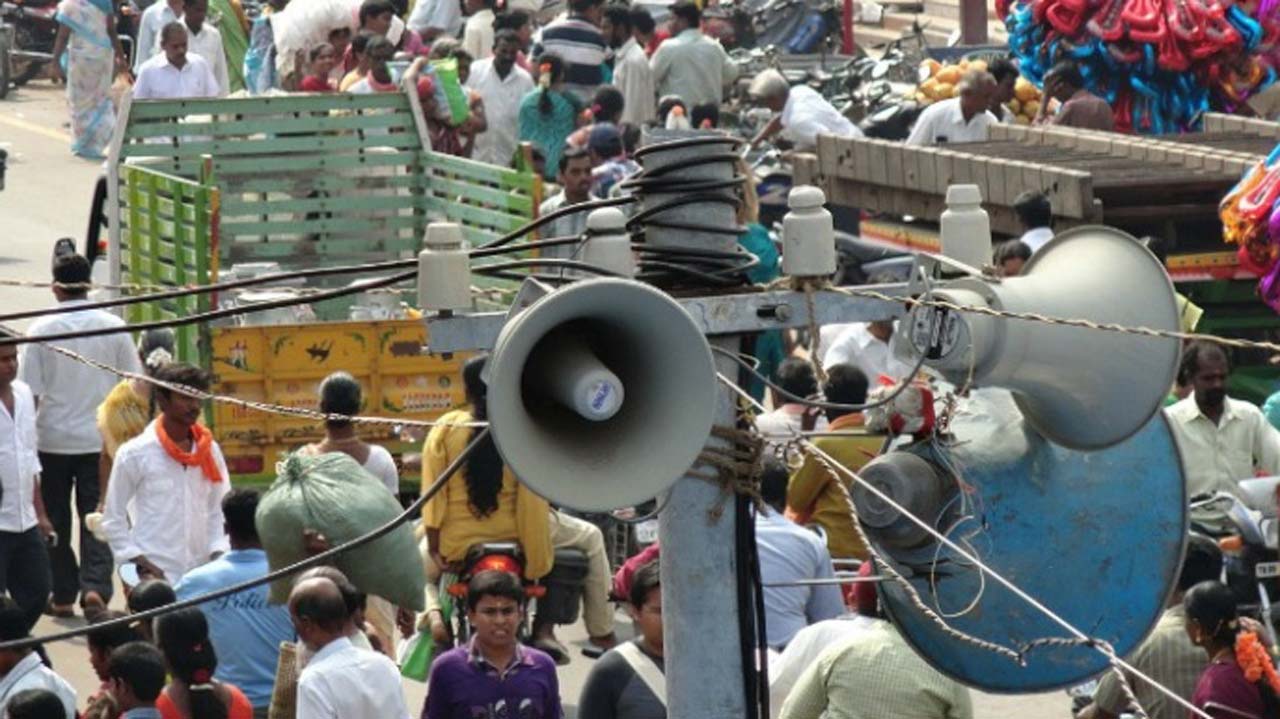
Some Lagos residents have expressed concern over environmental and health challenge arising from increasing noise pollution through public address systems use by religious centres, bars, workshops and also power generators. The residents, who spoke in separate interviews in Lagos, complained about frequent overnight vigils, loud music from bars, grinding machines, generators and overlapping sounds from worship centres located within residential neighbourhoods. Mrs. Adewale Miracle, a home baker residing in Abule Egba, said that noise pollution had become a daily struggle for many residents. “From morning till evening, you hear grinding machines and generator noise everywhere. “Sometimes, when there is a brief moment of silence, it feels as though your spirit has returned to your body. “The noise becomes overwhelming and physically draining. By the time one source stops, another starts.” Miss Chinwendu Nwoke, a university student residing in Akoka, said that constant noise from bars, generators and roadside activities have negatively affected her studies. “Most nights, loud music from nearby bars continues till very late, while generators run for hours because of power outages. “It becomes difficult to concentrate while reading, especially during examinations. “Sometimes, I end up rereading the same page repeatedly because of the distractions.” Daniel Ogunleye, a secondary school teacher in Bariga, said environmental noise had affected concentration and learning. “Teaching has become difficult. Sometimes, you forget what you were explaining because of sudden loud sounds from nearby workshops or loudspeakers. “Schools need to be in a controlled environment because the surrounding noise affects both teachers and students.” Oladipo Oladele, a civil servant residing in Ikotun, said persistent late-night noise in his neighbourhood had disrupted his sleep pattern. “You hardly sleep for more than a few hours before preparing for work because one church is conducting a vigil. “I slept off inside a bus yesterday and missed my stop.” According to him, exhaustion affects concentration and productivity at work. Mrs. Kemi Adebayo, a foodstuff seller at Ladipo Market, complained about constant noise from nearby mechanic workshops. “The banging of metals and continuous engine revving is unbearable. “Most times, agberos are shouting at drivers or fighting. Everybody is trying to out-shout one another.” She added that the persistent noise often left traders physically exhausted with headaches at the end of the day. Ibrahim, a retiree residing in Surulere, said noise from welding activities close to residential buildings had worsened his blood pressure and hearing condition. “Anytime there is loud noise around me, I feel uneasy and my heartbeat increases. “Sometimes, people have to repeat themselves before I hear clearly.” According to him, the sound from welding machines, metal cutters and hammering continues throughout the day, while bars and generators take over at night. Speaking at the 11th Noiseless Lagos Summit organised by the Lagos State Environmental Protection Agency, the agency’s General Manager, Dr. Babatunde Ajayi, warned about the health implications of prolonged exposure to excessive noise. “Scientific studies have shown that prolonged exposure to high noise levels can lead to hearing impairment, stress, hypertension, sleep disorders, reduced productivity and several other adverse health conditions.” Ajayi urged religious organisations, nightclub operators, workshop owners and event centre operators to adopt sound control measures and comply with approved environmental standards or face sanctions. Also speaking at the summit, an environmental consultant, Rotimi Soremekun, said persistent exposure to loud noise was contributing to rising health concerns globally. According to him, the World Health Organisation estimates that millions of people are exposed to harmful noise annually, with increasing cases of productivity losses linked to prolonged noise exposure. Source: NAN.
The National Hajj Commission of Nigeria (NAHCON) has rejected what it described as “substandard foods” served the Nigerian pilgrims currently in Minah, Saudi Arabia, for this year’s pilgrimage. The Commission has instituted a committee to investigate the caterers that supplied the rejected substandard foods. Information reaching us at Greenbarge Reporters online newspaper said that the pilgrims staged a protest last night (May 27) over lack of food for their dinner without knowing the circumstances behind it. It was gathered that in compliance with the food safety standards set by the Saudi health authorities to ensure the wellbeing of all pilgrims during the Hajj period, NAHCON had to reject some dinner meals. The standards, which the Saudi health authorities set and the dinner foods ran foul of, were set in view of the prevailing weather conditions in the Holy Land. Source said that the foods prepared for dinner last night “did not meet the required handling and packaging standards and were therefore rejected immediately in collaboration with NAHCON. “Alternative light refreshment was provided by the service support company to cushion the situation. “NAHCON Board members had since gone round to explain the situation to the affected State managers.” NAHCON assured that arrangements have been initiated for soonest refunds to pilgrims affected by last night’s meal situation. The NAHCON Chairman, Ambassador Ismail Abba Yusuf, has meanwhile, reported to have directed the Security Committee to investigate the caterers and those who facilitated their contracts. The Chairman also instructed the Central Security Committee to thoroughly investigate and identify the Tour Operators who brought in more pilgrims than they actually registered while at the same time are found to be exploiting innocent pilgrims. Ambassador Ismail Abba Yusuf made it clear that after the investigations, anyone found guilty would be penalized and have his license withdrawn. NAHCON expressed appreciation for the understanding of the pilgrims and reassured of its continued commitment to their welfare throughout the Hajj exercise.
We use cookies on our website to give you the most relevant experience by remembering your preferences and repeat visits. By clicking “Accept”, you consent to the use of ALL the cookies.
This website uses cookies to improve your experience while you navigate through the website. Out of these, the cookies that are categorized as necessary are stored on your browser as they are essential for the working of basic functionalities of the website. We also use third-party cookies that help us analyze and understand how you use this website. These cookies will be stored in your browser only with your consent. You also have the option to opt-out of these cookies. But opting out of some of these cookies may affect your browsing experience.
Necessary cookies are absolutely essential for the website to function properly. This category only includes cookies that ensures basic functionalities and security features of the website. These cookies do not store any personal information.
Any cookies that may not be particularly necessary for the website to function and is used specifically to collect user personal data via analytics, ads, other embedded contents are termed as non-necessary cookies. It is mandatory to procure user consent prior to running these cookies on your website.






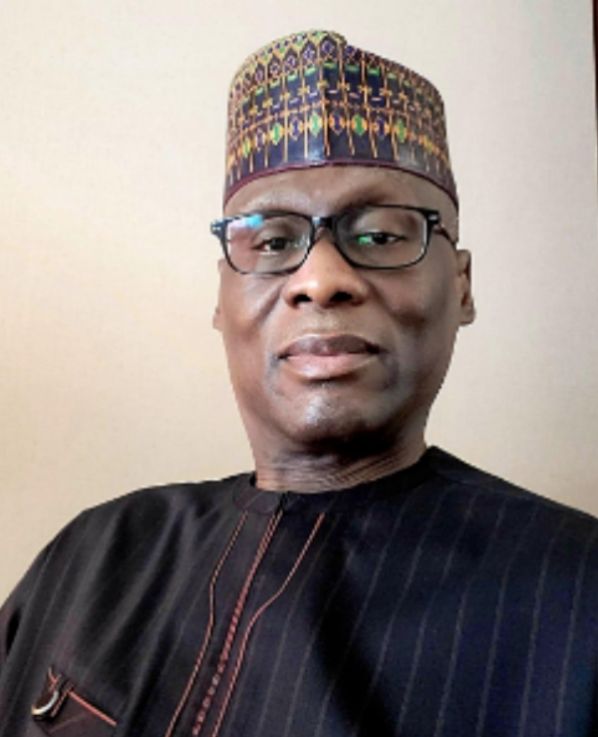


Nigeria’s Bloodied Fields: When Politics Overshadows Security, By Abdulfatai Usman Atima
Nigeria today stands at a dangerous crossroads. Across the country, communities are living in fear as kidnapping, banditry, terrorism, and mass killings continue to threaten lives and livelihoods. From the forests of the North-West to the villages of the Middle Belt and the highways of the South, insecurity has become one of the greatest challenges confronting our nation.
The recent kidnapping incidents involving school children in Oyo State once again exposed the vulnerability of innocent Nigerians. The trauma inflicted on young pupils, their parents, and their communities is immeasurable. Similar incidents have occurred in Kwara State, where kidnappers have repeatedly targeted travellers, students, and rural residents. In Kogi State, kidnappings along major roads and attacks on communities have become disturbingly frequent. Plateau State has witnessed recurring massacres of innocent villagers, with hundreds of lives lost in attacks that have left entire communities displaced and devastated.
These tragedies are not isolated events. They represent a national security crisis that demands urgent, coordinated, and sustained action.
Many Nigerians are increasingly concerned that political calculations surrounding the 2027 elections appear to be receiving more attention than the security emergency facing the country. Public discourse is increasingly dominated by defections, coalition-building, endorsements, and electoral strategies, while citizens continue to bury loved ones killed by criminals and violent extremists.
President Bola Ahmed Tinubu came into office with the promise of renewed hope. While some economic reforms have been initiated, many Nigerians believe that the government’s response to insecurity has not matched the scale and urgency of the threat. Citizens expect more than condemnations after attacks. They expect decisive action capable of preventing future tragedies.
The reality is that every successful kidnapping operation emboldens criminals. Every community attack that goes unanswered weakens public confidence in the state’s ability to protect its people. Every massacre that ends without accountability sends a dangerous message that human life has become cheap.
Security should never be treated as a secondary issue. It is the foundation upon which economic growth, education, healthcare, agriculture, and national development depend. Farmers cannot cultivate their lands when they fear abduction. Investors cannot commit resources where insecurity reigns. Children cannot learn effectively when schools become targets for kidnappers.
The question Nigerians are asking is simple: Where is the comprehensive strategy to end this nightmare?
The solution requires more than military deployments after attacks have already occurred. Nigeria needs a holistic security architecture that addresses both immediate threats and their root causes.
First, intelligence gathering must be strengthened. Security agencies need better coordination, modern surveillance technology, and real-time intelligence sharing. Criminal groups often operate successfully because they exploit gaps between agencies.
Second, community policing should be expanded and properly funded. Local communities often possess valuable intelligence about criminal activities, but there must be structured mechanisms for gathering and acting upon such information.
Third, the government must invest heavily in modern security technology, including drones, satellite surveillance, biometric databases, and advanced communication systems capable of monitoring vulnerable regions.
Fourth, the judicial process for kidnapping, terrorism, and mass murder cases must be accelerated. Criminals should face swift prosecution and punishment. Delayed justice weakens deterrence.
Fifth, economic opportunities must be expanded, particularly for unemployed youths who are often recruited by criminal networks. Security operations must be complemented by social and economic interventions.
Sixth, state governments should be granted greater operational roles in security management while maintaining national coordination. A nation as vast and diverse as Nigeria requires localized responses to localized threats.
Finally, political leaders at all levels must demonstrate that protecting lives is their foremost priority. Electoral ambitions should never overshadow the constitutional responsibility of safeguarding citizens. Governments are ultimately judged not by campaign promises but by their ability to secure lives and property.
Nigeria has the resources, manpower, and institutional capacity to overcome this crisis. What is needed is political will, strategic leadership, and unwavering commitment. The blood of innocent Nigerians should not become a recurring headline. The tears of grieving families should not become a normal feature of national life.
The time has come for leaders across board to place security above politics, governance above campaigns, and the protection of human life above every other consideration. The future of Nigeria depends on it.