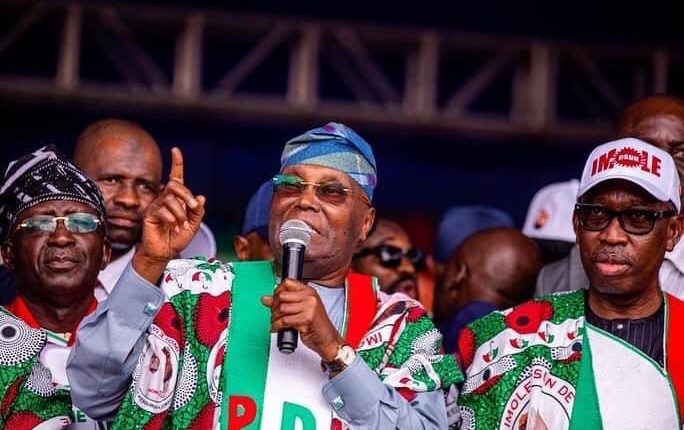
Former Nigeria’s Vice President, Atiku Abubakar has said that the ongoing effort to build a broad, united opposition front is not about power for power’s sake. “It is a moral imperative. It is about defending the legacy of June 12. It is about ensuring that no one — no matter how powerful — is allowed to privatize the state and reduce the people to pawns in their political chess game.” In a statement he issued to mark the Democracy Day today, June 12, Atiku accused President Bola Tinubu and the ruling All Progressives Congress (APC) of governing the country with the unmistakable intent to dominate, subdue, and silence. “Their tactics are not subtle. Opposition voices are being systematically erased. Contracts for multi-billion-naira infrastructure are funnelled to cronies and family associates of the president. “National institutions, once symbols of unity, are being brazenly renamed in honour of a sitting president — as though the country were a private estate. “What we are witnessing is not governance — it is conquest.” Atiku noted that today, Nigeria teeters on the edge of a dangerous precipice — a creeping one-party dictatorship is replacing the democratic order we bled for. “Those who laid down their lives did not do so for Nigerians to groan under the yoke of authoritarianism and economic suffocation.” The Vice President under President Oludegun Obasanjo said that Tinubu’s government represents the lowest ebb in the democratic journey of the country, adding that institutions have been weaponized. “Policies are crafted not to empower the people but to entrench fear, obedience, and control. “The common Nigerian has been abandoned at the altar of elite comfort. “And make no mistake: this is the antithesis of everything June 12 stands for. “We are again at a historic threshold. ” “Nigeria must choose: the path of democratic renewal or the dark alley of despotism. He said that the coalition is aimed at reclaiming Nigeria for Nigerians and safeguarding the future of generations unborn. “This is not just a political contest; it is a moral crusade. A struggle to liberate our economy, our democracy, and our dignity from the grip of authoritarian forces. “And like every righteous struggle, it demands courage, clarity, and collective resolve. “As long as oppression thrives, June 12 lives on — not just as memory, but as movement. The time to rise is now.” Atiku recalled that thirty two years ago, Nigeria stood on the cusp of greatness, saying that the winds of democratic change were sweeping through Africa, and all eyes turned to Nigeria with hope for it to rise as a beacon of liberty, justice, and self-determination. “I was privileged to be an active participant in that defining chapter, which culminated in a historic election that captured the imagination of the world and reshaped our political destiny. “It was a moment of great promise — and great sacrifice. “The political class made painful compromises, but it was the Nigerian people who bore the heaviest burden. They yearned for a new democratic order, and many paid dearly for it. “I, too, made my fair share of sacrifices, most notably setting aside my own presidential ambition in deference to the late Chief MKO Abiola — a gesture made in faith and fidelity to a higher national cause. “But others gave far more. The late Alhaja Kudirat Abiola, Tafida Shehu Musa Yar’Adua, Alfred Rewane — these brave souls gave their lives in pursuit of a freer Nigeria. “Their memories are etched into our national conscience and must never be forgotten. “The gains of June 12 were hard-won. But sadly, the democratic promise that blossomed in 1999 is being steadily dismantled before our very eyes.”
The second year has gone since Asiwaju Bola Tinubu was sworn in as the President of Nigeria, which translates to half of his tenure already spent! At the first anniversary, the thinking in some quarters was that one year was too short to assess the performance of any government. But now that it’s half of the tenure and behind the scene networking for him to return for the second term is in full gear, a comprehensive assessment should better be done by anyone that cares. Surprisingly, there is no meeting point between the two opinions on the performance of the President so far, and it seems there will never be a convergence, with those that are against him having nothing good to point at as achievement, while those in support are ready to sing his praise to the heavens. Those on the left pole as expected are from the camp of the opposition parties who are yet and may not be able to cross to the ruling party, and of course millions of citizens who are negatively hit by the president’s economic policies in the last two years. It has been very difficult for many to comprehend why government cannot banish an extreme hardship that has even surpassed what they saw when they thought there could never be a worse clueless leadership in Nigeria. Nigeria’s political system is yet to have a measurement mechanism where the performances of the leaders and the mood of the populace can be gauged as we see in many advanced democracies where opinion polls on leaders are released from time to time, and they are taken seriously, like a mirror to know the possibilities in future elections. THE NAY SAYERS The voice of those who seem to be discontented with the way things are going in the country no doubt is the loudest. The hardship voice is so loud in every corner such that if public opinion counts and if there is a remote possibility of having a free and fair election in the country, one would say that the President and his ruling party will be having sleepless nights. It will be interesting to see anyone that can swear that there is a free and fair election in Nigeria. I believe the closest to a consensus will be that candidates will rig and win where they are popular. This can explain why some supporters will sing ‘ba tie dibo, oti wole’ (even if we don’t vote, you have won) during electioneering campaigns or the audacity that the PDP had then to boast that it will rule for 60 years. The loud voice of discontentment in the last two years stems from the removal of fuel subsidies, Naira depreciation, spiraling inflation as high energy and food costs eroded the purchasing power of most Nigerians. In the opinion of the former Vice President Atiku Abubarka who is occupying the extreme end of the opposition, in two years, the Tinubu’s administration has proven to be one of the most incompetent, disconnected, and anti-people governments in Nigeria’s democratic history. He claimed a disregard for transparency, accountability, and responsible leadership, saying the government has not only deepened poverty, but set new records in wasteful public spending. Pointing out that Nigeria’s total public debt in two years skyrocketed from 150 per cent to N144 trillion when compared to those of state governments where debt levels dropped from N5.86 trillion to N3.97 trillion, he concluded that Tinubu administration was the primary driver of Nigeria’s debt crisis. His former boss, Former President Olusegun Obasanjo also shared same sentiment as he was quoted to have written in his book, Nigeria: Past and Future, that the Lagos-Calabar highway typifies waste and corruption. He was quoted as saying: “Typical examples of waste, corruption and misplaced priority are the murky Lagos-Calabar Coastal Road on which the President had turned deaf ears to protests and the new Vice-President’s official residence built at a cost of N21 billion in the time of economic hardship to showcase the administration hitting the ground running and to show the importance of the office of the Vice-President. What small minds!” Atiku’s political party, the PDP is also singing the same song while urging Tinubu to urgently address the issue of insecurity, reverse all economically suffocating policies and check the wholesale corruption, greed, unbridled profligacy, reckless misdirection of resources, arrogance in failure and totalitarian tendencies in his administration, which has shown itself as anti-people and impervious to the suffering of Nigerians. Mr. Peter Obi, the Presidential candidate of the Labour Party has always been critical of President Tinubu’s administration, particularly on economic issues. He had expressed concerns about the country’s economic downturn, highlighting a significant decrease in GDP from $477 billion to $252 billion, which dropped the country from the biggest economy in Africa to number four. SIMPLY THE BEST? But in a sharp contrast, those that could see with the same lenses as the President, particularly those in the organised private sector are happy with what they are seeing so far. Ironically, the removal of fuel subsidy which many are lamenting about is what the President’s admirers have embraced as one of his best achievements so far. They believe that Tinubu’s economic reforms are promising despite being tough on Nigerians and businesses as they see positivities in the fuel subsidy and foreign exchange rate unification; Compressed Natural Gas (CNG) initiative to save over N2 trillion monthly by cutting petrol imports; Billions approved for the Student Loan Scheme; significant increase in government revenue with funds being channeled into large-scale infrastructure projects; rise in oil production; over $500 million in foreign direct investments; other social intervention programmes which include over N200 billion allocated to the newly established Consumer Credit Corporation; N570 billion disbursed to states for livelihood support; new national minimum wage to N70,000; increasing NYSC allowances to N77,000; tariff waivers on food and pharmaceutical imports among others. Abdul Samad Rabiu, the Founder and Chairman, BUA Group in an interview listed what the administration had done right to include the removal of the fuel subsidy which he said was the biggest economic scam in our history. He said the administration unified the foreign exchange market and restored stability, fairness, and confidence in the economy. “These are the foundations of growth. Nigeria is full of potential. With the right leadership, which we now have, there is no limit to what we can achieve,” Rabiu said. The Chairman of the Dangote Group, Alhaji Aliko Dangote also shared the same view with Rabiu as he described Tinubu as a visionary leader, saying one of the Tinubu administration’s most transformative initiatives is the Naira for Crude Policy. He said that the policy stood out as a clear testament to the administration’s commitment to economic recovery and national sovereignty. He said: “This bold policy has enabled us to reduce product prices consistently and guarantee availability for the overall benefit of Nigerians. It has also helped significantly in stabilising the prices of petrol, diesel, jet fuel, LPG, and polypropylene to their lowest levels ever. The effect of this development is the stabilisation of our currency, a critical element in the development of economic policy and budgeting by businesses.” He also lauded the administration’s Nigeria First Policy, which aimed to drastically reduce reliance on foreign goods and services, prioritising local patronage in investment decisions, business operations, and consumption habits. Anambra State governor, Prof Charles Soludo from an opposition party also joined the camp of those that believed that Tinubu had been outstanding in the last two years. He said the President’s bold and visionary economic reform policies, have positioned the country on a trajectory of sustainable growth and development, despite temporary setbacks. He said President Tinubu’s game-changing initiatives, including the removal of fuel subsidies, foreign exchange reforms, and significant investments in infrastructure development, demonstrate his decisive commitment to building a prosperous nation. MAN SHALL NOT LIVE BY BREAD ALONE As expected, the administration has not been slack at defending its record with the President dismissing critics of his legacy projects for being ignorant about how the government awarded them to contractors. The President will be right if he borrows the phrase ‘man shall not live by bread alone’ to defend his administration’s thirst for legacy projects if one should reflect on the past when the country was turned into the dumping ground for imported products with strategic infrastructures left undeveloped. The administration no doubt has been bullish and performed beyond expectations on infrastructure development if one should reflect on the time that these projects were conceived, like the Sokoto-Badagry Superhighway which was said to have been envisioned 47 years ago under the Shagari administration. Another area where one can argue that the President has also surpassed expectation is the quality of appointment into strategic agencies as he did away with the past culture of mediocre in high places. I had in one of my early series, ‘If I were Tinubu: Setting a Tinubunomic agenda’, wrote that “ The President will need the right professionals to run the oil industry. Specifically, there will be a need for a total overhaul of the system. The new NNPC Limited should be made to advertise the positions of its CEO and other top directors to attract the right professionals from all over the world.” When the President initially retained the old management of the NNPCL, I had thought that could only happen because he had seen what people from outside could not see. But the dramatic replacement of the management and board which could pass for a corporate coup has been applauded in many quarters as the right thing to do. On sports, while the Tinubu’s administration has been commended for its development initiatives, particularly the reinstatement of the National Sports Commission (NSC) as the governing body for sports along with the timely payment of bonuses and allowances to athletes, its yet to be seen when these will translate to Nigeria winning medals in international events. With the government also deserving credit for the bold tax reform agenda which is expected to become more pronounced when the new tax bills are signed into laws, it’s not also too difficult to identify the areas where hope is still hanging in the balance. For instance, the claim of a repositioned health sector despite all odds has not been felt by a large segment of the masses, so also the initiatives to boost local food production, support farmers, and stabilise food prices have not yielded recognisable results, as the level of hunger in the land is still at the extreme. Moreover, the government has not been convincing with its programmes to improve electricity supply as the grid keep on suffering multiple collapses, with most people still living with poor supply despite increase in tariff. Also the blue economy that raised so much hope with the creation of the Marine and Blue Economy ministry has not lived up to the billing, with no sign of definite direction to harness the huge potential in the sector. While the road infrastructure where huge resources have been committed also hold great prospect for the country, it is understandable that the impact may not be felt in the next one or two years. TINUBU UNSTOPABLE? Going forward, it will be difficult to expect any dramatic change in the posture of the president for the rest of his term, more so when the groundwork for his reelection has started. By now, most Nigerians would have formed their opinions about who the president is, yet no one can absolutely boast that they know him. To say that he is stubborn or brave would be an understatement. Like a script in a mafia book, he has plotted his ways through the political trench to built a cult of followership and emerged as the most powerful and influential leader Nigeria has ever seen. His influence in the National Assembly is overwhelming, which would make it possible for him to push his agenda either legislatively or through Executive Orders. Unlike Obasanjo who would have instigated crisis in order to uproot their leadership as he would not like to share the limelight with anyone, Tinubu has allowed them the room to breath while pulling the string behind the scene to get his ways. In a congratulatory message to the President on the second anniversary in office, President of the Senate, Godswill Akpabio said Tinubu had restored the hope of Nigerians for a viable and sustainable nation through transformative and courageous leadership… he had placed Nigeria on a solid developmental pedestal using the Renewed Hope Agenda as his policy thrust. There may be likelihood of positivities in the enormous power that the President has amassed if positively deployed as the case of Lee Kuan Yew, the Singapore’s first Prime Minister who transformed his nation from a developing country to a developed one through visionary leadership and pragmatic policies between 1959 and 1990. If Tinubu can push through his legacy projects and other reforms, he could achieve the feet of Yew with Nigeria. However, since he is human and as absolute power corrupts, the fear of abuse cannot be overlooked. The opposition parties that could give him a run for his money are currently in a disarray. One will be expecting more manoeuvring to weakening them and lure away their remaining prominent leaders in the coming months, which will make victory look very obvious for the President in 2027 even if the masses are crying murder. The minister of Finance and coordinating minister of the Economy, Wale Edun told foreign investors few months ago that the government through its veracious reforms had laid the foundation that would make the country the desired destination for private investors, saying the country is on the road to 7 per cent annual growth, while the Governor of the Central Bank of Nigeria (CBN), Olayemi Cardoso, similarly said Nigeria’s economy is on a path of stabilisation and recovery following months of tough but necessary reforms. With assurances like these coming from government officials while the opposition parties are at disarray with defection waves sweeping through the South South up to the North, Nigerians can only buckle up for the rough ride that may go beyond 2027, with hope and prayer that light will eventually come at the end of the tunnel.
*Segun Adeleye is the President/CEO, World Stage Limited, the publisher of WorldStage Newsonline. He is the author of Tinubu The Audacity To Hope, So Long Too Long Nigeria among others.
The Innovative Media Partners Cooperative Multipurpose Society (IMPCMS) has formally taken off. The President of IMPCMS and Publisher of The Eagle Online, Dotun Oladipo, who announced the take off in statement today , June 12, said that all registration formalities and opening of a bank account are now in place. He said that the Executive Committee of the IMPCMS has approved the take off and that it now has the full compliments of members. Other members of the Executive Committee include Ugomma Cookey, a member of the Board of the Media Career Development Network, as Vice President; Nkanu Egbe, Publisher of Lagos Metropolitan, as General Secretary; Ijeoma Popoola, Editor with the News Agency of Nigeria, Financial Secretary; and Dolapo Otegbayi, a prominent media and marketing consultant, as Treasurer. The Ex-Officio members are media trainer, Taiwo Obe and Founder and Chief Executive Officer of WVL Development Advisers Limited and former Acting Managing Director/CEO of Bank of Industry, Dr. Waheed Olagunju. Oladipo gave details of how to join the cooperative society, which is for practicing journalists and media professionals. He said that would-be members should fill a form, which can be obtained at the secretariat at 1, James Robertson Street, Surulere, Lagos. He said that for the electronic version of the form, a WhatsApp message can be sent to: 08023204836, or email to: nkanu.egbe@gmail.com. “The cost of membership is N10,000, payable into the cooperative society’s account with the United Bank for Africa: Innovative Media Partner Surulere Multipurpose Cooperative Society, with account number 1028258688. “Among the early financial members of the society are the President of the Nigerian Guild of Editors and Editor of Vanguard Newspaper, Eze Anaba; seasoned broadcaster, Anike-ade Funke Treasure; eminent journalist, Dr. Hope Orivri; Publishers of Oriental News, Chika Izuora and Yemisi Izuora and Dayo Ojo. “All members of the Executive Committee of the IMPCMS have also become financial members. “The society was formed as a fallout of the Second Nigerian Media Leaders’ Summit held in Abeokuta, the Ogun State capital, in 2024, and organised by The Journalism Clinic, founded by Obe.”
I have just watched a four-minute video clip of Alex Otti, the Abia State Governor, commissioning a humongous haul of 14 road projects in one day in Aba, the major commercial hub in the state. My interest was not in the ceremonial cutting of tapes and ribbons at every turn during the exercise. More than that, I was swayed by the bonding, the connectivity of Otti with regular folks, his kinsmen and women. As Otti walked the streets of the famous Enyimba City, his people, evidently overwhelmed by the good works of their leader, wanted to touch him, to hug him, to take photographs with him. Whenever his excited constituents tried to get close to him just to touch him, they were, expectedly restrained by the protective wall around Otti. On each such occasion, Otti overruled his aides, allowing such people reach and embrace him. There was this particular point in the video clip under review, where a woman trader wanted to gift Otti a pack of bottled water, most probably in her appreciation of Otti’s endeavours. The security perimeter around Otti tried to kick the pack aside and block her from accessing the Governor. He read the situation, slowed down and even asked that the allowed near him and indeed be photographed with him. He equally directed that her gift of water be thankfully received and taken to his car. The 14 roads which Otti opened up for public use on that occasion are part of a bigger plan for the rehabilitation and reconstruction of 55 roads across Abia State. Otti is an Aba boy like the cerebral doyen of the national parliament, Enyinnaya Abaribe, whose book titled Made in Aba released in 2021, underscores how deeply the lionised city impacted his makeup. Otti knows how much a good network of roads can make life better and business easier for his distinctively industrious people. A functional Aba will accelerate productivity in the city and mitigate unemployment in a commercial nexus which prides itself a rival to Onitsha and Nnewi both in Anambra State. Both towns are renowned for commerce and manufacturing. Not one of the 14 roads which Governor Otti recently commissioned, nor any of the 44 others which are at various stages of completion, has been renamed after him. Some of them indeed still bear their colonial designations, a constant reminder of our history and antecedents. In Nigeria’s Federal Capital Territory, (FCT), there was pomp and pageantry, Wednesday June 10, 2025, as President Bola Tinubu “commissioned” the International Conference Centre, (ICC), built and activated by the administration of former military President Ibrahim Babangida, 34 years back, in 1991. Nigeria was bestowed, at very short notice, the hosting rights of the Summit of the Organisation of African Unity, (OAU), as it was then referred to. Abuja spontaneously became a massive construction site within the period under consideration. As the ICC was being readied, so were accommodation facilities built across various districts in Abuja, to house delegates to the OAU Summit. Till date, several residential complexes, mostly blocks of flats across Abuja are known by the name OAU Quarters, even though many residents of the various mini- OAU housing estates barely know the etymology of their present abodes. Babangida “stepped aside” in August 1993. Ernest Shonekan; Sani Abacha; Abdulsalami Abubakar; Olusegun Obasanjo; Umaru Yar’Adua; Goodluck Jonathan and Muhammadu Buhari have all come after him as Head of Interim National Government, (ING); military Heads of State and civilian Presidents. None of them christened the ICC or any other national asset for that matter, after himself. A standard, stately edifice, the ICC has remained the Numero Uno events destination in Abuja over the years. It has serially hosted world class dignitaries and functions across time and space. As serving President of the United States, the charismatic Bill Clinton was hosted to a state banquet at ICC in 2000. In similar fashion, Queen Elizabeth II of England topped the bill at the 2003 Commonwealth Heads of Government Meeting, (CHOGM), hosted by President Olusegun Obasanjo. A record 51 out of 54 Heads of State of member countries of the Commonwealth attended the four-day event. Such is how treasured, how valued this national monument is. That Tuesday June 10, 2025, an excitable Nyesom Wike, Tinubu’s Minister of FCTA, renamed the International Conference Centre, (ICC), the Bola Ahmed Tinubu International Conference Centre. The edifice which Babangida built from the preliminary stages of earthworks for N240 million in 1991, was whitewashed for re-inauguration at a whooping N39 Billion, in 2024. Typically, there was no competitive bidding. It was a direct award to a concern preferred by the FCT Minister. The ICC, by the way is the eighth monument, known to me, thus far christened after Tinubu within his first two years in office. Before it were the: *Tinubu International Airport, Minna, Niger State; Tinubu Polytechnic, Gwarimpa, Abuja and Tinubu National Assembly Library, Abuja. There are also the Tinubu Immigrations Technology Building, Airport Road, Abuja; the Tinubu Barracks, Asokoro, Abuja; the Tinubu Way, (formerly Southern Parkway), Abuja, and also the Bola Tinubu Centre for Islamic Affairs, Kaduna, built by the Department of State Services, (DSS).* President Tinubu seems to be lapping up blandishment, magnification and laudation as they coalesce towards his eventual deification. This is a path potentially laden with veritable landmines. We are never bound to accept and adopt every souvenir or memorabilia thrust at us. We can always ask our doctors questions about medications prescribed for us. Let’s indulge Wike that he probably doesn’t know the history of ICC. President Tinubu does. He was Senator in 1992 and functioned alongside his colleagues, from the very same ICC, in Abuja, in the absence of a purpose-built parliamentary complex. I would, if I were Tinubu, have thanked Wike for his thoughtful gesture. I would have reminisced over Nigeria’s political evolution and reminded him that Babangida in his time, it was, who conceived and erected the mega-structure which sits regally at the bosom of Abuja today. I would have enlightened Wike that just a few months ago, Babangida stepped forward to take responsibility for the annulment of the June 12, 1993 presidential election which produced Moshood Kashimawo Olawale Abiola, (MKO), as President. I would have drawn Wike’s attention to the fact that Babangida will be 84 on Sunday August 17, 2025. It would not be out of place to honour him with the ribbons and flowers of the ICC which was indeed his baby. Like or loathe him, Babangida has several positives against his eight year regime, from August 27, 1985 to August 26, 1993. He ensured the physical, effective relocation of Nigeria’s seat of government from Lagos to Abuja, in 1991. This was 15 years after Abuja was so proclaimed by General Murtala Ramat Mohammed, in February 1976, just days before his assassination. He built the eyeful, sprawling State House, Abuja, a tourist monument in its own right. To enhance better governance and developmental coverage of the country, Babangida’s government created Akwa Ibom and Katsina states in 1987, taking the number of states in the country from 19 to 21. On the sixth anniversary of his administration August 27, 1991, Babangida established an additional nine states, including Abia, Adamawa, Anambra, Delta, Jigawa, Kebbi, Kogi, Osun and Yobe, which brought the number of states in Nigeria to 30. Babangida established the Federal Road Safety Corps, (FRSC), to instil discipline on our highways and curb carnage, and built the ambitious Third Mainland Bridge in Lagos, to ease traffic in the water-constrained state. He continued Nigeria’s anti-apartheid campaign against White domination in South Africa, despite being a military leader. Under him, Nigeria had very strong foreign affairs profile in the eyes of the international community under his leadership. The Technical Aid Corps Scheme, (TACS), under which auspices Nigeria sent teachers and professionals to needy African and Caribbean countries, was initiated under Babangida. Nigeria intervened in troubled West African countries from possible dismemberment arising from civil strife, under Babangida’s watch. Nigeria initiated, led and substantially funded a multinational military peacekeeping corps under the auspices of the Economic Community of West African States, (ECOWAS), under him. We can go on. Interactions between the State House and various states, ministries, departments and agencies, (MDAs) ahead of every programme to be attended by the President, must be painstaking, detailed and explicit. Pleasant “ambushes,” detours away from agreed runs of events, and surprises of any kind are totally intolerable. This is the way it was in our time between 1999 and 2007. You cannot come to a high profile public event, especially the types Wike loves to telecast real-time on the network services of various television stations, to embarrass the President with such proclamations, in the name of springing surprises. Except of course if President Tinubu himself is sucked into such ego-massaging and vainglorious labelling. Except if the President is indifferent to order and conformity, consisting with extant rules and regulations. Or indeed, the ultimate verdict of history. President Tinubu will do well to be very circumspect about the manner he consents to every other national treasure or government facility being named or renamed after him. He needs to rein in his officials so they can guide him aright. They shouldn’t just be follow follow officials, to appropriate a phrase from the immutable lyrics of Fela Anikulapo-Kuti. They shouldn’t be content with just floating around as members of the President’s ring of “principal officers,” without adding desired value. Once it becomes the vogue that state governments and government departments catch the bug, it will become a ridiculously unending practice, inimical to the person and office of the President. For context, a famous rubbish dump on the *Aba- Port Harcourt* expressway was named after a former Governor of the state who craved adulation at every opportunity. At the rate things are unravelling courtrooms; prison blocks; rehabilitation centres for substance indulgents; psychiatric hospitals, and similar institutions may hereafter don Tinubu-esque appellations. Let’s hope President Tinubu wouldn’t wake up one day only to discover that he has become the President of the Federal Republic of Bola Tinubu!
Not even Field Marshal Idi Amin Dada of Uganda pulled off such a stunt.
*Tunde Olusunle, PhD, Fellow of the Association of Nigerian Authors, (FANA), is an Adjunct Professor of Creative Writing at the University of Abuja*
The presidency has owned up the mistake in Predident Bola Tinubu’s Democracy Day address at the joint session of the National Assembly earlier today, where he announced a list of pro-democracy activists and national figures to be honoured for their significant contributions to the restoration of democratic governance in Nigeria. In a statement today, June 12, shortly after the President’s left the National Assembly, Bayo Onanuga, Special Adviser to the President on information and strategy said that under the Posthumous Award category, “the names of Pa Reuben Fasoranti, the Afenifere leader, and Dr. Edwin Madunagu were incorrectly included. “Both distinguished individuals are very much alive and, therefore, should not have appeared in the posthumous category. “We sincerely regret this oversight. We shall make the necessary corrections across all State House digital platforms.” President Tinubu had read out the beneficiaries of the national honour awards in his address as follows: I announce the conferment of the posthumous national honour of CFR on Kudirat Abiola, the heroine of the June 12 struggle. I also confer posthumous national honours on Shehu Musa Yar’Adua (GCFR), Prof. Humphrey Nwosu (CON), Rear Admiral Ndubuisi Kanu (CON), Alhaji Balarabe Musa (CFR), Pa. Alfred Rewani (CFR), Bagauda Kaltho (OON), Chima Ubani (OON), Dr. Beko Ransome-Kuti (CON), Alao Aka Bashorun (CON), Chief Frank Kokori (CON), Emma Ezeazu (OON), Bamidele Aturu (OON), Fredrick Fasehun (CON), Professor Festus Iyayi (CON), Dr John Yima Sen (OON), Alhaja Sawaba Gambo (CON), Dr. Edwin Madunagu (CON), Dr. Alex Ibru (CON), Chief Bola Ige (CFR), Pa. Reuben Fasoranti (CFR), Sen. Ayo Fasanmi (CON), Sen. Polycarp Nwite (CON) and Dr. Nurudeen Olowopopo (CON). I also confer national honours on Prof. Wole Soyinka (GCON), Prof. Olatunji Dare (CON), the journalist and journalism teacher; Kunle Ajibade (OON); Nosa Igiebor (OON), Dapo Olorunyomi (OON), Bayo Onanuga (CON), Ayo Obe (OON), Dare Babarinsa (CON), Bishop Matthew Hassan Kukah (CON), Senator Shehu Sani (CON), Governor Uba Sani (CON), Barrister Femi Falana, SAN (CON), Prof. Shafideen Amuwo (CON), Barrister Luke Aghanenu (OON), Senator Tokunbo Afikuyomi (CON), Hon. Labaran Maku (OON), Dr. Tunji Alausa (CON), Mr Nick Dazang (OON), Hon Abdul Oroh (OON), Odia Ofeimun (CON), Seye Kehinde (OON), Barrister Felix Morka (CON) Barrister Ledum Mitee (CON), Hon. Olawale Osun (CON), Dr. Amos Akingba (CON), Prof. Segun Gbadegesin (CON), Mobolaji Akinyemi (CFR), Dr. Kayode Shonoiki (CON), Prof. Julius Ihonvbere (CON), Prof. Bayo Williams (CON), Sen. Abu Ibrahim (CFR), and Sen. Ameh Ebute (CFR), General Alani Akinrinade, GCON. Additionally, I confer the national honour of CON on Uncle Sam Amuka Pemu, a legendary journalist and publisher who remains true to his lifetime calling as he marks his 90th birthday tomorrow, June 13. Furthermore, I also confer posthumous national honours on Ken Saro Wiwa (CON), the leader of the Ogoni Nine and his fellow travellers, Saturday Dobee (OON), Nordu Eawo (OON), Daniel Gbooko (OON), Paul Levera (OON), Felix Nuate (OON), Baribor Bera (OON), Barinem Kiobel (OON), and John Kpuine (OON). I shall also be exercising my powers under the prerogative of mercy to grant these national heroes a full pardon, together with others whose names shall be announced later in conjunction with the National Council of State. Finally, it is my great privilege to now decorate the presiding officers of the National Assembly with the National Honours earlier conferred upon them last year: Presiding National Assembly Officers Senator Godswill Obot Akpabio, GCON – SENATE PRESIDENT Rt. Hon. Abbas Tajudeen, PhD, GCON – Speaker Senator Jibrin Ibrahim Barau, CFR – DEPUTY SENATE PRESIDENT Rt. Hon. Benjamin Okezie Kalu, CFR – Deputy Speaker.
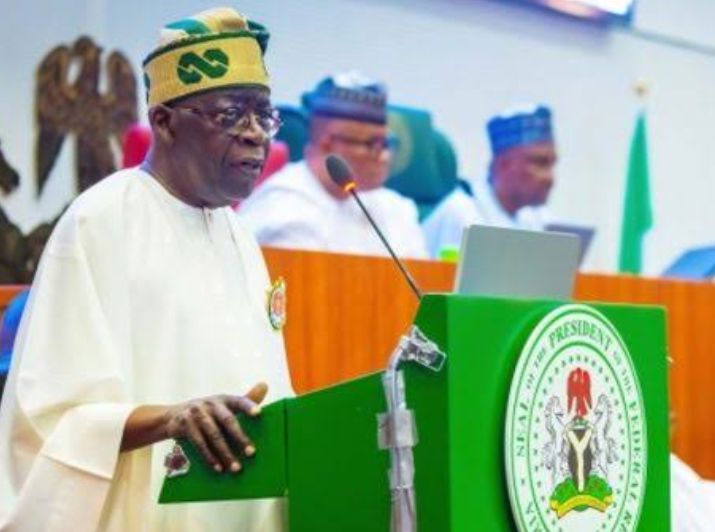
President Bola Ahmed Tinubu has swore that at no time in his political history has he flavoured a one-party state, and has no intention of encouraging same. He said however that he would not stop people from converging en-mass into his All Progressives Congress (APC), as was recently witnessed. Tibubu, who addressed the joint session of the National Assembly today, June 12, to commemorate Democracy Day, commended those from different parts of the country that had recently defected to his party. “A one-party state is not in the offing. Nor should it ever be. That said, we would be guilty of political malpractice if we closed the door on those from other parties who now seek to join the APC and I sincerely welcome our party’s newest members from Delta and Akwa Ibom States led by Governor Sheriff Oborevwori and Pastor Umo Eno and other members of this National Assembly. “To those who ring the alarm that the APC is intent on a one-party state, I offer you a most personal promise. While your alarm may be as a result of your panic, it rings in error. At no time in the past, nor any instance in the present, and at no future juncture shall I view the notion of a one-party state as good for Nigeria. I have never attempted to alter any political party registration with INEC. Equally, my friends, we cannot blame anybody seeking to bail out of a sinking ship even without a life jacket.” President Tinubu said that he would be the last person to advocate such a scheme, recalling that in 2003, when the then-governing party tried to sweep the nation clean of political opposition through plot and manipulation, he was the last of the progressive governors standing in his region. “In all their numbers and false grandeur, they boasted of ruling, not governing, Nigeria for the next half century or more. Where are they now? “Yet, I stood alone. My allies had been induced into defeat. “My adversaries held all the cards that mortal man could carry. Even with all of that, they could not control our national destiny because fate is written from above. “A greater power did not want Nigeria to become a one-party state back then. “Nigeria will not become such a state now.” The President said that the failed effort to create a one-party state placed progressive political forces on a trajectory to form the APC. “It put me on the trajectory which has brought me before you today. I dare not do such a favour to any political adversary by repeating the same mistake of political overreach.” Tinubu said that political parties which are fearful of members leaving should better examine their internal processes and affairs rather than fearfully conjuring up demons that do not exist. “For me, I would say try your best to put your house in order. I will not help you do so. It is, indeed, a pleasure to witness you in such disarray. “We must welcome and accept the diversity and number of political parties just as we welcome and embrace the diversity of our population. “Our efforts must never be to eliminate political competition but to make that competition salutary to the national well-being by working across the political aisle whenever possible.”
President Bola Ahmed Tinubu has praised the National Assembly for preserving the democractic ideals since since 1999 when the fourth democratic government began. “In 2006, the 5th National Assembly protected our democracy against an unseemly third-term bid that would have ripped our constitution apart.” Apparently referring to attempt by the then President Oludegun Obasanjo to force a Third-term rule on the nation that was stopped by the National Assembly, Tinubu, described the lawmakers as “the authors of the people’s law.” Speaking today, June 12, at the joint session of the national assembly to commemorate the Democracy Day, the President insisted that the National Assembly has acted to uphold democratic ideals at every critical moment in the national history.
Olusegun Obasanjo
Tinubu also recalled that in 2010, the National Assembly, through the doctrine of necessity, opened the door for then-Vice President Goodluck Jonathan to become the acting President following the illness of his predecessor. “Even under the military, the National Assembly tried to protect our democracy. “After General Abacha took over power on November 17, 1993, and dissolved the National Assembly, some of us, led by Senator Ameh Ebute, the Senate President in the 3rd Republic, defied the General and his goons to reconvene in the Old Parliament Building in Lagos. We were jailed or our defiance.” He said that while the executive and the legislature might not always agree, the two must forge a way to work together, “because this is what democracy demands of us. “I pledge myself to this cooperation and ask that you do the same for the good of our people. The President appreciated the invaluable role of the national assembly in lawmaking, oversight, and constituency representation.
“Uncle Sam used his (journalistic) pen as broom for cleaning up the rot in society. Few would match his crusading journalism. “By continuing to awaken the government and society, the Vanguard newspapers, which he founded, continue to be in the forefront of service to the nation.” These were the encouraging words by the immediate past Nigeria’s President, Muhammadu Buhari, in a birthday wishes to Prince Samson Oruru Amuka Pemu, popularly called in journalism’s world as “Uncle Sam.” Buhari, through his spokesperson in office, Malam Garba Shehu, said that the 90 years which Uncle Sam has so far spent up to today, June 12, would be written in gold in the annals of the nation’s history.
… Buhari Also describing Uncle Sam as “guru journalist, columnist and publisher,” the former Predident recalled that he had a beautiful relationship with him and that he (uncle Sam) had used his years in the media to spread light. “ I owe a deep debt to him. They call him ‘Sad Sam,’from the name of his column, but the distinctive style of his communication was spreading light. “Not only did one get information from reading him but also vision, which is very valuable. “I wish him many more years in good health and happiness, and continued service to his profession and the nation.”
An estimated 243 passengers onboard Air India passenger plane are feared dead as the large bodied plane crashed today, June 12, in the western Indian city of Ahmedabad. The Boeing 787-8 crashed not long after it departed for London’s Gatwick airport, Indian media reported. The airline confirmed, in a social media post, that the London-bound flight had been involved in “an incident,” saying: “Flight AI171, operating Ahmedabad-London Gatwick, was involved in an incident today. “At this moment, we are ascertaining the details and will share further updates.” There was no immediate confirmation from Indian officials of suspected casualties, but the former Gujarat chief minister was learnt to be among those onboard. The Air India flight 171, was believed to have reached an altitude of 625 feet before its signal was lost. Live flight tracking website Flight Radar said it had received a final signal from Flight AI171, a Boeing 787-8 Dreamliner aircraft capable of carrying more than 250 people, just seconds after it took off. The flight path showed it travelling southwest from the airport before the path stops. Indian TV channels showed thick smoke rising from the apparent crash site, with some images showing significant damage to buildings and multiple ambulances rushing to the scene.
The Central Bank of Nigeria (CBN) has maintained that the June 3 deadline set for Bureau De Change (BDC) operators to recapitalize remained valid, meaning that it has elapsed. The position of the CBN has put to lie, news that has been floating in social and conventional media across the country that the apex Bank had extended the deadline to December 31, 2025. It would be recalled that CBN had directed BDCs to ensure that they meet the new minimum capital requirements as follows: ₦2 billion for Tier-1 and ₦500 million for Tier-2 before or on June 3, 2025. This was part of the revised framework introduced by the CBN in February 2024. In a statement today, June 11, the Acting Director in the Corporate Communications Department of CBN, Mrs. Hakama Sidi Ali, said that the information about the extension of date was false, misleading and that it should be disregarded. According to her, the Bank has not granted any such extension beyond the previously communicated deadline of June 3, 2025. She advised members of the general public, journalists, media platforms and all stakeholders to consistently verify information directly from official CBN sources, such as the Bank’s website and authorised communication channels, before publishing or sharing news about the Bank and its regulatory directives. “The CBN remains committed to ensuring transparency, stability, and compliance in the foreign exchange market and will continue to engage with all relevant stakeholders in accordance with its statutory mandate.”
We use cookies on our website to give you the most relevant experience by remembering your preferences and repeat visits. By clicking “Accept”, you consent to the use of ALL the cookies.
This website uses cookies to improve your experience while you navigate through the website. Out of these, the cookies that are categorized as necessary are stored on your browser as they are essential for the working of basic functionalities of the website. We also use third-party cookies that help us analyze and understand how you use this website. These cookies will be stored in your browser only with your consent. You also have the option to opt-out of these cookies. But opting out of some of these cookies may affect your browsing experience.
Necessary cookies are absolutely essential for the website to function properly. This category only includes cookies that ensures basic functionalities and security features of the website. These cookies do not store any personal information.
Any cookies that may not be particularly necessary for the website to function and is used specifically to collect user personal data via analytics, ads, other embedded contents are termed as non-necessary cookies. It is mandatory to procure user consent prior to running these cookies on your website.







 … Buhari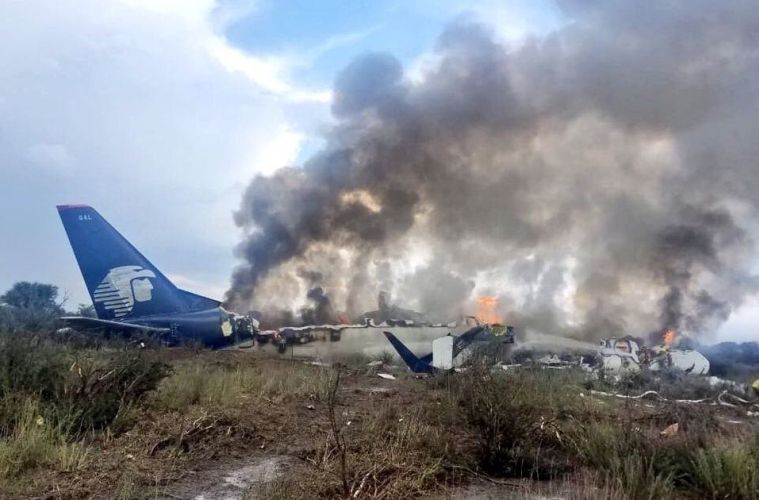




Tinubu, The Audacity To Hope: Two Years After, By Segun Adeleye
The second year has gone since Asiwaju Bola Tinubu was sworn in as the President of Nigeria, which translates to half of his tenure already spent!
At the first anniversary, the thinking in some quarters was that one year was too short to assess the performance of any government. But now that it’s half of the tenure and behind the scene networking for him to return for the second term is in full gear, a comprehensive assessment should better be done by anyone that cares.
Surprisingly, there is no meeting point between the two opinions on the performance of the President so far, and it seems there will never be a convergence, with those that are against him having nothing good to point at as achievement, while those in support are ready to sing his praise to the heavens.
Those on the left pole as expected are from the camp of the opposition parties who are yet and may not be able to cross to the ruling party, and of course millions of citizens who are negatively hit by the president’s economic policies in the last two years. It has been very difficult for many to comprehend why government cannot banish an extreme hardship that has even surpassed what they saw when they thought there could never be a worse clueless leadership in Nigeria.
Nigeria’s political system is yet to have a measurement mechanism where the performances of the leaders and the mood of the populace can be gauged as we see in many advanced democracies where opinion polls on leaders are released from time to time, and they are taken seriously, like a mirror to know the possibilities in future elections.
THE NAY SAYERS
The voice of those who seem to be discontented with the way things are going in the country no doubt is the loudest. The hardship voice is so loud in every corner such that if public opinion counts and if there is a remote possibility of having a free and fair election in the country, one would say that the President and his ruling party will be having sleepless nights.
It will be interesting to see anyone that can swear that there is a free and fair election in Nigeria. I believe the closest to a consensus will be that candidates will rig and win where they are popular. This can explain why some supporters will sing ‘ba tie dibo, oti wole’ (even if we don’t vote, you have won) during electioneering campaigns or the audacity that the PDP had then to boast that it will rule for 60 years.
The loud voice of discontentment in the last two years stems from the removal of fuel subsidies, Naira depreciation, spiraling inflation as high energy and food costs eroded the purchasing power of most Nigerians.
In the opinion of the former Vice President Atiku Abubarka who is occupying the extreme end of the opposition, in two years, the Tinubu’s administration has proven to be one of the most incompetent, disconnected, and anti-people governments in Nigeria’s democratic history.
He claimed a disregard for transparency, accountability, and responsible leadership, saying the government has not only deepened poverty, but set new records in wasteful public spending.
Pointing out that Nigeria’s total public debt in two years skyrocketed from 150 per cent to N144 trillion when compared to those of state governments where debt levels dropped from N5.86 trillion to N3.97 trillion, he concluded that Tinubu administration was the primary driver of Nigeria’s debt crisis.
His former boss, Former President Olusegun Obasanjo also shared same sentiment as he was quoted to have written in his book, Nigeria: Past and Future, that the Lagos-Calabar highway typifies waste and corruption.
He was quoted as saying: “Typical examples of waste, corruption and misplaced priority are the murky Lagos-Calabar Coastal Road on which the President had turned deaf ears to protests and the new Vice-President’s official residence built at a cost of N21 billion in the time of economic hardship to showcase the administration hitting the ground running and to show the importance of the office of the Vice-President. What small minds!”
Atiku’s political party, the PDP is also singing the same song while urging Tinubu to urgently address the issue of insecurity, reverse all economically suffocating policies and check the wholesale corruption, greed, unbridled profligacy, reckless misdirection of resources, arrogance in failure and totalitarian tendencies in his administration, which has shown itself as anti-people and impervious to the suffering of Nigerians.
Mr. Peter Obi, the Presidential candidate of the Labour Party has always been critical of President Tinubu’s administration, particularly on economic issues. He had expressed concerns about the country’s economic downturn, highlighting a significant decrease in GDP from $477 billion to $252 billion, which dropped the country from the biggest economy in Africa to number four.
SIMPLY THE BEST?
But in a sharp contrast, those that could see with the same lenses as the President, particularly those in the organised private sector are happy with what they are seeing so far.
Ironically, the removal of fuel subsidy which many are lamenting about is what the President’s admirers have embraced as one of his best achievements so far.
They believe that Tinubu’s economic reforms are promising despite being tough on Nigerians and businesses as they see positivities in the fuel subsidy and foreign exchange rate unification; Compressed Natural Gas (CNG) initiative to save over N2 trillion monthly by cutting petrol imports; Billions approved for the Student Loan Scheme; significant increase in government revenue with funds being channeled into large-scale infrastructure projects; rise in oil production; over $500 million in foreign direct investments; other social intervention programmes which include over N200 billion allocated to the newly established Consumer Credit Corporation; N570 billion disbursed to states for livelihood support; new national minimum wage to N70,000; increasing NYSC allowances to N77,000; tariff waivers on food and pharmaceutical imports among others.
Abdul Samad Rabiu, the Founder and Chairman, BUA Group in an interview listed what the administration had done right to include the removal of the fuel subsidy which he said was the biggest economic scam in our history. He said the administration unified the foreign exchange market and restored stability, fairness, and confidence in the economy.
“These are the foundations of growth. Nigeria is full of potential. With the right leadership, which we now have, there is no limit to what we can achieve,” Rabiu said.
The Chairman of the Dangote Group, Alhaji Aliko Dangote also shared the same view with Rabiu as he described Tinubu as a visionary leader, saying one of the Tinubu administration’s most transformative initiatives is the Naira for Crude Policy.
He said that the policy stood out as a clear testament to the administration’s commitment to economic recovery and national sovereignty.
He said: “This bold policy has enabled us to reduce product prices consistently and guarantee availability for the overall benefit of Nigerians. It has also helped significantly in stabilising the prices of petrol, diesel, jet fuel, LPG, and polypropylene to their lowest levels ever. The effect of this development is the stabilisation of our currency, a critical element in the development of economic policy and budgeting by businesses.”
He also lauded the administration’s Nigeria First Policy, which aimed to drastically reduce reliance on foreign goods and services, prioritising local patronage in investment decisions, business operations, and consumption habits.
Anambra State governor, Prof Charles Soludo from an opposition party also joined the camp of those that believed that Tinubu had been outstanding in the last two years. He said the President’s bold and visionary economic reform policies, have positioned the country on a trajectory of sustainable growth and development, despite temporary setbacks.
He said President Tinubu’s game-changing initiatives, including the removal of fuel subsidies, foreign exchange reforms, and significant investments in infrastructure development, demonstrate his decisive commitment to building a prosperous nation.
MAN SHALL NOT LIVE BY BREAD ALONE
As expected, the administration has not been slack at defending its record with the President dismissing critics of his legacy projects for being ignorant about how the government awarded them to contractors.
The President will be right if he borrows the phrase ‘man shall not live by bread alone’ to defend his administration’s thirst for legacy projects if one should reflect on the past when the country was turned into the dumping ground for imported products with strategic infrastructures left undeveloped.
The administration no doubt has been bullish and performed beyond expectations on infrastructure development if one should reflect on the time that these projects were conceived, like the Sokoto-Badagry Superhighway which was said to have been envisioned 47 years ago under the Shagari administration.
Another area where one can argue that the President has also surpassed expectation is the quality of appointment into strategic agencies as he did away with the past culture of mediocre in high places. I had in one of my early series, ‘If I were Tinubu: Setting a Tinubunomic agenda’, wrote that “ The President will need the right professionals to run the oil industry. Specifically, there will be a need for a total overhaul of the system. The new NNPC Limited should be made to advertise the positions of its CEO and other top directors to attract the right professionals from all over the world.”
When the President initially retained the old management of the NNPCL, I had thought that could only happen because he had seen what people from outside could not see. But the dramatic replacement of the management and board which could pass for a corporate coup has been applauded in many quarters as the right thing to do.
On sports, while the Tinubu’s administration has been commended for its development initiatives, particularly the reinstatement of the National Sports Commission (NSC) as the governing body for sports along with the timely payment of bonuses and allowances to athletes, its yet to be seen when these will translate to Nigeria winning medals in international events.
With the government also deserving credit for the bold tax reform agenda which is expected to become more pronounced when the new tax bills are signed into laws, it’s not also too difficult to identify the areas where hope is still hanging in the balance.
For instance, the claim of a repositioned health sector despite all odds has not been felt by a large segment of the masses, so also the initiatives to boost local food production, support farmers, and stabilise food prices have not yielded recognisable results, as the level of hunger in the land is still at the extreme.
Moreover, the government has not been convincing with its programmes to improve electricity supply as the grid keep on suffering multiple collapses, with most people still living with poor supply despite increase in tariff.
Also the blue economy that raised so much hope with the creation of the Marine and Blue Economy ministry has not lived up to the billing, with no sign of definite direction to harness the huge potential in the sector.
While the road infrastructure where huge resources have been committed also hold great prospect for the country, it is understandable that the impact may not be felt in the next one or two years.
TINUBU UNSTOPABLE?
Going forward, it will be difficult to expect any dramatic change in the posture of the president for the rest of his term, more so when the groundwork for his reelection has started.
By now, most Nigerians would have formed their opinions about who the president is, yet no one can absolutely boast that they know him. To say that he is stubborn or brave would be an understatement. Like a script in a mafia book, he has plotted his ways through the political trench to built a cult of followership and emerged as the most powerful and influential leader Nigeria has ever seen. His influence in the National Assembly is overwhelming, which would make it possible for him to push his agenda either legislatively or through Executive Orders. Unlike Obasanjo who would have instigated crisis in order to uproot their leadership as he would not like to share the limelight with anyone, Tinubu has allowed them the room to breath while pulling the string behind the scene to get his ways.
In a congratulatory message to the President on the second anniversary in office, President of the Senate, Godswill Akpabio said Tinubu had restored the hope of Nigerians for a viable and sustainable nation through transformative and courageous leadership… he had placed Nigeria on a solid developmental pedestal using the Renewed Hope Agenda as his policy thrust.
There may be likelihood of positivities in the enormous power that the President has amassed if positively deployed as the case of Lee Kuan Yew, the Singapore’s first Prime Minister who transformed his nation from a developing country to a developed one through visionary leadership and pragmatic policies between 1959 and 1990. If Tinubu can push through his legacy projects and other reforms, he could achieve the feet of Yew with Nigeria. However, since he is human and as absolute power corrupts, the fear of abuse cannot be overlooked.
The opposition parties that could give him a run for his money are currently in a disarray. One will be expecting more manoeuvring to weakening them and lure away their remaining prominent leaders in the coming months, which will make victory look very obvious for the President in 2027 even if the masses are crying murder.
The minister of Finance and coordinating minister of the Economy, Wale Edun told foreign investors few months ago that the government through its veracious reforms had laid the foundation that would make the country the desired destination for private investors, saying the country is on the road to 7 per cent annual growth, while the Governor of the Central Bank of Nigeria (CBN), Olayemi Cardoso, similarly said Nigeria’s economy is on a path of stabilisation and recovery following months of tough but necessary reforms.
With assurances like these coming from government officials while the opposition parties are at disarray with defection waves sweeping through the South South up to the North, Nigerians can only buckle up for the rough ride that may go beyond 2027, with hope and prayer that light will eventually come at the end of the tunnel.
*Segun Adeleye is the President/CEO, World Stage Limited, the publisher of WorldStage Newsonline. He is the author of Tinubu The Audacity To Hope, So Long Too Long Nigeria among others.