Home Blog Page 628

Pantami, Communication Minister, Becomes A Professor

Pantami

Minister of Communications and Digital Economy, Dr. Isa Ali Ibrahim Pantami has been promoted to the rank of Professor of Cybersecurity.

Pantami is among seven Readers (Associate Professors) promoted to Professor by the Governing Council of Federal Univerity of Technology Owerri (FUTO) at its 186th meeting held on Friday, August 20, 2021.

Others who have been promoted from Readers to Professor are Okechukwu Onyelucheya of Chemical Engineering, Alex I. Opara (Geology), Conrad Enenebeaku (Chemistry), Chikwendu Okereke (Geology), Lawence Ettu (Civil Engineering) and Godfrey Emeghara (Maritime Management Technology).

The Council also approved the recommendation of the Academic Staff Appointment and Promotions Committee (Professorial) for the promotion of nine Senior Lecturers to Readers and two Senior University Librarians to Deputy University Librarians.

An erudite scholar of information technology, Pantami who recently bagged the Security and Emergency Management Award (SAEMA) on Cybersecurity had lectured at Abubakar Tafawa Balewa University (ATBU), Bauchi, on ICT, before joining the Islamic University of Madinah as Head of Technical Writing in 2014.

He was appointed the Director-General and CEO of the National Information Technology Development Agency (NITDA) in 2016, before he was appointed the Minister of Communications and Digital Economy on 21 August 2019.

A senior lecturer at the FUTO hinted that the university committee is excited to have Pantami as one of its new seven Professors, even though the Minister has indicated that he would not receive remuneration because of his current position.

“We gladly welcome this new set of Professors, in our reputable institution. It is even more heartwarming to note that Prof. Pantami has already communicated to the University that he won’t collect salary for now because of his national assignment.

“As you are aware Professorial title on an individual connotes leadership and exceptional contribution at national and international levels in research, scholarship, teaching/mentorship and learning.

“In Nigerian Universities, a professorial appointment has been a prerogative of the Senate of the Universities. Because of autonomy, the criteria for the appointment of a professor varies from one university to another.

“A criteria for appointment of a professor is usually a process unless strong evidence indicates some waiver. The professorship is not a theory, but a practical aspect; an expert with the ability to profess his expertise in his field/profession.

“The procedure for appointment and conferment of a professor is annual and include an application by suitably qualified individuals through recruitment or promotion.

“The application is internally assessed by a panel of assessors (mostly professors) usually by the relevant members of a Senate standing committee of Appointment and Promotion (A&PC) of the University.

“Upon the committee’s positive assessment, the University may communicate to the applicant his appointment to the professorial position subject to a positive assessment of External Academic Assessors (usually three, one of which may be a reputable professor in Europe or North America).

“These External Assessors are independent of the applicant and are of professorial standing in a discipline related to the applicant’s core research and academic interest.

“The referees must not have supervised or collaborated with the applicant on any research/scholarly projects as well as must not be related whatsoever to the applicant.

“Therefore, in summary, appointment and promotion to a professorial position is a process and varies from university to university. University Senate is the final approving body for the conferment of professorial title on applicant and has also the power to waive certain criteria to confer the title when they are convinced that the applicant is qualified to have the title,” he said.

Source: PRNigeria
Nigerian Air Fighters Go Ruthless With Bandits, Kill Them, Destroy Arsenals

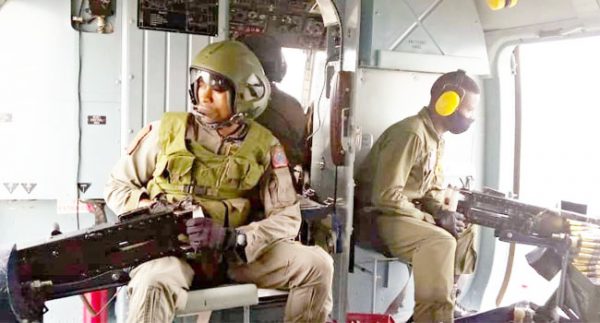
In the wake of aggressive bombardments by military air troops which have killed several armed bandits in Zamfara State in the last one week, a logistics base set up by armed criminals in Kaduna State has been destroyed by airstrikes of Nigerian military fighter aircraft.
The logistics are reportedly being used by bandits hiding at Kawara Forest in Igabi Local area of Kaduna State.

Sources said that no fewer than 50 bandits were killed by bombs shelled at the bandits’ logistics facility at the weekend.

According to one of the sources, a military air officer, a reconnaissance mission by Nigerian Air Force, NAF, helicopter gunships had intercepted a large gathering of bandits dressed in black clothes with rustled cattle around Kawara Village in Giwa local government area.

“On sighting the aircraft, the bandits ran and hide in between the cattle, while navigating their movement.

“After clustering at a water crossing point, the bandits were struck in successive passes by the aircraft.

“Some casualties that were spotted to be struggling to scamper for safety were also successfully neutralized by the aircraft.

“A reverse trail back to their initial departure point revealed a possible logistics base which was also struck until it went into flames.

“Sources on the ground at Kawara on Monday confirmed that at least 50 dead bodies of the bandits were counted while their motorcycles and food items were destroyed at the camps during the attack,” he said.

Source: PRNigeria

Vice President Osinbajo Heads Committee To Reform Nigeria’s Health Sector

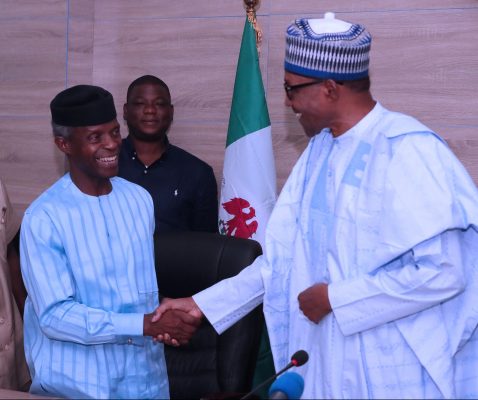
President Muhammadu Buhari and his Vice, Prof. Yemi Osinbajo

President Muhammadu Buhari has appointed his second in command, Professor Yemi Osinbajo to head the nation’s Health Sector Reform Committee.

The committee, according to a statement today, September 6 by the senior special assistant to the president on media and publicity, Malam Garba Shehu, will commence the development and implementation of a Health Sector Reform programme for Nigeria in collaboration with the State Governments and the FCT administration.

“This is sequel to a Health Sector Diagnostic Review Report developed by a consultant, Vesta Healthcare Partners and the Federal Ministry of Health.

The statement said that the committee will undertake a review of all healthcare reforms adopted in the past two decades and lessons learnt and factor them into the development of the new Health Sector Reform Programme.

The statement said that members of the committee are drawn from private and public sector health care management professionals, development partners, representatives from the National Assembly as well as the Nigeria Governors Forum among others. It has six months to complete the assignment.

Other members are Governor Ifeanyi Okowa of Delta State; Dr. Osagie Ehanire, Honourable Minister of Health; Mr. Alex Okoh Director General BPE; Prof. Ibrahim Abubakar, a Professor in Infectious Disease Epidemiology at University College London and Director of the UCL Institute for Global Health; Mr. Babatunde Irukera, Director General, Federal Competition and Consumer  Protection Council; Senator( Dr)  Ibrahim Yahaya Oloriegbe;  Dr. Adedamola Dada;  Dr. Sani Aliyu;  Dr. Mairo Mandara; Dr. Haliru Yahaya, Emir of Shonga;  Professor Uche Amazigbo ; Director Hospital Services, Federal Ministry of Health; Dr Faisal Shuaib; Prof Nasiru Sambo; Dr Ifedayo Morayo Adetifa; Dr Gambo Aliyu;

Others in the committee are Dr. Betta Edu (Chairman Nigeria Health Commissioners Forum representing National Council on Health); President Nigeria Medial Association;  President Pharmaceutical Society of Nigeria; President National Association of Nigeria Nurses & Midwives;  President Association of Medical Laboratory Scientists of Nigeria ; Mrs Temi Marcella Awogboro ; Dr. Muhammad Sadiq;  Dr. Azubike Tagbo and  World Health Organization, Nigeria.

Vesta Healthcare Partners and Bill & Melinda Gates Foundation are to serve as resources persons and have observer roles in the committee.

The statement said that President Buhari has also approved the appointment of Dr. Ifedayo Morayo Adetifa as the new Director General of Nigeria Centre for Disease Control (NCDC). The President named him as a member of the health reform committee.

Dangote Announces Plan To Increase Jobs To 57,000 In His Refinery

Aliko Dangote

The President/Chief Executive, Dangote Industries Limited, Aliko Dangote has announced plans to increase the human capacity at the Dangote Refinery Project site from 40,000 to 57,000 personnel in the coming months.
According to him, the project currently employs 29,000 Nigerians and 11,000 foreigners at the 650,000 barrels-per-day world’s largest single refinery project located in Ibeju, Lekki area of Lagos.
Speaking in Lagos on Arise TV programme, Aliko Dangote said that the refinery project remains the biggest in Africa and one of the biggest in the world, adding that many Nigerians are getting massive training as a way to build in-country capacity.
“When we started the project, we were supposed to bring a lot of foreign workers, but as we speak today, we have less than 11,000 expatriates. We have almost about 29,000 Nigerian workers that are getting massive training. We are also creating a lot of capacity in the country, which will be of great help for future oil projects in Nigeria, most especially with the opening up of the oil industry through the new Petroleum Industry Act.
“It means that the country can boast of human capacity needed in the oil and gas sector. Most of these Nigerians can compete anywhere in the world in terms of electrical, welding, mechanical erection etc. We have actually created massive capacity.”
The business mogul said that construction of the Dangote Petroleum Refinery was informed by his desire to help the Federal Government tackle the lingering petroleum products’ importation.
“It makes me feel terrible to see a country as big and resourceful as Nigeria with high population, importing all its petroleum products. It is very painful. So, we decided it is time to tackle this challenge. We tried before in 2007, but we were not able to make it happen. So, we jettisoned the idea.
“What actually inspired me is when you look at what happened in a country like India where entrepreneurs went ahead and created about five million barrels-per-day oil refinery. This country does not have as much oil as Nigeria. Nigeria is here sitting on over 2.4 million barrels per day at a point and we do not refine the oil we produce. Here, we have a country of over 200 million people and we are importing 100 per cent of what we consume.
“It is not sustainable. If you go to some places in Nigeria, you will discover that there are petrol stations that are not working. This actually pushed me into saying that this is a big challenge, which needed to be addressed urgently. Because I’m a Nigerian and if there are issues to be sorted out, I should be one of those who will bring solutions to our national problems.”
Dangote described the refinery project as an investment that would transform the economies of countries in sub-Saharan Africa. “This refinery is going to help transform, not only the oil sector, it is going to assist to transform the entire economy of Nigeria and all the countries in sub-Saharan Africa. It is unfortunate that all sub-Saharan African countries are importing petroleum products, and this is not what it is supposed to be.
“It is not government’s responsibility alone to address the challenge of petroleum products’ importation in Nigeria. No, we have to collaborate with the government to tackle these issues of petroleum importation. It will put millions of people directly and indirectly at work. The refinery is going to massively transform the economy. By this transformation, government will have more money to take care of infrastructure, health, education. So, it is a massive transformational project,” he added.
Dangote emphasized the need for the country to shift attention from crude oil export and diversify the economy. “We should not as a country be comfortable with generating revenue from crude oil export alone because tomorrow, people may not need crude oil. If we don’t move from crude oil to something else, we will have issues as a country. This is one of the things that I took upon myself to help address in this country,” he said.

Presidential Spokesman Lists Age-Old Jinx Buhari Broke In 6 Years

Special Adviser to President Muhammadu Buhari on media and publicity, Femi Adesina has listed out what he called age-old jinx (what were considered impossible) that the president has broken in his six years as leader of the country.
In a statement today, September 5, Femi Adesina said that the “giant-sized jinx” was broken recently when the Nigerian National Petroleum Corporation (NNPC) announced a first Net Profit in the 44-year history of the organization.
He said that under President Buhari, who doubles as Minister for Petroleum Resources, the oil conglomerate announced a first-ever profit of N287 billion.
He swore that such had never happened before, saying: “but that was by no means the only major jinx broken in the lifetime of the Buhari administration.
“They abound. And here are just some of them:
Policies and legislation:
*Petroleum Industry Bill signed into law in 2021, after almost two decades in the works. It is aimed at reforming a Petroleum Act dating back to 1969, as well as other supplementary laws and regulations.
*Deep Offshore and Inland Basin (Production Sharing Contracts) Act, 2019, amended for the first time since 1993.
*More than 6 billion dollars of inherited Cash Call Arrears now being cleared by the Buhari Administration, since 2016. More than 3 billion dollars of the arrears (payments due to International Oil Companies) have since been paid.
*The Buhari Administration has overseen the first successful Marginal Fields Bid Round in almost 20 years.
*The Buhari Administration has launched the first National Social Investment Programme in the country’s history. Today it is the largest Social Investment Programme in Africa and one of the largest in the world.
*Restoration of the Federal Budget to a January-to-December cycle, after more than a decade.
*The Nigeria Center for Disease Control (NCDC) was established in 2011, and for its first seven years did not have an enabling Act of the National Assembly — Until 2018 when President Buhari assented to the NCDC Act.
*Nigeria Police Act, 2020: The first overhaul of the Police Act since it was originally enacted in 1943
*Nigeria Correctional Service Act, 2019 – overhauled the existing Prisons Act, almost 50 years after it was first enacted.
*Finance Acts 2019 and 2020 – the first time ever that Federal Budgets are being accompanied by dedicated and specific reform legislation, to support implementation.
*Suppression of Piracy and Other Maritime Offences Bill (SPOMO), 2019: The first of its kind in the entire Gulf of Guinea, dedicated to prosecuting maritime offences.
*Police Trust Fund Act, 2019: First-ever legislation dedicated to addressing the financing of the Police Force
*CAMA, 2020 – the first overhaul of the Company and Allied Matters Act (CAMA) in 30 years.
*Discrimination Against Persons With Disabilities (Prohibition) Act, 2018: Another unprecedented piece of legislation in Nigeria
*Treasury Single Account (TSA) started in 2012, expanded across the entire Government by President Buhari
Projects –
*Itakpe-Warri Rail Line, started in 1987, abandoned for decades, and finally completed in 2020
*Completion of four standard gauge railway projects between 2016 and 2021: Abuja-Kaduna Rail Line, Abuja Metro Line, Itakpe-Warri Rail Line and Lagos-Ibadan Rail Line.
*President Buhari is the first President to start and complete a rail project in Nigeria’s history (Lagos-Ibadan Rail).
*The last NLNG Train project (Train 6) was completed in 2008. President Buhari has successfully flagged off Train 7 construction.
*Apapa-Oshodi-Oworonshoki Expressway, undergoing full reconstruction for the first time since it was constructed in the late 1970s.
*Bodo-Bonny Bridges and Road: Construction finally kicked off in 2017, after several decades of planning, and three false starts.
*The long-awaited Ogoni Clean-Up kicked off under the Buhari Administration.
*The Nigerian Navy has this year (2021) acquired its first new Landing Ship Tank (LST) in more than 40 years.
*The Nigerian Air Force has enjoyed the largest investment in fleet renewal in decades, under President Buhari, acquiring more than two-dozen new aircraft since 2016.
*Construction of the first full-scale private refinery and the first privately financed Deep Sea Port in Nigeria’s history both started under President Buhari’s watch.
*Only one Modular Refinery in the country pre-2016. Since 2018, there have been several either under construction or already completed.
*Maritime University, Delta State, licensed by the NUC and operationalized in 2018
*Completion, since 2016, of twelve (12) inherited Dam projects across the country: Kashimbila Multipurpose Dam, Taraba; Ogwashi-Uku Multipurpose Dam, Delta; Adada Dam, Enugu; Sulma Earth Dam, Katsina; Gimi Earth Dam, Kaduna; Amla-Otukpo Dam, Benue; Amauzari Earth Dam, Imo; Ibiono-Ibom Earth Dam, Akwa Ibom; Gadau/Lafia Zigau Dam, Bauchi; Alajue Small Earth Dam, Osun; Kampe Omi Dam, Kogi (Rehabilitation) and Kargo Dam, Kaduna (Rehabilitation)
*Completion of three (3) inherited Hydropower Projects, accounting for more than 100MW of electricity in total: Gurara Hydropower Project, 30MW, Kaduna State – completed and concessioned in 2020; Kashimbila Hydropower Project, 40MW, Taraba, Dadin-Kowa Hydropower Project, 40MW, Gombe.
*Completion, since 2016, of seven (7) inherited Irrigation projects and 30 Water Supply Projects inherited by the Administration, including the Central Ogbia Regional Water Supply Project in Bayelsa State, Northern Ishan Regional Water Supply Project and the Ojirami Dam Water Supply Scheme and Reticulation Network, both in Edo State; Sabke, Dutsi and Mashi Water Supply Project in Katsina State; Vom Water Supply Project and Mangu Regional Water Supply Scheme in Plateau State; Takum Water Supply Project in Taraba State; Gambaki/Chinade/Hardawa/Bulkachuwa Water Supply Project in Bauchi State; Inyishi Regional Water Supply Project in Imo State; Ilobu Water Supply Scheme and Osogbo Water Supply Scheme in Osun State; Idanre Water Supply Project in Ondo State; Ofeme Water Supply Project in Abia State; Uburu Water Supply Scheme in Ebonyi State; Gashua Water Supply Scheme in Yobe State; Kwami Gadam and Bojude Water Supply Project in Gombe State; the Saki Town Water Supply Project, Oyo State; and the Zobe and Kazaure Water Supply Projects in Katsina and Jigawa States respectively.
*NDDC HQ Complex, started in the mid-1990s, completed in 2021.
*EFCC HQ Complex, construction started in 2011, completed in 2018.
*Zik Mausoleum, started in 1996, completed and commissioned 2018.”

Military Strike In Guinea, May Have Taken Over Civilian Govt


Military may have forcefully taken over the civilian government of President Alpha Conde, in a coup d’etat in the Republic of Guinea.

Reports reaching us at Greenbarge Reporters online newspaper said that heavy artillery sounds were heard around the Presidential Palace today, September 5, in Conakry.

Foreign news agencies said that in Conakry, capital of Guinea, Special Forces whisked away President Conde from the Presidential Palace  to Kaloum Hotel in the capital city.

Although the leader of the Special Forces who staged the coupe and whose name was not immediately mentioned, had appeared on television to address the nation, reports said that President Conde, who was seen seating dressed in a casual wear, claimed that he is still in charge.

2,000 Names Of Unqualified Striking Doctors Submitted For Payments – Minister

Minister of Labour and employment, Chris Ngigi

Minister of labour, Dr. Chris Ngige has expressed regret over confusion injected in the ongoing negotiations with members of the Association of Resident Doctors ( ARD) who have been on nationwide strike for over a month now.
According to him, while the federal government has met all the 12-point demands of the association, members are trying to twist the hand of the government to do what is illegal in international law.
The Minister, who spoke to newsmen today, September 5, after an audience with President Muhammadu Buhari at the presidential villa, Abuja, said that even 2,000 names of none qualified members were submitted for payment of certain emoluments.
“From the monitoring meeting we did this morning, Ministry of Health has gotten the list of doctors who supposedly are to benefit from the Medica Residency Training Fund.
“A total submission of about 8,000 names were gotten and the Ministry of Health is scrutinising them. We have done the first round of scrutinization and they will now compare what they have with the Post-Graduate Medical College and the Chief Medical Directors who submitted the names.
“The Association of Resident Doctors in each of the tertiary centres, worked with the CMDs to produce those names, but now that the names are being verified, we discovered that about 2,000 names shouldn’t be there because they don’t have what is called Postgraduate Reference Numbers of National Postgraduate Medical College and (or) that of the West African Postgraduate Medical College.
“We are doing that verification because we do not want what happened last time in 2020 to reoccur; in 2020 the submitted names didn’t come through the appropriate source, which is the Postgraduate Medical College and payment was affected and it was discovered that about 588 persons, who were not resident doctors benefited from such money and they are now finding it difficult to make the full refund.
“Some are refunding, but there is no full consideration of the account. That account has to be reconciled to enable the accountants pay the next round of funding for 2021.”
Dr. Ngige said that during his audience with the President, they discussed the state of the healthcare system and the ongoing industrial disputes which has as at today, entered the 33rd day.
He said that government has been doing everything possible to make sure they get back to work, including accepting to implement all the 12-point issues they raised in their demands.
“We have done all; we have come to agreements on all, including those that even affect the Medical and Dental Consultants Association of Nigeria and medical doctors who are in academics and teaching universities.
“So, we have handled all. The only point of disagreement now is that they said that in the agreements and the memorandum of action, government should insert that Section 43 of the Trade Dispute Act will not apply to them. That section says that when a worker withdraws his services from his employer, the employer is at liberty to withhold payment of emoluments to him and the ILO (International Labour Organization) principles at work and strike said you can use that money to pay other people you have engaged in that particular period of strike.
“So, you have a right to strike, but your employer has also the right to withhold your emoluments. More importantly, in other climes, before unions go on strike, by that principle, they discuss with their workers and bring out what they call strike funds and it’s from that strike funds that the union will use to pay the workers who have gone on strike. They will also agree on the number of days the strike will last.
“That’s why overseas and in other climes, you don’t see strikes getting more than three days or four days or five days highest, and more importantly again, people on essential services, medical services, in particular, where you can lose live, they don’t go on strike anyhow. They only do picketing and things like that, because people’s lives are involved.
“So, this is where we are with them and we are saying that even if anybody cares to put it in any agreement, that clause will be void ab initio because it’s against the law of the land and we will not, as a government, succumb to undue arm twisting and then go and sign that. “Other workers have lost their pay during strikes; the Joint Health Systems Union (JOHESU). They lost their pay in 2018 when they went on four month strike, they lost about two or three months pay when the no-work, no-pay was invoked.
“Academic Staff Union of Universities (ASUU), no-work, no-pay applied to them. Nobody paid them anything for six months and it was during COVID-19.
“So, we can handle things administratively, but nobody should arm-twist us.
“I briefed Mr. President and we have agreed that they should come back to work and if they come back to work, we can take other things from there; we’ll drop the case in court and then they will come back and get things done.”

Borno Senator, Ndume Advises Govt To Thoroughly Investigate Surrendering Boko Haram Members

Senator Ali Ndume

Borno South Senator, Ali Ndume, has again, advised the federal and state governments to investigate repentant Boko Haram insurgents, most of who have surrendered before they are reintegrate into the society.

Speaking to newsmen shortly after he met with President Muhammadu Buhari in the Presidential Villa, Senator Ndume said: “there is a national law that should guide all these and there’s international law that guides this. “Because this is not the first time we’re having this sort of challenge. In various countries and normally, when you get to war level, you are expected to either defeat the enemy, or the enemy surrenders.

“Once the enemy surrenders, you lose the right of summarily executing him because he is an enemy.

“You also don’t have the right to summarily declare him innocent and say, Oh, you have sinned, go and sin no more. What I’m saying initially, and I still maintain this position, in as much as we welcome the surrendering of the Boko Haram, it is very important that we follow the due process, according to the law of the land and the international law. That is to say, take them in, profile them, process them, investigate them, interrogate them and then those that are innocent, should be let go, and those that have blood in their hands, they should be appropriately prosecuted.”
Senator Ndume said that once the person surrenders, now, he has an advantage; “once you surrender, you cannot just be summarily convicted, you will be given the right to go to court and declare your innocence or otherwise. That is what I’m asking for.
“I’m also saying that as long as the war is continuing, it is now time to apply the carrot and stick approach; while we are prosecuting the war rigorously, in order to bring it to an end, a window is there available to tell those that are willing to surrender, that you can surrender and then you will be processed accordingly.
“After that defeat or after the war has come to an end and the window is there for them to surrender as they are surrendering in droves now, they should be processed, they should be investigated.
“We had sat down in Borno State last week, as stakeholders, to look at what were the suggestions or what were the ways that these people could, after surrendering, be managed according to the law.
“My governor is already here with the resolutions and communique we issued to discuss with Mr. President and very soon I think the federal government will come out with a clear way or maybe a better way that this would be managed.
“So, I still say that my position has not changed; saying people should be given the window or the corridor to come in and surrender and then they will be processed.”

Senator Ndume said that those who are surrendering may be bold enough to own up and “most of them will disclose those who were their sources or their sponsors, if any, and where are they getting the equipment or the arms and ammunition they have been using and they will be useful in providing information to our security agencies in order to finish the business at hand and that is winning the war.
“I think we are getting there because they themselves, had the number, the number coming up to surrender is always increasing. I know in Cameroun, over 1000 of them surrendered and most of them are Nigerians. The Borno State Government is making arrangement.
“As I said, the governor is on top of the situation, the people are carried along, even the victims are being carried along. For example, I’m a victim and my people are victims. It varies, the degree of the effect of the insurgency on us, but we as Nigerians, we as humans, we have sympathy, or we have the heart to easily forgive.
“It’s not the forgiving that is the problem, it is the issue of if you forgive somebody that has done something he horrendous like that, and you are not sure that he’s not coming back or see repentance and all that. Besides, as I said, if somebody has blood in his hand, and it’s not your blood, do you have the right to say, ‘go, you are forgiven?’
“In all these, there must be procedure and fortunately, there is an international law and the national law that should guide this and that’s why at the summit, I said that we as National Assembly members are lawmakers and whatever is required by law, in order to address this thing that is strange in our hand, then we’ll support the government to do that.”

I Was Advised To Abort Brodashaggi’s Pregnancy – Mother

“I’m glad whenever my heart picks your picture I thank God that I did not abort you or listen to the shameful talk I faced in life, I appreciate God.”
This was contained in a short letter the mother of Brodashaggi, a popular comic actor, wrote to him.
The mother, who did not disclose her name in the letter further wrote:
“You are forever favored by Almighty God and it is permanent.
“My heart, my life, you are good to me and God will be good to you throughout your life.”
The letter was shared by Brodashaggi himself. He is one of the reigning comic actors on Instagram.
Source: The Nation.

Stop! Don’t Legalise Cannabis In Nigeria, NDLEA Boss Cautions NASS

The National Drug Law Enforcement Agency (NDLEA) has cautioned members of the National Assembly not to legislate in favour of making cannabis freely available in open markets for the consumption on Nigerians.


Answering reporters’ questions today, September 3, shortly after an audience with President Muhammadu Buhari at the presidential villa, Abuja, the NDLEA boss, Buba Marwa said that the disadvantages in legalising cannabis in the country far outweigh the advantages.
“Now, the World Health Organisation (WHO) itself has declared that cannabis affects the brain, alters brain function: it destabilizes and affects behavior. It also affects body organs, and at some points, it can lead to death.
“So while we appreciate those who want to localize it for financial gains, we have to be careful to reconcile it with life. So it’s money versus life.
“And up to this point, science has not developed up to the point where it can remove the THC in cannabis to zero. “Therefore, cannabis is harmful to our health. It is a danger to society. We must never allow its legalization.
“What’s more, Nigeria has 10.6 million cannabis users. This is the highest in the world. Isn’t it sad? We should be the highest in science, technology, mathematics, physics, and stuff like that. That is something we need.
“We can never support legalization and I don’t see how the National Assembly would pass the act because I know 90% or more of the honorable and distinguished members of the National Assembly know the implications of this legalization and they dare not go back to their constituencies if anyone signs legalization because we’re seeing the implication on the ground. The youths, the families are being destroyed because of cannabis and drugs. It wouldn’t be legalized by the grace of God.”
Advertisement ADVERTORIAL
WP2Social Auto Publish Powered By : XYZScripts.com