Home Blog Page 636

Beware Of Criminals During Sallah Festivities, Minister Advises Nigerians

Osun state Governor, Rauf Aregbesola

Minister of Interior, Rauf Aregbesola has advised all Nigerians to take responsibility by reporting any suspicious individuals and criminal activities to law enforcement agencies as the nation prepares for the 2021 Eid-el-Kabir celebration.

The minister, in a statement today, July 15, declaring July 20 and 21 as public holiday to mark the festival, asked Nigerians to beware of the activities of bandits in the Northwest and North-Central, insurgents in the Northeast, kidnappers, armed robbers, ethnic agitators and sundry criminals in other parts of the country.

In the statement by Dr Shuaib Belgore, Permanent Secretary in the ministry, Aregbesola assured that the administration of President Muhammadu Buhari is committed to the security of lives and property of every Nigerian, empowering the citizens for successful living, the provisions of social investments programmes, as well as the security in the schools, especially with the spate of innocent school children being targets of kidnapping.”

He also advised Nigerians to observe all COVID-19 protocols, particularly the non-pharmaceutical measures, wearing of facemasks, hand washing and social distancing designed to keep transmission of the disease at bay.

“We must all take responsibility for containment of the pandemic during this year’s festival,” he said.The minister sympathises with the families of school children who had been kidnapped or suffered one misfortune or another.“Our hearts and prayers of comfort are with you.”

Aregbesola congratulated Muslims and Nigerians at home and in the Diaspora on the occasion, saying: “I call on Muslims to continue to imbibe the spirit of love, peace, kindness and sacrifice, as exemplified by the Holy Prophet Muhammad (Peace be upon Him).”
He requested Muslims to use the period to pray for peace, unity, prosperity and the stability of the country, “considering the challenges of insecurity we face at the moment.”

2023: Northern Lawmakers Reject Zoning Of Presidency To South, Support Yahaya Bello

State assembly members from northern states of Nigeria have rejected the call to zone the 2023 presidency to the south, just as they support the presidential aspiration of Kogi State governor, Yahaya Bello.

The lawmakers, who met under the aegis of Nigeria Northern States Legislature Forum in Abuja today, July 15, asked Governor Bello who has already expressed interest in the race to consult more widely.

The meeting convened by the Speaker of the Kogi state House of Assembly, Matthew Kolawole, was to mobilize support for the governor’s ambition.

In the communiqué issued at the end of the meeting, which was read by Kolawole, the lawmakers argued that the south has had a total of 14 years in power as against the north’s 10 at the end of President Muhammadu Buhari’s administration.

They agreed that members should go back to their constituencies to consult with relevant stakeholders on the Kogi governor’s ambition, saying that he was competent to become president of the country.

The meeting also resolved to set up a national working committee to articulate and advance Governor Bello’s presidential aspiration.

106 Water Projects Abandoned In Many States – Minister

Suleiman Hussein Adamu,

Minister of Water Resources, Suleiman Hussein Adamu, has said that presently there are 106 water projects left uncompleted by various administrations in the country.

The minister, who spoke today, July 15, at a ceremony for the commissioning of the Zobe Regional Water Supply Scheme in Katsina State, assured that the Federal Government would keep working hard to ensure that Nigerians get adequate supply of water.

The commissioning was performed by President Muhammadu Buhari, who confirmed that the project was one of the many in some states that were initiated by a previous administration in 1992, and the Federal Government had to work in collaboration with the state to ensure completion.

“As you all know, the implementation of this very important project that commenced in 1992 suffered neglects under past administrations primarily due to lack of attention that resulted in poor funding and ultimate abandonment.

“It is therefore gratifying to note the positive efforts made by the Federal Ministry of Water Resources to salvage the project leading to its completion and eventual commissioning today.

“I have also noted the effective collaboration between the Ministry and Katsina State Government for execution of different components of the project as enshrined in the Memorandum of Understanding entered into by both parties way back in October 2017 when the project was resuscitated,” he said.

President Buhari enjoined other sectors to emulate the good practice of federal and state governments’ partnership to accelerate infrastructure development.

The President said the administration will work towards ensuring that all Nigerians, irrespective of location in the country, have access to adequate potable water supply and sanitation facilities as enshrined in the SDG target.

“However, for this national aspiration to be realized, we need to mobilize funds from all sources including the private sector. This is where the need for quick passage of the National Water Resources Bill that made provision for the National WASH Fund, as well as regulatory environment for private sector involvement in the sector, become relevant.

“I therefore call on the National Assembly to give attention to the Bill towards its passage into law as soon as possible,” he added.

The President noted that from the inception of the administration there had been a serious commitment to the development of the water sector through various efforts.

“Approval of the National Water Resources Policy by the Federal Executive Council in September 2016; Approval of a 15-year Roadmap developed by the Federal Ministry of Water Resources in 2016; Approval and Launching of Partnership for Expanded Water Supply, Sanitation and Hygiene Program in November 2016; Approval of the National WASH Action Plan for the revitalization of the sector and declaration of a “State of Emergency” on the sector in November 2018 and Launching of the “Clean Nigeria Campaign” in 2019 to make Nigeria Open Defecation Free by 2025.”

He said Executive Order Number 9 was signed in support of the Clean Nigeria Campaign Implementation and improved funding of the sector from special sources.

According to President Buhari, “the transformation being witnessed in the sector under the above listed efforts is highly commendable. I enjoin the Federal Ministry of Water Resources to continue the good work towards meeting our national aspirations as well as meeting the targets for water supply and sanitation under the Sustainable Development Goals by 2030.”

He urged the Katsina State Governor, Aminu Bello Masari, who signed an agreement ceremony to take over the project from the Federal Government, and community leaders to operate the facility efficiently, and jealously guard against vandalization.

In his remarks, the Kastina State Governor said the Federal Government had shown strong commitment to the development of communities, pointing out that the Zobe Regional Water scheme will address a major concern by supplying water for households, businesses and farms.

He said the project had to be separated into two phases in 2016 to enable completion, noting that by 2018 the first phase had been completed to provide more than 50 million litres of water to some communities in the state.

The governor called for more partnership to develop the state, adding that the government will keep providing the enabling environment.

I Won’t Be Tired Of Developing Railway Infrastructure, Buhari Vows

President Muhammadu Buhari in Kano

President Muhammadu Buhari has vowed that his priority in the transport sector will be the continued development and improvement of railway infrastructure, which he said is a potent economic driver.

The President, who spoke today, July 15 at the ground breaking ceremony of Kaduna– Kano segment of the Lagos– Kano railway modernization project, said that the take-off of construction activities on this segment of the Lagos– Kano represents the commitment of the Federal Government to the revival of the country’s railway system.

”The ground breaking ceremony for Kano – Kaduna segment of the Lagos – Kano railway modernization project signifies an important milestone of the construction of the third segment, having completed and commenced commercial operation on the first segment Abuja–Kaduna and recently the second segment Lagos-Ibadan.

”This project is crucial to the establishment of a supply chain in railway transport within its corridor, Kano –Kaduna-Abuja, as it links the major commercial cities of Kano and Kaduna to the Federal Capital Territory, Abuja.

”Upon completion, Kaduna-Kano railway project is to link the Lagos–Ibadan Railway project via Abuja, Minna, Ilorin, Oshogbo, Ibadan to Lagos on one end, and Maradi, Niger Republic on the other.

”This railway connection when completed will establish the ports in Lagos, as the choice for import and export business of the people of landlocked Niger Republic.

”This would positively drive our economies through employment from new business opportunities and wealth creation,” he said.

On financing for the project, the President expressed confidence that the Federal Ministry of Transportation and Ministry of Finance were working to engage co-financiers to conclude financial agreements for the development of the Ibadan–Kano line and to further increase the bankability of the project.

He explained that the railway line would be linked to the second Port in Lagos, the Tin Can Island Port, adding that the Inland Dry Port on these routes will be activated with the ports receiving imports directly from the international market as ports of destination such as the Ibadan, Kaduna and Kano Inland Dry Ports.

The President commended the Minister of Transportation, Rotimi Chibuike Amaechi, the Ministry and other project implementation partners that are contributing to this national effort of railway infrastructure development.

He noted that under this administration several landmarks have been achieved, beginning from the flag-off for commercial operation of Abuja – Kaduna railway in 2016 to the recent commissioning of the Lagos – Ibadan railway project on June 10 2021, thereby maintaining the pace for the actualization of this vital thoroughfare.

The minister, Amaechi thanked the President for the strong will in driving the overhaul of Nigeria’s moribund railway transport subsector and assured the President that the Transport ministry would remain committed to his vision for a strong and sustainable railway transportation backbone to engender and facilitate a new path to positive economic transformation of the country.

The Minister said that the rail line is also provided with accessories and special installations including power and water supply schemes, signaling system and communication in GSM-R, freight yards, rolling stock depots and maintenance workshops.

He announced that the Ministry has finalized plans to commence construction of the remaining addendum of Ibadan-Abuja to complete the entire stretch of the Lagos-Kano Railway modernization project.

At the ground breaking ceremony at Zawaciki, Dawakin Kudu Local Government Area of Kano State, President Buhari was joined by Governor Abdullahi Umar Ganduje of Kano State, Governor Atiku Bagudu of Kebbi State and Governor Simon Lalong of Plateau State.

Check, Balance Between Executive And Legislature Don’t Mean Conflict, Quarrel – Buhari

President Muhammadu Buhari Speaks

President Muhammadu Buhari has said that the term check and balance between the executive and legislature does not mean invitation to conflict and quarrel.
“The obligation to check and balance each other is not an invitation to conflict, and it should not be characterised by quarrelsome disagreement when consultation, engagements and compromise have proven time and again to be a more effective approach.”
President Buhari, who spoke at a dinner with members of the National Assembly, held at the State House Conference Centre, Abuja, said “our ability to govern in the best interests of the Nigerian people depends to a great deal on effective collaboration and partnership between the Legislature and the Executive.
The President hailed the ninth National Assembly for discharging their legislative duties with maturity and competence, describing the legislature as “full partners in national development.”
He particularly commended the minority parties in the legislature for their cooperation and support for Government programmes.
“In the 9th Assembly, you have distinguished yourselves by your conduct in office, by the scale and quality of your legislative interventions, and by your capacity for engaging with the difficult questions facing the country with maturity and competence,’’ he said.
The President listed some legislative accomplishments of the ninth assembly ranging from returning of our budget cycle to January to December, the amendment of the Companies and Allied Matters Act (CAMA), the Nigeria Police Act, the Finance Act, the Deep Offshore Production Sharing Contract Act, amongst others.
The President said that the leadership of the ninety National Assembly had also succeeded in overcoming the political and other obstacles that have, for two decades, inhibited the much-needed reforms of our Oil and Gas industry, resulting now in the passage of the Petroleum Industry Bill (PIB).
“I congratulate you all, and thank you for your contributions to the difficult, yet necessary task of nation building.’’
The President, who said that the executive and legislature came into office at a time of significant challenges for the country stressed: “we cannot allow ourselves to be distracted from this objective, or waver in our commitment, and I am confident that together we will triumph in our present efforts.
“Overcoming these challenges require that we finally confront long ignored questions of economics, politics, law and history that are often at the root of our national problems.
“This moment in history requires us to make hard choices, take difficult decisions and act with diligence and patriotism to ensure that our country can survive and thrive long after we have all left.
“What this means in effect is that our jobs will not get any easier. However, the objectives we seek, and will work together to achieve, deserve our best efforts regardless the sacrifice,’’ he said.
As the second legislative year of the 9th Assembly has just come to an end, the President noted that it was appropriate to jointly review shared commitments, to identify what has been achieved, and what is still left undone.
“This way, we can prioritise activities and allocate the resources necessary to ensure that in the lifetime of this Assembly, and of the administration, we can complete the work we have started, and leave behind a record of achievement that will stand all of us in good stead in the assessment of history,’’ he said.
The President said he looked forward to continued collaboration and partnership between the Executive and Legislative arms of government, working together to achieve a shared vision of a peaceful and prosperous country.

Kidnapped Kogi Monarch, The Adogu Of Eganyi


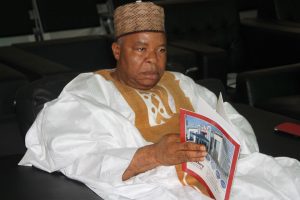
The picture of the first class traditional ruler: the Adogu of Eganyi in Ajaokuta Local Government Area of Kogi, Alhaji Mohammed Adembe that was kidnapped by unknown gunmen on Tuesday.

Social, Economic Significance Of New Kano-Kaduna Modern Railway

By Garba Shehu

President Muhammadu Buhari will on Thursday, July 15,  lay the foundation stone of the Kano-Abuja sector of the Lagos-Kano railway modernization project.

The Lagos-Kano rail project is part of the 25-year vision approved by the Federal Government for the rail transportation in 2002. The contract for it was signed on 30th October, 2002 and assigned to a Chinese Company, China Civil Engineering Construction Company, CCECC.

On October 22, 2009, CCECC and the Federal Ministry of Transportation signed a supplementary agreement for the implementation of the Abuja-Kaduna segment, which was completed, commissioned and put to use by the Muhammadu Buhari administration.

On 28th August 2012, the government signed another supplementary agreement for Lagos-Ibadan, the second segment of the corridor for the construction of double track railway of 156.8 kilometers. In addition to this, the CCECC and the government of Nigeria agreed on December 26, 2016 for the extension of this rail line to Apapa port, adding a distance of 8.57 kilometers.

Given the seriousness attached to the provision of super critical infrastructure projects the Buhari administration dusted off these agreements and commended actual execution. In June this year, the President was in Lagos to commission this project and officially place it at the service of Nigerians.In the same vein, the proposed Kano-Ibadan was signed in April 2019, and the segment traverses Oyo, Osun, Kwara , Niger, Abuja, Kaduna and Kano states. This segment, it was agreed, will be implemented in three addendums: Ibadan-Minna, 460 kilometers, Minna-Abuja, 127 kilometers and the now to be commenced, Kano-Kaduna segment covering a distance of 203 kilometers.

This is an important passenger transportation corridor to connect the northern and the southern parts of Nigeria. The kano-Kaduna segment of this project passes through important cities and towns in the north like Kaduna, Jaji, Zaria and Kano, and there is a dense population along the line. This line will undertake passenger exchange in various cities and towns between the capital of Nigeria and the largest city in the North, Kano. Therefore, this project is an important passenger transportation corridor to connect the main cities in the northern Nigeria, and in due course, the major towns down south.

This project is going to form an important part of the West African railway network. The 15 ECOWAS states are committed to a subregional railway network. It is hoped that it will connect to the Niger Republic railway through the Kano-Maradi rail standard gauge rail line which construction the President kick-started a few months ago. This project will be a trunk railway line in Nigeria and also an important part of the West African railway network. Upon completion, this project will promote development in the north and rest of the country, and will create a condition for economic cooperation, material and personnel exchange with the surrounding countries. The completion of this line is therefore significant to Nigeria and the Western African subregion.As stated above, this project is a trunk line of the national railway of Nigeria, an important part of regional network backbone system, a convenient channel and important passenger transportation corridor for passenger and freight exchange between cities in the country and an important part of the West African railway network.When completed, this line is expected to meet the demands for the development of national economy, and it will open an efficient and convenient railway channel for import and export of goods in Nigeria and passenger exchange along the line. It will provide an efficient and high-quality traffic means for the sustainable and rapid development of regional and the national economy, strengthen the cooperation and exchange between regions and further drive the development of traditional industry and domestic industrialization process, so as to promote the sustainable development of economy along the whole line and even in the whole nation.

This line connects Kano, the important industrial city in the north of Nigeria and passes through Zaria and connects to the capital Abuja and the coastal city Lagos via the modern railway. At present, there is an existing narrow gauge railway in the channel of Lagos-Kano, but it has a poor line condition and limited transportation capacity. The passenger and freight transportations between the South and the North are mainly undertaken by highway. The economic contact between cities in the North and all other parts of the country is restricted by unwanted conditions, forming a situation of limiting transportation. The south of Nigeria has relatively developed economy and high urbanization rate, while the north is dominated by agriculture and animal husbandry, with a weak economic foundation. This line will strengthen the contact and exchange between the areas with backward economy and the external economic environment, drive the economic development in the backward area and play an extremely important role to make up for the unevenness of economic and social development between regions. Therefore, the construction of this line should hopefully strengthen the economic contact between the north and south of Nigeria and realize the exchange of materials and personnel, and strengthen the coordinative development of regional economy in the north.  Another important aspect of the new railway which the construction starts today is that it meets the demand for the formation of a green transportation channel in Nigeria. There is a relatively fragile ecological environment along the line in this project, and highway transportation does not only have low transportation capacity and high transportation cost, but also high energy consumption and emission of environment-polluting waste gases. The existing narrow gauge railway has low traveling speed of trains and low transportation capacity, which mars the railway transportation efficiency. With this project, it is expected that the standard gauge railway technology, in comparison with the expressway, will offer with a large-capacity, convenient, land saving, energy saving, environment-friendly, safe and green way of transportation. This should improve the atmospheric quality substantially, improve water quality and reduce pollution greatly along the line. 

Lastly, it is to be noted that completed Abuja-Kaduna Railway is only 186km long, which seriously restricts the transportation capacity. The Kaduna-Kano Railway will provide the northward extension of Abuja-Kaduna Railway, and after completion, the length of Abuja-Kano will be 390km, which will greatly improve the transportation efficiency of Abuja-Kano Railway, and meet the demand for medium to long-distance and large-density transportation service.

The Kano-Kaduna Standard Gauge railway will improve mobility in the country as well as ensure seamless movement of passenger and freight trains on the Lagos-Kano rail link.

Federal Inland Revenue Boss Takes Campaign For Tax Paying To Kano

Executive Chairman, Federal Inland Revenue Service (FIRS), Muhammad Nami, has landed in Kano with the campaign for business community and other taxpayers in the country to continue to pay their taxes as and when due.

The Revenue Boss also called on members of staff of the FIRS to redouble their efforts in generating tax revenue for the country by expanding the national tax net to include those still outside it.  
Nami spoke  at Monday stakeholders meeting involving the Management and Staff of the FIRS and the Kano Business Community.

According to him, Nigeria’s economy presently depends mainly on non-oil revenues for it to discharge its statutory responsibility of paying salaries and providing social amenities to the citizenry. “However, despite the prospect which tax revenue holds for the country, the ‘’Tax to GDP’’ ratio for Nigeria is about 6% compared to Egypt at 15%, Ghana and Kenya at 17%, South Africa at 28%. This is a very sad reality that is unacceptable for a country that has the largest economy in Africa.

“To overcome this challenge, we must recognise and adapt to the changing pattern of the business environment where technology is the driver of business operations.  “For many years, our revenue generation architecture had been largely manual with limited use of technology. 

“Adopting technology in tax administration is crucial in improving domestic revenue mobilization given dwindling oil prices to avoid falling into a debt crisis. “It is against this backdrop that the TaxProMax became the channel for filing Naira-denominated tax returns effective from 7th June 2021.


“The TaxProMax enables seamless registration, filing, payment of taxes and automatic credit of withholding tax as well as other credits to the Taxpayer’s accounts among other features. The TaxProMax platform also provides a single view to Taxpayers for all transactions with the Service.
 “It will interest you to know that the Service collected over N650 billion in June 2021. This feat was achieved as a result of the efficiency and effectiveness of the TaxProMax Solution.”

Another groundbreaking development that Nami pointed out which occurred under his administration is the introduction of the court-backed “FIRS Practice Direction”. According to  Nami, this is another innovation introduced to aid revenue generation by cutting down on needless litigation which slows down revenue collection.
He listed the advantages which the FIRS Practice Direction conferred on tax revenue generation thus: “Cases of FIRS will be given accelerated hearing and priority in the Federal High Court; it enables the FIRS to obtain Order of the Court for forfeiture of immovable property of taxpayers, freezing of bank accounts, access to books, servers, billing systems etc; it fast-tracks the recovery of tax debts by civil action; it increases tax compliance, and increases the collection of revenue to the Government.” 

Nami also disclosed that the National Tax Policy Implementation Document had prioritised the assessment and collection of indirect taxes in Nigeria as they are difficult to dodge, easy to pay and easy to administer. He, therefore, charges members of staff at the FIRS to put the document to good use in the tax collection processes.The Executive Chairman listed challenges of tax collection in the country to include the fact that “when companies collect taxes as an agent of collection,  Value-Added Tax (VAT) for instance, they do not remit as and when due. In some cases, they do not remit it at all.”
He, therefore, appealed to defaulting corporate organisations to turn a new leaf by remitting VAT and other taxes as and when due, stressing that the consequences of not doing so under extant tax laws in the country are severe, which corporate executives would not wish to experience.

Kogi Traditional Ruler, Adogu Of Iganyi, Kidnapped

The Adogu of Eganyi in Ajaokuta Local Government Area of Kogi, Alhaji Mohammed Adembe has been kidnapped by unknown gunmen.

State police spokesman, DSP William Aya confirmed the incident and said that Adembe was kidnapped at about 5:20 pm on the Okene – Eganyi Road.

According to him, the traditional ruler was returning to his community from Okene when he was kidnapped.

“His car slowed down at one of the potholes on the road; the gunmen emerged from a nearby bush and started shooting sporadically into the air, thereby forcing him to a stop.

“Other occupants of the vehicle were spared as the gunmen marched only the traditional ruler into the bush,’’ Aya explained.

He said that policemen were already combing the surrounding area and the bush to rescue the victim and reunite him with his community.

120 Bandits Meet Their Waterloo In Air Force Bombardment In Zamfara

Information reaching us at Greenbarge Reporters online newspaper said that the Nigeria Air Force Fighter Jets have killed at least 120 Zamfara bandits in multiple airstrikes at Sububu Forest in Zamfara State.

The airstrikes followed reliable information supplied by the locals to security personnel on the arrival and movements of a large number of bandits within Sububu axis.
An intelligence operative confirmed that a reconnaissance aircraft was deployed for spotting, collection of imagery and observation of the bandits, before precision airstrikes were carried out on the targets.
“Following an intelligence, on 12 July 2021, that groups of bandits were amassing around SUBUBU, JAJANI and DAMMAKA, a reconnaissance aircraft was dispatched to recce the area for confirmation before carrying out the air strikes.
“Accordingly, the A-Jet conducted air recce over the said locations and observed several bandits arriving in droves and taking cover over large trees at the southwestern part of SUBUBU settlement.
“These targets were subsequently engaged and hit. “The few surviving bandits were seen fleeing the area. It is estimated that over 125 bandits were neutralized in the attack based on the information we received from our sources around the area,” he said.
When contacted, NAF spokesperson, Air Commodore Edward Gabkwet, confirmed the multiple airstrikes on the hideouts of the bandits, and the destruction of their motorcycles.
He, however, did not give further details on the human casualties recorded.
Commodore Gabkwet only specified that the military carried out “the precision airstrikes on the armed bandits after an intelligence and identification of the locations to avoid collateral damages.”
Nigerian troops under Operation Hadarin Daji, comprising operatives of the Nigerian military, security and intelligences services are jointly involved in fight against bandits in North-West.
Source: PRNigeria
Advertisement ADVERTORIAL
WP2Social Auto Publish Powered By : XYZScripts.com