


Dangote Cement Commits $150 Million To Acquire 2,000 Trucks
 Dangote Cement Plc has announced the purchase of 2,000 trucks worth $150 million to address the challenges related to the ease of distribution and availability of cement across the country, especially among its value-chain service providers.
The company, according to the Group Executive Director – Logistics and Distribution, Dangote Industries Limited, Alhaji Abdu Dantata, in a statement today, July 11, had taken delivery of the trucks, trailers, bulk tankers, tippers, cargo trucks and bulk cement tankers.
“These assets would meet the expected increase in demand for transportation of cement to every part of the country and create employment of over 4,000 people in Nigeria.
“Besides, Dangote Fertiliser, which recently made a grand entry into the market, has already taken delivery of 500 trucks from Dangote Sinotruk West Africa Limited (joint venture between Dangote Industries Limited and Sinotruk China) for the distribution of Urea to different States in Nigeria.
“The newly acquired trucks are expected to improve the efficiency and effectiveness of Dangote Cement Logistics network of distribution nationwide, as the company plans to commission its new cement plant in Okpella Edo state in a few weeks.
“We have acquired the new trucks in line with our new expansion capacity in Obajana, Ibese, Gboko and the new cement plant at Okpella. The acquisition is due to the growing needs of the business, especially as regards the increased trucking demands encountered lately, due to the surge in the demand for cement.
“The establishment of our clinker export terminals at Apapa and Onne Port led to the purchase of heavy duty tippers for haulage of clinker from the plants to the terminals.
“The introduction of these trucks would improve customers’ demand, improve on job creation in the country, as well as promote the economic development of Nigeria.”
Dantata disclosed that the company takes seriously the issue of safety of truck drivers and road users, which necessitated the collaboration between the Federal Road Safety Corps (FRSC) and the company to attain zero tolerance to road crashes in the country.
He said that the company has embarked on adequate training on effective driving techniques.
According to him, the collaboration involves recertification of drivers, pre-trip and post-trip inspection, drug test, real time tracking of vehicles, root cause analysis, convoy movement, checkpoint policy and sanctions among several others.
The locally assembled Sinotruk Howo trucks came in as semi-knocked-down kits (SKD), which were effectively assembled and commissioned for operations.
Dantata, who coordinates the group Logistic and Transport function, assured that the Dangote Sinotruk would continue the importation of semi-knocked-down kits into the assembling plant to support customers’ demand and improve on job creation in the country.
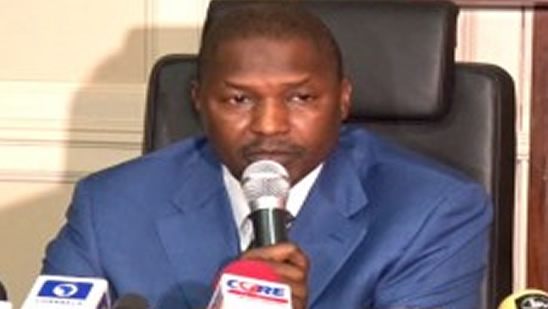

 A Yoruba monarch, the Oluwo of Iwo in Osun State, Oba Abdulrasheed Akanbi has begged President Muhammadu Buhari to forgive Yoruba Nation agitator, Sunday Adeyemo aka Sunday Igboho because he had suffered enough and is ready to step-down the agitation.

 Avarice and prejudice drove European conquistadors to carve up much of Africa like cake. With the gradual end of the transatlantic slave trade spurred by the industrial revolution in Europe, the trespassers, possessed by capitalist fiends, sought sources of raw materials for their industries and markets for their manufactured products. These encroachers considered Africa as ‘’terra nullius’’ – a vast land belonging to no one –, so they struck, usurping natural boundaries and turning brothers into strangers. All for greed, prejudice and arrogance.
 President Muhammadu Buhari has made it clear to the security operatives in Nigeria that his government cannot afford to disappoint Nigerians that entrusted power in his hand.

Nigeria’s Unity: Media At Crossroad, By Fredrick Nwabufo
The media naturally should serve only the public interest. What determines ‘’public interest’’ may be amorphous, but safety and security are principal elements of communal interest. The security of the nation and its people can be said to be a staple of shared interests. Therefore, national interest is a subset of public interest. To serve the public interest is to preserve the nation’s interest and security.
Nigeria’s constitution delineates the place of the media in the country. Section 22, chapter 2 of the canon says: ‘’The press, radio, television and other agencies of the mass media shall at all times be free to uphold the fundamental objectives contained in this chapter and uphold the responsibility and accountability of the government to the people.’’
Also, section 24 says: ‘’It shall be the duty of every citizen to – (a) abide by this constitution, respect its ideals and its institutions, the national flag, the national anthem, the national pledge, and legitimate authorities; (b) help to enhance the power, prestige and good name of Nigeria, defend Nigeria…’’
It is clear here that as media practitioners and citizens our duty is to the country and its people – ‘’holding the government to account and enhancing the power, prestige and good name of Nigeria’’.
Service to Nigeria is not a favour or obeisance to the government. Government will come and go, but Nigeria remains. Service to Nigeria is a duty to its people. Love for country is not lust for government, and loyalty to country is not servitude to government. Are we really doing our bounden duty as citizens and as seekers and keepers of the truth?
The Nigerian media is one that is somewhat politically governed. Some media organisations are owned by politically-exposed persons who are in different political parties. These media organisations are sometimes deployed to fight political battles, compromising the sanctity of information. Whose interest will these agencies naturally serve, their patron’s or Nigeria’s? This is the dilemma.
I shudder when I hear the statements of some political leaders and self-canonised activists – utterances belched from the bowels of prejudice and malice. But I am distressed when I find these blighted comments, which are capable of inciting violence, on the front pages or top corners of news publications. Everyone deserves to be heard, but can we modulate the outcome and concomitants of a potentially combustible statement? Is not judicious to control it from the source?
I recall the statements of Sunday Igboho which set off attacks on the Fulani in Igangan, Oyo state. These statements were given prominence in the media and Igboho was reported as an ‘’activist and youth leader’’ by a section of the media, ignoring his antecedents, and the precedent of his actions.
I understand the argument that the comments would have rippled on social media, regardless of whether it was published by the popular media. But the media as an agency of truth adds legitimacy to whatever is said. By reporting ‘’hate speech’’, the media cannot insulate itself from the collateral impact of bigotry.
Personally, I am of the view that voices of discord and anarchy should be muted. In the West, people who make homophobic, racist and sexist comments are de-platformed – shut out of the media. But why do we here give our platforms to anarchists and bigots?
Also, there seems to be a preponderance of negative news. This is understandable considering its ‘’market value’’. But as John Momoh, Channels TV CEO, advised in a paper he delivered at the National Defence College in 2016: “The media should avoid getting carried away by overstating negative news while under reporting positive developments’’.
In all, we cannot have a peaceful and secure country if we are remiss in our responsibility as gatekeepers. That Nigeria is still a going venture is largely because of the commitment of the media to the country’s unity.
We need to bond our voices as professionals for a united and progressive country. The military force cannot defeat insecurity without the ‘’national force’’ – which comprises the civil population. As Barack Obama said: “We cannot continue to rely on our military in order to achieve the national security objectives that we have set. We have got to have civilian national security force that is just as powerful, just as strong.’’ Nigeria’s unity is under threat as well its peace. It is the responsibility of every citizen to defend it.
It is in commitment to my purpose and belief that I have convened an ideological group, ‘Journalists for United Nigeria (JUN)’; a think-factory for idealists who trust in the possibilities of a greater Nigeria. Nigeria can be better.
At this tempestuous moment, citizens need to rise up and pull our nose-diving country from a plunge to certain death. With great power, comes great responsibility.
Nigeria is ours to salvage.
More Nigerian journalists and citizens are welcome to join me on this cause.