The Economic and Financial Crimes Commission (EFCC) has announced the arrest of one Amos Omotade-Sparks, identified as the operator of the “Inks Nation ponzi scheme” for allegedly defrauding people to the tune of N32 million.
The anti-graft agency said that Omotade-Sparks, who hails from Badagry in Lagos state, was declared wanted in November 2020 for masterminding a “huge pyramid investment scheme”.
In a statement today, May 28, spokesman of the EFCC, Wilson Uwujaren, said that the suspect was arrested in Sokoto yesterday, May 27, adding that he had floated an online digital currency, which he had urged people to invest in.
“Omotade-Sparks, who hails from Badagry, Lagos State, was declared wanted by the EFCC in November 2020 after efforts to apprehend him failed,” the anti-graft agency said.
“He is the alleged mastermind of a huge pyramid investment scheme through which many citizens were defrauded of monies to the tune of over thirty-two million naira.
“He had floated a phony online digital currency called “Pinkoin”, which lured many Nigerians to invest between one thousand naira to one hundred thousand naira with a promise of unrealistic returns and went ahead to distribute a payment card called “Pink Card” to further confuse his victims.
“Omotade-Sparks equally made false claims that he was in partnership with the EFCC to persuade people to invest in his devious scheme.”
“The scammer was not licensed to operate a financial institution. He will be arraigned in court at the conclusion of investigation.”
The management of Abuja Municipal Area Council (AMAC), has started the process leading to the award of scholarships to indigent students.
A statement today, May 28, by the head of public relations, Mrs. Patience Olaleye, said that the students should be indigenes of the Area Council studying in higher institutions across the country.
The statement said that the date for the collection of forms is from Monday, May 31 to Wednesday, June 2, 2021, adding that the Council had made the AMAC Annex secretariat, Apo, the collection centre.
“All eligible students are to come along with the following documents for filling of forms and submission at the venue: Indigene/resident certificate, admission letter; evidence of payment of recent school fees (receipt); a photocopy of school ID card; two recent passport-size photographs; birth certificate/declaration of age; functional bank account/details and other relevant documents.”
A middle-aged man, Sello Abram Mapunya, found guilty of raping different women at different times, has been sentenced to 1,088 years imprisonment. Mapunya was believed to have raped and robbed his victims in Pretoria, South Africa within a period of five years.
He was sentenced on Thursday by Judge Papi Mosopa of the Pretoria High Court.
The judge had earlier found the convict guilty of 41 rapes, 40 counts of robbery with aggravating circumstances and 40 counts of housebreaking.
Mapunya, who was initially charged with 101 different crimes, began his crime spree in 2014 by attacking his victims who included a 14-year-old girl, in Tshwane’s suburbs of Silverton, Nellmapius, Atteridgeville, Mamelodi and Olievenhoutbosch.
The brutal crime spree ended with his arrest by detectives from the serial electronic crimes investigation unit in March 2019.
Judge Mosopa sentenced Mapunya to life terms for raping his teenage victim and three other women whom he raped multiple times.
Mosopa also sentenced Mapunya to 15 years each for the other 31 rapes he committed, 15 years’ imprisonment for every count of housebreaking with the intent to rob and robbery and 15 years for every count of housebreaking with the intent to steal.
The Economic and Financial Crime Commission (EFCC) has seized jewellery worth N14 billion and houses worth over $80 million from former Minister of Petroleum, Diezani Allison-Madueke.
The Commission’s Chairman, Abdulrasheed Bawa made this known today, May 28 and at the House of Representatives ad hoc committee investigative session on the assessment and status of recovered loot.
The anti graft chairman said that Diezani’s jewellery were still in the custody of the agency, and that it had not been auctioned but had been finally forfeited to the Federal Government.
He said that court processes, procedures and administrative exigencies had stalled some of the seized assets from being auctioned by the anti graft agency.
Bawa however said that the agency would henceforth deal with the seized assets case by case at the courts in order to quickly dispose the assets.
“Already the Federal Government has set up a committee under the chairmanship of the Solicitor-General for the Federation and I think they are working tirelessly.”
This according to him, is to ensure that assets that were not only recovered by the EFCC but also the entirety of the recovery agencies assets were disposed off.
“We have EFCC representatives from that committee and we believe at the end of the day Nigerians are going to appreciate what that committee will come out with in term of the mandate given to them.”
Asked when the committee would wind up so the assets could be disposed, Bawa said that he was not a member of the committee to know how soon the assets were going to be disposed.
Bawa said that in its quest to transform the agency, it would soon digitalise its processes, adding that it had also created and upgraded four additional departments to restore confidence.
He listed the departments to include: Intelligence, procurement, Internal Affairs and the Information Communication Technology Department.
He said that there was no loot that had been re-looted as being speculated, stressing that going forward, the EFCC would be different and Nigerians would be the better for it.
He said that he would always honour the National Assembly to account for what the agency had done, adding that “public servants come and go but the institution would remain.”
The Central Bank of Nigeria (CBN) Governor, Godwin Emefiele has challenged Governors of the 36 States of Nigeria to embark on massive food production, which would lead to placing less emphasis on the Federation Accounts Allocation Committee (FAAC).
He advised them to invest more in agriculture, particularly crops in which they have comparative advantage.
Emefiele threw the challenge in Port-Harcourt today, May 27, at the launch of the Rivers Cassava Processing Company Limited, which is designed to support improved production and processing of cassava into high quality flour in Rivers State.
He said that the CBN would no longer support the continued importation of items that can be produced in Nigeria, even as he pledged that the Bank will collaborate with Rivers and other States in supporting the development of a viable agricultural and manufacturing sector across the country in line with the CBN mandate of promoting economic growth for the country.
According to him, principal agencies of government at the federal and state level should continue to work hand in hand towards diversifying the Nigerian economy and creating an enabling environment for further investment by firms such as the Rivers Cassava Processing Company.
Emefiele identified land development as a major constraint to increase in agricultural activities in the Southern parts of the country due to its topography, noting that the CBN had partnered with several States Governments in the region under the Accelerated Agricultural Development Scheme (AADS).
He said that about N7.436 billion had been accessed by four States in the South-South region to open up more land for cultivation, create access roads to agricultural lands, and provide infrastructure among other support services in the region. “These measures are helping to induce greater activity in the agricultural sector and are enabling the movement of goods from farm to factories, and to the markets,” he added.
The CBN boss commended the Rivers State Government, working with Shell Petroleum Development Corporation, the Dutch Embassy Investment Nigeria Limited and their technical partners for setting up the integrated facility, saying that investments such as the cassava plant could help in driving economic growth, reducing unemployment and inducing other wealth creating activities in the state.
He expressed optimism that the project would improve livelihoods, as well as enhance sustainability of farming operations for over 3000 farmers, by guaranteeing the offtake of their farm produce in addition to reducing the country’s reliance on imports of cassava by-products.
Emefiele noted that the emergence of the Nigerian economy from the recession in the fourth quarter of 2020, and the recent report that the economy continued to experience growth in the first quarter of 2021, was due to significant growth in the agricultural and manufacturing sectors.
Given the multiplier effects of the agricultural and manufacturing sectors, on growth, employment, and wealth creation, he challenged all stakeholders, particularly the State Governors to encourage more investment in the critical sectors of the economy.
“With the decline in our foreign exchange earnings, we can no longer afford to support continued importation of items that can be produced in Nigeria. Our current situation has also made it imperative for the Central Bank to work towards supporting programmes that will enable greater cultivation and processing of key agricultural commodities in Nigeria.”
Emefiele said that the developmental finance initiatives at the CBN had been focused on creating an enabling environment that will drive both public and private sectors participation in the real sector with strategic deliverables around price stability, job creation, financial inclusion, import substitution and accretion to foreign reserve among others, even as he said that so far, the sum of N333.196 billion had been disbursed to various projects in the South-South region covering activities in different economic sectors.
The Inspector General of Police (IGP), Usman Alkali Baba has given reasons why some Nigerians are being provided with police to guide and protect them over and above others.
He said: “there are those that need to be escorted: there are those that need to be guided because of the nature of job they are doing, or the nature of responsibility they are carrying. The state is supposed to provide security, to protect the citizens, particularly citizens that are vulnerable to attacks or assault or whatever kind attacks because of the nature of duty they do.”
The police boss who spoke to newsmen today, May 27 in Abuja, said that there are political leaders who by virtue of the political offices they find themselves in, are entitled to be escorted.
“Even businessmen, because of their position in the society need to be protected; they need to be guided. So we have a unit that is called A special Protection Unit.
“That unit is essentially created to provide security for those who are in the categories that l mentioned. And there are places to be guided, business premises, because of the nature of activities they do in that place, that company or factory or business entity need to be protected.
“So there is no way you can say this policeman… because you see maybe a classmate with a policeman behind him does not mean you have the same status.
“Suppose you come to my office and say that your life is under threat and I give you a policeman and somebody sees you with a policeman and complain? So these are the things we are having.
“And it is also a symbol of authority. When you have a police officer behind you, you’re working and his is following, it’s a symbol of authority. And some people want it.”
The Inspector-General of Police (IGP), Usman Alkali Baba has asked those agitating for State Police to be specific on how they would want it to be.
Answering reporters’ questions today, May 27 at an interactive session in Abuja, the police boss said that some state police and community policing had always been in place.
“I remember as far back as 1998, I think I had a project in one of our course writings on desirability of state policing and the issue has been reoccurring, but now I think it is no more.
“If you look at it technically, I doubt if there is any state that does not have state police even now. What do I mean?
“There are creations that are done by state governments to assist law enforcement agencies in trying to maintain law and order, or enforce regulations or laws that are created by state governments.
“We have vigilante everywhere in this country. We have various types of organisations that have been created by state governments to assist in policing.
“Some of them even have House of Assembly laws that guide their operations.
“The space is open to everybody. We even always say, policing is not a matter of the Nigerian police, or the Nigerian law enforcement agents; everybody can be involve on policing.
“But I want to know, the shape that the advocates of state police want it to take and it is an issue that is left for lawmakers and government.
“We are ready to work with anybody. We are ready to collaborate and synergize with anybody to make sure that Nigerian citizens enjoy the best of protection simple.
“And if you look at it, the community policing aspect: we have trained over 70,000 Nigerians from all states of the Federation, to assist in crime prevention and control. In fact, we have even gone to the extent of using the Police Act to kit them with police uniform, that will give them an identification as spy.
“And that is to say, all those who are trained to go back and assist in policing within their own locality. You are policing capability and powers ends within your community. And it is the community that we suggest who and who will be involved in such a business and we are working with them.
“State governments or state governors are chief security officers of their states. “As far as I’m concerned, they are and remain one. And my commissioners of police are ready to take all local instructions from them.
“As for agitation, it is there but everybody is already involved in creating one agency or the other to compliment the efforts of the Nigerian security agencies. The National Assembly can look into the agitation which is their own responsibility.”
The Nigerian National Petroleum Corporation (NNPC) has announced a ₦39.85 billion trading surplus for the month of February 2021 representing a massive 314.24% leap from the ₦9.62billion surplus it recorded in January 2021.
This is contained in the February 2021 edition of the NNPC Monthly Financial and Operations Report, according to a press release by the Group General Manager, Group Public Affairs Division of the Corporation, Dr. Kennie Obateru.
Trading surplus or trading deficit is derived after deduction of the expenditure profile from the revenue for the period under review.
According to the report, in February 2021, NNPC Group operating revenue as compared to January 2021, increased by 35.64% or N 152.07billion to stand at N578.79billion. Similarly, expenditure for the month increased by 29.21% or N121.83billion to stand at N538.94 billion. The expenditure for the month as a proportion of revenue was 0.93% as against 0.98% the previous month.
The significant increase in trading surplus is attributed mainly to reconciled accounts by the Corporation’s downstream subsidiary, the Petroleum Products Marketing Company (PPMC), using the Petroleum Products Pricing Regulatory Agency (PPPRA) pricing template.
Other factors that boosted the trading surplus figure, according to the Corporation, included the performance of Duke Oil, Nigerian Gas Company (NGC) and Nigerian Gas Marketing Company (NGMC) which recorded robust gains as a result of increased debt collection and cost optimization measures.
Conversely, during the period under review, 54 pipeline points were vandalized representing 50% increase from the 27 points recorded in January 2021.
The Warri Area accounted for 50% and Mosimi Area accounted for 39% of the vandalized points while Kaduna and Port Harcourt Areas accounted for 7% and 4% respectively.
NNPC continues to work in collaboration with the local communities and other stakeholders to eliminate the menace of pipeline vandalism.
In the period under review, the Corporation supplied a total of 1.41bn litres of Premium Motor Spirit (petrol) translating to 50.52m litres/day.
In terms of natural gas offtake, commercialization and utilization, out of the 206.05Billion Cubic Feet (BCF) produced in February 2021, a total of 133.06BCF was commercialized consisting of 40.15 BCF and 92.91 BCF for the domestic and export market respectively.
This translates to a total supply of 1,433.75Million Standard Cubic Feet Per Day (mmscfd) of gas to the domestic market and 3,318.25mmscfd of gas supplied to the export market for the month.
This implies that 64.48% of the average daily gas produced was commercialized while the balance of 35.52% was re-injected, used as upstream fuel gas or flared.
Gas flare rate was 7.67% for the month under review (i.e. 565.52mmscfd) compared with average gas flare rate of 7.12% (i.e. 529.20mmscfd) for the period of February 2020 to February 2021.
The February 2021 NNPC Monthly Financial and Operations Report is the 67th in the series. It is published in keeping with the Corporation’s commitment to transparency and accountability.
The new Chief of Army Staff, Major General Faruk Yahaya was born on 5 January 1966 in Sifawa, Bodinga Local Government Area of Sokoto state. Maj Gen Yahaya who is a member of the 37 Regular Course of the prestigious Nigerian Defence Academy (NDA), started his cadet training on 27 September 1985 and was commissioned into the Nigerian Army Infantry Corps on 22 September 1990. Maj Gen Yahaya has held several appointments including Staff, Instructional and Command.
Notable among the appointments held by the new COAS are Garrison Commander Headquarters Guards Brigade, Directing Staff at the Armed Forces Command and Staff College (AFCSC), Deputy Director Army Headquarters Department of Military Secretary, Deputy Director Army Research and Development and the Chief of Staff, Headquarters Joint Task Force Operation Pulo Shield.
He also served as the Principal General Staff Officer (PGSO) to the Honourable Minister of Defence, the Commander, Headquarters 4 Brigade and 29 Task Force Brigade (Operation Zaman Lafiya). He was also Director Manpower at the Army Headquarters, Military Secretary, Army Headquarters and General Officer Commanding (GOC) 1 Division of the Nigerian Army.
Until his appointment as the COAS, Maj Gen Faruk Yahaya was the Theatre Commander Operation HADIN KAI, responsible for Counter Terrorism and Counter Insurgency operations in North East Nigeria.
The new COAS is a proud holder of several honours and awards, some of which include, Forces Service Star, Meritorious Service Star, Distinguished Service Star, Grand Service Star, Passed staff course (Dagger), National DefenceCourse (Chile), Economic Community of West Africa State Monitoring Group Medal, Command Medal, Field Command Medal, General Operations Medal, Silver Jubilee Medal and Golden Jubilee Medal. He is happily married and blessed with children.
Please disseminate this information through your news medium.
ONYEMA NWACHUKWU Brigadier General Acting Director Defence Information
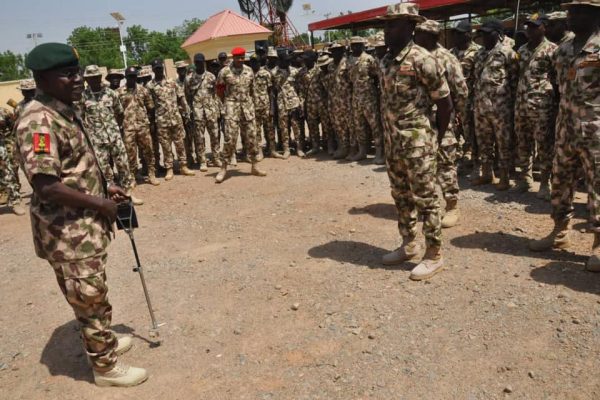
President Mohammadu Buhari has appointed Major General Farouk Yahaya as the new Chief of Army Staff.
In a three-paragraph statement today, May 27, the acting Director of Defence Information, Brigadier General Onyema Nwachukwu said that prior to his appointment Major General Yahaya was the General Officer Commanding 1 Division of the Nigerian Army and the incumbent Theatre Commander of the Counter terrorism Counter Insurgency military outfit in the North East code-named Operation HADIN KAI.
We use cookies on our website to give you the most relevant experience by remembering your preferences and repeat visits. By clicking “Accept”, you consent to the use of ALL the cookies.
This website uses cookies to improve your experience while you navigate through the website. Out of these, the cookies that are categorized as necessary are stored on your browser as they are essential for the working of basic functionalities of the website. We also use third-party cookies that help us analyze and understand how you use this website. These cookies will be stored in your browser only with your consent. You also have the option to opt-out of these cookies. But opting out of some of these cookies may affect your browsing experience.
Necessary cookies are absolutely essential for the website to function properly. This category only includes cookies that ensures basic functionalities and security features of the website. These cookies do not store any personal information.
Any cookies that may not be particularly necessary for the website to function and is used specifically to collect user personal data via analytics, ads, other embedded contents are termed as non-necessary cookies. It is mandatory to procure user consent prior to running these cookies on your website.