The Director-General and Chief Executive Officer of the National Identity Management Commission (NIMC), Dr. Abisoye Coker-Odusote has bagged an award in the Outstanding Performance in Public Service. She got the award at the African Iconic Women Recognition Awards, 2025. A statement from the Commission said that the award recognizes the Director General’s exceptional leadership and dedication to transforming Nigeria’s digital identity landscape. It said that the award organizers praised Dr. Coker-Odusote’s innovative and transformational leadership style, noting that her commitment to developing a robust and secure identity database has been instrumental in changing the scope of digital identity in Nigeria. “Her visionary leadership has positioned NIMC as a frontline player in the identity sector in Africa.” The statement said that under Dr. Coker-Odusote’s leadership, NIMC has achieved remarkable milestones, including a significant increase in National Identification Number (NIN) enrollment, the provision of a reliable and secure world-class identity database and the implementation of a 25/35% salary adjustment for staff. “Other notable achievements include improved staff welfare, enhanced human capacity building, data harmonization, and effective collaboration with relevant government agencies in utilizing the NIN. “One of the key drivers of NIMC’s success has been Coker-Odusote’s 5-point agenda, which is aligned with President Bola Ahmed Tinubu’s Renewed Hope Mandate. This agenda has led to unprecedented growth in Nigeria’s digital identity sector, marking a new era in the country’s history.” The statement advised members of the general public to leverage the benefits of NIN Authentication (NINAuth) for seamless verification services. “NINAuth is a cutting-edge solution designed to enhance the timely and secure verification of NINs. “By using NINAuth, individuals can protect their data from unauthorized use, decide when and how their data is shared, and enjoy seamless interactions with government agencies.” The Commission stressed its commitment to empowering individuals with control over their NIN data, ensuring a more secure and efficient identity management system. “By downloading and using NINAuth, Nigerians can experience the full benefits of a secure and efficient identity management system. “We congratulate Engr. (Dr.) Abisoye Coker-Odusote on this well-deserved recognition and look forward to continued progress in Nigeria’s identity management.”
Report reaching us at Greenbarge Reporters online newspaper has indicated that the Saudi Arabian authorities have denied a Kaduna-based Islamic Scholar, Sheikh Ahmad Gumi entry into the Holy land for this year’s pilgrimage. Sheikh Gumi is part of a delegation of scholars sponsored by the National Hajj Commission of Nigerian Commission (NAHCON) for religious services to pilgrims from Nigeria. It was learnt that when Sheikh Gumi arrived in Madinah with other clerics on Saturday, May 24, at about 10:30pm on an Umza Air flight, Saudi immigration officials prevented him from entering the country. Sheikh Gumi has since confirmed the development in his Facebook post today, May 26. He said that the Saudi government had granted him a visa to enter the country for Hajj, but that he was not allowed to enter Madinah to begin his religious duties. “Due to some reasons related to my views on world politics, the authorities in Saudi Arabia do not want me to be present at Hajj even though they have granted me a visa. “I am grateful to the authorities in Nigeria who have pledged to engage with the Saudi authorities on this matter.” Report has it that the Sheikh has already returned to Kaduna, Nigeria, earlier today.
The Nigerian Communications Commission (NCC) has made it compulsory for telecom licensees in Nigeria to let consumers know of major service outages of their networks through media channels. They are expected to state the specific causes of the service interruption and the areas affected by the service interruption or outage, as well as the time that would be taken to restore service. NCC insisted that consumers must also be informed, one week in advance, where operators have planned service outages. This development is contained in the “Directive on Reportage of Major Network Outages by Mobile Network Operators (MNOs),” and is part of the Commission’s drive to ensure timely resolution of outages, enhance quality of experience for telecom consumers, and keep consumers informed. According to a statement by the spokesperson of the Commission, Mrs. Nnenna Ukoha, Mobile Network Operators, Internet Service Providers and other operators that provide last mile services will also provide proportional compensation, including extension of validity, as may be applicable and in line with the provisions of the Consumer Code of Practice Regulations, where any major network outage continues for more than 24 hours. The Commission identifies three types of major outages to include any network operational condition such as fibre cut due to construction or access issues or theft & vandalism and force majeure that impacts five per cent or more of the affected operator’s subscriber base or five or more Local Government Areas (LGAs); having an occasion of unplanned outage of, or complete isolation of network resources in 100 or more sites or five per cent of the total number of sites (whichever is less) or 1 cluster that lasts for 30 minutes or more and lastly, any form of outage that can degrade network quality in the top 10 states based on traffic volume as specified by the Commission from time to time. The Commission directed that all Major Outages should be reported by operators through the Commission’s Major Outage Reporting Portal, which is accessible to the public through the Commission’s website, www.ncc.gov.ng. The portal additionally discloses the identity of the culprit responsible for the disruption. Commenting on the Directive and the Major Outage Reporting Portal, the Director, Technical Standards and Network Integrity, Engr. Edoyemi Ogor said: “the Commission has trialled the reporting process and portal with operators for some months now before issuing the directive. “By providing consumers and stakeholders in the telecommunications industry with timely and transparent information on network outages, we are entrenching a culture of accountability and transparency. This approach also ensures that culprits are held responsible for sabotage to telecommunications infrastructure. “This also aligns with our broader commitment to the effective implementation of the Executive Order signed by President Bola Ahmed Tinubu, which designates telecommunications infrastructure as Critical National Information Infrastructure (CNII). It reinforces the need to safeguard these assets, given their centrality to national security, economic stability, and the everyday lives of Nigerians.”
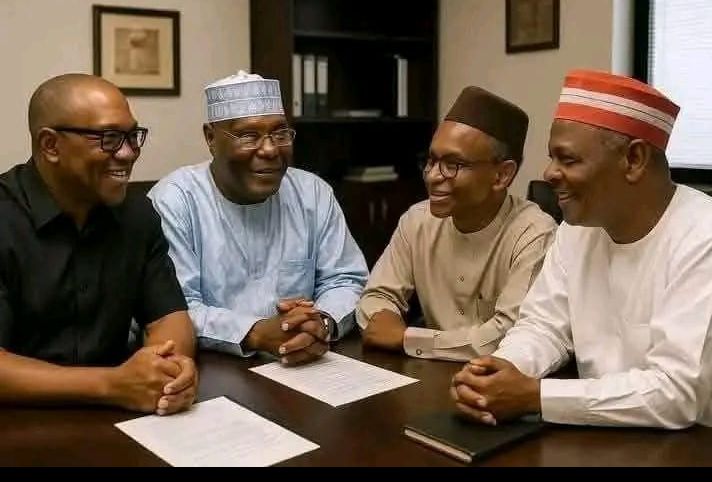
Movers and shakers of the Nigerian politics at the moment, from left: former Anambra State Governor, Peter Obi of the Labour Party, former Nigeria’s Vice President, Atiku Abubakar of the People’s Democratic Party, immediate past Governor of Kaduna State, Nasiru Ahmed el-Rufai of the Social Democratic Party and the former Kano State Governor, Rabiu Musa Kwankwaso of the New Nigeria People’s Party, are putting heads together in a move to form a political coalition ahead the 2027 general elections in the country.
Last week was a dark one for journalism in Nigeria. That was when the light of two of its bright stars, Hajiya Amina Alhassan Ahmad and Haruna Dauda Biu dimmed and blew out. Amina was cast in the print section of the profession, while Haruna was a star in broadcast journalism. I first noticed Amina in 2014 at a Leadership Newspaper editorial meeting for editors and senior editorial management staff. The meeting, held every Monday, had each editor defending their paper comparatively against its counterparts from other media houses. Friday Leadership, for instance, would be compared against every paper around the country published on the same day. Amina was a striking lady with a queenly pose who had a masterful command of English, spoken with the inflexion of the British tone. If you were in another room and overheard her speak, you might assume a Briton was speaking next door. As a diplomat’s daughter, she had the opportunity to study at Kuwait English School (KES) when her late father, Ambassador Yahya Alhassan, was an ambassador in the country. And in her gait and carriage, you would know she was a polished individual.
Haruna, the Voice of America (Hausa Service) reporter for Borno and Yobe states, was a gentleman of the first order. And humble, too. I would call him “maci gauta”, or “garden egg eater”, because the Babur, the tribe he belonged to in Biu Local Government in Borno State, are known to consider the small bitter types of garden eggs a delicacy, sometimes eaten with pepper. He always answered respectfully. In life, only Allah knows how every one of us will end our lives. A seemingly inconsequential sickness, thought to be high blood pressure, escalated into something else that caused him partial paralysis. The last time we spoke, he told me he had just returned from a Cairo hospital facilitated by the Borno State Governor, Babagana Umara Zulum. Amina’s case differed; she did not tell close friends about her ailment. I am still at a loss as to why she hid it. Being the considerate and kind-hearted person she was, was it that she did not want to bother people or be seen as a liability? She must have been seriously bedridden six months ago, as the mammary cancer spread to her brain about that time. According to one of her sons, she was diagnosed with it about three years ago, but she would not go for chemotherapy until it spread. After her death, I went through our chats to see if she had left me any hints, and I saw our SMS chat of 12 September 2022. I sent her a message that a man with a so-and-so number had called me from Alliance Hospital regarding her request for an interview on something related to cancer. And she replied to me, “Oh, yes. That must be the MD. I’ll call him, thank you.” That was the closest I came to associating her with cancer. At the time, she was my staff. She was an editor and rose to become Neptune Prime’s chief operating officer because of her diligence, dedication, and loyalty. She was the type who was ready to take the flak for others if anything went wrong. As the publisher, you could understand if I assumed she wanted to interview the MD for our paper because she drove our newspaper’s content direction and editorial policy. After her death, I realised that she wanted to consult a specialist. As I said, we first met at Leadership Newspaper. She was a features editor, and I was the stable’s Friday title editor. In 2014, I became the spokesman for Dr Abdu Bulama, minister of science and technology, and she was made acting editor in my place. She also rose to become editor of the weekend edition and a member of the newspaper’s editorial board. Our paths crossed again when I floated Neptune Prime, an online newspaper, in 2016; she was no longer with Leadership. The rest, as is often said, is history. While I was not very close to Haruna, who was Maiduguri-based, from my few interactions with him and the testimonies of friends, journalism has lost a gem, and humanity has lost a part of it. As for Amina, I knew her as a very compassionate, thoughtful, considerate, morally upright lady who was chaste and mindful of how God and society would look at her. Her British-intoned “assalamu alaikum” rings in the ears always. She is not just a loss to journalism but to humanity at large. May Amina Alhassan Ahman be in Jannatul Firdaus with her late father and beloved husband, and may Haruna Dauda Biu find favour with Allah (SWT).
OTHER STORIES:
Insecurity, Our Immigration, Our Airports
Last week, many Nigerians heard the news that the wife and mother of Ado Aleiro, a bandit kingpin making life a living hell for Nigerians in the Zamfara axis, were apprehended. Please wait for it; the arrest was made in Madina. No, not Gusau! Not at any of our airports. Not by the Immigration officers who processed their passports and were at the airports to monitor travellers. Our NDLEA officials were napping. DSS? No, Patrick Utomi has taken their attention. Where were the police, NSCDC, FAAN and NAHCO officials? But that is not even the worst part of it. Wait and watch. No heads would roll. And so, there is no “medicine” against future occurrences.
Don’t Tax Us Out of Business
Last week, at the 2025 Taraba International Investment Summit, Alhaji Aliko Dangote, Africa’s richest man, disclosed that foreign investors would come without invitation if local investors were treated well, that is, “if they were making a good profit to offset the cost of production.” He said that for every ₦1 he or any investor made, 52 kobo went to the Federal Government as tax. He should know because, last year, the Dangote Group and its subsidiaries paid over ₦402.3 billion in taxes, making them the highest taxpayers in Nigeria. Surely, there would be serious problems in our economic development if entrepreneurs who invest their resources to create employment opportunities for our teeming populations are taxed out of business. What of the wise saying not to kill the goose that lays the golden eggs?
Hassan Gimba, anipr, is the CEO/Publisher of Neptune Prime.
The Governor of the Central Bank of Nigeria (CBN), Olayemi Cardoso, has been conferred with a Honorary Award at the maiden Nairametrics Capital Market Choice Awards. Presenting the Award to Cardoso yesterday, May 23, in Lagos, the Founder/CEO of Nairametrics, Ugo Obi-Chukwu, said that the award was in recognition of Cardoso’s transformative leadership and strategic contributions to Nigeria’s financial and capital markets. According to him, under the leadership of Cardoso, CBN has pursued reforms that has transformed the financial sector, restored investor confidence, deepened market participation and fostered long-term economic resilience. In addition to the individual recognition, the Central Bank of Nigeria also won the “Market Reform Initiative of the Year” award, which is seen as a testament to the Bank’s continued efforts to drive systemic reforms and innovation within the financial ecosystem. According to the organisers, the CBN’s recent policy interventions aimed at strengthening monetary transparency, investor confidence and financial market stability earned it the distinguished award. Receiving the award on behalf of the Governor and the CBN, the Bank’s Director, Banking Supervision Department, Dr. Olubukola Akinwunmi, expressed gratitude to Nairametrics for the award and urged all stakeholders to continue striving for transparency to ensure stability in the financial system. Other Honorary Award recipients were the Governor of Lagos State, Babajide Sanwo-olu; the Minister of Industry, Trade and Investment, Dr. Jumoke Oduwole; the Director General, Securities and Exchange Commission (SEC), Dr. Emomotimi Agama and the President, Capital Market Academics of Nigeria, Professor Uche Uwaleke. Posthumous awards were also conferred on the trio of the late Chief Akintola Williams, Nigeria’s first Chartered Accountant; late Chief Subomi Balogun, pioneer banker and late Engr. (Mrs.) Florence Seriki, a pioneering female tech entrepreneur. The event featured 25 award categories and brought together key players from across the financial services sector to celebrate excellence, resilience and leadership that are shaping the future of Nigeria’s capital market.
About 21,082 candidates who were scheduled to resit the 2025 UTME examination set by the Joint Admission and Matriculation Board (JAMB) did not show up at their various centers last week. This information came out today, May 25, n a statement by the JAMB’s Public Communication Advisor, Dr. Fabian Benjamin, while announcing the release of the results of the resit examination.
According to Dr. Fabian, 21,082 out of the total of 336,845 candidates who were rescheduled for the examination failed to show up for the resit. He said that no explanation was provided for the high number of absentees. He said that the rescheduled list included only candidates from affected centres after filtering out sessions that were deemed valid, as well as previously unverified candidates.
The Nigerian National Petroleum Company Limited (NNPC Ltd) has announced the immediate shutdown of operations at the Port Harcourt Refining Company (PHRC) as part of a scheduled maintenance exercise set to begin today, May 24. In a statement, the Chief Corporate Communications Officer, Femi Soneye said the move is aimed at enhancing the refinery’s performance and ensuring long-term operational sustainability. “The Nigerian National Petroleum Company Limited (NNPC Ltd) wishes to inform the general public that the Port Harcourt Refining Company (PHRC) will undergo a planned maintenance shutdown. “This scheduled maintenance and sustainability assessment will commence on May 24, 2025. “We are working closely with all relevant stakeholders, including the Nigerian Midstream and Downstream Petroleum Regulatory Authority (NMDPRA), to ensure the maintenance and assessment activities are carried out efficiently and transparently. “NNPC Ltd remains steadfast in its commitment to delivering sustainable energy security.” The company assured that regular updates will be provided through official channels, including its website and media platforms, to keep the public informed throughout the maintenance period.”
No president in Nigeria’s history received more public endorsements for a second term than Goodluck Jonathan. Politicians across party lines, governors, senators, traditional rulers, religious leaders, billionaire businessmen, and over 10,000 well-funded support groups flooded the airwaves daily, confidently predicting his victory—some even before noon on election day. For Jonathan’s administration, money was never a constraint. Funds were recklessly thrown at anyone who showed the slightest support—so much so that merely greeting “Mama Peace” with a “Good morning” could attract largesse. A month to the February 2015 elections, the Jonathan government secretly commissioned an international poll expert to predict the election outcome. The result? A shocker. The poll predicted Jonathan would lose if the election were held as scheduled. Alarmed, the president summoned the National Security Adviser (NSA), Sambo Dasuki, and the head of the DSS. Their internal intelligence confirmed the grim forecast: the North was mobilized and ready to vote Jonathan out. In a state of panic, and despite nationwide outrage, the Jonathan administration postponed the elections by six weeks. The official reason was to address insecurity in the North-East, a region long neglected under his watch. Ironically, the same Jonathan government that allowed Boko Haram to displace thousands—hoping the chaos would suppress Northern voter turnout and give him an advantage in the South and North Central—was now racing to deploy troops and reclaim territory, not out of concern for the people, but to rescue a failing re-election bid. Why the sudden urgency? The NSA and DSS warned that Northerners were determined to defy the odds and cast their votes. INEC Chairman Attahiru Jega also resisted pressure to cancel elections in the troubled North, insisting that adequate arrangements were in place, even for displaced persons. Jonathan was boxed in. He delayed the polls, deployed military resources, and hoped that his last-minute efforts would appease Northern voters. But it was too little, too late. The North saw through the charade and rejected him. In desperation, Dasuki was dispatched to London to brief the international community on the “justification” for the postponement. On his return, the doors of the Central Bank were flung open to him. Billions in naira and dollars were siphoned—allegedly to buy arms, but in reality, used to bankroll Jonathan’s re-election campaign. The infamous $2.1 billion arms procurement fund became a political war chest, enriching cronies and drowning support groups in cash. Even former Sokoto State Governor, Attahiru Bafarawa reportedly received ₦4.6 billion (over ₦40 billion in today’s value) to hire local and international marabouts, witch doctors, and prayer warriors for Jonathan’s victory. But did all of this save him? No. Nigerians spoke loudly on election day and threw Jonathan out of power. The APC itself was stunned by the scale of its victory, and the PDP remains in denial to this day.
Fast forward to 2025, President Tinubu, buoyed by arrogance and flattered by sycophants who crown him a “master strategist,” is blindly walking the same path that ended Jonathan’s reign. But history teaches hard lessons. No leader who ignores or torments the Nigerian people walks away unscathed. Nigerians may appear passive, docile, or defeated, but when the time comes, they strike back—with the ballot or by force of will. Make no mistake: 2027 is not about APC versus opposition parties. It is a battle between the suffering masses and the architects of their torment. The level of hardship under Tinubu’s APC is unprecedented—far exceeding anything experienced under Jonathan. Yet, Tinubu and his cheerleaders carry on, deluded and indifferent. The warning signs are clear. Obasanjo once responded to a journalist asking if the 2015 election postponement would help Jonathan win: “Postponing the funeral doesn’t wake up the dead. You’re only delaying the burial.” That analogy is more relevant today than ever. Tinubu’s administration is already politically “dead” in the hearts of Nigerians. The charade of endorsements, the wasteful “validation” events, and the careless squandering of public funds won’t change the outcome. Nigerians are watching, and they are waiting. Nigeria is too vast, too diverse, and too proud to be subdued by any one man or cabal. Those who attempt it always learn the hard way.
Most of Nigerian Muslims are already in the Holy land of Saudi Arabia for this year’s pilgrimage. They are all in the blessed lands of Makkah and Madinah, ready to fulfil this divine obligation at the Two Holy Mosques. Yet, behind the grandeur, garbs, and symbolism of Hajj, lies a disturbing contradiction in the country’s socio-economic and political landscape. Many ignorant people embark on Hajj without equipping themselves with the basic knowledge of Islam, including the essence of Hajj and the minimum expected manifestation of the fear of Allah (Taqwa). Recently, villains, bandits and charlatans were seen donning sacred garb, both in Nigeria and Saudi Arabia. Yahaya Zango, a wanted bandit linked to multiple kidnappings in northern Nigeria, was arrested at the Hajj camp in Abuja during screening. Similarly, Sani Galadi, connected to abductions in Kogi state and Abuja, was apprehended at the Sultan Abubakar International Airport in Sokoto while preparing for pilgrimage. These arrests expose a disturbing trend! The purpose of this piece is to highlight how crucial it is for many Muslims to obtain a foundational education in Islam before hastily completing the Hajj. The five pillars of Islam form the foundation of a Muslim’s faith and practice. The first is the Shahadah, the declaration that there is no god but Allah and that Muhammad (peace be upon him) is His Messenger. The second is Sallah, performing five daily prayers that strengthen a Muslim’s connection and devotion to Allah. The third is Zakah, giving a portion of one’s wealth to the needy, promoting social equity. The fourth is Sawm, fasting during Ramadan to build self-discipline, power of restraint and spiritual awareness. The fifth pillar is Hajj, the sacred pilgrimage to Makkah, which is required once in a lifetime for every Muslim who is physically and financially able. The Hajj’s designation as the fifth pillar of Islam is interesting; this chronological order is intentional and highly symbolic. Allah offers precise instructions in the Qur’an for those who wish to embark on this profound journey. “Pilgrimage to this House is an obligation by Allah upon whoever is able among the people. But whoever disbelieves – then indeed, Allah is free from need of the worlds. (Qur’an 3:97) “And take provisions, but indeed, the best provision is Taqwa (God-consciousness). So, fear Me, O you of understanding (Qur’an 2:197).” The Prophet Muhammad (peace be upon him) reminds us: “Allah is Pure and only accepts what is pure.” (Sahih Muslim). Both the verses of the Qur’an and the sayings of the Prophet (peace be upon him) collectively instruct pilgrims, before, during, and after Hajj, to take essential provisions such as knowledge, fear of Allah, and inner purity. However, they emphasise that the best provision for the journey is Taqwa (God-consciousness), which should be wrapped in knowledge and sincerity. The guidance further urges those with understanding to cultivate a deep fear and reverence for Allah, as this is the true mark of a successful pilgrim. For many Nigerians, the Hajj has regrettably devolved into an annual ritual and a form of religious tourism that lacks introspection and self-purification. In an ill-informed and desperate attempt, Nigerians rush to “stone the devil” while still endorsing the devil’s schemes and antics. Professional politicians at different levels in Nigeria who embezzle public funds, unleash bad governance on the rest of us, and deny their constituents basic amenities line up to perform the Hajj with it. After hurting countless souls, businesspeople who take advantage of the masses by selling substandard goods, charging exorbitant prices, and dishonesty come to Makkah to “stone the devil.” In addition to lying to the public, abusing their power, and taking bribes to carry out their paid responsibilities, civil servants who are tasked with overseeing government institutions and structures also aspire to become Alhajis and Alhajas with obscene wealth. The half-educated Islamic scholars and the mischievous among the well-educated ones are culpable. These marabouts and alfas embolden civil servants and politicians to “stone the devil,” falsely assuring them that all their sins and atrocities will be forgiven. Who are they deceiving? The principles of repentance (Tawbah) regarding stolen wealth are clear in Islam: the entire stolen wealth must be returned. Physicians, nurses, and pharmacists who divert patients from government hospitals to their private clinics to profit from them or who steal drugs meant for the poor are also part of the charlatans in the medical profession running to Makkah to “stone the devil,”. Unfortunately, a large number of these medical officers have made quick fortunes by associating with dishonest officials at government hospitals. In schools, exam administrators, teachers, and principals who enable malpractice and operate so-called “miracle centres” take unethical breaks, only to embark on Hajj as if the pilgrimage will cleanse their misconduct. Contractors who construct deadly roads and collapsing buildings using substandard materials also find time to perform the rites of Hajj, hoping that tawaf and the stoning of the devil will somehow absolve them of their greed and negligence. The list of such violations against the sanctity of Hajj is countless, reflecting a deeper crisis of hypocrisy and moral decay cloaked in religious rituals. Even drug traffickers of narcotics and human traffickers now don the sacred garments of Hajj, hoping to mask their crimes with pilgrimage while defiling its sanctity.
Pilgrims on arafat
Next are the merchants of death—the contractors who construct deadly roads and highways, build substandard airport runways, and erect public buildings with inferior materials. Yet, they still find time to answer the call of Hajj, perhaps hoping that tawaf and the stoning rites will somehow cleanse the corruption of their hands. The list of such abuses against the sanctity of Hajj is endless, exposing a dangerous trend of using sacred rituals to mask moral bankruptcy. This is not an attack on the ritual of Hajj—a pillar of Islam and a spiritual pinnacle for every true believer. The writer is himself a firm believer in Islam, in the purifying power of Hajj, and the boundless mercy of Allah. However, the record must be set straight. This is, rather, a wake-up call: Islam is a complete and comprehensive way of life, and ‘Ibadah (worship). Hajj should not be demonised or reduced to a gathering of thieves and vultures! There can be no genuine spiritual cleansing without sincere repentance, no acceptance without purity, and no meaningful transformation without knowledge. Nigerian Muslims must revive the spirit of genuine submission to Allah to return to the core tenets of their faith, not just through external rites. The foundation of it is a profound comprehension of Tawheed, the Oneness of Allah, which influences every facet of a believer’s existence. It demands integrity in business, where profit is never sacrificed for honesty. It calls for justice in governance, where authority is used responsibly and fairly. It demands that morality be taught in schools, moulding students’ minds with virtue rather than vice. To ensure that every citizen is treated with dignity, it exhorts us to advance mercy and justice in public service. It pushes us to create families that are based on discipline, compassion, and faith. And when we do the Hajj, let it be with legal income, a cleansed heart, and a character that has been genuinely changed by Islam’s teachings—not just a trip to Makkah, but a return to righteousness. Until we live Islam before performing its rituals, our journeys to Makkah may remain nothing but costly charades. Let us not be deceived. You cannot stone the devil in Makkah while dining with him in Nigeria. We pray that Allah will give us the wisdom, sincerity, and Taqwa to be Muslims in thought, word, and deed, not just in name. To all sincere Nigerian pilgrims starting the holy Hajj journey, may Allah accept your journey and grant you Hajj Mabrur, a Hajj that is acknowledged, transformative, and rewarded with forgiveness and rejuvenation. I hope your prayers are heard, your hearts are cleansed, and you return with a stronger faith and a more moral lifestyle. AMEN. *Dr. Lukman Raimi, PhD, LL.M, MNIM is an entrepreneurship educator, legal researcher, and good governance advocate.
We use cookies on our website to give you the most relevant experience by remembering your preferences and repeat visits. By clicking “Accept”, you consent to the use of ALL the cookies.
This website uses cookies to improve your experience while you navigate through the website. Out of these, the cookies that are categorized as necessary are stored on your browser as they are essential for the working of basic functionalities of the website. We also use third-party cookies that help us analyze and understand how you use this website. These cookies will be stored in your browser only with your consent. You also have the option to opt-out of these cookies. But opting out of some of these cookies may affect your browsing experience.
Necessary cookies are absolutely essential for the website to function properly. This category only includes cookies that ensures basic functionalities and security features of the website. These cookies do not store any personal information.
Any cookies that may not be particularly necessary for the website to function and is used specifically to collect user personal data via analytics, ads, other embedded contents are termed as non-necessary cookies. It is mandatory to procure user consent prior to running these cookies on your website.








 Fast forward to 2025, President Tinubu, buoyed by arrogance and flattered by sycophants who crown him a “master strategist,” is blindly walking the same path that ended Jonathan’s reign. But history teaches hard lessons.



Last Week, A Dark One For Journalism In Nigeria; Other Stories, By Hassan Gimba
Last week was a dark one for journalism in Nigeria. That was when the light of two of its bright stars, Hajiya Amina Alhassan Ahmad and Haruna Dauda Biu dimmed and blew out. Amina was cast in the print section of the profession, while Haruna was a star in broadcast journalism.
I first noticed Amina in 2014 at a Leadership Newspaper editorial meeting for editors and senior editorial management staff. The meeting, held every Monday, had each editor defending their paper comparatively against its counterparts from other media houses. Friday Leadership, for instance, would be compared against every paper around the country published on the same day.
Amina was a striking lady with a queenly pose who had a masterful command of English, spoken with the inflexion of the British tone. If you were in another room and overheard her speak, you might assume a Briton was speaking next door.
As a diplomat’s daughter, she had the opportunity to study at Kuwait English School (KES) when her late father, Ambassador Yahya Alhassan, was an ambassador in the country. And in her gait and carriage, you would know she was a polished individual.
In life, only Allah knows how every one of us will end our lives. A seemingly inconsequential sickness, thought to be high blood pressure, escalated into something else that caused him partial paralysis. The last time we spoke, he told me he had just returned from a Cairo hospital facilitated by the Borno State Governor, Babagana Umara Zulum.
Amina’s case differed; she did not tell close friends about her ailment. I am still at a loss as to why she hid it. Being the considerate and kind-hearted person she was, was it that she did not want to bother people or be seen as a liability? She must have been seriously bedridden six months ago, as the mammary cancer spread to her brain about that time. According to one of her sons, she was diagnosed with it about three years ago, but she would not go for chemotherapy until it spread.
After her death, I went through our chats to see if she had left me any hints, and I saw our SMS chat of 12 September 2022. I sent her a message that a man with a so-and-so number had called me from Alliance Hospital regarding her request for an interview on something related to cancer. And she replied to me, “Oh, yes. That must be the MD. I’ll call him, thank you.”
That was the closest I came to associating her with cancer. At the time, she was my staff. She was an editor and rose to become Neptune Prime’s chief operating officer because of her diligence, dedication, and loyalty. She was the type who was ready to take the flak for others if anything went wrong.
As the publisher, you could understand if I assumed she wanted to interview the MD for our paper because she drove our newspaper’s content direction and editorial policy. After her death, I realised that she wanted to consult a specialist.
As I said, we first met at Leadership Newspaper. She was a features editor, and I was the stable’s Friday title editor. In 2014, I became the spokesman for Dr Abdu Bulama, minister of science and technology, and she was made acting editor in my place. She also rose to become editor of the weekend edition and a member of the newspaper’s editorial board.
Our paths crossed again when I floated Neptune Prime, an online newspaper, in 2016; she was no longer with Leadership. The rest, as is often said, is history.
While I was not very close to Haruna, who was Maiduguri-based, from my few interactions with him and the testimonies of friends, journalism has lost a gem, and humanity has lost a part of it.
As for Amina, I knew her as a very compassionate, thoughtful, considerate, morally upright lady who was chaste and mindful of how God and society would look at her. Her British-intoned “assalamu alaikum” rings in the ears always. She is not just a loss to journalism but to humanity at large.
May Amina Alhassan Ahman be in Jannatul Firdaus with her late father and beloved husband, and may Haruna Dauda Biu find favour with Allah (SWT).
OTHER STORIES:
Insecurity, Our Immigration, Our Airports
Last week, many Nigerians heard the news that the wife and mother of Ado Aleiro, a bandit kingpin making life a living hell for Nigerians in the Zamfara axis, were apprehended. Please wait for it; the arrest was made in Madina. No, not Gusau! Not at any of our airports. Not by the Immigration officers who processed their passports and were at the airports to monitor travellers. Our NDLEA officials were napping. DSS? No, Patrick Utomi has taken their attention. Where were the police, NSCDC, FAAN and NAHCO officials?
But that is not even the worst part of it. Wait and watch. No heads would roll. And so, there is no “medicine” against future occurrences.
Don’t Tax Us Out of Business
Last week, at the 2025 Taraba International Investment Summit, Alhaji Aliko Dangote, Africa’s richest man, disclosed that foreign investors would come without invitation if local investors were treated well, that is, “if they were making a good profit to offset the cost of production.”
He said that for every ₦1 he or any investor made, 52 kobo went to the Federal Government as tax. He should know because, last year, the Dangote Group and its subsidiaries paid over ₦402.3 billion in taxes, making them the highest taxpayers in Nigeria.
Surely, there would be serious problems in our economic development if entrepreneurs who invest their resources to create employment opportunities for our teeming populations are taxed out of business. What of the wise saying not to kill the goose that lays the golden eggs?
Hassan Gimba, anipr, is the CEO/Publisher of Neptune Prime.