

Ohinoyi, Paramount King Of Ebiraland, Kogi Central, Calls For Attitudinal Change To Attract Investors
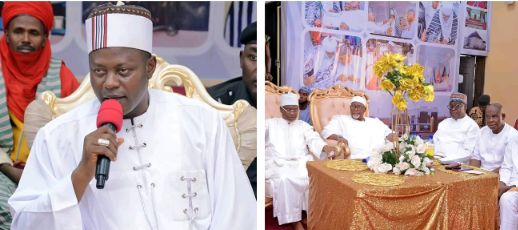
The Paramount Ruler of Ebira Land in Kogi Central, Ohinoyi Alhaji (Dr) Ahmed Tijani Muhammed Anaje, has called for attitudinal change amongst his subjects as a way of attracting outsiders and meaningful investors to boost the socioeconomic status of the land.
Dr. Ahmed Tijjani Anaje, who is also the Coordinator of the North Central Traditional Council and Vice Chairman of the Kogi State Council of Chiefs, reminded his people that through the ages, they were known only for good character and attitude, stressing the need for improvement.
The Royal father spoke during an important meeting held in his palace in Okene, with prominent Ebira sons and daughters from all parts of the country.
Ahmed Tijjani Anaje, Chairman Ebira Area Traditional Council and Patron Council of Ulamau, insisted that the only way to attract good things to the kingdom is through conscious efforts to rebrand the culture, lifestyle, and promotion of the local dialect among the young ones to avoid its extinction.
“As long as God has placed me here on the throne as the royal father of all Ebira, I will not keep quiet. I must stand up to do the needful to move the entire kingdom forward because God has named us Ebira, which connotes character: both good and bad, and each has its reward. The way you choose to live also matters. The world also needs you to be patient and live well.”
According to the Paramount Ruler, if good people do nothing, evil will continue to prevail even as he called for attitudinal change, cultural festivals rebranding, opening up of tourist sights, and good parenting, which is the root of all courses.
He charged parents to train their children in the way they should go, advising that parents should talk their children out of bad habits.
The King, who also serves as patron of the League of Imam and Vice President of the Jam’atu Nasrul Islam in Kogi State, lamented the damage drug addiction has caused Ebira youths.
He suggested an annual get-together of all sons and daughters of the soil to have a unique time to celebrate one another with a sense of belonging to a kingdom. He added that such forum could be used to generate and discuss ideas, initiatives, values, and norms to build a better society.
“It is high time to rise to this occasion to build a better society.”
The Ohinoyi encouraged the people to uphold the values of their forefathers, change the narrative, and that the orientation should start now, through the concerned people of Ebira, to guide the steps of the next generation.
“I am also not happy with how some community leaders have sold pieces of land to people at random, which could lead to the future wipe-out of such communities, with God-deposited natural resources worth billions of naira taken away for a small amount. This should not be supported by all.”
On cultural heritage and tourist centres, the Ohinoyi called for the proper overhauling and projection of some annual festivals known to be harmful due to their nature, and stereotyping, insisting that Ebira festivals are violent in nature.
He called on the people to think of an appropriate time and mode of celebration to attract other tribes, states and the international communities.
“I am for all Ebira people, and it will be to the glory of God if good things are spoken of us as a people. I will be glad that you are all doing well, attracting good things, and building a society where no violence will prevail.”
The Ohinoyi called for peaceful coexistence, respect for those in authority, and love for one another if Ebira must move forward.
He called for the inauguration of seven different committees and subcommittees with mandates to address social, economic, and political issues, rebrand and promote cultural heritage and tourism, promote inclusive development, and engage local communities in the process.
Their assignment was also to effect the orientation of attitudinal change among Ebira youths. It is expected that all committees will have representatives from traditional rulers, Christians, Muslims, youths, and the elderly for an all-encompassing dialogue and brainstorming for positive impacts.
The Ohinoyi used the occasion to announce an upcoming event at his palace that will attract over 200 course mates from the Nigerian Army and guests from across Nigeria, who will visit significant historical places in Kogi Central, starting from 23 April. He called on the people to rally round him for a successful event.
The Ohinoyi commended the immediate past Governor, Yahaya Adoza Bello, for his proactiveness in restoring peace, harmony, and unity among all Kogites, with social and infrastructural development across the three senatorial districts.
He also appreciated the present Governor, Ahmed Usman Ododo, for building on existing achievements and more.
Many prominent persons attended the meeting, including traditional title holders, former and present lawmakers, professors, technocrats, government officials, civil servants, market women, Ebira elites, and youths.







Shaka Ssali: The Voice That Bridged Continent – Tribute, By Emman Shehu Usman
About two years ago, a former student of mine at the International Institute of Journalism, Abuja, reached out to me to link her up with Shaka Ssali, whose voice through the years, had become emblematic of the African Service of the Voice of America (VOA).
Apparently, she had seen my social media post in late 2019, when I met the baritone-gifted Ssali during a visit to the Washington Studios of VOA. It was a memory laden moment as both Ssali and I shared what we knew of each other from afar as journalists and broadcasters.
That post about my meeting with Ssali, had mentioned his deep respect for Nigeria and my former student wanted to contact him for her proposed documentary on the late Dr Nnamdi Azikiwe.
She eventually got him to be on the documentary which was concluded recently, but he passed away this week and will not get to see the final product, including his input.
In the annals of African journalism, few names resonate with the gravitas and warmth of Shaka Ssali, the Ugandan-born broadcaster who, for over two decades, turned a microphone and a camera into a lifeline for a continent.
Ssali, who passed away on 27 March, 2025, at the age of 71 in Virginia, USA, was more than a journalist—he was a storyteller, a truth-seeker, and a bridge between Africa and the world. His death, just weeks shy of his 72nd birthday, marks the end of an era, but his legacy, forged through the airwaves of Voice of America’s (VOA) Straight Talk Africa, will echo for generations.
Born in the rolling hills of Kabale, Uganda, Ssali’s journey was anything but conventional. He was a child of modest beginnings, the son of John Mushakamba, a respected businessman, and Joyce, who instilled in him a curiosity that would shape his life. As a boy, he sat by the fireplace with his father, listening to the crackle of a Pie radio, captivated by the voices that floated through the ether.
Those evenings planted a seed—one that would sprout years later into a career that redefined African media. But the path was winding. Dropping out of school in 1968, Ssali joined the Ugandan Army at 16, rising to the rank of lieutenant by his early 20s. It was a detour shaped by the cinematic allure of cowboys—John Wayne and Clint Eastwood loomed large in his youthful imagination—but also by the stark realities of a nation under Idi Amin’s shadow. In 1974, after his name surfaced in a failed coup attempt, Ssali fled to Kenya, then to the United States, carrying little more than resilience and a hunger for knowledge.
What followed was a transformation as remarkable as it was improbable. In America, Ssali rebuilt himself, brick by intellectual brick. He earned a bachelor’s degree, two master’s degrees, and a doctorate in cross-cultural communication and history from UCLA—a testament to the “transformational power of knowledge” that one interviewer aptly ascribed to him.
A former Ford Foundation Fellow, he collected accolades like milestones: a United Nations Peacekeeping Special Achievement Award in International Journalism, VOA’s Best Journalist Award, and, just last year, a Lifetime Achievement Award from the Ugandan North American Association (UNAA). Yet, for all his academic and professional triumphs, Ssali remained the “Kabale Kid”—a nickname he wore with pride, a nod to the roots that grounded him.
In 1994, Ssali joined VOA, and in August 2000, he launched Straight Talk Africa, a program that would become his megaphone and his monument. For 21 years, until his retirement in May 2021, he hosted the weekly show with a signature blend of calm authority and incisive curiosity. From Washington, D.C., his voice reached millions across Africa via radio, television, and the internet, dissecting the continent’s triumphs and tribulations with equal measure.
Presidents and prime ministers—Uganda’s Yoweri Museveni, Rwanda’s Paul Kagame, Zimbabwe’s Robert Mugabe—sat across from him, fielding questions that cut through platitudes. Intellectuals like Nobel laureate Wangari Maathai and artists like Hugh Masekela shared his stage, their voices amplified by his platform. Ssali didn’t just interview; he convened a continental conversation, one that spanned democracy, governance, and the dreams of Africa’s youth.
What set Ssali apart was his humanity. He once said, “Information is the oxygen of democracy,” a credo he lived by with every broadcast. His guttural voice, tinged with the cadence of Kabale, carried a sincerity that disarmed guests and listeners alike. He was fearless but fair, a journalist who challenged power without losing sight of the powerless. “Get better, not bitter,” he often urged, a mantra that reflected his own journey from exile to eminence. His other signature phrase, “Keep the African hope alive,” became a rallying cry for a continent too often defined by its struggles rather than its potential.
Ssali’s impact transcended the studio. In Kampala, Dar es Salaam, and Abuja, his name opened doors—literally. Friends recount tales of leveraging his fame for hotel discounts or market cred, a testament to his reach. In Uganda, where he returned periodically, he inspired a generation of journalists. Andrew Agaba, station manager of Voice of Kigezi radio, credits Ssali with forging a partnership that brought Straight Talk Africa to local airwaves.
“He showed us what was possible,” Agaba says. Across the diaspora, from the UNAA convention to the streets of Kabale, he was a symbol of what discipline and determination could achieve.
His retirement in 2021 was not an end but a pivot. Replaced by South African journalist Haydé Adams, Ssali planned to mentor youth and share his vast reservoir of wisdom. Even as health challenges mounted in his final years—details of which remain private—he remained a beacon. In April 2024, he debunked death rumors with a chuckle, declaring, “I am alive and kicking,” a moment that captured his enduring spirit.
Tributes have poured in since his passing. VOA called him “a revered broadcaster” whose “indelible legacy” shaped African journalism. Former Ugandan Prime Minister Ruhakana Rugunda, a childhood friend, recalled their days debating politics in Kabale’s gardens. Bobi Wine, Uganda’s opposition leader, mourned “a giant” whose voice championed human rights. Across X (formerly known as Twitter), admirers hailed his passion for truth, his wit, and his unflagging hope.
Shaka Ssali’s death leaves a void, but his life leaves a blueprint. From a school dropout to a Ph.D., from a soldier to a storyteller, he embodied resilience. His Straight Talk Africa was more than a show—it was a mirror held up to a continent, reflecting its complexities and its promise. As Africa navigates an uncertain future, Ssali’s voice, now silent, still whispers through the static: Keep the hope alive. For that, we owe him not just our gratitude, but our action.
*Dr Shehu is the Director, International Institute of Journalism, Abuja