The Oluwo of Iwo in Osun State of Southwest, Oba Abdulrosheed Akanbi, has warned Yorubas against going into war with Fulanis because it will be translated into a war with entire Hausa people in the North.
“Declaring war against the Fulanis will be derogatorily translated to war against the Hausas. Fulanis are just a section of the Hausas. What will be the fate of billions of investments and properties of the Yorubas in the northern States?”
In a statement today, February 19, which he personally signed, Oluwo said that the lifestyle of many Fulanis is not worth fighting as they tend to lose nothing except their cows.
“The lingering Yoruba-Fulani saga is a fragile issue that demands a witty, technical approach. No doubt, the activities such as killing, kidnapping, raping perpetrated by the bad eggs among the Fulanis are condemnable.
“As a people, we must understand who to fight. I see Fulani as a section of the Hausas. And most Fulanis are not stationed in their origin. They have relocated and settled.
“Their most valued item is cows. Most of their properties are movable. Is this who we want to declare war against?”
“If their cows could be moved, how will our innocent sons and daughters in the northern states move their investments and properties? I see Yoruba losing more should there be war.
“I’m appealing to all and sundry to dignify human lives and toe the path of honour in sustaining a peaceful co-existence. War is an enemy of humanity. What war can do, peace can do better.”
A Yoruba activist, Sunday Igboho has surrendered, saying that he will no longer lead the quest to rescue the Yoruba nation from criminals, bandits and killer herdsmen.
In a recent interview with a Yoruba journalist, Mrs. Esabode, Igboho said that he’s no longer leading anymore.
In the interview, which was shared in a Youtube, he complained that his account was frozen because his activism.
Igboho confirmed however that the Federal government had unfrozen his account and his bank manager told him he could now make withdrawals.
He spoke on the attack on Professor Wole Soyinka’s house, saying that he learned of the attack and that two of those who attacked Soyinka’s house have been apprehended.
Igboho expressed disappointment on the leaders he claimed have not done good justice to the Fulani-herdsmen for their invasion of Yoruba soil.
According to him, nowhere is safe again for anyone, adding that even Nigerians in the Diaspora cannot come home because of the insecurity that is taking over the country.
“I’ve played my part; I’m not leading anything anymore if others don’t rise up. If they rise up, I will follow them. Others must stand up to do the needful.”
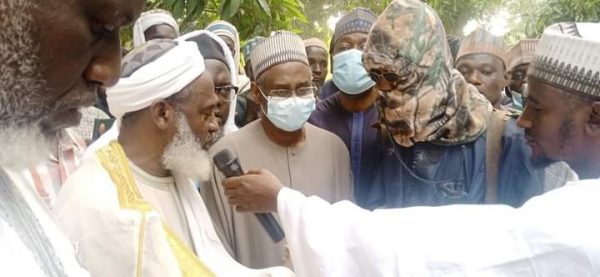
Armed bandits terrorizing some Local Government Areas and communities in Niger State, have promised to release all the kidnapped victims in their captivity, within the State, including students and staff of the Government Science College in Kagara.
This followed a ‘mediation parley’ between a popular Islamic Cleric, Sheikh Ahmad Abubakar Gumi, and the criminals.
Notorious kidnapping warlords such as Dogon Gida, Kachalla, and others, it was gathered, attended the reconciliation forum with Gumi.
They expressed willingness to part of any deradicalization exercise or programme that the government will unveil for their repentant ‘boys’.
“The meeting took place at an isolated area inside a forest in the State, yesterday,” a security source said.
The bandits, he said, told Gumi, that they are tired of the atrocities and killing of innocent persons, they have been carrying out.
“They are not happy that several of their cows have been bombarded, and some stolen by robbers. They alleged that their fellow herdsmen have been killed by some villagers,” he added.
According to the source, who declined giving his name, the bandits took Gumi round some wells were bodies of their fulani relatives and family members, killed in aerial bombardments, were dumped.
“They also let Sheikh Gumi know that vigilantee members in some communities always attack their fulani relatives and family members, whenever they sight them going to markets and towns,” he said.
The presidency and governors have agreed to include none indigenes of a particular community in the recruitment of personnel for local and conventional security outfits across Nigeria, including Amotekun, a Southwest security outfits.
They also agreed to ensure that perpetrators of crime of any type are promptly arrested and prosecuted, to reconstruct destroyed homes in the recent communal clashes, and pay compensation where appropriate for damage to property and livelihoods during targeted attacks on communities, as well as the unequivocal condemnation of manifestations of hatred, hate crimes and related violence against communities.
These agreements were reached yesterday, February 18, at the first physical meeting of the National Economic Council (NEC), presided over by Vice President Yemi Osinbajo, with governors of 36 State, minister of the Federal Capital Territory (FCT) and other key members of the federal executive as well as appointees of the President as members.
Other recommendations and agreements by NEC include the protection of all residents of all States, including non-indigenous communities and religious and ethnic minorities within State jurisdictions;
The arrest and prosecution of all perpetrators of crime;
In collaboration with federal authorities, the reconstruction of destroyed homes and payment of compensation where appropriate by State authorities for damage to property and livelihoods sustained during targeted attacks on communities within their jurisdictions;
Ensuring that deceased victims of such violence are duly accorded dignified burial rites;
The immediate public and unequivocal condemnation of all manifestations of hatred, targeted violence, and other hate crimes against ethnic, religious, and minority groups;
Ensuring that local security initiatives – whether they are State government law enforcement agencies or local vigilante groups or the Community Policing programme of the Nigeria Police Force – are inclusive and are composed with due consideration given to adequate representation of non-indigenous/minority resident communities;
Ensuring that all State, local and communal security initiatives operate according to guidelines consistent with State legislation and the Constitution of the Federal Republic of Nigeria and other relevant laws and are subjected to rigorous oversight;
Ensuring that innocent citizens and entire communities are not slandered, harassed, or victimized for the crimes perpetrated by criminal elements within those communities on the basis of ethnic or religious affiliation.
The continued organization of and participation in town hall meetings in the localities where ethnic strife has taken place by Governors representing all geopolitical zones.
That State Governments have statutory jurisdiction over forest reserves and will seek federal support for efforts to eradicate forest-based crime. (Council deliberated on how forests should be better managed and secured against criminals and criminality.)
That the National Livestock Transformation Plan is a comprehensive strategy for addressing the farmer-herder conflict developed by the States in collaboration with the Federal Government and Governors will seek its full implementation. (States are encouraged to promote modernization of livestock and Council, therefore, called for the strengthening of the National Livestock Transformation Plan.)
The strengthening of border controls to discourage cross-border crimes and the effective observation of ECOWAS Transhumance protocols.
According to a presidential spokesman, Laolu Akande, other discussions at the NEC meeting included the presentation of the strategy for the realization of the President’s vision to bring 100million Nigerians out of poverty.
“The presentation was made to the Council by the Presidential Economic Advisory Council, PEAC.
“Council resolved that the Technical Committee of NEC be set up with 3 Governors and representatives of the Federal Government to look at details of States’ involvement and how their concerns could be addressed regarding the presentation and the implementation of the strategy.”
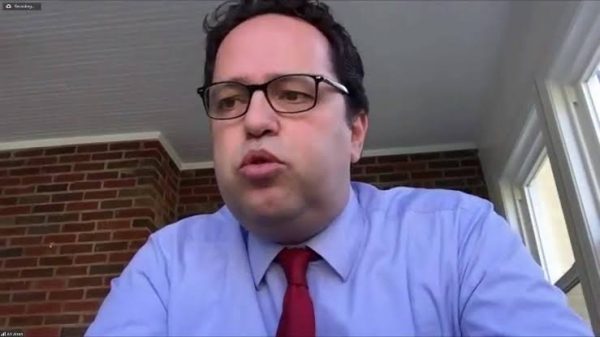
The International Monetary Fund (IMF) has raised eyebrow over the usage of cryptocurrencies, especially in Nigeria, a situation that had recently made the Central Bank of Nigeria (CBN) to ask commercial banks to stop attending to them
The Resident Representative of the IMF in Nigeria, Ari Aisen, in a virtual briefing today, February 18 on the recently published 2020 Article IV IMF Staff Report for Nigeria, recalled that many central banks around the world have taken similar policy decisions as the CBN.
“The issue with some of the crypto currencies is that perhaps some care should be taken about their activities. The use of crypto currencies is a concern. That is why some central banks, not only in Nigeria have these concerns about what kind of the activities these crypto currencies are put and how best to monitor those activities.
“Some of them may be illegal activities and may be related to money laundering, even drugs or other illegal things. It is natural that the monetary authorities will be concerned about how best to supervise and increase their oversight regarding the use of crypto currencies.
“The CBN is thinking closely about its trade-offs and is trying to design the best policy in the interest of the payment system and the sustainability of the financial sector.”
The IMF official called for the “unification of foreign exchange rates,” to make the management of foreign exchange (forex) more transparent.
On forex scarcity, Aisen said that there has been some level of scarcity of foreign exchange out there and that it would be useful to unify rates to allow it flunctuate and to make forex more accessible to those who needed them.
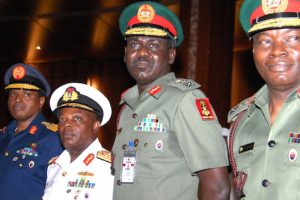
The immediate past Chief of Army Staff, retired Lt. General Yusuf Tukur Buratai has said that it might take 20 years for Nigeria to completely eliminate Boko Haram insurgence.
This is because, he said, Boko Haram fighters are winning more people from communities, especially in the Northeast, particularly Borno State, aside from the problem of ungovernable spaces in the area and across the country.
Buratai, who was being screened today, February 18, by the Senate Committee on Foreign Affairs along with past members of the country’s service chiefs for Ambassadorial position, said: “My state (Borno), is an epicenter, where this indoctrination has penetrated so deep. They (insurgents) have won the communities to their side. That is why they (communities) keep Boko Haram. So it is complex, it requires a whole of government approach to solve this, military action or activity is just one aspect.
“One mistake that we have been making is that only the military can solve this. It is not. There are political, social, economic aspects that need to be addressed.
“Development should be progressive, there should be roads everywhere, there should be employment, schools and hospitals all over.
“Yesterday, I counted five local government areas in Borno State that do not have good access roads.
“In northwest, north central, there are so many ungovernable spaces, which the insurgents are penetrating. The places don’t have schools, hospitals and so on and education is very fundamental.
“Unless these things are done, this insecurity will continue because the truth must be told. It may take another 20 years for the country to surmount the problem of Insurgency and that is the truth.”
Also speaking at the screening by the Senate Committee, the immediate past Chief of Defence Staff, retired General Abayomi Gabriel Olonisakin, attributed the security challenge in the country, especially Boko Haram insurgency to the over 1,000 forest reserves in the country that are not well managed and secured by respective state governments.
He stressed that the problem at hand requires a well galvanized national approach for it to be surmounted since it is more of an asymmetric cum hybrid warfare as against the conventional ones that can easily be confronted and defeated.
“I want to say that the solution to insecurity is multi-pronged. We talk about conventional warfare and asymmetric warfare. We are talking about hybrid warfare where everyone is involved.
“It is not about kinetics. Kinetics gives only 35 per cent success rate in any war we are fighting. It is a national approach that must be properly galvanized for us to actually surmount the insecurity.
“I will say three years ago, I conducted a research on the forests in the country. I realized we have over 1,000 forest reserves. I sent the team to Kenya. They went to Kenya and brought out a paper and I said then, three years ago that our next crisis will be in the forest.
“Some governors were invited and we told them because most of the forests are the prerogative of states. The states took over all the forest reserves. I told them that we have to protect the forests. We have to send troops to protect the forests.
“We did the research in 2018 for six months. I said that the next problem we are going to have is in the forests. But again, it is with us right now. It requires a multifaceted approach.
“Everyone has to come on board for us to be able to address the insecurity situation. You can never have enough weapons, personnel and so on but there are issues we must address and then it has to be all about the nation”
Former Chief of Air Staff, Air Marshal Abubakar Sadique, former Chief of Naval Staff , Vice Admiral Ibok – Ete Ibas and former Chief of Defence Intelligence , Air Vice Marshal Mohammed Sani Usman , who also appeared before the Senate Committee made similar observations and suggestions.
The former Intelligence Chief identified lack of synergy among the various security agencies, as one of the reasons for the lingering security challenges the country is facing.
After the separate screening carried out on the five nominees, the chairman of the Committee, Senator Adamu Muhammad Bulkachuwa (APC Bauchi North), said the committee will submit its report to the Senate next week.
The National Agency for Food and Drug Administration and Control(NAFDAC) has approved the use of AstraZeneca Vaccine for use in Nigeria.
At a news briefing today, February 18 in Abuja, the Director-General of NAFDAC, Professor Mojisola Adeyeye, said that NAFDAC got the dossier of the vaccine a week ago, while its safety committee went to work immediately to evaluate its safety and efficacy for Nigerians.
She said that the vaccine could be stored in two to eight degrees Centigrade, adding that there are three additional vaccines undergoing evaluation.
Astrazeneca Vaccine was recently approved by the World Health Organization for emergency use to curtail the spread of COVID-19
The names of persons abducted by armed bandits from Government Science College, Kagara,
Niger State government has given the names of the students and staff o of the Government Science College, Kagara by armed bandits.
The armed bandits, at about 01.30 am on February 17, stormed government Science College Kagara, Rafi LGA Niger State and kidnapped 27 student, 3 teachers and 12 of their families.
The State government gave the names of the teachers kidnapped as: Hannatu Philip, Lawal Abdullahi and Dodo Fodio. “The Non-teaching staff are MOHAMMED Musa and Faiza Mohammed. The family members are Christiana Adama, Faith Adama, Maimuna Suleman, Nura Isah, Ahmad Usah, Khadizat Isah, Mohammed Mohammed, Aisha Isah and Saratu isah. “The List of the Students are: Jamilu Isah, Shem Joshua, Abbas Abdullahi, Isah Abdullahi, Ezekeil DANLADI, Haliru SHUIBU, Mamuda suleman, Danzakar DAUDA, Abdulsamad Sanusi and Bashir Abbas “Other students include Suleman LAWAL, bdullahi ADAMU, Habakuk Augustine, Idris MOHAMMED, Musa ADAMU, Abdulkarim Abdulrahman, Abubakar Danjumma, Abdullahi Abubakar, Bashir kamalideen and MOHAMMED Salisu. Others are Yusuf M Kabir, Isah Abdullah makusidi, Polineous Vicente, Lawal BELLO, Mohammed k Shehu, Mubarak sidi and Abdulsamad Nuhu. Benjamin HABILA was the name of the student by the bandits in the college premises.
Nigeria’s economy has crawled out of the second “more dangerous” recession in the fourth quarter of 2020 as restrictions to curb the spread of the coronavirus were eased.
According to the National Bureau of Statistics (NBS), on its website today, February 18, Gross Domestic Product (GDP) grew 0.11 percent in the
three months through December from a year earlier, compared with a decline of 3.6 percent in the third quarter, the Abuja-based National Bureau of Statistics said on its website on Thursday.
The median estimate of five economists in a Bloomberg survey was for a quarterly decline of 1.86 percent.
The economy contracted 1.92% for the full year, the most since at least 1991, according to International Monetary Fund data.
The surprise rebound means Africa’s largest economy may recover faster than expected as the oil price and output increase this year.
It could also point to the growing dominance of the non-crude sector, according to Joachim MacEbong, a senior analyst at SBM Intelligence in Lagos.
Oil production fell to 1.56 million barrels a day in the fourth quarter from 1.67 million barrels in the previous three months.
While crude contributes less than 10% to the country’s GDP, it accounts for nearly all foreign-exchange earnings and half of government revenue in continent’s biggest producer of the commodity.
The government’s forecast for growth of 3% this year is double that of the IMF.
A stronger recovery could ease pressure on the central bank to stoke activity, paving the way for a renewed focus on its price stability mandate.
Accotding to a Bloomberg report, “That means the monetary policy committee could start raising interest rates again to fight inflation that’s been above the target band of 6% to 9% for more than five years. The panel eased by 200 basis points in 2020.”
Nigerian soldiers are believed to have been in hot pursuit of bandits who kidnapped members of staff and students of Government Science School, Kagara in Rafi Local Government Area of Niger State in the early hours of today, February 17.
A statement today by the Nigerian Army said that in line with it’s constitutional mandate, reassured the general public that soldiers, in operational synergy with sister security agencies, are in hot pursuit of the criminal elements in order to ensure safe return of the kidnapped victims.
The Army called on members of the general public to provide actionable information to security agencies that would lead to the arrest of the criminal elements.
Report had it that the bandits gained entry into the school in the early hours of today and kidnapped about 17 students and some staff.
We use cookies on our website to give you the most relevant experience by remembering your preferences and repeat visits. By clicking “Accept”, you consent to the use of ALL the cookies.
This website uses cookies to improve your experience while you navigate through the website. Out of these, the cookies that are categorized as necessary are stored on your browser as they are essential for the working of basic functionalities of the website. We also use third-party cookies that help us analyze and understand how you use this website. These cookies will be stored in your browser only with your consent. You also have the option to opt-out of these cookies. But opting out of some of these cookies may affect your browsing experience.
Necessary cookies are absolutely essential for the website to function properly. This category only includes cookies that ensures basic functionalities and security features of the website. These cookies do not store any personal information.
Any cookies that may not be particularly necessary for the website to function and is used specifically to collect user personal data via analytics, ads, other embedded contents are termed as non-necessary cookies. It is mandatory to procure user consent prior to running these cookies on your website.





 The National Agency for Food and Drug Administration and Control(NAFDAC) has approved the use of AstraZeneca Vaccine for use in Nigeria.
 The names of persons abducted by armed bandits from Government Science College, Kagara,
 Nigeria’s economy has crawled out of the second “more dangerous” recession in the fourth quarter of 2020 as restrictions to curb the spread of the coronavirus were eased.
 Nigerian soldiers are believed to have been in hot pursuit of bandits who kidnapped members of staff and students of Government Science School, Kagara in Rafi Local Government Area of Niger State in the early hours of today, February 17.
