Saudi Arabia has offered to pay more than 150,000 dollars (about N60 million) in support for every family whose member died due to Coronavirus infection.
A statement made available to Greenbarge Reporters today, October 28, said the beneficiaries are those in the health sector, whether a Saudi citizen or resident.
It said: “the Saudi Arabian Council of Ministers decided to disburse SR500,000 to the family members of those working in the health sector who died of #coronavirus( saudis and non saudi citizens).”
Nigeria Muslims listen to sermon by Imam (AP Photo/Sunday Alamba)
Federal Government has declared Thursday October 29, as Public Holiday to mark this year’s Eidul-Maulid Celebration in commemoration of the birth of the Holy Prophet Muhammad (Peace be upon him).
Minister of Interior, Ogbeni Rauf Aregbesola, who made the declaration on behalf of the Federal Government, congratulated the Muslim faithful both at home and abroad for witnessing this year’s occasion.
He enjoined them to imbibe the spirit of love, patience and perseverance which are the virtues of the Holy Prophet Muhammad (peace be upon him), adding that doing so would guarantee peace and security in the country.
The Minister admonished Muslims to follow the teaching of the Holy Quran in Chapter 4 Verse 59 which says: “O you who believe! Obey God and obey the Messenger, and those from among you who are vested with authority; and if you are to dispute among yourselves about anything, refer it to God and the Messenger, if indeed you believe in God and the Last Day. This is the best (for you), and fairest in the end”.Ogbeni Aregbesola enjoined Nigerians, particularly Muslims, at this moment, to abhor violence, lawlessness, wantonness and daylight robbery as witnessed across the country most recently, stressing that Nigeria is the pride of the black race and should provide responsible leadership for the greatness and development of the African continent and all black people.
While calling for a stop to all divisive tendencies across the country, the Minister urged all Nigerians and the youth in particular, to embrace peace and cooperate with the President Muhammadu Buhari led-Administration in its effort to build a virile nation, which all citizens can be proud of.
Ogbeni Aregbesola who described the youth as the hope and future of the nation advised them further to deepen democracy and not dampen it. For him, it is with more democracy that we can overcome our challenges, noting that the challenges of nationhood that we face are surmountable if we work through the democratic process.
He wished all Muslims a happy Eidul- Mawlid Celebration and all Nigerians a Happy Holiday.
Nigeria’s former finance minister and a former managing director of the World Bank, Dr Ngozi Okonjo-Iweala has emerged as the first female Director-General of the World Trade Organization(WTO), shattering the glass ceiling. Okonjo-Iweala broke the record, emerging as the first African and the first female to attain the position of DG of WTO by emerging as the finalist after eliminating South Korea’s current trade Minister, Yoo Myung-hee in a fierce battle for the coveted job on Monday night. The New Diplomat Europe’s outpost office gathered that with the EU nations and the United States moving in opposite direction, a move that triggered a deadlock between the two powerful geo-political allies for the first time in many years, it was the decisive and quiet support of China that finally tipped the scales in Okonjo-Iweala’s favour. The WTO’s Ambassador Walker’s led General Council, the overall organ responsible for picking the organization’s next DG, would officially announce the choice of Nigeria’s former Finance Minister, Dr Okonjo-Iweala today, October 27.
Diplomatic sources confided in The New Diplomat that an official announcement to this effect would be formally made today by New Zealand’s Ambassador Walker’s led WTO General Council.
The race for the coveted job of DG of WTO has been fierce with Nigeria’s Okonjo-Iweala and South Korea’s serving Trade Minister, Yoo Myung-hee, running neck-and-neck in the intense jostle and game of global diplomatic intrigues. Indications had emerged that influential global trading countries including the United States(US), the European Union(EU) nations, China, Japan and the BRICS countries were strongly divided on who should be the candidate to lead the WTO. High-level sources confided in The New Diplomat’s Europe’s outpost operations that it “took serious negotiations and prolonged talks to get China to go along with Nigeria with its decision to support Okonjo-Iweala.” China controls about 12.4% of the global trade. The influence of the United States on global trade is reportedly huge as well given that it single-handedly controls about 12% of global trade just as China holds about 12.4% of the global trade statistics. Diplomatic sources hinted that East Asia countries with the exception of China went along with Myung-hee in preference. These include Japan, Hong Kong, Taiwan, Macay, Mongolia and South Korea. Japan, a US ally is another strong international player in global trade with an estimated $705.7 billion worth of goods globally in 2020.
However, on Okonjo-Iweala’s side apart from the EU and 55 AU nations were 24 solid ACP countries that reportedly expressed preference for her candidacy. The CP countries in this regard include Bahamas, Cuba, Barbados, Guyana, Jamaica, Trinidad and Tobago, Dominica Republic, Dominica, Greneda, Fiji, Cook Islands, Solomon Islands, Timor-Lester, Parpua New Guinea, etc. A combination of this preponderance form about 79 block countries that solidly stood behind Nigeria’s Okonjo-Iweala. However, it was the quiet and deft diplomacy of China that sealed the deal in Okonjo-Iweala’s favour. A top diplomat in Geneva told The New Diplomat in confidence: “China quietly changed the game. They said nothing openly but silently they, deftly China voted in Nigeria’s favour.” Okonjo-Iweala, 66, served as Nigeria’s first female finance and later foreign minister, and has a 25-year career behind her as a development economist and international finance expert at the World Bank, eventually becoming its number two. She is also on Twitter’s board of directors and is a special envoy for the World Health Organization’s COVID-19 fight. Thus, Okonjo-Iweala has successfully edged out South Korea’s Myung-hee. Yoo Myung-hee 53, is the serving South Korea’s trade minister, following a long career in trade, diplomacy, law and foreign affairs. She had previously served as South Korea’s foreign Affairs minister, among others. A lawyer and diplomat, Myung-hee holds degrees in Law, Public Policy and was called to the New York Bar.
One major implication of this is that China has somewhat stamped its feet on the global diplomatic and economic dynamics as an indispensable power, having deftly supported Okonjo-Iweala to victory as the US and EU purportedly cancelled themselves in a diplomatic deadlock. Already, China is the biggest economy in the world in terms of P3, the Purchasing Power Parity. Thus, the consequence of this on the global scale, according to diplomats, is quite telling
Muhammadu Buhari has presented the Chairman of the Independent National Electoral Commission (INEC), Professor Mahmood Yakubu, to Senate for confirmation for a second term in office.
In a letter to President of the Senate, Ahmad Ibrahim Lawan, the President said in that accordance with the provision of Section 154 (1) of the Constitution of the Federal Republic of Nigeria, 1999 (as amended), “I am pleased to present for confirmation by the Senate, the nomination of Professor Mahmood Yakubu for appointment as Chairman, Independent National Electoral Commission (INEC) for a second and final term.”
Professor Yakubu was first appointed by President Buhari in November 2015
Things went out of hand very quickly with the emerging Nigerian “revolution” when on Tuesday, October 20, 2020, soldiers stormed the Lekki Toll Gate Plaza in Lagos, and started shooting. We were told they shot in the air. But the reports have been conflicting and troubling. The protesters insist that persons died, and that the attack was pre-meditated. The state authorities insist that persons were injured and that there were no corpses; may be just one. They made it sound as if one person dying was nothing to worry about. Nigeria is a country of over 200 million people. When one person dies, it is hard for the people to notice. The state does not even care. But the truth is that even if only one person died as claimed by the state government, that is enough indictment. There was no justification for anyone dying or sustaining gunshot wounds just because they took the patriotic step of protesting about injustice, police brutality, impunity and bad governance in their country. The #EndSARS protest was about justice, and good governance. The protesters were peaceful.
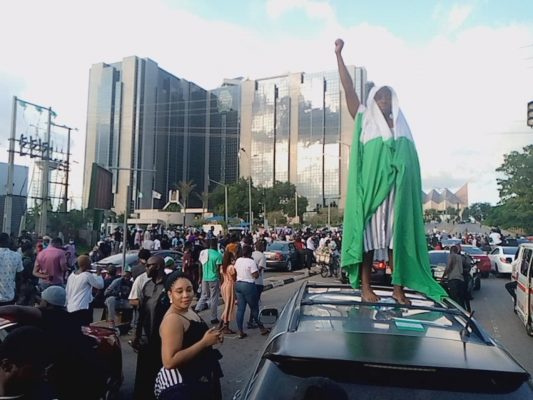
In the Northern states of the country, the protest was tagged #EndInsecurityNow, and the protesters were also peaceful. At the Lekki Toll Gate in Lagos, the protesters reportedly knelt down as soldiers stormed the scene. They waved the Nigerian Flag. They sang the National Anthem. Someone had told the angry young Nigerians- those I once referred to as the “collective children of anger” – that once soldiers see the Nigerian flag, they would not dare shoot at the target. The assumption is that soldiers only shoot the enemy, not their own country’s flag. The Lekki incident in Lagos turned that principle, if that is what it is, on its head. The most impactful image from Lekki is that of a blood-stained Nigerian flag, either as fact or symbol, but nonetheless a symbol of the Nigerian government’s clamp down on young Nigerians exercising their rights under Sections 35, 39 and 40 of the 1999 Constitution (as amended).
Away from the Lekki Toll Gate epicenter, other persons died in the course of the mayhem that ensued: from stray bullets, physical attacks, and wanton destruction. Amnesty International and other civil society groups have reported over 56 deaths. It has been so bad, so embarrassing, so disgraceful, that not even the military authorities are willing to admit that they sent soldiers to the streets. All of a sudden, Nigeria is back to the past, the military era, the bad days of dark-goggled Generals, the Abacha era, when human lives meant nothing; Nigerians disappeared in broad daylight,;and the state claimed that it would not tolerate any form of dissent. This throwback to the military era was further reinforced by the reluctance of the Nigerian leader, President Muhammadu Buhari to address the nation. Both the protesting Nigerian youths and the international community had to plead with him to take the situation in the country far more seriously and speak to the issues, empathize, say something to douse the tension in the land.
The official response was that the President had already acceded to the five demands of the angry young protesters. So what else did they want? The President later spoke at an event tagged Presidential Youth Empowerment Scheme (P-YES) but nobody took that seriously. His promise of an investigation that will ensure justice was dismissed as an afterthought, and an aside. The minimum demand of the angry youths of Nigeria soon changed from the 5-for-5 demands to a declaration that the President must speak up, and speak directly to the youths. On Tuesday, October 20, 2020, a day that is now a defining moment in the life of the Buhari administration, Lekki Toll Gate happened. It is now known as Black Tuesday. Or the Red October. A toll gate plaza, at which angry youths of Nigeria gathered has now become a symbol, indeed a watering hole, of the conflict, the alienation, the distance between the people and those who govern them.
After Black Tuesday, President Muhammadu Buhari finally summoned a meeting of the National Security Council. When the meeting ended, Nigerians were told to expect something important. The President had directed the Security Chiefs to use every lawful means to restore law and order, not just in Lagos, but across the country. By then, the #AntiSARS, #AntiSWAT, #AntiInsecurityNow protests had begun to spread like wildfire. The country was in turmoil, on the boil. We were told the President would finally address the angry youths. This was by the way, 48 hours after the blow-out in Lekki, Lagos, and 14 days after everyone had been pleading with the President to have a national broadcast. Expectations were high. On Thursday, October 22, 2020, the President showed up on national television. But it was an anti-climax. The 27-paragraph, 12-minutes delivery-time broadcast by the President was shallow, hollow, condescending, full of gas lighting and completely lacking in empathy, and emotional intelligence. It began on a note of warning, followed by threats, a thank you but shut up riposte to the international community, a bit of wrongly-timed self-congratulation about the government’s poverty alleviation programmes – now tell me, who goes to a condolence party to boast about their personal achievements! – and it ended on a note of threat. Nigerian were flabbergasted. They complained about the failure of the President to acknowledge the lives that have been lost. There was a line in the broadcast about the policemen that died in the course of duty, and yes indeed, police lives matter, and there was another line about the attack on the palace of the Oba of Lagos whose shoes, staff of office and other valuables are now missing, but the President said nothing about the many Nigerians who died, those whose investments and assets were attacked and destroyed, not even a word about the anguish in the land, the emotional trauma of citizens at home and in diaspora who had taken to the streets in every continent to condemn the reign of anarchy and chaos in their fatherland. I have argued on Arise TV that whoever wrote the draft of the President’s speech did him a bad turn. Whoever had a hand in the construction of that broadcast is unkind. The psychology of power, especially in Nigeria’s Presidential Villa conditions the people around the President to tell him to be strong and refuse to be intimidated by anybody. They would tell him: “Sir, you are the Commander-in-Chief, you cannot appear to be weak.” They will confront him with conspiracy theories: “Sir, it is your enemies that are behind the protests in Lagos. We know them. You must teach them a lesson. Your Excellency, you have nothing to worry about sir, we will deal with those hoodlums. We have everything under control.”
While such behavior can be explained away as human and archetypal, it is unacceptable that anyone will write a speech or offer such advice that will turn the President of Nigeria into his own fall guy. I am often reminded of the US President Harry S. Truman’s saying that the buck stops at the President’s desk, yes, but no two Presidents are the same. Buhari is not Truman. Some Presidents require more support than others. President Buhari’s advisers, who are now shockingly trying to edit, a posteriori, a speech they should have cleaned up properly, threw him under the bus. This singular error will redefine his Presidency and legacy. The best way to understand the ineffectuality of that broadcast is to assess what happened after in Nigeria, and in terms of international response to the Nigerian situation.
Things simply got worse. It would in fact have been better if that broadcast had not been made. Before Black Tuesday, there had been indications that hoodlums, fifth columnists and trouble-makers had hijacked the protests, infiltrated the ranks and were beginning to change the tone of the protest. With the alleged shooting and killings at Lekki Toll Gate, the peaceful protesters withdrew, and what was left was a spectacle of riotous and destructive behavior. Everything degenerated very quickly. Earlier, in Benin, Edo State, there were reports of the escape of prisoners from two prisons: the Benin Maximum prison and the Oko prison. This would eventually become a pattern as there were reports of attempted jailbreaks in Ikoyi and Kirikiri Prisons, Lagos and successful jailbreak in Okitipupa, Ondo State. Last week, in defiance of the President’s threat that those who had hijacked the protests will be dealt with, about 27 police stations in Lagos, were attacked and razed to the ground. The same was the fate of other police stations across parts of the country. Arms and ammunition and police uniforms were stolen. By weekend, Nigeria was in a state of anomie. In Lagos, Calabar, Jos, Osogbo, Ilorin Kebbi, Jalingo, warehouses storing COVID-19 palliatives were attacked by hungry and angry Nigerian youths. They said they were taking what belongs to them. They protested that it was wrong to hoard the COVID-19 palliatives meant for the people.
It was a bizarre situation. Not all the looters were hungry young men and women. Some middle class persons also went in cars, and tricycles and carted away their own part of the loot. Some of the palliatives – bags of rice, sacks of garri, boxes of Indomie and other food items …were found in private homes. In Lagos, the majority leader of the State House of Assembly said the palliatives found in his house in Ikorodu were being kept for distribution during the celebration of his forthcoming birthday. In Ibadan, another prominent politician from whose home over 300 motorcycles and 200 refrigerators were carted away said the materials were meant for the people’s empowerment. In Ilorin, Kwara State, soldiers were seen telling looters to loot peacefully and return peacefully! In Calabar, the home of Senator Gershom Bassey was raided. Furniture and other household items were carted away. Other persons and institutions were not so lucky. In Lagos, iconic buildings were set ablaze. BRT terminals across the city were torched, along with newly bought buses. In Calabar, 52 different sites were attacked. The home of Senator Victor Ndoma-Egba was set ablaze. Malls, supermarkets, private assets were not spared in Lagos, Ebonyi, Benin, Abia, Kano, Jos, Calabar, Kebbi and Taraba. Banks and their ATMs were a special target. The President’s words about maintaining law and order rang hollow. As the violence raged, the police were nowhere to be seen. The military also beat a tactical retreat and opted in Lagos for a strategy of pacification. Military officers became preachers appealing to the people to “calm down”.
What happened in Lekki on October 20, and the tone-deaf Presidential broadcast also seemed to have energized Nigerians in diaspora. After the President’s speech, more Nigerians trooped to the streets of UK, Germany and Canada to register their displeasure. The international community, asked by President Buhari to get the facts right before jumping to conclusions simply ignored him. It was after that ill-fated speech that the following spoke up: the Pope, the Archbishop of Canterbury, the US Department of State, the Congressional Black Caucus, the Special Prosecutor of the International Criminal Court (ICC) and many more. All of a sudden, Nigeria was on its way to becoming a pariah state all over again, as Nigerians signed petitions, directed at world parliaments and the International Criminal Court (ICC) to ask that Nigerian leaders should be blacklisted and arraigned for crimes against humanity.
Before Black Tuesday, there were insinuations of an ethnic, religious and geographical tint to the protests. The first sign in that regard was the emergence of a Pro-SARS group that emerged in Abuja and the Northern part of the country, a certain Northern Youth Alliance (NYA) which argued that there was nothing wrong with the Nigeria Police and that indeed, the people of the North needed the Special Anti-Robbery Squad that is considered lawless by protesters in the South. Before long, anti-SARS protesters were being chased off the streets in a violent manner by the pro-SARS groups, particularly in the Federal Capital Territory, Abuja. Northern Governors would also soon visit the Presidential Villa to tell the President that the people of the North need SARS. What was meant to be a peaceful protest against police brutality which exists all over Nigeria, was thus reduced to the politics of ethnicity and geography. Eventually, a group known as the Northern Coalition of Youth Groups joined the fray. It called for protests across the 19 Northern states, but the coalition focused majorly on insecurity and banditry and the failure of the Northern leadership elite. The most fertile arena for a revolution is the mind of the people. But Nigeria was in the grips of collective psychogenesis. In Calabar, a psychiatric hospital was attacked. The patients were freed. The beds were carted away. Across the streets of Nigeria, armed robbers, thieves, mental health patients, drug addicts took over what started out as a peaceful protest. In Lagos, there were reported clashes between the Yoruba and the Hausa Fulani. One Yoruba boy in London asked Igbos to leave Lagos. Another Igbo activist in Europe reportedly asked Igbos in Lagos to attack Yoruba interests and investments.
This is what happens when leadership and the state are compromised. The #EndSARS protest in Nigeria has gone through all the initial stages of a full scale revolution as seen in the French, American, Orange, Red and Velvet Revolutions. The crisis must not be allowed to tip over. Losing the trust and confidence of the same young Nigerians, and the international community, that brought them to power in 2015 and 2019 is the biggest damage that the APC and President Muhammadu Buhari have both suffered. But what are the lessons of the current rude awakening? The gains. The loopholes. Next week.
President Muhammadu Buhari confers with the Chief of Army Staff, LT General Tukur Yusuf Buratai
The Chief of Army Staff, Lt. General Tukur Yusuf Buratai has pledged the loyalty of the Army to the government of President Muhammadu Buhari and determined to ensure sustained democracy in the country.
“There is no choice between a democratically United, strong and prosperous Nigeria and a nation disunited in a state of anarchy and retrogression. We must all strive for a united, strong, stable and progressive Nigeria.”
General Buratai, who addressed newsmen yesterday, October 26 in Abuja, remarked: “the Nigerian Army will remain Loyal to the Federal Government of Nigeria under President Muhammadu Buhari and ensure the unity and indivisibility of our country.”
The army chief said that the military institution would also assist the Federal Government to bring an end to insecurity across the country and to prevent miscreants and criminals from hijacking the ENDSARS protest nation wide.
He stressed that the army would remain focus and not to be deterred by any local or international threats.
Read the full text of the news briefing as presented by the spokesman of the army, Colonel Sagir:
At the meeting, the COAS Lt Gen TY Buratai made it unambiguously clear to the PSOs, GOCs and Field Commanders that there will be no room for disloyalty amongst all officers and soldiers of the Nigerian Army (NA). He directed that they (PSOs, GOCs and Field Commanders) must reiterate to all their subordinates that the NA is determined to ensure democratic stability in Nigeria as the only panacea for development and progress. General Buratai also said – “The best system of governance is democracy and we must all ensure that Nigeria’s democracy remains stable and steady. We will not allow any force, elements or destabilising agents in or outside our country to set our beloved country on fire. We remain resolute in doing everything possible to ensure that subversive elements, detractors and other enemies of this great nation do not achieve their aims and objectives of destabilisation”.
General Buratai drew the attention of all the participants at the meeting that – “The events of the past few days in our dear nation have shown the determination of some unscrupulous individuals and groups to destabilize Nigeria by all means. These individuals, groups and other undesirable elements have hijacked the peaceful #ENDSARS protest marches resulting to widespread violence, acts of wanton destruction and looting of public and private properties in many parts of the country. These acts led to the imposition of curfew in several states of the federation” – he stated.
He also said that right from the onset of ENDSARS protest, the NA has been aware of the grand design by the sponsors of the protests to draw it into the crisis. The plan was to embark on massive propaganda to discredit the military and the government so as to set the people against the NA once it is called out to aid the civil authorities. The NA being aware of the devilish plan was careful not to be dragged in and issued the initial warning through a press release on 14 October 2020 of our resolve to secure and safeguard a United Nigeria. Now the detractors alongside their local and international collaborators have mischievously and deliberately misrepresented troops’ efforts to ensure compliance with the curfew imposed by legitimate civil authorities in Lagos and other states. These agitators are falsely accusing the NA of being responsible for the activities of the miscreants despite glaring evidence to the contrary. They have continually threatened to report the NA to the International Criminal Court (ICC) and also threatened various forms of sanctions against personnel and their families. Thankfully however, a large percentage of Nigerians and the international community have started seeing through the smokescreen of falsehood and deliberate misrepresentation of facts being orchestrated by enemies of Nigeria and have retracted their earlier false publications.
The COAS further said -“Despite all these, the NA has continued to exercise restraint applied all the Principles of Internal Security Operations and fully abided by the internationally recognized Rules of Engagement as contained in our published Standard Operating Procedures for Internal Security Operations which are derived from the International Human Rights Laws and are in accordance with the international principles guiding the use of force”. He used the opportunity to re-emphasize that none of the PSOs, GOCs, Field Commanders and other officers and soldiers of the NA should be afraid of the ICC for carrying out their legitimate duties as stated in the 1999 Constitution of the Federal Republic of Nigeria (as amended) and other extant laws, rules and regulations of Nigeria. He further averred that -“They have every right under the Constitution to carry out assigned and legitimate roles of maintaining law and order in aid of civil authorities and other security agencies. He reiterated that anyone who doubts their commitment to their constitutional responsibilities must be made to know that they remain committed, loyal and unwavering in ensuring the unity, stability and security of our dear country Nigeria. He charged them to show the detractors and other elements of destabilization that they are neither part of them nor in anyway supportive of their activities at all times. He directed that any act of arson or attempt to kill or maim any military or security personnel and other law abiding civilians must be responded to quickly and decisively.
According to him -“In dealing with any security threat, they must fully cooperate with personnel of the Nigerian Police Force and other security agencies and must ensure that everyone is in full compliance with imposed curfews and any other extant security instructions in force”.
General Buratai also alerted the PSOs, GOCs and Field Commanders that -“The recent activities by unscrupulous elements have shown their desire to acquire arms and ammunition at all cost from security personnel. No less than 10 AK-47 rifles have been lost to these miscreants in the past 2 weeks across the country with attendant lost of lives of personnel. He charged Commanders to nip in the bud this emerging trend at all cost, and directed them to warn their troops on internal security or on guard duties outside the barracks to be at maximum alert at all times and to also deal decisively with any attack on their duty locations”. General Buratai concluded that – “There is no choice between a democratically United, strong and prosperous Nigeria and a nation disunited in a state of anarchy and retrogression. We must all strive for a united, strong, stable and progressive Nigeria”.
At the end of the meeting, the PSOs, GOCs and Field Commanders resolved to:
a. Remain Loyal to the Federal Government of Nigeria under President Muhammadu Buhari.
b. Ensure the unity and indivisibility of our country.
c. Assist the Federal Government to bring an end to insecurity across the country and to prevent miscreants and criminals from hijacking the ENDSARS protest nation wide.
d. Remain focus and not to be deterred by any local or international threats.
e. All Commanders have been directed to intensify joint training with the Nigerian Police and other Sister Security Agencies to enhance interagency collaboration and cooperation.
Finally, I wish to extend the appreciation and best regards of the COAS. You are please requested to give this maximum publicity. Thank you for your attention and safe journey back to various destinations.
The National Economic Council (NEC) has set up a committee to address the deeper issues behind the EndSARS protests and its fallouts in many parts of the country.
The committee which emanated from an emergency meeting of the NEC, is to engage the youths, representatives of Civil Society Organizations, religious and traditional leaders on employment, social safety net programmes and national unity among other key issues of concern.
Members of the Committee are governors representing the six geopolitical zones and is being chaired by the Vice President, Professor Yemi Osinbajo.
The NEC meeting today, October 26, was attended by State Governors, Federal Capital Territory Minister, Central Bank Governor, Inspector General of Police, representatives from the Military, the Directorate of State Security and the National Human Rights Commission.
Members of the committee are
a. Governor of Sokoto State
b. Governor of Borno Statae
c. Governor of Niger State
d. Governor of Ondo State
e. Governor of Ebonyi State
f. Governor of Delta State
The Committee which is to commence work immediately will develop a comprehensive framework under the auspices of the Council that would coordinate joint actions and steps to be taken by both the Federal and State Governments to examine the fundamental issues underlining the protests and arrive at effective solutions, including how to enhance Nigeria’s national security.
While supporting President Muhammadu Buhari’s commitment to a complete overhaul of the nation’s security services, NEC also commended the Nigerian Police and Security agencies for their handling of the disturbances in some States of the Federation while also noting its unequivocal belief that most members of the Nigerian security personnel are law abiding and are capable of restoring law and order in the country.
File photo of Protesters at Lekki Toll gate, in Lagos
What we have learnt from history, including World Wars, civil wars and communal conflicts are what others are failing to learn from, as newer cycles of history unfold before our eyes. It is, no doubt, easier to tell lies about incidents than to go the inconvenient way of seeking the truth about situations and happenings.
In the last one decade of my life as a humanitarian worker and crisis communicator, working closely with the media, the security and response agencies, I have found out that many crises situations are triggered by reckless statements, irresponsible behaviours and unnecessary confrontations.
I was directly involved in managing the plights of internally displaced persons (IDPs) during the peak of Niger Delta militancy in 2009 (https://cutt.ly/lekkidelta); that of the victims of post-election violence in the North in 2011 (https://cutt.ly/lekkielection); and situations attendant upon the rampant Boko Haram suicide bombings across the Northern states and Abuja between 2011 and 2013 (https://cutt.ly/lekkiboko). I was also a member of a special team assigned to evacuate stranded Nigerians from Tunisia, Egypt and Libya, during the turmoil of the Arab Spring (https://cutt.ly/lekkilibya).
My engagement as a consultant on crisis management by the former National Security Adviser, Colonel Sambo Dasuki (rtd.), also further exposed me to the reality of the conditions of service and sacrifices of personnel of the Nigerian military, paramilitary and intelligence services, who are working tirelessly to keep us safe (https://cutt.ly/lekkisambo). Although my official engagements in those regards terminated with the tenure of President Goodluck Jonathan in 2015, however since emergency management is everyone’s business, I have continued to provide advisory services at NO COST to the same security agencies.
This mutual relationship has afforded me unfettered access to security sector spokespersons, as I volunteer my time in cementing the rapport between these agencies and the media, and by extension civil society groups.
When the protest against police brutality broke out a few weeks back, I ensured that as an independent forum, our news platform monitored and reported on the activities of the EndSARS protesters, as well as those of the ProSARS agitators. I also received regular updates from the spokespersons of the Police, the Department of State Services (DSS), the Customs, and the federal Correctional Service, among others that were in the frontline of response to the protests.
Surprisingly, while the Federal Government approved the disbanding of the Special Anti-Robber Squad (SARS), which was the original instance for the demonstrations, and acceded to other requests of the protesters, the situations rather grew worse.
Self-acclaimed freedom fighters, social media influencers and activists, aggravated the already tense situation, through the uttering of reckless and unsubstantiated statements.
In an audio broadcast, a highly divisive Igbo agitator, Nnamdi Kalu, incited the followers of his group, the Indigenous People of Biafra (IPOB), against security operatives, leaders of other ethnic groups and their structures, as located in different host communities.
Thereafter, Mujahideen Asari Dokubo, a former Niger Delta militant, responded by threatening Kalu and his followers with dire consequences if they dared to carry out any attack, or even assault on Muslims.
From Abuja, the nation’s capital, to other states, peaceful protests were turning violent. A prompt statement by Igbo leaders, denouncing Kalu’s provocative broadcast, averted what would have been a major ethnic clash in Nigeria’s most populous state of Kano.
Meanwhile, on the evening of Tuesday, October 20, the social media was suddenly driven into a frenzy as news came online that troops of the Nigerian Army were shooting at and massacring scores of innocent protesters.
Almost immediately and citing eyewitness accounts, the media and international community condemned what rapidly gained momentum as #LekkiMassacre. While these parties had genuine reasons to be concerned about the safety of citizens, it was a bit worrying to realise that the same level of attention, outrage and condemnation had not been paid by the global community to the atrocities regularly meted out to security personnel, who are also Nigerians, in the line of their duties. These included beheadings, arsonist attacks, assaults on security infrastructures, the looting of armouries, and also jailbreaks involving fatalities.
When our news platform reported on the subsequent disclosure of Governor Sanwo-olu of Lagos State that there had been no massacre at the Lekki Toll Gate on that Tuesday, except for an isolated case of a person who died from brute force to the head, we were accused of a one-sided report (https://cutt.ly/lekki).
Rather than have our objective reportage discredited, we asked for contrary evidence that showed true information about the purported deaths from the protesters and eyewitnesses of that evening. All we received as evidence were pieces of mostly unrelated footages to the incident, including doctored images and manipulated videos.
Concerned about the integrity of the media in relation to responsible and credible reporting, I personally reached out to friendly media to insist on concrete evidence from eyewitnesses, so as not deteriorate the security situation in the country at that particularly very tense moment. I spoke to the Editor of Daily Trust, Hamza Idris; the Editor-in-Chief of Premium Times, Musikilu Mojeed, the Publisher of DailyNigerian, Jaafar Jaafar; and the Aljazeera Chief Correspondent in Nigeria, Ahmed Idris. I also contacted respected columnist, Fredrick Nwabufo of The Cable newspaper; a prominent social media influencer, Gimba Kakanda; as well as a civil society activist, Auwalu Musa Rafsanjani of CISLAC. In addition, I engaged spokespersons of the Amnesty International and Emmanuel Onwubiko of HURIWA to help in facilitating the gathering of evidence on the alleged massacre.
In fairness to the media and civil society groups, they all spoke about relying on eyewitness accounts mostly from celebrities and social media influencers, without subjecting the information received to rigorous verification. There was also the admission that there was no authenticated footage of the said ‘massacre’ at Lekki Toll gate so far.
Equally disturbing was the fact that despite the increasingly widespread usage of the term “massacre” – which literally means an “indiscriminate killing of a large number of human beings” – to describe the Lekki incident, no single-family had stepped forward (even till date) to report the loss of a relative during the Lekki shooting.
In the aftermath of this confusion, the largest social media platforms, Facebook and Instagram, have continued to flag several contents containing the alleged images of the Lekki Massacre as false information, after these were subjected to scrutiny by independent fact-checkers.
Similarly, credible fact-checking sites have debunked footages purported to be from the alleged Lekki Massacre. Leading the pack in debunking fake images from the EndSARS protests is the world’s oldest news agency, Agence France-Presse (AFP) which describes ‘bodies recovered from Lekki Toll Shooting in Nigeria as FALSE (https://cutt.ly/lekkiafp). It is followed by Dubawa, Nigeria’s first indigenous independent verification and fact-checking project (https://cutt.ly/lekkidubawa) AllNews.ng (https://cutt.ly/lekkinews), Aledeh (https://cutt.ly/lekkialede) and a very recent fact-checking site on the alleged Lagos Black Tuesday (https://lagosblacktuesday.org/).
Regrettably, many people share stories before they even read them, at a period when the social media landscape is bedevilled by the antics of dangerous and anonymous sources who, for ulterior motives, manipulate contents for the consumption of publics whose gullibility are exploited.
The promoters of such deliberate disinformation spread false and misleading contents that confuse, fool and deceive their targets, with the sole aims of reinforcing sentiments, influencing bad judgement, aggravating anger, inducing mob attacks and plunging society into monumental crises and conflict.
While I personally support the objectives of EndSARS and similar protests towards good governance, the media and civil society groups should be wary of fake news on the social media by subjecting eye-witness accounts and other contents to critical verification and authentication before authorising their dissemination. Human society, as we know it to be, might one day depend on that crucial necessity of caution.
French President Emmanuel Macron, wearing a protective face mask
Italy has reported 19,664 new cases of coronavirus within 24 hours, even as it imposed another wave of lockdown to contain the spread of the resurgence..
“These are difficult days,” Health Minister Roberto Speranza said today, while reacting to the new wave of the virus.
“The curve of contagion is growing in the world. And in all Europe the wave is very high. We must react immediately and with determination if we want to avoid unsustainable numbers.”
This was even as the country’s Prime Minister, Giuseppe Conte ordered that gyms, swimming pools, theaters and cinemas shut down Monday until Nov. 24 to fight rising COVID-19 cases.
Under the fresh wave of restrictions, all bars and restaurants across the country will also have to close by 6 p.m., he said.
“The stress on the national health system has reached worrying levels,” Conte said, the Financial Times reported.
Conte said that the fresh restrictions are a better alternative to a nation lockdown, which was imposed in March and lasted 10 weeks.
“Our aim is to protect health and the economy,” Conte said.
This was even as Spain also declared a national state of emergency and curfew in order to beat back the coronavirus resurgence in Europe.
Spain’s Prime Minister Pedro Sánchez announced the curfew from 11 p.m. to 6 a.m. will go into effect Sunday on the mainland and likely last six months in order to combat the second wave of the virus.
“The reality is that Europe and Spain are immersed in a second wave of the pandemic,” Sánchez said in a nationwide address. “The situation we are living in is extreme.”
The curfew does not apply to people who are commuting to work, buying medicine, and caring for elderly and young family members, he said.
The order also won’t be imposed in the Canary Islands, where the infection rate remains low despite jumping by more than a third in the country in the past week.
Sanchez noted that the new decree is not as restrictive as the mandatory home confinement that he ordered in March, which lasted six weeks.
“There is no home confinement in this state of emergency, but the more we stay at home, the safer we will be. Everyone knows what they have to do.”
The British Broadcasting Corporation (BBC) has apologized to Nigeria over the lies and misinformation it churned out about the Lekki crisis and other crises that emanated from the EndSARS Protests in some parts of the country.
The Corporation took its time to give details of many fake news it aired about Nigeria to the world. They go thus:
Protests about the Sars police unit have been going on for two weeks
Protests began earlier this month in Nigeria calling on the authorities to abolish a controversial police unit called the Special Anti-Robbery Squad (Sars).
The story has started trending globally, with thousands of posts on social media, but not all of them factual. We have looked at some of the misinformation that has spread online.
The woman protestor whose brothers were not killed by the police
A striking image of a woman called Ugwu Blessing Ugochukwu crying while holding a folded Nigerian flag, and sitting on top of a statue have been widely shared on Twitter.
The image is real, and she had joined protests in south-eastern Nigeria. But as the image was shared, people started adding misleading information.
“Not one brother…3…on the same day…killed and dumped in a well,” a widely-circulated reply to one of the posts with the image said, claiming she’d lost family members at the hands of the police.
When we contacted a spokesperson for Ms Ugochukwu called Gideon Obianime, he told us this was not true.
He said Ms Ugochukwu herself was briefly detained by Sars forces in 2018, but although she has brothers, none of them had been killed by Sars forces.
“I think people started adding assumptions to the photo. She has been getting a lot of backlash [over this],” Mr Obianime told the BBC.
Carrying the national flag will not protect you from the army
This unproven claim has gone viral – that a soldier cannot shoot someone holding the Nigerian flag.
It’s been widely shared on Twitter, Facebook and Instagram, with some suggesting there’s an unwritten military code to that effect.
The claim appears to have originated from a screenshot of a conversation, in which someone says they were told this by their dad, a retired army officer.
Someone replies saying: “I think this is military code… You guys should repost so protesters will see.”
However, there’s no evidence for this, and some accounts have since deleted their posts after other online users pointed out it was misleading.
Onyekachi Umah, a lawyer in Nigeria, told the BBC there were laws about respecting the national flag, but added: “Just the fact that someone is holding the flag would not mean they [the army] cannot act.”
We have asked the army to find out if the practice is not to target any person holding the flag, but they have yet to respond.
However, a Nigerian journalist told us they had asked a former senior officer about this, and had been told no such practice existed.
No, a senior Nigerian official didn’t call the protests ‘child’s play’
Screen shot of Twitter post labelled misleading
A few days into the protests, a video was posted online showing one of President Muhammadu Buhari’s advisers, Femi Adesina, apparently referring to them as just “child’s play”.
Many interpreted this to mean the president’s adviser was dismissing the protests.
Alongside the video was a message: “If you are not angry enough, I hope this video helps you.”
But the video is old and has been edited out of context.
It relates to a different set of protests held two months ago – and has nothing to do with the Sars issue.
At the time, Mr Adesina had been on a local TV station talking about those protests. But the video posted on Twitter has been edited to remove the introduction, which would have given the proper context.
The TV station concerned, Channels TV, has now issued a clarification about the video.
And Mr Adesina himself has released a statement, thanking the station for the clarification, and saying that the misleading video led to his phone being “bombarded…. with curses, expletives, and messages from the pit of hell”.
The ‘fake’ shopping mall incident that wasn’t fake
A screenshot of a tweet claiming a video was an old video
And now for an example of something being called out as fake that did happen – although exactly who was involved is not clear.
A video showing looting and violence at a shopping mall in south-west Nigeria’s Osun state over the weekend became the subject of accusations and counter-accusations about links to the anti-police brutality protests.
The short video was posted by a Twitter account belonging to the All Progressives Congress UK – a group allied to Nigeria’s ruling party – alleging that protesters linked to the anti-Sars movement were looting.
But some online users supporting the anti-Sars protests were quick to dismiss the video.
They said it was not related to Sars protests, but from the retaliatory attacks last year against South African-associated businesses after Nigerians had been targeted in South Africa.
From the video, some shops in the location can be clearly identified and we found they match photos posted on the Osun Mall website.
The BBC spoke to one of the shop owners and someone who witnessed the attack, who confirmed it took place.
Also, this mall only opened in December last year, some months after the xenophobic attacks – which rules out the video being from then.
We have contacted the state police to try to find out who was involved in the incident, but have yet to receive a response.
Nigerian Catholic bishops and an anti-Sars protest
A tweet which used an old photo of Nigerian Catholic bishops on a march
A tweet that has been re-tweeted thousands of times falsely claimed that Catholic bishops had marched in support of the protests.
The tweet included a photo showing bishops among a procession of people, most of them wearing black, with some carrying placards.
A reverse image search shows it is from March, when the Catholic Bishop’s Conference of Nigeria (CBCN) led a protest in Abuja against killings and kidnappings in the country.
The umbrella body of Catholic Bishops in Nigeria has issued a statement supporting the Sars protests, but they have not physically joined in any protests.
Additional reporting by BBC Monitoring’s Linnete Bahati and BBC Africa’s Yemisi Adegoke
We use cookies on our website to give you the most relevant experience by remembering your preferences and repeat visits. By clicking “Accept”, you consent to the use of ALL the cookies.
This website uses cookies to improve your experience while you navigate through the website. Out of these, the cookies that are categorized as necessary are stored on your browser as they are essential for the working of basic functionalities of the website. We also use third-party cookies that help us analyze and understand how you use this website. These cookies will be stored in your browser only with your consent. You also have the option to opt-out of these cookies. But opting out of some of these cookies may affect your browsing experience.
Necessary cookies are absolutely essential for the website to function properly. This category only includes cookies that ensures basic functionalities and security features of the website. These cookies do not store any personal information.
Any cookies that may not be particularly necessary for the website to function and is used specifically to collect user personal data via analytics, ads, other embedded contents are termed as non-necessary cookies. It is mandatory to procure user consent prior to running these cookies on your website.







Lekki Massacre: Fake News, Anarchy And The Rest of Us, By Yushau A. Shuaib
What we have learnt from history, including World Wars, civil wars and communal conflicts are what others are failing to learn from, as newer cycles of history unfold before our eyes. It is, no doubt, easier to tell lies about incidents than to go the inconvenient way of seeking the truth about situations and happenings.
In the last one decade of my life as a humanitarian worker and crisis communicator, working closely with the media, the security and response agencies, I have found out that many crises situations are triggered by reckless statements, irresponsible behaviours and unnecessary confrontations.
I was directly involved in managing the plights of internally displaced persons (IDPs) during the peak of Niger Delta militancy in 2009 (https://cutt.ly/lekkidelta); that of the victims of post-election violence in the North in 2011 (https://cutt.ly/lekkielection); and situations attendant upon the rampant Boko Haram suicide bombings across the Northern states and Abuja between 2011 and 2013 (https://cutt.ly/lekkiboko). I was also a member of a special team assigned to evacuate stranded Nigerians from Tunisia, Egypt and Libya, during the turmoil of the Arab Spring (https://cutt.ly/lekkilibya).
My engagement as a consultant on crisis management by the former National Security Adviser, Colonel Sambo Dasuki (rtd.), also further exposed me to the reality of the conditions of service and sacrifices of personnel of the Nigerian military, paramilitary and intelligence services, who are working tirelessly to keep us safe (https://cutt.ly/lekkisambo). Although my official engagements in those regards terminated with the tenure of President Goodluck Jonathan in 2015, however since emergency management is everyone’s business, I have continued to provide advisory services at NO COST to the same security agencies.
This mutual relationship has afforded me unfettered access to security sector spokespersons, as I volunteer my time in cementing the rapport between these agencies and the media, and by extension civil society groups.
When the protest against police brutality broke out a few weeks back, I ensured that as an independent forum, our news platform monitored and reported on the activities of the EndSARS protesters, as well as those of the ProSARS agitators. I also received regular updates from the spokespersons of the Police, the Department of State Services (DSS), the Customs, and the federal Correctional Service, among others that were in the frontline of response to the protests.
Surprisingly, while the Federal Government approved the disbanding of the Special Anti-Robber Squad (SARS), which was the original instance for the demonstrations, and acceded to other requests of the protesters, the situations rather grew worse.
Self-acclaimed freedom fighters, social media influencers and activists, aggravated the already tense situation, through the uttering of reckless and unsubstantiated statements.
In an audio broadcast, a highly divisive Igbo agitator, Nnamdi Kalu, incited the followers of his group, the Indigenous People of Biafra (IPOB), against security operatives, leaders of other ethnic groups and their structures, as located in different host communities.
Thereafter, Mujahideen Asari Dokubo, a former Niger Delta militant, responded by threatening Kalu and his followers with dire consequences if they dared to carry out any attack, or even assault on Muslims.
From Abuja, the nation’s capital, to other states, peaceful protests were turning violent. A prompt statement by Igbo leaders, denouncing Kalu’s provocative broadcast, averted what would have been a major ethnic clash in Nigeria’s most populous state of Kano.
Meanwhile, on the evening of Tuesday, October 20, the social media was suddenly driven into a frenzy as news came online that troops of the Nigerian Army were shooting at and massacring scores of innocent protesters.
Almost immediately and citing eyewitness accounts, the media and international community condemned what rapidly gained momentum as #LekkiMassacre. While these parties had genuine reasons to be concerned about the safety of citizens, it was a bit worrying to realise that the same level of attention, outrage and condemnation had not been paid by the global community to the atrocities regularly meted out to security personnel, who are also Nigerians, in the line of their duties. These included beheadings, arsonist attacks, assaults on security infrastructures, the looting of armouries, and also jailbreaks involving fatalities.
When our news platform reported on the subsequent disclosure of Governor Sanwo-olu of Lagos State that there had been no massacre at the Lekki Toll Gate on that Tuesday, except for an isolated case of a person who died from brute force to the head, we were accused of a one-sided report (https://cutt.ly/lekki).
Rather than have our objective reportage discredited, we asked for contrary evidence that showed true information about the purported deaths from the protesters and eyewitnesses of that evening. All we received as evidence were pieces of mostly unrelated footages to the incident, including doctored images and manipulated videos.
Concerned about the integrity of the media in relation to responsible and credible reporting, I personally reached out to friendly media to insist on concrete evidence from eyewitnesses, so as not deteriorate the security situation in the country at that particularly very tense moment. I spoke to the Editor of Daily Trust, Hamza Idris; the Editor-in-Chief of Premium Times, Musikilu Mojeed, the Publisher of DailyNigerian, Jaafar Jaafar; and the Aljazeera Chief Correspondent in Nigeria, Ahmed Idris. I also contacted respected columnist, Fredrick Nwabufo of The Cable newspaper; a prominent social media influencer, Gimba Kakanda; as well as a civil society activist, Auwalu Musa Rafsanjani of CISLAC. In addition, I engaged spokespersons of the Amnesty International and Emmanuel Onwubiko of HURIWA to help in facilitating the gathering of evidence on the alleged massacre.
In fairness to the media and civil society groups, they all spoke about relying on eyewitness accounts mostly from celebrities and social media influencers, without subjecting the information received to rigorous verification. There was also the admission that there was no authenticated footage of the said ‘massacre’ at Lekki Toll gate so far.
Equally disturbing was the fact that despite the increasingly widespread usage of the term “massacre” – which literally means an “indiscriminate killing of a large number of human beings” – to describe the Lekki incident, no single-family had stepped forward (even till date) to report the loss of a relative during the Lekki shooting.
In the aftermath of this confusion, the largest social media platforms, Facebook and Instagram, have continued to flag several contents containing the alleged images of the Lekki Massacre as false information, after these were subjected to scrutiny by independent fact-checkers.
Similarly, credible fact-checking sites have debunked footages purported to be from the alleged Lekki Massacre. Leading the pack in debunking fake images from the EndSARS protests is the world’s oldest news agency, Agence France-Presse (AFP) which describes ‘bodies recovered from Lekki Toll Shooting in Nigeria as FALSE (https://cutt.ly/lekkiafp). It is followed by Dubawa, Nigeria’s first indigenous independent verification and fact-checking project (https://cutt.ly/lekkidubawa) AllNews.ng (https://cutt.ly/lekkinews), Aledeh (https://cutt.ly/lekkialede) and a very recent fact-checking site on the alleged Lagos Black Tuesday (https://lagosblacktuesday.org/).
Regrettably, many people share stories before they even read them, at a period when the social media landscape is bedevilled by the antics of dangerous and anonymous sources who, for ulterior motives, manipulate contents for the consumption of publics whose gullibility are exploited.
The promoters of such deliberate disinformation spread false and misleading contents that confuse, fool and deceive their targets, with the sole aims of reinforcing sentiments, influencing bad judgement, aggravating anger, inducing mob attacks and plunging society into monumental crises and conflict.
While I personally support the objectives of EndSARS and similar protests towards good governance, the media and civil society groups should be wary of fake news on the social media by subjecting eye-witness accounts and other contents to critical verification and authentication before authorising their dissemination. Human society, as we know it to be, might one day depend on that crucial necessity of caution.
Yushau A. Shuaib
Editor-in-Chief, PRNigeria.com
editor@prnigeria.com
yashuaib@yahoo com