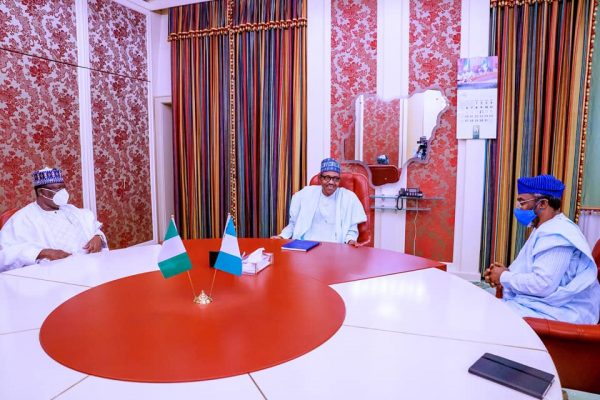
President Muhammadu Buhari has given assurance that measures so far taken by his government are meant to properly position Nigeria to safeguard its economy against the background of the challenges brought about by coronavirus that is ravaging the world.
The President declared after formally signing the Appropriation (Repeal and Amendment) Act, 2020 into law today, July 10: “with these budget amendments, as well as our recently launched N2.3 trillion Stimulus Programme, we are well-positioned to safeguard the economy.”
He stressed the need for the country to adjust its expected revenues, considering the widespread disruptions in domestic and international economic activities due to the COVID-19 Pandemic, and the containment measures taken in response thereto.
“Understandably too, we needed to reallocate resources in the Appropriation (Repeal and Amendment) Act, 2020 to ensure effective implementation of required health and emergency measures, as well as to mitigate the negative socio-economic effects of the COVID-19 Pandemic.
“The 2020 Amended Budget, which I have just signed into law today, underscores our Administration’s firm commitment to effectively contain the spread of COVID-19 and protect the lives and livelihood of our people.
“Considering recent budget implementation challenges, I have directed that efforts be made to ensure effective implementation of the Appropriation (Repeal and Amendment) Act, 2020 in order to realise its laudable objectives.
“All Ministers are to ensure that their Ministries, Departments and Agencies intensify capital project delivery efforts and fully cooperate with the Ministry of Finance, Budget and National Planning to achieve the laudable objectives of the Budget.
“We have, nevertheless, made some progress in the implementation of the Appropriation Act 2020. As at 31st May 2020, the sum of N253.33 billion has been released for the implementation of capital projects.
“The Federal Ministry of Finance, Budget and National Planning is in the process of effecting budgetary releases that will ensure that all Ministries, Departments and Agencies receive at least 50 per cent of their amended capital budgets by the end of this month.
“The Appropriation (Repeal and Amendment) Act, 2020, that I have just signed into law, provides for aggregate expenditures of N10.81 trillion, which is an increase of N216 billion over the level of expenditure initially proposed in the 2020 Appropriation Act. The Honourable Minister of Finance, Budget and National Planning will provide further details of the 2020 Amended Budget.”
The President said that it became necessary to revise the Appropriation Act 2020 which he first signed into law on December 17, 2019 in response to recent developments, in particular, the COVID-19 Pandemic.
He said that crude oil prices in the world market declined sharply from a high of $72.20 per barrel in January 2020 to below $20 per barrel in April 2020, and have since remained around $40 per barrel.
Buhari said that Nigeria’s crude oil production quota had been reduced as part of the efforts of the Organization of Petroleum Exporting Countries (OPEC) to strengthen the oil market.
“Global trade has generally been disrupted as almost all economies were locked down for protracted periods in the wake of the COVID-19 Pandemic.
“All these developments are plunging the global economy into recession, and Nigeria has not escaped the impact of this. In effect, the assumptions underlying the 2020 Appropriation Act are no longer sustainable.”
The President acknowledged the efforts of the Ministry of Finance, Budget and National Planning, particularly the Budget Office of the Federation, and everyone who collaborated and worked conscientiously to produce the Appropriation (Repeal and Amendment) Act, 2020, and thanked Nigerians for their understanding and unflinching support, especially during these difficult times.
“Steve Manson’s magazine dealt in corruption: he attacked the rich, the powerful and the famous – and he made enemies. In a job like that, you couldn’t afford to have dirty secrets of your own. With the whole town itching for you to make a slip, it was like living in a goldfish bowl…” — Goldfish Have No Hiding Place.
I don’t know if the detained acting Chairman of the Economic and Financial Crimes Commission (EFCC), Mr Ibrahim Magu, grew up (like some of us) reading the novels of English writer René Brabazon Raymond, who wrote under the pseudonym James Hadley Chase. Even so, I doubt he came across ‘Goldfish Have No Hiding Place’. As a student of power politics, I am not surprised that Magu—who took on far too many battles while leaving his own flanks wide open—is now caught in a dangerous web from which he may never recover.
Former Defence Minister, Lt General Theophilus Yakubu Danjuma (rtd) was recently at the villa to see President Muhammadu Buhari. It was a visit borne out of rage. A billionaire oil tycoon, Danjuma had paid for the purchase of an aircraft. His cheque bounced! The order to withhold payment, he was told by his banker, came from Magu! From what I gathered, it took some time before the president could convince Danjuma that he knew nothing about what was clearly power mongering by a reckless public official. A few weeks before that incident, the Minna residence of former Head of State, General Abdulsalami Abubakar was raided by EFCC operatives who “turned the house upside down”. The president also got to know only after the deed had been done.
While neither Danjuma nor Abdulsalami is above the law, power should never be used to harass and ridicule people, whether high or low. And even where there are justifications, for citizens at that level, these actions should certainly not occur without the president’s knowledge. Besides, a man who would take on the high and mighty in a society like ours, including members of the president’s immediate family, must also live above suspicion. In the past five years, Magu has at different times made claims about the hundreds of billions of Naira recovered from ‘treasury looters’. But subsequent auctions for recovered assets did not follow due process, resulting in choice properties being handed out to suspected cronies. Since Abuja is a city where residents know the dirty secrets of people in power (including who is sleeping with whose spouse), the president was being inundated with petitions that Magu is not above board in his dealings.
Apparently determined to get to the root of these allegations, the president on 22 November 2017 inaugurated a three-member committee to audit all assets recovered by agencies of the federal government from 29th May 2015. Headed by Mr Olufemi Lijadu, who later became the Securities and Exchange Commission (SEC) Chairman, the two other members are Mr. Mohammed Nami, the current Federal Inland Revenue Service (FIRS) chairman and Mrs. Gloria Bibigha, a respected accountant in the office of the Auditor General of the Federation who is regarded as a specialist in forensic auditing. “It has become obvious that fundamental gaps still exist in ensuring that the recovered assets are accounted for, and managed in an accurate, transparent and logical manner,” the President told the committee.It is noteworthy that exactly six days after the committee began its session, the then Senate President, Dr Bukola Saraki publicly accused anti-graft agencies of looting the recovered proceeds. Saraki spoke at the opening session of a “Strategic Retreat on Tracking the Progress of Anti-Corruption Bills”, on why the National Assembly had become “strident about the opacity shrouding the management of recovered funds, which in many cases get re-looted by the agencies that investigated and recovered them”. An ad hoc committee of the Senate, according to Saraki, had “discovered that many properties recovered from a fugitive from the law have not been accounted for by the investigating agency”.
Meanwhile, the Lijadu committee was working quietly in the background, obtaining information from government agencies and seeking clarification for inconsistencies. Although they had been given four months to complete their assignment, the trio of Lijadu, Nami and Bibigha ended up spending ten months, rummaging through thousands of pages of documents in dozens of files from the various agencies. But even before they submitted their report, the then Finance Minister, Mrs. Kemi Adeosun, had already noticed discrepancies from the figures that were emerging from their work. She sent Magu a memo seeking clarification on the recoveries “based on the information available to the Office of Accountant-General of the Federation.” According to Adeosun, the attention of her ministry had been drawn to “recovery figures in media reports by the EFCC that do not reconcile with the records of the ministry”, asking Magu to “clarify where these cash recoveries have been deposited and provide accompanying evidence.”
There is no record to show that Magu responded to Adeosun’s memo. But on 11th September 2018, the president formally received the report of the Lijadu committee that raised several unanswered questions about the recovered fixed and movable assets. The Attorney General of the Federation and Justice Minister, Abubakar Malami, SAN, later addressed the media on salient issues in the report. Although he gave no breakdown, Malami said: “In summary, the recovered funds by the three-man committee is N769 billion cash within the period under review”. What Malami did not disclose that day was that there were discrepancies in the EFCC figures and the disposal of some properties were done without transparency.From that moment, Magu’s fate was sealed. To compound his problem, the president had also received reports from a number of foreign agencies on the “lack of professionalism” by Magu who was said to be in the habit of leaking to the media information that compromises investigations. At home, critical agencies including the Directorate of State Security (DSS) and National Intelligence Agency (NIA) view Magu as a danger to the system because, as a top presidency official told me, “he doesn’t mind bringing down institutions to get at individuals, sometimes just for media adulation”. But in the mutual game of alliances and counter-alliances (often laced with mutual blackmail) used by members of this administration to checkmate one another, Magu remained in office. But despite concerted efforts by members of his own camp to have his name sent to the Senate for confirmation, the president refused to budge.
Meanwhile, the AGF to whose office Magu should ordinarily report (but doesn’t, out of sheer arrogance of power) bided his time before writing a damning memo to the president regarding the report on recovered assets. At the same time, Magu was basking in a false sense of security because he had just recently received approval from the president to auction more than 400 expensive cars forfeited by internet fraudsters. So secure in the fantasy that his name would soon be sent to the Senate for confirmation was Magu that he had begun planning how to dispose through public auction exotic vehicles including Ferraris, Range Rovers and Mercedes. That was before he was upended on Monday afternoon.I am not a fan of Magu and I stated the reason why in the past, especially given what my late principal, President Umaru Musa Yar’Adua told me about him. Those who may not have read the piece can do so here. I also do not like the cult of personality he has created in EFCC. The ‘Magu Boys’ who throw themselves around within the commission act as though above the law, despite allegations of unwholesome practices against them. And I have in the past five years rebuffed all entreaties from his media minders to meet with him. But the current tragedy raises higher questions about the integrity of institutions and how the cold calculations of factions of the ruling elite can cause rupture within the polity. Besides, I detest the idea of humiliating people out of office, especially by those who themselves are no paragon of virtue. Whatever might have been the excesses of Magu, his current ordeal appears more the culmination of a sinister plot to exact vengeance than any attempt to promote the public good.
On Monday, a member of the Presidential Advisory Committee Against Corruption (PACAC), Prof Femi Odekunle, released a statement which questions not only the entire process but the integrity of the AGF. Odekunle, who claimed to have consulted with other PACAC members, including its chairman, Prof Itse Sagay, SAN, before making the statement said “Malami has been exploiting his alleged loyalty and closeness to the president for his personal /power bloc agenda.” After highlighting a series of corrupt allegations against the AGF, Odekunle stated: “The alleged originating Malami memo, up to the current ’arrest’ seems an outcome of power-play by power blocs in the corridors of power in which Malami appears to be an arrow-head or major agent of a power bloc that is not really interested in, or in support of, Buhari’s anti-corruption fight.”
Although PACAC has distanced itself from Odekunle’s statement, his position represents the dominant view in a body whose members also belong to another ‘power bloc’ that seems to be losing out in this badly divided government. While it is not uncommon to have diverse tendencies within a government, I have never seen one like this where prominent members openly subvert one another without the president calling anyone to order. A March 2018 Senate “Report of the Ad Hoc committee on investigation of the arrest episodes of Tuesday 21st November 2017 among officers of EFCC, NIA and DSS” is illustrative of this state of affairs. The Senate probe followed the scandal in which personnel of the DSS and EFCC were almost exchanging gunshots on the streets of Abuja.
The open altercation, according to the Senate report, “arose from an attempt by EFCC officials to arrest Mr Ayodele Oke (former Director-General of NIA) and Mr Ita Ekpenyong (former Director-General of DSS) and the consequent resistance of NIA and DSS officers guarding their former principals.” With the heads of these security agencies openly attacking one another at the Senate session held in camera, as disclosed in the report, the then DSS Director General, Lawal Daura (who would later be removed by Vice President Yemi Osinbajo in his capacity as acting president) alleged in his written testimony that “The method (brawn instead of brain) deployed by the current EFCC under Magu is a Gestapo style that belongs to dictatorial regimes. The acting chairman runs the agency based on public rumours, maneouvers, gossips, political interferences from certain quarters and Marabouts.”
Now that the Magu saga has reached a denouement, there are several lessons, starting from the manner in which Daura in 2016 openly wrote to the Senate to question the judgement of the President in nominating him for the job. Even if we concede the mischief in that memo, it was obvious from the beginning that Magu lacked both the intellect and temperament to head the EFCC. And the moment the Senate refused to confirm his appointment, the president should have withdrawn his nomination. But whatever may have been his failings, Magu did record concrete achievements given his success in sending a few fat cats to learn from experience the prison conditions in Nigeria. Magu also revived the EFCC and brought in a needed fear factor before he lost his way. Now that it is obvious that the Magu era is over, the issue is about his replacement.Going forward, there should be an amendment to the EFCC Act to remove the limitation on the pool from which the president can nominate its chairman. The commission should not have to be headed by a serving or retired police officer, as is now the case. As I warned in the past, a Gotcha approach to fighting corruption, which Magu and some of his predecessors seem to favour, can only provide momentary entertainment. What our situation requires is a thorough, methodical and strategic war, anchored on the rule of law. You need people of a different orientation than police personnel for such assignment. Perhaps the tenure should be reduced to one term of four or five years to encourage occupants to put in their best from day one, instead of playing the game of reappointment. This may also be an opportunity for the president to investigate other people in his government who have been accused of sundry acts at odds with his professed agenda and reputation.
More importantly, the call for the reforms of Anti-Corruption Agencies (ACAs) requires urgent attention. In a statement by its Executive Director, Auwal Ibrahim Musa (Rafsanjani), the Civil Society Legislative Advocacy Centre (CISLAC) yesterday advocated that the current system “is prone to mismanagement, embezzlement and political misuse” since there “is no clear framework on who takes custodian of recovered assets and how they are utilized.” The federal government, according to Rafsanjani, “has claimed recoveries of assets worth billions of dollars without accounting (for) who manages these assets, how these assets are utilized and what prevents the re-looting of looted assets.” He added: “The control of lucrative asset recovery ‘business’, confiscations and repatriations has caused inter-agency rivalry among ACAs saddled with the responsibility of fighting corruption.”
Finally, a well-functioning government requires a certain level of cooperation and collaboration between and among senior officials in critical positions. Sadly, that is not the case with this administration. Where mutual suspicions and recriminations run high, as we have witnessed in recent years, the only person who can call a halt is the president. His seeming unwillingness to doing just that has divided the federal government in a manner that jeopardises efforts to tackle pressing challenges. With only two years to go before the 2023 campaigns begin, the administration needs everyone to pull together, not apart, if the president is to deliver on his mandate and cement his legacy.I hope President Buhari makes a course correction. Before it is too late!
• You can follow me on my Twitter handle, @Olusegunverdict and on www.olusegunadeniyi.com Culled from THISDAY.
Kogi State government is set to establish a Conference University of Science and Technology in Osara, as a way of providing enough local manpower for the Ajaokuta Steel project that is soon to take off in full swing.
The State Executive Council (SEC) meeting, presided over by the state governor, Alhaji Yahaya Bello, decided today, July 9, the University will enable the state to have enough manpower in the area of science and technology based courses that would feed industries in the state, especially the Ajaokuta Steel Company.
Briefing newsmen at the end of the Council meeting, the state Commissioner for Information and Communication, Kingsley Fanwo said that arrangements would be concluded to transmit the bill establishing the institution to the State House of Assembly through the state Attorney General and Commissioner for Justice.
This was even as the Commissioner for Water Resources, Abdulmumin Danga said that the council further gave approval for the reticulation of water from Osara dam to Okene and environs.
According to him, Contract for the project had been approved through a PPP arrangement to help curb water scarcity in three of the local councils in the Central Senatorial District of the state.
The Commissioner added that work would commence soon.
The Federal Capital Territory Administration Acting Secretary of the Health and Human Services Secretariat, equivalent to Commissioner, Dr. Mohammed Kawu has tested positive for coronavirus .
Dr. Kawu, who spoke to newsmen at the Asokoro District Hospital, where he is currently receiving treatment said that his journey to the Isolation Center began 12 days earlier when he experienced feverish conditions, adding the condition prompted him to take coronavirus test which turned out to be positive.
Dr. Kawu said it is very important for Nigerians to appreciate that coronavirus is real and can be fatal.
“I want every Nigerians, like I have always told them in the media, that this thing is real and anybody can be infected, especially those of us that are on the frontline.
“The disease can be fatal and it is important that everyone follows all the extant guidelines of hand washing or sanitizing, maintain social distancing wearing of facial covering and staying at home.”
On the challenges of being a frontline health workers Dr Kawu said that the major drawback was infecting members of their families at home. He said that his family members who are infected are also being managed within the FCT system.
Speaking on his symptoms and status of his health, Dr. Kawu said: “I’m happy and I thank my creator that mine was moderate infection. I got some symptoms that were not very severe. I had to be on intravenous (IV) drugs for about 10 days. I’m stronger now. Probably they will discharge me anytime soon”.
Speaking on other frontline health workers Dr Kawu said: “I noticed very important thing; there is so much commitment by the health workers, they are very committed, very patriotic. They are risking their lives to protect the society.
“So, my appeal to everyone in the society is that we must all be part and parcel of this fight against the COVID-19. Everybody must take personal responsibility to ensure that he or she protects his or herself and his or her family,.”
Other coronavirus patients also receiving treatment at the Asokoro Isolation and Treatment Center also called on the public to observe all extant guidelines to tame the spread of the disease.
The FCT has seven isolation and treatment centers across the Territory. Six of them are public facilities while one is privately managed.
Youth in Ebiraland, Kogi State, under the canopy of Ebira Youth Elite (EYE), have listed a number of positive contributions of a female legal practitioner and politician, Barrister Natasha Akpoti to the development of the area and its people. In an open letter signed by its President, Comrade Mohammed I. Hadi, the youth acknowledged that Natasha’s persistent hard work and research had resulted in the successful story of Ajaokuta Steel Company so far. The group described Natasha, who contested the senatorial seat in 2018, as a heroin of Ebiraland, and expressed appreciation for supporting critical investments from her personal funds. They also acknowledged that she paid for JAMB registration for secondary school students, adding that by working together as one big families, such move will build culturally competent youths. “We sincerely appreciate the time and effort you have spent in grooming some youths and moving them to a new level, your suggestions and model used in training have proved to be very helpful and gave them a new perspective on available opportunities.” The group listed the sacrifices Barrister Natasha had made from her purse, including enlightening the youths, especially females in ebiraland to know their roles and relevance in society. “You also donated certain amount of money to support some students in higher institution to enable them pay there school fees. “The food you distributed to the less privilege in ebiraland during the lock down is legendary. “
Sundiata Post Media Ltd, publishers of Sundiata Post, Nigeria’s fast growing multimedia news platform, has innovated an online commercial outlet, known as Dealboku. Speaking at the formal unveiling of the e-commerce platform today, July 9 in Abuja, the Founder and CEO of Sundiata Post Media, Max Amuchie, said that Dealboku is an idea whose time has come. He said that unlike the conventional online shops where goods are sold at shelf prices, Dealboku is an online deals marketplace, where merchants are made to sell same products and offer same services at discounted prices.
“We have built a robust platform that is unique in its approach to e-commerce. Both buyers and sellers are assured of excellent customer care and quality products and services at discounted prices.”
He said that with the establishment of Dealboku, Sundiata Post has made history as the first media platform in Nigeria to go into full e-commerce business. According to Amuchie, it is symbolic that Dealboku is opening business on same day (Thursday) in July 2020 that Sundiata Post was officially unveiled in Abuja five years earlier. Sundiata Post had been unveiled at an impressive ceremony in Abuja on Thursday, 7 July 2015.
The project consultant, Mrs.Hannah Atomode, said: “when you hear the word, deal, the first thing that comes to mind is reduction in price while maintaining the product or service quality.
“The goal of DEALBOKU is to get good discounted deals to you at your doorstep. A team of people agreed to build an e-commerce site using their bargaining power to get good price and get it delivered to you.
“The team has been working very hard to build a beautiful and a user-friendly website. This is a platform that comprises various products and services from fashion, automobile, furniture, foods, beauty, food, Spa and wellness, hotels, Online trainings etc.
“The payment system is not cumbersome, it is so simple and easy to use.
“There are three payment options namely payment using credit card, payment using wallet and payment by bank transfer.”
Human rights lawyer, Femi Falana (SAN), has said that the embattled Ibrahim Magu can get his job back as the Acting Chairman of the Economic and Financial Crimes Commission (EFCC), if he is not found guilty of allegations against him.
Falana, who spoke on Channels Television today, July 8, said that it is crucial that Magu is investigated, even as he said that he is not the first EFCC boss to be probed.
“If he is indicted, the law will have to take its course. There’s no two ways about it. We must be fair. All that Ibrahim Magu requires right now is to be given the opportunity to defend himself against these allegations.
“If he is not proven guilty, the government may give him back his job. Or he himself can say he has been sufficiently embarrassed and leave.
“But this is not the first time that an EFCC chairman has been investigated. And there should not be any reading of political motivations into it.
“It is the prerogative of the government to investigate misconduct.”
The Federal Character Commission (FCC) has commenced the auditing of the nominal rolls of federal Ministries, Department and Agencies (MDAs).
Speaking today, July 8 in Abuja, the New Executive Chairman of the Commission, Dr. Muheeba Dankaka, said that the aim was to ensure enforcement of the principles of federal character without sacrificing its Merits.
Dankaka said that public concerns have been expressed and she and the new Federal Commissioners have been confronted even before their assumptions of office with seeming unethical practice.
“It is of great concern that our laid down procedures and operations standard have been compromised.
“We have resolved to change these narratives. To enhance the power of prosecution for any erring agency, the Commission shall review the laws and seek amendments from the National Assembly where necessary.
“The Commission shall not hesitate to impose disciplinary measures on any erring staff or agency. It shall not be business as usual. We all must strive to live above board.
“All government MDAs must ensure adherence to the principle of federal character.
“To this end, the Commission shall soon embark on audit of the nominal rolls of all government MDAs with the view to enforcing the principles of federal character without sacrificing its merit.”
The FCC boss said that findings revealed that the second mandate of the Commission which dwelled on equitable distribution of infrastructural facilities had been seemingly neglected.
She noted that the Commission shall implement this critical mandate which impacted directly on the dividends of democracy and the well being of the people.
“We shall ensure that all implementing MDAs adhere to the principles of fairness and equitable distribution of social amenities.
“However, very soon, the Commission will organise an induction session for Honourable Members so as to acquaint them with the processes and workings of the Commission.
“As the world is experiencing the COVID-19 pandemic, I implore everyone to adhere strictly to the guidelines issued by NCDC and other health institutions in the country.”
Former Group Managing Director (GMD) of the Nigerian National Petroleum Corporation (NNPC), Andrew Yakubu, has said that substantial part of the money found at his Kaduna residence by Economic and Financial Crime Commission (EFCC) in 2017 was given to him as gift after leaving office.
The EFCC had, in 2017, raided the residence of the ex-NNPC boss in Kaduna State and found 9,772, 800 dollars and 74, 000 pounds (9.7 million dollars and 74, 000 pounds) in a safe.
Testifying today as a defence star witness today, July 8, in an alleged money laundering case instituted against him by the anti-graft agency, before Justice Ahmed Mohammed of the Federal High Court in Abuja, Yakubu confirmed that the money discovered in his property by the EFCC belonged to him.
The former NNPC boss, who was arraigned on March 16, 2017 on six counts, said: “yes, my lord, I confirm that the money in a safe in counts 3 and 4 was taken from my property.
“As I stated in my statement to EFCC, the money found in the safe is mine. The money was not received in bulk, it was received in tranches of not more than 10, 000 dollars and not more than 5000 pounds.
“And the substantial part of the amount was given to me after I left office and it was given to me on the occasions of birthday, thanksgiving service and other celebration I hosted after leaving office.”
According to him, the gift of money was mainly the one he got from the marriages of his daughters, saying: “approximately, the substantial amount of about over 98 per cent was given to me.”
Yakubu explained that the purpose of keeping the money was to think about a business venture he could embark on after his retirement.
“My lord, since the money was given to me unexpected, I kept the money in safety in the safe pending when I will decide on business venture to embark on and as soon as that decision crystalised, the business will be funded through a financial institution,” he said.
On the remaining two percent of the money, he said he got them through extacodes he received from international trips he had while in office.
“For over 25 years, I had reason by virtue of my schedule to travel to many parts of the world outside Nigeria and so I was entitled to extacodes in the United States dollars and any saving (earning) I made my lord during the trip, I had reason to save.
“So my lord, the remaining 2% is from the travels,” he said.
Yakubu told the court that he started the saving in the safe where the money was found at his residence between 2010 and 2014.
No sooner had Counsel to the EFCC, Mohammed Abubakar began his cross-examination than Justice Mohammed adjourned the continuation of the exercise until July 22.
NAN reports that the judge had, on June 24, declined to stop further proceedings in Yakubu’s trial, saying that though both parties had filed appeals before the Supreme Court, whose outcome would likely impact the case before him, he was constrained by virtue of Section 306 of the Administration of Criminal Justice Act to continue with the case as ordered by the Court of Appeal.
Senior Special Assistant to the President on Media and Publicity, Office of the Vice President, Laolu Akande, has sworn that Professor Yemi Osinbajo can never involve himself in any shady financial deal.
Reacting to news going round in social media that Vice President Osinbajo received the sum of N4 billion part of the recovered loots from the former acting Chairman of the Economic and Financial Crimes Commission, EFCC, Ibrahim Magu, Laolu Akanda described such report as fake news.
“I have been inundated by wide circulation of Fake News about VP’s purported involvement in some EFCC recovery billions, please rest assured they’re all LIES: calculated to confuse and concocted to smear Prof. Osinbajo’s image.
“The VP hasn’t and will never be involved in any such shady activities.”
We use cookies on our website to give you the most relevant experience by remembering your preferences and repeat visits. By clicking “Accept”, you consent to the use of ALL the cookies.
This website uses cookies to improve your experience while you navigate through the website. Out of these, the cookies that are categorized as necessary are stored on your browser as they are essential for the working of basic functionalities of the website. We also use third-party cookies that help us analyze and understand how you use this website. These cookies will be stored in your browser only with your consent. You also have the option to opt-out of these cookies. But opting out of some of these cookies may affect your browsing experience.
Necessary cookies are absolutely essential for the website to function properly. This category only includes cookies that ensures basic functionalities and security features of the website. These cookies do not store any personal information.
Any cookies that may not be particularly necessary for the website to function and is used specifically to collect user personal data via analytics, ads, other embedded contents are termed as non-necessary cookies. It is mandatory to procure user consent prior to running these cookies on your website.
Magu And The Abuja Power Game, By Olusegun Adeniyi
“Steve Manson’s magazine dealt in corruption: he attacked the rich, the powerful and the famous – and he made enemies. In a job like that, you couldn’t afford to have dirty secrets of your own. With the whole town itching for you to make a slip, it was like living in a goldfish bowl…” — Goldfish Have No Hiding Place.
I don’t know if the detained acting Chairman of the Economic and Financial Crimes Commission (EFCC), Mr Ibrahim Magu, grew up (like some of us) reading the novels of English writer René Brabazon Raymond, who wrote under the pseudonym James Hadley Chase. Even so, I doubt he came across ‘Goldfish Have No Hiding Place’. As a student of power politics, I am not surprised that Magu—who took on far too many battles while leaving his own flanks wide open—is now caught in a dangerous web from which he may never recover.
Former Defence Minister, Lt General Theophilus Yakubu Danjuma (rtd) was recently at the villa to see President Muhammadu Buhari. It was a visit borne out of rage. A billionaire oil tycoon, Danjuma had paid for the purchase of an aircraft. His cheque bounced! The order to withhold payment, he was told by his banker, came from Magu! From what I gathered, it took some time before the president could convince Danjuma that he knew nothing about what was clearly power mongering by a reckless public official. A few weeks before that incident, the Minna residence of former Head of State, General Abdulsalami Abubakar was raided by EFCC operatives who “turned the house upside down”. The president also got to know only after the deed had been done.
While neither Danjuma nor Abdulsalami is above the law, power should never be used to harass and ridicule people, whether high or low. And even where there are justifications, for citizens at that level, these actions should certainly not occur without the president’s knowledge. Besides, a man who would take on the high and mighty in a society like ours, including members of the president’s immediate family, must also live above suspicion. In the past five years, Magu has at different times made claims about the hundreds of billions of Naira recovered from ‘treasury looters’. But subsequent auctions for recovered assets did not follow due process, resulting in choice properties being handed out to suspected cronies. Since Abuja is a city where residents know the dirty secrets of people in power (including who is sleeping with whose spouse), the president was being inundated with petitions that Magu is not above board in his dealings.
Apparently determined to get to the root of these allegations, the president on 22 November 2017 inaugurated a three-member committee to audit all assets recovered by agencies of the federal government from 29th May 2015. Headed by Mr Olufemi Lijadu, who later became the Securities and Exchange Commission (SEC) Chairman, the two other members are Mr. Mohammed Nami, the current Federal Inland Revenue Service (FIRS) chairman and Mrs. Gloria Bibigha, a respected accountant in the office of the Auditor General of the Federation who is regarded as a specialist in forensic auditing. “It has become obvious that fundamental gaps still exist in ensuring that the recovered assets are accounted for, and managed in an accurate, transparent and logical manner,” the President told the committee.It is noteworthy that exactly six days after the committee began its session, the then Senate President, Dr Bukola Saraki publicly accused anti-graft agencies of looting the recovered proceeds. Saraki spoke at the opening session of a “Strategic Retreat on Tracking the Progress of Anti-Corruption Bills”, on why the National Assembly had become “strident about the opacity shrouding the management of recovered funds, which in many cases get re-looted by the agencies that investigated and recovered them”. An ad hoc committee of the Senate, according to Saraki, had “discovered that many properties recovered from a fugitive from the law have not been accounted for by the investigating agency”.
Meanwhile, the Lijadu committee was working quietly in the background, obtaining information from government agencies and seeking clarification for inconsistencies. Although they had been given four months to complete their assignment, the trio of Lijadu, Nami and Bibigha ended up spending ten months, rummaging through thousands of pages of documents in dozens of files from the various agencies. But even before they submitted their report, the then Finance Minister, Mrs. Kemi Adeosun, had already noticed discrepancies from the figures that were emerging from their work. She sent Magu a memo seeking clarification on the recoveries “based on the information available to the Office of Accountant-General of the Federation.” According to Adeosun, the attention of her ministry had been drawn to “recovery figures in media reports by the EFCC that do not reconcile with the records of the ministry”, asking Magu to “clarify where these cash recoveries have been deposited and provide accompanying evidence.”
There is no record to show that Magu responded to Adeosun’s memo. But on 11th September 2018, the president formally received the report of the Lijadu committee that raised several unanswered questions about the recovered fixed and movable assets. The Attorney General of the Federation and Justice Minister, Abubakar Malami, SAN, later addressed the media on salient issues in the report. Although he gave no breakdown, Malami said: “In summary, the recovered funds by the three-man committee is N769 billion cash within the period under review”. What Malami did not disclose that day was that there were discrepancies in the EFCC figures and the disposal of some properties were done without transparency.From that moment, Magu’s fate was sealed. To compound his problem, the president had also received reports from a number of foreign agencies on the “lack of professionalism” by Magu who was said to be in the habit of leaking to the media information that compromises investigations. At home, critical agencies including the Directorate of State Security (DSS) and National Intelligence Agency (NIA) view Magu as a danger to the system because, as a top presidency official told me, “he doesn’t mind bringing down institutions to get at individuals, sometimes just for media adulation”. But in the mutual game of alliances and counter-alliances (often laced with mutual blackmail) used by members of this administration to checkmate one another, Magu remained in office. But despite concerted efforts by members of his own camp to have his name sent to the Senate for confirmation, the president refused to budge.
Meanwhile, the AGF to whose office Magu should ordinarily report (but doesn’t, out of sheer arrogance of power) bided his time before writing a damning memo to the president regarding the report on recovered assets. At the same time, Magu was basking in a false sense of security because he had just recently received approval from the president to auction more than 400 expensive cars forfeited by internet fraudsters. So secure in the fantasy that his name would soon be sent to the Senate for confirmation was Magu that he had begun planning how to dispose through public auction exotic vehicles including Ferraris, Range Rovers and Mercedes. That was before he was upended on Monday afternoon.I am not a fan of Magu and I stated the reason why in the past, especially given what my late principal, President Umaru Musa Yar’Adua told me about him. Those who may not have read the piece can do so here. I also do not like the cult of personality he has created in EFCC. The ‘Magu Boys’ who throw themselves around within the commission act as though above the law, despite allegations of unwholesome practices against them. And I have in the past five years rebuffed all entreaties from his media minders to meet with him. But the current tragedy raises higher questions about the integrity of institutions and how the cold calculations of factions of the ruling elite can cause rupture within the polity. Besides, I detest the idea of humiliating people out of office, especially by those who themselves are no paragon of virtue. Whatever might have been the excesses of Magu, his current ordeal appears more the culmination of a sinister plot to exact vengeance than any attempt to promote the public good.
On Monday, a member of the Presidential Advisory Committee Against Corruption (PACAC), Prof Femi Odekunle, released a statement which questions not only the entire process but the integrity of the AGF. Odekunle, who claimed to have consulted with other PACAC members, including its chairman, Prof Itse Sagay, SAN, before making the statement said “Malami has been exploiting his alleged loyalty and closeness to the president for his personal /power bloc agenda.” After highlighting a series of corrupt allegations against the AGF, Odekunle stated: “The alleged originating Malami memo, up to the current ’arrest’ seems an outcome of power-play by power blocs in the corridors of power in which Malami appears to be an arrow-head or major agent of a power bloc that is not really interested in, or in support of, Buhari’s anti-corruption fight.”
Although PACAC has distanced itself from Odekunle’s statement, his position represents the dominant view in a body whose members also belong to another ‘power bloc’ that seems to be losing out in this badly divided government. While it is not uncommon to have diverse tendencies within a government, I have never seen one like this where prominent members openly subvert one another without the president calling anyone to order. A March 2018 Senate “Report of the Ad Hoc committee on investigation of the arrest episodes of Tuesday 21st November 2017 among officers of EFCC, NIA and DSS” is illustrative of this state of affairs. The Senate probe followed the scandal in which personnel of the DSS and EFCC were almost exchanging gunshots on the streets of Abuja.
The open altercation, according to the Senate report, “arose from an attempt by EFCC officials to arrest Mr Ayodele Oke (former Director-General of NIA) and Mr Ita Ekpenyong (former Director-General of DSS) and the consequent resistance of NIA and DSS officers guarding their former principals.” With the heads of these security agencies openly attacking one another at the Senate session held in camera, as disclosed in the report, the then DSS Director General, Lawal Daura (who would later be removed by Vice President Yemi Osinbajo in his capacity as acting president) alleged in his written testimony that “The method (brawn instead of brain) deployed by the current EFCC under Magu is a Gestapo style that belongs to dictatorial regimes. The acting chairman runs the agency based on public rumours, maneouvers, gossips, political interferences from certain quarters and Marabouts.”
Now that the Magu saga has reached a denouement, there are several lessons, starting from the manner in which Daura in 2016 openly wrote to the Senate to question the judgement of the President in nominating him for the job. Even if we concede the mischief in that memo, it was obvious from the beginning that Magu lacked both the intellect and temperament to head the EFCC. And the moment the Senate refused to confirm his appointment, the president should have withdrawn his nomination. But whatever may have been his failings, Magu did record concrete achievements given his success in sending a few fat cats to learn from experience the prison conditions in Nigeria. Magu also revived the EFCC and brought in a needed fear factor before he lost his way. Now that it is obvious that the Magu era is over, the issue is about his replacement.Going forward, there should be an amendment to the EFCC Act to remove the limitation on the pool from which the president can nominate its chairman. The commission should not have to be headed by a serving or retired police officer, as is now the case. As I warned in the past, a Gotcha approach to fighting corruption, which Magu and some of his predecessors seem to favour, can only provide momentary entertainment. What our situation requires is a thorough, methodical and strategic war, anchored on the rule of law. You need people of a different orientation than police personnel for such assignment. Perhaps the tenure should be reduced to one term of four or five years to encourage occupants to put in their best from day one, instead of playing the game of reappointment. This may also be an opportunity for the president to investigate other people in his government who have been accused of sundry acts at odds with his professed agenda and reputation.
More importantly, the call for the reforms of Anti-Corruption Agencies (ACAs) requires urgent attention. In a statement by its Executive Director, Auwal Ibrahim Musa (Rafsanjani), the Civil Society Legislative Advocacy Centre (CISLAC) yesterday advocated that the current system “is prone to mismanagement, embezzlement and political misuse” since there “is no clear framework on who takes custodian of recovered assets and how they are utilized.” The federal government, according to Rafsanjani, “has claimed recoveries of assets worth billions of dollars without accounting (for) who manages these assets, how these assets are utilized and what prevents the re-looting of looted assets.” He added: “The control of lucrative asset recovery ‘business’, confiscations and repatriations has caused inter-agency rivalry among ACAs saddled with the responsibility of fighting corruption.”
Finally, a well-functioning government requires a certain level of cooperation and collaboration between and among senior officials in critical positions. Sadly, that is not the case with this administration. Where mutual suspicions and recriminations run high, as we have witnessed in recent years, the only person who can call a halt is the president. His seeming unwillingness to doing just that has divided the federal government in a manner that jeopardises efforts to tackle pressing challenges. With only two years to go before the 2023 campaigns begin, the administration needs everyone to pull together, not apart, if the president is to deliver on his mandate and cement his legacy.I hope President Buhari makes a course correction. Before it is too late!
• You can follow me on my Twitter handle, @Olusegunverdict and on www.olusegunadeniyi.com
Culled from THISDAY.