

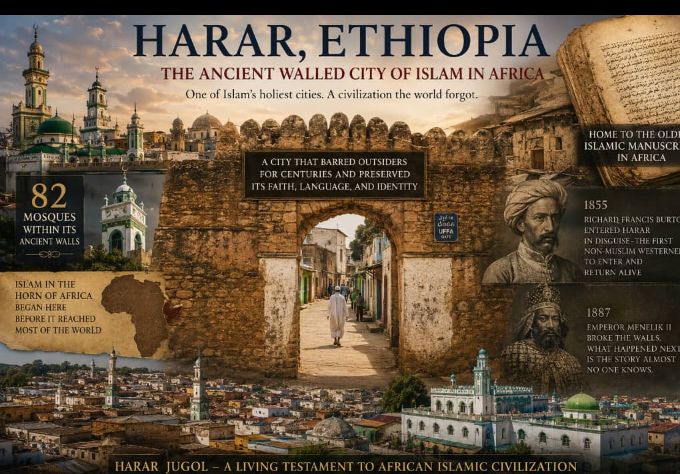
In an age where global Islamic history is often reduced to the deserts of Arabia, the palaces of Andalusia, or the empires of the Ottoman world, one ancient African city continues to sit quietly behind stone walls; almost forgotten by the modern Muslim world. That city is Harar.
Located in eastern Ethiopia, Harar is not just another historic settlement. For centuries, it stood among the most important centers of Islamic civilization in Africa. Some historians and travelers once referred to it as the fourth holiest city of Islam after Makkah, Madinah, and Jerusalem owing to its extraordinary concentration of mosques, shrines, scholars, and Islamic learning.
Inside its ancient walls known as the Jugol are 82 mosques and more than a hundred Islamic centers squeezed into narrow winding alleys that still echo with the call to prayer five times a day.
It is note worthy that beyond its spiritual reputation lies a deeper and more painful story: the story of a civilization many people never knew existed, and a people struggling not to disappear.
Long before Islam spread in Arabia and to other parts of the world, the Horn of Africa had already encountered the new faith. Islamic history records that some of the earliest Muslims migrated to Abyssinia during the lifetime of Prophet Muhammad to escape persecution in Makkah. That migration established one of the earliest relationships between Islam and Africa.
Centuries later, Harar emerged as one of the continent’s strongest Islamic centers.
Protected by a defensive wall built in the 16th century, Harar lbecame both a spiritual sanctuary and a cultural fortress. The city preserved Islamic scholarship, trade networks, architecture, poetry, and manuscript traditions while political upheavals reshaped surrounding regions.
To enter Harar in earlier centuries was no easy task. Outsiders were viewed with suspicion, and non-Muslims were generally forbidden from entering the city. This isolation strengthened Harar’s image as a mysterious holy city hidden within Africa.
That mystery fascinated the British explorer Richard Francis Burton, who famously entered Harar in 1855 disguised as a Muslim merchant. Burton later wrote about the city with amazement, describing its people, markets, religious devotion, and unique urban life.
At the time, Harar was unlike most cities outsiders had seen in Africa. It possessed organized Islamic institutions, libraries, schools, sophisticated trade systems, and strong cultural identity. The city was connected to the broader Muslim world through commerce and scholarship stretching across the Red Sea, Arabia, and beyond.
Yet Harar’s significance went beyond religion.
It was also a center of African intellectual achievement.
For generations, scholars in Harar copied and preserved handwritten Qur’anic manuscripts and religious texts, some of the oldest Islamic manuscripts found in sub-Saharan Africa today. Families passed knowledge from one generation to another in homes and mosques where Arabic, Harari, and Islamic sciences flourished side by side.
The city also became linked to the powerful Adal Sultanate, a Muslim state that played a major role in the political history of the Horn of Africa.
But like many great civilizations, Harar eventually faced forces larger than itself.
In 1887, Emperor Menelik II conquered the city. The fall of Harar marked a dramatic turning point in its history. The walls that once protected the city could no longer preserve its political independence.
What followed was a gradual political change with penetrating secular domination.
New populations entered the city. Political power shifted away from the Harari people. Cultural assimilation accelerated. Over time, the Harari language — once central to the city’s identity — began shrinking dramatically. Today, only tens of thousands still speak it fluently.
For many Hararis, the struggle is no longer simply about preserving buildings. It is about preserving memory itself.
Walking through Harar today feels like entering a living archive of African Islamic civilization. Ancient homes still stand. Elderly men gather near mosques discussing religion and history. Women preserve traditional dress and customs. The city’s old gates still open into labyrinth-like streets that seem untouched by time.
Yet modern pressures continue to threaten this fragile heritage.
Globalization, migration, economic hardship, and political instability have all contributed to the gradual erosion of Harar’s historic identity. Younger generations increasingly move toward dominant languages and cultures for survival and opportunity.
Ancient manuscripts risk deterioration. Oral traditions fade quietly when elders die.
The tragedy is not only that Harar is endangered.
The greater tragedy is that much of the world barely knows it exists.
African Islamic history has long suffered from neglect in mainstream historical narratives. Too often, Africa’s contribution to global civilization is discussed only through colonialism, slavery, poverty, or conflict. The rich intellectual and spiritual traditions of African Muslim societies rarely receive equal attention.
Cities like Harar challenge that distorted picture.
They remind the world that Africa did not merely receive civilization from elsewhere.
Africa also built civilizations of its own with cities of scholarship, architecture, law, spirituality, and trade deeply connected to global history.
Harar stands alongside places like Timbuktu in Mali as evidence that Islamic learning in Africa produced libraries, scholars, and urban cultures long before European colonial powers arrived.
But Harar’s survival carries another lesson for modern Muslims, everywhere.
Civilizations are not erased overnight.
They disappear slowly — when people stop preserving their stories, languages, institutions, and values.
The Harari people managed to protect their identity for centuries because they understood the importance of memory. They preserved manuscripts. They maintained mosques. They taught their children. They guarded traditions even during political uncertainty.
Today, many communities across the Muslim world face similar questions about identity and cultural survival in the face of rapid modernization.
What happens when younger generations no longer know their own history?
What happens when heritage becomes tourism instead of living tradition?
What happens when sacred places are remembered only after they are endangered?
Harar forces the Muslim world to confront these uncomfortable questions.
Despite everything, however, the city still breathes.
Every day, according to reports, the call to prayer rises above the old walls. Worshippers still fill the mosques. Markets still bustle. Ancient wooden doors still open onto hidden courtyards. The spirit of the city refuses to vanish completely.
Perhaps that is what makes Harar so extraordinary.
It is not merely a monument to the past.
It is a quiet act of survival.
In a world obsessed with louder civilizations and larger empires, Harar remains one of Africa’s most powerful reminders that history does not only belong to those who conquered continents. Sometimes history survives in narrow streets, fragile manuscripts, whispered prayers, and communities determined not to forget who they are.
 However, behind those ancient walls in eastern Ethiopia, the forgotten Islamic city continues to wait for the world to remember it again.