

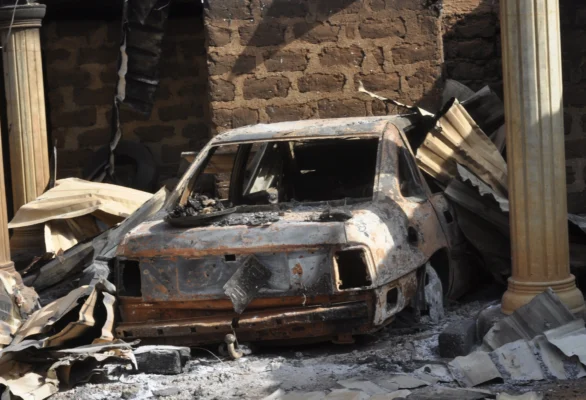
 A file photo of a burnt vehicle is seen following an attack by gunmen in Bokkos, north central Nigeria (AP photo)
Nigeria today stands at a dangerous crossroads. Across the country, communities are living in fear as kidnapping, banditry, terrorism, and mass killings continue to threaten lives and livelihoods. From the forests of the North-West to the villages of the Middle Belt and the highways of the South, insecurity has become one of the greatest challenges confronting our nation.
The recent kidnapping incidents involving school children in Oyo State once again exposed the vulnerability of innocent Nigerians. The trauma inflicted on young pupils, their parents, and their communities is immeasurable. Similar incidents have occurred in Kwara State, where kidnappers have repeatedly targeted travellers, students, and rural residents. In Kogi State, kidnappings along major roads and attacks on communities have become disturbingly frequent. Plateau State has witnessed recurring massacres of innocent villagers, with hundreds of lives lost in attacks that have left entire communities displaced and devastated.
These tragedies are not isolated events. They represent a national security crisis that demands urgent, coordinated, and sustained action.
Many Nigerians are increasingly concerned that political calculations surrounding the 2027 elections appear to be receiving more attention than the security emergency facing the country. Public discourse is increasingly dominated by defections, coalition-building, endorsements, and electoral strategies, while citizens continue to bury loved ones killed by criminals and violent extremists.

President Bola Ahmed Tinubu came into office with the promise of renewed hope. While some economic reforms have been initiated, many Nigerians believe that the government’s response to insecurity has not matched the scale and urgency of the threat. Citizens expect more than condemnations after attacks. They expect decisive action capable of preventing future tragedies.
The reality is that every successful kidnapping operation emboldens criminals. Every community attack that goes unanswered weakens public confidence in the state’s ability to protect its people. Every massacre that ends without accountability sends a dangerous message that human life has become cheap.
Security should never be treated as a secondary issue. It is the foundation upon which economic growth, education, healthcare, agriculture, and national development depend. Farmers cannot cultivate their lands when they fear abduction. Investors cannot commit resources where insecurity reigns. Children cannot learn effectively when schools become targets for kidnappers.
The question Nigerians are asking is simple: Where is the comprehensive strategy to end this nightmare?
The solution requires more than military deployments after attacks have already occurred. Nigeria needs a holistic security architecture that addresses both immediate threats and their root causes.
First, intelligence gathering must be strengthened. Security agencies need better coordination, modern surveillance technology, and real-time intelligence sharing. Criminal groups often operate successfully because they exploit gaps between agencies.
Second, community policing should be expanded and properly funded. Local communities often possess valuable intelligence about criminal activities, but there must be structured mechanisms for gathering and acting upon such information.
Third, the government must invest heavily in modern security technology, including drones, satellite surveillance, biometric databases, and advanced communication systems capable of monitoring vulnerable regions.
Fourth, the judicial process for kidnapping, terrorism, and mass murder cases must be accelerated. Criminals should face swift prosecution and punishment. Delayed justice weakens deterrence.
Fifth, economic opportunities must be expanded, particularly for unemployed youths who are often recruited by criminal networks. Security operations must be complemented by social and economic interventions.
Sixth, state governments should be granted greater operational roles in security management while maintaining national coordination. A nation as vast and diverse as Nigeria requires localized responses to localized threats.
Finally, political leaders at all levels must demonstrate that protecting lives is their foremost priority. Electoral ambitions should never overshadow the constitutional responsibility of safeguarding citizens. Governments are ultimately judged not by campaign promises but by their ability to secure lives and property.
Nigeria has the resources, manpower, and institutional capacity to overcome this crisis. What is needed is political will, strategic leadership, and unwavering commitment. The blood of innocent Nigerians should not become a recurring headline. The tears of grieving families should not become a normal feature of national life.
The time has come for leaders across board to place security above politics, governance above campaigns, and the protection of human life above every other consideration. The future of Nigeria depends on it.