A 14-year-old SS2 student of Imam Malik Ibn Anas Academy, Gwagwalada, in the Federal Capital Territory (FCT), from Ebira in Kogi State, Miss Qisma Onozasi Ahmed, has beaten no fewer than 200 older women from across Nigeria to emerge the overall best in the ICT education for women. The competition was floated through the First Lady, Senator Oluremi Tinibu’s Renewed Hope Initiative Women ICT Training and Empowerment Program, in collaboration with the National Information Technology Development Agency (NITDA). A statement today, November 9, described Miss Qisma Ahmed as exemplifying the transformative potential of ICT education for young women, with particular reference to those from underserved regions. The statement explained that the program is aimed at empowering women by providing essential digital skills and ICT training, creating new pathways for economic opportunities, self-sufficiency and improved livelihoods. “Such initiatives are especially impactful for women in underserved areas, who often face limited access to technology and educational resources. “By bridging this gap, the program supports gender equality, enhances employment prospects and fosters innovation, allowing women to contribute more effectively to their communities and national development. “With the expansion of this program, more women and youth will gain the skills to actively participate in the digital economy, which can drive long-term economic growth and social change.” It said that the First Lady Renewed Hope Initiative aligns closely with the United Nations Sustainable Development Goals (SDGs), particularly SDG 5 (Gender Equality) and SDG 4 (Quality Education). The statement said that by equipping women and young girls with digital skills, the program would promote gender equality, reduce economic disparities and contribute to a more inclusive society where all women, regardless of their socio-economic background, can achieve their potentials. Reacting, Miss Qisma Ahmed expressed gratitude to the First Lady for the invaluable opportunity offered her, adding that it has opened new doors for her to pursue her aspirations.
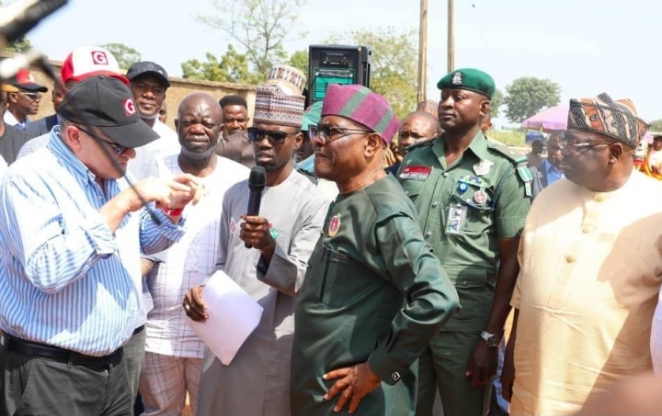
Minister of the Federal Capital Territory (FCT), Nyeson Wike has said that Nigerians he knows would pay their taxes if they know that the government is utilizing them for their benefit. “What is important to us is yes, we try to make sure that people pay their taxes. One thing I can tell you about people or Nigerians is that when they see that their taxes are being utilized, they reciprocate by making sure they pay their taxes. “But they are reluctant to pay when they see that the taxes they pay and nothing has been done with them.” Speaking with journalists shortly after inspecting the emergency construction of a 5-kilometer Kuje township road from the Garage Junction to the LEA Secretariat within the Kuje Area Council, amongst others, the minister said that his government relied mainly on Internally Generated Revenues (IGR) and also applies prudence in the utilization of available resources for the ongoing projects. “It’s a matter of strategy and being prudent with the available resources. “We are trying as much as possible to continue increasing our IGR. We are using our IGR to pay. “There is no other money coming from anywhere. “And again, we restrict the number of projects and ensure that we have gone far before awarding other projects and that the funding is available so that it will not be an abandoned project or projects. “So, it’s not that we have so much money. It’s just that we are trying to prudently manage what we have and apply it in the best interest of our people.” Nyesom Wike had inspected the full scope development of the 11km FCT Highway 105, otherwise known as Kuje highway, from the Airport Expressway to Kuje Junction with Spur at Kyami. Wike gave order for the dualisation of the 5-kilometer Kuje township road to be extended to the Gwagwalada Area Council to improve traffic situation, reduce travel distance and enhance economic activities within the Area Councils. “We believe that by this December, the contractor, Gilmor Engineering would have handed over, latest by the end of this December as promised and we have also directed them to continue the dualisation of Kuje to Gwagwalada. “That will ease off traffic difficulties when you are going to Gwagwalada and also reduce the travel distance. People who have no business passing through the airport road through Giri can now, from Gwagwalada and come to Kuje. Everybody in Kuje who is going to Gwagwalada, of course, will go straight and you know the economic impact. This road will trigger off a lot of economic activities.”
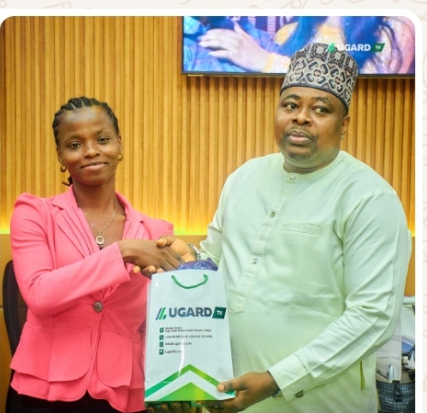
Kogi State government, through Lugard TV, based in the Government House, Lokoja, has offered an internship opportunity to the best graduating student of the Department of Mass Communication of the Federal University, Lokoja (FUL), Khadijat Blessing Mohammed. Special Adviser to Governor Ahmed Usman Ododo on Media, Ismaila Isah who spoke when he received the student at the Government House Media Centre, said that the offer is part of the commitment of Governor Ododo to nurturing young talents and providing them with hands-on experience. He said that the Government House Media Centre and LugardTV would provide the student invaluable experience, practical media knowledge and exposure to intense media operation, as well as an opportunity to work with media professionals in the government house. Ismail Isah said that the offer by LugardTV aims to bridge the gap between the academia and the media industry by opening doors for future media leaders, adding that the internship placement is intended to provide the candidate with the chance to engage in various aspects of journalism, high-quality content creation and best-in-class media intelligence. Response, Khadijat Blessing Mohammed expressed appreciation for the gesture and promised to justify the opportunity in the course of working at the Government House Media Centre.
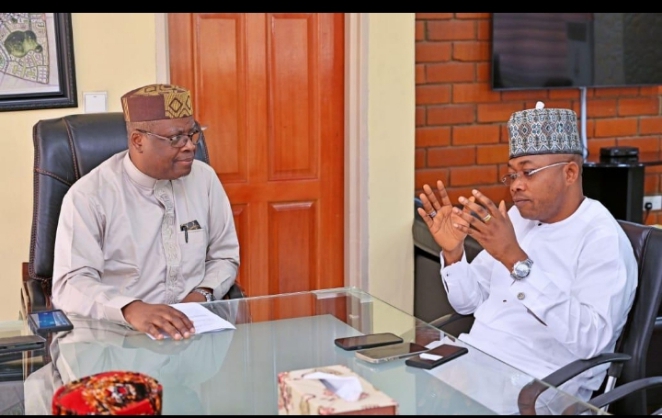
The Kogi State Governor, Ahmed Usman Ododo has set in motion, machinery for the establishment of a special economic zone with the status of a free trade zone in the Ajaokuta economic development corridor of the state. The Governor was in Abuja today, November 6, with top government functionaries to solicit the support of the Managing Director and Chief Executive Officer of the Nigeria Export Processing Zones Authority (NEPZA) Dr. Olufemi Ogunyemi in that direction. He said that the proposed NEPZA for the state has been on the drawing board for over ten years. Governor Ododo said that the establishment of a special economic zone in the state would create opportunity to harness the abundant natural resources and to maximize the economic potential of the state. He stressed the strategic location of the state as a connecting point between the northern and the southern parts of the country. According to him, the state is endowed with numerous solid mineral resources in commercial quantities, arable land for agricultural production and top quality human resources that are waiting to be tapped with the establishment of a special economic zone. The governor stressed that the proposed special economic zone will transform the state into a major hub for economic activities in the country as well as creating thousands of job opportunities for Nigerians. He gave assurance that the state government would put all the necessary requirements in place as soon as possible to ensure the realisation of the project. This was even as the Managing Director of NEPZA, Dr. Olufemi Ogunyemi said that the authority would support the Kogi state government by activating processes that would lead to the timely approval, licensing and other assistance for the state. Dr. Ogunyemi commended Governor Ododo for his handling of infrastructural development, welfare of workers and security of lives and property in the state. In line with procedures for the establishment of the proposed special economic zone, the Kogi state government had earlier allocated three thousand hectares of land in the Ajaokuta economic development corridor for the project, to be funded by a Public Private Partnership arrangement.
Following recent media reports, we find it necessary to address certain misinformation regarding the Presidential CNG Initiative. As a response to the high cost of petrol and the attendant rise in the cost of transportation, following the removal of fuel subsidy, President Bola Tinubu launched the Presidential CNG Initiative to provide a cheaper and cleaner energy source for Nigerians. Since the launch of this ground-breaking initiative, the response has been positive as Nigerians are embracing and converting their petrol-powered vehicles to CNG-enabled vehicles – with over 60% reduction in the amount of money they spend on fuel. To date, over 100,000 vehicles have been converted from petrol to CNG/bi-fuel-powered, and more conversion centres are being established across the country. In addition, investors are ramping up the development and deployment of CNG infrastructure, with over $200 million already invested across the value chain. Thousands of new jobs and economic opportunities are opening up along the line. Going by the level of progress being made as regards the adoption and deployment of CNG infrastructure, we are concerned over certain instances of misinformation against this epochal initiative by a section of the media. For instance, the October 31, 2024 editorial of the Punch Newspaper did not give a rational and fair assessment of the CNG initiative. It is surprising how the choice of petrol, for which Nigeria spent about $10 billion annually on subsidy, and CNG which has the potential to save the nation $3 billion while adding $2 billion revenue to the national purse in the next three to four years, is an issue of toxic debate. First, one of the issues raised against the CNG initiative and its implementation by The Punch is ease of conversion. We see this as an opportunity rather than a challenge, and we are already deepening the development of CNG infrastructure with our partners. However, the number of conversion centres has risen from seven in 2023 to more than 140 across the country, and certainly not 50 centres as claimed by The Punch. Facts are sacred. We believe the sacrosanctity of facts is not lost on The Punch, but to claim or assert without veracity and evidence is an obvious attempt at mischief. In addition, more than 2,000 Nigerians have been employed in these conversion centres, with more jobs in the offing as CNG penetration ratchets up. In the past year, the private sector invested over 2 billion naira to establish these conversion centres, and another 6 to 10 billion naira will go into setting up more centres to meet the targeted 1,000 centres required to transform the nation’s energy dynamics. Second, there is no cost of conversion for commercial vehicles in Nigeria. It is FREE under the President’s Conversion Incentive Programme. The programme seeks to convert one million commercial vehicles to CNG/bi-fuel in the next three years. This is verifiable information as the National Union of Road Transport Workers (NURTW), whose members have benefitted recently issued statements acknowledging this fact. The Punch also got it wrong with its “conversion explosion” slant in Edo State. It is important to emphasise that the explosion in Edo State happened because of substandard, uncertified, and poorly fabricated CNG cylinders, which exploded during an attempt to refill (not convert) at a station. It is equally important to reiterate that CNG is safe and cleaner to use. It is lighter and eight times less explosive than diesel and eighteen times less explosive than petrol. It is also more readily available and a more sustainable alternative for Nigeria’s energy security. With one million vehicles running on CNG, overall demand annually will be 220 million standard cubic feet of gas a day, or 2.75% of our current daily gas production, of which only 16% is consumed locally. CNG distribution is also picking up with 75 new daughter stations under construction across the country, and additional containerized and mobile refuelling units are being set up by the private sector working closely with regulators. Mother station investments have totalled over $175 million in the past one year, with 65 new licences issued. Lastly, CNG conversion kits are suitable for older vehicles. The experience in Egypt, India, and Iran shows that old vehicles operate better and more efficiently on CNG than they would on petrol. Open loop non-sequential conversion kits exist for aged vehicles, and the PCNGI has succeeded in Lagos in fitting several old yellow buses with the kits – with videos of the beneficiaries to show. The claim that the government is not leading by example on CNG is false. On the contrary, the conversion programme started with government institutions like the Nigerian Army and the Nigeria Police – through the Police Trust Fund. The programme has now expanded to other MDAs like the Federal Road Maintenance Agency, the Ministry of Finance, and even the Federal Inland Revenue Service, as well as the PCNGI leadership team. More MDAs are signing up to the use of CNG for their vehicles. In addition, the federal government had already issued clear directives that only CNG-enabled vehicles should be purchased by government agencies. President Tinubu also directed that only such vehicles are to be approved by the Federal Executive Council. Nevertheless, The Punch’s suggestion in its editorial that banks can fund the conversion to CNG for Nigerians who want to convert their vehicles is welcomed. The Tinubu administration is already partnering banks and other financial institutions through the Credit Corp Credit Access for Light and Mobility (CALM) programme. Through this credit system, civil servants and employees in the organised private sector can access loan to convert their vehicles from PMS to CNG/PMS Bi-Fuel. We recognise the indispensable role of the media in holding the government accountable and in keeping citizens informed. However, this role must be discharged with utmost responsibility and fidelity to truth, peace, and the collective well-being of the people. We are open and willing to work with the media to advance the advantages of the CNG initiative to the benefit of all Nigerians. Engr. Michael Oluwagbemi, Project Director/CEO, Presidential CNG Initiative, wrote in from Abuja.
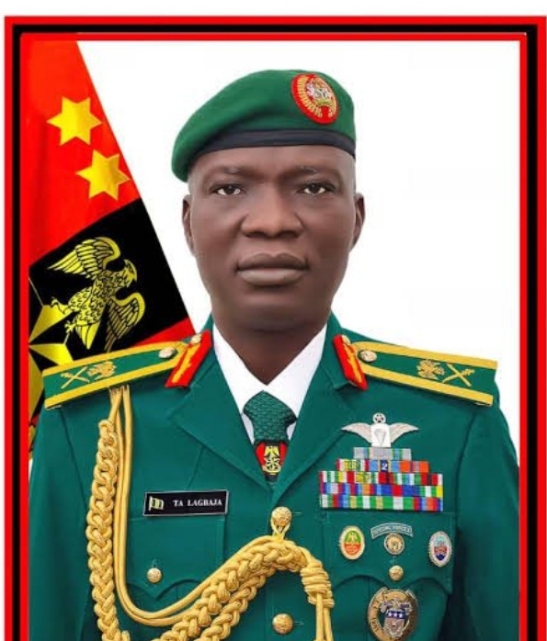
Osun State Governor, Ademola Adeleke has described the death of the nation’s Chief Of Army Staff, Lieutenant General Taoreed Lagbaja as a huge misfortune to his state.
This is even as President Bola Tinubu declared a 7-day mourning through flying of the nation’s flag at half mast, in addition to postponing the meeting of the Federal Executive Council (FEC) indefinitely. In a statement he personally signed today, November 6, the Osun governor said: “a huge misfortune has befallen the people of Osun State, the Nigerian army and the great Lagbaja family of Ilobu. “We lost a rare breed, a gentleman and a true patriot to the cold hand of death. “Our late brother has a big vision of operational reforms for the Nigerian Army. He launched out and commenced the implementation of root and branch reform of the Nigerian Army. Within his short stint in office, he enforced professionalism and battled terrorists and bandits with terrifying fierceness. “Our late brother was a very hardworking officer, a true workaholic, a fierce soldier, a replica of the traditional army officer with an ambitious plan for modernization and integration of the Nigerian Army. “In my last encounter with him, he exuded hope and aspirations of a better Nigeria with the military as a stabilizer and unifier of the federation. In late General Lagbaja, we had a great military leader with the poise, the confidence and the firmness to realize the vision of a new Nigerian Army. “Unfortunately, the end came suddenly. We surrendered to the will of the Almighty creator. I commiserate with the Commander – in- Chief, President Bola Ahmed Tinubu, the men and women of the Nigerian Armed Forces, my people of Ilobu and the great Lagbaja family. “We mourn together on this sad occasion. On behalf of the people and Government of Osun state, we extend commiseration to Mrs Mariya Lagbaja and the two children.” And a statement by the Presidential spokesperson, Bayo Onanuga said that FEC meeting, which was scheduled to hold today, has been postponed indefinitely in honour of late General Lagbaja. “President Tinubu also ordered flags to be flown at half-staff nationwide for seven days in honour of the departed general.”
Donald Trump has declared himself the winner of the American Presidential election, even as votes are still being counted in some swing states. Trump needs four electoral votes to attain the mandatory 270 needed to be officially declared victorious, and he is reportedly ahead in a number of the battle ground states as counting inches to conclusion. Addressing crowds in Palm Beach, Florida, he promised the American people a new “golden age”. In the prematured victory address, covered live by CNN, Trump said: “This was the greatest political movement of all time and now it’s going to reach a new level of importance because we’re going to let our country heal. “We’ve made history for a reason tonight and the reason is going to be just that. It is now clear that we’ve achieved the most incredible political… I mean look what happened, isn’t this crazy? “It’s a political victory that our country has never seen before, nothing like this, I want to thank the American people for making me your 47th President and your 45th president. “Every citizen I will fight for you, for your family and your future. Every single day I will be fighting for you with every breath in my body. “I will not rest until we have delivered the strong, safe and prosperous America that our children deserve, and that you deserve. “This will truly be the golden age of America. This is a magnificent victory for the American people that will allow us to make America great again.” Trump’s premature declaration was predicted by some in Washington D.C. Independent Senator for Vermont, Bernie Sanders, said that everyone “should be aware” that the Republican could announce an early victory. Speaking to CNN’s Kaitlan Collins, he said: “It’s not ‘what if,’ Kaitlan. It is not ‘what if’ – he will.” He claimed that Trump would prematurely declare victory, adding: “That is what will happen. … This is why he has got to lose, because this is exactly how you undermine democracy: ‘The only way I can lose is if there’s fraud.’ Well, that means you can’t lose a legitimate election.” Observers said however that whether Kamala Harris or Donald Trump become US President, it will have wide-reaching implications around the world
The Chief of Army Staff (COAS), Lieutenant General Taoreed Abiodun Lagbaja is dead. His death was announced today, November 6, by President Bola Ahmed Tinubu. In a statement by his spokesperson,Bayo Onanuga, President Tinuhu announced the passing of Lt. General Taoreed Abiodun Lagbaja, Chief of the Army Staff, at age 56. He died yesterday night, November 5, in Lagos after a period of illness. It was the same day the Acting Chief Of Army Staff was promoted to the same rank with him. The statement said that late Lagbaja was born on February 28, 1968, and was appointed Chief of Army Staff on June 19, 2023. The statement narrated that Lagbaja’s military career began when he enrolled in the Nigerian Defence Academy in 1987. On September 19, 1992, he was commissioned as a Second Lieutenant in the Nigerian Infantry Corps as a member of the 39th Regular Course. Throughout his service, Lt. General Lagbaja demonstrated exceptional leadership and commitment, serving as a platoon commander in the 93 Battalion and the 72 Special Forces Battalion. He played pivotal roles in numerous internal security operations, including Operation ZAKI in Benue State, Lafiya Dole in Borno, Udoka in Southeast Nigeria, and Operation Forest Sanity across Kaduna and Niger States. An alumnus of the prestigious U.S. Army War College, he earned a Master’s degree in Strategic Studies, demonstrating his dedication to professional growth and excellence in military leadership. Lt. General Lagbaja is survived by his wife, Mariya, and their two children. President Tinubu expressed his heartfelt condolences to the family and the Nigerian Armed Forces during this difficult time. He wished Lt. General Lagbaja eternal peace and honoured his significant contributions to the nation.
Dangote Petroleum Refinery has expressed its determination to roll out drums and celebrate the revival and functioning of all the Nigeria’s refineries towards ending the rumour making the rounds that it is out to monopolise the sector. “We eagerly anticipate the coming on stream of the Kaduna, Warri, and Port Harcourt refineries before the end of this year, as promised by the Group Chief Executive Officer (GCEO) of NNPCL, Mele Kyari. This milestone will not only end all baseless rumours of monopoly but also position Nigeria as a refining hub for petroleum products in Africa.” In a statement today, November 5, the Dangote Group spokesperson, Tony Chiejina said: “at Dangote Petroleum Refinery, we are committed to ensuring that Nigeria becomes self-reliant in petroleum production, and we welcome competition that drives innovation and quality. “However, we will never allow the continued importation and blending of petroleum products, nor the deliberate destruction of our national economy. “We believe that a strong, self-sufficient energy sector is vital to Nigeria’s economic growth, and we will continue to advocate for policies and practices that protect our industries and the well-being of all Nigerians.” Dangote refinery said it believed that a strong, self-sufficient energy sector is vital for Nigeria’s economic growth, even as it affirmed that it will continue to advocate for policies and practices that protect both industries and the well-being of all Nigerians. The company expressed its support for healthy competition that drives innovation and quality, and looked forward to the upcoming commissioning of the four state-owned refineries. The statement, which reacted essentially to Pinnacle Oil and Gas Limited, advised that deregulation should not be used as a justification for the importation of off-spec petroleum products or the undermining of Nigeria’s national interests. Responding specifically to remarks by Robert Dickerman, CEO of Pinnacle Oil and Gas Limited, concerning the importation and blending of petroleum products, which he framed within the context of a “deregulated commodity market,” Dangote Petroleum Refinery said that his argument for a deregulated market could not obscure the serious implications of his actions. It said that such claim not only threatened the integrity of Nigeria’s energy sector but also endangered the welfare of its citizens. Reiterating its support for deregulation and industrialisation, Dangote emphasised that this support is grounded in a commitment to the sustainable growth of the country’s economy and the protection of its people from exploitation. The refinery made it clear that the health and safety of Nigerians should never be compromised in the pursuit of profit. “The Dangote Petroleum Refinery and Petrochemicals Company has long been an advocate for deregulation and industrialisation in Nigeria, but our support is rooted in a commitment to the sustainable growth of the country’s economy and the protection of its people from any exploitation. Unlike Dickerman’s view, deregulation should not be a licence for the importation and distribution of off-spec products or the subversion of national interests.” The company also noted that, as an American, Dickerman should be well aware of how his own country protects its industries. It pointed to several recent examples from the United States to underline the point, saying that U.S. President, Joe Biden recently opposed the sale of U.S. Steel to Japan’s Nippon Steel, stressing the importance of maintaining strong American steel companies, supported by American workers—an example of protectionism that prioritises national economic interests over short-term profit. “Similarly, the U.S. has taken action to restrict the use of Chinese-made cranes in its ports, citing national security concerns. The U.S. has also imposed a 100% tariff on electric vehicles and a 50% duty on medical equipment imported from China, further demonstrating its commitment to safeguarding domestic industries. “The United States has also ramped up efforts to boost its own production of computer chips and medical supplies, driven by national security concerns and the need for economic self-sufficiency. “Furthermore, during his presidency, George W. Bush used anti-dumping laws to impose tariffs on a range of Chinese goods that were considered to be unfairly priced. “It is therefore perplexing that Dickerman, with all his experience in the U.S. market, would advocate for the importation and blending of petroleum products to Nigeria under the claim of deregulation and a free market. The fact is that he had deceitfully approached us and pleaded that we extend the pipeline from our refinery to Pinnacle’s tank farms for the purpose of blending our high-quality products with their imported products and selling them to Nigerians. We categorically rejected his request to extend our pipeline to their tank farms for such devious purposes because it would be a betrayal of the Nigerian people’s trust. “The health and safety of Nigerians cannot, and should not be compromised for profit.” Dangote also raised concerns over Pinnacle Oil’s decision to lease its tank farms to a company without any retail outlets in Nigeria, questioning the strategic intent behind such actions, particularly given that the farms are located just 500 metres from Dangote’s refinery. It expressed its vigilance regarding the coordinated efforts to undermine the Dangote Refinery, drawing parallels to the fate of refineries in Port Harcourt, Kaduna, and Warri. Dangote Petroleum Refinery called on the government, patriotic Nigerians, and local businesses to remain steadfast in defending the country’s sovereignty and economic independence. “The choice we face is between fostering industrialisation or allowing Nigeria to remain a dumping ground for inferior products while exporting jobs. For nearly three decades, cartels and their collaborators have sabotaged efforts to develop Nigeria’s refining capacity, keeping the country dependent on imported products. The time has come to end this cycle of exploitation and ensure that Nigeria’s energy sector works for the benefit of its people.”
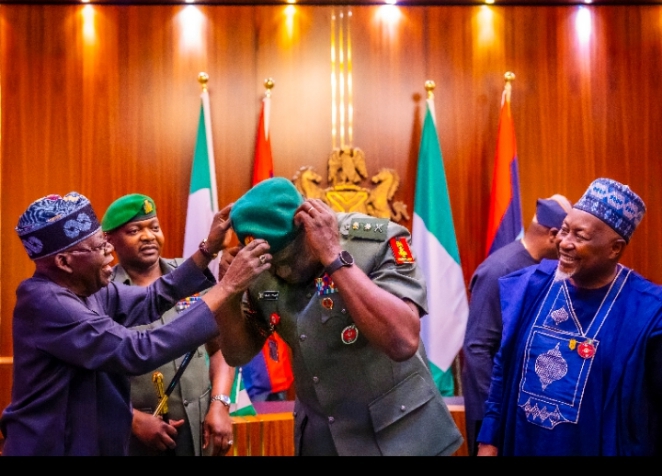
President Bola Tinubu has elevated the status of the Acting Chief of Army Staff, Olufemi Oluyede to Lieutenant General, the same as his boss, the substantive Chief of Army Staff, Lieutenant General Taoreed Lagbaja who is currently out of the country on sick leave. Decorating the Acting Chief Of Army Staff in a short ceremony at the President’s office today, November 5, President Tinubu commended the military for its unwavering courage, dedication and patriotism in maintaining the nation’s security. “It is both an honour and a privilege to decorate you today. This recognition reflects your commitment and service to the Nigerian military, which speaks volumes through your exemplary record. “We recognise all that you have been doing to ensure the country is safe and stable.” President Tinubu assured the military that the government would always listen to their advice and keep the country on the path of peace and prosperity. “We are facing challenges, but progress is being made.” The President attributed the success recorded in tackling terrorism and banditry to the “synergy’’ in the armed forces and urged the service chiefs to sustain harmony in their relationship for the betterment of the country. “The synergy among you has calmed the country, and we need that stability to continue. We need to assure all citizens that prosperity is not far from them,’’ President Tinubu stated. Lt. Gen. Oluyede expressed deep gratitude and acknowledged the solemnity of the occasion. He reiterated his commitment to upholding the vision of the Chief of Army Staff, Lt. Gen. Taoreed Lagbaja, and to maintaining peace across the country. Lt. Gen. Oluyede (N/9318) was granted Regular Combatant Commission as second lieutenant as a member of the 39 Regular Course on September 19, 1992, with seniority in the same rank effective September 12, 1987. The acting chief of army staff participated in several operations, including the Economic Community of West African States Monitoring Group (ECOMOG) mission in Liberia, Operation Harmony IV in Bakassi, and Operation Hadin Kai in the North East.
We use cookies on our website to give you the most relevant experience by remembering your preferences and repeat visits. By clicking “Accept”, you consent to the use of ALL the cookies.
This website uses cookies to improve your experience while you navigate through the website. Out of these, the cookies that are categorized as necessary are stored on your browser as they are essential for the working of basic functionalities of the website. We also use third-party cookies that help us analyze and understand how you use this website. These cookies will be stored in your browser only with your consent. You also have the option to opt-out of these cookies. But opting out of some of these cookies may affect your browsing experience.
Necessary cookies are absolutely essential for the website to function properly. This category only includes cookies that ensures basic functionalities and security features of the website. These cookies do not store any personal information.
Any cookies that may not be particularly necessary for the website to function and is used specifically to collect user personal data via analytics, ads, other embedded contents are termed as non-necessary cookies. It is mandatory to procure user consent prior to running these cookies on your website.





 Osun State Governor, Ademola Adeleke has described the death of the nation’s Chief Of Army Staff, Lieutenant General Taoreed Lagbaja as a huge misfortune to his state.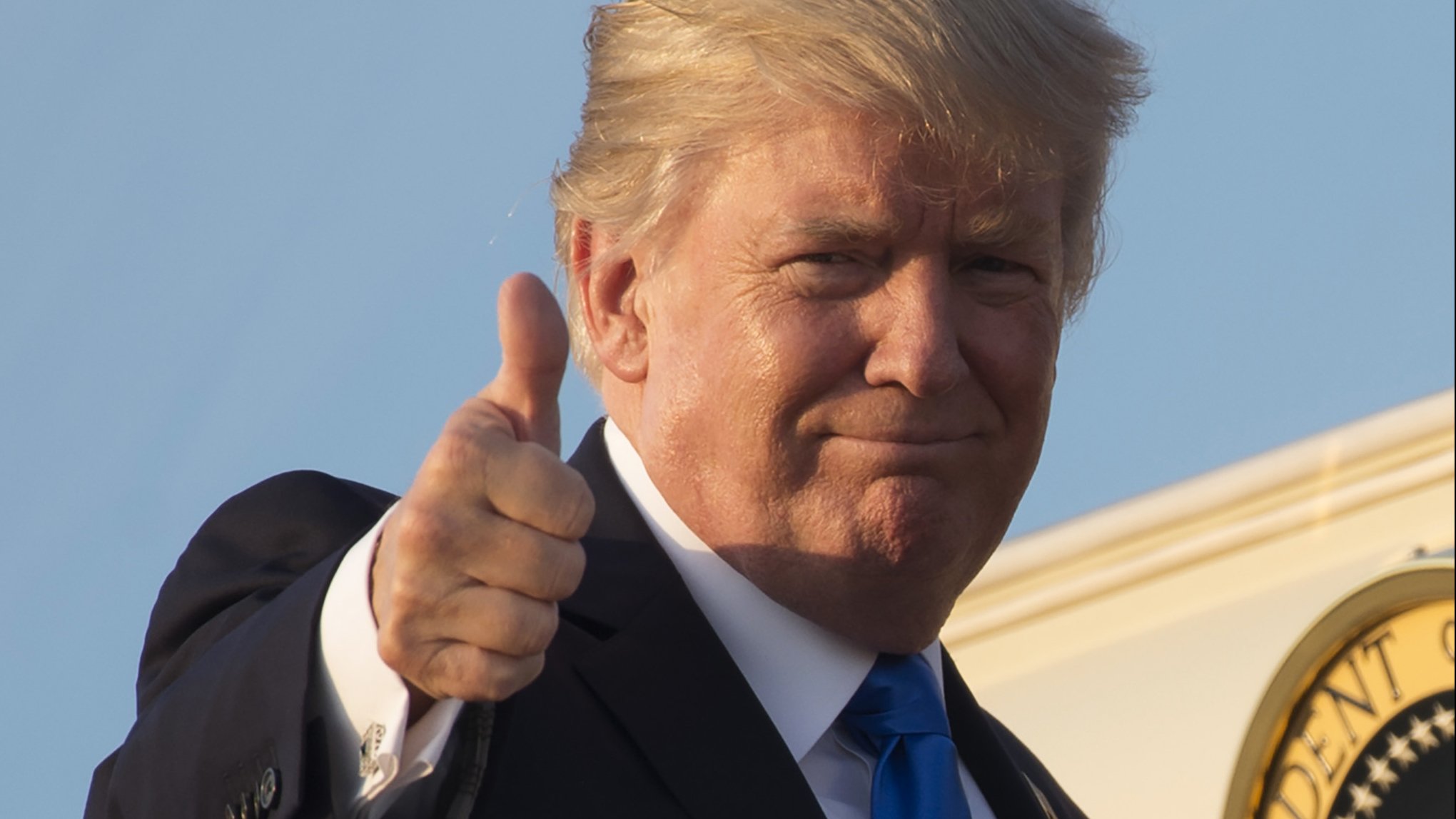


Correcting Media Misinformation On CNG, By Michael Oluwagbemi,
Following recent media reports, we find it necessary to address certain misinformation regarding the Presidential CNG Initiative. As a response to the high cost of petrol and the attendant rise in the cost of transportation, following the removal of fuel subsidy, President Bola Tinubu launched the Presidential CNG Initiative to provide a cheaper and cleaner energy source for Nigerians.
Since the launch of this ground-breaking initiative, the response has been positive as Nigerians are embracing and converting their petrol-powered vehicles to CNG-enabled vehicles – with over 60% reduction in the amount of money they spend on fuel.
To date, over 100,000 vehicles have been converted from petrol to CNG/bi-fuel-powered, and more conversion centres are being established across the country. In addition, investors are ramping up the development and deployment of CNG infrastructure, with over $200 million already invested across the value chain. Thousands of new jobs and economic opportunities are opening up along the line.
Going by the level of progress being made as regards the adoption and deployment of CNG infrastructure, we are concerned over certain instances of misinformation against this epochal initiative by a section of the media.
For instance, the October 31, 2024 editorial of the Punch Newspaper did not give a rational and fair assessment of the CNG initiative.
It is surprising how the choice of petrol, for which Nigeria spent about $10 billion annually on subsidy, and CNG which has the potential to save the nation $3 billion while adding $2 billion revenue to the national purse in the next three to four years, is an issue of toxic debate.
First, one of the issues raised against the CNG initiative and its implementation by The Punch is ease of conversion. We see this as an opportunity rather than a challenge, and we are already deepening the development of CNG infrastructure with our partners. However, the number of conversion centres has risen from seven in 2023 to more than 140 across the country, and certainly not 50 centres as claimed by The Punch. Facts are sacred. We believe the sacrosanctity of facts is not lost on The Punch, but to claim or assert without veracity and evidence is an obvious attempt at mischief.
In addition, more than 2,000 Nigerians have been employed in these conversion centres, with more jobs in the offing as CNG penetration ratchets up. In the past year, the private sector invested over 2 billion naira to establish these conversion centres, and another 6 to 10 billion naira will go into setting up more centres to meet the targeted 1,000 centres required to transform the nation’s energy dynamics.
Second, there is no cost of conversion for commercial vehicles in Nigeria. It is FREE under the President’s Conversion Incentive Programme. The programme seeks to convert one million commercial vehicles to CNG/bi-fuel in the next three years.
This is verifiable information as the National Union of Road Transport Workers (NURTW), whose members have benefitted recently issued statements acknowledging this fact.
The Punch also got it wrong with its “conversion explosion” slant in Edo State. It is important to emphasise that the explosion in Edo State happened because of substandard, uncertified, and poorly fabricated CNG cylinders, which exploded during an attempt to refill (not convert) at a station.
It is equally important to reiterate that CNG is safe and cleaner to use. It is lighter and eight times less explosive than diesel and eighteen times less explosive than petrol. It is also more readily available and a more sustainable alternative for Nigeria’s energy security.
With one million vehicles running on CNG, overall demand annually will be 220 million standard cubic feet of gas a day, or 2.75% of our current daily gas production, of which only 16% is consumed locally.
CNG distribution is also picking up with 75 new daughter stations under construction across the country, and additional containerized and mobile refuelling units are being set up by the private sector working closely with regulators. Mother station investments have totalled over $175 million in the past one year, with 65 new licences issued.
Lastly, CNG conversion kits are suitable for older vehicles. The experience in Egypt, India, and Iran shows that old vehicles operate better and more efficiently on CNG than they would on petrol. Open loop non-sequential conversion kits exist for aged vehicles, and the PCNGI has succeeded in Lagos in fitting several old yellow buses with the kits – with videos of the beneficiaries to show.
The claim that the government is not leading by example on CNG is false. On the contrary, the conversion programme started with government institutions like the Nigerian Army and the Nigeria Police – through the Police Trust Fund. The programme has now expanded to other MDAs like the Federal Road Maintenance Agency, the Ministry of Finance, and even the Federal Inland Revenue Service, as well as the PCNGI leadership team. More MDAs are signing up to the use of CNG for their vehicles. In addition, the federal government had already issued clear directives that only CNG-enabled vehicles should be purchased by government agencies. President Tinubu also directed that only such vehicles are to be approved by the Federal Executive Council.
Nevertheless, The Punch’s suggestion in its editorial that banks can fund the conversion to CNG for Nigerians who want to convert their vehicles is welcomed.
The Tinubu administration is already partnering banks and other financial institutions through the Credit Corp Credit Access for Light and Mobility (CALM) programme. Through this credit system, civil servants and employees in the organised private sector can access loan to convert their vehicles from PMS to CNG/PMS Bi-Fuel.
We recognise the indispensable role of the media in holding the government accountable and in keeping citizens informed. However, this role must be discharged with utmost responsibility and fidelity to truth, peace, and the collective well-being of the people. We are open and willing to work with the media to advance the advantages of the CNG initiative to the benefit of all Nigerians.
Engr. Michael Oluwagbemi, Project Director/CEO, Presidential CNG Initiative, wrote in from Abuja.