The Presidency is angry with The Punch newspaper which it said published “wicked and unfounded” that President Muhammadu Buhari is sympathetic to the activities of violent herdsmen, and has been indifferent to their atrocities.
“We reject The Punch newspaper’s September 4th, 2018, editorial which alleged that President Buhari had sympathy for criminality perpetuated by a misguided group. The editorial was not only disrespectful of the President and his office, but was also reckless, thoughtless, inflammatory and totally irresponsible.”
In a statement today, Wednesday, the senior special assistant to the President on media and publicity, Garba Shehu said that it is steadily becoming clear from the views, news and opinions of this newspaper that it will explore every opportunity and twist every fact to declare every Nigerian and ECOWAS member with Fulani blood a terrorists, who must be stripped of their rights as citizens, or worse subjected to ethnic cleansing.
“We believe and strongly insist that criminality perpetrated by some miscreants should not be used to demonize other responsible and decent members of the same ethnic group. The collective demonization of any ethnic group because of the misguided behaviour or conduct of criminals is improper and no responsible government will ever do so.
“The Punch editorial is, therefore, sheer blackmail and mischief designed to push its own sinister and unpatriotic agenda disguised as free speech. By inciting the people against an ethnic group because of the criminal activities of a few is unhelpful and deleterious to peace.
“Rather than proffer solutions, the editorial only regurgitated simplistic narratives of complex national issues, deliberately neglecting the broader and unbiased understanding and interpretation.
“After the highly biased and misleading editorial, the newspaper could not but come to terms with the established fact that climate change and criminality remained key drivers of the farmers-herdsmen conflict.
“Currently, a massive and fierce military operation is going on in Zamfara State to neutralise the activities of bandits who have been sacking communities and killing innocent people, and the security outfits have been deployed to safeguard lives and property.
“The President’s commitment to the security and wellbeing of all Nigerians is unwavering and total, and no criminal group, herdsmen or ethnic militias, will be spared the wrath of the law.
“In its attempt to build a case against the President and tarnish his hard-earned reputation, the newspaper misquoted and removed from the actual context words attributed to him, one or two of which we wish to clarify here.
“In pointing out that some Nigerians, who dare the desert and the Mediterranean in order to migrate illegally to Europe have to blame themselves, the President had a context, following severe warnings by local authorities that were clearly being ignored. The unfortunate Nigerians were always lured into harmful and unsafe journeys, with high likelihood of death or slavery.
“The President said the ECOWAS protocol allows freedom of movement but Nigeria will not tolerate the illegality. An administration that paid USD500,000 to evacuate 3,000 stranded Nigerians in Libya and a similar amount to bring back those that went to Russia to watch the World Cup this year cannot, in all fairness, be accused of insensitivity to the plight of illegal migrants.
“The question to ask the newspaper is simple: are we to say nothing, do nothing when our young citizens make the wrong choice of embarking on journeys that lead to slavery and death in the Mediterranean? Is it out of place to warn of the dangers of such wrong decisions?
“For the second issue, the President could not have been wrong in drawing attention to negative, abrasive and insensitive reporting by a section of the press that threatens to jeopardize national security by draining the morale of our uniformed men and women who are sacrificing their lives to keep the country united. Without a safe, peaceful and stable country, it is difficult to imagine how newspapers can prosper in their trade.
“Under this administration, no media, no matter how provocative, will be fettered in their freedom of expression. Rather, we will continue to appeal to their conscience to place national interest and professionalism above narrow concerns.
“The Presidency advises members of the media to exercise restraint and good judgement for the larger good of the society. We must not forget the significant and unsavoury roles played by journalists in the Rwandan genocide of 1994, which claimed almost one million lives.
“We should all work for the good of the country and all citizens.”
I cannot now remember exactly how I first encountered this phrase: “In defence of history”. But I think it was during my days on the Editorial Board of The Guardian newspaper, between mid-1980s and mid-1990s. The specific source must have been Odia Ofeimun, a friend and colleague that I had met and engaged about seven years before I landed in that newspaper house. In the first encounter with the phrase, it was used as title for a contribution to the debate on a widely-known account of a “cross-carpeting” (today’s “defection”) episode in a Nigerian regional House of Assembly in the early 1950s. The phrase had thereafter remained a favourite one in my historical writings.
From November 1990 to early January 1991, I used “Refutation of official history” (which in my head was a variant of “In defence of history”) as title for the longest series in my Thursday column in those days. In August 1998, the phrase—in its original form—was used as title for a special publication of our archive and research library in Calabar. And another variant of the phrase—“Refutations of false narratives”—is the title of an unpublished (or yet-to-be-published) collection of my articles and essays on Nigerian History.
The 1998 special publication, “In defence of history” was not intended for wide distribution in the first instance. Rather, it was put out as a supplement to our regular discussion notes but with the hope that it would become the first issue of a regular journal. Unfortunately, the hope has not been realized: that first issue has remained the only issue. However, over the last 20 years, I have made more frequent trips to this small publication (especially to its preface) than to any other publication of our archive and research library—although it is the least known. The latest trip was in the preparation for my last article, “To Samir Amin, a personal tribute” (August 27, 2018).
I shall, below, present extracts from the preface to the August 1998 publication. I had drafted that preface, titled: “In defence of history: Why and How?”, as Executive Editor. I shall conclude with a proposition to the Nigerian Left.
“In May 1998, the mainstream press of Western Europe and North America announced the death of a man by the name Pol Pot. This man was said to have caused the death of more than two million people in Cambodia—a small country in Southeast Asia bordered by Vietnam and Thailand. Pol Pot was said to have committed this ‘crime against humanity’ between 1975 and 1978 when he was in power in Cambodia. Journalists, newspaper editorialists and political commentators in Nigeria, including those who had never before heard of Cambodia, proceeded from this Western announcement to condemn Pol Pot and regret that the ‘monster’ died just as he was about to be handed over, not to the government of his country, but to the United States of America, to be tried for his heinous crimes.
“In all this expression of righteous indignation the Western press did not tell us, and the Nigerian press did not ask, what sustained Pol Pot in the jungle of that small country for 20 years, from the time of his removal from power in 1978 to his death in 1998. We were not told how Pol Pot came to power in the first place and how and by whom he was removed from power. We were not told how Pol Pot managed to kill more than two million of his country men and women. Did he run amuck slaughtering them in the manner of Rwanda? Did he march them into gas chambers in the manner of Adolf Hitler? Did he simply starve them to death?
“If we have been told all this, we probably would still have condemned Pol Pot, but we would at least have known that the man came to power in the Second Indo-China War, that is, the war in the third quarter of the 20th century between the peoples’ liberation forces of Vietnam, Cambodia and Laos, on the one hand, and American forces on the other; that, in that war, American forces killed, through bombing and starvation, more than two million Cambodians; that American governments sustained Pol Pot for 20 years after he was overthrown by the Vietnamese in a border war; and finally that those in power in Cambodia today, through the help of American government, were all collaborators of Pol Pot.”
I wrote the preceding two paragraphs 20 years ago, in August 1998. Were I to revise them today I would have added: “We would, above all, have uncovered a big irony of history, namely, that the Pol Pot regime which has been “universally” accused and condemned for killing its people by starvation, actually came to power in 1975 with the primary agenda of tackling the mass starvation caused by the sustained bombing of Cambodia carried out by American forces for five years.”
In a study finding, Cambodia: Starvation and Revolution, published in 1976 by the Monthly Review Press, New York, two American scholars summarized what they saw on ground in Cambodia: “Nowhere was the war—The second Indochina War—so brutal, so devoid of concern for human life, or so shattering in its impact on a society as in Cambodia. But while the U.S. government and news media commentary have contrived to avoid the subject of the death and devastation caused by the U.S. intervention in Cambodia, they have gone to great lengths to paint a picture of a country ruled by irrational revolutionaries, without human feelings, determined to reduce their country to barbarism”.
Away from Cambodia, the 1998 Preface went to other theatres, including Panama and Zaire (now Democratic Republic of Congo, DRC): “Manuel Noriega, the military ruler of Panama, who was, in 1989, abducted and taken to prison in America, was for a long time an agent of American governments through their Central Intelligence Agency (CIA).
Joseph Mobutu (alias Sese Seko) who staged his first coup in 1960, died in 1997 after being in power in Zaire for more than 32 years. Imperialists led the world in the condemnation of Mobutu, but failed to tell us who sustained Mobutu’s murderous regime for so long and tried, even in the dying hours of his rule, to secure a settlement that would have left him in office, if not in power.” The Preface also touched on Cuba, Libya, Iran, Iraq, North Korea, Israel, South Africa – and Nigeria where deliberate falsifications and ignorance are entangled.
The falsifications reproduced above are just a small fraction of what the 1998 Preface carried. But falsifications have continued, more brazenly and more systematically than ever before, and at all levels: national, regional and global. The aim is to de-link us from our past, from the true history of the exploited, the oppressed and the marginalized peoples of Nigeria and the world.
The need therefore arises for the Nigerian Left to revive the journal, “In defence of history” which, ideally, should be independent and whose broad aims would include: To assist our people, especially the young ones, to know, understand and appreciate the history of Nigeria and the history of the world into which Nigeria is inserted and integrated; to correct historical errors, distortions, and falsifications and, by so doing, rehabilitate the truth; to link the present to the past; to articulate and formulate the urgent questions of our time as they emerge from history and especially as they affect the working and toiling masses, the exploited, the oppressed, the marginalized and the humiliated peoples of Nigeria and nations of the world;; and to assist our young people to develop critical perspectives of historical analysis.
Madunagu, mathematician and journalist, writes from Calabar, Cross River State, Nigeria.
President Muhammadu Buhari has struck a deal with the Chinese President, Xi Jinping, for Nigeria’s aspiration to build the 3050 Megawatts Mambila hydroelectric power project, just as the two countries signed the agreement of $328m for the Information and Communication Technology Infrastructure Backbone Phase II (NICTIB II) project.
According to the Presidential spokesman, Garba Shehsu, the concessional loan agreement between Galaxy Backbone Limited and Huawei Technologies Limited (HUAWEI) was signed today, Wednesday in Beijing, China, by Nigeria’s Minister of Finance Kemi Adesoun and Wang Xiaotoa, Director-General, International Development Agency, in the presence of President Muhammadu Buhari and President Xi Jinping of China.
He said that Nigeria and China also signed a Memorandum of Understanding for the One Belt One Road Initiative (OBOR).
According to Garba Shehu, Nigeria’s Minister of Foreign Affairs Geoffrey Onyeama and He Lifeng, Director, China’s National Development and Reform Commission signed the OBOR- an initiative of President Xi which focuses on improving connectivity and cooperation among multiple countries spread across the continents of Asia, Africa and Europe.
He said that earlier during his meeting with President Xi, the Nigerian leader, while commending the Chinese government for successfully hosting the Forum on China-Africa Cooperation (FOCAC) solicited support for the Mambilla hydropower project.
President Buhari was quoted as saying that Mambilla project remains a key priority to Nigeria, the President also sought additional Chinese funding for four airport terminal projects as well as the Abuja light rail project.
President Buhari told his Chinese counterpart that since his last visit to China in 2016, the brotherly relationship between both countries had continued to flourish.
According to the President, ‘‘in the past 24 months, the Chinese Government has provided humanitarian aid to our conflict-affected areas, scholarship to Nigerian youth, military training and security support to our personnel and agricultural modernization training.’’
President Buhari noted that in the period under review, China had provided concessionary loans to fund critical infrastructure projects in Nigeria, adding that these interventions have positively impacted millions of Nigerians and will continue to do so for generations to come.
‘‘Mr President, as we celebrate these successes, I would like to once again solicit your support for the Mambilla Hydropower Project which remains a key priority for my government. Our hope is to fund the project with concessionary loans from China as any alternative funding arrangement will adversely impact the project’s viability.
‘‘We have been informed that our submission on this project is undergoing assessment by the relevant Chinese agencies. We hope with your kind intervention, this assessment will be expedited. Your Excellency, Mambilla is Nigeria’s equivalent of the three gorges dam. My wish is that you join me for the groundbreaking ceremony of this project in the not too distant future,’’ President Buhari said.
On Lake Chad Basin, the President thanked China for accepting to support the international efforts to recharge the Lake.
‘‘The inclusion of this project in the FOCAC Action Plan 2019 to 2021 will go a long way in supporting our efforts to rehabilitate and resettle the conflict-impacted North East region,’’ he said.
On people-to-people relations, President Buhari told his host that in the course of his visit, he interacted with Nigerian students and entrepreneurs living in different parts of China.
‘‘I was very pleased to hear about the positive experiences these hard working and law abiding citizens are having in their host communities. I also had the pleasure of meeting young Chinese students learning three Nigerian languages.
‘‘We must continue to support such exchange programmes to enhance our people-to-people contacts,’’ he said.
Similarly, President Buhari noted that easy movement of citizens of both countries would complement the currency swap agreements recently signed by the central banks of both countries.
‘‘Since our last meeting two years ago, Nigeria has relaxed its visa requirements to Chinese citizens. Today, I am pleased to inform Your Excellency that Chinese citizens receive Nigerian visas in less than 48 hours.
‘‘Another measure that will improve our trade volumes will be to introduce import duty waivers on Nigeria’s commodity exports to China. Today, our commodities such as sesame seeds, hibiscus and cassava amongst others attract import duty in China,’’ he said.
The Nigerian leader also lauded China’s support for two permanent seats for Africa at the United Nations, noting that the reform of the Security Council would ensure equitable representation for the continent.
In his remarks, President Xi who commended Nigeria’s fight against terrorism and the progress that has been made so far, promised China’s support in capacity building and intelligence sharing.
He also pledged 50 million Chinese Yuan support to Nigeria’s military, noting that ‘‘Buhari is as decisive in dealing with terrorism as China.’’
President Xi said China would import more agricultural products from Nigeria and expressed gratitude to President Buhari on Nigeria’s interest to participate in the forthcoming Chinese Import Fair.
‘‘The relationship between Nigeria and China is as best as ever, especially given the deepening mutual trust. China will continue to stand with Nigeria,’’ he said.
On Mambilla, the Chinese leader told President Buhari: ‘‘We understand how critical the project is to your country and we will take a serious look at it and ensure that it succeeds because of its social and economic benefits.’’
Meanwhile, at a separate meeting with Chinese Premier Li Keqiang, President Buhari reaffirmed Nigeria’s commitment to expanding mutually beneficial cooperation with China.
The Presidency has described the former Nigeria’s Vice President, Atiku Abubakar as a man who is either undemocratic by his recent actions and utterances or has seen defeat staring him, and his party, in the face.
Responding to Atiku’s accusation of President Muhammdu Buhari in a foreign news medium of being “very uncompromising, also power drunk; (and) who will not be ready to leave power without a fight,” the Presidency said: “the insinuation of a fight is the mindset of a man who is either undemocratic, or has seen defeat staring him, and his party, in the face.
“Let the former Vice President rest assured that there will be no ‘fight’ over power in Nigeria. Not under President Buhari’s watch. The people don’t want a fight. It is some political leaders we must beseech to eschew pugnacity, and mind their language.”
In a statement today, Wednesday, the special adviser to President Buhari on media and publicity, Femi Adesina admitted that the President is truly uncompromising only when it comes to looting the common patrimony of Nigerians, and squandering their riches.
“President Buhari is uncompromising in the quest to restore probity and accountability to public office. He is uncompromising in cleaning the rot Nigeria was consigned into pre-2015, thus the war against corruption is being fought without fear or favour. The President is equally resolute in the determination to ensure that Nigeria is no longer a mono-economy, depending only on oil.
“Yes, President Buhari is single-minded in effecting change in every area of Nigerian life. So, Alhaji Abubakar is right, if that was what he meant by the President being “uncompromising.
“But power drunk? No! And being a man “who will not be ready to leave power without a fight?” Never! Not President Buhari, who has demonstrated in many ways that he is a committed democrat, though also a retired military general. He has no apologies about that. Through a sterling military career, he served Nigeria with his heart and might, before venturing into partisan politics.
“In many ways, President Buhari has wielded power with decency, and as a means of serving the people, rather than for personal ends. If there’s one person not intoxicated by power, it is President Buhari, and scores of millions of Nigerians know this. That is why they will invest him with power again next year, knowing that he won’t misuse or misapply what has been entrusted to him.”
Adesina advised the former Vice President to borrow a leaf from the decorous language employed by Vice President Yemi Osinbajo, in answering his recent press statement on the restructuring debate, adding that Osinbajo signifies a hallmark of statesmen, “and not crying wolf where none exists, which is what the allegation of being uncompromising and power drunk truly is.
He remided Atiku that President Buhari is actuated by service to country, and nothing else, saying that there could therefore not be anything like “not ready to leave power without a fight.”
He called on Atiku not to use the name of President Buhari to buoy his bid to get the presidential ticket of a party, “whose flag has been flying at half-mast since it got roundly trounced at the polls in 2015.”
File Photo of police PRO, Jimoh Moshood addressing press
The Nigeria Police Force has released the names of the four officers who raided the Abuja resident of the Niger Delta elder, Chief Edwin Clark and the informant, even as the Force announced that a delegation led by a Deputy Inspector General of Police has been dispatched to apologize to him.
The police officers’names, as released by the Force Headquarters’ spokesman, Jimoh Moshood are ASP David Dominic, Inspectors Godwin Musa, Sada Abubakar, Yabo Paul and the informant Ismail Yakubu from Waru Village in Apo District, Abuja.
The statement said that the Officer who led the team has been queried and the three Inspectors are currently undergoing orderly trial for the appropriate punishment to be meted out on them.
The Force restated that the Inspector General of Police is not aware and did not order the raid of the residence of Chief Edwin Clark.
The statement said that the high powered delegation will apologize to the Edwin Clark over what it called “unauthorized, illegal and unprofessional misconduct in the Search of Chief Edwin Clark’s Residence in Asokoro, Abuja on the 4th of September, 2018.
“The delegation was received by Chief Edwin Clark and the apology was accepted by him.
“The informant (suspect), Ismail Yakubu – Informant from Waru Village, Apo District, Abuja will be arraigned in court this morning for giving false information and telling falsehood to mislead police action.”
The Presidency has warned members of the public to beware of fake instagram accounts @ymbuhari, being run by unknown personsclaiming to be that of Yusuf Buhari, the son of President Muhammadu Buhari.
A statement today, Wednesday by the special adviser to the President on media and publicity, Femi Adesina said that the accounts are being used to express opinions in Yusuf’s name without his knowledge.
“This is to inform the general public that Yusuf Muhammadu Buhari is not on any social media platform. The public is therefore, advised to disregard such handles and pages, while those perpetrating the illegality are advised to stop forthwith, as it amounts to impersonation.
“The same advice goes to those running other pages and handles impersonating other members of the family of the President.”
President of American University of Nigeria (AUN), Professor Dawn Dekle has asked new students of the institution to strive to overcome personal circumstances of their birth and challenges in childhood, including economic and social class expectations, to achieve greatness.
Speaking at the University’s Fall Semester Convocation and Pledge Ceremony, which marked the beginning of its 14th academic year for the undergraduate class of 2022, law class of 2023, post-graduate diploma class of 2020, masters’ degree class of 2020, and doctoral class of 2022, President Dekle advised them to dream big and aim for greatness.
“You are so much more than where you were born or your childhood circumstances,” the President told the students.
“You contain multitudes; you have the talents and skills you have not yet recognized. Use your time at AUN to develop yourself, make AUN work for you, make the most of it, and you will make your lives masterpieces.”
Four Chibok schoolgirls and several freshmen from other African countries were among the more than 203 students who took the University’s Community Pledge, a tradition of American universities.
The four Chibok girls, who graduated from AUN’s New Foundation School, an intensive pre-college preparatory program, which integrates academic and counseling contents, met the admission requirements leading to their enrollment into undergraduate programs.
Three of the girls who plan to go on to medical school are enrolled in AUN’s globally acclaimed Natural & Environmental Science program, with a concentration in Biomedical Science; the other will study Law. Altogether 12 students from Chibok community in Borno State are enrolled in different programs at AUN. Five are studying to become doctors, two each are in Law and Accounting, and two others are in the Business Administration and Communications & Multimedia programs.
Supported by their parents, faculty members, fellow students and other community members, the girls drew the loudest applause from the audience when they were called up to the podium to receive their Class sashes from Dr. Dekle.
Drawing broadly from sporting metaphors and anecdotes, Dr. Dekle noted that at its best, football transcends language, religion, race, and politics. Of all sports, it is the most inclusive, tolerant, and diverse.
“University study is a lot like football. In both, you have to rely on your team and make a plan for each test of your skill; you have to learn mental toughness to manage your anxieties and fears, and you have to take the opportunity to shine in the spotlight when you are asked to lead.
“If I have one last prayer for each of you; it is that you use your time at AUN to develop the mindset of a midfielder on the football pitch. Why do I choose a midfielder, when the striker is the one who bends or chips the ball into the goal and wins the glory for the team? I choose midfielder because the position is the most flexible and fit, the most adaptable, and the best team player.”
All the newly admitted students took part in their first Community Service the previous Saturday at the Yolde Pate Primary School in Yola South LGA. All students of the American University of Nigeria, Africa’s first Development University, are required to participate in Community Service.
The Independent National Electoral Commission (INEC) has announced that it had registered over five million eligible voters in Kano State for the 2019 general elections.
In a statement today, Tuesday, the Commission’s spokesman, Alhaji Garba Lawal Muhammad said that during the recently concluded Continuous Voters Registration (CVR) 540,792 newly registered voters were captured in Kano.
“The results of the successful conduct of the Continuous Voters Registration(CVR) and Distribution of the Permanent Voters Card,(PVC) is as follows, total CVR 540, 792, total transfer 11,504, PVC collected 56, 405, total of uncollected PVC’s 517, 927.”
Garba said that the concluded exercise also recorded 46,258 cases that comprises of loss of voters card, defaced cards and applicants, who had approached the commission for corrections to be carried out on their voters cards.
“The total number of voters in Kano, including the 2015 registered voters stands at 5,535,703. This figure may change, after consolidation of data and AFIS.”
He said that security agencies played an apparent role that ensures the hitch free PVC collection and CVR exercise in the state.
Garba assured the people of Kano that the commission is committed toward the conduct of free, fair and credible elections.
“We also want to call on all those who registered in 2011, 2014, and 2017 and have not collected their PVC, to visit INEC Local Government Offices statewide to collect their PVC.”
He said that residents who were captured during the 2018 registration exercise would be issued with their Permanent Voters Cards, PVC prior to the staging of the 2019 General Elections.
President Muhammadu Buhari reportedly declared in China, last Sunday, that he believes in the idea of free and fair elections, and that he is committed to this pillar of the democratic process. I don’t expect him to say anything otherwise. On the whole idea of free and fair elections, electoral integrity as it were, rests the political stability of our country and the legitimacy of democratic governments. Besides, President Buhari is a beneficiary of the framework of electoral integrity instituted by his predecessor in office. On account of the misgivings reported about the conduct of the 2007 general elections, President Goodluck Jonathan upon his assumption of office had declared that he hoped to leave a legacy of free, fair and credible elections. He tried to do this in 2011, even if there was an outbreak of violence in parts of the North, owing more to ethnic emotions rather than any far-reaching failings by the Independent National Electoral Commission (INEC). Between 2011 and 2015, President Jonathan remained committed to his promise.
Whenever elections were held, gubernatorial elections or bye elections and the ruling party lost, he was always the first to congratulate the winner of the election and to call for due respect for the people’s choice. I recall when the Gubernatorial election in Edo State was held in 2012. The President characteristically congratulated the winner in that election – Adams Oshiomhole, now Chairman of the All Progressives Congress (APC). Some elements with the Edo State PDP had grumbled loudly that the President should not have congratulated Oshiomhole because they intended to reject the results and make trouble. I received one or two phone calls, as presidential spokesman, telling me I was stupid to have issued a statement so quickly congratulating Adams Oshiomhole. The President’s acceptance of the result of the election tied their hands. They didn’t make trouble, instead they went to the Tribunal and pursued their case all the way to the Supreme Court.
The apex court in a lead judgement read by Bode Rhodes-Vivour (JSC) upheld Oshiomhole’s election. The rule of law prevailed. Again, in 2015, when the Presidential election did not favour President Goodluck Jonathan, he conceded victory to President Buhari and vacated office. He respected the Nigerian people’s right to choose. He chose to lead by example. If anyone is uncomfortable with this short narrative, let the person be further apprised of the fact that Professor Attahiru Jega, who served as the Chairman of the Independent National Electoral Commission (INEC) under President Jonathan, (2010 – 2015), remains today perhaps the most successful electoral umpire in Nigeria since independence. With probably the exception of Hon. Justice Ephraim O. I. Akpata, every other electoral commission chairperson before him, left office with a trail of controversy. The two general and other elections conducted by Attahiru Jega were widely regarded as credible. It may be too early to offer a final assessment of his successor, but it is safe to say that today’s INEC does not seem to be as strong and as prepared as Jega’s INEC.
This is the more reason why President Muhammadu Buhari’s declaration as regards free and fair elections is important. The preparedness and integrity of the electoral commission have far-reaching implications for the outcomes of the 2019 electoral process. In a recent research essay by Mathew T. Page and Sola Tayo, titled “Countdown to February 2019: A Look Ahead at Nigeria’s Elections” (July 2018) legitimate concerns have been raised about “Nigeria’s volatile pre-election season” and the strategic importance of the National Electoral Commission. If the Gubernatorial elections conducted in Kogi, Ondo and Ekiti states can be used as signs of things to come, then, indeed, Nigerians have cause to worry and the government enough reason to reassure the people. In the face of all this, it is important that President Buhari matches his words with action. The series of double entendres coming from the Presidency in the past few weeks, increase anxiety, not confidence, about the promise of credible elections in 2019.
It should be a matter of interest to us, for example, that barely six months to the 2019 general election, the National Assembly and the Presidency remain locked in a disruptive battle over the Electoral Act Amendment Bill 2018. In February 2018, the National Assembly forwarded an Electoral Act (Amendment) Bill to the President. This was vetoed. The President vetoed the Bill over disagreements on the issue of whether or not the National Assembly has the right to determine the sequence of elections. The lawmakers in re-ordering the 2019 elections had put the presidential election last, apparently to prevent the possibility of the elections being influenced by any bandwagon effect. The matter went to court and the Court of Appeal ruled in favour of the National Assembly. On June 27, 2018, the National Assembly sent another version of the amended Bill to the President for his assent. This was again vetoed on the grounds that it contained constitutional breaches. On July 24, 2018, the very day the National Assembly embarked on a recess till September 25, the National Assembly again passed another version of the Electoral Act (Amendment) Bill which purportedly reached the President on August 3, 2018. Pressures from National Assembly members to the effect that the Bill should be signed was rebuffed by the Presidency, with the argument that the President still had enough time, since the Constitution provides for a 30-day window within which the President can assent to a bill or he would be deemed to have vetoed it. That 30-day window closed on September 2.
Meanwhile, the only explanation that was offered by the President’s Senior Special Assistant on National Assembly Matters (Senate), Senator Ita Enang, when I interviewed him on “The Morning Show” (Arise News, DSTV Ch. 416, GoTV, Ch. 44 and SKY Ch. 519), on September 3 is that “it is well with the Electoral Bill”. I couldn’t figure out what that means in plain English language. “It is well”? How? I tried to provoke Senator Enang to comment on the Electoral Bill and its amendment. He argued that we should wait till September 25 when the National Assembly resumes, for us to know what the President has done with the Electoral Act (Amendment) Bill. I wondered: Why the secrecy? Why the mystery? I didn’t make much headway. Enang invoked his Miranda rights – a right that does not apply to him in the instance. But it is reassuring that before the close of work, on September 3, Enang had reconsidered his position and rightly taken the good step of providing clarifications. He reportedly disclosed that the President declined assent to the Electoral Bill on August 30 (which is the same as the President vetoing the Bill) on the ground that the Bill as proposed contains “some drafting issues.” Incidentally this is also one of the excuses that the Presidency gave to justify President Buhari’s rejection of the Petroleum Industry Governance Bill (PIGB) as presented to him by the National Assembly.
Nonetheless, the fate of the Electoral Act (Amendment) Bill remains dangerously shrouded in mystery. Why is it so difficult for the Executive and the Legislature to agree on a legal framework for the 2019 elections? Sometime in August, both Enang and Garba Shehu, the president’s other spokesman, told us that there was still enough time for the President to sign the amended bill. We now know that he chose not to sign it. In response to allegations by the rival opposition party, the Peoples Democratic Party (PDP), that the President continues to veto the bill because it contains provisions that would block under-age voting, identity theft, the influx of alien voters, and the manipulation of results between the polling station and the collation centre, Shehu responded that the President believes in the card reader system and the use of Permanent Voters Cards.
I consider the to-ing and fro-ing on this matter utterly contemptuous of the Nigerian people. If the matter is treated as important enough, the National Assembly should cut short its recess, and return immediately to take another look at the Bill and the earlier the better. For if the Bill continues to travel like a yo-yo between the National Assembly and the Presidency, it may be practically impossible to apply the recommended amendments to the 2019 electoral process. My suspicion however is that the Presidency probably does not want anything to tamper with the status quo, that is the Electoral Act 2010.
It all gets curiouser because members of the National Assembly have protested that the supplementary budget of N143 billion for INEC that has been endorsed by the joint committee of the National Assembly on electoral matters, clearly off-season, I mean during recess time, cannot be accessed if the President refuses to sign the amended electoral bill. Their argument is that the Bill covers approvals for INEC to procure necessary equipment and logistics for the 2019 elections. Long before now, INEC itself had complained that any further delay over the enabling legislation for the 2019 elections could hamper its ability to conduct a hitch-free election. So I ask: with all of these plain-sight facts, is there something that Nigerians should know that is not yet in the public domain? Could there be a covert attempt to derail the 2019 elections? Do we face the possibility at some point, of INEC throwing its hands up in the air in despair saying it is not ready, and that the election should be postponed in national interest, followed by the trading of blames? Please place emphasis on “national interest”.
It is also clear, so far, that there is no love lost between the National Assembly and the Presidency. Both arms of government even when the ruling party had a sure-footed majority in parliament have not been able to work together harmoniously due to reasons not far from ego-conflicts, the conflict of sycophants on both sides, and the absence of a guiding, all-inclusive, shared vision and mission. Nigerians are also suffering the effect of the inability of the ruling party, a network of strange bedfellows, to transform into a political party. Those who sold the APC as the best thing since toothpaste have since departed the party, returning majorly to the Peoples Democratic Party, the party that ruled Nigeria for 16 years, which today, by the way, is also still struggling to get its groove back. On the question of the Electoral Bill, President Buhari should see the need to provide the necessary leadership to ensure that a consensus that works for all parties concerned is established. He needs to realize that his own integrity is at stake. The amount of energy that the Presidency has devoted to the argument over the Electoral Act (Amendment) Bill raises high suspicion and may be used against President Buhari, in the future, whichever way the 2019 Presidential election goes.
The situation is not helped by the fact that the President most recently ran into murky waters with inappropriate and uninformed comments about the rule of law and national security, but perhaps he needs to worry more about these two issues within the context, not of power and might, but how best to ensure free, fair and credible elections in 2019. Respect for the rule of law will help to achieve that objective: and this would include: respect for the right of the Nigerian voter to make a free choice without threat or intimidation and for that choice to be respected and protected. No attempt should also be made to hijack the National Electoral Commission, and no one should see the 2019 election as a do-or die-election. Respecting the rule of law would mean putting Nigeria first, before, during and after the election. National security: this does not necessarily need to be at conflict with the rule of law, instead it must be operationalized within the context of the rule of law. This is the simple point that sycophants and intellectual marabouts do not seem to get.
In the recent gubernatorial election in Ekiti State there were reports that the Nigeria Police deployed about 30, 000 policemen, other security agencies were also on ground with lorry-loads of men. Nigerians should not be made to vote under the rule of the gun and a climate of fear. It is a sign of our underdevelopment and the failure of institutions that in Ekiti, vote-buying was done in the open, by agents of the two major political parties involved, with security agents looking the other way. To have free and fair elections, President Buhari cannot also afford to tolerate the impunity of security chiefs who have turned themselves and their agencies into his campaign billboards. The politicization of public institutions in Nigeria on the grounds of religion, ethnicity and geography remains a serious threat to national progress, the professional political elite is collectively guilty; it only just got worse under President Buhari’s watch.
What President Buhari does or does not do, in the next six months has serious implications for his own politics and political fortune and for the Nigerian polity. It is not for nothing that the international community seems for now to have shifted attention away from Nigeria’s Presidential politics and seem to be more concerned about trade, migration and security. But they are watching and waiting and listening. Nigeria is certainly under international searchlight. President Buhari should beware of those who tell him “all is well”. This is precisely the same kind of illusion that swept the PDP out of power in 2015.
File Photo of police PRO, Jimoh Moshood addressing the press
The Inspector General of Police (IGP), Ibrahim Idris has ordered the arrest and detention of four police men involved in the raiding of the Abuja resident of Niger Delta political elder, Chief Edwin Clark.
Also to be arrested and detained are the informants who spread the news of the raid, which the police authority said it is not aware of.
In a statement today, Tuesday, the police spokesman, Jimoh Moshood, stressed that the Inspector General of Police is not aware and did not order the raid of the residence of the Elder Statesman, Chief Edwin Clark as claimed by the writer of the story.
The statement said: “the attention of the Nigeria Police Force has been drawn to a report on vanguard online publication of 4th September, 2018 credited to one Henry Umoru claiming that the Police on Tuesday (today), raided the Abuja residence of Federal Commissioner for Information and South South Leader, Chief Edwin Clark.”
The police said that while the police men amd informant involved are being detained, it will carry out detail investigation into the incidence and that the outcome of the investigation will be made public.
The statement made it clear that the Force will not condone misconduct by any of its personnel that can run contrary to the rule of law, even though it receives information on daily basis from members of the public which were promptly used to prevent and detect crimes and criminalities.
We use cookies on our website to give you the most relevant experience by remembering your preferences and repeat visits. By clicking “Accept”, you consent to the use of ALL the cookies.
This website uses cookies to improve your experience while you navigate through the website. Out of these, the cookies that are categorized as necessary are stored on your browser as they are essential for the working of basic functionalities of the website. We also use third-party cookies that help us analyze and understand how you use this website. These cookies will be stored in your browser only with your consent. You also have the option to opt-out of these cookies. But opting out of some of these cookies may affect your browsing experience.
Necessary cookies are absolutely essential for the website to function properly. This category only includes cookies that ensures basic functionalities and security features of the website. These cookies do not store any personal information.
Any cookies that may not be particularly necessary for the website to function and is used specifically to collect user personal data via analytics, ads, other embedded contents are termed as non-necessary cookies. It is mandatory to procure user consent prior to running these cookies on your website.



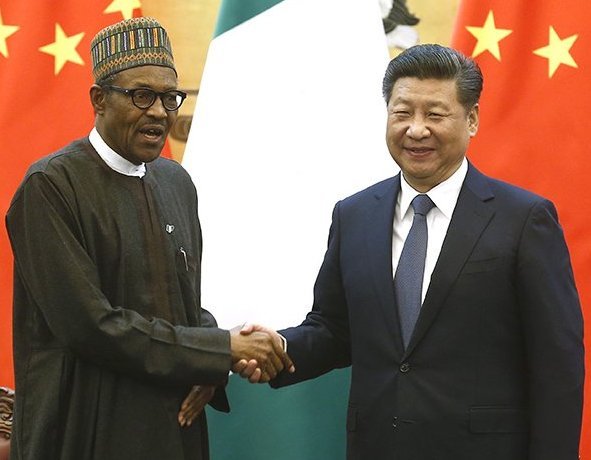 President Muhammadu Buhari has struck a deal with the Chinese President, Xi Jinping, for Nigeria’s aspiration to build the 3050 Megawatts Mambila hydroelectric power project, just as the two countries signed the agreement of $328m for the Information and Communication Technology Infrastructure Backbone Phase II (NICTIB II) project.




In Defence Of History, By Edwin Madunagu
I cannot now remember exactly how I first encountered this phrase: “In defence of history”. But I think it was during my days on the Editorial Board of The Guardian newspaper, between mid-1980s and mid-1990s. The specific source must have been Odia Ofeimun, a friend and colleague that I had met and engaged about seven years before I landed in that newspaper house. In the first encounter with the phrase, it was used as title for a contribution to the debate on a widely-known account of a “cross-carpeting” (today’s “defection”) episode in a Nigerian regional House of Assembly in the early 1950s. The phrase had thereafter remained a favourite one in my historical writings.
From November 1990 to early January 1991, I used “Refutation of official history” (which in my head was a variant of “In defence of history”) as title for the longest series in my Thursday column in those days. In August 1998, the phrase—in its original form—was used as title for a special publication of our archive and research library in Calabar. And another variant of the phrase—“Refutations of false narratives”—is the title of an unpublished (or yet-to-be-published) collection of my articles and essays on Nigerian History.
The 1998 special publication, “In defence of history” was not intended for wide distribution in the first instance. Rather, it was put out as a supplement to our regular discussion notes but with the hope that it would become the first issue of a regular journal. Unfortunately, the hope has not been realized: that first issue has remained the only issue. However, over the last 20 years, I have made more frequent trips to this small publication (especially to its preface) than to any other publication of our archive and research library—although it is the least known. The latest trip was in the preparation for my last article, “To Samir Amin, a personal tribute” (August 27, 2018).
I shall, below, present extracts from the preface to the August 1998 publication. I had drafted that preface, titled: “In defence of history: Why and How?”, as Executive Editor. I shall conclude with a proposition to the Nigerian Left.
“In May 1998, the mainstream press of Western Europe and North America announced the death of a man by the name Pol Pot. This man was said to have caused the death of more than two million people in Cambodia—a small country in Southeast Asia bordered by Vietnam and Thailand. Pol Pot was said to have committed this ‘crime against humanity’ between 1975 and 1978 when he was in power in Cambodia. Journalists, newspaper editorialists and political commentators in Nigeria, including those who had never before heard of Cambodia, proceeded from this Western announcement to condemn Pol Pot and regret that the ‘monster’ died just as he was about to be handed over, not to the government of his country, but to the United States of America, to be tried for his heinous crimes.
“In all this expression of righteous indignation the Western press did not tell us, and the Nigerian press did not ask, what sustained Pol Pot in the jungle of that small country for 20 years, from the time of his removal from power in 1978 to his death in 1998. We were not told how Pol Pot came to power in the first place and how and by whom he was removed from power. We were not told how Pol Pot managed to kill more than two million of his country men and women. Did he run amuck slaughtering them in the manner of Rwanda? Did he march them into gas chambers in the manner of Adolf Hitler? Did he simply starve them to death?
“If we have been told all this, we probably would still have condemned Pol Pot, but we would at least have known that the man came to power in the Second Indo-China War, that is, the war in the third quarter of the 20th century between the peoples’ liberation forces of Vietnam, Cambodia and Laos, on the one hand, and American forces on the other; that, in that war, American forces killed, through bombing and starvation, more than two million Cambodians; that American governments sustained Pol Pot for 20 years after he was overthrown by the Vietnamese in a border war; and finally that those in power in Cambodia today, through the help of American government, were all collaborators of Pol Pot.”
I wrote the preceding two paragraphs 20 years ago, in August 1998. Were I to revise them today I would have added: “We would, above all, have uncovered a big irony of history, namely, that the Pol Pot regime which has been “universally” accused and condemned for killing its people by starvation, actually came to power in 1975 with the primary agenda of tackling the mass starvation caused by the sustained bombing of Cambodia carried out by American forces for five years.”
In a study finding, Cambodia: Starvation and Revolution, published in 1976 by the Monthly Review Press, New York, two American scholars summarized what they saw on ground in Cambodia: “Nowhere was the war—The second Indochina War—so brutal, so devoid of concern for human life, or so shattering in its impact on a society as in Cambodia. But while the U.S. government and news media commentary have contrived to avoid the subject of the death and devastation caused by the U.S. intervention in Cambodia, they have gone to great lengths to paint a picture of a country ruled by irrational revolutionaries, without human feelings, determined to reduce their country to barbarism”.
Away from Cambodia, the 1998 Preface went to other theatres, including Panama and Zaire (now Democratic Republic of Congo, DRC): “Manuel Noriega, the military ruler of Panama, who was, in 1989, abducted and taken to prison in America, was for a long time an agent of American governments through their Central Intelligence Agency (CIA).
Joseph Mobutu (alias Sese Seko) who staged his first coup in 1960, died in 1997 after being in power in Zaire for more than 32 years. Imperialists led the world in the condemnation of Mobutu, but failed to tell us who sustained Mobutu’s murderous regime for so long and tried, even in the dying hours of his rule, to secure a settlement that would have left him in office, if not in power.” The Preface also touched on Cuba, Libya, Iran, Iraq, North Korea, Israel, South Africa – and Nigeria where deliberate falsifications and ignorance are entangled.
The falsifications reproduced above are just a small fraction of what the 1998 Preface carried. But falsifications have continued, more brazenly and more systematically than ever before, and at all levels: national, regional and global. The aim is to de-link us from our past, from the true history of the exploited, the oppressed and the marginalized peoples of Nigeria and the world.
The need therefore arises for the Nigerian Left to revive the journal, “In defence of history” which, ideally, should be independent and whose broad aims would include: To assist our people, especially the young ones, to know, understand and appreciate the history of Nigeria and the history of the world into which Nigeria is inserted and integrated; to correct historical errors, distortions, and falsifications and, by so doing, rehabilitate the truth; to link the present to the past; to articulate and formulate the urgent questions of our time as they emerge from history and especially as they affect the working and toiling masses, the exploited, the oppressed, the marginalized and the humiliated peoples of Nigeria and nations of the world;; and to assist our young people to develop critical perspectives of historical analysis.