Police has announced the arrest of armed robbery Kings, kidnappers and others that have been terrorising motorists and people in nearby villages in Tafa village, along Abuja-Kaduna highway.
The arrest was made by the special tactical squad of the Inspector General of Police (IGP).
A statement by the Force Public Relations Officer, (PRO) Jimoh Moshood, said that the suspects were responsible for several criminal activities bordering on killings, kidnappings, robbery in villages and towns along Abuja- Kaduna –Birnin Gwari- Funtua – Zamfara state a few weeks back.
Moshood, a Deputy Commissioner of Police, however, explained that the Inspector General of Police, Ibrahim Idris, was worried about the criminal activities on the highway.
“The Inspector General of Police (IGP) Ibrahim Idris, concerned with the new surge in violent crimes, such as kidnap, killings, Armed robberies of innocent Commuters/travellers and villagers in villages and towns along Abuja- Kaduna –Birnin Gwari- Funtua – Zamfara state few weeks back, re-gird operations Absolute Sanity with the deployment of more operatives and investigators of IGP Special Tactical Squad to unravel and arrest those behind the heinous and dastardly acts to bring the perpetrators to justice,” he said.
According to Moshood, 31 suspects in six different gangs including three Commanders of bandits that killed innocent people in Zamfara state were arrested.
The suspects were accused of being responsible for the kidnap of Sheik Mohammed Ahmed Alqarkawi in Kaduna State and collected a ransom of 12 million naira before he was released.
Items recovered from them include: 22 AK-47 Rifles, One LAR Rifle, two single Barrel Guns, One Locally made Pistol, One Dane Gun and 247 round of Ammunition.
Moshood also explained that most of the suspects confessed to the criminal roles they played in the alleged commission of the crimes.
He also stated that the police have rescued some of their kidnaps and would release the names of the suspects in due course.
Ex Nigeria’s Vice President Atiku Abubakar has fired back at Vice President Yemi Osinbajo by asking him to come out clear as to whether he is in support of restructuring or not instead of “prevaricating. “
In his quick response to Osinbajo response to his earlier lecture, Atiku said: “my advice to the Vice President is that he should choose whether he is for restructuring or whether he is against it and stick to his choice.
“This continuous prevarication, this approbation and reprobation, helps no one, least of all true progressives who know that Nigeria needs to be restructured and restructured soon.”
Read the full text of Atiku’s statement which he issued a few hours after that of Osinbajo:
My attention has been drawn to a letter written to Premium Times in response to an essay on restructuring authored by me.
Faced with an avalanche of public condemnation for his 360-degree turn on the concept of restructuring, it is understandable that the Vice President, Professor Yemi Osinbajo, has written to Premium Times to douse the tension his comments created. However, in doing so, the Vice President should not attempt to revise history by saying that he spoke against ‘geographic restructuring’.
I have been in the forefront of the discourse on restructuring since the 1995 Abacha Constitutional Conference and to the best of my knowledge, there has not been any term like ‘geographic restructuring’. It is a strange concept, not only because it is not what the restructuring debate is all about, but also because the words of the Vice President, which prompted my response were clear, unambiguous and unequivocal.
Mr. Osinbajo said, “the problem with our country is not a matter of restructuring”. That I disagree with and so do many other Nigerians. If the Vice President has changed his stance, I welcome it, but we should not use one finger to hide behind semantics.
For the Vice President to say “Alhaji Atiku’s concept of restructuring is understandably vague, because he seeks to cover every aspect of human existence in that definition”, is most unfortunate.
I have been very clear, detailed, and unambiguous about my ideas for restructuring. At several occasions, including, but not limited to my speeches at the Royal Institute of International Affairs (Chatham House), and at the University of Nigeria, Nsukka (made in April this year and July 2017, respectively), I gave very clear and concise ideas about administrative, political and economic restructuring as followss:
· Devolution of powers and resources to the states.
· No state will receive less Federal funds than today as a result of restructuring
· Matching grants from the federal government to the states to help them grow their internally generated revenue position.
· The privatisation of unviable federal Government-owned assets.
· A truly free market economy driven by the laws of demand and supply.
· Replacing state of origin with state of residence, and
· Passing the PIGD so that our oil and gas sector will run as a business with minimal governmental interference.
I am hard pressed to see how these clear and specific ideas can be described as ‘vague’. One would have thought that if anything is vague, it would be the idea of ‘geographic restructuring’ whose meaning is hanging in the air.
Be that as it may, in his letter, Vice President Osinbajo then jumps from the topic of restructuring and goes on to say:
“Good governance involves, inter alia, transparency and prudence in public finance. It involves social justice, investing in the poor, and jobs for young people; which explains our School Feeding Programme, providing a meal a day to over 9 million public school children in 25 States as of today. Our NPower is now employing 500,000 graduates; our TraderMoni that will be giving microcredit to 2 million petty traders; our Conditional Cash Transfers giving monthly grants to over 400,000 of the poorest in Nigeria. The plan is to cover a million households.”
While what Professor Osinbajo says may be true or false, I must say that his dovetailing into the area of the economy does not explain certain facts such as the fact that the Nigerian Bureau of Statistics reported in December 2017 that Nigeria lost 7.9 million jobs in the 21 month period under review.
If the Vice President cannot see that losing 7.9 million jobs in 21 months while creating 500,000 jobs is a deficit, then I do not know what to say to the honourable professor.
Professor Osinbajo also harps on about “prudence in public finance”, but he fails to show the wisdom in sharing out $322 million of Abacha funds to the poor only to take a loan of $328 million from the Chinese the very next month. Many Nigerians, myself included, see this as imprudence.
Finally, while the Vice President is not exactly correct when he says “In four years from 2010 to 2014 the PDP government earned the highest oil revenues in Nigeria’s history, USD381.9billion. By contrast the Buhari Administration has earned USD121 billion from May 2015 to June 2018”, let us for the sake of argument say that he is right.
My response to Vice President Osinbajo is that while I was Vice President of the Federal Republic of Nigeria in 2006, Nigeria’s Economic Management Team, of which I was a prominent member, paid off Nigeria’s entire foreign debt of $30 billion, at a time when we were earning one third of what the Buhari administration is currently earning from oil. So such arguments are puerile at best.
My advice to the Vice President is that he should choose whether he is for restructuring or whether he is against it and stick to his choice. This continuous prevarication, this approbation and reprobation, helps no one, least of all true progressives who know that Nigeria needs to be restructured and restructured soon.
Atiku Abubakar, Vice President of Nigeria, 1999-2007 is a presidential aspirant of the Peoples Democratic Party.
Vice President Yemi Osinbajo has lectured ex Vice President Atiku Abubakar on the proper functioning of restructuring of the country.
Osinbajo, who apparently responded to Atiku’s recent comments on his earlier lecture, said: “restructuring in whatever shape or form, will not mean much if our political leaders see public resources as an extension of their bank accounts.”
In a statement to the PREMIUM TIMES today, Tuesday, Osinbajo recalled that despite earning so much less as compared to the previous governments and without restructuring, the Muhammadu Buhari government is still able to invest more in infrastructure than any government in Nigeria’s history.
“The difference is good governance, and fiscal prudence. This, I believe, is the real issue.”
Read the full text of the Vice President of letter:
Kindly permit me a response to a piece in your publication, titled “Osinbajo got it wrong on Restructuring,” written, we are told, by my illustrious predecessor in office, Alhaji Atiku Abubakar.
First, let me say that I really would have expected Alhaji Abubakar to at least get the full text of my comments before his public refutal of my views. But I understand; we are in that season where everything is seen as fair game! He quoted me as saying that “the problem with our country is not a matter of restructuring… and we must not allow ourselves to be drawn into the argument that our problems stem from some geographic re-structuring”.
Yes, I said so.
As the quote shows, I rejected the notion that geographical restructuring was a solution to our national problems. Geographical restructuring is either taking us back to regional governments or increasing the number of States that make up the Nigerian federation.
As we all may recall, the 2014 National Conference actually recommended the creation of 18 more States. And I argued that, with several States struggling or unable to pay salaries, any further tinkering with our geographical structure would not benefit us.
We should rather ask ourselves why the States are underperforming, revenue and development wise. I gave the example of the Western Region (comprising even more than what is now known as the South West Zone), where, without oil money, and using capitation tax and revenues from agriculture and mining, the government funded free education for over 800,000 pupils in 1955, built several roads, farm settlements, industrial estates, the first TV station in Africa, and the tallest building in Nigeria, while still giving up fifty percent of its earnings from mining and minerals for allocation to the Federal Government and other regions.
I then argued that what we required now was not geographical restructuring but good governance, honest management of public resources, deeper fiscal Federalism, and a clear vision for development.
On the issue of deeper fiscal Federalism or restructuring, I explained how the then Lagos State Government, led by Asiwaju Bola Ahmed Tinubu, decided to fight for greater autonomy of States.
As Attorney-General at the time, it was my duty and privilege to lead the legal team against the then Federal government, in our arguments at the Supreme Court. I am sure that Alhaji Atiku Abubakar would remember these cases on greater autonomy for States that I cite below, as he was Vice President of the Federal Republic of Nigeria at the time.
At the Supreme Court, we won several landmark decisions on restructuring Nigeria through deeper fiscal federalism, some of which our late converts to the concept, now wish to score political points on.
It was our counter-claims alongside those of other littoral States, that first addressed so comprehensively the issue of resource control. We agreed with the oil producing States that they had a right to control their resources. We argued, though unsuccessfully, that the Ports of Lagos were also a resource, which should enable Lagos State, in the worst case, to be paid the derivation percentage for proceeds of its natural resources. Years later, we also filed an action at the Supreme Court arguing that the Value Added Tax, being a consumption tax, should exclusively belong to the States.
On the issue of who, between the Federal and State governments, should have authority to grant building permits and other development control permits, the Supreme Court, by a slim majority, ruled in our favour. It held that, even with respect to federal land, States had exclusive authority to grant building or other developments control permits.
In 2004, we created 37 new local governments in Lagos State. We believed that we had a Constitutional right to do so and that in any event, a State should have a right to create its own administrative units. Several other States joined us and created theirs.
The Federal government’s response was to seize the funds meant for our local governments, thus strangulating States like Lagos, which had created new local governments. We challenged this at the Supreme Court. The court held that the President had no right under the Constitution to withhold or seize funds meant for the States. The allocations were not a gift of the Federal Government to the States. They were the Constitutional right of the States and local governments.
The court also agreed that States had a Constitutional right to create local governments, pursuant to section 8 of the Constitution, but that the creation remained inchoate until the National Assembly, by resolution, amended the existing list of local governments to capture the newly created LGs.
In response, we created by State Law, Local Council Development Areas (LCDAs), to accommodate the newly created Local Government Councils until such a time as the National Assembly would complete the process. But the Lagos State Government took up the challenge to re-engineer its revenue service, making it autonomous. With innovative management, tax collection in Lagos became more efficient, and tax revenues continued to grow geometrically. Today, the State earns more IGR than 30 States of Nigeria put together!
Further, we contested the attempts of the then Federal Government to create supervisory authority over the Finances of Local Governments by the signing into law of the Monitoring of Revenue Allocation to Local Governments Act, 2005. The Supreme Court also ruled in our favour, striking down many provisions of the law that sought to give the Federal government control over local government funding.
I have been an advocate, both in court and outside, of fiscal Federalism and stronger State Governments. I have argued in favour of State Police, for the simple reason that policing is a local function. You simply cannot effectively police Nigeria from Abuja. Only recently, in my speech at the Anniversary of the Lagos State House of Assembly, I made the point that stronger, more autonomous States would more efficiently eradicate poverty. So I do not believe that geographical restructuring is an answer to Nigeria’s socio economic circumstances. That would only result in greater administrative costs. But there can be no doubt that we need deeper fiscal Federalism and good governance.
Alhaji Atiku’s concept of restructuring is understandably vague, because he seeks to cover every aspect of human existence in that definition. He says it means a “cultural revolution”. Of course, he does not bother to unravel this concept. He says we need a structure that gives everyone an opportunity to work, a private sector driven economy. Yes, I agree. These are critical pillars of our Economic Recovery and Growth Plan (ERGP), including our Ease of Doing Business Programme.
If, however, this is what he describes as restructuring, then it is clear that he has mixed up all the issues of good governance and diversification of the economy with the argument on restructuring.
Good governance involves, inter alia, transparency and prudence in public finance. It involves social justice, investing in the poor, and jobs for young people; which explains our School Feeding Programme, providing a meal a day to over 9 million public school children in 25 States as of today. Our NPower is now employing 500,000 graduates; our TraderMoni that will be giving microcredit to 2 million petty traders; our Conditional Cash Transfers giving monthly grants to over 400,000 of the poorest in Nigeria. The plan is to cover a million households.
Surprisingly, Alhaji Atiku leaves out the elephant in the room – corruption. And how grand corruption, fueled by a rentier economic structure that benefits those who can use political positions or access to either loot the treasury or get favorable concessions to enrich themselves. This was a main part of my presentations the Minnesota Town Hall meeting.
In arguing for good governance, I made the point that our greatest problem was corruption. I pointed out that grand corruption, namely the unbelievable looting of the treasury by simply making huge cash withdrawals in local and foreign currency, was the first travesty that President Buhari stopped.
I showed the OPEC figures from oil revenues since 1990. In four years from 2010 to 2014 the PDP government earned the highest oil revenues in Nigeria’s history, USD381.9billion. By contrast the Buhari Administration has earned USD121 billion from May 2015 to June 2018, less than 1/3 of what Jonathan Administration earned at the same period in that administration’s life. Despite earning so much less, we are still able to invest more in infrastructure than any government in Nigeria’s history. The difference is good governance, and fiscal prudence.
In the final analysis, restructuring in whatever shape or form, will not mean much if our political leaders see public resources as an extension of their bank accounts.
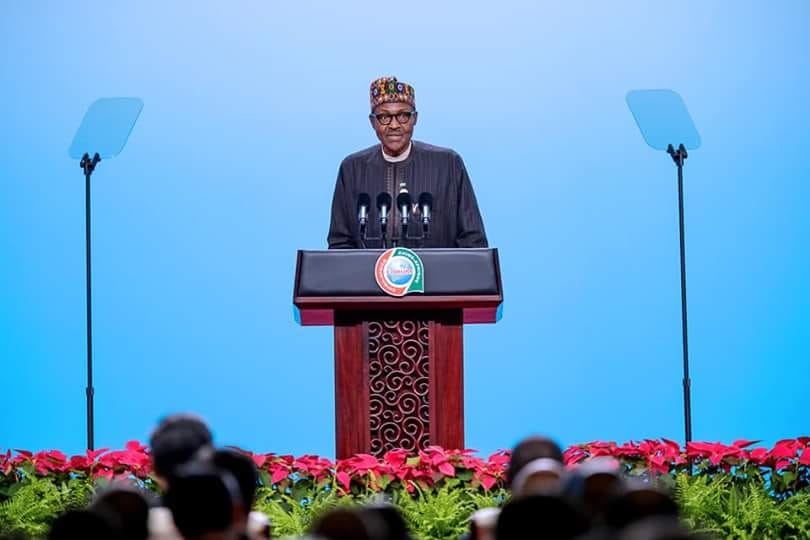
President Buhari participated in a round table meeting on FOCAC
President Muhammadu Buhari has acknowledged that Nigeria has benefited from partnership with China through the Forum on China-Africa Cooperation (FOCAC) resulting in the execution of vital infrastructure projects across the country, valued at over $5 billion in the last three years of his administration.
President Buhari who spoke today, this Tuesday in Beijing at the FOCAC Round Table meeting, attended by African leaders and Chinese President Xi Jinping highlighted specific projects under FOCAC.
According to him, through the Chinese support, Nigeria has impressively addressed significant challenges in the areas of infrastructure, human capacity development, power, transport, agriculture and humanitarian assistance.
”For Nigeria, our partnership with China through the FOCAC platform, has resulted in the construction of the first urban rail system in West Africa. This $500 million project in Abuja was commissioned in July this year.”
The President also cited the construction and operation of the first rail system in Africa that uses modern Chinese standards and technology.
“This 180km rail line that connects Abuja and Kaduna was commissioned two years ago at a cost of $500 million. Today the rail line is functioning efficiently with no issues – indeed, a sign that Chinese technology is world class.
”Nigeria is leveraging Chinese funding to execute $3.4 billion worth of projects at various stages of completion. These include the upgrading of airport terminals, the Lagos – Kano rail line, the Zungeru hydroelectric power project and fibre cables for our internet infrastructure.
”Furthermore, less than 3 months ago, Nigeria signed an additional $1billion loan from China for additional rolling stock for the newly constructed rail lines as well as road rehabilitation and water supply projects”.
The Nigerian leader said that the aforementioned projects had demonstrated the high level of consistency and commitment China has shown in boosting its relations with African countries under the umbrella of FOCAC.
”I am optimistic that this Summit will offer new opportunities that would build on these past achievements,” he said, adding that, ”Nigeria will continue to support the FOCAC initiative and also seek to key into the Belt and Road Initiative as an additional Chinese mechanism to build further cooperation in our quest for infrastructural and economic development.”
President Buhari dispelled insinuations about the so-called death trap by Chinese government on developing countries, insisting that Nigeria would be able to re-pay the loans.
”These vital infrastructure projects synchronize perfectly with our Economic Recovery and Growth Plan. Some of the debts incurred are self-liquidating. Our country is able to re-pay loans as and when due in keeping with our policy of fiscal prudence and sound housekeeping.”
Buhari applauded China for its overall commitment to the ideals of FOCAC, even as he acknowledged that since the launch of the Forum in 2000, China and Africa had striven to implement the declarations and follow-up action plans for the benefit of both parties.
President Buhari also commended President Jinping, his Government and people for successfully hosting the Beijing Summit aimed at further strengthening China-Africa partnership.
President Muhammadu Buhari delivering speech at 2018 FOCAC summit on behalf of ECOWAS Commission
Protocols:
On behalf of the Government and people of the Federal Republic of Nigeria and the Authority of Heads of State and Government of the Economic Community of West African States (ECOWAS), I wish to express our appreciation to the Government and people of the People’s Republic of China for the warm hospitality extended to our delegations since our arrival in China.
2. The participation of so many Heads of State and Government of ECOWAS at this High-Level Dialogue between Chinese and African Leaders and Business Representatives is a demonstration of the excellent relations between China and ECOWAS.
3. We are happy to welcome to the FOCAC family, two Member States of ECOWAS; the Republics of The Gambia and Burkina Faso as well as São Tomé and Principe.
4. It is therefore worthy of note that for the first time, all ECOWAS Member States are participating in a FOCAC Summit.
Excellencies, Ladies and Gentlemen.
5. The ECOWAS region accounts for some 30% of Africa’s population and GDP.
6. ECOWAS Member States are presently embarking on policies and strategies to stabilise and strengthen internal growth. Our Member States are making efforts at diversifying their economies and developing specific policies targeting the most vulnerable groups, in order to ensure more inclusive growth. In this regard, Member States will continue to encourage Chinese State-owned companies and entrepreneurs to invest in our sub-region.
7. I take this opportunity to convey the appreciation of ECOWAS Member States for China’s increasing investment in our sub-region with the aim of building a prosperous and shared future. China is today, the largest investor in the sub-region in both private and public sectors covering areas such as infrastructure, energy, agriculture, mining, healthcare. China also provides significant assistance in emergency humanitarian aid and response to climate change.
8. Various construction projects are now ongoing in the sub-region, including the construction of railway projects, power infrastructure, airports and numerous roads through Chinese financing.
9. While it is pertinent to mention that Member States of ECOWAS are at different stages of development, President Xi Jinping’s recent visit to our sub-region has highlighted the need for even closer collaboration to enable more Chinese investment to support the cause of regional integration and development.
10. We should also realise that while China’s help is vital, the main push to transform our economies must come from our own efforts and commitment.
11. ECOWAS also welcomes more Chinese tourists to visit West Africa. This will enhance people-to-people exchanges, especially now that Member States are getting involved in the Belt and Road Initiative. Our sub-region is endowed with enormous tourism potentials. With China’s support, tourism related infrastructure should be developed to empower our citizens, create more employment opportunities among the teeming population and eliminate poverty.
12. We would also request visa facilitation for our businessmen and women, and students who seek to visit China.
13. ECOWAS Member States will continue to pay emphasis on encouraging more foreign direct investment in the sub-region. To this end, Member States are looking at the opportunities that the China International Import-Export initiative will offer our exporters to gain market access for their goods and services in China. Such an opportunity will help in diversifying the economy of our sub-region from over reliance on primary agricultural and mineral products and subsequently correct the huge trade imbalance between China and the ECOWAS sub-region on a win-win basis for both parties.
14. Excellencies, while expressing our appreciation for the strong engagement of China with the ECOWAS sub-region, I also wish to thank President Xi Jinping for the pledge to build a befitting Secretariat for the Commission.
Distinguished Ladies and Gentlemen.
15. Let me reiterate the commitment of ECOWAS Member States to deepening and strengthening institutions in the sub-region, through good governance, the fight against corruption, combating terrorism, violent extremism and organised crime. These are necessary actions if the right conditions for sustainable economic growth in West Africa are to be achieved.
16. Finally, on behalf of the Authority of Heads of State and Government of the ECOWAS, I wish the High-Level Dialogue and Conference successful deliberations and a fruitful outcome.
The minister of Labour and Employment, Dr. Chris Ngige, has cautioned his fellow Igbos to stop crying wolf of marginalization by the government of Muhammadu Buhari where there is no such marginalization. Ngige, who spoke to newsmen in Awka, Anambra State said: “there’s nothing that is being shared by the Buhari government that is not equitably done. “Buhari has five flagship projects; Lagos-Ibadan to Ilorin Mambila Power Plants; Abuja-Kaduna-Kano Highway; Second Niger Bridge and East West roads. “You can see how it was shared. So, how are you (Igbos) left out? Why are you crying marginalisation: why are you crying wolf when there is none and it is this mentality that I’m telling you people that you have to come out from. “So, all I’m saying in effect is that you (Igbos) must do political engineering; that’s the Igbo of the South-East and the step to take forward is to support a Buhari presidency for 2019/2023 and vote for it with all their strengths. “By so doing, they will not be left out in the power-sharing that will come thereafter like it was done at this period.” Responding to a question on the health and age of President Buhari, Dr. Ngige said that the President is healthier and stronger than 80 percent of Nigerians. “I can tell you authoritatively as a medical doctor of over three decades standing that Mr President is physically and mentally healthy. He is healthier than 80 per cent of Nigerians”, he said. Ngige Speaking with newsmen in Awka, Ngige averred that Buhari sits for over eight hours during their executive meetings. Whereas most of them who thought they have sat for a very long time would go for a tea break to stretch the legs. “Mr President sits on his seat continuously, drinking only water.”
The sudden death of Mr Kofi Annan, former Secretary-General of the United Nations came as a rude shock to the world. He died on 18th August in a hospital in Bern, Switzerland after a short illness. He was aged 80. Mr Kofi Annan was a global icon of peace. He straddled the United Nations for a decade as its Secretary-General during which he worked tirelessly to ensure global peace and security. During his distinguished career and leadership of the UN, he championed the cause of peace, sustainable development, human rights and the rule of law.
Kofi Annan, a product of the UN, having joined the World Health Organisation in 1962, had the singular distinction of being the first career bureaucrat of that body to be elevated to the enviable position of Secretary-General. He had earlier served as Under Secretary-General for Peacekeeping between March 1992 and December 1996. He replaced Boutros Ghali, the first African to head the UN. He was the 7th chief of the UN and he served for two terms.
An excellent diplomat and global statesman, he was committed to multilateralism as key to solving the world’s intractable problem. He craved for a fairer and more peaceful world. He will be remembered for his singular effort in the run-up to the Iraq crisis during which he made strenuous efforts to broker peace between the United States and Iraq under Saddam Hussein. His aim was to avoid conflagration in the Middle East. His advocacy of multilateralism in resolving that crisis fell on deaf ears. However, the US had presented the UN with a fait accompli, citing Iraq’s failure to comply with past Security Council resolutions, and later using it as pretext for war. In the end, Annan’s yeoman effort came to naught as the United States under President George Bush Jr disregarded the wise counsel of the UN and instead rolled out both ground and air forces to pound Iraq into submission. Later Mr Annan had described the US and UK action as not in conformity with UN charter, and was therefore illegal.
He was a harbinger of reforms in the UN during his era. He reformed the UN bureaucracy and worked to combat HIV/AIDS especially in Africa and launched the UN Global Compass where the goals of the UN and those of business can be mutually supportive. He regarded the HIV/AID pandemic as a personal priority and proposed the establishment of the Global Aids and Health Funds dedicated to battle against HIV and other debilitating diseases. As part of UN reforms, he introduced strategic management to strengthen unity of purpose, establishment of the position of Deputy Secretary-General, 10% reduction in post, cut in administrative cost, as well as reaching out to civil society and the private sector as partners. He also recommended the expansion of the Security Council.
As the prime mover of the Millennium Development Goals, Kofi Annan in his report following a Millennium Summit called on states to “put people at the centre of everything we do. No calling is nobler, and no responsibility greater, than that of enabling men, women and children in cities and villages around the world, to make their lives better.” The priority area of the report which served as the basis for Millennium Development Goals, aims to “free our fellow men and women from the abject poverty and dehumanizing poverty in which more than one billion of them are currently confined”. Furthermore, Mr Kofi Annan played a vital role in restoring Nigeria to the path of democracy. He’s widely applauded for his peace initiative and support for the transition from military to civilian rule in 1998. He also worked towards supporting efforts of East Timor to secure independence from Indonesia the following year. Again he brokered peace between Nigeria and Cameroon which subsequently led to the settlement of the dispute between the two countries over the Bakassi peninsula, avoiding a potential Kashmir crisis in Africa. He was also instrumental in raising UN peacekeeping mission to Darfur, Sudan.
At the centennial of the UN in 2001, a fitting tribute for his peace efforts culminated in the award of the Nobel Peace Prize to both the UN and Mr Kofi Annan as joint winners for having revitalized the UN, and for having given priority to human rights. The Nobel Committee noted his commitment to the struggle to control the spread of HIV in Africa and his declared opposition to international terrorism.
Despite his meritorious career in the UN, in 2004 a UN’s Oil for Food programme report came to the fore that Kojo, the secretary- general’s son received payments from a Swiss company, Cotecna, hired to monitor humanitarian imports into Iraq under the programme. As the fallout from this, Mr Annan came under scrutiny, and there were calls for him to step down. Soon after an independent commission of inquiry investigated the report, and later exonerated Mr Annan from any complicity in the deal. However, the statesman drew his greatest flak for the passivity of the UN as head of its peacekeeping mission during the Rwandan genocide in which about 800,000 lives were lost. The UN peacekeeping mission also experienced varying degrees of failures in Somalia and Bosnia under his watch.
As if to buttress this point, in 2003, Canadian ex-General Romeo Dallaire, force commander of UN Assistance Mission for Rwanda, claimed Annan was passive in his response to imminent genocide. In his book Shake Hands with the Devil: The Failure of Humanity in Rwanda (2003), Gen Dallaire asserted that Annan held back UN troops from intervening to settle the conflict and from providing more logistical support. Although in 2004, ten years after the Rwandan genocide, Kofi Annan admitted that “I could and should have done more to sound the alarm and rally support.” In his book Interventions: A Life in War and Peace, Annan argued that the Department of Peacekeeping Operations (DPKO) could have made better use of media to raise awareness of the violence in Rwanda and put more pressure on governments to provide troops necessary for intervention.
Perhaps on account of this huge omission, Kofi Annan had introduced, prior to his departure from the UN, the doctrine of ‘Responsibility to Protect’ as part of the ‘Larger Freedom’ which gives rights to states to intervene in crisis situations to protect civilian populations at risk.
Despite his exertions as UN Secretary General, Kofi Annan realised that there was still much work to be done. Because of the partial failings in the world body, in his farewell address to the UN in 2006, he outlined 3 major problems of “an unjust world economy, world disorder and widespread contempt for human-rights and the rule of law,” which he believes, have not resolved but sharpened” during his time as secretary-general. He also pointed to violence in Africa and Arab-Israeli conflict as two major crises that require attention. Although long on rhetoric but short on action, still Mr Kofi Annan believes “The UN can be improved, it is not perfect but if it didn’t exist we would have to create it,” he told the BBC’s HardTalk during an interview for his 80th birthday last April.
Even after retirement Kofi Annan still remained relevant. His widely acknowledged negotiation and mediation skills recommended him to serve as UN-Arab League Joint Special Representative for Syria to help find resolution to the conflict there. He later quit when he admitted to being frustrated on the peace initiatives. In 2016, he was appointed to lead UN commission to investigate the Rohingya crisis.
In retirement, he founded the Kofi Annan Foundation dedicated to the promotion of better global governance, which builds up capacities of peoples and countries to achieve a fairer and more peaceful world. He was a member and chairman of the Elders, a group of independent global leaders founded by Nelson Mandela, dedicated to global peace and human rights. Kofi Annan was a recipient of several awards and honours. He was a recipient of over 20 honorary degrees from universities all over the world in recognition of his contribution to global peace and security.
A man overflowing with dignity and grandeur, Mr Kofi Annan exuded personal warmth, and he was a sincere and honest broker. He was an epitome of peace, patience, goodness and gentleness. Mr Annan will be remembered as an eminent statesman, global icon of peace, astute diplomat, peacemaker and humanist par excellence. His exit has made the world the poorer, for he was a quintessential diplomat and excellent administrator. An illustrious son of Ghana and Africa, Kofi Annan worked and died for global peace. A champion of peace, Kofi Annan has left his footprints on the sands of time.
A number of politicians seeking for political offices in the 2019 general elections in Kogi State on the platform of the Peoples Democratic Party (PDP), it have vowed to destroy the party if it goes ahead with the plan to give automatic tickets to serving members of the two chambers of the National Assembly. The aspirants, who protested at the national headquarters of the party in Abuja, demanded a level-playing field for all aspirants, and stressing that only free, fair and transparent primaries across the states would be acceptable to them. The protesters, who sang different songs to register their anger, said offering automatic tickets to the lawmakers, including Senator Dino Melaye who recently defected to the party from the All Progressives Congress (APC) would be a clear violation of the Electoral Act, the PDP constitution and the party’s guidelines. Leader of the protesting group, Dr Halimat Alfa, insisted that all aspirants must be given equal opportunity to be voted for, either through delegates’ election or direct primaries. He said that the party’s plan to offer automatic tickets to the lawmakers was uncovered last week when an aspirant for the House of Representatives visited the Abuja home of one of the party’s leaders, where he met a serving PDP senator. According to Alfa, the senator was said to have told the aspirant that tickets for all the National Assembly positions had already been allocated to serving members of the Senate and House of Representatives. “As if that was not enough, Senator Dino Melaye met with all the members of the seven local governments in Kogi West on Friday and boasted that the issue of the senatorial ticket had been settled by the highest organs of the party. “Melaye also told them that the PDP’s senatorial ticket for Kogi West had already been given to him even as someone who recently defected to the PDP. This is in total disregard for the interests, eligibility and qualification of other aspirants.” Alfa expressed reservations about the possibility of the party leadership conducting free, fair and transparent primaries into the available senatorial and House of Representatives seats. He reminded the national chairman of the PDP, Prince Uche Secondus, of his often repeated pledge to do away with impunity and imposition of candidates for elections. Alfa cautioned the party against manipulation of the nomination process to avoid what they described as a looming fragmentation of the PDP across the states. “We, the aspirants for legislative seats in the National Assembly on the platform of the PDP, shall collectively and wholeheartedly work for the interest of the party and any candidate duly nominated through a transparent primary. “But should the party proceed with its pre-determined or manipulated elections to nominate any candidate, an implosion that would be inimical to the interest of the party might occur.”
Today, I’m hereby announcing my candidacy for President of the Federal Republic of Nigeria. The 2019 presidential election will either save Nigeria or speed up its democratic self-destruction. My declaration today is a threshold moment in our politics opening the door for anyone to run or at least think about it, who might not have before. Our history shows Nigerian presidency is for the unintelligent, the unprepared, the corrupt, for looters, thieves, and despicable politicians. Nigerian voters believe being qualified for the presidency is not a qualification which is why people like me is running. Our history also shows you can attain the presidency if you are dumb, clueless, crude, corrupt, and of course if you’re a criminal. Visionary candidates with moral probity, intellectual capacity, and capability don’t win elections in our political climate. On the contrary, imbeciles, potty-mouthed, corrupt candidates, without saying anything coherent or even intelligible are favored to win. Because democracy is the only really amusing form of government, that is why is possible for a person like me to run and even win. This is agreeably accurate description of where we find ourselves today. It suggests why a thief, a shameless con artist with no moral value is much preferred for the presidency. I don’t have the morals. I don’t have the integrity. I don’t have the honesty. I don’t have the intelligence. But I have 180 million dumb Nigerians who will vote for me and elect me as the next president of Nigeria in 2019. Sadly, Nigeria is a failed state. But when I become president, I’ll revive it. I’ll make it better and stronger. Our country is in serious trouble. We need armed robbers, thieves, kidnappers, political assassins, and other criminals to bring back Nigeria, hence I’m the most qualified for the job. I’m the most successful criminal ever to run for the presidency by far. I know I’ll win. I would win. Hands down. I would win. I’m the foundation this traumatized and troubled, lawless, disorderly, chaotic, corrupted, and crisis ridden nation needs at this particular time. My eight years as Kwara State Governor witnessed unprecedented corruption and more importantly, the pulverization of Kwara people. My tenure as Senate President was marked by forgery, scandals, fraud, looting, corruption. Lest you forget, I was also responsible for the liquidation of two or three banks with millions of depositors money unrecovered. Combating poverty, providing healthcare, creating jobs, providing quality education, ensuring safety and security of our people are not of importance to me. Because in the Nigerian politics, the rich and the privileged have their own priorities and different socioeconomic and political agendas. As 2019 looms large, we as a nation have come to this: a choice between murderers and kidnappers, a choice between criminals and cowards, a choice between fools and idiots, a choice between armed robbers and robber barons. I’m happy to observe that images of relief and joy have been uploaded into your collective psyche as I announced my candidacy today. Here’s how my presidency will be defined: Nigeria’s political Armageddon stares us in the face with great trepidation. The time capsule of life for Nigerians will be between intensely bitter taste and disgust. Nigerians will be pushed further to the nadir of main indices of quality of life. Corruption will escalate and make life more miserable and unbearable for our people. The frenzy for corruption will assume a more demonic crave. The 180 million dumb Nigerians who will vote me into office will continue to be kept in the dark, uneducated, uninformed, hopeless and helpless. Nigerians will continue to live in abject poverty, hunger, and disease. Greed, filth, and viciousness will continue to be the norm. Ruined cities and towns will compete for a place in the refuse dunghill. Social decay will reign like we have never experienced before. The ruling class will expand and extend plundering, looting, wickedness and terrorism, while the poor will live in penury and sedated with crumbs, fears, propaganda and lies and will remain too docile to rebel or revolt. Ethnic acrimonious rancor, violence, hatred, division, and subversion of democracy and justice with bloodletting politics will provide the minefield for thugs and hooligans like Dino Melaye and other detestable pimps of Nigerian politics. Corruption of the ruling class will crush the working class. All power and economic privilege will reside and remain with the oppressive ruling class, their cronies, friends, and families. I cannot remind you too often that the leopard doesn’t change it’s colors. I have not changed a bit. With greater frequency and audacity, my presidency will foster moral and political debauchery, corruption, and confusion. My presidency will take misgovernance and incompetence to dizzying levels of raw candor with revolutionary zeal. My presidency will be paralyzed with conflicts and crisis. It will have problem with futility – no good will come from a right decision. As usual, the presidency will look out for its own – the rich. Nigerians will be imprisoned by fear and preoccupied with survival. My administration will exhibit bizarre antics and unrestrained behavior. We’ll see endless parade of swindlers, con men and con women, crooks, and charlatans, the country ever witnessed. Nigerians will become butlers to wait on every command of the hapless president. Number of scams and scandals in my administration will skyrocket and will defy explanation or description. Moral failure, financial chicanery, blatant injustice, lawlessness, will become deeper and dirtier. There will be exponential mass poverty, squalor, suffering, oppression, political assassination, suppression of justice and press freedom will be on the rise. Sick Nigerians will be treated as criminals while thieves in government will continue to be ferried to foreign hospitals for treatment. Nigeria will be a country of decay and squeezed morals buried under tremendous pressure of shame and greed. And much more. Well, we cannot prepare for a future we cannot project or predict. As your president, you will not be able to predict the future of Nigeria. In my administration, Nigeria will be thrown into a national funeral which no one will attend. This is a call for action. The time is now. Let’s come together as a nation, and as a people. Let’s join hands together in this historic journey into the unknown. Let’s make Nigeria three separate, hostile, and unequal nation: Hausa, Yoruba, and Igbo. Let’s roll our sleeves and get to work! God bless Nigeria! bjoluwasanmi@gmail.com
Former Kano State Governor, Malam Ibrahim Shekarau, has called it quit with the main opposition political party, the Peoples Democratic Party (PDP), it complaining of the national chairman dancing to the tune of another ex Kano State Governor, Rabiu Musa Kwankwaso of the All Progressive Congress (APC). In a statement by his media aide, Sule Ya’u Sule, and Shekarau, who quickly announced his joining the ruling All Progressives Congress (APC), said “I want confirm to you that I have decided to defect from PDP to APC due to the injustice meted on me and my supporters by the PDP leadership.
Shekerau and Gov Ganduje met in Kano, recently
“My boss has met with Kano State Governor, Dr Abdullahi Umar Ganduje in Abuja yesterday and concluded plans for our return to APC. He will meet with all the stakeholders concern in Kano and then made his decamping public. “There is no way they could remain in PDP watching the national leadership of the party dancing to the tune of Kwankwaso at the detriment of other PDP big wigs.” He said that he had made wider consultations among his supporters before he finally returned to his former party.
We use cookies on our website to give you the most relevant experience by remembering your preferences and repeat visits. By clicking “Accept”, you consent to the use of ALL the cookies.
This website uses cookies to improve your experience while you navigate through the website. Out of these, the cookies that are categorized as necessary are stored on your browser as they are essential for the working of basic functionalities of the website. We also use third-party cookies that help us analyze and understand how you use this website. These cookies will be stored in your browser only with your consent. You also have the option to opt-out of these cookies. But opting out of some of these cookies may affect your browsing experience.
Necessary cookies are absolutely essential for the website to function properly. This category only includes cookies that ensures basic functionalities and security features of the website. These cookies do not store any personal information.
Any cookies that may not be particularly necessary for the website to function and is used specifically to collect user personal data via analytics, ads, other embedded contents are termed as non-necessary cookies. It is mandatory to procure user consent prior to running these cookies on your website.

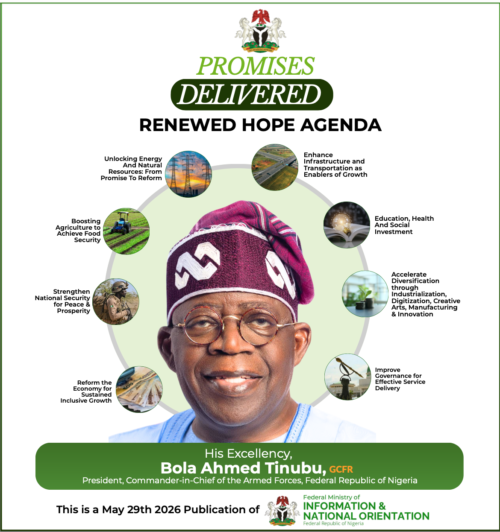




 Today, I’m hereby announcing my candidacy for President of the Federal Republic of Nigeria. The 2019 presidential election will either save Nigeria or speed up its democratic self-destruction. My declaration today is a threshold moment in our politics opening the door for anyone to run or at least think about it, who might not have before.



Kofi Annan, Global Icon Of Peace, By Kola King
The sudden death of Mr Kofi Annan, former Secretary-General of the United Nations came as a rude shock to the world. He died on 18th August in a hospital in Bern, Switzerland after a short illness. He was aged 80. Mr Kofi Annan was a global icon of peace. He straddled the United Nations for a decade as its Secretary-General during which he worked tirelessly to ensure global peace and security. During his distinguished career and leadership of the UN, he championed the cause of peace, sustainable development, human rights and the rule of law.
Kofi Annan, a product of the UN, having joined the World Health Organisation in 1962, had the singular distinction of being the first career bureaucrat of that body to be elevated to the enviable position of Secretary-General. He had earlier served as Under Secretary-General for Peacekeeping between March 1992 and December 1996. He replaced Boutros Ghali, the first African to head the UN. He was the 7th chief of the UN and he served for two terms.
An excellent diplomat and global statesman, he was committed to multilateralism as key to solving the world’s intractable problem. He craved for a fairer and more peaceful world. He will be remembered for his singular effort in the run-up to the Iraq crisis during which he made strenuous efforts to broker peace between the United States and Iraq under Saddam Hussein. His aim was to avoid conflagration in the Middle East. His advocacy of multilateralism in resolving that crisis fell on deaf ears. However, the US had presented the UN with a fait accompli, citing Iraq’s failure to comply with past Security Council resolutions, and later using it as pretext for war. In the end, Annan’s yeoman effort came to naught as the United States under President George Bush Jr disregarded the wise counsel of the UN and instead rolled out both ground and air forces to pound Iraq into submission. Later Mr Annan had described the US and UK action as not in conformity with UN charter, and was therefore illegal.
He was a harbinger of reforms in the UN during his era. He reformed the UN bureaucracy and worked to combat HIV/AIDS especially in Africa and launched the UN Global Compass where the goals of the UN and those of business can be mutually supportive. He regarded the HIV/AID pandemic as a personal priority and proposed the establishment of the Global Aids and Health Funds dedicated to battle against HIV and other debilitating diseases. As part of UN reforms, he introduced strategic management to strengthen unity of purpose, establishment of the position of Deputy Secretary-General, 10% reduction in post, cut in administrative cost, as well as reaching out to civil society and the private sector as partners. He also recommended the expansion of the Security Council.
As the prime mover of the Millennium Development Goals, Kofi Annan in his report following a Millennium Summit called on states to “put people at the centre of everything we do. No calling is nobler, and no responsibility greater, than that of enabling men, women and children in cities and villages around the world, to make their lives better.” The priority area of the report which served as the basis for Millennium Development Goals, aims to “free our fellow men and women from the abject poverty and dehumanizing poverty in which more than one billion of them are currently confined”.
Furthermore, Mr Kofi Annan played a vital role in restoring Nigeria to the path of democracy. He’s widely applauded for his peace initiative and support for the transition from military to civilian rule in 1998. He also worked towards supporting efforts of East Timor to secure independence from Indonesia the following year. Again he brokered peace between Nigeria and Cameroon which subsequently led to the settlement of the dispute between the two countries over the Bakassi peninsula, avoiding a potential Kashmir crisis in Africa. He was also instrumental in raising UN peacekeeping mission to Darfur, Sudan.
At the centennial of the UN in 2001, a fitting tribute for his peace efforts culminated in the award of the Nobel Peace Prize to both the UN and Mr Kofi Annan as joint winners for having revitalized the UN, and for having given priority to human rights. The Nobel Committee noted his commitment to the struggle to control the spread of HIV in Africa and his declared opposition to international terrorism.
Despite his meritorious career in the UN, in 2004 a UN’s Oil for Food programme report came to the fore that Kojo, the secretary- general’s son received payments from a Swiss company, Cotecna, hired to monitor humanitarian imports into Iraq under the programme. As the fallout from this, Mr Annan came under scrutiny, and there were calls for him to step down. Soon after an independent commission of inquiry investigated the report, and later exonerated Mr Annan from any complicity in the deal. However, the statesman drew his greatest flak for the passivity of the UN as head of its peacekeeping mission during the Rwandan genocide in which about 800,000 lives were lost. The UN peacekeeping mission also experienced varying degrees of failures in Somalia and Bosnia under his watch.
As if to buttress this point, in 2003, Canadian ex-General Romeo Dallaire, force commander of UN Assistance Mission for Rwanda, claimed Annan was passive in his response to imminent genocide. In his book Shake Hands with the Devil: The Failure of Humanity in Rwanda (2003), Gen Dallaire asserted that Annan held back UN troops from intervening to settle the conflict and from providing more logistical support. Although in 2004, ten years after the Rwandan genocide, Kofi Annan admitted that “I could and should have done more to sound the alarm and rally support.” In his book Interventions: A Life in War and Peace, Annan argued that the Department of Peacekeeping Operations (DPKO) could have made better use of media to raise awareness of the violence in Rwanda and put more pressure on governments to provide troops necessary for intervention.
Perhaps on account of this huge omission, Kofi Annan had introduced, prior to his departure from the UN, the doctrine of ‘Responsibility to Protect’ as part of the ‘Larger Freedom’ which gives rights to states to intervene in crisis situations to protect civilian populations at risk.
Despite his exertions as UN Secretary General, Kofi Annan realised that there was still much work to be done. Because of the partial failings in the world body, in his farewell address to the UN in 2006, he outlined 3 major problems of “an unjust world economy, world disorder and widespread contempt for human-rights and the rule of law,” which he believes, have not resolved but sharpened” during his time as secretary-general. He also pointed to violence in Africa and Arab-Israeli conflict as two major crises that require attention. Although long on rhetoric but short on action, still Mr Kofi Annan believes “The UN can be improved, it is not perfect but if it didn’t exist we would have to create it,” he told the BBC’s HardTalk during an interview for his 80th birthday last April.
Even after retirement Kofi Annan still remained relevant. His widely acknowledged negotiation and mediation skills recommended him to serve as UN-Arab League Joint Special Representative for Syria to help find resolution to the conflict there. He later quit when he admitted to being frustrated on the peace initiatives. In 2016, he was appointed to lead UN commission to investigate the Rohingya crisis.
In retirement, he founded the Kofi Annan Foundation dedicated to the promotion of better global governance, which builds up capacities of peoples and countries to achieve a fairer and more peaceful world. He was a member and chairman of the Elders, a group of independent global leaders founded by Nelson Mandela, dedicated to global peace and human rights. Kofi Annan was a recipient of several awards and honours. He was a recipient of over 20 honorary degrees from universities all over the world in recognition of his contribution to global peace and security.
A man overflowing with dignity and grandeur, Mr Kofi Annan exuded personal warmth, and he was a sincere and honest broker. He was an epitome of peace, patience, goodness and gentleness. Mr Annan will be remembered as an eminent statesman, global icon of peace, astute diplomat, peacemaker and humanist par excellence. His exit has made the world the poorer, for he was a quintessential diplomat and excellent administrator. An illustrious son of Ghana and Africa, Kofi Annan worked and died for global peace. A champion of peace, Kofi Annan has left his footprints on the sands of time.