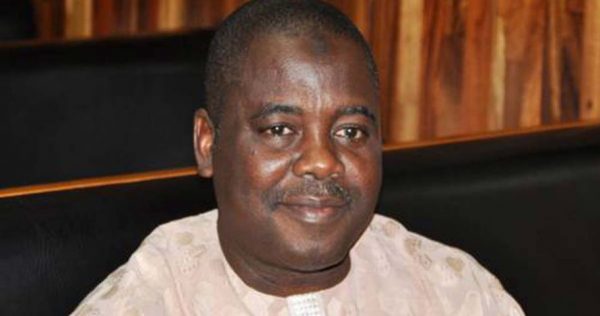
The Chief of Staff to Governor Muhammad Umar Jibrilla Bindow of Adamawa State, Alhaji Abdurrahman Abba Jimeta died in the early hours today, Monday18, in Makkah the Kingdom of Saudi Arabia during the observance of Umrah (the lesser Hajj) and the remains buried within the same vicinity of his death in Makkah according to Islamic rites.
The Adamawa State Government which announced the death of Abdurrahman Abba Jimeta, said that the governor had declared three days of mourning in the State, starting from today, Monday 18.
“The Governor calls on the people of the State to pray for the peaceful repose of the soul of the late Chief of Staff.”
In a statement, the state government called on workers to be more committed to the progress and development of the State as they resume from Sallah breaktomorrow, Tuesday, June 19, adding that workers dedication to their duties will be a good tribute to what late Abdurrahman Abba Jimeta stood for in his over three decades of public life.
The statement hinted that the late Chief of Staff would have been 60 years old at his next birthday in November 2018 even as it said that he is survived by an aged father, one wife and eleven children.
The current global security environment is increasingly becoming complex and dynamic due to the activities of non-state actors who have become the major source of conflict all over the world. Add to this is the upsurge in intra-state crisis and conflicts as well as the entanglement between domestic and international threats which have compounded the security challenges.
Africans are containing terror and terrorists, in addition to the rise of repetitive civil conflict in such desperate African countries as Burundi, the Central African Republic, the Democratic Republic of the Congo, South Sudan and Sudan, dangerous depredations of Islamist terror continue to shake Somalia, Kenya, Cameroon, Chad, Mali, Burkina Faso and Niger.
Nigeria is currently facing multiple security challenges that are spread across the major regions of the country. None of the regions in Nigeria is insulated from one crisis or the other. For instance, there are the lingering challenges of terrorism, cattle rustling, armed banditry, kidnappings, arms and IED proliferation and other sundry crimes such as armed robbery in the North East Region.
There are also the threats of armed robbery, insurgency, ethno religious disturbances, cattle rustling, kidnappings and political crisis among other menaces in the North Western part of Nigeria.
Incidences of militancy, arms proliferation, illegal oil bunkering, sea piracy, oil thefts, kidnappings and pipeline vandalization/sabotage, armed robbery, cultism and political violence are serious security challenges in the South-South Zone and the Delta Region. So also are the challenges of farmers-herdsmen clashes, cattle rustling, ethnic tension, and the influx of mercenaries and arms flow in Benue, Nasarawa and Taraba States.
Here in the South Eastern Region, we have security threats such as kidnappings, armed robbery, communal crisis, cultism, herdsmen-farmers clashes, the proliferation of arms, political disturbances and the disturbing activities of MOSSOB and the outlawed IPOB groups.
Recently, we are witnesses to the emerging trend of the use of Improvised Explosive Devices (IED) in pursuit of political objectives.
In the midst of these challenges, the Nigerian Army (NA) has a constitutional duty to effectively checkmate these complex national security threats. While in the South East, the NA through the 82 Division, in conjunction with other security agencies have contained these threats to manageable proportion, in the North East and other parts of Nigeria, the NA is fully involved in far more complex security threats such as insurgency, terrorism, cyber threats, militancy, arms and IED proliferation and ethno-religious conflicts.
The relevant security agencies must, therefore, continue to seek new ways and means to consistently mitigate the new challenges and provide an effective deterrence. Consequently, the NA under Lt Gen TY Buratai proactively and consistently appraised the numerous security threats across the nation, initiated and conducted several Field Training Exercises and Operations with the major aim of containing the threats.
These exercises were deliberately initiated and conducted with an overarching aim of checkmating identified security challenges in the regions where they were carried out. In this regard, Exercise SHIRIN HARBI, for example, was originally staged from 17- 19 April 2016 in 3 Division Area of Responsibility to take care of the insurgency, cattle rustling and armed banditry common in parts of the North Eastern Region. In the same vein, Exercise HARBIN KUNAMA was held in 1 Division Area of Responsibility from 9-15 July 2016 to rid the general area of the North West Region of banditry, insurgency, religious insurrection, armed robbery and cattle rustling among other menaces.
Also, Exercise CROCODILE SMILE was conducted originally from 5-10 September 2016 in the Niger Delta Region by a combination of 2 and 82 Divisions with the major aim of reducing incidences of illegal bunkering, piracy, the influx of arms, pipeline vandalization, kidnappings and other criminalities across the entire region.
Similarly, here in the South Eastern Region, Exercise PYTHON DANCE was initially carried out from 27 November – 27 December 2016. The peculiar security challenges in the region such as kidnappings, armed robbery, cultism, farmers-herdsmen clashes, communal conflicts, traffic gridlock particularly at the Asaba-Onitsha Head Bridge and the violent secessionist agitation among others were the targets of the exercise.
On the whole, these exercises were successfully conducted as the objectives of the exercises/operations were greatly achieved. For that reason, all the exercises are now scheduled NA training exercises which are being conducted annually in the various regions of the nation.
We may recall that despite the initial disinformation, agitation and misplaced apprehension about Exercise PYTHON DANCE in 2016 and now Exercise EGWU EKE 11 in 2017, the record of achievements of the exercise are many and are acknowledged by well-meaning Nigerians up to today.
One major achievement is in the area of peace and security. Due to the intensity of patrols, roadblocks, raids and other activities in the Military Line of Operation, miscreants and criminals were denied freedom of action in the entire South Eastern States of Abia, Anambra, Ebonyi, Enugu and Imo. The account of peace, law and order and secure environment in the entire South Eastern Region occasioned by the exercise was widely circulated by the media among others and is being enjoyed up to today.
Therefore, in view of the obvious security threats in the South East such as kidnappings, cultism, armed robbery, communal conflict, farmers-herdsmen clashes, political violence and secessionist agitation as well as the emerging dangerous trend of the use of IED as seen in the recent explosion in Ohanaeze leaders’ compound, a catholic church and a popular yam market, there is the need for members of the public especially the media to be more watchful, so as to sensitize the public on the disturbing trend and the necessity for partnership with the security agencies with the view to collectively and effectively contain these challenges.
Finally, in the midst of all these security threats, it is obvious that the South East Zone is the most peaceful region in Nigeria. Major security challenges that could have dramatically disturb the peace; security and stability of the region have been effectively silenced. Consequently, there is the need for the various tiers of government, security agencies, Civil Society Organizations, media and members of the public to collectively cooperate to improving if not sustaining the current security situation.
Colonel Sagir Musa, Deputy Director of Nigerian Army Public Relations, 82 Division, Enugu, gave this remark at the Nigerian Union of Journalists (NUJ) Media Summit, Held in Owerri, Imo State on June 14, 2018.
Deputy President of the Senate, Ike Ekweremadu, has expressed optimism that despite the defeat the Super Eagles suffered in the hands of Croatia yesterday, Saturday, they can rise to greater height in the ongoing World Cup tournament in Russia.
“I am an optimist. It is not over yet for the Super Eagles in Russia, especially given their traditional resilient spirit. I have no doubt also that they understand that they bear the expectations and hopes of over 180 million people on their shoulders. But, we owe them total support and prayers.”
Senator Ekweremadu, in a statement today, Sunday by his Special Adviser on Media, Uche Anichukwu, admitted that the team had made what he called ‘costly mistake’ and that Nigeria is in a tight corner, but said that he is sure that the players and coaching crew have picked some lessons.
“The technical crew might have to rethink the team’s formation.
“Maybe, also, we stand to gain more from the players in their natural wings.”
Iceland, the next team in group D the Supper will meet in the next round, had played a one-all draw with Argentina in their opening encounter
Germany’s defence of their World Cup title started with a whimper as they suffered a surprise 1-0 defeat to Mexico in Moscow on Sunday.
Joachim Low’s side came into the tournament on a run of poor form, winning just one of their six friendlies since qualifying for Russia 2018 with a 100 per cent record.
Those recent struggles were evident from the outset against a vibrant Mexico, who scarcely gave their more illustrious opponents a chance to settle during a pulsating opening.
Their positive approach was rewarded with the only goal of the game after 35 minutes when Hirving Lozano finished off a flowing counter-attacking move with a crisp drive.
Joshua Kimmich and Timo Werner both came close in the second period, but Mexico were able to hold on for a famous victory with something approaching relative comfort.
Low must quickly lift his team for their next Group F game against Sweden on Saturday, while Mexico know a win against South Korea on the same day would give them a wonderful chance of qualifying for the knockout stages.
Manuel Neuer was handed a first competitive start since September and would surely have been called into action inside the first minute had Jerome Boateng not superbly blocked Lozano’s close-range effort.
Werner then fired a warning shot across the face of Guillermo Ochoa’s goal during a breathless opening few minutes.
Any thoughts that Mexico would be overawed by Germany’s assortment of superstars continued to be dispelled during a high-octane first half-hour, Hector Moreno heading straight at Neuer from their clearest opening.
Germany looked shell-shocked by Mexico’s verve and vigour, eventually falling behind 10 minutes before the break.
Javier Hernandez’s superb one-two with Andres Guardado allowed him to spin away from Mats Hummels just inside the Germany half and feed Lozano down the left.
The PSV forward then cut inside the wafer-thin resistance offered by the back-tracking Mesut Ozil to crash a shot inside Neuer’s right post.
That deserved lead was nearly extinguished just two minutes later, however, when Toni Kroos’ dipping free-kick arrowed towards the top corner. Ochoa did wonderfully well to deny the midfielder, getting the faintest of touches to push the ball against the crossbar.
Yet any thoughts that Low’s star-studded team would come out for the second half rejuvenated failed to materialise.
Mexico were able to keep them at bay until Kimmich’s ambitious overhead kick and Werner’s instinctive close-range effort both flashed narrowly over in quick succession midway through the half.
After squandering a number of golden opportunities in the closing stages, with Miguel Layun particularly wasteful, Mexico were fortunate to see Julian Brandt’s half-volleyed effort clip the post in a frantic finish to proceedings. (goals.com)
An elected delegate to the national convention of the ruling All Progressives Congress (APC), Osita Okechukwu, has expressed confidence that with President Muhammadu Buhari as the rallying point for the party, the forthcoming convention will be hitch-free.
He said: “To be honest, in spite of conflicting reports of parallel congresses, one envisages a hitch-free national convention of our great party, APC, on June 23. This is because we have President Muhammadu Buhari, who from every index is the presumptive consensus candidate, come 2019 Presidential election.
“Mr. President is more like a guardian post for our great party. He is the canopy covering us all from bad weather.”
Osita Okechukwu, who spoke to news men today, Sunday, in Enugu, said that the presidential system Nigeria is operating does not make the supremacy of the party less profound, adding that every President in all presidential systems, be it in the United States, “tailors the cloth of the party to his size.”
Okechukwu, who is the Director-General of the Voice of Nigeria (VON), said that all the tendencies and factions had a common ground, which is the endorsement of President Buhari.
“In addition, those who lost in the congresses are not only loyalists to Buhari, but are aware of the truism that they were swimming against the tide of the provisions of APC’s Constitution.
“The constitution mandated the National Working Committee, subject to the approval of the National Executive Committee to make rules and regulations for nomination of candidates”.
“Nobody has the right to reverse the national delegates list validly elected during the local government congress,’’ he said.
According to him, with such iconic leader like Buhari, loyalty is enhanced. Loyalty to one leader minimises intra-party conflict. It could have been different if we have two strong presidential contenders.
“Our collective support for Mr. President makes it easy for reconciliation in APC before the 2019 general elections.”
Former Kaduna State Governor and immediate past National Caretaker Committee Chairman of the People’s Democratic Party (PDP), Senator Ahmed Mohammed Makarfi has declared his intention to contest for Nigeria’s Presidency under the platform of the PDP.
Makarfi who spoke to news men in Kaduna today, Sunday, said that he has consulted widely and arrived at a conclusion that it is okay for him to contest for the Presidency.
“I have been consulting across the country since I left as the chairman of the party. It is just consultations and not endorsement. But it gives you an opportunity to feel the pulse and it will tell whether to go forward or not to go forward. The consultations have been quite positive and I believe it is fair enough to come to the conclusion that one should join other equally capable party men and women who have shown interest in seeking the party’s nomination for the 2019 presidential election.
“At this stage, it is to seek for the party’s nomination. The successful nominees will become the candidate that will stand for the election. But first thing first. If ones party does not put him forward, you can’t say you are contesting for presidency yet. At this stage, I have come to the conclusion that it is okay, based on the consultations that I have had.”
The two term Governor and two term Senator from Kaduna State said he knows governance and has what its takes to govern Nigeria, after successfully governing a complex state like Kaduna for eight years.
“I have known governance for sometimes at state level. I served Kaduna for three years as commissioner for finance and economic planning. I came in from the private sector. I have private sector experience, especially banking. I governed this complex state for eight years. I have legislative experience, having been in the senate for a two term of eight years. I got a bonanza when the party leadership fell on my laps, to know about managing political party.
“If you cannot manage your party, even if you are elected, you will have problems governing. If you can’t manage the legislature and build cordial relationship such that key legislations that can take this country forward are passed, then governance becomes complex for you. If you cannot manage complex society such as kaduna, which is a mini nigeria, you cannot manage Nigeria. God has so designed that one has passed through all these processes.
“These, to me, are advantages but of course it does not mean that it is a forgone conclusion. Somebody who may have not prepared himself in governance at all may find himself in government but the country will pay a price for that. I believe I have these advantages.
“Managing complex security issues is not new to me. Managing complex people of societies is not new to me. If you look at it from that perspective, I am prepared for the job. I served as the Governor of Kaduna state where I was able to mobilise the citizens of Kaduna state, irrespective of where they came from in Nigeria, earned their confidence and they worked with me and supported me and we were able to restore normalcy that people thought was impossible.
“If I am nominated and eventually gets elected, my philosophy will not be to go after opposition. It is to see how I will work with the opposition in any area for the good of all of us while maintaining our independent political opinion over any matter. That is how you can bring Nigerians together. And that is when people will not even have any need to cross carpet. If I get nominated and get elected and I find somebody in APC who can help me do what I want to do, I will look for you without demanding that you join the PDP. I will leave you to make that decision on your own, that is the kind of politics that I want to see happening in Nigeria.”
The Methodist Archbishop of Abuja, Most Rev. Oche Job, has said that President Muhammadu Buhari has successfully checkmated the much talk about cabals in the Aso Rock Presidential Villa.
“There are cabals in Aso Villa till now, but they are no longer well-pronounced like before. At the time of Goodluck Jonathan, every time and then, you hear of cabals. But I think because Buhari makes up his mind and he knows where he is going, he doesn’t listen to people. That’s why the issue of cabal is no longer pronounced like in the past.”
Archbishop Oche Job who spoke in an interview with the News Agency of Nigeria in Abuja today, Sunday, said if Buhari “is a man who fears what people will say, by now, he would have become very nervous.
“For sure, I commend him. You see, Buhari fears no one and that’s why I like him. He makes up his mind and says and does what he thinks is the best for the nation.
“People may not praise him now; but by the time he leaves the seat, and somebody comes in and they begin to do comparison, they will say if it were in the time of Buhari, oh my God, this thing would have been this.”
The clergyman, who stressed that a good leader must have self-confidence, insisted: “if you must rule and have the blessings of the majority, you need to have what is called self-confidence.”
Super Eagles captain John Obi Mikel has expressed hope that despite the 2-0 defeat by Croatia in the opening match yesterday, Saturday, Nigeria can still spring surprises by passing through to knock-out stage.
He however suggested that Nigeria should ‘go back to the drawing board,’ saying: “we have to play better. I think we can play better, we can do better.”
Mikel Obi, who spoke to news men shortly after the match in which Oghenekaro Etebo scored own-goal with Luka Modric scoring the second gola on penalty shot, acknowledged: “it is difficult to say I think. We have to go back to the drawing board and see what we can do better, together as a team.”
Obi who was former Chelsea midfielder said: “it’s not easy playing against these fantastic players, European players; they can hurt you in any given time. We know that, but we have to do better.”
Mikel Obi is confident that progression from Group D is still possible; citing that Argentina’s unexpected draw with Iceland has provided the Super Eagles with a lifeline.
“Why not? We believe. That’s why we’re here,” the skipper added.
“That’s why we came here. We have two more games to play. Argentina drew so I think this is a bit better for us.”Next game, we have to go and try to win the game. If we do that, we’re back in it again.”
Nigeria will clash with Iceland on Friday in their second round in group D.
L-R: Prof. Wole Soyinka, Former Vice Presidential Candidate Amb Babagana Kingibe, Vice President Yemi Osinbajo, President Muhammadu Buhari, Alhaji Kola Abiola and Alhaja Ganiyat during the Special Investiture and National Honours Award Ceremony for Late MKO Abiola
Though a political masterstroke, the timing of the national honour investiture on Chief MKO Abiola by President Muhammadu Buhari has continued to be enmeshed in controversy. Proponents and opponents of the event have their points; but we lose the relevance of that electoral epoch if we disregard the fact that June 12 has become a national paradox that epitomises the dark and bright side of our democracy. The annulled presidential election represents the resilience of the Nigerian people amidst the shackles of military dictatorship. When hope was lost and the citizens were tired of the trampling of their rights; they stood on the side of democracy. For once, a nation that was being invaded by demons of religious violence buried the hatchet and stood behind a Muslim-Muslim ticket. From Borno to Lagos; Katsina to Port Harcourt; Calabar to Sokoto; and Ibadan to Adamawa; the electorate marched with the Hope ’93 Campaign Team. When it seemed obvious that that late Are Ona Kakanfo was coasting to victory, the military reversed our expected dawn of hope and replaced it with a moment of despondency. The annulment exposed the underbelly of some politicians whose sole pre-occupation in politics is to grab power. No doubt, Buhari’s choice of the late Chief Gani Fawehinmi for the national award is in recognition of his struggles not just for June 12, but for the masses. The acceptance by Ambassador Babagana Kingibe who served as Foreign Affairs Minister in the Abacha military regime and thereafter Secretary to the Government of the Federation (SGF) under President Umaru Yar’Adua, proved a heavy blow against the June 12 struggle. To Kingibe’s critics, honouring the former Secretary to Government of the Federation (SGF) with the GCON award amounted to honouring Judas. The presence of Senator Jonathan Zwingina, who served as Director General of Hope ’93 Campaign Organisation, at the event proved that politics and prostitution could be bedmates. It was Zwingina who quickly renounced the June 12 struggle to become a commissioner in Adamawa State. His speech at the investiture ceremony is akin to Brutus’ justification of the assassination of Julius Caesar. The absence of Professor Humphrey Nwosu, who was the Chief Midwife of June 12 Miscarriage, was an irredeemable mistake. For those who are quick to describe the chief electoral umpire as a coward, I only pray for them not to have an encounter with a bandit. According to his account as contained in his book, Professor Nwosu came under an unprecedented pressure to keep silent. He must have taken to the advice of Professor Chinua Achebe who said, “It is good to be fearless my son, but sometimes it is good to be a coward; for we often stand in the compound of a coward to point at a ruin where a great man used to live.” Professor Wole Soyinka must have been miffed at the presence of some of these politicians who had come to a feast to brighten their prospects ahead of 2019 polls. He recalled the selfless efforts Ola Oni in rallying other nameless Nigerians to stake out their lives in defiance of the military over the annulment. For justice to be served, Soyinka advocated for the setting up of Halls of Fame and Shame to appropriately recall the roles played by various people. The June 12 struggle is the most profound movement that threatened Nigeria’s oppressive forces as it propelled our people to take control of their destiny. As Senator Bola Tinubu rightly noted, June 12 was not a South-west affair as some have tried to paint it. Victims of the June 12 annulment cut across ethnic, religious and social status. Any deliberate ploy to ethnicise the struggle will amount to a grievous injustice to those nameless people who lost their lives in the struggle. The trajectory to June 12 victory was the fallout of a bridge-building process by Abiola that spanned several decades of service to the Nigerian people. Permit me a little digression to explain one of those nameless acts of kindness by Abiola that made June 12 a reality. In 1981, the absence of a bridge at the Kolosok stream in Kamuru Ikulu, then in Kachia Local Government of old Kaduna State, had led to loss of lives during raining season. With the people poor and government not responding to their plight, the people came up with the idea of organising an appeal fund, with Abiola as the Chief Launcher. Somehow, by struck of a magic, an invite was delivered to the generous money bag through Rev Father Matthew Hassan Kukah. He was said to have promised to honour the event. On the day of the ceremony, the man who was expected to cough out large chunk of the expected fund was nowhere close to the venue of the event. Organisers of the ceremony had to scan through the assembly to see if there was anyone sent to represent the owner of Concord Newspapers. Finding none, the organisers caved in to despair. Hope of many months of planning to end the death trap at Kolosok began to fizzle out. With the people tired of waiting for someone whose name was then only heard on radio, they proceeded with the ceremony. After few remarks, the anchor of the ceremony enquired if someone was in the assembly to represent Abiola as the Chief launcher. To the embarrassment of many at the event, a scrawny fellow dressed in clothes unworthy of being an Abiola representative stood up. When the fellow announced Abiola’s donation, not many ears were attentive as they had given up on the man who needed a decent hair cut and good clothes. To make matter worst, he told the disappointed faces that he was a journalist working for the Hausa Community Concord in Zaria. He told the gathering that his boss had to be away for another important event. When he announced Abiola’s donation to the gathering, a moment of surreal silence blew over the people who before now had been mourning the absence of Abiola. Shout of joy broke through the gathering when the Master of ceremony announced that Chief MKO Abiola had donated the entire amount needed by the organisers of the appeal fund launching committee. Abiola, in his absence, had brought hope to a land threatened by Kolosok stream. In his worn-out bag, the representative brought out bundles of money that sent an excitement through the crowd. The scrawny fellow with a faded bag became a magician. One of the men in the gathering, Baba Sheyin, who had regained his cheerful disposition, said, “A man who can reach out to a fellow man in anguish and bring hope is not just a man; he is a leader”. Over a decade later, it was pay-back time. The Hope ’93 Team had arrived Kamuru Ikulu and reminded the people that the man who built the Kolosok Bridge was on the ballot for the June 12, 1993 presidential poll. Despite criticism that Abiola was running a Muslim-Muslim ticket, Baba Sheyin said, “Even if it is the Grand Sheikh of the Mecca Mosque that is on the ticket with Abiola, we shall still vote for him. He saved us when there was none to help us.” Days before June 12, 1993, words had gone round that anyone that was a true son of the Ikulu Nation must vote for the Social Democratic Party (SDP) to reciprocate the kind gesture of Kolosok Bridge Builder. The queues for the ‘horse party’ (SDP) in the various polling units were long, compared to the few faces on the National Republican Convention (NRC) queues at various polling units. “May you fall off from the Kolosok Bridge as you cross it next time”, a voice screamed against the NRC queue in a particular polling unit. Baba Sheyin and many old men who remembered the generosity of the multi-millionaire were dumbstruck when news came that the June 12 poll had been annulled. One of Baba Sheyin’s friends was heard heaping curses on all those behind the annulment. Back to our discourse. Abiola did not only walk, but worked his way into the hearts of Nigerians by demonstrating generosity and assisting the citizens to tackle challenges confronting them on various fronts. Though coming from a poverty-stricken background, he knew the pangs of wretchedness and was committed to ending it. Unlike some of our political leaders who escaped poverty by the whiskers, political power has been turned into a platform of advancing pecuniary interest to ruin the future of the country. Abiola invested in Nigeria because he believed in the nation. He provided jobs to thousands and shared in the dream for a greater Nigeria where wretchedness is banished and the nation’s resources deployed to serve the needs and not the greed of a few controlling the levers of power. As patriots and political villains assembled to honour the memory of the man who paid the supreme price for democracy, we must not lose sight of what June 12 symbolises. It was a movement for the emancipation of the citizens from the primordial forces that seek to destroy the dream for a prosperous and just Nigeria. Our leaders and those who assembled to honour Abiola should honestly answer these questions: Would Abiola endorse the mass murders that have turned our country into a hair-rising cynosure of killing field? Would Abiola accept our present condition of cascading poverty where no fewer than nine million jobs have been lost in the last three years? Would the winner of the June 12 presidential poll accept a situation where some state governments sack thousands of workers in a bid to provide for the feeding of primary pupils? Would Abiola not have revolted against the cries of marginalisation and outright discrimination on the basis of ethnic and religious factors tearing the fabric of our nation apart? Would Abiola have accepted a situation where the executive and legislative arms are almost at war at a time when all hands ought to be on deck? The investiture may have come and gone, but the controversy may not fizzle for a long while to come. June 12 is not a memory; it is a flame of inspiration to move Nigeria forward, no matter its imperfections.
Dateline: June 11, 2018. Abuja. Artificial barriers and shared prejudices crumbled like a pack of cards at the Ladi Kwali Hall of Sheraton Hotel and Towers when I met, for the first time, former governor of Edo state, Comrade Adams Aliyu Oshiomhole. The truth is: my paths never crossed his when I was pounding the streets plying my trade as a reporter. Validation: I did not cover the labour beat when he was president of the Nigeria Labour Congress (NLC). And, when he was in Edo state for eight years, I was in Abuja from where I was monitoring the affairs of my state under his stewardship.
In the course of that journalistic exertion, I had written, just like I had done about the previous administrations, a number of analyses and opinions in the media about the Oshiomhole government and his politics. Amid the tension of misconstrued objectives harboured and nurtured by some overzealous officials and friends who had the privilege of working in his administration, an otherwise altruistic enterprise, geared towards the process of promoting good governance in my state, suffered critical stereotype. I could, therefore, not escape unwarrantable condemnation.
My momentous meeting with Oshiomhole, albeit short and sharp like the angel’s visit, took place on the neutral ground of Ladi Kwali Hall. Oshiomhole’s former Chief of Staff, Honourable Patrick Obahiagbon, made it possible. He had invited me to attend a dinner being hosted by his boss in celebration of the posthumous national honours conferred by President Muhammadu Buhari on the winner of the annulled June 12, 1993 presidential election, the late Chief M.K.O. Abiola and human rights lawyer, the late Chief Gani Fawehinmi, who played a frontline role in the struggle for the revalidation of the June 12 mandate.
At the venue, I shared a table with Obahiagbon at the end of the hall. He had excused himself to conduct his boss from table to table to greet guests that were already seated and I was left alone on the table. However, that did not diminish the weight of the courtesy by Oshiomhole when he got to me. The tenor of the pleasantries changed when Obahiagbon introduced me; on hearing my name, Oshiomhole could not hold back his excitement. “Oh yes, Sufuyan Ojeifo. Good to meet you at last. You are a brilliant and gifted writer. I read your writings. I know you are sitting at the back here so you can capture everything that happens here today”, he said as we pumped hands. He cracked a joke bordering on the use of bombasts with Obahiagbon as the butt of it.
After we were photographed, he gave Obahiagbon a carte blanche to arrange a subsequent get-together for us to meet minds on issues. I left with some impressions. I saw through the veneer of combustibility and combativeness that have become parts of his writ-large identity, as a dogged labour activist, a streak of amiableness and affection. Obahiagbon would later tell me something that I found difficult to believe: that Oshiomhole is naturally a shy person who, most times, finds it difficult to look into people’s eyes during conversations. He, however, gave a caveat: but do not assault his sensibilities or attack his convictions otherwise, you will awaken the lion in him. I was able to deconstruct and rationalise the ramifications of the Oshiomhole phenomenon within that context.
Significantly, Oshiomhole is defined by his antecedents and pedigree, and not by his diminutive physical stature or height. Even though, the weight of evidence -size and height- is heavily not in his favour, yet, wherever he goes countrywide, his presence is elephantine and he enjoys essential approbation. Journalists are wont to deploy the two words to describe the highly fecund labour leader, restless political aficionado and inimitable public space man. It is indeed interesting to know that he is aware of journalists’ pleasure to engage in the seemingly ludicrous pigeonholing.
Oshiomhole called attention to this at the dinner while making his speech. According to him, “some say I am short but fail to tell the world what I am short of.” There is no doubt that he has the capacity to take on anyone who dares to accuse him of any character flaws. It is, indeed, obvious that Oshiomhole is not short of brilliance, sharpness, wittiness, patriotism, commitment and conviction. Besides, he is sure-footed in his fidelity to integrity even though his traducers are always quick to disagree with him on that score.
That is not all; whenever he seizes the centre stage, he would always leave behind strong impressions, defining footprints and clear courses for national conversations and agenda. The Oshiomhole persona had contoured his trajectory in labour activism and has continued to do so in politics. Historically, he had intrepidly defended the causes of workers while in the saddle as president of the NLC, providing leadership during strikes against government’s policy choices that were anti-workers and anti-people. In the process, he had had his fair shares of blackmail, intimidation and detention in the hands of the powers-that-be. In his homily at the dinner, he announced that the late Fawehinmi had always defended him and the NLC pro bono.
Oshiomhole is sui generis. He speaks truth to power, not minding whose ox is gored. He speaks forcefully to issues. Imbued with the power of oration, his voice ricochets in a familiar pro-people, pro-poor refrain, reinforcing his declarations in affirmative gestures. Presently, he is rolling up his sleeves to step in as national chairman of the governing All Progressives Congress (APC). His ambition, which enjoys the endorsement of President Buhari and governors of the party, will be legitimated on June 23 at the national convention of the party at the Eagles Square in Abuja. Suffice to declare that the APC has a fait accompli in a man that is robustly capacitated to lead it into the crucial 2019 general election.
He goes into the job with intimidating credentials; and, at an intersection that the APC needs someone with energy, oratorical prowess and legerdemain to beat back the rambunctious opposition Peoples Democratic Party (PDP) that has become an irritant to the Buhari presidency. Oshiomhole is expected to mount the soap box during electioneering to remind the PDP of its contentious 16-year records in power. Public space domination and verbal onslaughts against identified political opponents are Oshiomhole’s fortes. Besides, he has the requisite intellectual magnitude to reinforce the policy choices of the Buhari presidency and to defend the actions and inactions of the administration per time.
Political dispensations provide and identify their respective objective conditions. They also define and select the persona that is suitable to superintend them. Those who are positioned to take positive actions are thus expected to act in accordance. This explicates the philosophical underpinning of Oshiomhole’s choice. The era of Chief John Odigie-Oyegun required the placid persona of the former permanent secretary and one-time governor of Edo state. The APC at that time enjoyed an obligatory nationwide support by Nigerians who yearned for change. But now, the character, contents, shape and texture of governance have changed. The socio-economic conditions are undergoing critical changes such that the people are finding it difficult to appreciate the patriotic commitment that the Buhari presidency is investing in the mission to redeem Nigeria.
The ramifications of the change that the administration is undertaking have exposed the political capital of the Buhari presidency to serious interrogation and pressure. To provide answers and relieve pressure, the APC and the Buhari presidency will benefit a great deal from Oshiomhole’s nimbleness and profound elucidation of issues, especially during the forthcoming electioneering and after should the presidential mandate be renewed by Nigerians.
We use cookies on our website to give you the most relevant experience by remembering your preferences and repeat visits. By clicking “Accept”, you consent to the use of ALL the cookies.
This website uses cookies to improve your experience while you navigate through the website. Out of these, the cookies that are categorized as necessary are stored on your browser as they are essential for the working of basic functionalities of the website. We also use third-party cookies that help us analyze and understand how you use this website. These cookies will be stored in your browser only with your consent. You also have the option to opt-out of these cookies. But opting out of some of these cookies may affect your browsing experience.
Necessary cookies are absolutely essential for the website to function properly. This category only includes cookies that ensures basic functionalities and security features of the website. These cookies do not store any personal information.
Any cookies that may not be particularly necessary for the website to function and is used specifically to collect user personal data via analytics, ads, other embedded contents are termed as non-necessary cookies. It is mandatory to procure user consent prior to running these cookies on your website.
An Insider’s Account Of South-East Security Challenges, By Colonel Sagir Musa
The current global security environment is increasingly becoming complex and dynamic due to the activities of non-state actors who have become the major source of conflict all over the world. Add to this is the upsurge in intra-state crisis and conflicts as well as the entanglement between domestic and international threats which have compounded the security challenges.
Africans are containing terror and terrorists, in addition to the rise of repetitive civil conflict in such desperate African countries as Burundi, the Central African Republic, the Democratic Republic of the Congo, South Sudan and Sudan, dangerous depredations of Islamist terror continue to shake Somalia, Kenya, Cameroon, Chad, Mali, Burkina Faso and Niger.
Nigeria is currently facing multiple security challenges that are spread across the major regions of the country. None of the regions in Nigeria is insulated from one crisis or the other. For instance, there are the lingering challenges of terrorism, cattle rustling, armed banditry, kidnappings, arms and IED proliferation and other sundry crimes such as armed robbery in the North East Region.
There are also the threats of armed robbery, insurgency, ethno religious disturbances, cattle rustling, kidnappings and political crisis among other menaces in the North Western part of Nigeria.
Incidences of militancy, arms proliferation, illegal oil bunkering, sea piracy, oil thefts, kidnappings and pipeline vandalization/sabotage, armed robbery, cultism and political violence are serious security challenges in the South-South Zone and the Delta Region. So also are the challenges of farmers-herdsmen clashes, cattle rustling, ethnic tension, and the influx of mercenaries and arms flow in Benue, Nasarawa and Taraba States.
Here in the South Eastern Region, we have security threats such as kidnappings, armed robbery, communal crisis, cultism, herdsmen-farmers clashes, the proliferation of arms, political disturbances and the disturbing activities of MOSSOB and the outlawed IPOB groups.
Recently, we are witnesses to the emerging trend of the use of Improvised Explosive Devices (IED) in pursuit of political objectives.
In the midst of these challenges, the Nigerian Army (NA) has a constitutional duty to effectively checkmate these complex national security threats. While in the South East, the NA through the 82 Division, in conjunction with other security agencies have contained these threats to manageable proportion, in the North East and other parts of Nigeria, the NA is fully involved in far more complex security threats such as insurgency, terrorism, cyber threats, militancy, arms and IED proliferation and ethno-religious conflicts.
The relevant security agencies must, therefore, continue to seek new ways and means to consistently mitigate the new challenges and provide an effective deterrence. Consequently, the NA under Lt Gen TY Buratai proactively and consistently appraised the numerous security threats across the nation, initiated and conducted several Field Training Exercises and Operations with the major aim of containing the threats.
These exercises were deliberately initiated and conducted with an overarching aim of checkmating identified security challenges in the regions where they were carried out. In this regard, Exercise SHIRIN HARBI, for example, was originally staged from 17- 19 April 2016 in 3 Division Area of Responsibility to take care of the insurgency, cattle rustling and armed banditry common in parts of the North Eastern Region. In the same vein, Exercise HARBIN KUNAMA was held in 1 Division Area of Responsibility from 9-15 July 2016 to rid the general area of the North West Region of banditry, insurgency, religious insurrection, armed robbery and cattle rustling among other menaces.
Also, Exercise CROCODILE SMILE was conducted originally from 5-10 September 2016 in the Niger Delta Region by a combination of 2 and 82 Divisions with the major aim of reducing incidences of illegal bunkering, piracy, the influx of arms, pipeline vandalization, kidnappings and other criminalities across the entire region.
Similarly, here in the South Eastern Region, Exercise PYTHON DANCE was initially carried out from 27 November – 27 December 2016. The peculiar security challenges in the region such as kidnappings, armed robbery, cultism, farmers-herdsmen clashes, communal conflicts, traffic gridlock particularly at the Asaba-Onitsha Head Bridge and the violent secessionist agitation among others were the targets of the exercise.
On the whole, these exercises were successfully conducted as the objectives of the exercises/operations were greatly achieved. For that reason, all the exercises are now scheduled NA training exercises which are being conducted annually in the various regions of the nation.
We may recall that despite the initial disinformation, agitation and misplaced apprehension about Exercise PYTHON DANCE in 2016 and now Exercise EGWU EKE 11 in 2017, the record of achievements of the exercise are many and are acknowledged by well-meaning Nigerians up to today.
One major achievement is in the area of peace and security. Due to the intensity of patrols, roadblocks, raids and other activities in the Military Line of Operation, miscreants and criminals were denied freedom of action in the entire South Eastern States of Abia, Anambra, Ebonyi, Enugu and Imo. The account of peace, law and order and secure environment in the entire South Eastern Region occasioned by the exercise was widely circulated by the media among others and is being enjoyed up to today.
Therefore, in view of the obvious security threats in the South East such as kidnappings, cultism, armed robbery, communal conflict, farmers-herdsmen clashes, political violence and secessionist agitation as well as the emerging dangerous trend of the use of IED as seen in the recent explosion in Ohanaeze leaders’ compound, a catholic church and a popular yam market, there is the need for members of the public especially the media to be more watchful, so as to sensitize the public on the disturbing trend and the necessity for partnership with the security agencies with the view to collectively and effectively contain these challenges.
Finally, in the midst of all these security threats, it is obvious that the South East Zone is the most peaceful region in Nigeria. Major security challenges that could have dramatically disturb the peace; security and stability of the region have been effectively silenced. Consequently, there is the need for the various tiers of government, security agencies, Civil Society Organizations, media and members of the public to collectively cooperate to improving if not sustaining the current security situation.
Colonel Sagir Musa, Deputy Director of Nigerian Army Public Relations, 82 Division, Enugu, gave this remark at the Nigerian Union of Journalists (NUJ) Media Summit, Held in Owerri, Imo State on June 14, 2018.