Eighteen-year-old Maryam Habila Usman, a former student of Air Force Girls Secondary School, Jos, has emerged the overall winner of the nationwide scholarship examination into the American University of Nigeria (AUN). Ms. Usman, who outscored all other candidates from all states of the federation, hails from Borno State and has applied to study Natural & Environmental Sciences at AUN. Welcoming her and other spring scholarship awardees, the President of the Institution, Ensign said: “Ms. Usman and her fellow AUN students represent the brightest hope for a better future for Nigeria and for Africa. We shall all do our very best to ensure that their time with us is as rewarding and fruitful as they clearly deserve. Congratulations all!” As the overall winner of the national scholarship exams for spring 2017, Ms. Usman’s award will cover tuition, boarding, meals, and other fees at AUN. The scholarship examination was conducted simultaneously at six centers covering all the geopolitical zones of Nigeria, in December 2016. The aim was to screen college-ready applicants for AUN’s 49 scholarships for spring 2017. Ms. Usman, who graduated with distinction in all her SS3 subjects and scored 253 marks in the Unified Tertiary Matriculation Examination, took the scholarship exam at the Northeast center, which is on the AUN campus in Yola, Adamawa State. In a short essay accompanying her application for AUN admission, Ms. Usman wrote: “I have chosen AUN because I consider it (to be) one of the (most) prestigious universities in Africa and a place where I can fulfill my dream.” She went on to say that she was born in a perennially flooded Lagos neighborhood, hence her desire for environment-related studies. The Assistant Vice President of Marketing & Recruitment of the Institution, Linus Ikyurav, who released details of the awards, said that altogether, 34 candidates won 45 of the 49 available slots. Four states–Gombe, Ebonyi, Bayelsa, and Yobe–did not field eligible candidates. The American University of Nigeria had also offered 67 scholarships to students across Nigeria during the 2016 Fall semester which began on August 26. This brings to 116, the total number of scholarships offered to fresh students by AUN in the current academic year. Competitive scholarships which afford brilliant candidates from poor background an opportunity to acquire world-class education is a tradition of American universities; and along that tradition, the American University of Nigeria, which is a member of Association of American International Colleges and Universities (AAICU), is committed to cultivating the best and brightest students from Nigeria and Africa. Result of the scholarship exams have been posted on the university’s website: www.aun.edu.ng. [myad]
There are several ironic happenstances around the acting Chairman of the Economic and Financial Crimes Commission (EFCC), Mr. Ibrahim Magu, almost to the level of the myriad of paradoxes around Nigeria as a country.
However, of these many ironies about the man, the most interesting to me, and I think to majority of the discerning public, is the temerity of a public officer, with what in Nigeria is a huge political bridge to cross, namely confirmation of his acting appointment, to throw all caution to the wind and embark on his work, firing from all cylinders, as the work demands. Some people have said, “The problem of Magu is that he acted like he has been confirmed, like he has no river to cross.”
If one is to hazard a guess, I could say the man went into the work in November of 2015 with the mindset of a wartime military commander—thinking of nothing else but how to surmount the assigned task, no matter how Herculean it was. And, in tackling the malfeasance, Magu diversified the fight with a clear focus on how to make the Nigerian economy function; restore the confidence of foreign investors and clean up all sections of the formal economy.
However, the most ironic of the ironies around Magu is that at the right time when his stewardship was beginning to be assessed and rated by the public, having reached one year in office steering the delicate operations of the EFCC, he got drown into needless controversy around the politics of his confirmation. This, sadly for keen watchers like myself, threatened the dispassionate atmosphere to consider the performance of the man bearing the torch of President Muhammadu Buhari’s celebrated fight against corruption. But it did not take away the glows that came from different quarters, even at the thick of the intrigues.
Magu’s gallantry and dispassionate drive has earned him, the EFCC and Nigeria, accolades from all angles of the compass. The influential Abuja-based newspaper, Leadership, crowned him as a joint winner of its person of the year award. Few days later, Silverbird TV, owned by the controversial senator from Bayelsa State, Ben Murray-Bruce, listed him among its nominees for man of the year. Not long afterwards, The Nation newspaper came up with Magu as its man of the year.
Previously, several prominent Nigerians had given their endorsements of what is happening with the fight against corruption, with credit to President Buhari for his square peg in square hole appointment and to Magu for being courageous and sincere about his work.
According to the Chairman of the Presidential Advisory Committee Against Corruption (PACAC), the fiery Prof. Itse Sagay, the country has not had a more committed anticorruption czar with “sterling qualities as Ibrahim Magu” since the pioneer EFCC chairman, Nuhu Ribadu. Interestingly, Ribadu himself has publicly acknowledged Magu’s vision and the renewed energy he has given the anticorruption fight.
This is what Ribadu had to say recently about Magu: “I will assure you that the leadership of the EFCC today is one that has the same spirit and belief in the vision of the EFCC right from the foundation and time the EFCC was established. It is a leadership that carries itself with integrity, a leadership that is strong, a leadership that is honest and a leadership that works with a lot of courage. You can see it in war that is going on.”
“Today, more than ever before, in our history, we have more cases that are being taken. We have more in terms of recoveries taking place, more than any time ever. You can simply say that maybe there is no one single anti- corruption organization in the world today that is doing the work that the EFCC is doing. So, that must be acknowledged and that must be understood,”
International commendation is equally huge, coming from world leaders such as President Barack Obama, the UK Government, the Commonwealth Secretary General, Patricia Scotland, and a host of others. When the US Secretary of State, Mr. John Kerry visited Nigeria in August, 2016, he specifically commended President Buhari for “making significant progress” in the fight against corruption, as he pledged US government’s support.
When the Nigerian delegation, led by President Buhari attended the London Anti-Corruption Summit in May last year, Nigeria stood out. That delegation was the toast of all with President Buhari conferring with fellow heads of government, while Magu was the toast of the experts from around the world.
Interestingly, as Magu approached one year in office with the uncertainty of his appointment hanging around his neck, it was the media, alongside civil society, as the voice of the critical mass, that began agitation for his confirmation as a tribute to his “dogged fight against corruption”, as one newspaper put it.
Many newspapers, among which the very credible and influential foursome of The Punch, Leadership, The Nation and Daily Trust on Sunday, have variously penned editorials, giving kudos to Magu for taking the war against corruption from a mantra off the mouth of the policymakers to a daring, resulted-oriented crusade. The four newspapers were also unanimous in calling on those saddled with the task of making Magu the substantive chairman of the EFCC to hasten and do that.
According to Leadership, in its editorial of November 3, 2016: “In our considered opinion, the best interest of the anti-corruption effort will be served when someone who has what it takes to call a spade by no other name is encouraged to do the work for which he is trained and has the aptitude. At the risk of being misunderstood, Magu, from our disinterested position, is one man who has been well primed for the task.”
Also in November, the who-is-who of civil society organisations working on anticorruption issued a joint press statement calling for Magu’s confirmation as substantive head of EFCC citing these credentials: “…the EFCC has of late stepped up the fight against acts of corruption and abuse of public trust as exemplified in the tracking of those remotely and directly connected with the misapplication of monies meant to fight Boko Haram insurgency, confiscation of the properties suspected to have been acquired from proceeds of crime linked to politically exposed persons as well as the investigation and prosecution of alleged owners”.
With this gale of endorsements from independent-minded individuals and stakeholders, and with the outburst of public outrage witnessed penultimate Saturday when the orchestrated news went out that Magu had been relieved of his duties, it is clear where Nigerians stand on this matter.
These two scenarios: the praises and the rage, are clear pointers that though the anticorruption work may be a thankless job, with majority of Nigerians, the effort is much appreciated. And as the Latin maxim says, the voice of the people is the voice of God.
Modibbo is editor-at-large at Verbatim magazine. He can be reached at ibrahimmodibbo60@gmail.com. [myad]
A quest for federalism in Nigeria cannot end even when we eventually succeed in achieving a viable federal structure. This is because the idea of federalism itself is a constantly evolving one that must be continually worked at and iterated to face any emerging challenges to national integration and unity. Stability is an unruly political animal that is subject to severe pressure, and requires eternal vigilance.
Let me commence by deeply appreciating Ambassador Sunday Thomas Dongoyaro, the brain behind the African Policy Research Institute (APRI). Initiatives like this complement the genuine efforts of all right thinking Nigerians to contribute to the nation building effort without which Nigeria can never hope to stand on its feet as a great nation. I am truly excited about APRI because its vision and mission intersects those of the Ibadan School of Government and Public Policy (ISGPP). The ISGPP is on its part is motivated by the mandate to make the Nigeria government work better than it is currently doing in terms of democracy and development through consistent policy dialogues and executive education.
It is therefore highly commendable that APRI would facilitate the publication of a seminal text on Nigerian federalism as part of its vision. And being asked to do a review of this significant issue in Nigeria’s national development is a huge honour. But my accepting that honour comes with its own limitation. If I had seen the text before being asked to review it, I would have rejected the task outright. This is because the timing of less than ten days was just not sufficient to do justice to the intellectual efforts of the eminent contributors. But my abiding interest in federalism as a critical plank in overall governance reform and my deep respect for Ambassador Dongoyaro and the outstanding federalism scholars/contributors and some others who facilitated the production of this volume overrode every other reservation I had. I am not a federalism scholar, but the federal issue has been on the agenda of political science in Nigeria since the founding of Nigeria. My student days in Political Science had its own fair share of debates and discourses on Nigeria’s lopsided federal system.
An equally fair share of my public commentaries and public education articles have engaged with Nigeria’s federal dynamics, especially with regards to the urgency of reform as an institutional imperative for making the Nigerian national project a viable one in the final analysis. I have championed the reform of the Nigerian civil service system for over twenty years, and it is not difficult to see how the inadequate federal system intersects with the lackluster performance of the public service as one of the democratic necessities Nigeria has to contend with. Let us take just one historical example. When the legislature was working out the intricacies of the Nigerianisation Policy in the immediate post-Independence period, it was confronted with the dilemma between representativeness (as a nod to Nigeria’s plural status) and meritocracy (as a nod to the professional status of the civil service structure). The principle of representativeness eventually won the day, and as a consequence, the civil service system went into a professional decline. I am genuinely convinced, as a critical participant in the civil service institutional trajectory for a while, that the public service has a role to play not only in the renewal of Nigeria’s federal status, but in the eventual success of Nigeria’s development profile and democratic success.
It is in this regard that I consider Nigerian Federalism: Continuing Quest for Stability and Nation-Building not just an impressive seminal volume, but an invaluable reference text that no serious federalism scholar can afford to ignore. In this connection, I must first commend Professors Okechukwu Ibeanu and Mohammed Kuna for assembling such an eminent team of federalism scholars to again interrogate an issue that can never disappear from the list of urgent concepts and ideas that Nigeria requires to engage with to become a significant national entity unto itself and unto other nations. It is not easy putting together another federalism volume, as the editors rightly observed. There are already countless other volumes which critically examine federalism and the federal idea from several seminal angles. Which raises the Question: What does this new one add to the list and our collective yearnings to make Nigeria work?
The first justification for this volume, as I see it, comes from the imperative embedded in the title. As long as Nigeria remains locked within a lopsided and unviable ‘federal” system, there is no volume that can be too many in the collective attempt at understanding and rethinking federalism in Nigeria. Federalism is a critical ingredient in making sense of Nigeria’s plural existence. Like the United States of America, India, Russia, United Kingdom, etc., Nigeria is circumscribed by linguistic, religious, cultural and ethnic differences that constitute centrifugal forces undermining all attempts at achieving a civic nationalism that brings together the endorsement of all the constituent parts of the Nigerian states. The true test of federalism resides in its capacity to put together a structural framework which could ensure that all these constituents have sufficient reasons to stay together in a Nigerian national entity that allows its citizens to realize their aspirations as individuals and as Nigerians.
Thus, understanding federalism becomes a significant quest for achieving stability and making sense of the nation building effort in Nigeria. A quest for federalism in Nigeria cannot end even when we eventually succeed in achieving a viable federal structure. This is because the idea of federalism itself is a constantly evolving one that must be continually worked at and iterated to face any emerging challenges to national integration and unity. Stability is an unruly political animal that is subject to severe pressure, and requires eternal vigilance. The experience of Syria, Egypt, Tunisia and other conflicted national spaces warn us that stability is a critical issue. Without it, development is already compromised. And stability within an emerging democratic context like Nigeria is even doubly problematic without a viable federal structure that has sufficient shock absorbers to take the knocks and strains of centrifugal forces.
Apart from its historical perspectives—in chapters two, seven, eight, nine, and ten—the eleven-chapter volume also critically outline some significant dimensions to the federalism debate in Nigeria, especially with regard to intergovernmental relations (chapter three), federal-state relations (chapter four) and fiscal federalism (chapter five). Prof. Jinadu’s chapter on the federal idea in Nigeria sets the pace for a thorough historical excavation of federalism from pre-colonial times till 1946. This chapter gives us a significant insight into what the editors of the volume calls the “pre-federal phase” of the federal idea in Nigeria. Jinadu’s chapter not only provides useful analysis of the significance of the 1946 Richards Constitution and its instigation of federalism, it provides interesting arguments for tracing the federal idea back in time to pre-colonial Nigerian societies. In chapters three, four and five, we have a coincidence of issues that capture how federalism relates to intergovernmental relations, federal-state relations and government performance in Nigeria. The real question in these three chapters concerns how federalism can be made more empowering especially in the relationship between the three tiers of government for the sake of the citizens. This is critical because the federal system in Nigeria is a centralised one where 83 legislative items are under federal control! And this is all the more worrisome because centralisation has a lot of implication for revenue allocation and government performance especially at the local government level where decentralisation would have benefitted Nigerians the more.
My reform intuition, for instance, has a lot to agree with in Prof. Adetula’s chapter on “Fiscal Federalism and Government Performance in Nigeria.” He began the chapter by connecting with a deep assumption: “An underlying assumption of fiscal federalism is that it should create incentives for both the central and constituent governments to efficiently and effectively deliver services to their citizens” (p. 111). This assumption has been the premise on which my agitation for administrative reform has been based.
Between chapters six and seven, we have the duo of Bande and Ogbonnaya (on federalism and party politics) and Aiyede (on the relationship between federalism and critical elections in Nigeria since 1946) providing sustained and critical connection between the formation of party politics in Nigeria, the influence of Nigeria’s plural character on the type of parties formed, the inimical effects of ethnicities on the internal functioning of the parties, and the deleterious consequences these parties have on electoral matters. Stability has been a major issue in Nigeria since independence, and elections have also been a major point of conflict. Nigeria’s lopsided federal idea and its centralizing logic has also ensured that parties now constitute the focal point for winning a seat at the feast where the national cake is shared to the detriment of Nigerians. This is one good reason why almost every critical election in Nigeria is a source for worry on stability.
Edoba Omoregie’s chapter on “Federalism Jurisprudence of the Supreme Court of Nigeria” is significant for what the editors refer to as one component of the federal idea, namely, to federate. This component concerns the legal complexities involved in the relationship between the federal government and the federative units. Federalism is rooted essentially in the constitutional provisions that make the federating relations legal and binding on the parts involved. One way to understand how these legal constitutional provisions have evolved over time is to examine the judicial review of federalism in Nigeria through the federalism jurisprudence of the Supreme Court over time. This is the significance of Prof. Omoregie’s contribution in chapter eight. The same can be said for Prof. Jideofor Adipe’s contribution in chapter nine. “Federalism and the Broadcast Media, 1914-2015” is an impressive historical interrogation of the relationship between the media and the federal idea. The important question in this chapter is: What role did the broadcast media play in mediating the centripetal and centrifugal influences on national unity in Nigeria. This question is important because the media is regarded as the fourth estate of the realm and its influence on stability or the lack of it cannot be underestimated. The slant that a radio or television gives to any political news can be the ultimate difference between war and peace. We have the solid example of the role played by Radio Kudirat in the fight for democratic consolidation in Nigeria, and Radio Biafra in the interrogation of the idea of national unity. In chapter ten, Prof. Osita Agbu examines the relationship between federalism and Nigeria’s foreign relations policy since independence. This chapter is enlightening because the relationship it meant to shed light on is not always so obvious even to scholars of federalism. The significant link which the chapter elaborates is the extent to which the achievement of national unity—which is the core of the federal idea—affects a state’s foreign policy which is equally founded on the state’s coherent understanding of itself as a state relating with other coherent states.
Thus, I totally agree with the editors that Nigerian Federalism, and all its constitutive chapters, is justified because it promises “a conceptual re-evaluation of Nigerian federalism.” According to the editors,
Prevailing conceptions of federalism in Nigeria essentially consider it from a structural-institutional perspective namely, a system of sharing governmental powers between a Centre and “federating” units, conferring on each level of government an autonomy n competence, underscored by adequate resourcing and fiscal independence. This is necessary, principally, to foster national unity and cognately, to ensure even development (p. 3).
The editors, on the contrary, think that this structural-institutional perspective is “ahistorical and static” because it fails to properly situate federalism within its on contextual trajectory of evolution. To facilitate such an understanding of Nigerian federalism therefore, the editors introduces certain conceptual distinctions, namely, between “to federate” and “to be federal”; on the one hand, and “homogeneity-centralisation” and “diversity-decentralisation” on the other hand. These are useful distinction, I agree. Conceptual distinctions enable a firm grip on disparate realities, and they allow for neater historical mapping, especially of Nigeria’s national circumstances.
But I have a nagging worry all the same. While there is no doubt that history matters, especially the history of the evolution of the Nigerian state and its plural complexities, we should also not forget that historical anomalies can only be undermined through a serious attention to a policy agitation that facilitates a significant policy architecture over what has been called the “major issues” of Nigerian federalism. Nigerian Federalism is very strong on historical diagnosis and analysis. But I see a policy gap. Apart from all the questions raised by the editors as being at the heart of the chapters in the volume, one critical one which I think would have deepen the value of Nigerian Federalism for our current agitations over Nigeria’s federal status is the question of what specific policy directions could be deduced from the historical understanding of the distinction between to federate and to be federal, and between homogeneity-centralisation and diversity-decentralisation. In other words, how can these theoretical distinctions enable us to come to grip with thorny issues of resource control, fiscal federalism, intergovernmental relations, marginalization, government performance, federal-state relations, and all the other “major issues” of federalism in Nigeria? How, for instance, can the discourse about Nigerian federalism be moved away from within the context of the national question to that of the social question? Federalism, by it very definition, focuses on the national configuration of the Nigerian state as well as the relationship between the state and its constituent parts. The social question raises the issue of how the state can empower its citizens through adequate and democratic service delivery. This is why I find Prof. Adetula’s chapter on fiscal federalism and government performance quite interesting as a significant chapter in any book that addresses the confluence of federalism and the social question in Nigeria.
To be fair, it is not the case that the entire volume is devoid of policy articulations. For instance, Prof. Galadima’s chapter on intergovernmental relations recommended the establishment of a national agency for intergovernmental relations, the constitutional distribution of powers on the basis of subsidiarity, and a reinvigorated public service. And in the chapter on federalism and foreign relations, Prof. Agbu argues for a policy that would enable decentralisation by empowering states to contribute to issues of foreign policy. What is however clear, and which bears out the initial worry, is that the attention to policy implications of federal practices in Nigerian Federalism is only incidental. It is not central to the conception of the volume itself. While this may not be a critique of the significance of the work, it seems to me that it would have taken the issue of federalism to a level that would confront policy makers with serious framework for confronting the deep issues involved in making Nigeria work better than it is presently doing.
Thus, in terms of analytic rigour and breath of historical perspicacity, the editors of Nigerian Federalism must be commended for putting together a volume that traverse significant issues in Nigerian federalism. This is a book that will provide both the students and the scholars of Nigerian political history and/or Nigerian federalism with a one-stop volume of rigorous essays that outline the historical trajectory of Nigerian federalism with significant conceptual innovation to stimulate the agenda of rethinking and rehabilitating federalism as a historical political practice in Nigeria. But as someone who has been in occupying the interstice of theory and practice for so many years, I know for certain that Nigeria’s redemption must be find in that intricate atmosphere where theory infuses rigorous policy advocacy to bring about incremental institutional transformation of the type that will make Nigeria s state that all can believe in, beyond just cosmetic institutional realignment.
In the final analysis, I agree with the editors that “the major challenges of Nigerian federalism are not about to go away. However, a better understanding of their dynamics is required to manage them more effectively.” This is a significant book that can serve as a basis for jumpstarting such further discussion on the complex evolution of federalism in Nigeria.
Dr. Tunji Olaopa is the Executive Vice-Chairman of Ibadan School of Government and Public Policy (ISGPP) and he delivered this paper at the public presentation event organised by the African Policy Research Institute (APRI) on Monday 12th of December, 2016 at NAF Conference Centre & Suite, Kado, Abuja. [myad]
The kidnappers of students and members of staff of the Tulip International School have demanded 1.2 billion naira ransom for the victims to regain their freedom.
It was gathered that the kidnappers reportedly called a family member of one of the victims today, Sunday to make the demand.
Five staff members and three students of the school, formerly known as Turkish International School, were kidnapped by gunmen on Friday night from the school premises in Isheri area of Ogun State..
The police confirmed that the gunmen invaded the school and took the students and the teachers away in a white Toyota Hilux vehicle.
The school authorities also said that the gunmen gained entrance through the back fence of the school premises and escaped through the swamp.
The students, two from the Junior Secondary School and the third in Senior Secondary, were said to have been part of the moral instruction class when they were taken
The Ogun State government has assured parents and relatives of the students and staff of the school of prompt action to ensure safe and immediate release of the kidnapped victims.
The unfortunate incident was said to have occurred on the 9th anniversary of the school.
It is coming barely three months after gunmen invaded Lagos Model College in Epe and kidnapped four students, a vice president and a teacher from the school. [myad]
Minister of the Federal Capital Territory (FCT), Malam Muhammad Musa Bello has called for improvement in the quality of services being rendered to enrollees of the National Health Insurance Scheme (NHIS) in FCT hospitals.
The Minister who made this call when the Executive Secretary/Chief Executive Officer of the Scheme, Professor Usman Yusuf paid him a visit in his office, said the feedback he has been receiving from enrollees of the Scheme has not been encouraging, especially with regards to the quality of drugs being provided to them.
The Minister wondered why patients would be asked to purchase drugs from third parties outside of the scheme, despite making part payments to hospital managements in addition to their contributions to the National Health Insurance Scheme.
Muhammad Bello urged the organization to also tackle the issue of the perception in the public that drugs in the NHIS system are always of low quality types because this is what the feedbacks usually reveal.
“If the funding or contribution being made by the enrollees is the issue, then it is very important for us to tackle that because it is not appropriate for them to pay for portion of the services in the hospitals and then they go outside to pay for other services. That makes it difficult for the physicians and for you the agencies moving these services to really profile your patients properly, because parties that are under your supervision as well as parties that are not under your supervision are giving services. So, it becomes difficult for you to detect issues of maybe wrong diagnosis or wrong prescription.”
Responding to the suggestion that Desk Officers should be assigned to healthcare facilities nationwide to monitor the services being provided to subscribers of the NHIS, the Minister said the FCT Administration would give full support to any idea that could help improve services to the residents.
“The bottom line is service delivery and the feedback from the general public, not only in FCT but so many other States has not been encouraging. For the Scheme to succeed, we as the operators, the policy makers and more importantly, those in enforcement and supervision are the key and that’s why we whole heartedly support your vision and requirement to assign Desk Officers in all the hospitals nationwide”.
“The FCT will naturally key into it and provide you the necessary support. The advantage you have is that being stationed in the FCT, you could always use the facilities you have in the FCT to try all the new ideas and interventions you want to do and we will support you so that the FCT will be a model that you will always showcase to other states when you go for advocacy or when you invite them to Abuja,” the Minister stressed.
Muhammad Bello thus, directed the Secretary of the FCT Health and Human Services Secretariat, General Manager of the FCT Hospital Services Management Board as well as the FCT Health Insurance Scheme to sit down with the NHIS team and discuss issues on how to improve the situation.
Speaking earlier, the Executive Secretary/Chief Executive Officer of the Scheme, Professor Usman Yusuf said, “Our enrollees nationwide have not been treated with the respect and dignity they deserved as many of our patients go to hospitals and they complain to us that drugs are usually out of stock”.
“That is why I solicit the support of the FCT Minister to allow NHIS to deploy Desk Officers in FCT hospitals to advocate for patients. So that when our patients go to hospitals and are told they encounter problems, they have somebody to go to and complain, which is the NHIS Desk Officer. The Desk Officer will get direct access to me just as I have direct access to the Hon. Minister of FCT.” [myad]
An Ilorin Magistrate’s court has remanded one Peter Itopa Adogun who was arraigned by the Kwara state police command for alleged certificate and identity theft. Itopa Adogu was said to have been practising as a lawyer in Ilorin and its environs since 2007 with the name “Barrister I. T. David” and appeared in several matters at all levels of Nigerian courts, up to the Supreme Court, winning several cases in the process. The suspect was arrested following a petition written to the police on behalf of the Ilorin branch of the Nigerian Bar Association by its legal adviser, Oyetunji Ojuokaiye. According to the prosecutor, Nasir Yusuf: “the suspect jumped police administrative bail after being arrested while appearing before an Area Court in Ilorin. He was however, rearrested on the roof top of his house on January 7.” The police First Information Report (FIR) reads: “It was discovered that the accused had falsely taken the credentials of one Inufin David Taiwo, an Abuja-based lawyer, under the guise of helping him to secure job in an oil company, only to come to Ilorin and start practising as a lawyer with the photocopies. “Investigation, however, showed he did not undertake any law programme in any institution.” The report said: “found in his possession at the point of arrest included complete legal practitioner’s robe, legal books, complementary cards, copies of legal processes filed in several courts and other incriminating items relating to his fraudulent legal practice. “The owner of the certificates, who claimed to know the suspect, said that Adogun was a client at the office where he observed the mandatory one-year National Youth Service Corps.” He said that he gave him copies of his credentials to help him to secure employment. Magistrate I.O Olawoyin, in her ruling, refused to grant the accused bail and therefore ordered that he be remanded in Mandala Medium Prison. The case was adjourned to February 1. [myad]
“Please pass my message to your families that we are very mindful of their patience and anxiety whenever you are in the field.” These were the comforting words from President Muhammadu Buhari when he spoke simultaneously to Nigeria troops in Sambisa Forest, United Nations Mission In Liberia (UNMIL) and the Air Force Base in Yola via video-conferencing. He spoke shortly after performed the Wreath Laying Ceremony for the 2017 Armed Forces Remembrance Day today, Sunday, at the National Arcade in Abuja. The President was accompanied by Vice President Yemi Osinbajo, the Senate President, the Speaker of the House of Representatives, the Acting Chief Justice of Nigeria, the Service Chiefs and the Inspector-General of Police. President Buhari spoke to the Commanders in the three locations, namely: Major General Victor Ezugwu, Acting GOC, 7 Division, Nigerian Army (Sambisa Forest); Major General Salihu Uba, Force Commander for the United Nations Mission in Liberia (UNMIL) and Air Commodore Charles Owoh, Air Commander, Operation Lafiya Dole, Air Force Base Yola. To the commander at Sambisa Forest, the President said: good morning officers and men of the 7th Division of the Nigerian Army. You have done Nigeria a great pride. Your success was received spontaneously by all Nigerians. I congratulate you and thank you very much for the honour done to the country and to us. Well done! I wish you and your families well and I hope that you are in touch with your families. I wish you more success and please maintain the standard of discipline and efficiency. Thank you very much indeed. To the commander at the UNMIL, President Buhari said: “good morning General [Salihu Uba, Force Commander for the United Nations Mission in Liberia]. We thank God and we thank technology. I can see you and I can hear you. I am impressed with the turnout of your men and I thank you for keeping the flag flying on the performance of Nigerian military in the United Nations peacekeeping operations. God willing as you briefed us, in 2018, the last contingent of Nigeria troops in Liberia will come back. I sincerely wish them a successful operation and I wish the General the best of luck. And to the Air Force Base commander in Yola, Buhari said: “that was a good presentation. I get regular briefing from your Chief of Air Staff. Your performance speaks for itself and you have raised the morale of your colleagues in the military especially the army. With your hi-tech performance and platforms, we have been able to restore the sanity and the territorial integrity of Nigeria; I congratulate you. For the officers and men, you know you cannot be over-trained. With your hi-tech outfit, training has to be continuous and I am very pleased with the initiative that you have taken in maintenance of equipment. It is very encouraging and a boost to our morale here. I congratulate you. Thank you very much indeed.” [myad]
Daniel Ortega has been sworn in for a third consecutive term as Nicaragua’s president, with his wife Rosario Murillo as the new vice president, giving a married couple the reins of power for the first time in the Central American country’s history. Ortega, a 71-year-old former rebel fighter, took the oath in Managua with the presidents of Venezuela, Bolivia and Taiwan in attendance. Ortega and Murillo were elected in November with 72.5 percent of the vote, but with a high rate of abstentions. Their party won 71 of the 92 seats in parliament. Nicaragua could face economic challenges in Ortega’s third five-year term amid a steep drop in aid from Venezuela, which has funded many social programmes. A law is also being considered in the US that could block Nicaragua’s access to loans from international lending organisations, pushed by US legislators claiming a critical of a lack of government transparency. [myad]
The Presidency has alerted Nigerians that there is no scheme under the Federal Government’s Social Investment Programmes (SIP) that attracts an application fee, warning that they should not pay anyone money. According to the Senior Special Assistant to Vice President Yemi Osinbajo on media and publicity, Laolu Akande: “we have been receiving reports about instances where Nigerians are being asked to pay application fees for SIP forms. We want to make it clear that such action is illegal and could warrant criminal prosecution. “Let us make this very clear: in order to benefit from N-Power, you don’t have to pay any application fees at all. The way to apply is to go online to the N-Power portal. But it is not open right now as we are still working on the 200,000 unemployed graduates already engaged.” Akande insisted that there are no application forms or fees to be paid either for the CCT, saying: “we are using a Community-Based Targeting template of the World Bank and as we have explained this is the mode of identifying the poorest of the poor and the most vulnerable.” He observed that there were instances during the N-Power online application process when some leaders decided to gather information of their people and then upload them onto the N-Power Internet portal to meet the online application requirement. “We don’t frown on such an effort as long as the information of the N-Power applicants are properly in-putted online. But we frown at anyone selling forms to Nigerians for these programmes.” On claims that some party agents have been involved in such illegal form sales, Akande said: “the rule affects everyone. No one should sell forms for N-Power or any of the President’s Social Investment Programmes. That is exploitation and it is fraudulent.” On the progress so far recorded on the CCT, Akande said that payment is now taking place in all the 9 pilot states, adding that altogether FG has already made cash available to keep the payments going. Akande said that while the CCT payments have started in the pilot states, not everyone in those states have been paid due to logistics and banking challenges. He disclosed that three banks: Stanbic, Access and GTB have been very helpful in the process, including supporting the implementation of aspects of the CCT pro bono. The Vice President’s spokesman disclosed that the Homegrown School Feeding Programme would also proceed this week with the addition of five states that will be getting Federal Government’s funding to ensure that primary school pupils in those states start enjoying one hot meal a day. The states are Ogun, Oyo, Ebonyi, Enugu, and Osun in additional to Anambra where the school feeding programme kicked off last year. At least 5.5 million Nigerian primary school pupils would be fed for 200 school days under the free Homegrown School Feeding Programme, according to the 2016 Budget, which has an allocation of N93.1 billion appropriated for the feeding scheme. [myad]
We use cookies on our website to give you the most relevant experience by remembering your preferences and repeat visits. By clicking “Accept”, you consent to the use of ALL the cookies.
This website uses cookies to improve your experience while you navigate through the website. Out of these, the cookies that are categorized as necessary are stored on your browser as they are essential for the working of basic functionalities of the website. We also use third-party cookies that help us analyze and understand how you use this website. These cookies will be stored in your browser only with your consent. You also have the option to opt-out of these cookies. But opting out of some of these cookies may affect your browsing experience.
Necessary cookies are absolutely essential for the website to function properly. This category only includes cookies that ensures basic functionalities and security features of the website. These cookies do not store any personal information.
Any cookies that may not be particularly necessary for the website to function and is used specifically to collect user personal data via analytics, ads, other embedded contents are termed as non-necessary cookies. It is mandatory to procure user consent prior to running these cookies on your website.


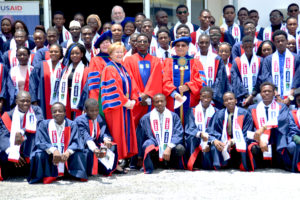 Eighteen-year-old Maryam Habila Usman, a former student of Air Force Girls Secondary School, Jos, has emerged the overall winner of the nationwide scholarship examination into the American University of Nigeria (AUN).


 An Ilorin Magistrate’s court has remanded one Peter Itopa Adogun who was arraigned by the Kwara state police command for alleged certificate and identity theft.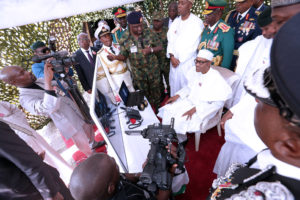
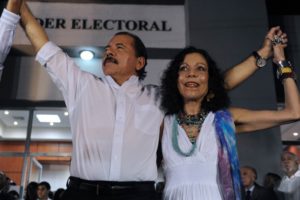 Daniel Ortega has been sworn in for a third consecutive term as Nicaragua’s president, with his wife Rosario Murillo as the new vice president, giving a married couple the reins of power for the first time in the Central American country’s history.
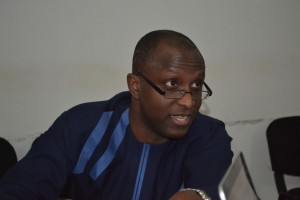 The Presidency has alerted Nigerians that there is no scheme under the Federal Government’s Social Investment Programmes (SIP) that attracts an application fee, warning that they should not pay anyone money.

Ibrahim Magu: Garlands At A Time Like this, By Ibrahim Modibbo
There are several ironic happenstances around the acting Chairman of the Economic and Financial Crimes Commission (EFCC), Mr. Ibrahim Magu, almost to the level of the myriad of paradoxes around Nigeria as a country.
However, of these many ironies about the man, the most interesting to me, and I think to majority of the discerning public, is the temerity of a public officer, with what in Nigeria is a huge political bridge to cross, namely confirmation of his acting appointment, to throw all caution to the wind and embark on his work, firing from all cylinders, as the work demands. Some people have said, “The problem of Magu is that he acted like he has been confirmed, like he has no river to cross.”
If one is to hazard a guess, I could say the man went into the work in November of 2015 with the mindset of a wartime military commander—thinking of nothing else but how to surmount the assigned task, no matter how Herculean it was. And, in tackling the malfeasance, Magu diversified the fight with a clear focus on how to make the Nigerian economy function; restore the confidence of foreign investors and clean up all sections of the formal economy.
However, the most ironic of the ironies around Magu is that at the right time when his stewardship was beginning to be assessed and rated by the public, having reached one year in office steering the delicate operations of the EFCC, he got drown into needless controversy around the politics of his confirmation. This, sadly for keen watchers like myself, threatened the dispassionate atmosphere to consider the performance of the man bearing the torch of President Muhammadu Buhari’s celebrated fight against corruption. But it did not take away the glows that came from different quarters, even at the thick of the intrigues.
Magu’s gallantry and dispassionate drive has earned him, the EFCC and Nigeria, accolades from all angles of the compass. The influential Abuja-based newspaper, Leadership, crowned him as a joint winner of its person of the year award. Few days later, Silverbird TV, owned by the controversial senator from Bayelsa State, Ben Murray-Bruce, listed him among its nominees for man of the year. Not long afterwards, The Nation newspaper came up with Magu as its man of the year.
Previously, several prominent Nigerians had given their endorsements of what is happening with the fight against corruption, with credit to President Buhari for his square peg in square hole appointment and to Magu for being courageous and sincere about his work.
According to the Chairman of the Presidential Advisory Committee Against Corruption (PACAC), the fiery Prof. Itse Sagay, the country has not had a more committed anticorruption czar with “sterling qualities as Ibrahim Magu” since the pioneer EFCC chairman, Nuhu Ribadu. Interestingly, Ribadu himself has publicly acknowledged Magu’s vision and the renewed energy he has given the anticorruption fight.
This is what Ribadu had to say recently about Magu: “I will assure you that the leadership of the EFCC today is one that has the same spirit and belief in the vision of the EFCC right from the foundation and time the EFCC was established. It is a leadership that carries itself with integrity, a leadership that is strong, a leadership that is honest and a leadership that works with a lot of courage. You can see it in war that is going on.”
“Today, more than ever before, in our history, we have more cases that are being taken. We have more in terms of recoveries taking place, more than any time ever. You can simply say that maybe there is no one single anti- corruption organization in the world today that is doing the work that the EFCC is doing. So, that must be acknowledged and that must be understood,”
International commendation is equally huge, coming from world leaders such as President Barack Obama, the UK Government, the Commonwealth Secretary General, Patricia Scotland, and a host of others. When the US Secretary of State, Mr. John Kerry visited Nigeria in August, 2016, he specifically commended President Buhari for “making significant progress” in the fight against corruption, as he pledged US government’s support.
When the Nigerian delegation, led by President Buhari attended the London Anti-Corruption Summit in May last year, Nigeria stood out. That delegation was the toast of all with President Buhari conferring with fellow heads of government, while Magu was the toast of the experts from around the world.
Interestingly, as Magu approached one year in office with the uncertainty of his appointment hanging around his neck, it was the media, alongside civil society, as the voice of the critical mass, that began agitation for his confirmation as a tribute to his “dogged fight against corruption”, as one newspaper put it.
Many newspapers, among which the very credible and influential foursome of The Punch, Leadership, The Nation and Daily Trust on Sunday, have variously penned editorials, giving kudos to Magu for taking the war against corruption from a mantra off the mouth of the policymakers to a daring, resulted-oriented crusade. The four newspapers were also unanimous in calling on those saddled with the task of making Magu the substantive chairman of the EFCC to hasten and do that.
According to Leadership, in its editorial of November 3, 2016: “In our considered opinion, the best interest of the anti-corruption effort will be served when someone who has what it takes to call a spade by no other name is encouraged to do the work for which he is trained and has the aptitude. At the risk of being misunderstood, Magu, from our disinterested position, is one man who has been well primed for the task.”
Also in November, the who-is-who of civil society organisations working on anticorruption issued a joint press statement calling for Magu’s confirmation as substantive head of EFCC citing these credentials: “…the EFCC has of late stepped up the fight against acts of corruption and abuse of public trust as exemplified in the tracking of those remotely and directly connected with the misapplication of monies meant to fight Boko Haram insurgency, confiscation of the properties suspected to have been acquired from proceeds of crime linked to politically exposed persons as well as the investigation and prosecution of alleged owners”.
With this gale of endorsements from independent-minded individuals and stakeholders, and with the outburst of public outrage witnessed penultimate Saturday when the orchestrated news went out that Magu had been relieved of his duties, it is clear where Nigerians stand on this matter.
These two scenarios: the praises and the rage, are clear pointers that though the anticorruption work may be a thankless job, with majority of Nigerians, the effort is much appreciated. And as the Latin maxim says, the voice of the people is the voice of God.
Modibbo is editor-at-large at Verbatim magazine. He can be reached at ibrahimmodibbo60@gmail.com. [myad]