

Is Turkey Headed For Martial Law? Asks Michael Rubin

A car bomb, allegedly set off by a militant offshoot of the Kurdistan Workers Party (PKK), denoted outside an Izmir courthouse, killing at least two. The terror attack is just one more in a string of attacks demonstrating the collapse of Turkey’s counterterrorism capacity in the wake of President Recep Tayyip Erdogan’s political purges.
Erdogan loves a crisis. He called the abortive July 15 coup “a gift from God.” He has since ushered in and extended emergency laws and purged tens of thousands of political enemies.
He is also allergic to criticism. Journalists either blame Erdogan’s enemy du jour or end up in prison. Since the terror campaign began, Erdogan has arrested more journalists than terrorists.
For months, there has been a looming showdown between Erdogan and Turkey’s military. Dogu Perincek, a Maoist-turned-ultranationalist, has a powerbase among senior officers. Erdogan has apparently tried to erode Perincek’s influence by returning purged Islamists to power all the while building his own personal militia under the guise of SADAT, a private security company training paramilitaries whose head, Gen. Adnan Tanriverdi, Erdogan appointed as his military counsel.
Erdogan has worked with Perincek to purge their mutual enemies: liberals, Kurds, and followers of Fethullah Gülen. Where the two have clashed most prominently is over the new constitution which Erdogan wants to confirm his dictatorial powers.
The question is whether the two might temporarily bury the hatchet by striking a deal to turn Turkey more permanently toward Russia. Perincek has long denigrated NATO and urged closer ties between Ankara and Moscow. Erdogan’s recent embrace of Russia (“Close incirik” is trending right now on Turkish twitter and prominent Turkish papers blame the United States for recent attacks) play into Russia’s hands.
If Erdogan continues his battle against Perincek, Turkey is heading for another coup, political assassinations, or civil war. If he calls a truce with Perincek, then there is no impediment for Erdogan to declare martial law and to bring the full force of the military to bear against anyone who would stand in Erdogan’s way. Martial law, however, is no magic bullet:
- Erdogan is like Putin. Both leaders may believe they can use the other and out maneuver the other. But Putin is smarter than Erdogan. The Turkish leader should ask: Does he really think he can outmaneuver Putin? Could Putin use Perincek against Erdogan by either supporting a coup or assassinating the Turkish leader or his close aides?
- Perincek has declared his opposition to the new constitution. Would he cooperate with martial law even if it meant Erdogan continued to push the new pact through parliament?
- Erdogan retains the support of half the country, many of whom is conservative Muslims and embrace political Islam. Having incited religious hatred and intolerance for more than a decade, Erdogan will not likely be able to rein in those constituents even if their demands become politically inexpedient.
- Martial law and a turn toward Russia and China will not revive Turkey’s economy; they will only cause it to sink further.
- Erdogan has pulled the trigger on the Kurds. He has not only walked away from peace talks, but also arrested democratically elected Kurdish leaders. Many Kurdish cities today resemble Aleppo; only the crackdown on media both foreign and domestic has tempered outrage. Martial law will not resolve that problem. It will only transform Turkey’s psychological partition into physical division.
Russia is not known for bringing either freedom or prosperity to its clients—and that is exactly how Putin views allies.
So what can Turkey do to recover? Emergency laws are addictive, but they will no more bring stability to Turkey than they did to Syria. Nor is press censorship wise. Avoiding accountability seldom improves quality of governance. Military force will exacerbate rather than resolve societal polarization. The United States can do without Turkey, and NATO let alone the European Union would be better off without the Turkey shaped by Erdogan. If Erdogan wants to dance with Putin, Turks will suffer. Russia is not known for bringing either freedom or prosperity to its clients—and that is exactly how Putin views allies.
Martial law will push Turkey further into the morass. Simply put, there is no substitute for rule-of-law and democracy, the very ideals to which Erdogan has now turned his back. [myad]



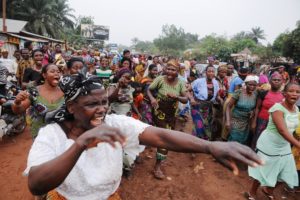 As a way of restoring normalcy to the troubled Southern Kaduna, President Muhammadu Buhari has ordered that two battalions of the Nigerian Army be deployed to the area with immediate effect.


President Buhari, Nnamdi Kanu, The Enemies Between, By SKC Ogbonnia
Events after events have shown that the continued detention of the Director of Radio Biafra, Nnamdi Kanu, by the Federal Government of Nigeria needs a serious rethink. The matter is not only plaguing the country socially and politically, but its toll on the national economy is not difficult to fathom. The unfortunate irony yet is that while the two principal actors, President Muhammadu Buhari and Kanu, may have good intentions, they are fighting the wrong enemies.
Please hold your thoughts till the later part of this essay on the flaming issue of secession for which Nnamdi Kanu is now better known. For it may not occur to many that before Kanu became a recurring decimal of Buhari’s presidency, a major aim of Radio Biafra, in Kanu’s own words, was to uproot “all looters, embezzlers, kidnappers, sponsors of terrorism, child traffickers, corrupt judges, crooked university lecturers, murderous Nigerian security forces and all thieving individuals masquerading as public officials who steal public funds thereby preventing developmental projects from impacting positively on the lives of the ordinary people.”
Any read of the statement above readily shows that such aspect of Kanu’s advocacy is in tandem with Buhari’s standing vow for a corrupt-free Nigeria. If the rationale is inadequate, then consider that just about every group or leader who has pleaded for Kanu’s release suggested that lack of development provoked his advocacy. This goes without saying that the president and Kanu have common
foes in the corrupt leaders who plundered our common wealth during the last 16 years of the astronomical oil boom–that is, even before Buhari assumed democratic power.
Therefore, in case President Buhari and Mazi Kanu are yet to get it, which appears to be the case, their real enemies in this context ought to be the corrupt leaders from the Southeast (SE) and South-South (SS) zones of Nigeria who combined to hinder the provision of efficient public amenities as well as job opportunities in the Biafra land that drew the ire of Kanu in the first place.
More specifically, the enemies are the very politicians and contractors that connived to embezzle the funds budgeted for projects vital to the region, some of which include but are not limited to: The 2nd River Niger Bridge; East-West Highway; Enugu-Onitsha/Enugu-PH Expressways; Akanu Ibiam and PH International Airports; Calabar and PH Seaports; Dredging of River Niger; Eastern Gas Pipeline network (CAP); Niger Delta Development Commission (NNDC); Legislative Constituency Projects; National Conference convened by President Jonathan that adopted, among other things, the restructuring of the country; the Constitutional Amendment, initiated under President Umaru Yar’Adua, and funded to the brim to address the concerns for equitable distribution of states and local governments.
A simple scan of these projects and their attendant ministries reveals that politicians from the South-East or South-South played one dubious role or the other in sabotaging the desired implementation or development. Needless to say, none of the states or local governments in the SE/SS zones is run by the Hausa or Fulani people–that Nnamdi Kanu has commonly blamed–but wholly by the natives themselves. Yet, there is no commensurate development in the area for their share of federal statutory allocations.
This outright rebuke of the SS/SE politicians must not be misconstrued as exalting those from other regions as saints. Far from that! The emphasis on SS/SE is because of the topic of Biafra. Besides, the very zones under review produced the then president (Goodluck Jonathan), then de facto Prime Minister (Ngozi Iweala), and the then Minister of Petroleum Resources (Diezani Madueke)—the specious trio who superintended the national treasury during the period their kinfolks were looting the project funds in the area.
In a normal clime, this sort of exposé would be sufficient to unmask the culprits linked with the money-spinners cited herein. But in the event that more specific details are needed, my identity has always been an open book. Moreover, this case will not require the state to dole out from its meager purse to fulfill the new policy on whistle-blowing. For quid pro quo is beneath my personal code of ethics in matters of public interest.
Change does not come easy, understood, but containing the situation in the east must not be a rocket science. Make no mistake about it; President Buhari deserves commendation for quietly undertaking some of the projects in the region that were funded but looted during previous administrations. Yet, to continue to punish the primary whistle-blower in Nnamdi Kanu while condoning the corrupt politicians–who return a portion of their loot–is sadly an oxymoron. In view of this irony, instead of the futile detention of Kanu, the masses prefer a leader that can summon the courage to expose the real enemies who had corralled the project funds into private bank accounts.
Any call for the release of Nnamdi Kanu easily stirs emotions, and that is understandable. The style of his advocacy alone is jarringly hostile and can constitute a problem by itself. But the manner of the man’s detention, including the state’s refusal to obey court orders, does not serve any good purpose. The only beneficiaries are the real enemies, the corrupt vortex of the opposition, who have nothing concrete to show for their time in office, but who are today having a field day, grandstanding as the champion for the oppressed, claiming the passionate desire to liberate Kanu while stoking a view of General Buhari as an unrepentant dictator determined to abridge freedom of speech in the land. Their ultimate goal, of course, is to capitalize on the Kanu saga to con the mass support needed to derail the president’s war against corruption.
Fifth columnists are sure to hide behind the urgency of Kanu’s threat of secession to continue to sidetrack Buhari from the right path to justice. But fighting the right causes through the wrong courses usually creates more problems than solutions. Moreover, the president does not need to be reminded that, similar to other multi-ethnic nations, for example, the United States of America, and the United Kingdom, there has always been, and will always be, threats for secession in Nigeria, regardless of who is in power. The manner of the approach is where leadership begins and ends.
SKC Ogbonnia writes from Houston, Texas. [myad]