

Yes, I Am Like Hitler, I Will Slaughter Millions Of Drug Addicts – Philippines President
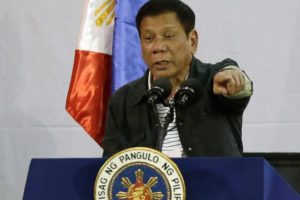
“I have been portrayed to be a cousin of Hitler by critics. If Germany had Hitler, the Philippines would have …”
These were the exact words of Philippines President, Rodrigo Duterte in a rambling speech on his arrival in Davao City after a visit to Vietnam.
President Duterte remarks, likingg himself to late German leader, Adolf Hitler, triggered shock and anger among Jewish groups in the United States of America.
The Phlippine strong man stressed: “I will be happy to examine three million drug users and peddlers in the country. You know my victims. I would like them to be all criminals to finish the problem of my country and save the next generation from perdition.” Since he took office on June 30, more than 3,100 people have been killed, mostly alleged drug users and dealers, in police operations and vigilante killings.
However, the administration of U.S. President, Barack Obama played down the remark, but could create pressure on the U.S. government to take a tougher line with the Philippines leader.
U.S. State Department spokesman Mark Toner, today, Friday said that Duterte’s comments were “a significant departure” from America’s partnership with the Philippines “and we find them troubling.”
In Washington earlier today, Friday, a State Department spokeswoman, Anna Richey-Allen, had repeated concerns about reports of extrajudicial killings in the southeast Asian country but offered no response to Duterte’s comment referring to Hitler.
A White House official stuck to a strategy of stressing Washington’s long-standing ties with Manila, saying: “we continue to focus on our broad relationship with the Philippines and will work together in the many areas of mutual interest.”
How relations between the U.S. and the Philippines evolve will depend more on what Duterte does than on what he says, administration officials have said.
In Hawaii, U.S. Defense Secretary, Ash Carter met with the defense chiefs of southeast Asian nations, including the Philippines, and U.S. officials said they would use the forum to clarify comments by Duterte that throw into doubt his commitment to military ties with the United States, including joint exercises and patrols. Carter, speaking before Duterte’s remarks in Davao, said Washington had an “ironclad” alliance with Manila. Duterte, who was elected in May on the back of a vow to end drugs and corruption in the country of 100 million people, has insulted Obama and in a number of remarks he has undermined the relationship between Manila and Washington. Reacting to critical comments on his war on drugs by U.S. Senators, Patrick Leahy and Benjamin Cardin, Duterte said: “do not pretend to be the moral conscience of the world. Do not be the policeman because you do not have the eligibility to do that in my country.” Jewish groups quickly condemned Duterte’s Hitler comments. Rabbi Abraham Cooper, head of the Simon Wiesenthal Center’s Digital Terrorism and Hate project, called them “outrageous”. “Duterte owes the victims (of the Holocaust) an apology for his disgusting rhetoric,” Cooper said. The Anti-Defamation League, an international Jewish group based in the United States, said that Duterte’s comments were “shocking for their tone-deafness. “The comparison of drug users and dealers to Holocaust victims is inappropriate and deeply offensive,” said Todd Gutnick, the group’s director of communications. “It is baffling why any leader would want to model himself after such a monster.” Duterte has said there will be no annual war games between the Philippines and the United States until the end of his six-year term, and his hostility may make Washington’s strategy of rebalancing its military focus toward Asia in the face of an increasingly assertive China more difficult to achieve. Murray Hiebert, a Southeast Asia expert at the Center for Strategic and International Studies think tank in Washington, said Obama was “taking the long view” in dealing with Duterte. Obama leaves office in January. Malcolm Cook, a senior fellow at Singapore’s ISEAS Yusof Ishak Institute, said the U.S-Philippines alliance was not necessarily at risk, but Washington could seek to focus on ties elsewhere in the region. “We are all in some sense becoming, by necessity, desensitised to Duterte’s language,” he said. “Diplomatically, the U.S. would say they’ll continue to work with him and the alliance is strong. But it’s whether they’ll continue to strengthen that alliance or not.”[myad]





Nigeria At 56: Our Lies Against Independence Leaders, By Olawale Rasheed
Reading commentaries on Independence Day amuses me a lot especially considering our deliberate lies on our revered independence leaders. We painted rosy pictures of founding fathers who painstakingly laboured and delivered a united peaceful and harmonious federation.
In 1960, leaders joyously received mantle of leadership without intrigues, infighting and justice delivered. In fact, ethnic politics, corruption, skewed federalism, controversial census and all sorts of ills now pervasive today were non-existent.
So from 1960 to 1966,a perfect federation was in operation where all Nigerians acted as one and under which a vibrant young nation was demonstrating best examples to the rest of Africa. Leaders at independence ate, slept and adored a united federation with shared common destiny.
That was the utopia we perpetuated even in the face of denial by history, lying to our children and demonizing the successor generation. A nation that fails to diligently study history or accords history prime place cannot but be plunge into an ocean of ignorance, deceit and falsehood even about basic facts of her evolution. Even in 2016, we still continue our lies and misrepresentation of our independence leaders.
Our leaders at independence were great patriots, well grounded within their respective skills and capacities . They were political war leaders who had to fight from ethnic turfs and who struggled on all fronts to give realities to their people’s driven agenda. Men of timber and deliver they were,their greatness cannot be disputed as they were frontline players in the making of Nigeria no matter how imperfect it was.
Late sage, Obafemi Awolowo,the erudite scholar-politician of immeasurable intellect and contributions to national and regional politics. The Great Zik of Africa, Dr Nnmdi Azikwe,a flamboyant cross border politician, an astute nationalist and a great leader for a controversial, expansive united Nigeria without ethnic map. Sir Abubabakar Tafawa Balewa, a perfect English gentleman as described by some British leaders and a clean incorruptible independence prime minister. Former premier of old Northern region, Sir Ahmadu Bello, Sardauna Sokoto, an undiluted devotee to the greatness and well being of his people, a traditional ruler ,an Islamic scholar and a greatly loved leader of his people.
As 1959 approached then, how did these leaders acted? What was the pre-independence electoral campaign like? The records are well preserved in our libraries-it was bitter political war and battles that laid a negatively strong ground for many ills that still dogged the nation till date.The 1959 election was fought by political generals who appeared to be representing separate countries.
And yes, by 1959 ,Nigeria was still a paper nomenclature comprising of three countries namely North, west and eastern regions. Fact was that from 1914 to 1959, the so called united Nigeria was never united.
1959 to 1960 was the time the new nation was to be delivered in reality. That independence election was to lay the foundation for the birth of the new baby. Unfortunately, the conception was fraught with still birth even though the British induced the birth of a defective baby whose jaundice has refused to heal since.
Why are commentators repeatedly lying about events preceding our independence in 1960?Why are we not coming clean of the bitterness of post -1959 election which manifested openly even on the day of independence ? Why are we lying that the nation was truly united as at the time the British lowered the union Jack flag?
Our erudite scholars have documented the realities of what was handed over to Independence leaders, a fractured nation with deep level of distrust among leaders .Nigeria was borne out of intrigues and back stabbing among leaders, leading to an incohesive leadership and consequent implosions six years later. Ours was a nation deliberately modeled by the British to be incohesive, conflicting and divisive through connivance with some local leaders.
At independence, the Igbos aligned with the North, leaving the West in the opposition. The North ruling under the party called Northern People’s Congress later supported the implosion of the opposition Action Group, generating so much heat from 1964 to 1965.Igbos disengaged from the alliance to later embraced another alliance with the Yorubas under United Grand Alliance (UPGA) while the North aligned with breakaway factions from East and West to form the New Nigeria Alliance. The bitter fact is at independence Nigeria was as fractured as it is today.
From 1960 to 1966,it was a tale of bitterness ,political corruption, selfish deployment of state power ,minority oppression, political persecutions ,intolerance of opposition, corruption among leaders among others. The foundation built on intrigues and ethnic permutations only gave rise to a nation reeling from ethnic politics, imperfect federalism, stunted growth and retrogressive genotype. Is that why we don’t want history in our school curriculum?
Many scholars have equally documented evidence that proved that the pre-and post- independence embedded ills in national and regional structures watered and prepared the ground for the unfortunate first coup, counter coup and the three years civil war of 1967 to 1970.Where is the utopia of an Eldorado First Republic that we so annually eulogize?
There are surviving actors of the independence era and the troubled first republic across the states. Those surviving elders know the fact; they know the faulty foundations they helped foisted or they were forced to be foisted on the new nation which may not solely be their fault. We need to come clean and accept that 56 years after, we are still unable to correct first, the errors of 1914 and more seriously heal the injuries of 1959-60s.
Ler me assert that Nigeria’s continued survival despite her “down syndrome” is due to just one major bloc of power brokers -the military political elite. When Independence leaders failed to heal the political tuberculosis of 59s-60s,the tumbling from first to second coups to the civil war produced a strange national dynamics in leadership evolution. A new set of leaders acting like a brotherhood surfaced.
From 1975 to date, the military elite successfully subjugated the remnants of Independence political elite, creating a new league of leaders still ruling till date. Records showed that all those military leaders of the civil war and specifically those who masterminded directly or indirectly the 1975 coup are still subsisting leaders of Nigeria till date. If they did not occupy office, their cronies play the proxy game.
So the big question is if Independence elite had issues as to the entity created by them or bequeathed for them, has the military elite fair better? That is contentious and a discourse for another day.
But for now, let us come clean with our history -there was never a time we have gotten it right as a nation.
*Olawale Rasheed , a policy analyst, is the CEO of Sahel Media Group.
+234 803 913 4578
Twitter-@iwogoke. [myad]