Former national Chairman of the Peoples Democratic Party’s Board Of Trustees, Chief Tony Anenih has explained to the Economic and Financial Crime Commission (EFCC) how he shared the N260 million he got from embattled former National Security Adviser (NSA), Sambo Dasuki, to some party members for the purpose of Presidential campaign for former President Goodluck Jonathan’s second-term bid.
In a letter he wrote to the Commission, Anenih was said to have told the anti graft body that he gave N63 million to a group coordinated by a former Special Assistant to former President Shehu Shagari, Tanko Yakassai, for the 2015 presidential election.
Anenih was also said to have disbursed the money to various other groups whose identities he did not disclose but which EFCC is currently investigating.
Meanwhile, the Commission has indicated its intention to invite Yakassai to shed more light on why his group was allocated N63million arms funds even as it has already invited Anenih to make a Statement on Oath and for interrogation. [myad]
The Economic and Financial Crimes Commission (EFCC) has arrested a former military governor of Kaduna State and chieftain of the ruling All Progressives Congress (APC), Lawal Jafaru Isa.
Jafaru Isa is the first chieftain of the APC that has so far been arrested since the beginning of a sweeping probe into the alleged diversion of $2.1 billion meant for arms purchase by officials of the immediate-past administration.
Jafaru Isa who was the military Administrator of Kaduna State from December 1993 to August 1996 during the military regime of General Sani Abacha and one-time governorship candidate of the defunct CPC in Kano State. He is a close friend of the embattled former National Security Adviser (NSA), Sambo Dasuki.
Jafaru Isa, also a close political associate of President Muhammadu Buhari, was arrested at his Abuja residence located at Ajayi Crowther Street, Asokoro yesterday.
Operatives of the anti-graft commission were said to have occupied Jafaru Isa’s residence at about 9 pm yesterday, and then whisked away. It was learnt the a retired Brigadier General in the Nigerian Army, was invited last week to appear before the commission yesterday to clear the air on “some questionable receipts” from the former NSA.
Jafaru Isa was suspected to have received over N100million from Dasuki.
It was gathered that instead of honouring the invitation, he wrote a letter to the EFCC through his lawyer, seeking a postponement of his appearance date on the grounds of death of a relative.
Apparently dissatisfied with his excuse, the EFCC however arrested him to clarify the “questionable receipts.”
The spokesperson of the EFCC, Wilson Ujuwaren, could not be reached today morning for comments on the arrest. But a top official of the commission confirmed the development.
”He has been wasting our time, and we just have to pick him up for our investigation to continue,” the official said. [myad]
International Satellite Providers of Free to Air and Pay TV platforms including HISPASAT, EUTELSAT and Nile SAT worldwide have bounced off the proposed Biafra Television Free to Air scheduled to start transmission on the 15th January 2016.
It was learnt on good authority said that the international Communications Union and High Frequency Coordinating Conference has approved such moves by the providers.
It was learnt that the cancellation of the contracts for which no reason was given has created major problem for Pro Biafra groups, whose media and propaganda structures were severely crippled by an earlier successful takeover of 15560KHz – 19 meter Band Shortwave by the Federal Government barely two months ago.
The Indigenous People of Biafra (IPOB) is believed to have been hit by the string of setbacks, with one of them, Austin Ofomah, expressing regret at the action of the satellite providers.
“The spirit of Biafra cannot be defeated” he said in a statement, adding “what the Federal Government is doing is against International Broadcasting Convention on the right of free expression.”
It was also gathered that the success of the Federal Government effort is largely due to the role of the National Security Adviser (NSA), retired General Babagana Monguno, whose discreet contacts and reach has shut the Pro Biafran groups at the international level. [myad]
African Telecommunication giant, MTN has sealed the deal to acquire Visafone, the leading CDMA operator in Nigeria. The acquisition is expected to provide MTN the robust voice and data platform of Visafone to cater for the booming internet population in Nigeria.
A source who confirmed the transaction said: “It’s certainly a multimillion naira deal because Visafone was the largest CDMA operator in the country”.
“The acquisition is expected to ensure high quality data services and improve mobile broadband experience for subscribers of Visafone and MTN”.
“The merger is also expected to provide the much-needed relief to the booming internet economy by making available quality mobile broadband services adopting the state of the art 4G LTE technologies during the year.”
Nigeria ranks among the fastest growing countries in terms of mobile subscribers and data penetration. The number of subscribers that surf the internet in June was put at 92,816,572 but increased to 93,551,811 in the month of July.
The data shows that of the 93,551,811 internet users in July, 93,403,147 were on GSM networks, while 148,664 users were on the CDMA.
Moreso, of the 93,403,147 internet users on the GSM networks in the month under review, MTN Nigeria had 41,101,886 customers browsing the internet on its network.
It stated that MTN had an increase of 616,216 internet subscribers in July after it recorded 40,485,670 users in the month of June.
According to the report, Globacom had 19,330,549 subscribers surfing the net in July as recorded in June.
Airtel Nigeria, it said, had 17,605,852 internet users in the month of July, as against 17,598,626 customers recorded in June.
Internet users on the Airtel Nigeria network increased by 7,226 in July, while Etisalat had 15,393,860 internet users in July, against the 15,285,079 in June.
Those browsing on Etisalat’s network also rose by 108,781 in the month of July.
The NCC also revealed that the CDMA operators (Multi-Links and Visafone), had a joint total of 148,664 internet users on their networks in July.
It showed that the only surviving two CDMA networks in the country listed an increase of 33,016 internet subscribers in the month under review, from the 115,648 users they recorded in June.
Visafone had an increase of 32,980 customers surfing the internet in July, rising to 148,461, compared to the 115,481 users in June.
Multi-Links had 203 internet users in July, adding 38 customers from the June record of 165 users.
It explained that the increase in the use of the internet in the month of July showed that more Nigerians were embracing ICT.
NCC noted that the country was making progress towards achieving 30 per cent broadband penetration by 2018. [myad]
A Kano Higher Sharia Court has sentenced Abdulaziz Daud to death by hanging for charges of blasphemy against Islam after a secret trial in the state.
Abdulaziz Daud, popularly known as Abdul Inyass was arrested on August, 18 2015, in Abuja and brought to Kano to face a secret trial on a two-count charge of blasphemy and inciting crisis, which led to the razing of a Sharia Court and some vehicles in the state.
The accused person was alleged to have committed the said charges on June 31, 2015, during Maulud festivity, where he allegedly made comments against Islam,
Counsel to the state government, Barrister Lamido Abba Soron Dinki disclosed that five witnesses, including the police, testified before the Court.
It should be recalled that nine other accomplices had previously been sentenced to death by the same court. The convicted has right to appeal the death sentence. [myad]
Acting Executive Chairman of the Economic and Financial Crime Commission (EFCC), Ibrahim Mustafa Magu has vowed to clean the commission of bad eggs as it set out to wage sustainable war against corruption in the country. The chairman acknowledged that in any organisation such as EFCC, one could not rule out such bad eggs, who are themselves corrupt, adding that he would look for them and weed them out. Answering questions today at an interactive meeting with members of the Guild of Corporate Online Publishers (GOCOP) in Abuja, Ibrahim Magu said: “we are looking at corruption within EFCC to have a clean house to be able to face other corrupt Nigerians.” He expressed his determination to restructure the commission to make it strong and confidence enough to go for any corrupt individuals, no matter how highly place. The chairman debunked the allegation in some quarters that EFCC has been one sided in the fight against corruption, saying that there is no truth in such allegation. Ibrahim Magu made it clear that, with the declaration by President Muhammadu Buhari that any of his ministers found to be corrupt would be sacked and prosecuted, the commission too would not engage in any form of favouratism. According to him, the commission is searching the wardrobe of every Nigerian whether he is in All Progressives Congress (APC), Peoples Democratic Party (PDP) or in any other party or place. “But as I’m talking now, the commission has not received any complaint about people serving currently in the Buhari’s government. Any time such information gets to us, we will act on it.” [myad]
Acting Executive Chairman of the Economic and Financial Crime Commission (EFCC), Ibrahim Mustafa Magu has revealed that more influential Nigerians are now on the Commission’s list and their names would soon be released. “As we speak, many more influential Nigerians are on the radar of the EFCC and, in the coming weeks, they would have their days in court and Nigerians will be kept fully abreast of the results of our investigations.” Ibrahim Magu who spoke today at the maiden interaction with online publishers, said that since assuming office as the chairman of the Commission, he had tried to infuse a new life on the war against corruption. “This I have done primarily by re-ordering EFCC’s priorities. The effect, which is obvious for all to see, is the investigation, arrest and prosecution of some of the most powerful forces in Nigeria, who have questions to answer on their stewardship whilst in office. “A former National Security Adviser, former ministers, former governors serving and retired military men, a media mogul and several others are among those we have called to answer critical questions power on to the management of our commonwealth.” Ibrahim Magu swore that in fighting corruption, he is being guided by the fear of God, national interest and the rule of law, adding that apart from bringing corrupt public officers to justice, he is determined, in line with the stance of the current administration, to send a unmistakable message to everyone, that no Nigerian shall be regarded as being above the law or treated a scred cow as far as the fight against corrupt is concerned. The EFCC boss said that the commission is lucky to have the backing of all the arms of the government in the onerous task of war against corruption. “By far more inspiration is the political will of Mr. President to foght corruption. This unbending will, which some now call body language, has given needed traction to the anti-graft campaign. “The President’s resolve is closely mirrored by that of the Chief Justice of Nigeria (CJN), Justice Mahmud Mohammed, who, during the last All Nigerian Judge’s Conference, declared unwavery support of the judiciary under him, for the war on corruption. “At that same Judges Conference, Mr. President had expressed the concern of the Nigerian people for the undue delays experienced in the trial of corrupt suspects. “The judiciary has responded with some practical steps in the form of the designation of selected courts to try EFCC cases and some practice directions. We believe that when holistically and effectively cut the time corruption cases spend in court before Nigerians know whether the accused is guilty as charged or innocent of the crime.” He sought for the collaboration of the media, particularly the Online publications in the renewed war against corruption, adding: “the EFCC needs you; Nigeria needs your critical support if we are to make any headway in this important campaign against corruption. My pleas for your support is underscore by my understanding that the forces which we are battling are powerful and some of them may want to use all platforms of the media to distract and derail us. If and when they do come to you, please allow the ethics of your profession, your conscience and overriding national interest be your guide.” Ibrahim Magu stressed that media would lose credibility if the practitioners allow their platforms to be used by unscrupulous individuals who have reasons other the national interest as their motivation. [myad]
Certain propositions are so pathetically impossible that a person who undertakes to utter them audibly earns questions about their sanity.
Olisa Metuh’s suggestion that Sambo Dasuki, former National Security Adviser (NSA) to President Goodluck Jonathan and the infamous mascot of the Peoples Democratic Party (PDP) era of unprecedented plunder of the Nigerian treasury, is the odds-on favorite to win the presidency in 2019 rests in that category of unfeasible you-dey-craze? Fantasy.
Metuh, the National Publicity Secretary of the ‘’largest political party in Africa’’ now reduced,in David Mark’s words, to a party ‘’in coma’’, is dreaming of PDP’s return to the Nigerian presidency. Dreaming of the party’s recovery of the keys to the national treasury. Dreaming of the return of kleptocracy.
And Metuh figures that Dasuki, the most aggressive looter of public funds Nigeria has ever seen, is best suited to actualize the dream!
Metuh claimed that the Buhari administration was not pressing charges against Dasuki because the ex-NSA repurposed the money earmarked for the purchase of arms for the anti-insurgency operations of the Nigerian military and rerouted it to private pockets. Metuh said Buhari was trying to secure himself an easy re-election in 2019 by eliminating Dasuki, his presumptive rival, through persecution.
Metuh said that Buhari was manifestly threatened by the prospect of a Dasuki candidacy, ‘’given his vast political and security network’’. Buhari was all the more jittery because ‘’the PDP has zoned its presidential ticket to the north’’, where Dasuki hails from.
All decent members of the PDP ought to feel scandalized by Metuh’s comment. They should be embarrassed that the man who speaks for their party and the entirety of its members is possessed of an appalling thought process.
Metuh who had once accused President Muhammadu Buhari of ‘’demarketing Nigeria’’ gave himself away as a foolish man.
For starters, nothing is more obvious than the fact that Dasuki’s own horse’s mouth admission that he wantonly raided the treasury and spread the cash among chieftains of the PDP has tarnished him till death.
His confessions have foreclosed his chance of his featuring in governance again. His unmasking as the linchpin who evacuated the treasury and packed the pockets of PDP big men full of loot places him under eternal stigma. After his plunder of the defense budget left Nigerian troops armless before Boko Haram; after he contributed to the making of 2 million internally displaced persons; after he has caused an indeterminate fraction of 20,000 deaths, he is too irreparably damaged to attempt a bid for any public office.
The prospect of a Dasuki run for the presidency is so bleak it cannot be wished into feasibility. Dasuki represents PDP’s worst advertisement. He is the most toxic liability the party can dare to parade.
Metuh, a ‘’lawyer’’ who functioned in the highest hierarchy of a former ruling party should know that a Dasuki presidential campaign will make the election a walkover for the incumbent. Metuh should know that better than any newspaper stand political pundit!
And, even if we assume that Dasuki has a fighting chance, the towering evidence against him and the corroboration of the profiteers of his looting philanthropy make it almost certain that he will end up in jail.
But Metuh is hankering for a Dasuki presidency counterintuitively. He just can’t help trying to procure the incredible with his optimism. This is because Dasuki symbolizes normalcy to Metuh. Dasuki personifies the ideology of mindless looting that Metuh has grown to be dependent on.
Dasuki’s criminal generosity to the party’s big men bespeaks a loyal conformation to the PDP’s de facto motto ‘’PDP, share the money!’’
Ordinarily, one would have encouraged Metuh and his party to self-destruct by crowning Dasuki PDP’s presidential nominee. At least, we will have drama at the looters’ expense. The Dasuki for President campaign will, for sure, fetch the PDP a wipeout.
But to taunt Metuh and PDP into proving that Dasuki’s ‘’vast political and security network’’ make the potential prisoner invincible would be subscribing to the insult implicit in Metuh’s suggestion.
Metuh’s wild claim that Dasuki is the only Northerner who is ready to be president is a blanket slur on all the human beings of the region.
The mention that Dasuki is PDP’s pre-ordained presidential candidate implies that the north suffers the scarcity of men of presidential caliber. There is no man or woman from the north who has a nobler profile than a notorious rogue. No one is competent and fit to be President except Dasuki.
That’s a proper abuse. And, it is, needless to say, a diabolical lie.
The North is rich in honorable and capable people. The North boasts many decent men and women who can creditably govern Nigeria. Dasuki is not the best leadership material the North can gift Nigeria. If anything, he is probably the worst face that can represent the North.
Metuh knows this. The reason why he is campaigning for a Dasuki presidency, I imagine, must be that Metuh personally yearns for the good old days which Dasuki represents.
PDP’s loss of the presidency in 2015 was disruptive. The party’s defeat abruptly ended the enjoyment Metuh and his ilk would last for 60 years.
That would have been the longest running heist in human history. Muhammadu Buhari’s victory, thankfully, truncated that and rid the nation of merciless rapists.
The change of fortune hit Metuh and his likes too bad. They weren’t weaned. They were thrust into starvation!
Metuh misses the old order. He had himself publicly confessed that the defunct looting regime enriched him.
When Dasuki started to reel out the names of the PDP folks he had shared Nigeria’s defense budget with, Metuh was seized by fear. He panicked as he saw his friends, collaborators and fellow party chieftains implicated in the arms purchase scam and he arranged a hasty press conference. He said he must be excused from the ongoing arrests because he didn’t receive his bribes from Dasuki, the National Security Adviser. He received his own bribes from…Goodluck Ebele Jonathan, the President of Nigeria!
With a glint of shameful pride in his eyes, Metuh said, ‘’ in the course of my duties’’ as National Publicity Secretary of the PDP, ‘’the then President invited and directed I carry out some assignments relating to my office and which he duly funded.’’
That has now been officially graded a pants-on-fire lie!
The Economic and Financial Crimes Commission reported that Metuh was one of the biggest profiteers of the Dasukigate arms scam. Metuh received, through the bank account of his company, Destra Investment Limited, hefty deposits. On November 24, 2014, he received 400 million naira; on December 2 and 4, 2014, he received 253 million naira; on the same December 2, 2014, he received 91 million naira and 92 million naira on December 3, 2014.
The state investigators can’t find any trace of paperwork that remotely suggests the multi-million naira payments were made in fulfillment of terms of a valid contract.
Other documents show that Metuh was collecting 4 million naira cash from Dasuki’s office as monthly stipend!
What we have learnt from this seemingly inexhaustible fraud, whose particulars are being released piecemeal –ostensibly in deference to the citizenry’s inability to bear the impact of a one-off dumping- is that the entire PDP/Dasuki regime did not stop at normalizing looting of public funds. The regime legitimized the crime.
The regime made participation in the plunder the standard proof of your status. Those who are somebody by Abuja’s reckoning partake of the loot: Those who don’t measure up don’t enjoy ‘’the privilege.’’
Metuh, a man of little mettle and poor reason, cannot be fairly described as any better than the most underwhelming image maker a political party can retain. His press statements are wishy-washy, weedy and weak. His off the cuff remarks are feeble, facile and forgettable. Every of his engagement with the public tends to succeed only in confirming that he is out of his depth!
But the mediocre whose skill set is supposed to be a sentencing to subsistence livelihood collected a 1.4 billion naira –for his effort in gaining admission into the looting gang!
Dasuki paid Metuh unmerited monies just as he paid Iyorchia Ayu, an expired politician, 345 million for consultancy on ‘’electoral matters.’’
The party is over. The bank deposit alerts no longer stream in. And the anti-graft agencies are haunting and hunting the predators!
Metuh wants Nigeria to return to kleptocracy. That will not happen. The current paradigm cannot permit the ascension of a notorious thief to the Nigerian presidency.
Here’s my advice to Olisa Metuh:
Now that EFCC has arrested you for interrogation, start preparing to defend yourself in court. You need to ready your mind for the grist of cartoons the media will make out your case. You need to hire some lawyers –preferably, those Senior Advocates of Nigeria whose specialty is defending corrupt politicians!
You need not worry about 2019. Or an impractical Dasuki for President campaign. What should agitate your mind is the present challenge of stopping your own looming jail term!
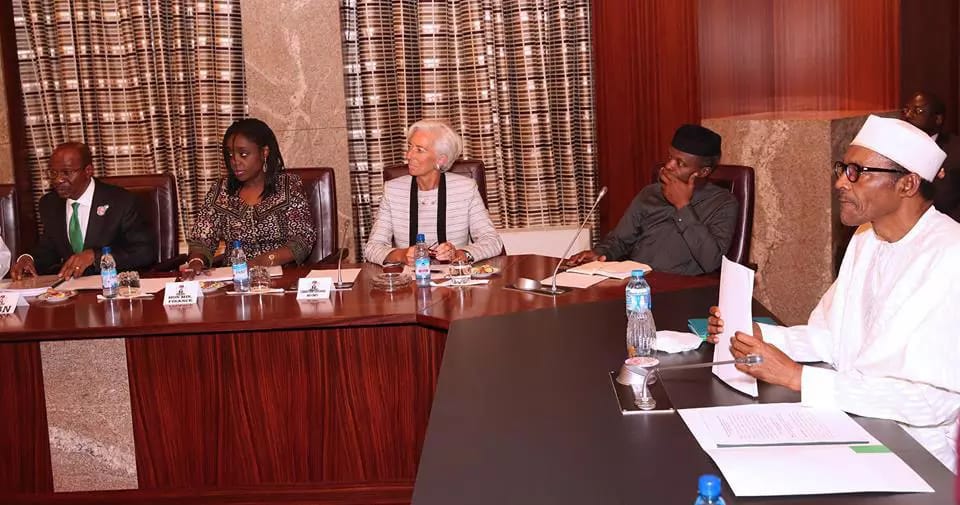
President Muhammadu Buhari has announced that henceforth all heads of Ministries, Departments and Agencies of government will fully account for all funds that get into their coffers. “We have also told all heads of Ministries, Departments and Agencies of government that on our watch, they will fully account for all funds that get into their coffers.” President Buhari spoke today when he received in audience, the Managing Director of the International Monetary Fund (IMF), Ms. Christine Lagarde at the Presidential Villa, Abuja. President Buhari said: “we are working very hard and with the budget as our way forward, we will do our best to ensure that our country survives the current economic downturn.” The President said that the Federal Government is currently reviewing its operational costs and had directed all the Ministries, Departments and Agencies to cut down on their overhead costs. He assured the IMF chief that his government would work hard to look inwards to generate revenue in addition to enforcing regulations that would stop financial leakages as well as adopting global best practices in generating more revenue to mitigate the effect of dwindling oil prices on the Nigerian economy. He promised that his government would also enforce greater discipline, probity and accountability in all revenue generating agencies of the Federal Government. “We have just come out of budget discussions after many weeks of taking into consideration the many needs of the country, and the down turn of the economy with falling oil prices and the negative economic forecasts.” He said that his government will welcome the technical support and expertise of the IMF for its plans to diversify the Nigerian economy and further unleash its growth potentials. Ms Lagarde assured President Buhari that the IMF is ready to assist his government in plugging revenue leakages, tracing stolen funds and restructuring its tax system. She noted that Nigeria has all the potentials to overcome the current economic challenge caused by falling commodity prices without resorting to the IMF for financial support. Ms. Lagarde later told newsmen shortly after her meeting with the President that Nigeria has become the largest economy in Africa, “certainly the most populated and with a very attractive market.” She said that within the last four years when she first visited Nigeria, things have changed in a more complicated way in the sense that the source of revenue to the government of Nigeria which was predominantly oil has seen its price divided by more than half and the financing cost around are beginning to rise if only because the economic situation in the United States has improved and interest rates will begin to rise. The IMF chief said that she had excellent discussions with President Buhari, including the challenges ahead which stemmed from oil price reduction, the necessity to apply fiscal discipline and the need to also respond to the population needs while addressing the Medium Term specificities of improving the competitiveness of Nigeria and yet also focusing on the short term fiscal situation which requires that revenue sources be identified in order to compensate the shortfall resulting from oil price decline. She argued that oil is no longer the major contributor to the Nigerian GDP, adding: “it is only about 40 percent, but it is a big source of revenue for the government. “We discussed with the President, Vice President and the Minister of Finance and Minister of Budget how more efficiency, more transparency, better accountability, the enlarging the base of revenue could actually contribute to sound budget going forward. It is not for me here and now to actually approve or comment on the budget because we have procedures in the IMF under which a team of Economists is going to come next week actually to do what we call the Article 4 which is to review the budget. “We and the country’s authorities will look at whether financing is in place, whether the debt is sustainable, whether the borrowing cost is sensible and what strategy put in place in order to address challenges going forward. “But what I certainly mentioned to Mr. President was that his fight and his determination to fight corruption and his determination to bring about transparency and accountability at all levels of the economy are very important agenda item and very ambitious goal that needed to be deliberated upon which he, himself is definitely committed to as he indicated this morning and as he inspires his team members. “With that I am going to have more discussions with the finance minister, with Governor of Central Bank. We will be discussing issue of fiscal discipline, financing monetary policies and the degree of flexibility, all that with the fact that Nigeria with a vibrant large economy still has to deal with poor people, a lot of inequality and those two components should certainly be the drivers of reforms, whether it is looking at subsidies and how they are structured and how they can be phased out, whether it is monetary policy and the flexibility needed and knowing what effect it has on the poor, of those are ambitions that we could quickly recognize and support. Our technical discussions will continue and to those of you who wonder why the IMF Director is visiting Nigeria. It is precisely to have good discussion about these new objectives, these reforms agendas that have been identified and supported by the President and also to appreciate the impact that it will have on neighbouring countries because when a country large as Nigeria, anything that it decides, any hardship that it faces will have consequences around it and that is what our research and analytical work is demonstrating.” The IMF boss acknowledged that Nigeria is one of those that have impact not just on itself and its people but around it and it’s neighbours. [myad]
As the diplomatic row grows deeper between Saudi Arabia and Iran over the execution of a Shiite leader, the Saudi authorities have announced the stoppage of air traffic and trade link with Iran.
The Saudi Foreign Minister, Adel al-Jubeir, who announced this today in Riyadh that the Saudi government was demanding that Tehran must “act like a normal country” before it would restore severed diplomatic relations. “We will also be cutting off all air traffic to and from Iran. We will be cutting off all commercial relations with Iran and government will have a travel ban against people travelling to Iran.” He, however, said that Iranian pilgrims would still be welcome to visit Islam’s holiest sites in Mecca and Medina in western Saudi Arabia, either for the annual hajj or at other times of year on the Umrah pilgrimage. Al-Jubeir, a former ambassador to Washington where the FBI in 2011 said he had been the target of an Iranian assassination plot, said the break in ties was a response to older problems as well as the embassy storming. The minister accused Tehran of rising tensions after the kingdom executed Shi’ite Muslim cleric, Nimr al-Nimr, on Saturday, describing him as a terrorist. He said the time has come for Riyadh to react to “Iranian aggression.” He accused Tehran of dispatching fighters to Arab countries and plotting attacks inside the kingdom and its Gulf neighbours. Al-Jubeir said: “There is no escalation on the part of Saudi Arabia because our moves are all reactive. It is the Iranians who went into Lebanon. “It is the Iranians who sent their Qods Force and their Revolutionary Guards into Syria.” The execution of Nimr provoked protests among Shi’ites across the region and Iranian protesters stormed the Saudi embassy in Tehran, setting fires and causing damage, prompting Riyadh to cut ties and inflaming an already heated rivalry. Al-Jubeir said Saudi Arabia had been right to execute Nimr, whom he accused of “agitating, organising cells, providing them with weapons and money. “We should be applauded for this, not criticized.” [myad]
We use cookies on our website to give you the most relevant experience by remembering your preferences and repeat visits. By clicking “Accept”, you consent to the use of ALL the cookies.
This website uses cookies to improve your experience while you navigate through the website. Out of these, the cookies that are categorized as necessary are stored on your browser as they are essential for the working of basic functionalities of the website. We also use third-party cookies that help us analyze and understand how you use this website. These cookies will be stored in your browser only with your consent. You also have the option to opt-out of these cookies. But opting out of some of these cookies may affect your browsing experience.
Necessary cookies are absolutely essential for the website to function properly. This category only includes cookies that ensures basic functionalities and security features of the website. These cookies do not store any personal information.
Any cookies that may not be particularly necessary for the website to function and is used specifically to collect user personal data via analytics, ads, other embedded contents are termed as non-necessary cookies. It is mandatory to procure user consent prior to running these cookies on your website.









Olisa Metuh, The ‘Dasuki For President’ Campaigner, By Emmanuel Ugwu
Olisa Metuh’s suggestion that Sambo Dasuki, former National Security Adviser (NSA) to President Goodluck Jonathan and the infamous mascot of the Peoples Democratic Party (PDP) era of unprecedented plunder of the Nigerian treasury, is the odds-on favorite to win the presidency in 2019 rests in that category of unfeasible you-dey-craze? Fantasy.
Metuh, the National Publicity Secretary of the ‘’largest political party in Africa’’ now reduced,in David Mark’s words, to a party ‘’in coma’’, is dreaming of PDP’s return to the Nigerian presidency. Dreaming of the party’s recovery of the keys to the national treasury. Dreaming of the return of kleptocracy.
And Metuh figures that Dasuki, the most aggressive looter of public funds Nigeria has ever seen, is best suited to actualize the dream!
Metuh claimed that the Buhari administration was not pressing charges against Dasuki because the ex-NSA repurposed the money earmarked for the purchase of arms for the anti-insurgency operations of the Nigerian military and rerouted it to private pockets. Metuh said Buhari was trying to secure himself an easy re-election in 2019 by eliminating Dasuki, his presumptive rival, through persecution.
Metuh said that Buhari was manifestly threatened by the prospect of a Dasuki candidacy, ‘’given his vast political and security network’’. Buhari was all the more jittery because ‘’the PDP has zoned its presidential ticket to the north’’, where Dasuki hails from.
All decent members of the PDP ought to feel scandalized by Metuh’s comment. They should be embarrassed that the man who speaks for their party and the entirety of its members is possessed of an appalling thought process.
Metuh who had once accused President Muhammadu Buhari of ‘’demarketing Nigeria’’ gave himself away as a foolish man.
For starters, nothing is more obvious than the fact that Dasuki’s own horse’s mouth admission that he wantonly raided the treasury and spread the cash among chieftains of the PDP has tarnished him till death.
His confessions have foreclosed his chance of his featuring in governance again. His unmasking as the linchpin who evacuated the treasury and packed the pockets of PDP big men full of loot places him under eternal stigma. After his plunder of the defense budget left Nigerian troops armless before Boko Haram; after he contributed to the making of 2 million internally displaced persons; after he has caused an indeterminate fraction of 20,000 deaths, he is too irreparably damaged to attempt a bid for any public office.
The prospect of a Dasuki run for the presidency is so bleak it cannot be wished into feasibility. Dasuki represents PDP’s worst advertisement. He is the most toxic liability the party can dare to parade.
Metuh, a ‘’lawyer’’ who functioned in the highest hierarchy of a former ruling party should know that a Dasuki presidential campaign will make the election a walkover for the incumbent. Metuh should know that better than any newspaper stand political pundit!
And, even if we assume that Dasuki has a fighting chance, the towering evidence against him and the corroboration of the profiteers of his looting philanthropy make it almost certain that he will end up in jail.
But Metuh is hankering for a Dasuki presidency counterintuitively. He just can’t help trying to procure the incredible with his optimism. This is because Dasuki symbolizes normalcy to Metuh. Dasuki personifies the ideology of mindless looting that Metuh has grown to be dependent on.
Dasuki’s criminal generosity to the party’s big men bespeaks a loyal conformation to the PDP’s de facto motto ‘’PDP, share the money!’’
Ordinarily, one would have encouraged Metuh and his party to self-destruct by crowning Dasuki PDP’s presidential nominee. At least, we will have drama at the looters’ expense. The Dasuki for President campaign will, for sure, fetch the PDP a wipeout.
But to taunt Metuh and PDP into proving that Dasuki’s ‘’vast political and security network’’ make the potential prisoner invincible would be subscribing to the insult implicit in Metuh’s suggestion.
Metuh’s wild claim that Dasuki is the only Northerner who is ready to be president is a blanket slur on all the human beings of the region.
The mention that Dasuki is PDP’s pre-ordained presidential candidate implies that the north suffers the scarcity of men of presidential caliber. There is no man or woman from the north who has a nobler profile than a notorious rogue. No one is competent and fit to be President except Dasuki.
That’s a proper abuse. And, it is, needless to say, a diabolical lie.
The North is rich in honorable and capable people. The North boasts many decent men and women who can creditably govern Nigeria. Dasuki is not the best leadership material the North can gift Nigeria. If anything, he is probably the worst face that can represent the North.
Metuh knows this. The reason why he is campaigning for a Dasuki presidency, I imagine, must be that Metuh personally yearns for the good old days which Dasuki represents.
PDP’s loss of the presidency in 2015 was disruptive. The party’s defeat abruptly ended the enjoyment Metuh and his ilk would last for 60 years.
That would have been the longest running heist in human history. Muhammadu Buhari’s victory, thankfully, truncated that and rid the nation of merciless rapists.
The change of fortune hit Metuh and his likes too bad. They weren’t weaned. They were thrust into starvation!
Metuh misses the old order. He had himself publicly confessed that the defunct looting regime enriched him.
When Dasuki started to reel out the names of the PDP folks he had shared Nigeria’s defense budget with, Metuh was seized by fear. He panicked as he saw his friends, collaborators and fellow party chieftains implicated in the arms purchase scam and he arranged a hasty press conference. He said he must be excused from the ongoing arrests because he didn’t receive his bribes from Dasuki, the National Security Adviser. He received his own bribes from…Goodluck Ebele Jonathan, the President of Nigeria!
With a glint of shameful pride in his eyes, Metuh said, ‘’ in the course of my duties’’ as National Publicity Secretary of the PDP, ‘’the then President invited and directed I carry out some assignments relating to my office and which he duly funded.’’
That has now been officially graded a pants-on-fire lie!
The Economic and Financial Crimes Commission reported that Metuh was one of the biggest profiteers of the Dasukigate arms scam. Metuh received, through the bank account of his company, Destra Investment Limited, hefty deposits. On November 24, 2014, he received 400 million naira; on December 2 and 4, 2014, he received 253 million naira; on the same December 2, 2014, he received 91 million naira and 92 million naira on December 3, 2014.
The state investigators can’t find any trace of paperwork that remotely suggests the multi-million naira payments were made in fulfillment of terms of a valid contract.
Other documents show that Metuh was collecting 4 million naira cash from Dasuki’s office as monthly stipend!
What we have learnt from this seemingly inexhaustible fraud, whose particulars are being released piecemeal –ostensibly in deference to the citizenry’s inability to bear the impact of a one-off dumping- is that the entire PDP/Dasuki regime did not stop at normalizing looting of public funds. The regime legitimized the crime.
The regime made participation in the plunder the standard proof of your status. Those who are somebody by Abuja’s reckoning partake of the loot: Those who don’t measure up don’t enjoy ‘’the privilege.’’
Metuh, a man of little mettle and poor reason, cannot be fairly described as any better than the most underwhelming image maker a political party can retain. His press statements are wishy-washy, weedy and weak. His off the cuff remarks are feeble, facile and forgettable. Every of his engagement with the public tends to succeed only in confirming that he is out of his depth!
But the mediocre whose skill set is supposed to be a sentencing to subsistence livelihood collected a 1.4 billion naira –for his effort in gaining admission into the looting gang!
Dasuki paid Metuh unmerited monies just as he paid Iyorchia Ayu, an expired politician, 345 million for consultancy on ‘’electoral matters.’’
The party is over. The bank deposit alerts no longer stream in. And the anti-graft agencies are haunting and hunting the predators!
Metuh wants Nigeria to return to kleptocracy. That will not happen. The current paradigm cannot permit the ascension of a notorious thief to the Nigerian presidency.
Here’s my advice to Olisa Metuh:
Now that EFCC has arrested you for interrogation, start preparing to defend yourself in court. You need to ready your mind for the grist of cartoons the media will make out your case. You need to hire some lawyers –preferably, those Senior Advocates of Nigeria whose specialty is defending corrupt politicians!
You need not worry about 2019. Or an impractical Dasuki for President campaign. What should agitate your mind is the present challenge of stopping your own looming jail term!
immaugwu@gmail.com
@emmaugwutheman. [myad]