Home Blog Page 2023

Why History Should Be Taught, By Reuben Abati

Reuben Abati
Reuben Abati

There is never a scarcity of shocking events, revelations, encounters and experiences in the course of the interesting times we seem destined to live in. But nothing can perhaps be more shocking than a recent encounter I had with a young man. He had remarked quite innocently to my hearing that he wondered what all the noise was all about over the late Chief M.K.O. Abiola. “Who is he?”, he asked. I almost passed out.
“Who is Chief M.K.O. Abiola? How old are you? When were you born?”, I retorted, trying to figure out whether it is indeed possible for anyone in this country not to know who MKO Abiola is.  I followed up with another question.
“You mean you don’t know who MKO is?”
“Why should I know him? Does he know me?”
By now, I was sweating. It turned out that the young man was born in 1995, two years after the 1993 Presidential election, and he was still a toddler by the time of the return to civilian rule in 1999. Now 20 years old, and a university graduate, he has grown up inside Nigeria, never knowing the late MKO Abiola, the martyr of the struggle for democracy: the main man whose sacrifice and heroism resulted in a long, civil society protest against military rule. Abiola was in addition, a major African philanthropist, a promoter of sports and one of the most remarkable figures in Nigerian history in the latter part of the 20th Century. I tried to explain Abiola’s significance to the young man.
“Good for him,” was his response. I could sense that he wasn’t excited.
I had to take on the additional task of further urging him to check out the name on Google: the knowledge made-easy platform on which the young ones rely for quick information. I dare not ask him to read some books about that period in Nigerian history, knowing what new technology has done to many of our youth, who find it difficult to read anything that is more than a few easy paragraphs. My encounter with this particular young Nigerian ended with the sad feeling that there are many like him out there, already out of university and busy thinking of next steps in their lives but who know next to nothing about the history of their country.
I have had similar encounters in more recent times: young Nigerians who do not know the author of Things Fall Apart, and who have never heard of Lord Lugard, Ahmadu Bello, Bola Ige or Kaduna Nzeogwu. The other day, I stumbled on an exercise on social media in which someone posted the picture of Samuel Ladoke Akintola, and asked that he should be identified.  This generated some confusion as some referred to him as Adegoke Adelabu, and some of those who could identify him said Akintola was the one that uttered the famous phrase: “peculiar mess,” which got translated by his Yoruba listeners to “penkelemesi”.  The only relief I took away was that nobody said the picture was that of Aminu Kano or Sa’ad Zungur. I imagine, at this rate, that a day may well come in the future when some young Nigerians may never have heard of Murtala Muhammed, or any of the present-day historical figures.
This is one of those self-inflicted omissions in our development process. Close to two decades ago, history was removed from the primary and secondary school curricula as a core subject. The teaching of history also became threatened at the tertiary level, as it got labeled as one of those disciplines that cannot get anyone a job in the oil and gas sector or the banks.  In an attempt to remain relevant and avoid being shut down by the National Universities Commission, History Departments became creative by changing their content and nomenclature to History and Diplomatic Studies, or History and International Relations.
A succeeding generation of History graduates never failed to emphasize the suffixes. At the primary and secondary levels, history was replaced with social studies (which is at best a study of civics), or made optional, until it was even completely removed from the syllabus.  Years of lamentation by history teachers has not made any difference, but the point needs to be made ad nauseam, that the school curriculum must be reviewed to place a better emphasis on the learning and teaching of history.  It is in fact quite ironic that Religious Studies occupies a more privileged place in the Nigerian school curriculum: we are busy teaching our students and the future generation, the two major religions, and many of them grow up force-fed with only that kind of history that the religious books teach, along with the dogma. Today, we are harvesting the dangers.
History is the connecting link between the past, the present and the future.  Serious nations take time out to teach students and the general populace the history of the people and their country, for it is only when a people know where they have been, where they are, and where they are going that they can better prepare themselves for challenges. The history of mankind is repetitive, another way of saying there is nothing new under the sun, by learning from other ages, we build the confidence to forge ahead.
Every country that cherishes memory and the art and culture of remembrance of all things past and present strengthens nationalism, a sense of citizenship and the current of knowledge in the public space. History is a truckload of mistakes made, from which we can draw lessons and accomplishments from which we can draw inspiration. It is also an instrument of power: colonialists in Africa did not teach the history of the colonized, they taught their own history, and insisted that Africans had no history, and no culture. It took a whole generation of African historians to insist on the existence and the authenticity of African history, and to tell our story to the world as a means of affirming identity, cultural heritage and independence. And yet today, this aspect of the struggle against mental slavery and domination has been abandoned.
The teaching of history needs not be formal: indeed in developed countries, more history is taught informally, bits of history are inserted into the landscape of social being in various forms. These include different types of museums: natural history, art, aviation, technology, war. Monuments are erected at chosen locations to remind the people of the past. Homes and birthplaces of famous achievers, including writers, statesmen and war heroes are marked and described. Public buildings welcome visitors with history. Cultural products, including movies, are also used to promote national history and energize the populace. By the time a child grows up in the midst of all this, he develops a sense of awareness that guides his relationship with country. It is also for the same reason that professions, including the military, teach their own history, to project tradition and achievement.
The historical narrative, thus represented in many shapes, has defined many societies. We visit such societies, enjoy their spectacles, absorb their narratives, and even buy their mementoes, but here back home, we have no museums, telling any significant story. We have no public places preserving the memories of our heroes past. Every child in Ghana knows who Kwame Nkrumah is, because his legacy is well-preserved in the public space. Where are the Nigerian equivalents: we don’t even keep official records anymore. Where is Nigeria’s National Presidential library? A nation without a conscious promotion of its history, culture, landmarks, icons, symbols, monuments, and heroes is a society deserving of extinction.
In the absence of a deliberate and structured effort to see history as a tool for national development, we have over the years left the telling of our story to revisionists playing games with national unity and promoting the enemies of amalgamation.  Revisionists are propagandists, masters of dogma, and promoters of falsehood and lies. They deliver their narratives in convenient short-hand formats and through rumours. Many of the young men today who are clamouring for secession have never read the history of the civil war; they are victims of a false single story, which says other Nigerians do not like Igbos.  The Yoruba landlord who does not want an Igbo tenant may not have heard that Igbos once represented Yorubas in parliament, or that Igbos have always been strong stakeholders in Lagos politics – all he knows is that silly story that Igbo tenants take their landlords to court, as if Yoruba tenants don’t do the same.
Those young men and women who allow themselves to be turned into foot-soldiers by Pastors and Imams, and who turn religion into a vehicle of violence have never been taught that those who did the same in the past in this same country got gunned down. Those religious groups who take over the highways and our streets, claiming they are holding a special revival or a procession, and who do not care about the rights of other road users and citizens have probably never read stories about the tension generated by such encounters between the state and religion. They all do not know that turning religion and ethnicity into enemies of the Nigerian state will ordinarily attract dire consequences because the state has a responsibility to allow freedom of expression but also an equal responsibility to prevent any form of abuse. By the same token, those trigger-happy security men who indulge in extra-judicial murder, have never read how such conduct indeed violates the dignity of the state, and sets a condition for the failure of government and state.
The historical sociology of the Nigerian condition points to much repetitiveness of social and political conduct with very little change in capacity to manage same, from the colonial period to the present.  Those who ignore history and fail to learn from it are bound to repeat it. And so, we keep repeating the same errors because we forget too easily. The process of national re-orientation must include a promotion of our history for national development purposes. It is not enough to admit that some of the worst fanatics using religion and ethnicity to threaten national integration are university graduates: this indicates a great omission in the curriculum; in form of the failure to use the education system to produce Nigerians who are first and foremost citizens with loyalty to country. [myad]

Buhari To Rev. Father Mbaka: You Are Courageous

 President Muhammamudu Buhari and Rev. Fr. Mbaka in Statehouse on 18th Dec 2015
President Muhammamudu Buhari and Rev. Fr. Mbaka in Statehouse on 18th Dec 2015

President Muhammadu Buhari has said that one of the best exhortations to the nation  he has heard from the pulpit was the one made early this year by Father Ejike Mbaka of the Adoration Ministries, Enugu.
Receiving Father Mbaka who was on a courtesy visit to him today at the Presidential Villa, Abuja, President Buhari expressed his appreciation of the Catholic priest’s exemplary courage.
“Thank you very much for what you have done and said. It brought you out to the whole country as a man of courage. It was honest and well delivered. “It has gone into the records as one of the best concerns expressed from the pulpit, not because it favoured me and my party, the All Progressives Congress (APC), but because it was good for the country.”
President Buhari reaffirmed his conviction that change will come to the country, “with a lot of hard work, despite the security and economic problems.”
He appealed for  the continued understanding and patience of Nigerians.
This was even as Vice President Yemi Osinbajo, who was present at the President’s audience with Father Mbaka described the priest  as a man “who stood for truth and propriety, and declared corruption unacceptable.”
Osinbajo said that the Buhari administration is committed to truth and justice, and won’t encourage corruption in any way.
Father Mbaka, who in the run up to the 2015 presidential election, told his teeming followers that erstwhile President Goodluck Jonathan would not be re-elected because of pervading corruption and insecurity in the land, said he was happy with the mission and methodology of the Buhari administration.
He also wished the President a happy 73rd birthday. [myad]

Bayelsa Supplementary Governorship Poll Holds January 9

New INEC ChairmanThe Independent National Electoral Commission (INEC) has fixed January 9, 2016 for the Supplementary election in the Bayelsa State governorship election.

The commission arrived at this date after a meeting it had with leaders of political parties who fielded candidates in the Saturday, December governorship election and the candidates who contested the election.

The meeting was held at the INEC headquarters, Abuja today. [myad]

51 Nigerian Police Men Dismissed For Corruption

Police recruitment The Inspector General of Police, Solomon Arase, has announced the dismissal of 51 police officers for corrupt practices, even as 56 others are facing various forms of punishments.

The police boss, who spoke at the end of the year get-together in Abuja said: “between May and November, the anti-corruption enforcement architecture emplaced by the Force leadership has led to the dismissal of 51 personnel for proven corrupt practices while another 56 have been awarded various punishments.”

Arase said the Monitoring Unit, X-Squad and the Provost Marshal have been charged to sustain the enforcement drive in the upcoming year.

The IG promised that the policy of holding Commissioners of Police, Area Commanders and Divisional Police Officers liable for professional misconduct would be re-enforced.

He absolved the Force from acts of violence during the Bayelsa State governorship election.

Arase explained that Police did what was expected of them and should not be blamed for problems created by politicians.

“In fact, I have written letters of appreciation and recommendation for the Police on duty during the election,” he added.

Meanwhile, the Police high command has launched scholarship awards to 301 children of personnel who lost their lives in the line of duty.

Arase said: “They shall not walk alone.

“We, as their commanders and colleagues, will do everything within our professional powers to keep their invaluable dreams alive and support the family they left behind.”

He said the force would reward the families of serving police officers that kept faith with the vision of the force.

Arase urged individuals and corporate organisations to support the gesture, adding that it would add value to the future of the children and serve as a source of encouragement for officers to perform better. [myad]

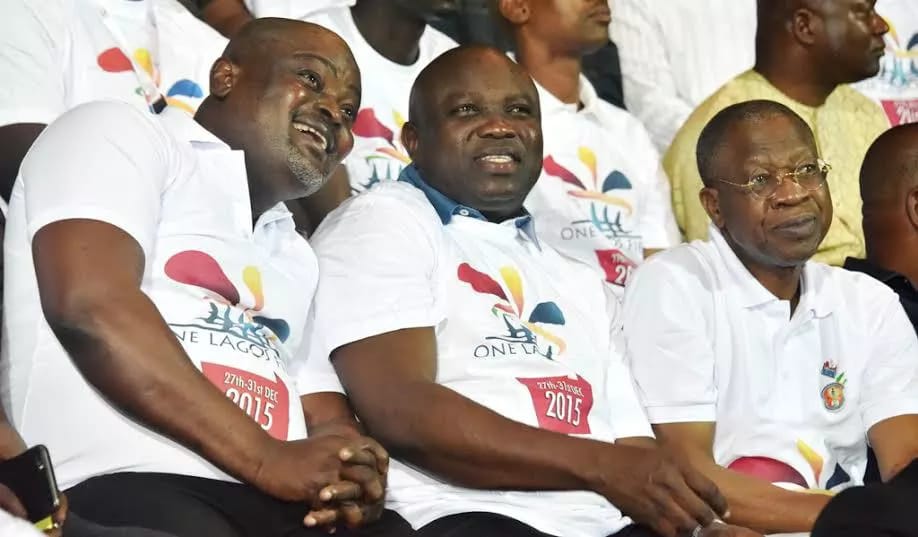
Lagos Governor, Ambode Presents N662.58 Billion Budget For 2016

Ambode in LagosGovernor Akinwunmi Ambode of Lagos State has presented a 2016 budget proposal of N662.58 billion to the Lagos State House of Assembly for approval.

Ambode, who tagged the budget: “The People’s Budget,” said that it would promote massive investment in security, transport/traffic management, physical and social infrastructural development as well as enhance job creation.

The budget is made up of capital expenditure of N383.678 billion and a recurrent expenditure of N278.909 billion in the ratio of 58:42 respectively as against 51:49 in 2014 and 2015.

“This represents an improvement of 26 per cent over the budgets of 2014 and 2015 respectively, which stood at N489.69 billion,” Ambode said.

It would be recalled that the N489.69 billion year 2015 budget was later reordered and signed into law on September 23, 2015.

The reordered budget comprised N19.7 billion capital expenditure and N5.7billion recurrent expenditure within the initial budget size.

Ambode said that the total revenue estimate for 2016 fiscal year is N542.87billion.

He said that this showed that the balance of N119.71billion would be funded through deficit financing that would be 0.41 per cent of the state GDP based on 2016 budget alone and a cumulative debt to GDP ratio of about 3 per cent.

The budget breakdown showed that Economic Affairs had the highest allocation of N211,04 billion followed by General Public Services, N120,50 billion.

Education and Health had N113.37 billion and N64.67 billion respectively.

Housing and Community Housing and Community Amenities got N62.71 billion while Environment got N53.04 billion and Public Order and Safety N28.55 billion.

Others are Recreation, Culture and Religion, N4.63 billion and Social Protection N4.02 billion.

Ambode said that the 2016 budget would be used to strategically build new infrastructure, while existing ones would be maintained. [myad]

EDITORIAL: APC, PDP: Our Stand

APC AND PDPWe have, at different times and places, came across people from the Peoples Democratic Party (PDP), its sympathizers and even Journalists who accused us in Greenbarge Reporters of being one-sided in the coverage of the two major political parties in the country – All Progressives Congress (APC) and PDP itself.
They said that Greenbarge Reporters has been reporting and analyzing the positive side of APC while hitting PDP negatively. And that we hardly feature the PDP news.
We become more concerned and feel that we have some explanations to make when a top leader of the PDP diplomatically made the same complain to us.
In looking at this matter, we concede that everyone has the right and freedom to form any opinion and air such opinion the way he or she deems fit, even though, there are so many opinions formed out of ignorance of the real situation on the ground and are aired in wrong ways.
To start with, it is the PDP that has decided to discriminate against certain media outfits, including Greenbarge Reporters, by selecting which ones to invite to its functions, which ones to send relevant press statements to and which ones it would generally patronize and which ones to ignore.
In fact, our Editor-In-Chief had made several requests and even pleading to spokesmen of the PDP: the main party’s spokesman, Olisa Metuh; the spokesman of the defunct PDP Presidential Campaign Council, Femi Fani Kayode: spokesman of the Presidency, Dr. Doyin Okupe and other top members of the party as well as Goodluck Jonathan’s government to enlist the medium in the party’s mailing list, for it (Greebarge Reporters) to be getting at least, press statements and may be, invitation to its functions, but all such efforts were roundly rebuffed.
And in spite of such treatment, Greenbarge Reporters has always scrapped news items of the PDP through other means just so that it would escape the accusation of being one-sided. It is a fact that there is no way a news medium worth its salt would manufacture story from just anywhere: if the PDP operatives deliberately refuse or fail to involve Greenbarge Reports in its activities, there is practically no way the medium can begin to conjure up story, just so that it would be seen to be balanced.
Of course, it is not as if we don’t have a few friends in PDP, whose grace the party has been enjoying our news coverage for the party. Such friends, including the former Delta state governor, Dr. Emmanuel Uduaghan: former information minister, Labaran Maku; former governor of Akwa Ibom state, Godswill Akpabio; former foreign affairs minister, Ambassador Aminu Bashir Wali, former minister of the FCT, Bala Mohammed; former minister of Justice, Bello Adoke; former special adviser to Vice President Namadi Sambo on political matters, Alhaji Abba Dabo and a few others. Individually, these PDP chieftains related with us based on the worth they attached to Greenbarge Reporters. The relation might not be purely on the basis of monetary gratification, but also inclusive of mere encouragement and acknowledgement of our importance in the miliu of information dissemination.
The same thing about the few ‘good’ people in PDP can also be said of APC, whose operatives in all departments not only patronize Greenbarge Reporters, especially with their bombardment of us with news items daily, but in terms of small advertisement slots, realizing that we are also in business and need to pay staff salaries.
Of course, APC would always say things that are negative about PDP, the same way PDP would never see anything positive about PDP. If therefore APC bombards us with negative stories about PDP and we publish them as they are, we are only mirroring the views of APC. And PDP has all the opportunities to counter APC the way it feels. But if the information handlers of the PDP feel that Greenbarge Reporters is not qualify to be given their stories, the anger and frustration of its members and chieftains who have been our friends should not be directed at us.
The point here is very important because, for one thing, the issue of discrimination or one-sidedness and negative presentation of one side against the other side is the function of the source from where the news items are supposed to emanate. If therefore, PDP would be kind just to oblige us their press statements and invitations to its functions where we would get stories to write, we would be most glad to oblige it, and do it with passion.
We therefore assure our readers, including the supporters of PDP all over the world that, our stand would always remain the same: open, factual, balance, fair and friendly to all, irrespective of creed, class, political, religious, regional, tribal and other differences.
Truth, we dare say, will always remain our source of integrity. [myad]

UNICEF Laments: Over 16 Million Babies’er Born Into Conflict In 2015

Baby born in conflictThe United Nations Children Education Funds (UNICEF) has revealed that more than 16 million babies were born in conflict zones in 2015 which represents one in eight of all births worldwide this year.
in a statement, UNICEF described the figure as having underscored the vulnerability faced by increasing numbers of children.
“Every two seconds, a newborn takes its first breath in the midst of conflict, often in terrifying circumstances and without access to medical care,” said UNICEF Executive Director, Anthony Lake.

“Too many children are now starting their lives in extreme circumstances – from conflict to natural disasters, poverty, disease or malnutrition. Can there be a worse start in life?”
The statement said that in conflict-affected countries such as Afghanistan, the Central African Republic, Iraq, South Sudan, Syria and Yemen, or on perilous journeys to escape fighting, newborn children and their mothers face enormous risks.
“Pregnant mothers are in danger of giving birth without medical help and in unsanitary conditions. Their children are more likely to die before they reach their fifth birthdays and to experience extreme – or “toxic” – stress, which can inhibit their long-term emotional and cognitive development.
“In addition to conflict, poverty, the effects of climate change and lack of opportunity are making children increasingly vulnerable and have pushed millions on dangerous journeys away from their homes.

“More than 200,000 children applied for asylum in European Union countries in the first nine months of 2015, adding to the 30 million children across the globe forced from their homes by 2014 due to war, violence and persecution. More people are displaced now than at any moment since World War II.
“More than a quarter of a billion children – or one in nine – live in countries and areas in conflict and face enormous obstacles to their health, education and well-being.
“More than half a billion children live in areas where floods are extremely common and nearly 160 million live in high or extremely high drought severity zones.
“Children represent almost half of all people living in extreme poverty although they make up roughly a third of the world’s population.
“The final months of 2015 have seen the world come together around tackling climate change and a new global development agenda.  These ambitious agreements present a huge opportunity if we can translate our promises into action for the most vulnerable children,” said Lake.  “If we address the reasons so many families feel the need to uproot themselves and their children from their homes – by resolving conflict, by addressing climate change, by expanding opportunity, we can make 2016 a year of hope for millions – not a year of despair.” [myad]

Buhari Wants ECOWAS To Accelerate Efforts To Attain Monetary Union

President Buhari delivering his address at the plenary session of the 3rd summit of the Gas Exporting Countries Forum in Tehran Iran on 23rd Nov 2015
President Buhari delivering

President Muhammadu Buhari has called on member countries of the Economic Community of West African States (ECOWAS) to accelerate their efforts towards achieving monetary union by meeting the   convergence criteria.
He also asked the member–states to strive to key into the Common External Tariff, which came into being this year.
The President spoke today at the occasion of the 40th Anniversary of the ECOWAS in Abuja.
Buhari, who paid tribute to the founder fathers of the organisation, reminded members of the enormous challenges that still lye ahead in spite of the outstanding achievements.
“As I observed yesterday, we have a lot more work to do. We need to fast track the integration process, and the most effective way to do so is through accelerated and focused investments in key development sectors, including but not limited to energy, transportation, as well as road and rail networks. We should therefore push existing initiatives and adopt new ones. “Insufficient power supply has been identified as a major obstacle to investments in the region.”
President Buhari said that as members make individual efforts to boost power supply in their respective countries, they should accelerate the implementation of critical infrastructure, such as the West African gas pipeline project, while remaining committed to the promotion of alternative and renewable energy sources.
He wanted urgent steps to be taken to encourage intra – regional trade among member states in order to boost employment generation and trade relations.
On the consequences of climate change, Buhari wanted members to continue to coordinate actions with the other African countries, including through the African Union, in working with the rest of the world to reduce global warming without compromising their industrial development drive.
“Similarly, our region continues to be confronted with the daunting scourge of transnational organized crime including arms trafficking, drug trafficking, as well as piracy and criminality at sea. Equally worrying is the rising scourge of violent extremism and terrorism.
“All these constitute serious threats to peace and security in the region, and therefore require sustained focus and concerted actions.
“We must continue to enhance our system of governance and, working with our partners, accelerate the implementation of our joint initiatives and mechanisms that were created to address these daunting but not insurmountable risks. We must enhance cooperation with other regional and continental organisations such as the Economic Community of Central African States (ECCAS), the Gulf of Guinea Commission (GGC), and the African Union particularly in the fight against violent extremism, terrorism and piracy.
“As we celebrate today, let us not forget that beyond politics, the economic integration of our region must remain the fundamental objective of this Organisation. We need to accelerate our efforts towards achieving monetary union by meeting the convergence criteria while member–states should strive to key into the Common External Tariff, which came into being this year.” [myad]


Professor Jega Takes The Gospel Of Peaceful Elections To Ghana

INEC Boss, Prof. Atahiru Jega


Former Chairman of the Independent National Electoral Commission (INEC), Professor Attahiru Jega, has taken his gospel of peaceful elections to Ghana, saying that elections in African countries need not generate conflicts as they often do.

He insisted that the need for the right mindset by all actors towards elections should help to unify the peoples.

Jega spoke in Ghana during a five-day visit to the country at the instance of the Institute of Economic Affairs, Ghana, which invited him to come and share Nigeria’s experience of the 2015 general election with Ghanaian stakeholders as the country prepares for its presidential and parliamentary elections in 2016. The visit ends tomorrow, Friday.

Professor Jega wanted African countries to work together to promote peace and stability on the continent, adding that each country should work at reforming its electoral system towards deepening democracy and ensuring that the vote of the people truly count.

“Elections do not have to create conflicts, and our countries need not be so conflict-prone because of elections. Democracy should promote good governance, and elections, which are essential to democracy, should help to unify our people,” he said.

IEA Ghana, a frontline think-tank, invited the former INEC Chairman to the country as part of its 25th Anniversary celebrations.

During the visit, Jega gave two public lectures – one in the national capital, Accra, and another in the capital of Ashanti Region, Kumasi – and he met with key stakeholders including presiding officers of the Ghanaian Parliament led by the Speaker, Rt. Hon. Edward Doe Adjaho; and the Chief Justice, Lady Justice Georgina Theodora Wood.

He also met with Ghanaian political party leaders and candidates, traditional rulers and religious leaders, the civil society as well as international development partners and donors, among others.

At the various points of encounter with Jega, Ghanaians were fulsome with praise for Nigeria’s 2015 general election and celebrated the former INEC Chairman for leading the electoral commission to conduct the applauded poll.

Enthusiastic crowds attended the public lectures, which Jega used to rally his hosts for cooperation and peaceful conduct as they approach the forthcoming general election. He reminded them that Nigeria and Ghana are noted for healthy sub-regional rivalry, hence they should put all hands on board to ensure that they surpass Nigeria’s celebrated 2015 record in their impending elections – not just for the good of their country, but for the good and stability of the entire African continent.

The former INEC Chairman, in his public lectures, shared the experiences, successes and challenges of Nigeria’s electoral system leading to the 2015 general election.

He drew lessons for Africa, saying: “There is no doubt that Africa is making tremendous progress with elections. Clearly, the number of Africans living in countries that routinely conduct elections has grown tremendously since the 1990s. We are glad that Nigeria is now being counted among such countries…The 2015 Nigerian general election may have set a new standard for democracy across the African continent. All countries with elections slated for next year, like Ghana, are now challenged to make theirs at least as free, fair and peaceful as Nigeria’s. Specifically for Ghana and Ghanaians, we now pose you a big challenge: make your next elections better than ours! Learn from our mistakes and don’t repeat them. See if you can adapt some of our innovative reform measures and do them better. I must say that we ourselves learnt a lot and adapted good things from the National Electoral Commission (NEC) of Ghana. We can, and should learn from one another as we consolidate and deepen our democracy.”

At his meeting with presiding officers of the Ghanaian Parliament led by the Speaker, Rt. Hon. Adjaho, Prof. Jega canvassed close collaboration between Ghana and Nigeria to advance the cause of democracy in the sub-region.

He told the parliament leaders: “We share quite a lot in common, and there is no area that we need to keep on partnering and working together more than in the area of democratic development and deepening democracy in our countries.

“The conduct of elections is central to all that. How can we get our elections right? How can we ensure that elections are conducted with integrity, so that the vote of the people will truly count in the choice of elected representatives? Nigeria had a long history of poorly conducted elections until 2011 when things began to turn around. And we were fortunate that in 2015, we were able to conduct general elections that were better than the 2011 elections, and which are now generally recognized as a turning point in terms of the conduct of elections in our country. So, I was delighted that the IEA invited me to come and share these experiences, and also to learn more from the Ghanaian experience. As I said in my lecture, there was a time in Nigeria that we were frustrated by elections in our country, and we were looking for examples of how to conduct elections. We looked towards Ghana to see what we could learn, and we did learn quite a lot. Of course, as we learnt, we tried to refine or improve upon them, and that is how we got to where we are. There is no doubt that we have a lot to share by way of knowledge and experiences to consolidate and deepen our democracies.”

During her meeting with the former INEC Chairman, the Ghanaian Chief Justice, Lady Justice Theodora Wood, mooted the idea that election management bodies in Africa should consider taking polling officers across national borders on ad hoc basis to participate in conducting other countries’ elections.

This, in her view, could redress challenges associated with perception of polling officials in their native countries and enhance the integrity of elections across the continent.

The Chairman, Board of Directors of the IEA Ghana, Dr. Charles Mensa, said Jega was invited to Ghana because of the sudden transformation of Nigeria from an electoral pariah into a shining role model in the comity of nations.

Mensa noted that until some few years back, many foreign observers, including those in Ghana, wrote off Nigerian elections as always predetermined and lacking in integrity, but now the country is being highly regarded and celebrated as a good example in the conduct of elections, from which other countries should learn some lessons.

IEA Ghana is a leading public policy think-tank, with a mission to promote good governance, democracy and fair market economy in Ghana and across the whole of Africa. [myad]

Selective Probe Theory, By Abdulmaleek Yusuf

Dasuki colonelTop members of the Peoples Democratic Part (PDP) in particular and some sympathizers of Goodluck Jonathan government in general, are still mumbling that President Muhammadu Buhari government has been selective in the current probe of the alleged financial recklessness preferred against a few agents of that (Jonathan) regime.
This issue of selective theory was first floated by Jonathan himself shortly before he bowed out of office. Dr. Jonathan it was who insisted that if Buhari must probe his government, he should extend such probe to other governments before his.
Ever since Buhari mounted the leadership of the country, this theory has been emphasized and drummed up by the National Secretary of the PDP, Olisa Metuh, the governor of Ekiti state, Fayose and many others. Most of the proponents of selective probe theory have not been so vocal like a few of the party’s functionaries.
The major probe that has caught the nation in frenzy currently is that of the $2.1 Billion (over N400 Billion) which was meant solely to procure arms and ammunition for soldiers fighting members of Boko Haram mainly in the North East, and across the North in general. The huge sum of money was allegedly diverted for other purposes by the former National Security Adviser (NSA), retired Colonel Sambo Dasuki.
There have been other cases, like the Abacha loot that runs into billion which was also diverted.
It is not clear if the issue of $2.1 Billion for arms procurement has anything to do with the past governments, and for which the probe must extend. As a matter of fact, the probe that is ongoing has a clear focus and definition. It is not about abandoned projects or corruption or stealing that has a history from the government before that of Jonathan.
The magnitude of the nation’s money that a few people have allegedly stolen and distributed amongst themselves is enough to collapse the economy of a nation. The luck we have is that our economy is large and resilience enough to absorb the shocks. But Buhari cannot achieve any meaningful development if such monies are not traced and recovered.
In any case, the President has been very clear that no one, not even members of All Progressives Congress (APC) would be spared in his fight against corruption.
Besides, the President has never referred to Jonathan’s government in isolation when he spoke about the past government: he has always referred to it as PDP government, which include the Presidents which the party had produced and who ruled the country since 1999.
So, those who subscribe to the selective theory may have deliberately misunderstood the concept they are espousing or are just been plain mischief.  [myad]

Advertisement ADVERTORIAL
WP2Social Auto Publish Powered By : XYZScripts.com