Home Blog Page 2137

How Over N200 Billion Loan For Rail Line Contract Was Diverted By Jonathan Government – Permanent Secretary,

Railways
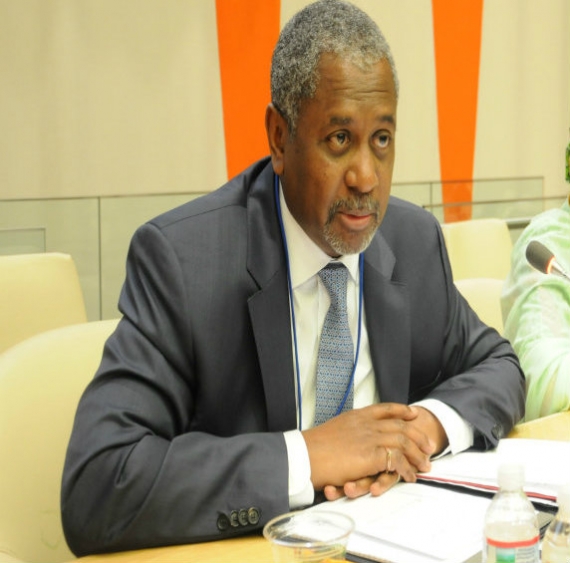
The Permanent Secretary in the federal ministry of Transport, Alhaji Mohammed Bashar has revealed how $1.005 billion (over N200 billion) foreign loans obtained for rail projects in Nigeria was diverted to other purposes during the regime of the immediate past President, Dr. Goodluck Jonathan.
According to him, the loan was obtained from the Chinese Exim Bank for the construction of a standard gauge rail line linking Lagos and Kano but that the fund was moved elsewhere.
The Permanent Secretary made these revelations today when he briefed President Muhammadu Buhari on the performance of the ministry during the last regime. The briefing took place at the Presidential Villa, Abuja.
Alhaji Mohammed Bashar said that out of the total amount of the loan, only $400 million is currently in the purse of the Ministry of Finance.
An angry President Buhari quickly called on the ministry of finance to explain the circumstances surrounding the loan and why substantial part of it was diverted for different purposes.
President Buhari said that it is disappointing to find that foreign loans obtained in line with signed agreements were moved from one project to another.
“I hope that due process was followed before such diversions were carried out.  Taking money from one project to another has to be done properly,” the President warned.
The President regretted that government had, over the years, failed to meet its counter-part funding obligation on some projects, leading to such projects being left uncompleted or abandoned.
He added that there was a clear need  to streamline, harmonize, and prioritize on-going projects in the transportation sector.
The Permanent Secretary also briefed the President on other challenges facing the transport and maritime sectors such as  encroachment on railway land, lack of security on inland waterways and the confused nature of agreements between the Nigeria Ports Authority and ports concessionaires.

Also after receiving a briefing on the activities of the National Population Commission from the Chairman, Eze Duru Iheoma (SAN), who led other National Commissioners to the Presidential Villa, President Buhari asked government agencies to harmonize the collection and usage of biometric data in the country, instead of replicating their efforts in this regard.
The President wondered why each agency would gather its own biometric data, when such data could easily be shared.
“It will be more cost effective if you work together. It helps even the credibility of the election process, as Nigerians of voting age can be identified easily.”
Government organizations that currently collect biometric data include the National Population Commission, National Identity Management Commission, Federal Road Safety Commission, Independent National Electoral Commission, among others.
President Buhari said that all the agencies should work collaboratively, instead of going in different directions, stressing that adequate data was necessary for planning and development in any country.
Eze Duru Iheoma  had briefed the President on what will be required for the  commission  to conduct a national census next year, 10 years after the last exercise, as stipulated by the United Nations.
A national population census, the chairman said, would cost about N273 billion, while about N10 billion of the amount would be needed immediately.
He told the President that a biometric-based census was being proposed because it will eliminate multiple respondents, and ghost respondents, while making the outcome easy to audit. [myad]

WAEC Visits The Sins Of 13 States Owing It On 118,101 Students

Students in class
The West African School Certificate, (WAEC) has decided to visit the sins of 13 state governments which had failed to settle their candidates’ registration fees on 118,101 such candidates by withholding their results.
INEC, which released the result of the May/June 2015 Senior School Certificate Examination (SSCE) today, said that a total of 1.5 million students sat for the examination.
Head of National Office of the WAEC, Mr. Charles Eguridu said today in Lagos that the candidates in public schools in the 13 states would not have their results until their state governments pay their candidates’ registration fees.
The examination body had recently raised alarm that 19 states owed the agency about N4 billion which, if it is not paid, could cripple its operations. The SSCE result is currently online to make it easier for candidates to access, using the number on the scratch card they had earlier purchased. [myad]

Buhari Eagerly Waiting To Receive Victorious Nigerian Special Athletes From America

Special Olympic Nigeria Athletes
President Muhammadu Buhari has assured Nigeria’s team at the just concluded Special Olympics in Los Angeles, United States that he is waiting to give them Presidential hand-shake when they returned to the country soon. The Special Athletes won a total of 71 medals, including 34 gold medals in the games.
In a congratulatory message, President Buhari commended the team for the diligence, dedication and wonderful performance in the games.
He described the victory of the special athletes as inspiring even as he believed that such performance epitomized the true Nigerian spirit.
Buhari said that he is personally conviced that whatever challenges Nigeria faces as a nation, “we can overcome them through similar dedication, hard work and perseverance, and rise to the highest possible levels of accomplishment.
President Buhari assured the athletes that the government and  all Nigerians are very proud of their exhilarating and dominant performance at the Special Olympics. [myad]

Heat Wave Kills 21, Lands 66 In Hospitals In Egypt

Mohammed Morsi of Egypt
Heat wave has claimed no fewer than 21 lives and sent 66 others to hospitals in Cairo and other parts of Egypt. The country’s ministry of health announced today that temperatures and high humidity has been soaring.
The victims, who all died yesterday, were said to have succumbed as temperatures soared as high as 47 degrees Celsius (117 Fahrenheit), in conditions made less bearable by elevated humidity levels.
Fifteen people died in Cairo, four in the Delta province of Qalibiya and two in Upper Egypt’s Qena province, the ministry said in a statement. Those who died, including seven women, were all aged over 60.
Sixty-six people were admitted to hospital after suffering from exhaustion, including 37 who are still under observation.
“There is a big rise in temperature compared with previous years. But the problem is the humidity which is affecting people more,” said the ministry’s spokesman, Hossam Abdel Ghaffar.
“Long exposure under the sun is a killer.”
Meteorological officials confirmed that temperatures in the capital and some parts of the country were higher than average.
“The temperature is higher by four to five degrees than what is usually seen, and the humidity is very high this month,” Waheed Soudi, head of analysis in the Egyptian Meteorological Authority said.
“The peak temperature in the shade was 38 degrees Celsius in Cairo on Sunday, which means it was 47 degrees under the sun or in places with bad ventilation.”
Although it is not uncommon to see summer temperatures in the high 30s throughout Egypt, it is rare for humidity levels to remain elevated during excessively hot weather. [myad]

Governor Wada and Marginalisation in Kogi by Dr Tom Adaba

Gov-Idris-Wada-2A recent interview allegedly granted by Kogi State Governor, Captain Idris Wada quoted him as saying that there is no marginalization of any group in his State. We would not want to believe that he said so. But if for any reason he did, we wish to serve this as a freshener.

Perhaps it may be necessary to define marginalization and cite a few, among the innumerable and outrageous instances of abuse of power and office in the name of marginalization by Governor Wada and his predecessors in a series of Igala governance.

By way of definition and education of all who cannot see happenings in Kogi State as marginalization, the Webster’s Collegiate Dictionary describes it as “the relegation to an unimportant position within a society or group”

In stating the entrenchment of a series of unforgivable marginalization in the State, we may have to make a comparative analysis of Wada’s government viz-a-vis that of the founding Governor Abubakar Audu (1991 – 1993 and 1999 – 2003).

In Kogi State, there are three senatorial districts
• East – comprising Igala and minorities like Bassa-Komu; Bassange Egbira Mozum

  • West with the Okuns, Nupes, Oworos, Egbira-Kotos, Bassa-Komu, Gukeri, Ganagana and Hausa;
  • Central – comprising Ebira-Okene, Ogori Magongo and Ajaokuta.

The State’s Internally Generated Revenue (IGR) stands at

  • 7% East,
  • 12% West; and
  • 72% Central, yet the East has produced the governor of the State for 18-years, the life-span of democratic governance since the creation of Kogi State in1991.

Audu’s 6-year governance of two terms (1991 – 93 and 1999 – 2003) produced the following:-
17 Commissioners out of which nine were from the East, while four each come from the West and Central respectively.

33 Permanent Secretaries with 18-from Kogi East, 10 from the West and 5 from Central.

In the State’s Civil Service of 33,000 workforce, the East had a lion share of 23,100, while 5,940 were from the West and 3,960 were from the Central. Here one wonders whether it is the brilliance or competence of the Igalas in Benue State that had given them this advantage on arrival in Kogi. For those of us who were there at the inception of the State and knew the caliber of products that were moved from Benue State Civil Service to the new State of Kogi, we have our huge doubts, we denounced the fictitious figures and have been proved right by the recent audit that revealed the huge deposit of ghost workers.

If Audu’s government was inequitous, Ibrahim Idris’ and Wada’s are a glaring display of impunity. The figures below attest:
Wada’s government has 18 Commissioners out of which 9 are from the East, 5 West and 4 Central.
60 Special Advisers with a whopping 30 from his home area, the East while the West and Central have 20 and 10 respectively.

Wada’s government has 83 Senior Special Assistants out of which 41 (50%) are from the East, 26 (31.1%) from the West and 16 (19.1%)from the Central.

Of Gov. Wada’s 242 Special Assistants, 139 are from the East, 66 from the West and 37 from Central.

Could this be somebody’s idea of justice, fairness and equitable distribution? Could this be the opposite of marginalization?

Of the 32 Permanent Secretaries, 24 (75%) are from the East while the West and Central share 4 or 12.5% each. Again one wonders if the civil service knowledge, skills and even experience are the exclusive preserve of the East. Here again, we reiterate in the negative.

Indeed the reverse should be the case because the reservoir of highly talented, experienced and skilled staff from the West and Central have been edged out by the nepotic system and replaced by the Igalas.

The State has 25 Board Chairmen comprising 14 (56%) from the East, 8 (32%) from the West and 3 (12%) from Central.

The present government of Kogi State headed by Capt Idris Wada has a Civil Service of 18,650 which breaks down as follows:

10,393 (approx 56%) from the East,

4,977 (27%) from the West; and

3,280 (17%) from Central

On the distribution of road projects, the East has N39.3billion for about 476.6 kilomretres, the West N21.9billion for 209-kilometres, while Central has a paltry N3.3billion for 62 kilometres. It is however an irony that despite these figures, one cannot see a translation of them in action.

The litany of primitive imbalances is legion. If all these are not heartless instances of marginalization, we are not sure what else to call it. Perhaps, it may make better sense labeling it inequitous voodoo governance.

This must change. Kogi has all the potentials for a first class State in the Federal Republic of Nigeria, considering its history, strategic location and boundless endowment. The time has come to flush out ineptitude and jungle inequity. It is time to redeem Kogi State by installing a civilized, just, fair and equitable government.

Dr A Tom Adaba, OON
Chairman, Media & Publicity
Kogi West and Central Forum for Equity and Justice

Battle For Kogi Governorship Hots Up, As 27 Jostle For APC Ticket

Yahaya Bello fairplus

The battle for the Kogi state governorship contest in November has began in earnest as no fewer than 27 aspirants under the canopy of All Progressives Congress (APC) have so far obtained the party’s expression of interest forms from the national secretariat in Abuja. Screening of the aspirants has been scheduled to begin tomorrow, Monday.

With the number of aspirants, the party is believed to have had raked in N148 million from the sales of the expression of interest forms,  which costs N5.5 million each.

The aspirants include a former Kogi State Governor, Abubakar Audu; James Ocholi (SAN), Alhaji Yahaya Bello, Senator Nicholas Ugbane, Sani Shuaibu, Suleiman Baba Ali, Air Vice Marshall Saliu Atawodi, Muhammad Abdullahi, Senator Nuruddeen Usman, and Hajiya Hadiza Ibrahim.

They also include the veteran journalist and one of the founding fathers of Newswatch Magazine, Yakubu Muhammad, Chief Clarence Olafemi, Suleiman Abutu, Sunday Ejibo, Suleiman Ipinmisho, and Dr. Tim Diche.

Others are Habeeb Yakeen, Rotimi Obadofin, Babatunde Irukera, Olusola Oluwaranti, Dr. Onukaba Adinoyi, Aliyu Zakari, Senator Alex Kadiri, Alhaji Abubakar Umar, Idris Kashim and Dr. Sanusi Abubakar.

One of the aspirants,  Shuaibu, while addressing journalists in Abuja, said the Igala axis of Kogi State should not be blamed for the underdevelopment of the state.

He said it was incumbent on the citizenry of the state to vote into power persons with the exposure and competence, who could rescue the state from its pitiable state.

“Kogi state is backward today not because it doesn’t have the right calibre of persons to take it out of the woods. I have heard a section of our citizenry say the problem lies with power shift; that the state is backward because my Igala people have been administering it without tangible results for all to see.

“I beg to differ on this proposition. For me, such talk is a creation of the opposition Peoples Democratic Party. The PDP has a hand in the backwardness of the state because for the past 12 years, it has produced the governors that brought the state to its knees.” [myad]


The Looters Have Come Home To Roost, By Emmanuel Yawe

Yawe
“President Jonathan’s party, the PDP is another source of worry. Even if Jonathan were a man of high moral standards, the PDP would drown him. It is a gathering of avaricious and greedy men and women.
They do not have an ideology in that party. There are certain agreements and minimum standards even among wild beasts in the bush. In the PDP, nothing is morally repulsive. The only thing they agree on in the PDP is that Nigeria is a war booty to be looted.”
Those were my words in my Monday Column, published first on May 30, 2011 and reproduced on May 24, 2015 by the Peoples Daily newspaper. Captioned: ‘Can we trust this President?’ my column first appeared in the paper a day after Jonathan was sworn in as President in 2011, having won the presidential contest on his own steam.
Four years after, having watched his performance in office, I felt like plagiarising my own work, so I reproduced it – asking my readers to judge if I was wrong or right in predicting four years earlier that President Jonathan and his band of PDP looters would lead us to doom.
One reader was outraged because he felt I had scandalised him. A top shot in the PDP, he called me to make a serious protest. What irked him in particular was my blanket classification of the PDP as “a gathering of avaricious and greedy men and women.” On phone, he told me he was a foundation member of the party and it was libellous to publish that he is avaricious and greedy because he is not. While agreeing with me that the PDP has its bad eggs, he exonnorated himself from the vices I accused all party members of. “I am not avaricious and I am not greedy” he protested.
I sympathised with him, even offering my column the following week to enable him state his case.  He declined. Since my big PDP friend was not prepared to come out in the public to state his case, I will respect his person by keeping his identity secret.
On reflection and as a Christian, I remembered the Biblical story of Lot as told in Genesis 19. This man called Lot lived in the city of Sodom. The city was so full of sin that God in His anger decided to destroy it. He sent two angels to do the nasty job and the men found succour in Lot’s house. By evening, a large crowd of homosexuals both old and young gathered outside his house, calling on him to bring out the two visitors for a taste of their ass. The crowd persisted on defilling the men even when Lot offered them his two virgin daughters as alternatives to satisfy their libido. In the end, Lot and his two daughters were saved and the city destroyed with a rain of brimstone and fire by the angels of God.
I know for certain that there are a few Lots in the PDP. My anger and blanket condemnation must have been born out of frustration which in psycology fuells agression. This party had the singular opportunity of making Nigeria great but for some strange reasons decided to run it aground. It is not for want of good advice that the party went astray.
In the beginning, Solomon Lar raised the first major alarm. In a letter to President Olusegun Obasanjo dated July 19, barely two months after the party came to power, the first National Chairman of the party complained of marginalisation by the government it had just installed. He was roundly ignored and later eased out of office. Then followed a succession of party chairmen, each with a sad tale to tell. Chief Audu Ogbe for instance confessed that he signed his resignation with a loaded gun pointed to his head. Soon, the PDP became a one man orchestra – hardly a platform for the people and even less for democracy.
The end result is what we have today. If we are to believe the Comrade Governor of Edo state, one minister under PDP government of Goodluck Jonathan helped himself (most likely herself) to a whooping heist of $6billion. If the legendry Ali Baba of Saudi Arabia came alive again, his eyes would be filled with green. If this thief were around on the day Jesus was nailed to the cross, she would have substituted one of those two men who were the greatest thieves of their time who shared with Him the shameful and painful death of crucifixion.
But that is what the PDP gave us – one minister stashing away $6billion in just one account. What about her other accounts; what about the other ministers?
The tragedy in the PDP today is that the shit has hit it’s                              ceiling fan and everybody under the umbrella stands the risk of being sprayed with it. This time, it is not me who is accusing the party of harbouring ‘avaricious and greedy men and women’ Workers of the party are accusing it’s officials of running the secretariat aground financially by squandering N12 billion in nine months.
Led by Chairman and Secretary of PDP Staff Welfare, Ngozi Nzeh and Dan Ochu-Baiye respectively, the workers are calling on anti gratf agencies to probe the activities of members of the party’s National Working Committtee (NWC).
Ochu-Baiye, who read the statement signed by 74 staff members of the party accused it’s NWC of financial sharp practices and incompetence in running the affairs of the party.
He also accused the NWC members of using party finances to fund frivolous personal obligations as weddings, naming ceremonies, funerals, among others, running into hundreds of millions of naira.
He also mentioned the allegation by Ndudi Godwin Elumelu who paid N750million naira to the NWC to obtain the gubernatorial ticket of the party in Delta State.
He added that the governor of Kogi was requested to pay one billion naira to the same NWC to retain his ticket.
“How on earth will any political party undergo this level of tortuous mismanagement and expect to win elections?” he asked.
The National Publicity Secretary of the party, Chief Olisa Metuh, described the allegations as baseless. Metuh said the staff members were misguided in the pursuit of their interest when the PDP was fighting the cause of Nigerians with the ruling All Progressives Congress.
The music coming out of Wadata House now is what you get when looters come home to roost. [myad]

The Centenary City Project And Free Zone Disparity In Nigeria, By Hassan M. Bello

Abuja Centenary City
The recent shameful ranting by some failed politicians led by Dr. Cairo Ojougboh against the Centenary City Project and their caustic political mudslinging against the champion of the project’s well-planned development in the person of the former Secretary to the Government of the Federation, SGF, Senator Anyim Pius Anyim, have indeed thrown up critical national development issues worth examining.
The Centenary City Project was one of the Legacy Projects initiated by the Federal Government as part of activities to celebrate Nigeria’s 100 years anniversary as a nation. The SGF, Senator Anyim, was directed by then President Goodluck Jonathan to coordinate the activities for Nigeria’s Centenary Celebration and the Centenary City as a purely and wholly private sector driven programme without any financial involvement by the Federal government.
The due process followed in securing land for the Centenary City Project are well documented and the records are available at the Federal Capital Development Authority, FCDA. Moreover, the entire transparent process and steps taken to establish, register and incorporate Centenary City PLC  have been copiously documented publicly.
Also a public knowledge are measures used in: appointing and inaugurating Centenary City PLC’s Board with His Excellency General Abdulsalami Alhaji Abubakar  (rtd), GCFR as Chairman, hiring its management. Also widely known are the withdrawal of the SGF as the Facilitator of the Centenary City Project after the inauguration of its Board, the groundbreaking ceremony of the Centenary City Project, the granting of a Free Zone status to Centenary City by NEPZA, and the commencement of the Centenary City Project by its principal developer – Eagle Hills International Properties LLC.
At present, the Centenary City PLC is a public limited liability company owned by forty-one well known, credible and verifiably organizations from Nigeria, UAE, and USA, and duly registered by the Corporate Affairs Commission (CAC). And at US$18Billion, it is indeed the biggest single private foreign direct investment (FDI) in Nigeria ever.
Clearly in our view, the Centenary City initiative of the Goodluck Jonathan Administration will remain one of the most outstanding legacies any administration will ever leave behind in Nigeria. Even when it has become fashionable to deny every achievement of the immediate past administration and denigrate and disparage everybody who served in it, the Centenary City will stick out as one well thought out, carefully planned, methodically implemented and socially and economically rewarding initiative of any government in Nigeria.
Nonetheless, one of the issues thrown up by the recent controversy is that The Centenary City Project was duly applied for and granted Free Zone status by the President at the recommendation of the Honourable Minister of Industry, Trade and Investment.
Pursuant to the transformative economic programmes of the Federal Government, the activities of the Authority has been strengthened and this has led to the establishment of 34 Free Zones spread across the country. Some of the Zones cater for a specific area of economic enterprise while others are more general in nature. There are currently over 300 licensed Free Zone Enterprises (FZEs) operating in the various Zones across the country.
Since the inception of the scheme, Nigeria’s economy has witnessed tremendous patronage and steady growth through FDI inflow and revitalisation of local industries.
The Nigerian Export Processing Zones Authority (NEPZA) administers the incentives for all the variants of Free Zones ranging from Export Processing Zones, Free Trade Zones, Border Free Zones, Export Farms, Science and Technology Parks, Tourism and Resort Centers, and other more specialised Free Zones.
A Zone can be operated by the public or private sector, or a combination of both. NEPZA’s cardinal objective is to ensure that the operational and strategic objectives of free zone operators are realised through responsive, cost effective and efficient services and instant pragmatic solution to their needs.
On Going Reforms At NEPZA
Nigerian economic reforms have succeeded in reshaping the investment climate with tremendous inflow of FDI especially in telecommunication, banking, manufacturing and agricultural, and with the Centenary City, real estate. The international business community needs to come and explore the abundant investment opportunities that are available in Nigeria Free Zones, either by locating in the existing zones or through the establishment of industrial cities, clusters and parks. Given the investment friendly disposition of Nigeria, there is no better time than now to invest in Nigeria Free Trade Zones – African’s most profitable economy. [myad]

The Legacy of Shaykh, Dr. Aminuddeen Abubakar, By Muhammad Jameel Yusha’u

Aminudeen Abubakar
Sometime in 1983, my mother broke the news to me that henceforth, I will be joining my father to attend Friday prayers at the Bayero University old campus mosque, where my father regularly prays. It was an excellent news for a little kid. Apart from attending prayers, it was an opportunity to go out, and as you know, when you go out with your dad, you get a treat, and I still remember those days with nostalgia.
On arrival at the mosque, sitting by the side of my father, we listened to the sermon delivered by Imam Abbas. But even as a kid, I noticed a man sitting slightly ahead of the first row, listening attentively to the sermon, you can’t miss his exceptional devotion from the way he sat. Immediately after the prayers, this gentleman stood, and after some introduction in Arabic, he started translating the Khutbah (sermon) in Hausa, our native language. Instead of people leaving the mosque shortly after the prayers, they started moving forward, those outside the mosque where trying to find a space inside in order to listen to the translation of the Khutbah. The man was dressed in a long gown, an ash coloured jallabiyya, and a cap a made from wool, also an ash colour with some black stripes.
I asked my father, who is this gentleman? He said this is Shaykh Aminuddeen Abubakar. He was looking youthful, most likely in his mid or late thirties at the time. Then comes another good news. “We will pray Asr, (the late afternoon prayer) in his mosque,” my father told me. It means we will stay some more hours before returning home. After listening to the translation of the sermon, we came out of the old campus mosque; there was a convoy of cars, one of them an SUV with public address system on top. The translation of the sermon was played, and the convoy started moving, which we also joined, and move straight to No 483, Sulaiman Crescent in Nassarawa quarters, Kano metropolis.
Again I asked my father to tell me more about this place, and he said, this is Kajawah Group of Nigeria, founded by Shaykh Aminuddeen Abubakar. Inside the compound was a newly built school, a mosque made from wood, painted in blue, but made bright by the number of fluorescents in and outside. Some feet away from the mosque was a construction site, which later became the current mosque within the vicinity of the centre, some classes as well as the office of the Shaykh.
We prayed Asr in the mosque shortly after Shaykh Aminuddeen arrived from Bayero University. He attended to a number of students and visitors afterwards before entering his house briefly, to be ready for the Magrib (night prayer), where he also delivered different lessons on daily basis in between the Maghrib and Isha (late night) prayers. After spending the entire evening at the centre, my father broke another news to me, “a new Islamic school has started here at night, and you would be enrolled in the night classes.” I still remember with ecstasy when my father took me to Shaykh Muhammad Sanusi Abubakr, the brother and one of the closest associates of the Shaykh, to interview and register me for the classes.
The founding of Daawah Group of Nigeria was in my opinion, one of the major legacies left by Shaykh Aminuddeen Abubakr for a number of reasons. First, it was the first modern religious organization of its type established in Kano, and one of the first in northern Nigeria with a completely different approach to Islamic education.
Da’awah Group was a major religious centre with a global worldview, but rooted within the local culture. Shaykh Aminuddeen Abubakar has established strong partnership with international organisations, particularly in the Middle East and other parts of the world. As such, the centre was a major hub for international visitors from Saudi Arabia, Egypt, Sudan, Jordan, Syria, United States, United Kingdom, Morocco, Algeria and different parts of the world.
Whenever these visitors came, he seized the opportunity either to ask them to deliver the Friday Khutbah (sermon) or dedicate to them one of the slots during the lessons he delivers between Maghrib and Ishaa. This culture, established by the Shaykh, contributed significantly in creating a worldview among the visitors, which made them understood global issues, and learn how Muslims live in other parts of the world, as well as the challenges they were facing.
This culture provided an opportunity for comparison between various Muslim nations and what obtains in Nigeria. I can still recall the visit by Shaykh Babandi Abubakar Gumel in the early 1990s, who took his time to lead a delegation of Muslim reverts to Nigeria, and they camped at the Daawah Mosque sharing their experiences on how they came in contact with Islam, and why they devote their time to the propagation of Islam.
Secondly, Daawah Group was unique because of the chain of schools established by Dr Aminuddeen Abubakar. The schools include a modern primary school which combines both Islamic and Western education. In the evening there was a school for married women which I shall elaborate on later. The school for women runs simultaneously with a section for children learning the memorization of the Glorious Qur’an. The children school was a perfect fit, because the women do not have to worry about their children, as the section takes care of the kids, with an added value, which is learning the Qur’an. At night there was the school for children which runs for four nights at the time, and the remaining three nights dedicated to male adults. These chain of schools completely revolutionized the running of Islamic schools in Kano, a feat that continue to be replicated to date in Kano and other parts of Nigeria.
Thirdly, Da’awah Group was unique with the daily lessons between Magrib and Isha delivered by Dr Aminuddeen. This contribution was unique because he brought for the first time a different methodology of teaching which was different from the traditional system of Makarantun Zaure. Under makarantun Zaure, as I witnessed with my late grandfather, Malam Yusuf Abdurra’uf, a group of students will visit the scholar, each of them with his book(s), usually, Taalimul Muta’allim, Al Akhdari, Al-Izziyya, Arrisala and Mukhtsar Khalil. There were other books like Aajurumiyya, Muwatta Malik and Tafsir Al Jalaalain, as well as the Sihah Assitta for more advanced students. This system treat each student according to his learning ability. The scholar listens to each student while reading from the text, and then translates and provide interpretation in Hausa.
It was a unique system that has value till date, because apart from the textual lessons, the students learn from the character of the scholar, listening to more advanced students and becoming more familiar with advanced texts before reaching that level. The student also has a more learned authority to make reference to whenever the need arises. It is a system that the Muslim community should pay significant attention to its revival, especially in this age when people accord to themselves the status of scholars without going through tarbiyya that is associated with learning from pious scholars.
What Dr Aminuddeen Abubakar did was to add a spice to the traditional system of makarantun zaure by encouraging the learning of Arabic as a language, at least ensuring that students have an excellent reading and writing proficiency. Then he transformed the Da’awah mosque to provide multipurpose function by serving as a mosque and library.
The first thing a visitor will notice in the 1980s and 1990s when he enters the mosque, which differentiates it from many mosques, was that it was covered by bookshelves. The bookshelves contain abundant copies of books from the Sihah al-Sitta (Bukhari, Muslim, Tirmidhy, Abu Dawood, Ibn Maja, Nasaa’iyy, and Sunan Ahmad), Riyad Assalihin, Kitaab Al Kabaa’ir, Fath Al Majid, Bulugh Al-Maram and several books of Tasfsir (Quranic exegesis) and Dhikr (remembrance of Allah).
He ensured that enough copies were made available. Between Maghrib and Isha he teaches one book only from the collection stated, and each student attending the lesson has a copy available for use. A student does not have to worry about purchasing a copy, especially those who cannot afford to do so. For those with strong thirst for knowledge, they can utilize the time after prayers to revise the lessons and even read from other books. At any time, the mosque was a reference point.
This system that he established contributed greatly in producing a lot of youths with a sound understanding of Islam, some of whom later developed to study in higher institutions of learning in Nigeria and others in universities in Saudi Arabia, Egypt, Sudan, Pakistan and Niger among others. In those days, we have witnessed people who embraced Islam in Daawah Group, or came to the centre with a very weak foundation, yet develop sound understanding of Arabic and other religious texts, which enables them secure admission into secondary and post-secondary institutions in Nigeria and abroad in order to advance their studies. [myad]

How Jonathan Returned To Aso Rock In The Night For Talks With Buhari

buhari and jonathan
Immediate Nigeria past President, Dr. Goodluck Jonathan was confirmed to have returned to Aso Presidential Villa, Abuja, under the darkness of the night on Thursday to hold what is said to be secret talks with President Muhammadu Buhari.
Special adviser to President Buhari on media and publicity, Femi Adesina who confirmed the secret visit to newsmen today said that the visit was made discreetly to the extent that photographs were not taken.
“Nobody was with them. I am sure they don’t want the visit to be an item in the media. That probably explains why the former President visited at night and went straight to the residence.
“They met for a few minutes in the President’s residence.”
The Thursday meeting, like the Saturday meeting between President Buhari and former President Olusegun Obasanjo, was held in the President’s official residence. [myad]

Advertisement
Advertisement ADVERTORIAL
WP2Social Auto Publish Powered By : XYZScripts.com