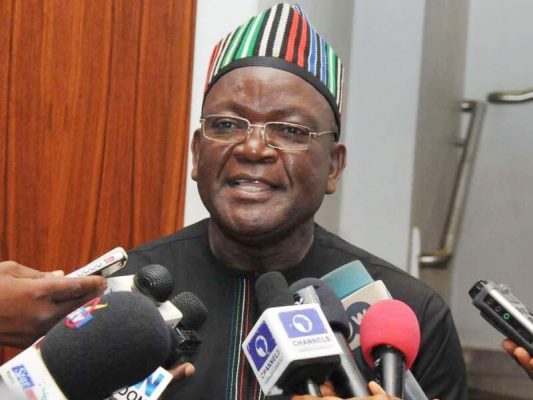
Chairman of the Independent Corrupt Practices and other related Offences Commission (ICPC), Professor Bolaji Owasanoye has revealed how the commission blocked N143 Billion accounts of various Ministries, Departments and Agencies (MDAs) in the country in its desire to keep financial records of the government clean.
Professor Owasanoye, who spoke today, December 1, at a round table session in Abuja, with top median managers from across the country, said that such accounts were issued what he called “negative warrant” because they were questionable.
Professor Owasanoye explained that some of the MDAs were used to keep such monies as extra from the budgetary allocations, saying that when the commission discovered that the extra monies were not tied to any particular project or programme from the point of budget provision, it wrote to relevant authorities to allow the Commission declare the account “negative warrant.”
He said that currently, the commission’s operatives are all over the country investigating the constituent projects which Senators enjoy from budget provision, adding that any Senator found wanting would be properly sanctioned.
The ICPC boss said also that the allegations against top military leaders on none payment of allowances to those in the junior cadres has been investigated and found to be untrue
He stressed that the Commission is open to genuine cases of corruption and would prosecute anyone, irrespective of his or her status in the country confirmed to be corrupt in anyway
Professor Owasanoye disclosed that some operatives of the Commission who were confirmed to have compromised in the discharge of their duties are now being prosecuted.
“The clamour for the sack is out of place considering that the president is not subject to the opinion of opposition political party which has clamoured for this all the time.”
These was the submission of the Senior Special Assistant to President Muhammadu Buhari on Media and Publicity, Malam Garba Shehu when he answered questions in an interview with Arise TV.
Garba Shehu insisted that the President has the prerogative to appoint or sack any of the country’s service chiefs and he can keep them as long as he is satisfied with their performance.
“I am not aware that the tenure of service chiefs is subjected to any law or regulation that is clearly stated. They serve at the pleasure of the president and (if) the president is satisfied with their performance, he keeps them. The buck stops on his table —with due respect to the feelings of Nigerians.
“It is entirely his own determination; he decides who he keeps as his service chiefs and for how long.”
The Senate has confirmed Professor Mahmood Yakubu as chairman of the Independent National Electoral Commission (INEC) for a second term of five years.
The confirmation today, December 1 followed the consideration of the report of the Senate Committee on INEC, chaired by Senator Kabiru Gaya which recommended Yakubu for confirmation.
Professor Mahmood Yakubu had appeared before the committee on November 26.
In his remarks, he appealed to the National Assembly to pass the Amended Electoral Act Bill latest in the first quarter of 2021.
He explained that passing the piece of legislation within the timeframe recommended was critical for the success of the 2023 general elections.
First Lady of Nigeria, Mrs. Aisha Buhari, has cautioned health authorities and Nigerians not to place much emphasis on the new coronavirus epidemic and neglect the HIV,AIDS that is rampant in the country.
She particularly appealed to the health workers to remember that they are obligated to reduce any potential risk to the HIV community as funding, researchers and healthcare are being diverted to Covid 19.
Speaking today, December 1, at commemorative session of the World AIDS Day, 2020, Aisha Buhari said that it is essential that health services remain available to people living with and affected by HIV.
The First Lady, whose speech was delivered by the Special Assistant to the President on African First Ladies, Dr. Mrs. Mairo Almakura, noted that no other epidemic has received as much global attention and support like HIV in the past two decades.
Aisha Buhari said that she advocated for the eradication of mother to child transmission of HIV in Nigeria and has mobilized the support of Governors’ wives to do the same at the state level.
She said that she has also mobilized her team at Future Assured to collaborate with NACA on the inclusion of HIV services during the MNCH weeks. She said that a joint initiative by the Embassy of the People’s Republic of China, African countries and international organizations has led to a three-year health promotion and HIV prevention advocacy among young people to ensure that HIV/AIDS is eradicated by 2030.
This was even as the President of National Council for Women Societies, Mrs. Gloria Laraba Shoda highlighting the possibility of higher rates of HIV for women due to gender based violence, exacerbated by the increased rates of insurgency, banditry, cattle rustling and domestic violence due to the COVID 19 pandemic.
She called for concerted effort to ensure that this is prevented from happening.
On Saturday, November 28, about 43 farmers who had gone to their farms during the current harvest season were attacked by Boko Haram terrorists. They were tied up; their hands behind their backs, one after the other their throats were slit. The United Nations puts the number of casualties at 110, not 43. Amnesty International says over 10 women and others are missing. The people of Zabarmari were so outraged they refused to bury the dead. They asked that the Governor of Borno State, Professor Baba Gana Zulum, must show up to witness the tragedy that has befallen their community. Zabarmari, in Jere Local Government Area, is about 20 kilometres out of Maiduguri, the capital of Borno State. Two weeks earlier, terrorists had also attacked and killed members of the community. Maiduguri and the entire Lake Chad region have remained the hotbed of terrorism in Nigeria. In September, the state Governor’s convoy was attacked by insurgents during a visit to Baga, on the shores of Lake Chad. A death toll of 30 was reported. Several policemen and soldiers posted to that axis to help combat the menace of terrorism have also fallen victim, and died in the hands of terrorists. Many have had to lay down their arms and remove their uniforms. The security situation in the North Eastern part of Nigeria is proving intractable despite the Nigerian government’s repeated assurances that the Boko Haram has been technically defeated and degraded.
The wanton killing in Zabarmari is a clear affirmation of the reality we live with: Nigeria has not defeated or degraded the terrorists, and if anything, the country’s security problem has worsened between 2015 and now. The lie has been further put to all claims of achievement of peace and stability through all kinds of military operations and initiatives – Operation Lafiya Dole, Operation Safe Corridor, the establishment of super camps, OperationYancin Tafki. Last week, Nigeria was named the third most terrorized country in the world in the Global Terrorism Index, after Afghanistan and Iraq. Governors of the North also cried out about the spate of insecurity in their region. They asked that the Attorney General of the Federation should grant their state Attorneys General the fiat to enable them prosecute terrorism-related cases at the state level. It was in the same week, that the Sultan of Sokoto, Alhaji Muhammad Sa’ad Abubakar III, speaking at a meeting of the Nigeria Inter-Religious Council (NIREC) declared that the North is the most unsafe part of Nigeria, and the most difficult place to live in. Zabarmari is a tragic reminder of the truthfulness of this statement. The Arewa Consultative Forum (ACF) and the Coalition of Northern Elders for Peace and Development share the same view.
It should therefore make sense that as youths protested in October against police brutality in Southern Nigeria under the banner of #EndSARS, the protest slogan in the Northern states was tagged #EndInsecurityNow. As has become traditional, the slaughter of 43 or more farmers in Zabarmari has been greeted with expression of outrage, anger and disappointment. President Muhammadu Buhari through one of his spokespersons, says it is “senseless and insane”. It is indeed barbaric and horrific. What manner of men would tie up their fellow human beings and slaughter them like rams? The cruelty is unspeakable. For every act of this nature that is reported, there are many other incidents that are never reported. The biggest cost of the insecurity in Nigeria is the devaluation of human lives. Look at how Nigerians often argue over the number of casualties. It is 43, no, 45, actually UN says 110, as if not every single life matters.
On October 31, we all witnessed how the United States sent the elite SEAL Team Six special forces unit to rescue a Catholic priest and farmer, Philipe Walton (27), who had been kidnapped at the Niger-Nigeria border and kept in Northern Nigeria. It was a “precision” hostage rescue operation which was instructive for all it said about citizenship and state responsibility. The abductors didn’t know what hit them. Six of them were killed and the American was rescued. Over 40 Nigerians have been slaughtered and yet there has been no serious feeling of accountability and empathy on the part of government. Everyone was shocked yesterday when Garba Shehu, presidential spokesperson reportedly told the BBC in an interview that the 43 farmers whose throats were slit didn’t have clearance from the military before going to the farm. So it is their fault that they got killed? Zabarmari is 20 km away from Maiduguri – should such an area so close to the state capital be an ungoverned space? Garba Shehu has since back-tracked a little. He was only explaining “the military’s mode of operation”, he says. The survivors insist that they alerted the military! Does Garba Shehu now speak for the Nigerian military?
In some other countries, the authorities would have deployed an elite counter-force to track down the murderers. But here, it is convenient to give excuses. One excuse is that the terrorists are now attacking “soft targets” and that is because they have been weakened. Only the wicked will refer to the waste of 43 lives as a “soft target”! Another excuse is that terrorism does not have a specific end-date; after all in Afghanistan and elsewhere, terrorism remains a problem after so many years. But how about demonstrable capacity to “downgrade, degrade, and defeat?” Where is the value of all that attempt to engage and rehabilitate the insurgents? And of what use is the store of intelligence about the enemy that is available? In another statement, the Federal Government says the military has been given “needed support to take all necessary steps to protect the country’s population and its territory”. Really? Where is the evidence? In August, President Buhari gave the service chiefs marching orders to “rejig their strategy” and address the security problem in the country. He needs to summon them to another meeting.
Terrorists, bandits, kidnappers, drug addicts and all kinds of violent characters including criminally-minded herders have constituted themselves into overlords across Nigeria. It is not only the North that is unsafe; the entire country has become a killing field. This is not new. President Buhari did not create terrorism and banditry, but the insecurity problem has worsened under his watch, and that is ironic considering the fact that he was the “expected messiah” who most Nigerians believed would put an end to insecurity in the country. Northern Nigerians voted massively for President Buhari in 2015 and 2019. If they also ever thought that having a Northerner in power would translate into special advantages for the ordinary Northerner, that has not happened. Not even in Katsina, the President’s home state is life safe. Nigeria’s insecurity crisis explodes the myth of the politics of proximity, the thinking that having “one of our own” in charge automatically confers advantages on the group or community. Northern Nigerian remains strictly divided along ethnic and religious lines; essentially, the significant war in Nigeria is between the rich and the poor. The latter are united by “their thingification,” that is the manner in which they are treated as worthless by a self-seeking aristocracy of power, and their own counter-response of anger and protest.
There are killings in every part of the North: Zamfara, Kebbi, Sokoto, Southern Kaduna, Adamawa, and in the Middle Belt/North Central Nigeria: Benue, Plateau, Niger, Nasarawa, Kogi. Life has become so short in many places, even luxury bus owners from the East announced that they may suspend trips to certain parts of the country. The Abuja-Kaduna highway has become a risky route either by road where bandits lie in wait, or by rail – a scary route where the Chinese trains Nigeria procured, often break down in the middle of nowhere. Many of the Governors and “big men of the North” have since relocated to Abuja, the Federal Capital Territory. They visit their states of origin, under the protection of heavily armed escorts. Even incumbent Governors are on exile in Abuja. One Governor was accused of abandoning his state for the Federal Capital Territory. His response was that he visits home four times a month, and why should anyone complain about that? It would be interesting to study this phenomenon of distance-governance and its value.
In the South, kidnapping is on the rise. Bandits have also taken over the roads. A day before the Zabarmari killings, bandits, identified as kidnappers, attacked and killed a traditional ruler, Oba Adegoke Israel Adeusi, the Olufon of Ifon, as he returned from a meeting in Akure, Ondo State. On Monday, November 23, during the debate of the #EndSARS October protests in Nigeria and the aftermath by the Petitions Committee of the UK House of Commons, there were references to killings by state authorities in Obigbo, Rivers state, the persecution of Nigerian Christians in the Middle Belt, and the abuse of human rights by state actors in Nigeria. In the Niger Delta, a coalition of nine militant groups has now served notice of a new round of attacks on oil and gas installations. They identify themselves as Reformed Niger Delta Avengers (RNDA). The reign of insecurity places Nigeria in great difficulty. The country suffers a revenue problem, given the volatility of oil prices, occasioned by COVID-19, the disruption in demand and supply chains and declining national productivity. The country is in recession, the second time in five years. Poverty is galloping, seated as it is astride a sturdy horse. Many are jobless. This has deepened the insecurity challenge in the country. The population of angry and hungry men and women has increased, creating a complex situation in which social, economic and political problems hold a rendezvous of violence.
But one unmistakable aspect of this dilemma is how insecurity up-ends everything else, particularly agricultural productivity, and job creation. Food security is one of the major cardinal targets of the Buhari administration. When the Federal Government decided to close down Nigeria’s borders with its neighbours in August 2019, the plan was to encourage food production within Nigeria, check food importation and encourage in particular rice production, in which Nigeria is said to enjoy a comparative advantage. At the time, the Minister of Agriculture, Muhammmad Sambo-Nanono even boasted that there is no hunger in Nigeria. Agricultural productivity also formed the kernel of the administration’s plan to diversify the Nigerian economy. But national insecurity is an antithesis to food security. What is curious is that bandits and terrorists seem to target agricultural production deliberately as a way of inflicting pain. In 2018, about 73 farmers were killed in two local governments in Benue state in what was described as a farmers-herders clash. The same 2018, a farm in Ondo State, belonging to Chief Olu Falae, former Secretary to the Government of the Federation and a Yoruba leader was attacked by bandits. Three years earlier, Chief Falae was also kidnapped on his farm. A week ago, the bandits returned to Chief Falae’s farm again. They set it ablaze. In the evening, they launched an attack on the workers as they slept. Chief Falae is calling on the “Amotekun” to help save his farm and workers!
Incessant attacks on communities and farmlands in Southern Kaduna have reduced food production in that part of the country. Fishing and farming around the Lake Chad Basin have been halted due to insecurity. In both the North East and the North West, farming communities have been displaced. The most affected states in fact represent the food basket of the nation. Zabarmari where 43 -110 farmers were killed on Black Saturday, is well known for the good yield of its rice fields. Now that terrorists have taken over those fields, surviving farmers would be afraid to go to farm. They may be peasant, subsistence farmers but they contribute to the country’s food output, and the agriculture value chain. Food transportation has also been affected. Even where farmers are still able to produce, they have to contend with the insecurity on Nigeria’s highways and the high cost of transportation. Why are farmers being targeted in the North and the South? The All Farmers Association of Nigeria (AFAN) has warned of an imminent food crisis. The crisis is already here. Food inflation in Nigeria is over 17% according to the National Bureau of Statistics. COVID-19, and the flood that disrupted food production in the Niger River basin may have been part of the problem, but insurgency and banditry pose the biggest threats to agricultural production in Nigeria. Food insecurity can in turn worsen the country’s public health crisis. The growing combination of poverty, hunger and insecurity in the land is a national emergency.
Security was projected as one of President Buhari’s legacy issues. Incidentally, that – combined with people’s welfare – is the original purpose of government. Rediscovering that purpose while eschewing the temptation to offer excuses, is the way forward.
President Muhammadu Buhari has said that the former Nigeria’s minister and head of different public institutions, Professor Jerry Gana has distinguished himself from others with his zeal to see that Nigeria grow.
In a goodwill message to the Professor as he marks his 75th birthday, President Buhari acknowledged Professor Gana’s “life of service to country, humanity and God, with many reasons to be thankful.”
He described Professor Gana as a scholar, politician and administrator, who came into national and global limelight at an early age, and passionately threw himself into public service, working variously as head of institutions, including Directorate of Food, Roads and Rural Infrastructure (DFRRI), Mass Mobilization for Social Justice and Economic Recovery and Minister of Agriculture and Natural Resources, Information and Culture and Cooperation and Integration.
He appealed to the Professor to be more committed to the cause of the nation with his experience, knowledge and wisdom.
Operatives of the Nigeria Police Force have re-arrested five inmates who escaped from lawful custody at the Oko Correctional Centre, Benin City during the EndSARS protests.
A statement by the Force spokesman, Frank Mba, gave their names as Onaruje Benjamin, who had earlier been convicted for Conspiracy and Armed Robbery and was on death-row at the time of escape; Adebayo Opeyemi, a dismissed soldier, Peter Felix Osas, Frank Odion Oloye and Alhaji Hudu Musa a.k.a Mai Cellular were arrested by operatives of the FIB – Intelligence Response Team in Kaduna State for the offences of Armed Robbery, Car Theft and Unlawful Possession of Firearms.
Frank Mba said that investigations showed that the suspects having, escaped from the Correctional Centre, formed a new criminal gang and returned to their old criminal enterprise.
“As a matter of fact, one of the suspects, Onaruje Benjamin, snatched a Toyota Corolla Car in Benin, 30-minutes after his escape from the Correctional Centre.
“Five vehicles earlier snatched from their owners at gun point in different parts of the country were recovered from the gang. While Onaruje Benjamin is the leader of the gang and the arms bearer, Alhaji Hudu Musa is in charge of ferrying and disposing the stolen vehicles to Niger Republic.”
The statement said that the police also arrested a 40 year old female suspect, Talatu Ibrahim, from Shinkafi Local Government Area of Zamfara State from whom six AK49 rifles were recovered.
It said that her arrest led to the subsequent arrest of one Duleji Alhaji Abubakar a.k.a Ori jeje residing at Ekka village, Koro Local Government Area of Kwara State.
“Findings reveal that Ori Jeje has been getting arms supply from Talatu Ibrahim to carry out series of kidnapping and armed robbery in Kwara State.
“The operatives also arrested one Abdullahi Mohammed a.k.a ‘Governmenti’, a specialist in car snatching. Investigation reveals that the suspect, within 90-days (August, September, and October, 2020) snatched 18 vehicles at gun-point from their owners in Jos and Bauchi States.
The statement said that all the suspects will soon be arraigned in court after completing investigations
“Before this administration came, all 27 local councils and the Emirs had migrated to Maiduguri. They were driven from their various palaces by Boko Haram. We had no power from the National Grid. Telephone services were discontinued and the airport was closed.”
These were the words of the Shehu of Borno, Abubakar Umar Ibn Garbai, when President Muhammadu Buhari, represented by a powerful delegation, paid sympathy visit to him in his palace today, November 30, over the murder of 43 rice farmers in Borno State yesterday, November 29. The presidential delegation was made up of high level officials, representing the Executive and Legislative arms of government.
The Senate President, Ahmed Lawan, spoke for the team while the Chief of Staff, Professor Ibrahim Gambari representing President Buhari, presented a joint message to the government and people of Nigeria to the Borno State Governor, the Shehu of Borno, and the bereaved Zabarmari community.
The Shehu of Borno, who described as “madness,” the gruesome killings of the farmers, commended the President for changing all the previous narrations for the better. He called on his subjects to pray and offer useful information to the security agencies.
This was even as the Presidential delegation described the massacre of the farm workers as the worst form of “senseless, barbaric and gruesome murder.”
In the message, President Buhari expressed the condolences of the government and people of Nigeria and gave strong assurances of his continuous commitment to fighting insurgency and all forms of insecurity in Borno State and all over Nigeria.
Buhari stressed that he is committed to making more resources available to the military to prosecute the war, adding that he will work closely with neighbouring countries on bilateral and multilateral levels to ensure that there is no hiding place for the terrorists.
“Nothing is more important than ensuring the security of lives and property of the people. Everything is secondary when security is at a stake.
“As we mourn the loss of our sons in Zabarmari, the Armed Forces have been given the marching order to take the fight to the insurgents, not on a one-off, but on a continuous basis until we root out the terrorists.”
President Buhari commended Governor Babagana Zulum for his leadership in running the affairs of the state.
Responding, Governor Zulum thanked the President for “ensuring relative peace since his assumption of office,” stating clearly that the situation is much better than he met it.
The Governor presented a number of requests on behalf of his people, including that the youths of the state should be enlisted in military and paramilitary organizations to play their roles in the defence of the nation.
He called on the federal government to assist in the repatriation of Borno indigenes in camps in neighbouring countries and requested the National Assembly to tweak the draft budget now before them to allow better allocation of resources for the Northeast sub-region, which he alleged is being side-lined.
The delegation was also in Zabarmari, Jere Local Government where the incident took place.
Aside the Senate President and Chief of Staff to the President, the delegation included the House Majority Whip, Tahir Monguno, the Ministers of the Federal Capital Territory, Muhammed Musa Bello, Communications and Digital Economy, Dr. Isa Ali Ibrahim Pantami, Agriculture (State), Mustapha Shehuri and Works and Housing (State), Engineer Abubakar Aliyu.
Others are National Security Adviser, Major General Babagana Monguno (Rtd) and the Senior Special Assistant to the President on Media and Publicity, Garba Shehu.
The United States has expressed sympathy to Nigeria, saying that it stands with the country over the killing of 43 rice farmers in Borno State by Boko Haram insurgents
In a statement today, November 30, by the Embassy, the US condemned in the strongest terms the killing even as it offered its condolences to the families and friends of those killed or kidnapped.
The Embassy said: “The United States offers our deepest condolences to the families and friends of those killed or kidnapped.
“These abhorrent attacks are a stark reminder of why the United States stands with the Nigerian government and people as they fight to defeat terrorism and work to bring the perpetrators to justice.”
This was even as the Police Service Commission described the unprovoked and mindless killing of the farmers in Borno State as horrifying and barbaric, “especially at a time all efforts are geared towards restoring peace and order in the troubled North-East zone of the country.”
The Commission in a statement today, its spokesman, Ikechukwu Ani, said it was disturbed that the victims of the callous act were ordinary and harmless Nigerians who were on their farms to seek their livelihood.
According to the commission, there can never be any justifiable reason for madness and cruelty.
It called on the security agencies to quickly re-strategize and put an end to “this unending circle of killings in the North East,” adding that the citizens should also be in the forefront “as security has become the business of everybody.
“We wish to commiserate with Mr President, the leaders of the North-East, the Government and people of Borno State and the families of the assassinated farmers on this sad development. We pray that God will see the nation through these difficult times.”
Governor Samuel Ortom of Benue State has appealed to the President, Muhammadu Buhari to sustain the policy on the ban of rice importation and not succumb to any pressure.
The governor, who spoke today, November 30 in Makurdi when the Minister of Information and Culture, Alhaji Lai Mohammed, paid him a courtesy visit, said that the state as the food basket of the nation, commended the president and the Federal Government for the policy which helped in boosting rice production and agriculture in general in the state.
“The ban on rice importation remains a major milestone in the development of agriculture in Benue. We want to appeal to the Federal Government to continue with the policy.
“There might be hardship for a little while but farmers are smiling to their banks now compared to what used to happen. I have been into farming since 1984 and I am a living witness to this development.
“Before now, when we cultivate rice, we were not able to sell even the cost of production but today things have changed. Just harvest, the market is already there.”
The governor said that many youths had ventured into rice farming thereby solving the challenge of unemployment, even as he assured that with sustained policy and a value chain in the sector, Benue had the capacity to produce the staple food for the country.
Governor Ortom asked the Federal Government to compel the Central Bank of Nigeria to provide incentives for farmers and private investors in the value chain.
The governor also thanked the president for the support to the state in addressing the challenge of insecurity.
He said the issue of farmers-herders clashes had been reduced to the barest minimum with the help of the laws passed by the state banning open grazing.
Governor Ortom said with the support of the security agencies, no fewer than 400 herdsmen had been arrested for infraction out of which 140 had been convicted.
He appealed to the Federal Government to help the state in the relocation of internally displaced persons as a result of the conflict to their homes.
Earlier, the minister hailed the governor’s efforts in agriculture and tourism development, and for keeping his promise in donating the edifice for the institution.
We use cookies on our website to give you the most relevant experience by remembering your preferences and repeat visits. By clicking “Accept”, you consent to the use of ALL the cookies.
This website uses cookies to improve your experience while you navigate through the website. Out of these, the cookies that are categorized as necessary are stored on your browser as they are essential for the working of basic functionalities of the website. We also use third-party cookies that help us analyze and understand how you use this website. These cookies will be stored in your browser only with your consent. You also have the option to opt-out of these cookies. But opting out of some of these cookies may affect your browsing experience.
Necessary cookies are absolutely essential for the website to function properly. This category only includes cookies that ensures basic functionalities and security features of the website. These cookies do not store any personal information.
Any cookies that may not be particularly necessary for the website to function and is used specifically to collect user personal data via analytics, ads, other embedded contents are termed as non-necessary cookies. It is mandatory to procure user consent prior to running these cookies on your website.




 On Saturday, November 28, about 43 farmers who had gone to their farms during the current harvest season were attacked by Boko Haram terrorists. They were tied up; their hands behind their backs, one after the other their throats were slit. The United Nations puts the number of casualties at 110, not 43. Amnesty International says over 10 women and others are missing. The people of Zabarmari were so outraged they refused to bury the dead. They asked that the Governor of Borno State, Professor Baba Gana Zulum, must show up to witness the tragedy that has befallen their community. Zabarmari, in Jere Local Government Area, is about 20 kilometres out of Maiduguri, the capital of Borno State. Two weeks earlier, terrorists had also attacked and killed members of the community. Maiduguri and the entire Lake Chad region have remained the hotbed of terrorism in Nigeria. In September, the state Governor’s convoy was attacked by insurgents during a visit to Baga, on the shores of Lake Chad. A death toll of 30 was reported. Several policemen and soldiers posted to that axis to help combat the menace of terrorism have also fallen victim, and died in the hands of terrorists. Many have had to lay down their arms and remove their uniforms. The security situation in the North Eastern part of Nigeria is proving intractable despite the Nigerian government’s repeated assurances that the Boko Haram has been technically defeated and degraded.

 “Before this administration came, all 27 local councils and the Emirs had migrated to Maiduguri. They were driven from their various palaces by Boko Haram. We had no power from the National Grid. Telephone services were discontinued and the airport was closed.”
 The United States has expressed sympathy to Nigeria, saying that it stands with the country over the killing of 43 rice farmers in Borno State by Boko Haram insurgents