Governors of the 36 State in Nigeria have confirmed that the nation’s Excess Crude Account is not depleted, contrary to speculations making the rounds. Answering reporters’questions today, February 27 shortly after the meeting of the National Economic Council (NEC) at the presidential villa in Abuja, the governors explained that the operation of the Account is conducted with their knowledge and due approvals of NEC. Governor David Umahi of Ebonyi State, who spoke on behalf of his colleagues said that the change in balance of the ECA from $325 million last month to $71 million is due mainly to the new $250 million investment in the Nigerian Sovereign Investment Authority (NSIA), approved by the Council. “The Authority is doing very well; they are handling infrastructure so nicely that the governors and the Federal Government are investing well. When the investment was made both the Federal Government, State Governments and Local Governments all get their investment certificates, so we are together in this.” Governor Umahi said that other expenditure of $4 million being significantly reduced consultancy cost approved by the Council besides the $250 million NSIA investment. “So no money is missing.” The NEC, chaired by Vice President Yemi Osinbajo, is made up of governors of the 36 states, the Minister of the Federal Capital Territory (FCT) and the Governor of Central Bank. Highlights of the meeting today, according to the vice presidential spokesman, Laolu Akande, include reporting balances on the Excess Crude Account which stands at the sum of $71,813,941.84. The balance on the Stabilization Account stands at N34, 186, 655,761.82, while the balance on the Natural Resources Account stands at the sum of N101, 889,686,452.53. He said that the Minister of Health, Dr. Osagie Ehanire, made a presentation on the Nigeria Centre for Disease Control on Lessa Fever. He quoted the minister as saying: “103 confirmed cases and 13 deaths reported from 18 States (Ondo, Ebonyi, Edo, Bauchi, Plateau, Benue, Enugu, Gombe, Kaduna, Kastina, Kogi, Sokoto, Taraba, Delta, Rivers, Adamawa, Nasarawa and Lagos). Of the confirmed cases 72% are from Edo, Ondo and Ebonyi states.” On the efforts at addressing Lassa fever, the Health Minister said that National Multi-Sectoral Emergency Operation Centre (EOC) has been activated while state Health EOCs are activated in affected states, adding “intensive sensitization of the public on safety measure needs to be carried out.” Ehanire assured of the country’s readiness to respond to the Coronavirus pandemic (COVID-19), saying multi-sectoral Coronavirus Preparedness Group has been established, 4 diagnostic testing facilities are ready at National Reference Laboratory in Abuja, LUTH in Lagos, Irrua in Edo State and Redeemer’s University in Osun State. NEC was also updated on the status of ownership structure of the Electricity Power Distribution Companies (DISCOs) by the Council Committee set up for the purpose. According to the Committee, it has received responses from the public, while forensic audit of the DISCOs are being conducted. While requesting for additional time to complete the report, the Committee stated that state governments would provide it with details of their investments in the electricity companies. Council was also informed that Edo State is hosting 20th National Sports Festival (NSF) from Sunday, March 22nd, 2020, while the new governor of Bayelsa State, Senator Duoye Diri was introduced and welcomed by the Council.
Yellow House has emerged the champions of the Home Science Association Secondary School, Alakuko, Lagos State inter-house sports. The House won the contest with 15 Gold, 4 Silver and 2 Bronze medals. The event, held on February 14, saw Red House coming in second with 8 Gold, 9 Silver and 9 Bronze medals. Third was Blue House with 7 Gold, 7 Silver and 11 Bronze medals, with Green House emerging fourth with 5 Gold, 15 Silver and 13 Bronze medals. In the Girls invitation relay, Sebis School, Alakuko, Lagos State came first, while The Bells Secondary School, Ota, Ogun State and Divine Scroll Secondary School, Lagos came in second and third respectively. For the Boys invitation relay, The Bells was first, while Sebis School came second and Goldbeam School third.
Saudi Arabia has suspended entry to the Kingdom for the purpose of lesser hajj or Umrah and visiting the Prophet’s Mosque against the spreading of coronavirus.
The country’s Ministry of Foreign Affairs in a statement today, February 27, also announced the suspension of the entry of tourist visa holders coming from countries where the new coronavirus is spreading dangerously, according to the criteria determined by the competent health authorities in the Kingdom.
The ministry of Foreign Affairs said that the health authorities are closely following the developments of the new Coronavirus (COVID-19).
The Ministry affirmed the keenness of the Kingdom’s government through those authorities to implement the approved international standards and support the efforts of countries and international organizations, especially the World Health Organization, to stop the virus from spreading.
The ministry of Foreign Affairs said that this precautions comes in completion of the efforts taken to provide the utmost protection to the safety of citizens and residents and everyone who intends to come to the the Kingdom to perform Umrah or visit the Prophet’s Mosque or for the purpose of tourism.
“This precautions based on the recommendations of the competent health authorities to apply the highest precautionary standards, and take proactive preventive measures to prevent the arrival of the new Coronavirus (COVID-19) to the Kingdom and its spread,” The ministry added.
The authorities have also suspended the use of the national identity card to travel to and from the Kingdom by Saudi nationals and Gulf citizens, in order for the concerned authorities at the entry points to verify from which countries visitors came before their arrival to the kingdom, and apply health precautions to deal with those coming from those countries.
Saudi Arabia affirms that these procedures are temporary, and subject to continuous evaluation by the competent authorities.
The Foreign Ministry called on citizens not to travel to countries where the new Coronavirus (COVID-19) is spreading.
The Supreme Court has fined two Senior Advocates of Nigeria (SAN), Chief Afe Babalola and Chief Wole Olanipekun N30 million each for agreeing to file an application for the review of the apex court’s judgment on Bayelsa election. Justice Amina Augie announced the fine while reading the judgment in the applications for a review of its February 13, 2020 judgment which overturned the All Progressives Congress’ victory in the last governorship election in Bayelsa State. With tears in her eyes, the justice regretted that “very senior” lawyers were responsible for filing the applications. Subsequently, the apex court awarded the costs of N10 million to be personally paid by David Lyon’s lawyer, Chief Afe Babalola who represented Lyon, and APC’s lawyer, Olanipekun. It ruled that each of the lawyers must pay the N10 million to each of the three respondents – the Peoples Democratic Party (PDP), Governor Duoye Diri, and the Deputy Governor of Bayelsa State, Lawrence Ewhruojakpo, bringing the total amount to be paid to N60 million. She said the applications amounted to an invitation for the apex court to sit in appeal on its own judgment in violation of the Constitution. A seven-man panel of the apex court led by Justice Sylvester Ngwuta described the applications filed by the APC and its governorship candidate at the poll, Lyon, as vexatious, frivolous, and constituted a gross abuse of court process. Justice Augie held that it would amount to violating the finality of its judgment if the applications were granted. She said granting the applications would open a floodgate for the review of decisions of the Supreme Court. “There must be an end to litigation,” she said, adding, “the decision of the Supreme Court is final for ages in a matter” and only legislation could change it. Source: Punch
Ebonyi State Government has announced plans to partner with National Automative Design and Development Council (NADDC) to establish an electronic powered vehicle assembly plant in the state. According to the special assistant to the governor on media, Francis Nwaze, in a statement today, February 26, an agreement has been reached between the Governor, David Umahi and the Director of NADDC, Jelani Aliyu, in Abuja. Speaking, Jelani Aliyu said that NADDC is at the finishing stage of certification of vehicle parts imported into the country. He said that NADDC will soon start monitoring all imported vehicle parts and will not allow vehicles parts in the country without certification. The NADDC boss explained that they have started building an Automative Training Centre in Ebonyi state, aimed at training the people to understand the techniques of vehicles and make them become technicians. He called on the governor to identify areas of possible partnership. Responding, Governor Umahi said that the State Government has ordered the importation of 24 electric tricycles and 24 others to be assembled in the State. He said that the State Government is willing to partner with NADDC to establish an electrically powered assembling plant, using the already imported tricycles to kickstart. The statement said that a demonstrative electric-powered vehicle was inspected by Governor Umahi.
Serving and retired judges, members of the Judicial Service Commission, Executives of Magistrate Association and Chairmen of Customary Courts have converged on the Imo State government House in Owerri to plead with governor Hope Uzodinma to help address their financial stress brought about by neglect of their legitimate entitlements. At a meeting with the governor today, February 26, the judicial officers complained that over times, they have not been paid their salary arrears, gratuities, severance and pensions. Justice Nnadi, who spoke on behalf of the group, stressed the urgent need for the governor to redress the plights of judicial workers, which apart from payment of severance packages to Judges, gratuity, pension to retired Judges, also include provision of vehicles to serving Judges and payment of allowances of Judges from May 2016 to April 2019. The judicial workers expressed appreciation to governor Uzodinma for making funds available for the furnishing of the Justice Oputa Court which has enabled the High Court Judges to move to the new complex with the 14 court halls working in full capacity. Responding, Governor Uzodinma assured that his administrations would ensure independence of the three arms of government, stressing that the role of the judiciary in particular, cannot be over emphasized. He said that the potency of any government is largely dependent on the cooperation of its judicial arm, saying that any serious government must strengthen its Judiciary to be able to maintain law and order. The Governor promised to look at the budget of 2020 to know to what extent provisions were made for all those things they requested his government to address. “I want to know whether they are carried in the budget or not to know whether we can plead with the Speaker to send a supplementary request to ensure that these things are done and done very well in a manner that we dont solve a problem and create another.”
The Supreme Court has struck out an application for review of the judgement which sacked David Lyon and Biobarakuma Degi-Eremienyo as winners of the governorship election held last November in Bayelsa State.
According to the seven-man panel of the court led by Justice Sylvester Ngwuta on Wednesday, the applications filed by the APC and Mr Lyon, were “vexatious, frivolous, and constituted a gross abuse of court process.”
Justice Amina Augie, who read the judgement, said the application lacks merit, and that the court’s decisions were final.
Every citadel of learning derives its claim to greatness from the reputation and accomplishments of its students and staff: the great academics and scholars to whom has been given the enormous task of instructing, guiding and inspiring the minds and talents that are destined to define the future. Your task is possibly the noblest anyone could ask for, yet often without great reward or even gratitude. But we thank you today for your great and priceless service to this and coming generations.
It is most pleasing to learn that the proverbial seed planted less than a decade ago, the Federal University, Dutse, has not only produced four sets of graduates already and tomorrow by the grace of God, a fifth set, but has also grown so bounteously to now have over 7,000 students spread across 6 faculties, including a College of Medicine and Health Sciences.
Yours is the first among the set of Universities set up by the Federal Government in 2011 to establish a College of Medicine and Health Sciences. Congratulations! Equally remarkable are reports of the great exploits being recorded by the University in many fields that amply validate the promise of the fruitful synergy between town and gown.
Let me cite just two such examples, in recognition of your relevant and innovative research efforts. First is the Federal Ministry of Agriculture selected your University to host the Agribusiness Incubation Centres.
The second has been your response to the security challenges besetting our nation today, you elected to express a shared commitment to the national search for solution by being the first among your peers to mount a programme on Criminology and Security Studies, thereby demonstrating your relevance and proving that the university should not just be an incubator of ideas, but also a solution provider.
Congratulations on these sterling achievements. And to the students of this university, and especially the graduating class of 2019, let me just say congratulations and well done! The future is certainly very bright indeed.
Madam Vice Chancellor, my lecture titled “Facing the New Decade”, a topic you graciously allowed me to choose, is really directed at the young men and women here in this arena today. I count myself among those young men and women and I hope that those of us who are here also see ourselves as young men and women.
The reason why this is addressed to the young people here is first, the young men and women, students of this University, are the future of our country. Secondly, that future has already arrived at our doorsteps, perhaps much faster than we expected. For the next few minutes permit me to take you on a brief journey into this imminent future, how it will affect us all and my humble suggestions about what you may need to do to make the best of it.
Let me begin by making a few general statements and perhaps some predictions. First is that the next few decades will present tremendous opportunities for getting well-paying jobs and lucrative entrepreneurship opportunities all over the world. Anyone will be able to access many of those jobs without even having to move from your own country, in some cases even without leaving your home.
There will be a truly international market place of ideas, talents and opportunities, but to access that market place, you need to become, in many senses, a global citizen by your own effort. Self-education and self-development will be important.
Second, technology in its various iterations and applications will be crucial in all and every aspect of human existence. The greater our access to technology, our adaptation and application of the ideas we have, the more successful we are likely to be.
The third is that we are today in the most advanced moment in human history, and on a daily basis, knowledge and its applications grow in leaps and bounds. For the first time in human history, anyone of us can be heard or seen all over the world by live-streaming without owning our own satellite TV station. We can share ideas with millions of people in seconds on Facebook or Instagram.
It was Arthur Clarke, the British Science Fiction writer, who said that “any sufficiently advanced technology is not different anymore from magic.” If you follow some of the trends in technology over the past years in particular, much of his statement appears true, as the coming years look set to be one of the most spectacular magic shows ever.
Last year, DeepMind, which is a learning outfit, announced that one of its healthcare algorithms could detect over 50 eye diseases as accurately as a trained doctor. Only recently, we witnessed the trial run of an Artificial Intelligence, AI, a newsreader on the Chinese Xinhua News station, and the unveiling of a digital assistant that can mimic the voice of humans with uncanny likeness. It is called ‘Google Duplex’. There are provinces in China that are now trying out AI teachers in remote villages where graduates and young people are not likely to stay. In 2018, there was a world-first recording of an Artificial Intelligence system engaged in a two-way debate with a human opponent!
The fourth and perhaps the most important point I wish to make today is that the abundance of natural resources such as we have in Nigeria, oil and several minerals, even talents, mean little or nothing unless we are able to creatively and by using innovation and adding value, add to whatever it is that we have in terms of talent or resources.
Let me put it differently, the difference between poverty and wealth or mediocrity and high achievement is creativity, or the capacity and willingness to add value. This is the reason why Apple, manufacturers of the iPhone and iPad, make more money in four months than Nigeria earns from oil in one year.
Apple sells the product of the ingenuity of the human mind, ideas translated to products, services and solutions that millions are prepared to pay for. And because the capacity of the human mind for creativity, generation of ideas and for innovation and invention is limitless, the source of wealth of innovative companies and individuals is literally limitless. On the other hand, oil drilling and selling, and other extractive activities without adding value by refining and developing a whole petrochemical ecosystem cannot yield optimal profit or create the jobs and wealth.
Similarly, the mere fact that you have large tracts of arable land for agriculture does not mean you will succeed in agriculture or become wealthy, or even as a nation, feed yourself. Anybody can plant a seed and expect a harvest, but the reason why most farmers, our subsistent farmers, remain relatively poor is that they add no value to what they produce by processing, packaging or making other products out of the raw harvest.
And also, because many times they do not have access to cutting-edge innovations and inventions in farm inputs and farming techniques. Those who can add value to the farmers’ harvest become wealthier than the farmer. So the growers of the raw materials are the weakest in the value chain and the poorest.
For example, the man who makes chocolates from cocoa is bound to be richer than the cocoa farmer. He has added value to the raw cocoa by processing and designing and packing the chocolates in appealing wrappers. By adding value, he will create more jobs and more wealth. So, while we will always need the traditional professionals, doctors, lawyers, accountants and bankers, those adding value to their services will make more money than they can. So those developing Artificial Intelligence for giving legal advice or medical diagnoses, or accounting or banking will be more successful than the professionals themselves.
So, the future of banking and financial services doesn’t belong to banks or bankers as we know them today, it may well belong to the FinTechs and other technology-enabled solutions. For example, today we have KiaKia, which uses Artificial Intelligence and algorithms, to process loan requests in minutes and grant credit without the hassles of regular banks. Besides, there is Kuda Bank, for example, a bank without a single physical branch with all its features built into a mobile application. There is also Eyowo, another example of a payment services company which is designed for identifying, enumerating and paying to and collecting repayments from 2.2 million TraderMoni and MarketMoni beneficiaries.
They have revolutionized financial inclusion, making and receiving payments from the farthest parts of Nigeria. There is also another company called Paystack, whose founders are just over (the age of) 30. They have developed applications that make it easier to make payments across the world. There is also InvestBamboo, for example, which was started by two 26-year-olds, and offers new ways for you to save money and invest in stocks, all from a single application.
Others have developed technologies that make it possible for you to invest in a farm without ever seeing the farm. Two Nigerian companies again, ThriveAgric and Farmcrowdy, set up by young Nigerians under the age of 35, are great examples of the service providers that help small-scale farmers scale-up, and access valuable training; and all of these done through crowdfunding.
In the world of medicine and healthcare, there is LifeBank, owned by a young Nigerian lady. This is a health tech startup, which also uses drone technology to facilitate blood delivery to various health centres. We could highlight another called 54gene, a firm that is harnessing genomic data from African DNA to revolutionize the drug industry, and change the future of medicine. Even in the usually conservative legal profession, which I am the chairman, entrepreneurs are disrupting old trends. There is a digital legal research company called Law Pavilion, the company’s digital tools help lawyers to do legal research quickly and efficiently and even answer legal questions. Judges and lawyers subscribe to it and the usage is a very lucrative value addition to legal practice. Yet the founder and CEO of the company is not even a lawyer.
So today there are opportunities for entrepreneurs to build their businesses around traditional professions without being professionals themselves. The most widely read online publications are neither owned nor run by trained journalists. Some of us are familiar with the news aggregation platform called Nairaland which was started by two Obafemi Awolowo University students while still in school. Today it is one of the most successful online platforms we have. Even many of the most successful online advertising or PR companies have no formal training in these disciplines, most are self-thought. My nephew, who is a lawyer, is establishing an organic farm and poultry after taking lessons online. His only knowledge is derived from taking a few classes from somebody in Kano State offering online training for people interested in poultry farming.
But let me direct your minds to the new areas for job opportunities being created today. Data Science is one big area. Currently, we leave vast amounts of personal data online and in the near future, companies will need data scientists to go through it all and generate answers to business questions and make recommendations based on their findings. Many businesses already spend time and money going through people’s data so that they can sell their products. This is a new area of opportunities for jobs.
A big area today is Content Production – 3D/2D animation, Virtual Effects and Special Effects, as well as Augmented Reality and Virtual Reality. The use of animation in education, entertainment and media is growing in leaps and bounds. Those who can create content with animation are being and will be much sought after in the years to come.
According to a recent survey by the US Bureau of Labour Statistics, multimedia artists and animators are among the highest-paid within the US workforce. This has translated to more jobs for animators in emerging economies such as India, Vietnam and now Nigeria. The average pay of a 3D animator in Nigeria who has just started out after learning his trade could be in the region of N300,000 – N500,000 monthly. In our training of N-Power beneficiaries, we set aside a fair amount of money to train animators. We have carried out two sets of training; one in the North and one in the South of Nigeria. In total, we have trained over 25,000 young men and women in animation.
Also, remember that content is becoming more in demand with the streaming wars that have engulfed Netflix, Apple, Disney Plus, HBO and only recently, Airtel, the telecommunications provider, launched its own streaming service in Nigeria.
Then we have the whole range of Cybersecurity, another big area of opportunity. Today, there are new opportunities for cybersecurity specialists. How is that? With each technological advance comes the implied addition of more security risks just to store and keep the information secure. Therefore, cybersecurity will continue to be a growing sector. In this sense, each country will have its own specific regulations just as we have and many other international regulations, which will ensure that professionals with an advanced technological background capable of nullifying new threats posed to both technology and people, will be in demand all the time.
How about 3D Printing? 3D printing is becoming an area of great need. It will become even more relevant and fundamental in the future when compared with Artificial Intelligence and Robotics. Experts in 3D printing must possess creative skills with the ability to improve the profitability and applicability of models. Also, they must have computer skills and knowledge of 3D printing tools. The Federal Government established a humanitarian hub in Adamawa State about two years ago. In that hub, young Nigerians are making artificial limbs with 3D printers for people who lost their limbs in the conflict in the North East. This is a growth area which will continue to grow because 3D printing can be applied in different ways and for many purposes. It doesn’t take a year to learn how to use 3D printers.
The technical revolution from the last few decades have considerably changed the business and cultural world. Currently, we live in an “application economy” as a result of the amount of technology and mobility that surrounds us with our smartphone applications that we depend on for everything, from mobile banking to even health monitoring. As such, it is difficult to find a reason why one shouldn’t try to find a career related to technology, especially when we consider that it is already present in everything we do; from our professions in our companies to our personal lives as consumers. This means computer programming in one shape or form of the other, will continue to be an important skill for those seeking viable employment and a decent pay.
So today, the most successful businesses are those able to add value, even our culture can become a great wealth creator, but only if we add value. So just doing traditional dances is not enough, to put together 8 or 16 barefooted young men and women dancing when foreign guests are visiting cannot make enough money. Organizing dance dramas, on the other hand, can make money. When a whole drama outfit is created with our culture and our songs, where we are able to employ a director, scriptwriter, a composer and an arranger, then it is possible to make money from our cultural dances.
In our future, there is truly something for everyone. We should all take advantage of digital technology, especially social media and the various platforms on offer, to grow a customer base, gain traction and advance businesses. You can write a blog, develop a website to sell your products or even your ideas – whatever it is you know how to do best. People are running fully-fledged commercial businesses on Instagram without a single physical shop, an opportunity only made possible by the internet. We are an entrepreneurial people, a society of multitaskers who, thanks to the virtual economy, can make a real opportunity out of anything we are passionate about.
The question for many of our young people today is: what is your passion? How can you take the skills that you have, and add value to the world around you? The future is going to depend a great deal on what we do with our passions and how we can sell what we are passionate about to millions of people around the world.
I have seen videos tutorials on how to make the best soups or bake the best cakes, getting hundreds of thousands of views on Instagram and YouTube, and people advertising on them. YouTubers like Dimma Umeh are showing us how to do makeup, how to master that highlight and contour, and she told us in one video that she made her first million from YouTube! I have also seen videos of people teaching young women how to keep their husbands, very interesting videos!
Thanks to the social media age, whatever ideas and skills that you have can be leveraged for benefit. Your knowledge is of immense importance and you have to find creative ways to take advantage of it.
While it is easier than ever to sell your knowledge and skills, it has also become easier and cheaper for you to acquire them. “The Mobile Prof” in Lagos, for example, is teaching people how to code from their mobile phones, you don’t even need a laptop anymore!
The future is about self-education, self-development. It is important for us to invest a little in the incredible opportunities for online education. Years ago, it was impossible to do a specialized course in a leading international university without getting an admission, paying a lot of money and then travelling abroad. Today, you can sit in the comfort of your home and get an Ivy League education. Universities such as Harvard University and Dartmouth College, for example, offer full-time online courses on Data Science and Linux Programming through an online learning platform called EdX.
This means you can learn a whole new programming language in a year, for less than it would cost you to even get to America! There are new means of self-education and they are more accessible than you might have thought.
There is no question that an exciting future lies ahead. There are breakthroughs in radical technologies, capable of disrupting whole industries, and perhaps even our very conception of work itself. For higher institutions who are getting graduates ready for the world of work, for the graduates, and new and near graduates who are here today, what does the disruption of the workforce by emerging technologies signify for both livelihoods and employment?
Today, there are several important implications related to the fields of Artificial Intelligence and Emerging Technologies that will change the way we work and our economies. So, we have seen for example that much of what is considered analytical work by lawyers, investment bankers, accountants, and other age-old professions will be performed better by machines in a fraction of the time that humans can. There is a need to train these professionals differently, and with these new opportunities and challenges in mind.
With the advent of the Fourth Industrial Revolution, the Internet of Things, the world of work is in a state of flux, changing as never before, driven by inexorable forces that have an impact, not only on professional services but on manufacturing and trade, global supply chains and the digitalization of the global economy to name just a few. So, for example, the supervision work that managers do is changing rapidly and there may be no more need for it. A young lady who owns a clothing store in Abuja and Lagos, who lives in Abuja was showing me how she can remotely see all that is going on in her shop in Lagos on her laptop in real-time. And she can speak to all her employees from her laptop in real-time. In other words, she can supervise her store herself from anywhere in the world. So, the type of manager you will need going forward will be a different type.
Education today must be education for employability, the sort of education that makes us employable and relevant in the technologies and opportunities that present themselves today.
So, our university curricula must be versatile and dynamic. The focus must be on innovation, critical thinking, interdisciplinary thinking, design thinking, synergizing and collaboration with others across the world to solve problems.
The era of cramming the teacher’s notes and regurgitating for high grades is over. The graduate of the future is a problem solver, a thinker, an entrepreneur. Our educators, policymakers, schools, universities must now adapt their curricula, policies and projects to improve the skills that enable the graduate to nimbly and constantly respond to the ever-changing face of the economy and the workplace.
A student of humanities today equipped with the right skills and mindset will be a crucial part of the collaboration required to build an application that will redefine an aspect of business. In other words, a student of History, English, Languages, without any previous scientific training or knowledge, can with the right skills being taught today, with self-teaching, develop applications that will change business and industries, earn a lot of money. Applications are developed through collaborations; there are those that are scientists, there are those who come from the point of view of imagination and others from the point of view of design; all of them collaborating together.
Steve Jobs, the founder of Apple, was more of an artist than a computer scientist. Yet he developed some of the most incredible applications that we have ever seen and made the kind of profit that makes people wonder whether they are not in the wrong profession.
A man or woman of ideas, no matter your degree, can become, in collaboration with others, the designers or owners of the next application that will make billions and create jobs for millions. This is the exciting future ahead of us, the opportunities are limitless.
I want to urge all of us, especially the young people who are here, to note that we are in the best times in the history of mankind. Let nobody tell you about the good old days. I said before, and I am quoting someone, I’m not so sure who he is, he said that “those who remind us of the good old days are probably suffering from memory loss.” We must not allow them to keep talking about the good old days. We are in the best times possible today. And the reason why these are the best times is that we are in the most technologically advanced human history.
This is the most technologically advanced moment. This is the most advanced moment in the history of mankind, we have never been advanced as we are today. It was Fareed Zakaria, the CNN journalist, who said and I’m quoting him that, “the smartphones that we have today, have more computing powers than all of the computing power that took men to the moon on the spacecraft, all of the computing powers that were in that spacecraft, we now have a hundred times of that computing power in the Smartphone that we carry about today.”
So, we are living in a time of sheer magic! We must take every advantage of it and I know the young people today, especially those in this Federal University Dutse, are rearing to go. The future is certainly bright!
VICE PRESIDENT, Prof. Yemi Osinbajo delivered the lecture at the 5th Convocation ceremony of the Federal University of Dutse, Jigawa State, on 21st February, 2020
The Bank of Industry has approved a $20 million technology fund for young innovators, even as the Central Bank of Nigeria (CBN) has offered a N90 Billion soft loan facility for small scale agriculture enterprises.
A statement today, February 25, by a presidential spokesman, Laolu Akande said that the idea emanated from a meeting at the Presidential Villa, Abuja, which was presided over by Vice President Yemi Osinbajo, to review progress on the Buhari administration’s efforts to support MSMEs. Akande recalled that the National MSMEs clinics driven by the Vice President has reached 26 States, with more Clinics to come in the series. According to him, the National Agency for Food and Drug Administration and Control (NAFDAC) is now poised more than ever to register more Nigerians venturing into the food and drug businesses.More details to follow.
Abel Ozioko, laywer to the convicted former national publicity secretary of the Peoples Democratic Party (PDP), Olisa Metuh has referred to the court verdict which sent his client to seven year jail for N400 Million Dasuki loot as a bad judgment.
Reacting to Justice Okon Abang ruling at the Federal High Court in Abuja today, February 25, Ozioko said that the case was new to the judge and as such, he carried out an experiment on Metuh. The lawyer who vowed to appeal the verdict, stressed that the case was new to the judge and as such, he carried out an experiment on Metuh. “The judge confessed that an issue like this is novel; in other words, he was carrying out an experiment.” Metuh’s counsel alleged that the ruling was a clear example of bad judgement and that this is why it must be contested. “I still have confidence in the law court and we are heading upstairs to the three wise men to know whether he is right or wrong.” The Court had earlier in the day, found Metuh guilty of money laundering, and found Metuh guilty on all the seven charges slammed against him by the Economic and Financial Crimes Commission (EFCC).
We use cookies on our website to give you the most relevant experience by remembering your preferences and repeat visits. By clicking “Accept”, you consent to the use of ALL the cookies.
This website uses cookies to improve your experience while you navigate through the website. Out of these, the cookies that are categorized as necessary are stored on your browser as they are essential for the working of basic functionalities of the website. We also use third-party cookies that help us analyze and understand how you use this website. These cookies will be stored in your browser only with your consent. You also have the option to opt-out of these cookies. But opting out of some of these cookies may affect your browsing experience.
Necessary cookies are absolutely essential for the website to function properly. This category only includes cookies that ensures basic functionalities and security features of the website. These cookies do not store any personal information.
Any cookies that may not be particularly necessary for the website to function and is used specifically to collect user personal data via analytics, ads, other embedded contents are termed as non-necessary cookies. It is mandatory to procure user consent prior to running these cookies on your website.

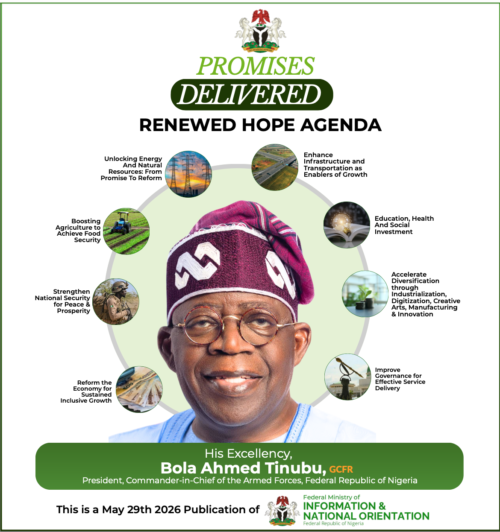


 The Supreme Court has fined two Senior Advocates of Nigeria (SAN), Chief Afe Babalola and Chief Wole Olanipekun N30 million each for agreeing to file an application for the review of the apex court’s judgment on Bayelsa election.

 The Bank of Industry has approved a $20 million technology fund for young innovators, even as the Central Bank of Nigeria (CBN) has offered a N90 Billion soft loan facility for small scale agriculture enterprises.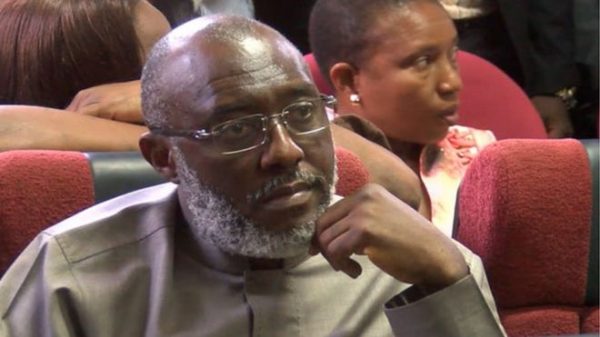


Facing The New Decade – A Letter To Young Nigerians, By Prof Yemi Osinbajo
Every citadel of learning derives its claim to greatness from the reputation and accomplishments of its students and staff: the great academics and scholars to whom has been given the enormous task of instructing, guiding and inspiring the minds and talents that are destined to define the future. Your task is possibly the noblest anyone could ask for, yet often without great reward or even gratitude. But we thank you today for your great and priceless service to this and coming generations.
It is most pleasing to learn that the proverbial seed planted less than a decade ago, the Federal University, Dutse, has not only produced four sets of graduates already and tomorrow by the grace of God, a fifth set, but has also grown so bounteously to now have over 7,000 students spread across 6 faculties, including a College of Medicine and Health Sciences.
Yours is the first among the set of Universities set up by the Federal Government in 2011 to establish a College of Medicine and Health Sciences. Congratulations! Equally remarkable are reports of the great exploits being recorded by the University in many fields that amply validate the promise of the fruitful synergy between town and gown.
Let me cite just two such examples, in recognition of your relevant and innovative research efforts. First is the Federal Ministry of Agriculture selected your University to host the Agribusiness Incubation Centres.
The second has been your response to the security challenges besetting our nation today, you elected to express a shared commitment to the national search for solution by being the first among your peers to mount a programme on Criminology and Security Studies, thereby demonstrating your relevance and proving that the university should not just be an incubator of ideas, but also a solution provider.
Congratulations on these sterling achievements. And to the students of this university, and especially the graduating class of 2019, let me just say congratulations and well done! The future is certainly very bright indeed.
Madam Vice Chancellor, my lecture titled “Facing the New Decade”, a topic you graciously allowed me to choose, is really directed at the young men and women here in this arena today. I count myself among those young men and women and I hope that those of us who are here also see ourselves as young men and women.
The reason why this is addressed to the young people here is first, the young men and women, students of this University, are the future of our country. Secondly, that future has already arrived at our doorsteps, perhaps much faster than we expected. For the next few minutes permit me to take you on a brief journey into this imminent future, how it will affect us all and my humble suggestions about what you may need to do to make the best of it.
Let me begin by making a few general statements and perhaps some predictions. First is that the next few decades will present tremendous opportunities for getting well-paying jobs and lucrative entrepreneurship opportunities all over the world. Anyone will be able to access many of those jobs without even having to move from your own country, in some cases even without leaving your home.
There will be a truly international market place of ideas, talents and opportunities, but to access that market place, you need to become, in many senses, a global citizen by your own effort. Self-education and self-development will be important.
Second, technology in its various iterations and applications will be crucial in all and every aspect of human existence. The greater our access to technology, our adaptation and application of the ideas we have, the more successful we are likely to be.
The third is that we are today in the most advanced moment in human history, and on a daily basis, knowledge and its applications grow in leaps and bounds. For the first time in human history, anyone of us can be heard or seen all over the world by live-streaming without owning our own satellite TV station. We can share ideas with millions of people in seconds on Facebook or Instagram.
It was Arthur Clarke, the British Science Fiction writer, who said that “any sufficiently advanced technology is not different anymore from magic.” If you follow some of the trends in technology over the past years in particular, much of his statement appears true, as the coming years look set to be one of the most spectacular magic shows ever.
Last year, DeepMind, which is a learning outfit, announced that one of its healthcare algorithms could detect over 50 eye diseases as accurately as a trained doctor. Only recently, we witnessed the trial run of an Artificial Intelligence, AI, a newsreader on the Chinese Xinhua News station, and the unveiling of a digital assistant that can mimic the voice of humans with uncanny likeness. It is called ‘Google Duplex’. There are provinces in China that are now trying out AI teachers in remote villages where graduates and young people are not likely to stay. In 2018, there was a world-first recording of an Artificial Intelligence system engaged in a two-way debate with a human opponent!
The fourth and perhaps the most important point I wish to make today is that the abundance of natural resources such as we have in Nigeria, oil and several minerals, even talents, mean little or nothing unless we are able to creatively and by using innovation and adding value, add to whatever it is that we have in terms of talent or resources.
Let me put it differently, the difference between poverty and wealth or mediocrity and high achievement is creativity, or the capacity and willingness to add value. This is the reason why Apple, manufacturers of the iPhone and iPad, make more money in four months than Nigeria earns from oil in one year.
Apple sells the product of the ingenuity of the human mind, ideas translated to products, services and solutions that millions are prepared to pay for. And because the capacity of the human mind for creativity, generation of ideas and for innovation and invention is limitless, the source of wealth of innovative companies and individuals is literally limitless. On the other hand, oil drilling and selling, and other extractive activities without adding value by refining and developing a whole petrochemical ecosystem cannot yield optimal profit or create the jobs and wealth.
Similarly, the mere fact that you have large tracts of arable land for agriculture does not mean you will succeed in agriculture or become wealthy, or even as a nation, feed yourself. Anybody can plant a seed and expect a harvest, but the reason why most farmers, our subsistent farmers, remain relatively poor is that they add no value to what they produce by processing, packaging or making other products out of the raw harvest.
And also, because many times they do not have access to cutting-edge innovations and inventions in farm inputs and farming techniques. Those who can add value to the farmers’ harvest become wealthier than the farmer. So the growers of the raw materials are the weakest in the value chain and the poorest.
For example, the man who makes chocolates from cocoa is bound to be richer than the cocoa farmer. He has added value to the raw cocoa by processing and designing and packing the chocolates in appealing wrappers. By adding value, he will create more jobs and more wealth. So, while we will always need the traditional professionals, doctors, lawyers, accountants and bankers, those adding value to their services will make more money than they can. So those developing Artificial Intelligence for giving legal advice or medical diagnoses, or accounting or banking will be more successful than the professionals themselves.
So, the future of banking and financial services doesn’t belong to banks or bankers as we know them today, it may well belong to the FinTechs and other technology-enabled solutions. For example, today we have KiaKia, which uses Artificial Intelligence and algorithms, to process loan requests in minutes and grant credit without the hassles of regular banks. Besides, there is Kuda Bank, for example, a bank without a single physical branch with all its features built into a mobile application. There is also Eyowo, another example of a payment services company which is designed for identifying, enumerating and paying to and collecting repayments from 2.2 million TraderMoni and MarketMoni beneficiaries.
They have revolutionized financial inclusion, making and receiving payments from the farthest parts of Nigeria. There is also another company called Paystack, whose founders are just over (the age of) 30. They have developed applications that make it easier to make payments across the world. There is also InvestBamboo, for example, which was started by two 26-year-olds, and offers new ways for you to save money and invest in stocks, all from a single application.
Others have developed technologies that make it possible for you to invest in a farm without ever seeing the farm. Two Nigerian companies again, ThriveAgric and Farmcrowdy, set up by young Nigerians under the age of 35, are great examples of the service providers that help small-scale farmers scale-up, and access valuable training; and all of these done through crowdfunding.
In the world of medicine and healthcare, there is LifeBank, owned by a young Nigerian lady. This is a health tech startup, which also uses drone technology to facilitate blood delivery to various health centres. We could highlight another called 54gene, a firm that is harnessing genomic data from African DNA to revolutionize the drug industry, and change the future of medicine. Even in the usually conservative legal profession, which I am the chairman, entrepreneurs are disrupting old trends. There is a digital legal research company called Law Pavilion, the company’s digital tools help lawyers to do legal research quickly and efficiently and even answer legal questions. Judges and lawyers subscribe to it and the usage is a very lucrative value addition to legal practice. Yet the founder and CEO of the company is not even a lawyer.
So today there are opportunities for entrepreneurs to build their businesses around traditional professions without being professionals themselves. The most widely read online publications are neither owned nor run by trained journalists. Some of us are familiar with the news aggregation platform called Nairaland which was started by two Obafemi Awolowo University students while still in school. Today it is one of the most successful online platforms we have. Even many of the most successful online advertising or PR companies have no formal training in these disciplines, most are self-thought. My nephew, who is a lawyer, is establishing an organic farm and poultry after taking lessons online. His only knowledge is derived from taking a few classes from somebody in Kano State offering online training for people interested in poultry farming.
But let me direct your minds to the new areas for job opportunities being created today. Data Science is one big area. Currently, we leave vast amounts of personal data online and in the near future, companies will need data scientists to go through it all and generate answers to business questions and make recommendations based on their findings. Many businesses already spend time and money going through people’s data so that they can sell their products. This is a new area of opportunities for jobs.
A big area today is Content Production – 3D/2D animation, Virtual Effects and Special Effects, as well as Augmented Reality and Virtual Reality. The use of animation in education, entertainment and media is growing in leaps and bounds. Those who can create content with animation are being and will be much sought after in the years to come.
According to a recent survey by the US Bureau of Labour Statistics, multimedia artists and animators are among the highest-paid within the US workforce. This has translated to more jobs for animators in emerging economies such as India, Vietnam and now Nigeria. The average pay of a 3D animator in Nigeria who has just started out after learning his trade could be in the region of N300,000 – N500,000 monthly. In our training of N-Power beneficiaries, we set aside a fair amount of money to train animators. We have carried out two sets of training; one in the North and one in the South of Nigeria. In total, we have trained over 25,000 young men and women in animation.
Also, remember that content is becoming more in demand with the streaming wars that have engulfed Netflix, Apple, Disney Plus, HBO and only recently, Airtel, the telecommunications provider, launched its own streaming service in Nigeria.
Then we have the whole range of Cybersecurity, another big area of opportunity. Today, there are new opportunities for cybersecurity specialists. How is that? With each technological advance comes the implied addition of more security risks just to store and keep the information secure. Therefore, cybersecurity will continue to be a growing sector. In this sense, each country will have its own specific regulations just as we have and many other international regulations, which will ensure that professionals with an advanced technological background capable of nullifying new threats posed to both technology and people, will be in demand all the time.
How about 3D Printing? 3D printing is becoming an area of great need. It will become even more relevant and fundamental in the future when compared with Artificial Intelligence and Robotics. Experts in 3D printing must possess creative skills with the ability to improve the profitability and applicability of models. Also, they must have computer skills and knowledge of 3D printing tools. The Federal Government established a humanitarian hub in Adamawa State about two years ago. In that hub, young Nigerians are making artificial limbs with 3D printers for people who lost their limbs in the conflict in the North East. This is a growth area which will continue to grow because 3D printing can be applied in different ways and for many purposes. It doesn’t take a year to learn how to use 3D printers.
The technical revolution from the last few decades have considerably changed the business and cultural world. Currently, we live in an “application economy” as a result of the amount of technology and mobility that surrounds us with our smartphone applications that we depend on for everything, from mobile banking to even health monitoring. As such, it is difficult to find a reason why one shouldn’t try to find a career related to technology, especially when we consider that it is already present in everything we do; from our professions in our companies to our personal lives as consumers. This means computer programming in one shape or form of the other, will continue to be an important skill for those seeking viable employment and a decent pay.
So today, the most successful businesses are those able to add value, even our culture can become a great wealth creator, but only if we add value. So just doing traditional dances is not enough, to put together 8 or 16 barefooted young men and women dancing when foreign guests are visiting cannot make enough money. Organizing dance dramas, on the other hand, can make money. When a whole drama outfit is created with our culture and our songs, where we are able to employ a director, scriptwriter, a composer and an arranger, then it is possible to make money from our cultural dances.
In our future, there is truly something for everyone. We should all take advantage of digital technology, especially social media and the various platforms on offer, to grow a customer base, gain traction and advance businesses. You can write a blog, develop a website to sell your products or even your ideas – whatever it is you know how to do best. People are running fully-fledged commercial businesses on Instagram without a single physical shop, an opportunity only made possible by the internet. We are an entrepreneurial people, a society of multitaskers who, thanks to the virtual economy, can make a real opportunity out of anything we are passionate about.
The question for many of our young people today is: what is your passion? How can you take the skills that you have, and add value to the world around you? The future is going to depend a great deal on what we do with our passions and how we can sell what we are passionate about to millions of people around the world.
I have seen videos tutorials on how to make the best soups or bake the best cakes, getting hundreds of thousands of views on Instagram and YouTube, and people advertising on them. YouTubers like Dimma Umeh are showing us how to do makeup, how to master that highlight and contour, and she told us in one video that she made her first million from YouTube! I have also seen videos of people teaching young women how to keep their husbands, very interesting videos!
Thanks to the social media age, whatever ideas and skills that you have can be leveraged for benefit. Your knowledge is of immense importance and you have to find creative ways to take advantage of it.
While it is easier than ever to sell your knowledge and skills, it has also become easier and cheaper for you to acquire them. “The Mobile Prof” in Lagos, for example, is teaching people how to code from their mobile phones, you don’t even need a laptop anymore!
The future is about self-education, self-development. It is important for us to invest a little in the incredible opportunities for online education. Years ago, it was impossible to do a specialized course in a leading international university without getting an admission, paying a lot of money and then travelling abroad. Today, you can sit in the comfort of your home and get an Ivy League education. Universities such as Harvard University and Dartmouth College, for example, offer full-time online courses on Data Science and Linux Programming through an online learning platform called EdX.
This means you can learn a whole new programming language in a year, for less than it would cost you to even get to America! There are new means of self-education and they are more accessible than you might have thought.
There is no question that an exciting future lies ahead. There are breakthroughs in radical technologies, capable of disrupting whole industries, and perhaps even our very conception of work itself. For higher institutions who are getting graduates ready for the world of work, for the graduates, and new and near graduates who are here today, what does the disruption of the workforce by emerging technologies signify for both livelihoods and employment?
Today, there are several important implications related to the fields of Artificial Intelligence and Emerging Technologies that will change the way we work and our economies. So, we have seen for example that much of what is considered analytical work by lawyers, investment bankers, accountants, and other age-old professions will be performed better by machines in a fraction of the time that humans can. There is a need to train these professionals differently, and with these new opportunities and challenges in mind.
With the advent of the Fourth Industrial Revolution, the Internet of Things, the world of work is in a state of flux, changing as never before, driven by inexorable forces that have an impact, not only on professional services but on manufacturing and trade, global supply chains and the digitalization of the global economy to name just a few. So, for example, the supervision work that managers do is changing rapidly and there may be no more need for it. A young lady who owns a clothing store in Abuja and Lagos, who lives in Abuja was showing me how she can remotely see all that is going on in her shop in Lagos on her laptop in real-time. And she can speak to all her employees from her laptop in real-time. In other words, she can supervise her store herself from anywhere in the world. So, the type of manager you will need going forward will be a different type.
Education today must be education for employability, the sort of education that makes us employable and relevant in the technologies and opportunities that present themselves today.
So, our university curricula must be versatile and dynamic. The focus must be on innovation, critical thinking, interdisciplinary thinking, design thinking, synergizing and collaboration with others across the world to solve problems.
The era of cramming the teacher’s notes and regurgitating for high grades is over. The graduate of the future is a problem solver, a thinker, an entrepreneur. Our educators, policymakers, schools, universities must now adapt their curricula, policies and projects to improve the skills that enable the graduate to nimbly and constantly respond to the ever-changing face of the economy and the workplace.
A student of humanities today equipped with the right skills and mindset will be a crucial part of the collaboration required to build an application that will redefine an aspect of business. In other words, a student of History, English, Languages, without any previous scientific training or knowledge, can with the right skills being taught today, with self-teaching, develop applications that will change business and industries, earn a lot of money. Applications are developed through collaborations; there are those that are scientists, there are those who come from the point of view of imagination and others from the point of view of design; all of them collaborating together.
Steve Jobs, the founder of Apple, was more of an artist than a computer scientist. Yet he developed some of the most incredible applications that we have ever seen and made the kind of profit that makes people wonder whether they are not in the wrong profession.
A man or woman of ideas, no matter your degree, can become, in collaboration with others, the designers or owners of the next application that will make billions and create jobs for millions. This is the exciting future ahead of us, the opportunities are limitless.
I want to urge all of us, especially the young people who are here, to note that we are in the best times in the history of mankind. Let nobody tell you about the good old days. I said before, and I am quoting someone, I’m not so sure who he is, he said that “those who remind us of the good old days are probably suffering from memory loss.” We must not allow them to keep talking about the good old days. We are in the best times possible today. And the reason why these are the best times is that we are in the most technologically advanced human history.
This is the most technologically advanced moment. This is the most advanced moment in the history of mankind, we have never been advanced as we are today. It was Fareed Zakaria, the CNN journalist, who said and I’m quoting him that, “the smartphones that we have today, have more computing powers than all of the computing power that took men to the moon on the spacecraft, all of the computing powers that were in that spacecraft, we now have a hundred times of that computing power in the Smartphone that we carry about today.”
So, we are living in a time of sheer magic! We must take every advantage of it and I know the young people today, especially those in this Federal University Dutse, are rearing to go. The future is certainly bright!